Academic Writing
Skills
Nseabasi Ikput
Title:
First Class Dissertation Structuring
and Writing Skills
Author:
Nseabasi IkputAbout
First Point of Call
Overall referencing
● Referencing is the most important part of your Project, Dissertation or
Thesis.
● You must be accurate in your referencing in order to avoid plagiarism.
● I suggest that you use the Harvard system of referencing.
● Here’s the Information http://libweb.anglia.ac.uk/referencing/harvard.htm
Abstract
Guidelines
Your abstract should explain why the research
is important and provide a summary of the
major results found during the conduct of the
research.
It should also explain the implications of your
work and be concise. Your abstract should be
between 400 and 500 words. From my
experience over the years, here’s a model I’ve
developed for writing my abstracts – BMRC.
Structuring Approach
The Abstract
Background
Methods
Results
Conclusion
You could choose to make each of them a
paragraph and end up with four paragraphs or if
possible work towards two paragraphs BM and
RC.
Do not repeat the information in the title in your
abstract; Try to avoid citations and use of
references.
Ideally your abstract and introduction should be
written last.
Introduction
Proposed Structure for Chapter 1
General Introduction
1.1 Background
1.2 The Study Area
1.3 Rationale for the Study
1.4 Aim and Objectives
1.5 Structure of the Thesis
The General Introduction
Background
● Sometimes, you find that some people can
speak well about a subject matter but are
unable to convey their thoughts in writing.
● One of the tricks to writing a narrative is to
write as you speak and then subsequently fine
tune it.
● Start your introduction with a captivating
statement. What will make the reader want to
read through the whole body of the
introduction? I call it a hook.
● Indeed this rule should apply to all the
different Chapters/ sections of the report.
Chapter 1
KEY MESSAGE
“The hook for your introduction
should be an important or
specific scientific problem that
your research has solved or
addressed”.
Strategy
Earliest Research (ER): This should describe the earliest forms of this in which this sort of research has
been conducted. If possible, I think it is very important to state or cite the persons who had the ideas first.
You determine the length of the paragraphs depending on how much there is to talk about.
Recent Research (RR): Subsequent to tracing the antecedents of work within that area, you can then move
on to citing the works of those who have conducted recent and relevant work
Pre Justification (PJ): The next line of thought should be about explaining why more work is necessary.
That way, you create a platform for the justification of your research. And the ideas begin to flow.
Strategy
● You need to state why you have undertaken the study. This must not be a repetition of the abstract! It
should be an explanation of the goal of the research work.
● Next you need to provide some context to allow whoever is reading your work to understand why the
significance or implication of the different questions you are trying to address.
● You now need to properly acknowledge the specific piece(s) of work you want to build upon. Make
use of sufficient references that can easily help your reader build a picture of the questions.
Strategy Contd
● Your introduction must remain focused on the specific questions you have developed for further
research and so should the references you cite. Try not to drift away from the central issues by
summarizing everything you have ever read during your master’s programme. Stay focused on the
aims and objectives directly relevant to the project.
● You now need to provide an explanation of the scope of your research work. You are certainly not
going to be able to do everything within the constrained time you have so provide an explanation
of what you will and will not research if possible with one or two reasons.
● Next, present a verbal road-map of what lies ahead for the reader. You can use phrases like: The
remainder of this thesis is structured as follows:
● Chapter two provides a robust and detailed review of literature relevant to this research work...... In
Chapter three, ......
The Study Area
Talk about the population and demographics, general socio-economics, its
location and adjoining towns.
You should also include statistics and maps with references and sources.
Rationale
● Think about this: In reality, when trying to solve a problem (whether personal or not) you identify
the important reason for dealing with that problem first before specifying what you are going to do
to ensure that the problem is solved.
● In principle, the rationale for the study gives birth to the aim and objectives!
● Your research rationale reflects your comprehension status and your level of knowledge in regard
to the topic that you are going to research.
● This rationale can also decide your overall success or failure of the research project.
● What you want to do in the rationale is to convince the reader to believe and accept your
viewpoint
● It is like selling something to someone who does not necessarily want to buy.
Aims and Objectives
● Research aims are simply broad statements of intent that describe what you
want to achieve.
● Objectives on the other hand are the specific statements that are linked to
your aim and show how the aim will be achieved logically
● Important: Your objectives need to align with the structure of your chapters
in a logical manner!
● Use the structure below to write your aim and objectives.
Aims and Objectives Contd
This thesis is generally about ........ “The overall aim of the thesis is to explore and demonstrate the
policy relevance of monitoring geological sites, by focusing on St. Helens.”
In order to achieve the aim of the research, a number of dedicated objectives were formulated. The
research objectives are:
Objective 1: To critically review relevant literature, data sources and methods in relation to the potential
and policy relevance of monitoring geological sites.
Objective 2:
Objective 3:
Structure of the Thesis
This section shows how the objectives are linked to the different sections and where the reader can get the
answers to the objectives.
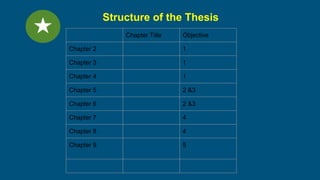
Your Task: Populate the Table below. Call it Thesis Outline. Then further summarise each chapter (in up
to three lines each) as paragraphs.
Structure of the Thesis
Chapter Title Objective
Chapter 2 1
Chapter 3 1
Chapter 4 1
Chapter 5 2 &3
Chapter 6 2 &3
Chapter 7 4
Chapter 8 4
Chapter 9 5
General
● Try to use footnotes. It adds a professional touch to your work especially where
there is no academic reference for what you are talking about. You can
describe it in the footnote.
● Whenever you use an acronym for the first time, always write it in full e.g. “The
Millennium Development Goals (MDGs) are a set of eight goals. The MDGS
also embed a set of targets which further encapsulate multiple indicators......”
● Note that it is not MDGs (Millennium Development Goals).
● Try to avoid spreading paragraphs over two pages. Always keep every
paragraph within a page. If a paragraph is too long, simply move it to the next
page or if possible break it into two.
General
● When citing references within your report, it is good practice usually to support
your arguments with more than one reference. This is in part the evidence that
you conducted a research on what you are talking about. However, it may not
always be possible sometimes to use more than one reference if the subject
matter has not been researched and published widely. Where possible
however, try to use up to two references to support your arguments.
● Avoid sentences that are too long. This can be difficult at times but you need
to learn through practice. Another way around it is to use semicolons.
● Avoid clauses or phrases with more than two ideas in them.
General
● Do not use double negatives e.g. “You can not afford not to use…”
● Make sure that the antecedent for every pronoun (it, these, those, that, this,
one) is crystal clear. So for instance if you are referring to someone or
something using those pronouns, it has to be very clear in your writing. Don’t
leave the reader asking the question who or what or which! If you are in doubt
then use the exact noun instead of the pronoun even if you think the resulting
sentence will appear a little redundant.
● When describing concepts that can be quantified, try an avoid using
qualitative adjectives. For instance instead of saying “the water is deep” you
can say “the depth of water is 5 metres”.

Academic Writing Skills

  • 1.
  • 2.
    Title: First Class DissertationStructuring and Writing Skills Author: Nseabasi IkputAbout
  • 3.
    First Point ofCall Overall referencing ● Referencing is the most important part of your Project, Dissertation or Thesis. ● You must be accurate in your referencing in order to avoid plagiarism. ● I suggest that you use the Harvard system of referencing. ● Here’s the Information http://libweb.anglia.ac.uk/referencing/harvard.htm
  • 4.
    Abstract Guidelines Your abstract shouldexplain why the research is important and provide a summary of the major results found during the conduct of the research. It should also explain the implications of your work and be concise. Your abstract should be between 400 and 500 words. From my experience over the years, here’s a model I’ve developed for writing my abstracts – BMRC. Structuring Approach The Abstract Background Methods Results Conclusion You could choose to make each of them a paragraph and end up with four paragraphs or if possible work towards two paragraphs BM and RC. Do not repeat the information in the title in your abstract; Try to avoid citations and use of references. Ideally your abstract and introduction should be written last.
  • 5.
    Introduction Proposed Structure forChapter 1 General Introduction 1.1 Background 1.2 The Study Area 1.3 Rationale for the Study 1.4 Aim and Objectives 1.5 Structure of the Thesis
  • 6.
    The General Introduction Background ●Sometimes, you find that some people can speak well about a subject matter but are unable to convey their thoughts in writing. ● One of the tricks to writing a narrative is to write as you speak and then subsequently fine tune it. ● Start your introduction with a captivating statement. What will make the reader want to read through the whole body of the introduction? I call it a hook. ● Indeed this rule should apply to all the different Chapters/ sections of the report. Chapter 1
  • 7.
    KEY MESSAGE “The hookfor your introduction should be an important or specific scientific problem that your research has solved or addressed”.
  • 8.
    Strategy Earliest Research (ER):This should describe the earliest forms of this in which this sort of research has been conducted. If possible, I think it is very important to state or cite the persons who had the ideas first. You determine the length of the paragraphs depending on how much there is to talk about. Recent Research (RR): Subsequent to tracing the antecedents of work within that area, you can then move on to citing the works of those who have conducted recent and relevant work Pre Justification (PJ): The next line of thought should be about explaining why more work is necessary. That way, you create a platform for the justification of your research. And the ideas begin to flow.
  • 9.
    Strategy ● You needto state why you have undertaken the study. This must not be a repetition of the abstract! It should be an explanation of the goal of the research work. ● Next you need to provide some context to allow whoever is reading your work to understand why the significance or implication of the different questions you are trying to address. ● You now need to properly acknowledge the specific piece(s) of work you want to build upon. Make use of sufficient references that can easily help your reader build a picture of the questions.
  • 10.
    Strategy Contd ● Yourintroduction must remain focused on the specific questions you have developed for further research and so should the references you cite. Try not to drift away from the central issues by summarizing everything you have ever read during your master’s programme. Stay focused on the aims and objectives directly relevant to the project. ● You now need to provide an explanation of the scope of your research work. You are certainly not going to be able to do everything within the constrained time you have so provide an explanation of what you will and will not research if possible with one or two reasons. ● Next, present a verbal road-map of what lies ahead for the reader. You can use phrases like: The remainder of this thesis is structured as follows: ● Chapter two provides a robust and detailed review of literature relevant to this research work...... In Chapter three, ......
  • 11.
    The Study Area Talkabout the population and demographics, general socio-economics, its location and adjoining towns. You should also include statistics and maps with references and sources.
  • 12.
    Rationale ● Think aboutthis: In reality, when trying to solve a problem (whether personal or not) you identify the important reason for dealing with that problem first before specifying what you are going to do to ensure that the problem is solved. ● In principle, the rationale for the study gives birth to the aim and objectives! ● Your research rationale reflects your comprehension status and your level of knowledge in regard to the topic that you are going to research. ● This rationale can also decide your overall success or failure of the research project. ● What you want to do in the rationale is to convince the reader to believe and accept your viewpoint ● It is like selling something to someone who does not necessarily want to buy.
  • 13.
    Aims and Objectives ●Research aims are simply broad statements of intent that describe what you want to achieve. ● Objectives on the other hand are the specific statements that are linked to your aim and show how the aim will be achieved logically ● Important: Your objectives need to align with the structure of your chapters in a logical manner! ● Use the structure below to write your aim and objectives.
  • 14.
    Aims and ObjectivesContd This thesis is generally about ........ “The overall aim of the thesis is to explore and demonstrate the policy relevance of monitoring geological sites, by focusing on St. Helens.” In order to achieve the aim of the research, a number of dedicated objectives were formulated. The research objectives are: Objective 1: To critically review relevant literature, data sources and methods in relation to the potential and policy relevance of monitoring geological sites. Objective 2: Objective 3:
  • 15.
    Structure of theThesis This section shows how the objectives are linked to the different sections and where the reader can get the answers to the objectives. Your Task: Populate the Table below. Call it Thesis Outline. Then further summarise each chapter (in up to three lines each) as paragraphs.
  • 16.
    Structure of theThesis Chapter Title Objective Chapter 2 1 Chapter 3 1 Chapter 4 1 Chapter 5 2 &3 Chapter 6 2 &3 Chapter 7 4 Chapter 8 4 Chapter 9 5
  • 17.
    General ● Try touse footnotes. It adds a professional touch to your work especially where there is no academic reference for what you are talking about. You can describe it in the footnote. ● Whenever you use an acronym for the first time, always write it in full e.g. “The Millennium Development Goals (MDGs) are a set of eight goals. The MDGS also embed a set of targets which further encapsulate multiple indicators......” ● Note that it is not MDGs (Millennium Development Goals). ● Try to avoid spreading paragraphs over two pages. Always keep every paragraph within a page. If a paragraph is too long, simply move it to the next page or if possible break it into two.
  • 18.
    General ● When citingreferences within your report, it is good practice usually to support your arguments with more than one reference. This is in part the evidence that you conducted a research on what you are talking about. However, it may not always be possible sometimes to use more than one reference if the subject matter has not been researched and published widely. Where possible however, try to use up to two references to support your arguments. ● Avoid sentences that are too long. This can be difficult at times but you need to learn through practice. Another way around it is to use semicolons. ● Avoid clauses or phrases with more than two ideas in them.
  • 19.
    General ● Do notuse double negatives e.g. “You can not afford not to use…” ● Make sure that the antecedent for every pronoun (it, these, those, that, this, one) is crystal clear. So for instance if you are referring to someone or something using those pronouns, it has to be very clear in your writing. Don’t leave the reader asking the question who or what or which! If you are in doubt then use the exact noun instead of the pronoun even if you think the resulting sentence will appear a little redundant. ● When describing concepts that can be quantified, try an avoid using qualitative adjectives. For instance instead of saying “the water is deep” you can say “the depth of water is 5 metres”.