Chapter 5
SUMMARIES
Chapter 5 Learning Objectives
 In this chapter, you will learn how to:
 Understand the differences among the several
kinds of summary
 Write informative descriptive summaries
 Compose detailed informative summaries
 Create convincing evaluative summaries
 Accurately summarize both written and oral
sources
Copyright © 2017, 2014, 2011 by Pearson Education, Inc.
All rights reserved.
Summaries—An Overview
 Briefly capture the essential content of
something heard, seen, or read
 Are organized logically with clear and
concrete terminology
 Highlight key points with an awareness
of what to leave out
 Most commonly take the form of
abstracts and executive summaries
that accompany long reports
Copyright © 2017, 2014, 2011 by Pearson Education, Inc.
All rights reserved.
Understand the Differences Among
the Several Kinds of Summaries
 Descriptive
States what the original document is
about but does not convey specific
information
Functions like a table of contents in
paragraph form
Kinds of Summaries, continued
 Informative—most common form of summary
 Presents document’s content in greatly
compressed form
 May allow reader to skip the original
altogether
 Conveys main ideas in shorter form
 Includes hard data—names, dates, statistics
Copyright © 2017, 2014, 2011 by Pearson Education, Inc.
All rights reserved.
Kinds of Summaries, continued
 Evaluative
Is fully developed, like an informative
summary
Includes writer’s personal assessment
of the original
Copyright © 2017, 2014, 2011 by Pearson Education, Inc.
All rights reserved.
Write Informative
Descriptive Summaries
 Purpose: Help reader determine summarized
document’s value in a given situation
 Does not include recommendations or
findings of the document
 See page 87 of the text for a sample descriptive summary
Copyright © 2017, 2014, 2011 by Pearson Education, Inc.
All rights reserved.
Compose Detailed
Informative Summaries
 Purpose: May allow reader to skip the source
document
 Include source’s findings and
recommendations
 Include some factual details such as
names/dates/statistics
See pp. 87-88 of text for a sample informative
summary
Summaries Accompanying
Long Reports
 Abstract
 Provides an overview of the report
 Appears near the beginning
 Executive Summary
 Assists management in making decisions without having to read the
report
Copyright © 2017, 2014, 2011 by Pearson Education, Inc.
All rights reserved.
Create Convincing
Evaluative Summaries
 Purpose: Provide summary writer’s assessment of
the source document, in addition to informative
summary
 Are more fully developed than informative
summaries
 Include summary writer’s subjective value
judgments throughout
 See p. 88 of the text for an evaluative summary
Copyright © 2017, 2014, 2011 by Pearson Education, Inc.
All rights reserved.
General Characteristics
of Good Summaries
 Retain emphasis of original
 Do not introduce new or additional information
(unless writing an evaluative summary)
 Use simplest possible terms and complete sentences
with clear meaning
 Are organized coherently so that summary can
stand alone
 Are limited to no more than 25 percent of original
document’s length
Accurately Summarize Both Written
and Oral Sources
 Oral sources
 Take notes quickly without missing anything
Use personal system of shortcuts—
abbreviations, symbols, etc.
 Use hand-held recorder or download source
Take notes to highlight important points
Use notes to find points in recording
Copyright © 2017, 2014, 2011 by Pearson Education, Inc.
All rights reserved.
Accurately Summarize Both Written
and Oral Sources
 Written sources
 Read entire document straight through
 Watch for context clues
 Go back and underline or highlight most important
sentences in each paragraph
 Edit sentences you selected, compressing, combining,
and streamlining
 Reread summary and insert transitions as needed
 Include concrete facts as appropriate
 Do final edit and proofreading
Copyright © 2017, 2014, 2011 by Pearson Education, Inc.
All rights reserved.
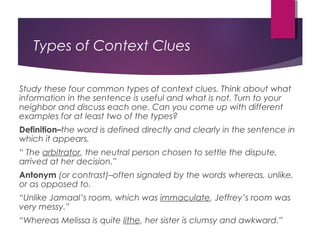
Types of Context Clues
Study these four common types of context clues. Think about what
information in the sentence is useful and what is not. Turn to your
neighbor and discuss each one. Can you come up with different
examples for at least two of the types?
Definition–the word is defined directly and clearly in the sentence in
which it appears.
“ The arbitrator, the neutral person chosen to settle the dispute,
arrived at her decision.”
Antonym (or contrast)–often signaled by the words whereas, unlike,
or as opposed to.
“Unlike Jamaal’s room, which was immaculate, Jeffrey’s room was
very messy.”
“Whereas Melissa is quite lithe, her sister is clumsy and awkward.”
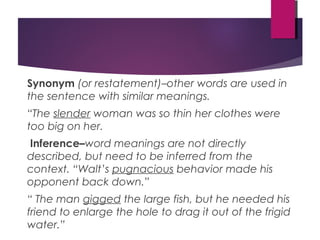
Synonym (or restatement)–other words are used in
the sentence with similar meanings.
“The slender woman was so thin her clothes were
too big on her.
Inference–word meanings are not directly
described, but need to be inferred from the
context. “Walt’s pugnacious behavior made his
opponent back down.”
“ The man gigged the large fish, but he needed his
friend to enlarge the hole to drag it out of the frigid
water.”
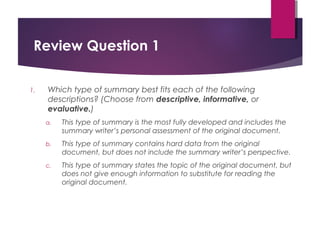
Review Question 1
1. Which type of summary best fits each of the following
descriptions? (Choose from descriptive, informative, or
evaluative.)
a. This type of summary is the most fully developed and includes the
summary writer’s personal assessment of the original document.
b. This type of summary contains hard data from the original
document, but does not include the summary writer’s perspective.
c. This type of summary states the topic of the original document, but
does not give enough information to substitute for reading the
original document.
Copyright © 2017, 2014, 2011 by Pearson Education, Inc.
All rights reserved.
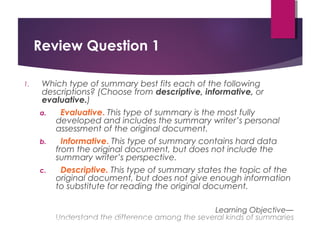
Review Question 1
1. Which type of summary best fits each of the following
descriptions? (Choose from descriptive, informative, or
evaluative.)
a. Evaluative. This type of summary is the most fully
developed and includes the summary writer’s personal
assessment of the original document.
b. Informative. This type of summary contains hard data
from the original document, but does not include the
summary writer’s perspective.
c. Descriptive. This type of summary states the topic of the
original document, but does not give enough information
to substitute for reading the original document.
Learning Objective—
Understand the difference among the several kinds of summariesCopyright © 2017, 2014, 2011 by Pearson Education, Inc.
All rights reserved.
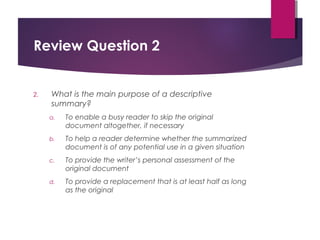
Review Question 2
2. What is the main purpose of a descriptive
summary?
a. To enable a busy reader to skip the original
document altogether, if necessary
b. To help a reader determine whether the summarized
document is of any potential use in a given situation
c. To provide the writer’s personal assessment of the
original document
d. To provide a replacement that is at least half as long
as the original
Copyright © 2017, 2014, 2011 by Pearson Education, Inc.
All rights reserved.
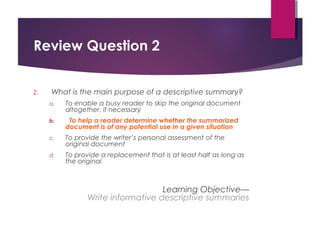
Review Question 2
2. What is the main purpose of a descriptive summary?
a. To enable a busy reader to skip the original document
altogether, if necessary
b. To help a reader determine whether the summarized
document is of any potential use in a given situation
c. To provide the writer’s personal assessment of the
original document
d. To provide a replacement that is at least half as long as
the original
Learning Objective—
Write informative descriptive summaries
Copyright © 2017, 2014, 2011 by Pearson Education, Inc.
All rights reserved.
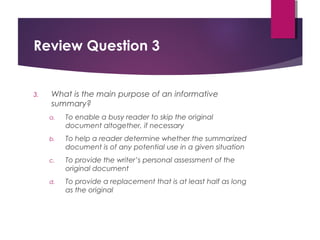
Review Question 3
3. What is the main purpose of an informative
summary?
a. To enable a busy reader to skip the original
document altogether, if necessary
b. To help a reader determine whether the summarized
document is of any potential use in a given situation
c. To provide the writer’s personal assessment of the
original document
d. To provide a replacement that is at least half as long
as the original
Copyright © 2017, 2014, 2011 by Pearson Education, Inc.
All rights reserved.
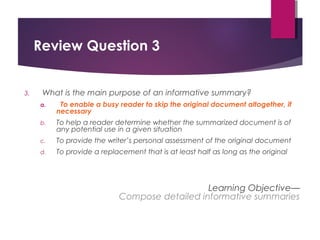
Review Question 3
3. What is the main purpose of an informative summary?
a. To enable a busy reader to skip the original document altogether, if
necessary
b. To help a reader determine whether the summarized document is of
any potential use in a given situation
c. To provide the writer’s personal assessment of the original document
d. To provide a replacement that is at least half as long as the original
Learning Objective—
Compose detailed informative summaries
Copyright © 2017, 2014, 2011 by Pearson Education, Inc.
All rights reserved.
Review Question 4
4. The summary writer’s personal opinion should
appear
a. In every type of summary
b. Only in an evaluative summary
c. Only in an executive summary
d. Only in an abstract
Copyright © 2017, 2014, 2011 by Pearson Education, Inc.
All rights reserved.
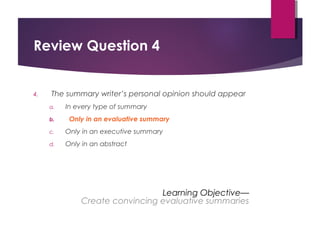
Review Question 4
4. The summary writer’s personal opinion should appear
a. In every type of summary
b. Only in an evaluative summary
c. Only in an executive summary
d. Only in an abstract
Learning Objective—
Create convincing evaluative summaries
Copyright © 2017, 2014, 2011 by Pearson Education, Inc.
All rights reserved.
Review Question 5
5. Details about the original document’s
recommendations and conclusions, as well as
hard data (names, dates, and statistics), should be
included in which of the following?
a. A descriptive summary
b. An informative summary
c. An evaluative summary
d. All of the above
e. Both (a) and (b)
f. Both (b) and (c)
Copyright © 2017, 2014, 2011 by Pearson Education, Inc.
All rights reserved.
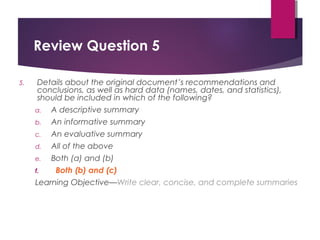
Review Question 5
5. Details about the original document’s recommendations and
conclusions, as well as hard data (names, dates, and statistics),
should be included in which of the following?
a. A descriptive summary
b. An informative summary
c. An evaluative summary
d. All of the above
e. Both (a) and (b)
f. Both (b) and (c)
Learning Objective—Write clear, concise, and complete summaries

Chapter 5 summary writing

  • 1.
  • 2.
    Chapter 5 LearningObjectives  In this chapter, you will learn how to:  Understand the differences among the several kinds of summary  Write informative descriptive summaries  Compose detailed informative summaries  Create convincing evaluative summaries  Accurately summarize both written and oral sources Copyright © 2017, 2014, 2011 by Pearson Education, Inc. All rights reserved.
  • 3.
    Summaries—An Overview  Brieflycapture the essential content of something heard, seen, or read  Are organized logically with clear and concrete terminology  Highlight key points with an awareness of what to leave out  Most commonly take the form of abstracts and executive summaries that accompany long reports Copyright © 2017, 2014, 2011 by Pearson Education, Inc. All rights reserved.
  • 4.
    Understand the DifferencesAmong the Several Kinds of Summaries  Descriptive States what the original document is about but does not convey specific information Functions like a table of contents in paragraph form
  • 5.
    Kinds of Summaries,continued  Informative—most common form of summary  Presents document’s content in greatly compressed form  May allow reader to skip the original altogether  Conveys main ideas in shorter form  Includes hard data—names, dates, statistics Copyright © 2017, 2014, 2011 by Pearson Education, Inc. All rights reserved.
  • 6.
    Kinds of Summaries,continued  Evaluative Is fully developed, like an informative summary Includes writer’s personal assessment of the original Copyright © 2017, 2014, 2011 by Pearson Education, Inc. All rights reserved.
  • 7.
    Write Informative Descriptive Summaries Purpose: Help reader determine summarized document’s value in a given situation  Does not include recommendations or findings of the document  See page 87 of the text for a sample descriptive summary Copyright © 2017, 2014, 2011 by Pearson Education, Inc. All rights reserved.
  • 8.
    Compose Detailed Informative Summaries Purpose: May allow reader to skip the source document  Include source’s findings and recommendations  Include some factual details such as names/dates/statistics See pp. 87-88 of text for a sample informative summary
  • 9.
    Summaries Accompanying Long Reports Abstract  Provides an overview of the report  Appears near the beginning  Executive Summary  Assists management in making decisions without having to read the report Copyright © 2017, 2014, 2011 by Pearson Education, Inc. All rights reserved.
  • 10.
    Create Convincing Evaluative Summaries Purpose: Provide summary writer’s assessment of the source document, in addition to informative summary  Are more fully developed than informative summaries  Include summary writer’s subjective value judgments throughout  See p. 88 of the text for an evaluative summary Copyright © 2017, 2014, 2011 by Pearson Education, Inc. All rights reserved.
  • 11.
    General Characteristics of GoodSummaries  Retain emphasis of original  Do not introduce new or additional information (unless writing an evaluative summary)  Use simplest possible terms and complete sentences with clear meaning  Are organized coherently so that summary can stand alone  Are limited to no more than 25 percent of original document’s length
  • 12.
    Accurately Summarize BothWritten and Oral Sources  Oral sources  Take notes quickly without missing anything Use personal system of shortcuts— abbreviations, symbols, etc.  Use hand-held recorder or download source Take notes to highlight important points Use notes to find points in recording Copyright © 2017, 2014, 2011 by Pearson Education, Inc. All rights reserved.
  • 13.
    Accurately Summarize BothWritten and Oral Sources  Written sources  Read entire document straight through  Watch for context clues  Go back and underline or highlight most important sentences in each paragraph  Edit sentences you selected, compressing, combining, and streamlining  Reread summary and insert transitions as needed  Include concrete facts as appropriate  Do final edit and proofreading Copyright © 2017, 2014, 2011 by Pearson Education, Inc. All rights reserved.
  • 14.
    Types of ContextClues Study these four common types of context clues. Think about what information in the sentence is useful and what is not. Turn to your neighbor and discuss each one. Can you come up with different examples for at least two of the types? Definition–the word is defined directly and clearly in the sentence in which it appears. “ The arbitrator, the neutral person chosen to settle the dispute, arrived at her decision.” Antonym (or contrast)–often signaled by the words whereas, unlike, or as opposed to. “Unlike Jamaal’s room, which was immaculate, Jeffrey’s room was very messy.” “Whereas Melissa is quite lithe, her sister is clumsy and awkward.”
  • 15.
    Synonym (or restatement)–otherwords are used in the sentence with similar meanings. “The slender woman was so thin her clothes were too big on her. Inference–word meanings are not directly described, but need to be inferred from the context. “Walt’s pugnacious behavior made his opponent back down.” “ The man gigged the large fish, but he needed his friend to enlarge the hole to drag it out of the frigid water.”
  • 16.
    Review Question 1 1.Which type of summary best fits each of the following descriptions? (Choose from descriptive, informative, or evaluative.) a. This type of summary is the most fully developed and includes the summary writer’s personal assessment of the original document. b. This type of summary contains hard data from the original document, but does not include the summary writer’s perspective. c. This type of summary states the topic of the original document, but does not give enough information to substitute for reading the original document. Copyright © 2017, 2014, 2011 by Pearson Education, Inc. All rights reserved.
  • 17.
    Review Question 1 1.Which type of summary best fits each of the following descriptions? (Choose from descriptive, informative, or evaluative.) a. Evaluative. This type of summary is the most fully developed and includes the summary writer’s personal assessment of the original document. b. Informative. This type of summary contains hard data from the original document, but does not include the summary writer’s perspective. c. Descriptive. This type of summary states the topic of the original document, but does not give enough information to substitute for reading the original document. Learning Objective— Understand the difference among the several kinds of summariesCopyright © 2017, 2014, 2011 by Pearson Education, Inc. All rights reserved.
  • 18.
    Review Question 2 2.What is the main purpose of a descriptive summary? a. To enable a busy reader to skip the original document altogether, if necessary b. To help a reader determine whether the summarized document is of any potential use in a given situation c. To provide the writer’s personal assessment of the original document d. To provide a replacement that is at least half as long as the original Copyright © 2017, 2014, 2011 by Pearson Education, Inc. All rights reserved.
  • 19.
    Review Question 2 2.What is the main purpose of a descriptive summary? a. To enable a busy reader to skip the original document altogether, if necessary b. To help a reader determine whether the summarized document is of any potential use in a given situation c. To provide the writer’s personal assessment of the original document d. To provide a replacement that is at least half as long as the original Learning Objective— Write informative descriptive summaries Copyright © 2017, 2014, 2011 by Pearson Education, Inc. All rights reserved.
  • 20.
    Review Question 3 3.What is the main purpose of an informative summary? a. To enable a busy reader to skip the original document altogether, if necessary b. To help a reader determine whether the summarized document is of any potential use in a given situation c. To provide the writer’s personal assessment of the original document d. To provide a replacement that is at least half as long as the original Copyright © 2017, 2014, 2011 by Pearson Education, Inc. All rights reserved.
  • 21.
    Review Question 3 3.What is the main purpose of an informative summary? a. To enable a busy reader to skip the original document altogether, if necessary b. To help a reader determine whether the summarized document is of any potential use in a given situation c. To provide the writer’s personal assessment of the original document d. To provide a replacement that is at least half as long as the original Learning Objective— Compose detailed informative summaries Copyright © 2017, 2014, 2011 by Pearson Education, Inc. All rights reserved.
  • 22.
    Review Question 4 4.The summary writer’s personal opinion should appear a. In every type of summary b. Only in an evaluative summary c. Only in an executive summary d. Only in an abstract Copyright © 2017, 2014, 2011 by Pearson Education, Inc. All rights reserved.
  • 23.
    Review Question 4 4.The summary writer’s personal opinion should appear a. In every type of summary b. Only in an evaluative summary c. Only in an executive summary d. Only in an abstract Learning Objective— Create convincing evaluative summaries Copyright © 2017, 2014, 2011 by Pearson Education, Inc. All rights reserved.
  • 24.
    Review Question 5 5.Details about the original document’s recommendations and conclusions, as well as hard data (names, dates, and statistics), should be included in which of the following? a. A descriptive summary b. An informative summary c. An evaluative summary d. All of the above e. Both (a) and (b) f. Both (b) and (c) Copyright © 2017, 2014, 2011 by Pearson Education, Inc. All rights reserved.
  • 25.
    Review Question 5 5.Details about the original document’s recommendations and conclusions, as well as hard data (names, dates, and statistics), should be included in which of the following? a. A descriptive summary b. An informative summary c. An evaluative summary d. All of the above e. Both (a) and (b) f. Both (b) and (c) Learning Objective—Write clear, concise, and complete summaries

Editor's Notes

  • #4 Students may be interested to know that executive summaries are the part of the report most frequently read by managerial readers.
  • #5 Note that descriptive, informative, and evaluative summaries increasingly progress in the amount of information they contain.
  • #8 See p. 87 of the text for a sample descriptive summary.
  • #9 See pp. 87–88 of the text for a sample informative summary.
  • #10 Figure 11.3 on p. 209 of the text contains an example of an abstract. Executive summaries are typically a bit longer than abstracts (up to 1 page) and may be written in multiple paragraphs.
  • #11 See p. 88 of the text for an example of an evaluative summary.
  • #14 Have students define “context clues,” perhaps using examples of such clues that appear in the textbook. Ask them what clues enable them to decide what to highlight in their academic reading.
  • #20 See p. 87 of the text.
  • #22 See p. 87 of the text.
  • #26 See pp. 87–88 of the text.