

Dr Raju Indukoori 1
Compounding
(Future Value of Money)
S S N Raju Indukoori
Dr Raju Indukoori 2
Future Value of Money (FVM)
COMPOUNDING
Dr Raju Indukoori 3
Future Value of Money
It is the Process of
Compounding
PV of money
for a
Future Period of Time
Dr Raju Indukoori 4
Purpose of compounding
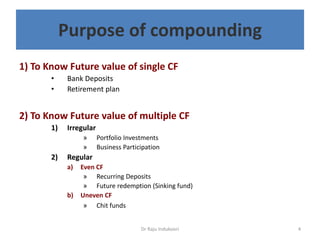
1) To Know Future value of single CF
• Bank Deposits
• Retirement plan
2) To Know Future value of multiple CF
1) Irregular
» Portfolio Investments
» Business Participation
2) Regular
a) Even CF
» Recurring Deposits
» Future redemption (Sinking fund)
b) Uneven CF
» Chit funds
Compounding – Time Line
Dr Raju Indukoori 6
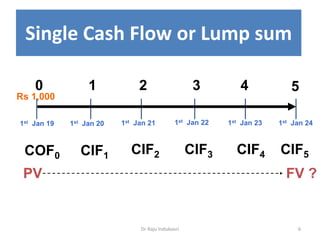
Single Cash Flow or Lump sum
0 1 2 3 54
1st Jan 19
CIF2 CIF3 CIF4CIF1 CIF5COF0
Rs 1,000
1st Jan 20 1st Jan 221st Jan 21 1st Jan 23 1st Jan 24
PV FV ?
Dr Raju Indukoori 7
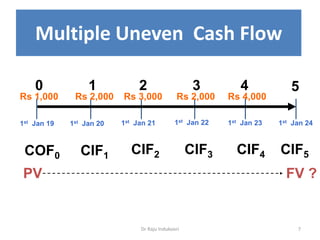
Multiple Uneven Cash Flow
0 1 2 3 54
1st Jan 19
CIF2 CIF3 CIF4CIF1 CIF5COF0
Rs 1,000
1st Jan 20 1st Jan 221st Jan 21 1st Jan 23 1st Jan 24
PV FV ?
Rs 2,000 Rs 3,000 Rs 2,000 Rs 4,000
Dr Raju Indukoori 8
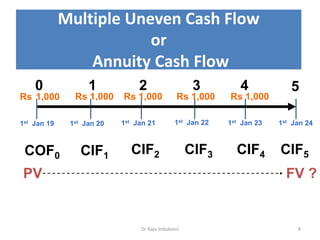
Multiple Uneven Cash Flow
or
Annuity Cash Flow
0 1 2 3 54
1st Jan 19
CIF2 CIF3 CIF4CIF1 CIF5COF0
Rs 1,000
1st Jan 20 1st Jan 221st Jan 21 1st Jan 23 1st Jan 24
PV FV ?
Rs 1,000 Rs 1,000 Rs 1,000 Rs 1,000
Compounding Tools
Dr Raju Indukoori 10
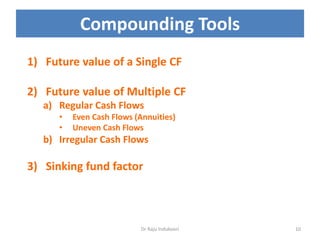
Compounding Tools
1) Future value of a Single CF
2) Future value of Multiple CF
a) Regular Cash Flows
• Even Cash Flows (Annuities)
• Uneven Cash Flows
b) Irregular Cash Flows
3) Sinking fund factor
Dr Raju Indukoori 11
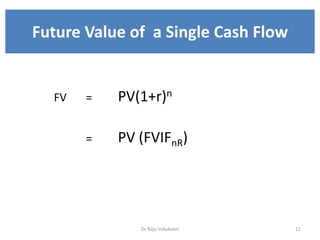
Future Value of a Single Cash Flow
FV = PV(1+r)n
= PV (FVIFnR)
Dr Raju Indukoori 12
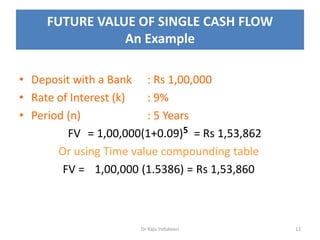
FUTURE VALUE OF SINGLE CASH FLOW
An Example
• Deposit with a Bank : Rs 1,00,000
• Rate of Interest (k) : 9%
• Period (n) : 5 Years
FV = 1,00,000(1+0.09)5 = Rs 1,53,862
Or using Time value compounding table
FV = 1,00,000 (1.5386) = Rs 1,53,860
Dr Raju Indukoori 13
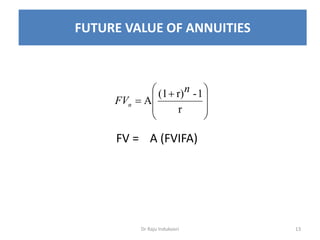
FUTURE VALUE OF ANNUITIES
FV = A (FVIFA)







 

r
1-r)(1
A
n
FVn
Dr Raju Indukoori 14
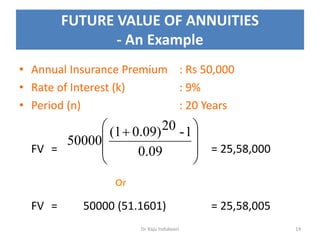
FUTURE VALUE OF ANNUITIES
- An Example
• Annual Insurance Premium : Rs 50,000
• Rate of Interest (k) : 9%
• Period (n) : 20 Years
FV = = 25,58,000
Or
FV = 50000 (51.1601) = 25,58,005







 
0.09
1-200.09)(1
50000
Dr Raju Indukoori 15
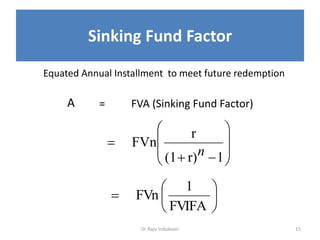
Sinking Fund Factor
Equated Annual Installment to meet future redemption
A = FVA (Sinking Fund Factor)










1r)(1
r
FVn
n







FVIFA
1
FVn
Dr Raju Indukoori 16
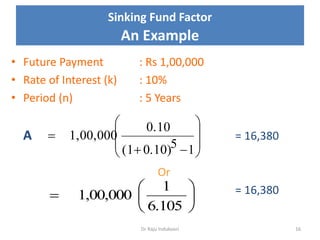
Sinking Fund Factor
An Example
• Future Payment : Rs 1,00,000
• Rate of Interest (k) : 10%
• Period (n) : 5 Years
A = 16,380
Or
= 16,380










15.10)0(1
0.10
1,00,000







6.105
1
1,00,000
Dr Raju Indukoori 17
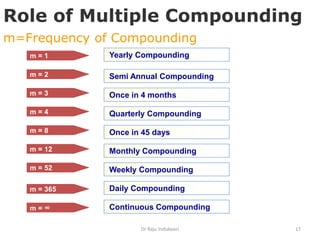
Yearly Compoundingm = 1
Role of Multiple Compounding
m=Frequency of Compounding
m = 2
m = 3
m = 4
m = 8
m = 12
m = 52
m = 365
m = ∞
Semi Annual Compounding
Once in 4 months
Quarterly Compounding
Once in 45 days
Monthly Compounding
Weekly Compounding
Daily Compounding
Continuous Compounding
Dr Raju Indukoori 18
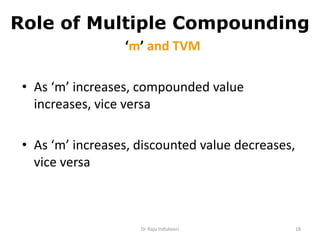
Role of Multiple Compounding
‘m’ and TVM
• As ‘m’ increases, compounded value
increases, vice versa
• As ‘m’ increases, discounted value decreases,
vice versa
Dr Raju Indukoori 19
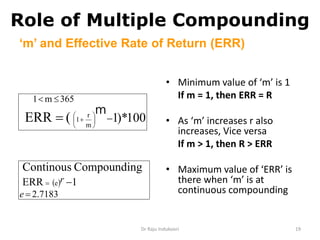
Role of Multiple Compounding
• Minimum value of ‘m’ is 1
If m = 1, then ERR = R
• As ‘m’ increases r also
increases, Vice versa
If m > 1, then R > ERR
• Maximum value of ‘ERR’ is
there when ‘m’ is at
continuous compounding
100*)1m
r
1(ERR
365m1








m
 
7183.2
1ERR e
gCompoundinContinous


e
r
‘m’ and Effective Rate of Return (ERR)
Dr Raju Indukoori 20
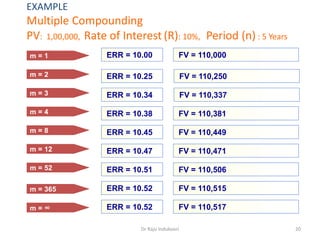
ERR = 10.00m = 1
EXAMPLE
Multiple Compounding
PV: 1,00,000, Rate of Interest (R): 10%, Period (n) : 5 Years
m = 2
m = 3
m = 4
m = 8
m = 12
m = 52
m = 365
m = ∞
FV = 110,000
FV = 110,337
FV = 110,381
FV = 110,449
FV = 110,471
FV = 110,506
FV = 110,515
FV = 110,517
FV = 110,250
ERR = 10.51
ERR = 10.52
ERR = 10.52
ERR = 10.38
ERR = 10.45
ERR = 10.47
ERR = 10.25
ERR = 10.34
Dr Raju Indukoori 21
Any Questions
Dr Raju Indukoori 22
Thank You
Dr Raju Indukoori

Compounding - Future Value of Money

  • 1.
    Dr Raju Indukoori1 Compounding (Future Value of Money) S S N Raju Indukoori
  • 2.
    Dr Raju Indukoori2 Future Value of Money (FVM) COMPOUNDING
  • 3.
    Dr Raju Indukoori3 Future Value of Money It is the Process of Compounding PV of money for a Future Period of Time
  • 4.
    Dr Raju Indukoori4 Purpose of compounding 1) To Know Future value of single CF • Bank Deposits • Retirement plan 2) To Know Future value of multiple CF 1) Irregular » Portfolio Investments » Business Participation 2) Regular a) Even CF » Recurring Deposits » Future redemption (Sinking fund) b) Uneven CF » Chit funds
  • 5.
  • 6.
    Dr Raju Indukoori6 Single Cash Flow or Lump sum 0 1 2 3 54 1st Jan 19 CIF2 CIF3 CIF4CIF1 CIF5COF0 Rs 1,000 1st Jan 20 1st Jan 221st Jan 21 1st Jan 23 1st Jan 24 PV FV ?
  • 7.
    Dr Raju Indukoori7 Multiple Uneven Cash Flow 0 1 2 3 54 1st Jan 19 CIF2 CIF3 CIF4CIF1 CIF5COF0 Rs 1,000 1st Jan 20 1st Jan 221st Jan 21 1st Jan 23 1st Jan 24 PV FV ? Rs 2,000 Rs 3,000 Rs 2,000 Rs 4,000
  • 8.
    Dr Raju Indukoori8 Multiple Uneven Cash Flow or Annuity Cash Flow 0 1 2 3 54 1st Jan 19 CIF2 CIF3 CIF4CIF1 CIF5COF0 Rs 1,000 1st Jan 20 1st Jan 221st Jan 21 1st Jan 23 1st Jan 24 PV FV ? Rs 1,000 Rs 1,000 Rs 1,000 Rs 1,000
  • 9.
  • 10.
    Dr Raju Indukoori10 Compounding Tools 1) Future value of a Single CF 2) Future value of Multiple CF a) Regular Cash Flows • Even Cash Flows (Annuities) • Uneven Cash Flows b) Irregular Cash Flows 3) Sinking fund factor
  • 11.
    Dr Raju Indukoori11 Future Value of a Single Cash Flow FV = PV(1+r)n = PV (FVIFnR)
  • 12.
    Dr Raju Indukoori12 FUTURE VALUE OF SINGLE CASH FLOW An Example • Deposit with a Bank : Rs 1,00,000 • Rate of Interest (k) : 9% • Period (n) : 5 Years FV = 1,00,000(1+0.09)5 = Rs 1,53,862 Or using Time value compounding table FV = 1,00,000 (1.5386) = Rs 1,53,860
  • 13.
    Dr Raju Indukoori13 FUTURE VALUE OF ANNUITIES FV = A (FVIFA)           r 1-r)(1 A n FVn
  • 14.
    Dr Raju Indukoori14 FUTURE VALUE OF ANNUITIES - An Example • Annual Insurance Premium : Rs 50,000 • Rate of Interest (k) : 9% • Period (n) : 20 Years FV = = 25,58,000 Or FV = 50000 (51.1601) = 25,58,005          0.09 1-200.09)(1 50000
  • 15.
    Dr Raju Indukoori15 Sinking Fund Factor Equated Annual Installment to meet future redemption A = FVA (Sinking Fund Factor)           1r)(1 r FVn n        FVIFA 1 FVn
  • 16.
    Dr Raju Indukoori16 Sinking Fund Factor An Example • Future Payment : Rs 1,00,000 • Rate of Interest (k) : 10% • Period (n) : 5 Years A = 16,380 Or = 16,380           15.10)0(1 0.10 1,00,000        6.105 1 1,00,000
  • 17.
    Dr Raju Indukoori17 Yearly Compoundingm = 1 Role of Multiple Compounding m=Frequency of Compounding m = 2 m = 3 m = 4 m = 8 m = 12 m = 52 m = 365 m = ∞ Semi Annual Compounding Once in 4 months Quarterly Compounding Once in 45 days Monthly Compounding Weekly Compounding Daily Compounding Continuous Compounding
  • 18.
    Dr Raju Indukoori18 Role of Multiple Compounding ‘m’ and TVM • As ‘m’ increases, compounded value increases, vice versa • As ‘m’ increases, discounted value decreases, vice versa
  • 19.
    Dr Raju Indukoori19 Role of Multiple Compounding • Minimum value of ‘m’ is 1 If m = 1, then ERR = R • As ‘m’ increases r also increases, Vice versa If m > 1, then R > ERR • Maximum value of ‘ERR’ is there when ‘m’ is at continuous compounding 100*)1m r 1(ERR 365m1         m   7183.2 1ERR e gCompoundinContinous   e r ‘m’ and Effective Rate of Return (ERR)
  • 20.
    Dr Raju Indukoori20 ERR = 10.00m = 1 EXAMPLE Multiple Compounding PV: 1,00,000, Rate of Interest (R): 10%, Period (n) : 5 Years m = 2 m = 3 m = 4 m = 8 m = 12 m = 52 m = 365 m = ∞ FV = 110,000 FV = 110,337 FV = 110,381 FV = 110,449 FV = 110,471 FV = 110,506 FV = 110,515 FV = 110,517 FV = 110,250 ERR = 10.51 ERR = 10.52 ERR = 10.52 ERR = 10.38 ERR = 10.45 ERR = 10.47 ERR = 10.25 ERR = 10.34
  • 21.
    Dr Raju Indukoori21 Any Questions
  • 22.
    Dr Raju Indukoori22 Thank You Dr Raju Indukoori