The Essence of Continuous Improvement
An Ideal Role for Human Resources                     John Hansen
                                    MBA610 Issues in Human Resources
                                     John Vesco – Concordia University
                                                    19 December 2011
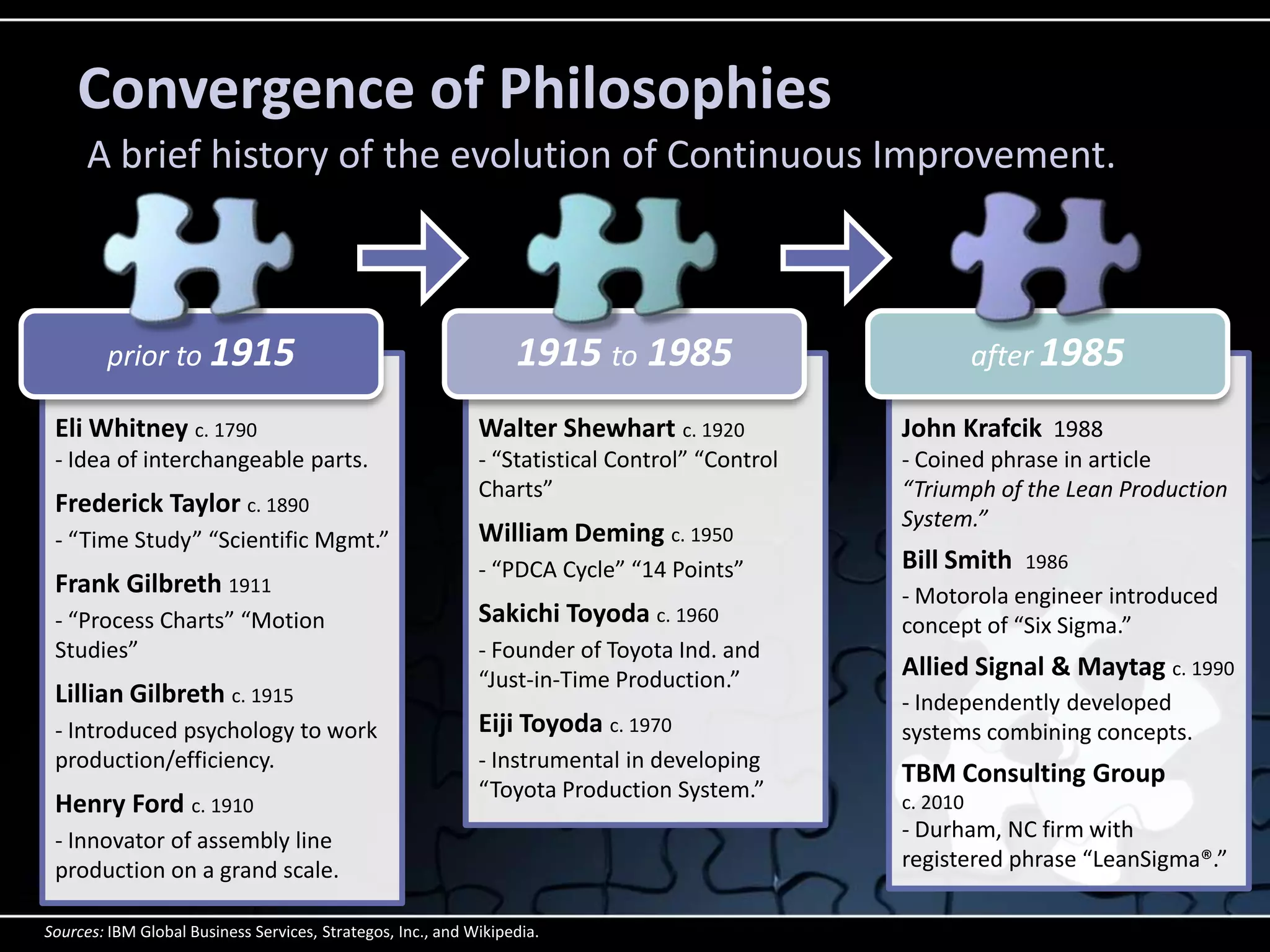
Convergence of Philosophies
     A brief history of the evolution of Continuous Improvement.


        prior to 1915                                             1915 to 1985                            after 1985

 Eli Whitney c. 1790                                         Walter Shewhart c. 1920            John Krafcik 1988
 - Idea of interchangeable parts.                            - “Statistical Control” “Control   - Coined phrase in article
                                                             Charts”                            “Triumph of the Lean Production
 Frederick Taylor c. 1890
                                                                                                System.”
 - “Time Study” “Scientific Mgmt.”                           William Deming c. 1950
                                                             - “PDCA Cycle” “14 Points”         Bill Smith   1986
 Frank Gilbreth 1911                                                                            - Motorola engineer introduced
 - “Process Charts” “Motion                                  Sakichi Toyoda c. 1960             concept of “Six Sigma.”
 Studies”                                                    - Founder of Toyota Ind. and
                                                             “Just-in-Time Production.”         Allied Signal & Maytag c. 1990
 Lillian Gilbreth c. 1915                                                                       - Independently developed
 - Introduced psychology to work                             Eiji Toyoda c. 1970                systems combining concepts.
 production/efficiency.                                      - Instrumental in developing
                                                                                                TBM Consulting Group
                                                             “Toyota Production System.”
 Henry Ford c. 1910                                                                             c. 2010
 - Innovator of assembly line                                                                   - Durham, NC firm with
 production on a grand scale.                                                                   registered phrase “LeanSigma®.”

Sources: IBM Global Business Services, Strategos, Inc., and Wikipedia.
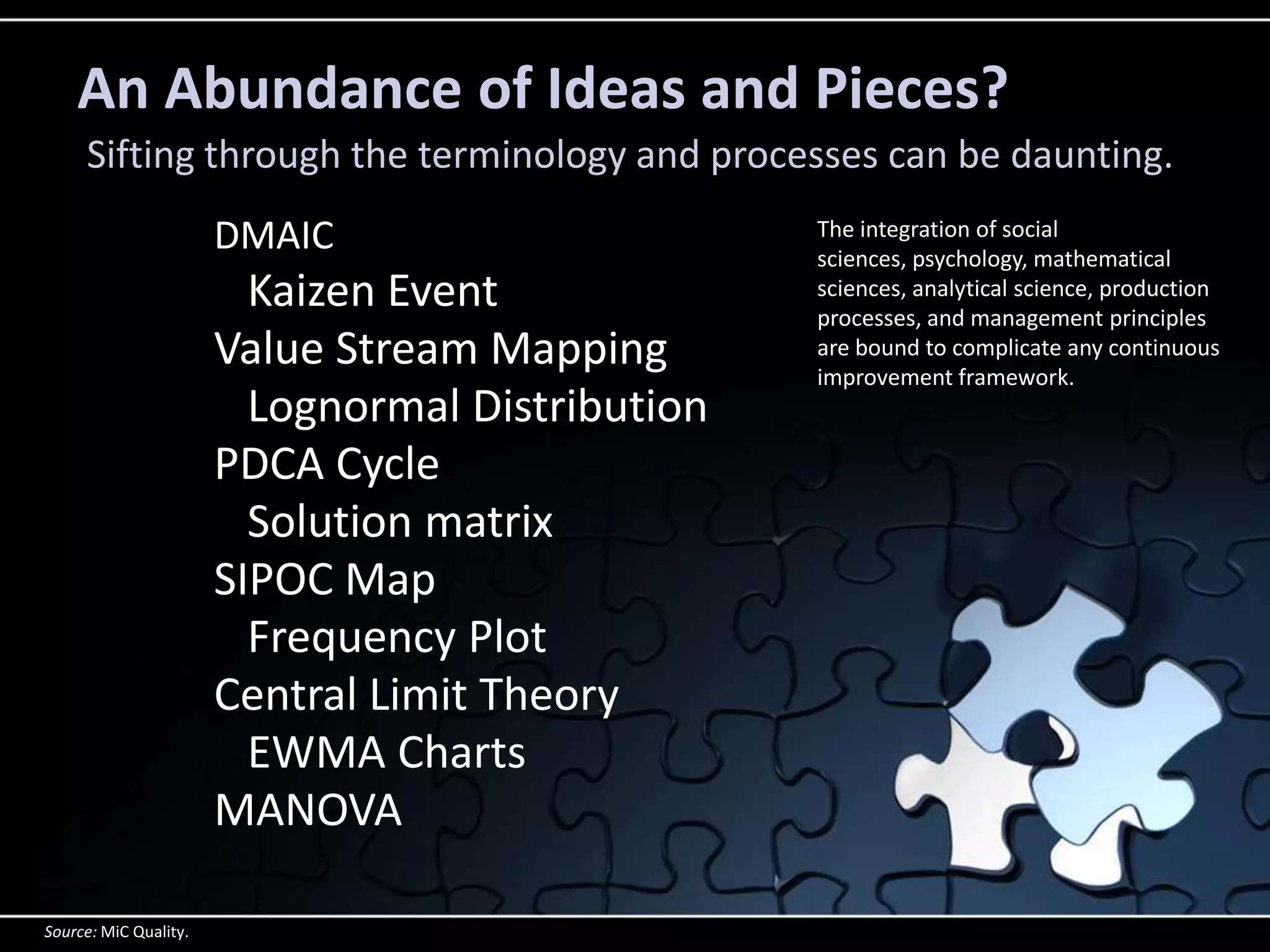
An Abundance of Ideas and Pieces?
     Sifting through the terminology and processes can be daunting.
                       DMAIC                      The integration of social
                                                  sciences, psychology, mathematical
                         Kaizen Event             sciences, analytical science, production
                                                  processes, and management principles
                       Value Stream Mapping       are bound to complicate any continuous
                                                  improvement framework.
                         Lognormal Distribution
                       PDCA Cycle
                         Solution matrix
                       SIPOC Map
                         Frequency Plot
                       Central Limit Theory
                         EWMA Charts
                       MANOVA

Source: MiC Quality.
Getting Lost in Convoluted Information
     “It’s not about a set of tools, procedures or logical steps…
     (it) is a thought process, a culture, or belief system.”(2)

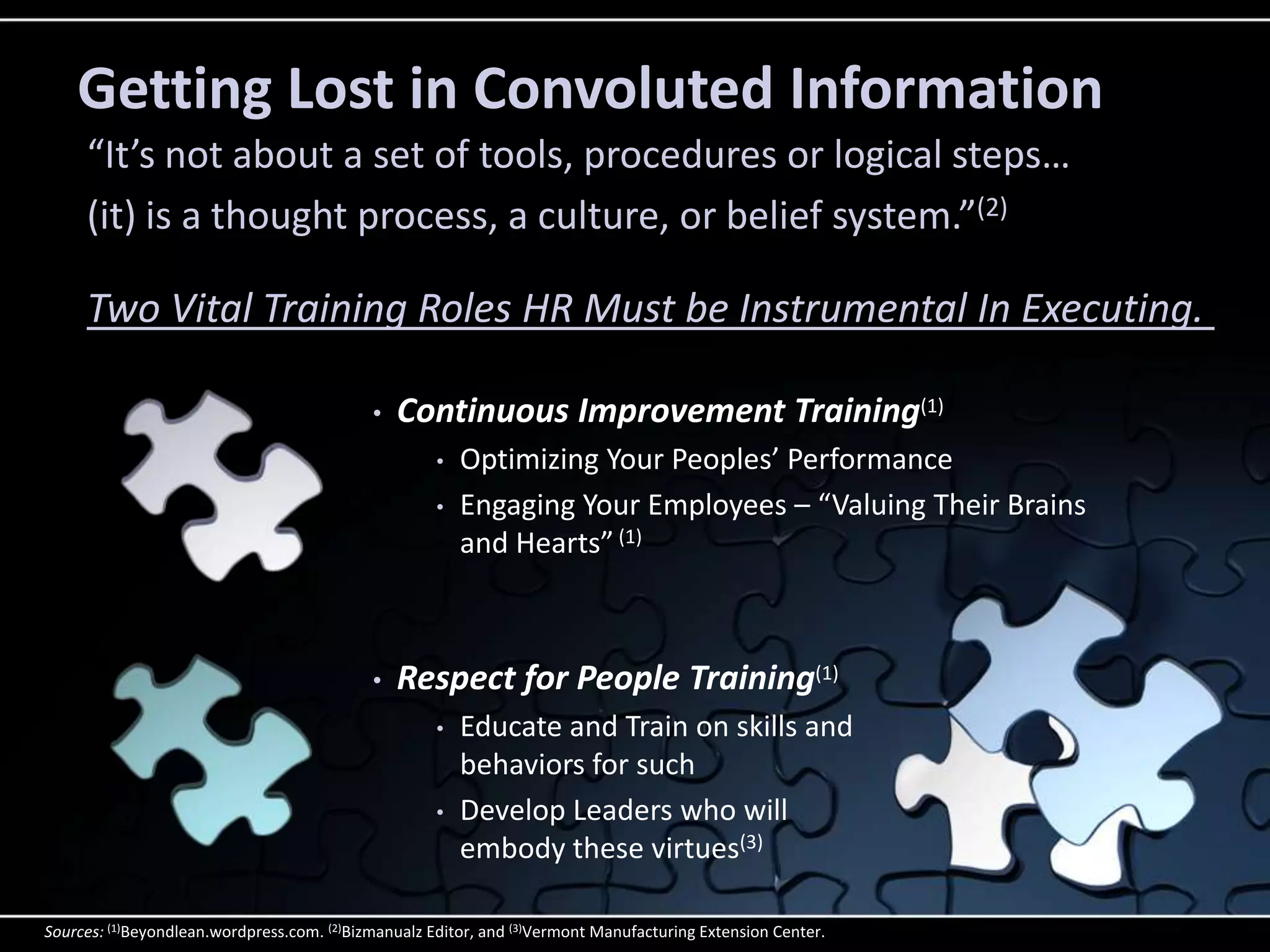
     Two Vital Training Roles HR Must be Instrumental In Executing.

                                            •   Continuous Improvement Training(1)
                                                     •   Optimizing Your Peoples’ Performance
                                                     •   Engaging Your Employees – “Valuing Their Brains
                                                         and Hearts” (1)


                                            •   Respect for People Training(1)
                                                     •   Educate and Train on skills and
                                                         behaviors for such
                                                     •   Develop Leaders who will
                                                         embody these virtues(3)

Sources: (1)Beyondlean.wordpress.com. (2)Bizmanualz Editor, and (3)Vermont Manufacturing Extension Center.
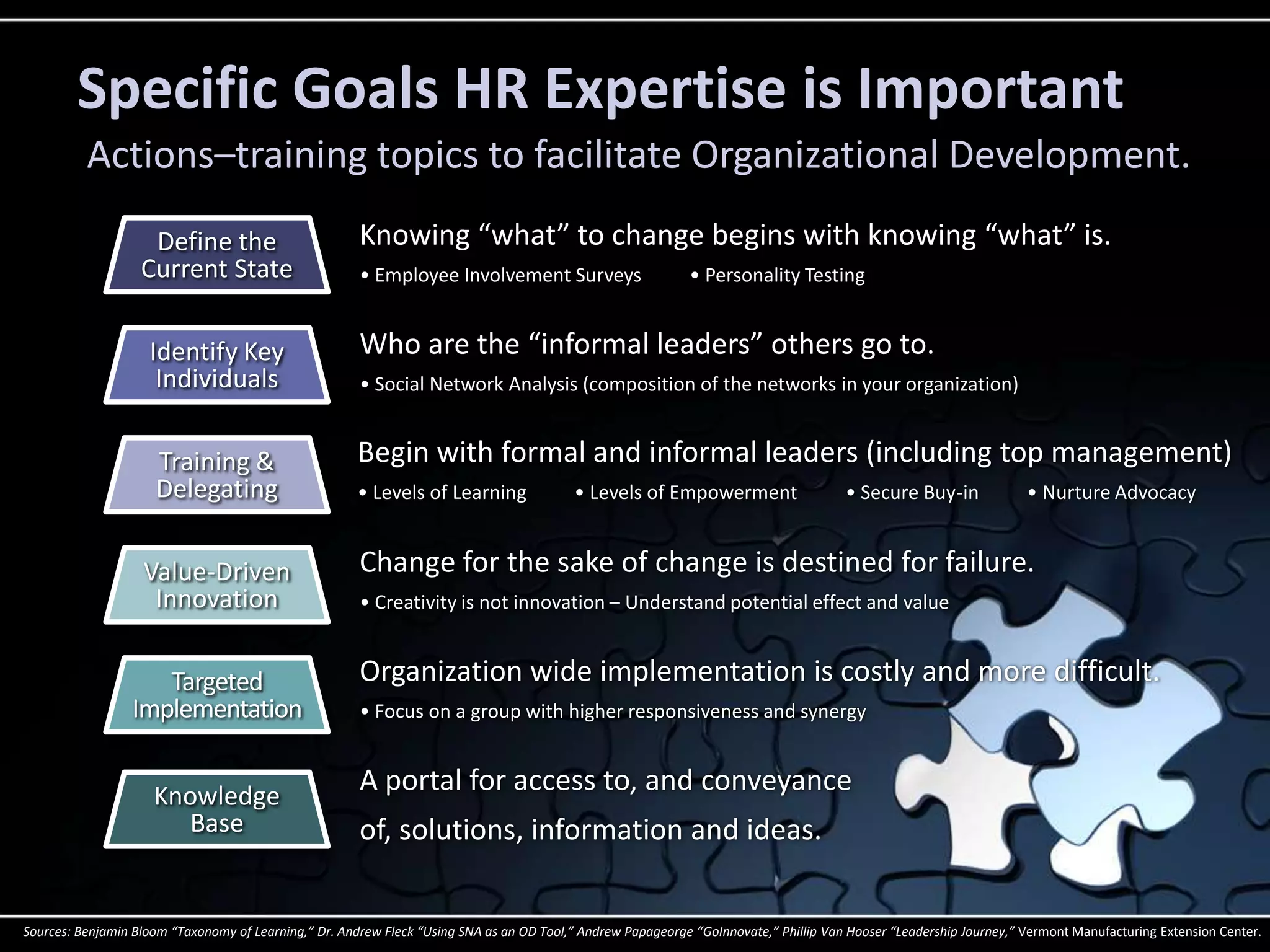
Specific Goals HR Expertise is Important
          Actions–training topics to facilitate Organizational Development.
                    Define the                         Knowing “what” to change begins with knowing “what” is.
                   Current State                       • Employee Involvement Surveys                        • Personality Testing


                    Identify Key                       Who are the “informal leaders” others go to.
                     Individuals                       • Social Network Analysis (composition of the networks in your organization)


                     Training &                        Begin with formal and informal leaders (including top management)
                     Delegating                        • Levels of Learning               • Levels of Empowerment                      • Secure Buy-in               • Nurture Advocacy


                   Value-Driven                        Change for the sake of change is destined for failure.
                    Innovation                         • Creativity is not innovation – Understand potential effect and value


                    Targeted                           Organization wide implementation is costly and more difficult.
                 Implementation                        • Focus on a group with higher responsiveness and synergy


                     Knowledge
                                                       A portal for access to, and conveyance
                       Base                            of, solutions, information and ideas.


Sources: Benjamin Bloom “Taxonomy of Learning,” Dr. Andrew Fleck “Using SNA as an OD Tool,” Andrew Papageorge “GoInnovate,” Phillip Van Hooser “Leadership Journey,” Vermont Manufacturing Extension Center.
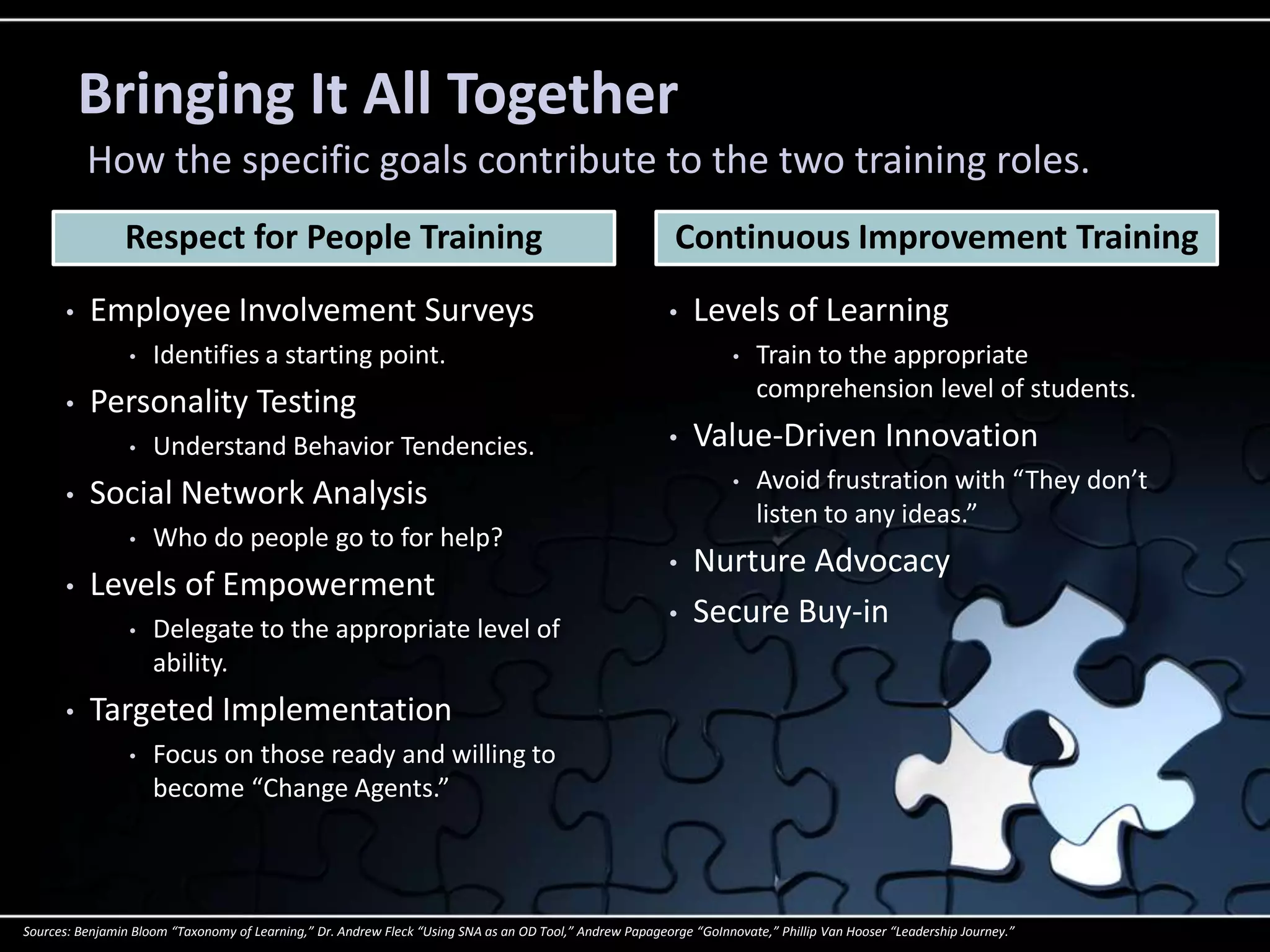
Bringing It All Together
           How the specific goals contribute to the two training roles.
                Respect for People Training                                                                Continuous Improvement Training
       •   Employee Involvement Surveys                                                                   •   Levels of Learning
                 •   Identifies a starting point.                                                                    •   Train to the appropriate
                                                                                                                         comprehension level of students.
       •   Personality Testing
                 •   Understand Behavior Tendencies.                                                      •   Value-Driven Innovation
                                                                                                                     •   Avoid frustration with “They don’t
       •   Social Network Analysis
                                                                                                                         listen to any ideas.”
                 •   Who do people go to for help?
                                                                                                          •   Nurture Advocacy
       •   Levels of Empowerment
                 •   Delegate to the appropriate level of
                                                                                                          •   Secure Buy-in
                     ability.
       •   Targeted Implementation
                 •   Focus on those ready and willing to
                     become “Change Agents.”


Sources: Benjamin Bloom “Taxonomy of Learning,” Dr. Andrew Fleck “Using SNA as an OD Tool,” Andrew Papageorge “GoInnovate,” Phillip Van Hooser “Leadership Journey.”
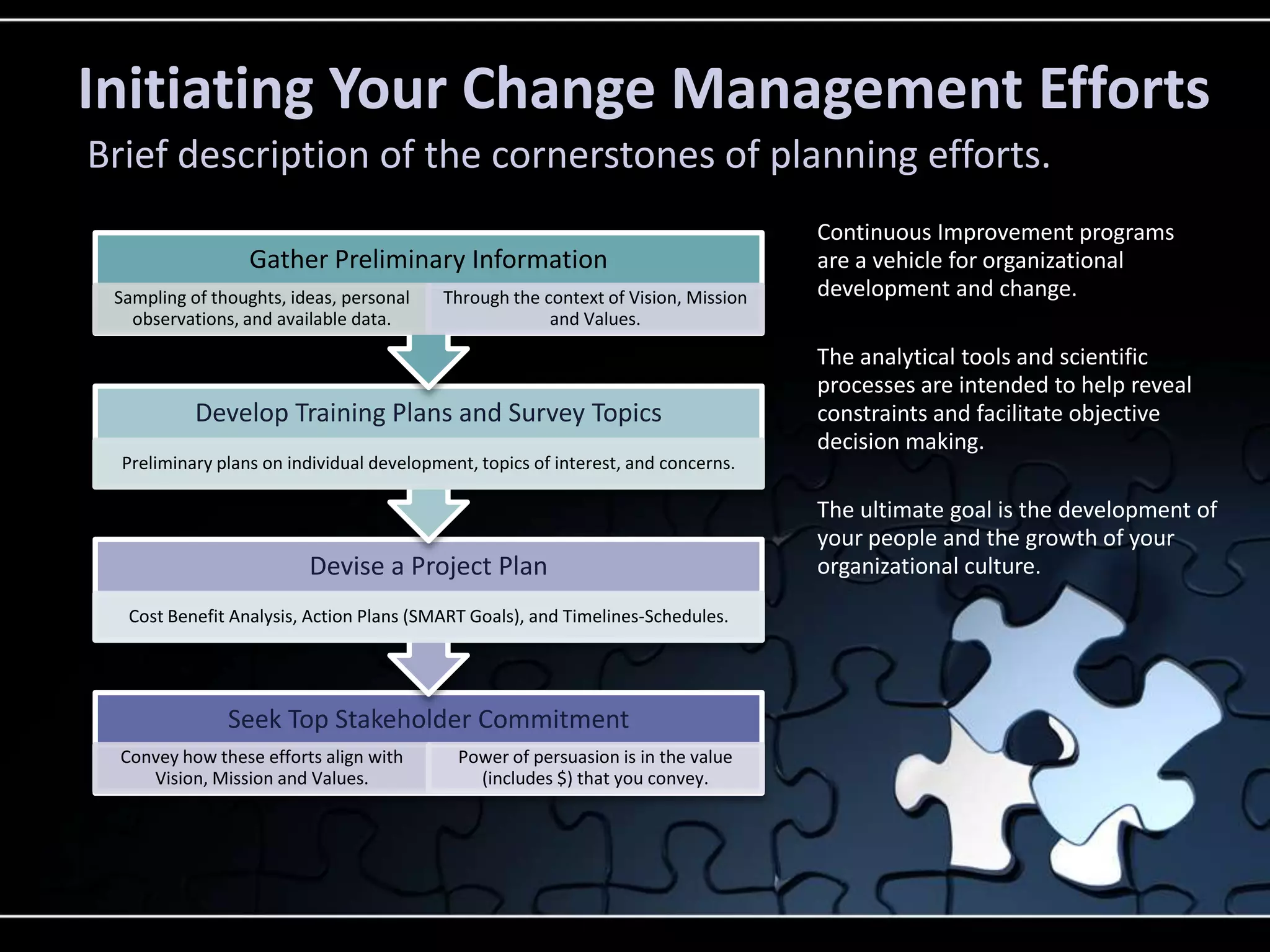
Initiating Your Change Management Efforts
Brief description of the cornerstones of planning efforts.
                                                                                   Continuous Improvement programs
                  Gather Preliminary Information                                   are a vehicle for organizational
 Sampling of thoughts, ideas, personal    Through the context of Vision, Mission   development and change.
   observations, and available data.                   and Values.

                                                                                   The analytical tools and scientific
                                                                                   processes are intended to help reveal
           Develop Training Plans and Survey Topics                                constraints and facilitate objective
                                                                                   decision making.
  Preliminary plans on individual development, topics of interest, and concerns.

                                                                                   The ultimate goal is the development of
                                                                                   your people and the growth of your
                         Devise a Project Plan                                     organizational culture.
   Cost Benefit Analysis, Action Plans (SMART Goals), and Timelines-Schedules.


               Seek Top Stakeholder Commitment
  Convey how these efforts align with       Power of persuasion is in the value
     Vision, Mission and Values.              (includes $) that you convey.
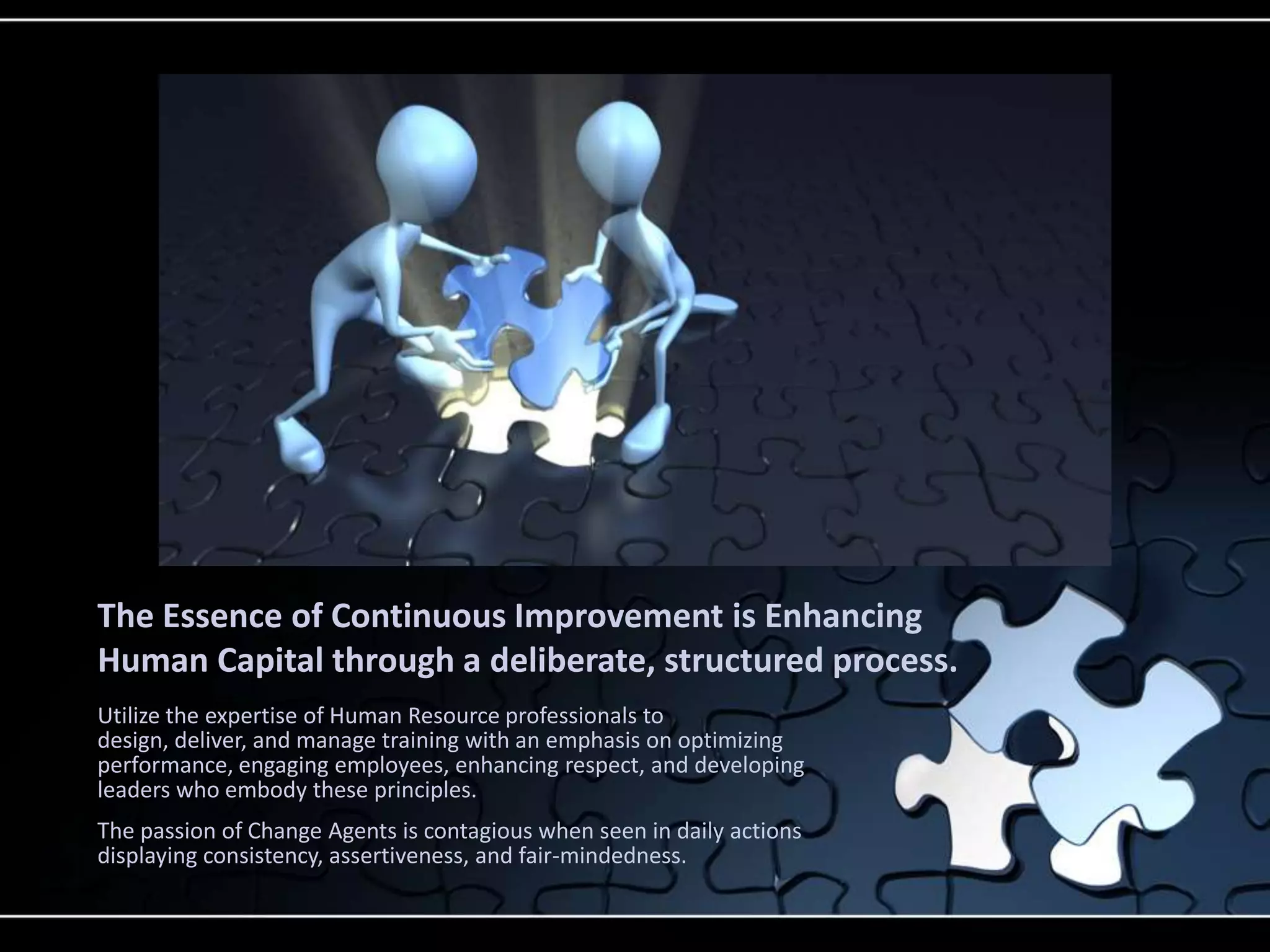
The Essence of Continuous Improvement is Enhancing
Human Capital through a deliberate, structured process.
Utilize the expertise of Human Resource professionals to
design, deliver, and manage training with an emphasis on optimizing
performance, engaging employees, enhancing respect, and developing
leaders who embody these principles.
The passion of Change Agents is contagious when seen in daily actions
displaying consistency, assertiveness, and fair-mindedness.
Time for Questions
                     www.PresenterMedia.com

The Essence of Continuous Improvement

  • 1.
    The Essence ofContinuous Improvement An Ideal Role for Human Resources John Hansen MBA610 Issues in Human Resources John Vesco – Concordia University 19 December 2011
  • 2.
    Convergence of Philosophies A brief history of the evolution of Continuous Improvement. prior to 1915 1915 to 1985 after 1985 Eli Whitney c. 1790 Walter Shewhart c. 1920 John Krafcik 1988 - Idea of interchangeable parts. - “Statistical Control” “Control - Coined phrase in article Charts” “Triumph of the Lean Production Frederick Taylor c. 1890 System.” - “Time Study” “Scientific Mgmt.” William Deming c. 1950 - “PDCA Cycle” “14 Points” Bill Smith 1986 Frank Gilbreth 1911 - Motorola engineer introduced - “Process Charts” “Motion Sakichi Toyoda c. 1960 concept of “Six Sigma.” Studies” - Founder of Toyota Ind. and “Just-in-Time Production.” Allied Signal & Maytag c. 1990 Lillian Gilbreth c. 1915 - Independently developed - Introduced psychology to work Eiji Toyoda c. 1970 systems combining concepts. production/efficiency. - Instrumental in developing TBM Consulting Group “Toyota Production System.” Henry Ford c. 1910 c. 2010 - Innovator of assembly line - Durham, NC firm with production on a grand scale. registered phrase “LeanSigma®.” Sources: IBM Global Business Services, Strategos, Inc., and Wikipedia.
  • 3.
    An Abundance ofIdeas and Pieces? Sifting through the terminology and processes can be daunting. DMAIC The integration of social sciences, psychology, mathematical Kaizen Event sciences, analytical science, production processes, and management principles Value Stream Mapping are bound to complicate any continuous improvement framework. Lognormal Distribution PDCA Cycle Solution matrix SIPOC Map Frequency Plot Central Limit Theory EWMA Charts MANOVA Source: MiC Quality.
  • 4.
    Getting Lost inConvoluted Information “It’s not about a set of tools, procedures or logical steps… (it) is a thought process, a culture, or belief system.”(2) Two Vital Training Roles HR Must be Instrumental In Executing. • Continuous Improvement Training(1) • Optimizing Your Peoples’ Performance • Engaging Your Employees – “Valuing Their Brains and Hearts” (1) • Respect for People Training(1) • Educate and Train on skills and behaviors for such • Develop Leaders who will embody these virtues(3) Sources: (1)Beyondlean.wordpress.com. (2)Bizmanualz Editor, and (3)Vermont Manufacturing Extension Center.
  • 5.
    Specific Goals HRExpertise is Important Actions–training topics to facilitate Organizational Development. Define the Knowing “what” to change begins with knowing “what” is. Current State • Employee Involvement Surveys • Personality Testing Identify Key Who are the “informal leaders” others go to. Individuals • Social Network Analysis (composition of the networks in your organization) Training & Begin with formal and informal leaders (including top management) Delegating • Levels of Learning • Levels of Empowerment • Secure Buy-in • Nurture Advocacy Value-Driven Change for the sake of change is destined for failure. Innovation • Creativity is not innovation – Understand potential effect and value Targeted Organization wide implementation is costly and more difficult. Implementation • Focus on a group with higher responsiveness and synergy Knowledge A portal for access to, and conveyance Base of, solutions, information and ideas. Sources: Benjamin Bloom “Taxonomy of Learning,” Dr. Andrew Fleck “Using SNA as an OD Tool,” Andrew Papageorge “GoInnovate,” Phillip Van Hooser “Leadership Journey,” Vermont Manufacturing Extension Center.
  • 6.
    Bringing It AllTogether How the specific goals contribute to the two training roles. Respect for People Training Continuous Improvement Training • Employee Involvement Surveys • Levels of Learning • Identifies a starting point. • Train to the appropriate comprehension level of students. • Personality Testing • Understand Behavior Tendencies. • Value-Driven Innovation • Avoid frustration with “They don’t • Social Network Analysis listen to any ideas.” • Who do people go to for help? • Nurture Advocacy • Levels of Empowerment • Delegate to the appropriate level of • Secure Buy-in ability. • Targeted Implementation • Focus on those ready and willing to become “Change Agents.” Sources: Benjamin Bloom “Taxonomy of Learning,” Dr. Andrew Fleck “Using SNA as an OD Tool,” Andrew Papageorge “GoInnovate,” Phillip Van Hooser “Leadership Journey.”
  • 7.
    Initiating Your ChangeManagement Efforts Brief description of the cornerstones of planning efforts. Continuous Improvement programs Gather Preliminary Information are a vehicle for organizational Sampling of thoughts, ideas, personal Through the context of Vision, Mission development and change. observations, and available data. and Values. The analytical tools and scientific processes are intended to help reveal Develop Training Plans and Survey Topics constraints and facilitate objective decision making. Preliminary plans on individual development, topics of interest, and concerns. The ultimate goal is the development of your people and the growth of your Devise a Project Plan organizational culture. Cost Benefit Analysis, Action Plans (SMART Goals), and Timelines-Schedules. Seek Top Stakeholder Commitment Convey how these efforts align with Power of persuasion is in the value Vision, Mission and Values. (includes $) that you convey.
  • 8.
    The Essence ofContinuous Improvement is Enhancing Human Capital through a deliberate, structured process. Utilize the expertise of Human Resource professionals to design, deliver, and manage training with an emphasis on optimizing performance, engaging employees, enhancing respect, and developing leaders who embody these principles. The passion of Change Agents is contagious when seen in daily actions displaying consistency, assertiveness, and fair-mindedness.
  • 9.
    Time for Questions www.PresenterMedia.com