
Nursing Informatics
&
Technology
Babitha K Devu, RN, RM, M.Sc (N), MBA
Assistant Professor, SMVD College of Nursing, J & K
Research Scholar, Ph.D (N), Amity University, Gurugram
2
INTRODUCTION
 Globally the use of computer technology in the field of medical sciences began in
the early 1950s.
 In 1949 Gustav Wagner recognized the first professional organization for
informatics in Germany.
 In 1960s specialized university divisions and informatics training programs began
in France, Germany, Belgium and Netherlands.
 The research department related to health informatics was established during
1970s in Poland and US.
 IMIA: International Medical Informatics Association: an international body
working in the field of health inofrmatics.
3
HEALTH INFORMATICS
 Informatics is an emerging discipline that has been defined as the study,
invention, and implementation of structures and algorithms to improve
communication, interpretation, understanding and management of
information in order to help solve application-specific problems.
 Health informatics: is the field of science and engineering that aims at
developing methods and technologies for the acquisition, processing,
and study of patient data, which can come from different sources and
modalities, such as electronic health records, diagnostic test results,
medical scans.
 Health informatics is a spectrum of multidisciplinary fields that includes
study of the design, development and application of computational
innovations to improve health care.
4
HEALTH INFORMATICS
 All data are not created equal and technology implementation alone is not
enough to improve the healthcare provided to patients.
 Providers and organizations must be able to distinguish between an abundance
of data, meaningful data, and integration of data.
 Healthcare organizations are challenged to meet these data dilemmas in their
daily practices and workflow, where new technologies and treatment modalities
are changing and evolving at a rapid rate.
 The American Medical Informatics Association (AMIA) has defined clinical
informatics as the application of informatics and information technology to
deliver healthcare services. It includes a wide range of topics from clinical
documentation to provider order entry systems and from system design to
system implementation and adoption issues.
 Each discipline-specific area—such as nursing or pharmacy—within the overall
sphere of informatics in healthcare has specific needs. Informatics in nursing,
for example, focuses on issues such as tracking and documenting nursing care
by using information technology.
5
NEED OF HEALTH INFORMATICS
 To improve patient care.
 To produce information of the patients.
 To enhance easy access to the patient information.
 To manage information of the patients.
 To respect patient privacy and patient safety
 To assist effective decision making
 To use data to detect and control emerging as well as endemic health issues.
 To monitor progress towards the achievement of goals.
 To enhance interoperability.
 To strengthen the evidence base for making effective policies.
 To improve the communication between health care professionals.
 To provide standardized patient care.
 To evaluate the health care system.
6
OBJECTIVES OF HEALTH INFORMATICS
 Easy access to health services:
1. Fill the gap between the consumers and service providers.
2. Service to the people in need.
3. Improving health care outcome.
4. Reaching out to people who have no easy access to health care
facility.
5. Applicable in subfields Tele-health, Telemedicine and tele-nursing.
6. Equitable distribution of health services
7. Usage of electronic communication, telecommunication,
continuing education, administrative meeting, attending remote area
health issues.
 8. Easing research, education and practice.
7
OBJECTIVES OF HEALTH INFORMATICS
 Providing cost effective services as per the standards:
1. Move from Illness to Wellness
2. Integration of all services leads to cost effective health care
service.
3. improved quality of life
4. Minimize errors
5. Reduce Mortality
6. Access to up to date information
8
ADVANTAGE OF HEALTH INFORMATICS
 Cost Effective: Healthcare informatics has contributed immensely in reducing cost in the
medical business as it has a way of minimizing medical errors which costs a lot in the
business. However, technologies like Computer Provider Order Entry Systems (CPOE) or
Clinical Decision Support Systems (CDSS) are programmed to detect medical errors
specifically in duplication, mismatches, and allergies of patients based on their data,
leading to huge cost-reduction for healthcare companies.
 Time saving: Computers are capable of processing huge amount of data within no time.
The Hospital Information System provide professionals with templates and pre-designed
platform to save time.
 Enhances inter-sectorial approach: With an increase in specialization of healthcare,
patients usually receive care simultaneously from different medical professionals in one
hospital stay. This increase in the number of medical professionals attending to a patient
may lead to a certain level of incoordination. Health informatics makes the necessary
coordination possible by allowing health professionals involved in a patient’s care to
simultaneously record, disseminate, and share updates, logs, and findings. It also ensures
that conversations regarding issues like blood levels, therapy, nutrition, discharge
instructions, etc. are made in tandem with one another so as to avoid problems.
9
ADVANTAGE OF HEALTH INFORMATICS
Systematic Record Keeping: For a long period of time, most medical facilities used outdated
methods to store patient records. Even to this day, a large number of hospitals around the
world still use paper-based system of patient data storage. However, with the informatics
industry booming and allowing for new electronic technology and information systems e.g.,
Electronic Health Record (EHR) systems, the management of patients’ records is now made
faster and easier. Medical professionals now find patient’s data stored in convenient coded
computer systems. Also, workload is drastically reduced as searching for data using the
manual processes puts extra stress on the entire personnel of a medical facility thereby
hindering their ability to work efficiently throughout their shift.
Empowering patients: Patients having electronic access to their own health history and
recommendations are most likely to be empowered in taking care of their health. In addition to
keeping track of their symptoms and medications, having access to information allows
patients to be more involved in their treatment plans and stay better informed about their
conditions. This systematic process also allows patients to reach out to the right healthcare
professional or access expert advice in real-time when needed.
1 0
ADVANTAGE OF HEALTH INFORMATICS
 Ensures patient safety: Data confidentiality and patient privacy is a very vital
aspect in healthcare, therefore, using block chain technology, medical
professionals are already experimenting with new methods of data encryption.
When data gets encrypted, patients and doctors wouldn’t have to worry about
data breaches and compromised data, as records will now be completely safe.
This particularly fosters patients’ faith in doctors and makes them eager to
provide more crucial information. Out of all the benefits of health informatics,
block chain-powered privacy benefits are perhaps the closest to becoming a
standard.
 Better outcomes: With manual jobs and tasks now being automated, time and
money are being saved both for patients, hospitals, insurance companies, and
even the government. Also, there are now improved diagnoses and lesser
errors, which have led to an increase in healthcare efficiency.
1 1
DISADVANTAGE OF HEALTH INFORMATICS
 Non- uniform data: Different system in in different organization, with different
illustrations and terminologies.
 Data Privacy & Safety: Threat to digital records via ransome or virus. Storage
Failure and Mechanical Fault.
 Resist to Change: Switching over from traditional to modern system.
 Potential for hacking: Data Safety
 Expensive: Initial Set Up and training of people is expensive.
 Lack of user friendliness
 Over dependence
1 2
DATA, INFORMATION & KNOWLEDGE IN
HEALTHCARE
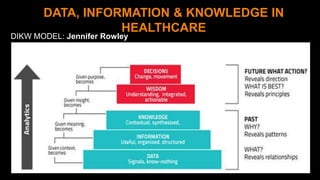
 Data are the fundamental element of cognition, the common denominator on
which all constructs are based, and are stored in information systems.
 Derived from data, and positioned along a continuum that eventually leads to
wisdom, are information and knowledge.
 Data pertain to facts and given attributes, such as name, gender, birth date,
address, phone number, temperature, and so forth. Attaching meaning to data
transforms them into semantic data, or information.
 Knowledge, at the next level, implies contextualized information, which is
information interpreted by the receiver and from the perspective of the receiver.
 The highest level on this continuum-wisdom-pertains to a state of refined,
sublimated knowledge that affords the receiver the potential to optimize
interaction with the environment.
1 3
DATA, INFORMATION & KNOWLEDGE IN
HEALTHCARE
• In many instances the distinction between information and knowledge is rather
ambiguous.
• Certain users may interpret one set of data as information, while for others it is
knowledge.
• To minimize equivocation, an information system uses a database to store data and
metadata, which are data about data.
• Metadata help interpret and transform data into information.
• Large organizations often store the same data in different systems.
• For every given system, one must take into account metadata when attempting to
interpret data.
• Sometimes, additional data elements must be considered together (for example, a
patient's name may be stored in three different data fields, as last name, first name,
and middle name) before information can be derived from data.
• For healthcare enterprises, the complexities involved in accessing patient information
across different software applications and across organizational boundaries are
significant, yielding a potential for costly errors.
1 4
DATA, INFORMATION & KNOWLEDGE IN
HEALTHCARE
DIKW MODEL: Jennifer Rowley
1 5
DATA, INFORMATION & KNOWLEDGE IN
HEALTHCARE
• Tayi and Ballou (Tayi & Ballou, 1998) define data as ‘the raw material for the
information age’.
• Data support managerial and professional work and are critical to all decisions at
all levels of an enterprise (Tayi & Ballou, 1998), (Fuller & Redman, 1994).
• Data can take the form of single entities that are textual or numerical, but can
also include documents, photographic images, sound, or video segments
(McFadden, Hoffer, & Prescott, 1999).
• In the health care environment data are found in many different forms than just
textual.
• Unlike physical raw material, however, data are not consumed and in fact can be
reused repeatedly for various purposes.
• Data models are the definitions of entities, their attributes, and the relationships
between them that organizations use to structure their view of the real world.
1 6
DATA, INFORMATION & KNOWLEDGE IN
HEALTHCARE
• There is general agreement in the literature that data are now important to all
organizations, regardless of their functions.
• Organizations are becoming more and more dependent on data; virtually
everything the modern organization does both creates and depends upon
enormous quantities of data.
• A comprehensive data management program is therefore essential to meet the
needs of the organization.
1 7
DATA, INFORMATION & KNOWLEDGE IN
HEALTHCARE
• The management of data is becoming increasingly complex, in part through the
progress of technology such as databases and telecommunications (Fuller &
Redman, 1994).
• Pautke and Adelman (Adelman, 2001) have found that the typical organization
does not take full advantage of its data resources.
• There is often a poor connection between the organization's business strategy
and the data it holds and manages.
• Data are of low accuracy levels, there is inadequate knowledge of what data
resources are available and lack of management accountability.
• These issues point to the need for an organization-wide policy on data
management that actively considers data as a business requirement, that data
should be of good quality and that accountability for data needs to sit at the
highest level of the organization.
• According to Adelman (Adelman, 2001), what is required is a ‘data strategy’.
1 8
DATA, INFORMATION & KNOWLEDGE IN
HEALTHCARE
• Information is useful data that have been processed in such a way as to
increase the knowledge of the person who uses the data (McFadden et al.,
1999) and the term is often used interchangeably with ‘data’ in the data quality
literature.
• High quality data and derived information are also needed to create institutional
knowledge (stored information) plus reasoning processes that help an
organisation extract the maximum benefit from the resources.
• This approach, which has recently been dubbed knowledge management
(Davenport, 1998; Davidson & Voss, 2002), draws together the tangible and
intangible elements of data and shares them amongst all workers.
• Knowledge itself may be processed to generate decisions and new knowledge
including the results of formal studies and also common-sense facts,
assumptions, heuristics (strategic rules of thumb), and models – any of which
may reflect the experience or biases of people who interpret the initial data.
THANK YOU
1 9

Babithas Notes on unit-2 Health/Nursing Informatics Technology

  • 1.
    Nursing Informatics & Technology Babitha KDevu, RN, RM, M.Sc (N), MBA Assistant Professor, SMVD College of Nursing, J & K Research Scholar, Ph.D (N), Amity University, Gurugram
  • 2.
    2 INTRODUCTION  Globally theuse of computer technology in the field of medical sciences began in the early 1950s.  In 1949 Gustav Wagner recognized the first professional organization for informatics in Germany.  In 1960s specialized university divisions and informatics training programs began in France, Germany, Belgium and Netherlands.  The research department related to health informatics was established during 1970s in Poland and US.  IMIA: International Medical Informatics Association: an international body working in the field of health inofrmatics.
  • 3.
    3 HEALTH INFORMATICS  Informaticsis an emerging discipline that has been defined as the study, invention, and implementation of structures and algorithms to improve communication, interpretation, understanding and management of information in order to help solve application-specific problems.  Health informatics: is the field of science and engineering that aims at developing methods and technologies for the acquisition, processing, and study of patient data, which can come from different sources and modalities, such as electronic health records, diagnostic test results, medical scans.  Health informatics is a spectrum of multidisciplinary fields that includes study of the design, development and application of computational innovations to improve health care.
  • 4.
    4 HEALTH INFORMATICS  Alldata are not created equal and technology implementation alone is not enough to improve the healthcare provided to patients.  Providers and organizations must be able to distinguish between an abundance of data, meaningful data, and integration of data.  Healthcare organizations are challenged to meet these data dilemmas in their daily practices and workflow, where new technologies and treatment modalities are changing and evolving at a rapid rate.  The American Medical Informatics Association (AMIA) has defined clinical informatics as the application of informatics and information technology to deliver healthcare services. It includes a wide range of topics from clinical documentation to provider order entry systems and from system design to system implementation and adoption issues.  Each discipline-specific area—such as nursing or pharmacy—within the overall sphere of informatics in healthcare has specific needs. Informatics in nursing, for example, focuses on issues such as tracking and documenting nursing care by using information technology.
  • 5.
    5 NEED OF HEALTHINFORMATICS  To improve patient care.  To produce information of the patients.  To enhance easy access to the patient information.  To manage information of the patients.  To respect patient privacy and patient safety  To assist effective decision making  To use data to detect and control emerging as well as endemic health issues.  To monitor progress towards the achievement of goals.  To enhance interoperability.  To strengthen the evidence base for making effective policies.  To improve the communication between health care professionals.  To provide standardized patient care.  To evaluate the health care system.
  • 6.
    6 OBJECTIVES OF HEALTHINFORMATICS  Easy access to health services: 1. Fill the gap between the consumers and service providers. 2. Service to the people in need. 3. Improving health care outcome. 4. Reaching out to people who have no easy access to health care facility. 5. Applicable in subfields Tele-health, Telemedicine and tele-nursing. 6. Equitable distribution of health services 7. Usage of electronic communication, telecommunication, continuing education, administrative meeting, attending remote area health issues.  8. Easing research, education and practice.
  • 7.
    7 OBJECTIVES OF HEALTHINFORMATICS  Providing cost effective services as per the standards: 1. Move from Illness to Wellness 2. Integration of all services leads to cost effective health care service. 3. improved quality of life 4. Minimize errors 5. Reduce Mortality 6. Access to up to date information
  • 8.
    8 ADVANTAGE OF HEALTHINFORMATICS  Cost Effective: Healthcare informatics has contributed immensely in reducing cost in the medical business as it has a way of minimizing medical errors which costs a lot in the business. However, technologies like Computer Provider Order Entry Systems (CPOE) or Clinical Decision Support Systems (CDSS) are programmed to detect medical errors specifically in duplication, mismatches, and allergies of patients based on their data, leading to huge cost-reduction for healthcare companies.  Time saving: Computers are capable of processing huge amount of data within no time. The Hospital Information System provide professionals with templates and pre-designed platform to save time.  Enhances inter-sectorial approach: With an increase in specialization of healthcare, patients usually receive care simultaneously from different medical professionals in one hospital stay. This increase in the number of medical professionals attending to a patient may lead to a certain level of incoordination. Health informatics makes the necessary coordination possible by allowing health professionals involved in a patient’s care to simultaneously record, disseminate, and share updates, logs, and findings. It also ensures that conversations regarding issues like blood levels, therapy, nutrition, discharge instructions, etc. are made in tandem with one another so as to avoid problems.
  • 9.
    9 ADVANTAGE OF HEALTHINFORMATICS Systematic Record Keeping: For a long period of time, most medical facilities used outdated methods to store patient records. Even to this day, a large number of hospitals around the world still use paper-based system of patient data storage. However, with the informatics industry booming and allowing for new electronic technology and information systems e.g., Electronic Health Record (EHR) systems, the management of patients’ records is now made faster and easier. Medical professionals now find patient’s data stored in convenient coded computer systems. Also, workload is drastically reduced as searching for data using the manual processes puts extra stress on the entire personnel of a medical facility thereby hindering their ability to work efficiently throughout their shift. Empowering patients: Patients having electronic access to their own health history and recommendations are most likely to be empowered in taking care of their health. In addition to keeping track of their symptoms and medications, having access to information allows patients to be more involved in their treatment plans and stay better informed about their conditions. This systematic process also allows patients to reach out to the right healthcare professional or access expert advice in real-time when needed.
  • 10.
    1 0 ADVANTAGE OFHEALTH INFORMATICS  Ensures patient safety: Data confidentiality and patient privacy is a very vital aspect in healthcare, therefore, using block chain technology, medical professionals are already experimenting with new methods of data encryption. When data gets encrypted, patients and doctors wouldn’t have to worry about data breaches and compromised data, as records will now be completely safe. This particularly fosters patients’ faith in doctors and makes them eager to provide more crucial information. Out of all the benefits of health informatics, block chain-powered privacy benefits are perhaps the closest to becoming a standard.  Better outcomes: With manual jobs and tasks now being automated, time and money are being saved both for patients, hospitals, insurance companies, and even the government. Also, there are now improved diagnoses and lesser errors, which have led to an increase in healthcare efficiency.
  • 11.
    1 1 DISADVANTAGE OFHEALTH INFORMATICS  Non- uniform data: Different system in in different organization, with different illustrations and terminologies.  Data Privacy & Safety: Threat to digital records via ransome or virus. Storage Failure and Mechanical Fault.  Resist to Change: Switching over from traditional to modern system.  Potential for hacking: Data Safety  Expensive: Initial Set Up and training of people is expensive.  Lack of user friendliness  Over dependence
  • 12.
    1 2 DATA, INFORMATION& KNOWLEDGE IN HEALTHCARE  Data are the fundamental element of cognition, the common denominator on which all constructs are based, and are stored in information systems.  Derived from data, and positioned along a continuum that eventually leads to wisdom, are information and knowledge.  Data pertain to facts and given attributes, such as name, gender, birth date, address, phone number, temperature, and so forth. Attaching meaning to data transforms them into semantic data, or information.  Knowledge, at the next level, implies contextualized information, which is information interpreted by the receiver and from the perspective of the receiver.  The highest level on this continuum-wisdom-pertains to a state of refined, sublimated knowledge that affords the receiver the potential to optimize interaction with the environment.
  • 13.
    1 3 DATA, INFORMATION& KNOWLEDGE IN HEALTHCARE • In many instances the distinction between information and knowledge is rather ambiguous. • Certain users may interpret one set of data as information, while for others it is knowledge. • To minimize equivocation, an information system uses a database to store data and metadata, which are data about data. • Metadata help interpret and transform data into information. • Large organizations often store the same data in different systems. • For every given system, one must take into account metadata when attempting to interpret data. • Sometimes, additional data elements must be considered together (for example, a patient's name may be stored in three different data fields, as last name, first name, and middle name) before information can be derived from data. • For healthcare enterprises, the complexities involved in accessing patient information across different software applications and across organizational boundaries are significant, yielding a potential for costly errors.
  • 14.
    1 4 DATA, INFORMATION& KNOWLEDGE IN HEALTHCARE DIKW MODEL: Jennifer Rowley
  • 15.
    1 5 DATA, INFORMATION& KNOWLEDGE IN HEALTHCARE • Tayi and Ballou (Tayi & Ballou, 1998) define data as ‘the raw material for the information age’. • Data support managerial and professional work and are critical to all decisions at all levels of an enterprise (Tayi & Ballou, 1998), (Fuller & Redman, 1994). • Data can take the form of single entities that are textual or numerical, but can also include documents, photographic images, sound, or video segments (McFadden, Hoffer, & Prescott, 1999). • In the health care environment data are found in many different forms than just textual. • Unlike physical raw material, however, data are not consumed and in fact can be reused repeatedly for various purposes. • Data models are the definitions of entities, their attributes, and the relationships between them that organizations use to structure their view of the real world.
  • 16.
    1 6 DATA, INFORMATION& KNOWLEDGE IN HEALTHCARE • There is general agreement in the literature that data are now important to all organizations, regardless of their functions. • Organizations are becoming more and more dependent on data; virtually everything the modern organization does both creates and depends upon enormous quantities of data. • A comprehensive data management program is therefore essential to meet the needs of the organization.
  • 17.
    1 7 DATA, INFORMATION& KNOWLEDGE IN HEALTHCARE • The management of data is becoming increasingly complex, in part through the progress of technology such as databases and telecommunications (Fuller & Redman, 1994). • Pautke and Adelman (Adelman, 2001) have found that the typical organization does not take full advantage of its data resources. • There is often a poor connection between the organization's business strategy and the data it holds and manages. • Data are of low accuracy levels, there is inadequate knowledge of what data resources are available and lack of management accountability. • These issues point to the need for an organization-wide policy on data management that actively considers data as a business requirement, that data should be of good quality and that accountability for data needs to sit at the highest level of the organization. • According to Adelman (Adelman, 2001), what is required is a ‘data strategy’.
  • 18.
    1 8 DATA, INFORMATION& KNOWLEDGE IN HEALTHCARE • Information is useful data that have been processed in such a way as to increase the knowledge of the person who uses the data (McFadden et al., 1999) and the term is often used interchangeably with ‘data’ in the data quality literature. • High quality data and derived information are also needed to create institutional knowledge (stored information) plus reasoning processes that help an organisation extract the maximum benefit from the resources. • This approach, which has recently been dubbed knowledge management (Davenport, 1998; Davidson & Voss, 2002), draws together the tangible and intangible elements of data and shares them amongst all workers. • Knowledge itself may be processed to generate decisions and new knowledge including the results of formal studies and also common-sense facts, assumptions, heuristics (strategic rules of thumb), and models – any of which may reflect the experience or biases of people who interpret the initial data.
  • 19.