



e - Health:
Patients and the Interest
Babitha K Devu, RN, RM, M.Sc (N), MBA
Assistant Professor, SMVD College of Nursing, J & K
Research Scholar, Ph.D (N), Amity University, Gurugram
2
Introduction
• The Internet and eHealth technologies represent new opportunities
for managing health. Age, sex, socioeconomic status, and current
technology use are some of the known factors that influence
individuals’ uptake of eHealth; however, relatively little is known about
facilitators and barriers to eHealth uptake specific to older adults,
particularly as they relate to their experiences in accessing health
care.
• e-Health is the use of information and communication technology to
support health and healthcare. Three major predicted areas of
disruption are telemedicine, smartphone Apps, and wearable sensors.
Increasingly, citizens are using digital technologies to support their
own health and healthcare decision making.
3
Introduction
• E-health defined as “the cost-effective and secure use of information and
communications technologies (ICT) in support of health and health related fields,
including health care services, health surveillance, health literature and health
education, knowledge and research,”(World Health Organization 2005) is an
ever-growing body of technology-based solutions which are revolutionizing the
way the healthcare is delivered.
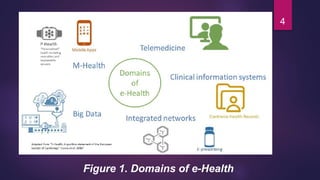
• E-Health is an umbrella term comprising of many information and communication
technology services including telemedicine, mobile health (mHealth), Electronic
Health Records (EHRs) and Health Information Systems.
• Definition:
• e-Health is defined by the World Health Organization (WHO) as “the use of
information and communications technology in support of health and health-
related fields.”
4
Figure 1. Domains of e-Health
5
Principles of Health Communication
• Accessible to decisions-makers: Communicators should identify all channels
that are available and map their comparative capacities to reach priority
audiences. Using the right mix of channels helps empower audiences with the
information they need in order to make informed decisions.
• Actionable by decisions-makers: Communicators must understand the
knowledge, attitudes and behaviors of the target audience in order to create
messages that address barriers and encourage decision makers to take the
recommended steps.
• Credible and trusted as perceived by decision-makers: The reputation of
WHO is a crucial factor in deciding whether individuals will take action on its
advice and guidance. The more decision-makers trust WHO, the more likely they
will believe, and act on the information communicated by the Organization.
• Relevant to decisions-makers: In order to be relevant, communications must
help decision-makers understand that there is a health risk for themselves or for
those they care about, that the risk could be severe and that they can reduce
that risk by undertaking recommended actions.
6
• Timely to enable decision-making: Across all health issues, WHO must make
information, advice and guidance available in a timely way, so audiences have
the information they need when they need it in order to make appropriate health
decisions.
• Understandable to decision-makers: The WHO communicates with a wide
variety of decision-makers. Some have backgrounds in medicine and public
health and rely on WHO for technical information. However, many key audiences
are not technical experts. They need information that is easy to understand in
order to understand health risks and take appropriate actions.
Principles of Health Communication
7
• Increasing risk perception
• Reinforcing positive behaviors
• Influencing social norms
• Increasing the availability of support and needed services
• Empowering individuals to change or improve their health conditions
Need of Health Communication
8
• The use of the Information and Communication Technology (ICT) in Health is
defined as e-Health.
• It encompasses broader concepts like m-Health, telemedicine, Health
Information Systems, electronic health records and many more.
• Each of the ICT intervention has brought its own bundle of benefits to healthcare.
• Mobile Technology is being used for the purposes of data collection, health
workforce training, early warning of unusual health related events and many
more.
• With the advancement of Telemedicine and Tele-counselling, it is now possible to
deliver health care services in rural and remote areas of the country.
• Health information systems have made possible the monitoring of health data in
real time.
• Electronic health records (EHRs) have made it possible to digitize paper health
records and has made healthcare delivery quick, coordinated, transparent and
secure.
Trends of ICT in Health Care
9
• ICT basically means the technology that helps to access information through the
process of communication.
• ICT has tremendously changed the way we used to communicate with each
other. The most evident way in which ICT did this is through making
communication process cost – effective & time saving.
• ICT in Personal Life
• ICT in Public Healthcare
Use of ICT in Personal & Public Health Care
10
11
12
13
14
15
16
17
18
19
20
21
22
23
24
• On one hand e-Health is catalyzing transformation of health system and on the
other the way is paved with numerous challenges.
• The technology is creating a digital divide between those who have the
technology and those who do not have.
• Currently, ICT applications are fragmented and there is lack of interoperability.
• Common registration system and unique patient identifiers for the beneficiaries
are non-existent till date.
• There is a need to address big challenges related to cost, infrastructure and
connectivity.
• There is a need for more rigorous impact evaluation studies on the use of ICT
interventions for improved health service quality and delivery.
• Government and private sector support should be strengthened for sustainability
and scale up of ICT based interventions for health services.
• Lack of awareness of, and confidence in e-Health solutions among patients,
citizens and healthcare professionals
Challenges of ICT in Health Care
25
India has seen a significant rise in Information and Communication
Technology (ICT) health platforms, which are transforming the
healthcare landscape by enhancing accessibility, efficiency, and quality
of care.
National-level Platforms
• Ayushman Bharat Digital Mission (ABDM): The ABDM aims to
create an integrated digital health infrastructure that supports
universal health coverage. It connects various stakeholders in the
healthcare ecosystem, including patients, healthcare providers, and
insurers, facilitating seamless access to health services.
• eSanjeevani: This is India’s National Telemedicine Service that
provides two primary services: provider-to-provider consultations
and patient-to-provider consultations through telemedicine.
Existing ICT based Health Platforms
26
National-level Platforms
• Integrated Disease Surveillance Project (IDSP): Portal IDSP is a web based
portal facilitating online reporting of disease surveillance data under Integrated
Disease Surveillance Programme (IDSP). IDSP programme is one of the
National Health Programme launched in Nov, 2004 under National Health
Mission (NHM) and is currently running in all the States & Union Territories (UTs)
in India.
• Mother and Child Tracking System (MCTS): Mother and Child Tracking
System is a centralized web-based application launched in 2009 and developed
by National Informatics Centre (NIC). This is an initiative by Ministry of Health
and Family Welfare to leverage Information Technology for delivering a full
spectrum of health care services to pregnant women and their children upto 5
years of age through name-based tracking. MCTS portal generates a 16 digit ID
which helps register and track pregnant women and their children upto 5 years of
age.
Existing ICT based Health Platforms
27
National-level Platforms
• eHMIS (electronic Health Management Information System): e-HMIS is a
web based digital initiative under National Health Mission designed to collect,
collate and analyze health related data from lowest health facility to central level.
This facility based aggregation system minimizes error in the data flow process
and helps in rapid transfer of data from the facility to federal level.
• Nikshay: Nikshay is a web based platform launched by Government of India in
June 2012. It was developed by the Central TB Division of the Ministry of Health
and Family Welfare and National Informatics Centre (NIC). This portal helps
keep track of TB patients and monitor the performance of Tuberculosis
programme in the country.
• NAMMIS (National Anti-Malaria Management Information System): NAMMIS
is a web based platform set up by National Vector Borne Disease Control
Programme (NVBDCP) to monitor and periodically review the performance of
malaria Indicators. This system was fully functional in the year 2008 and is
implemented through the health workers involved in the delivery of NVBPCP
interventions.
Existing ICT based Health Platforms
28
• Digital Life Care: Digital Life Care is a web and android based platform built by
Dell. It was initiated as a pilot in the state of Karnataka in 2014 but since late
2017, it is being customized to be deployed in all the 29 states and seven Union
territories across India. Digital Life Care was launched in April, 2018 by Hon’ble
Prime Minister of India. It will be used by health departments in public sector
across the country. This technology based platform has been built to facilitate
Auxiliary Nurse Midwives (ANMs) and doctors screen and manage non-
communicable diseases (NCDs), one of the comprehensive Primary health care
services (CPHC) under Ayushman Bharat Yojna. The android application will be
used by Auxiliary Nurse Midwives (ANMs) on their tablets to collect data in the
field; while the web platform will be used by doctors at all the levels in the health
system-primary, secondary and tertiary and dashboards will be available for
health officials to monitor the performance of health program.
Emerging ICT based Health Platforms
29
• National Health Stack (NHS): National Health Stack (NHS) is a visionary digital
framework (NITI Aayog 2018). Though conceptualized to be built in the context
of Pradhan Mantri Rashtriya Swasthya Suraksha Mission (PM-RSSM) under
Ayushhman Bharat Yojna, NHS will be designed beyond PM-RSSM to create a
holistic platform supporting various health verticals and their branches at national
and state levels both in public and private domain. National health Stack has a
layered structure. At the base of the stack, there is a layer of national health
registries. Above this, there is a layer of software platforms which include
coverage and claims platform for the implementation of national health insurance
program, federated personal health records (PHR) framework to provide an
integrated view of an individual health records across various health care
providers, national health analytics platform and many more. The system aims to
create digital health records for all Indian citizens by the year 2022.
Emerging ICT based Health Platforms
30
• India, has a current population of 1.45 billion.
• By 2050, it is expected to reach 1.6 billion.
• The performance of the health sector is suboptimal because of an increased
burden of factors like political instability, underdevelopment, weak institutions,
scarcity of resources, inadequately developed social sectors and evident social
inequalities.
• With an increase in population, healthcare service resources will not increase in
the same proportion.
• There are big geographical disparities in health and wellbeing of the population
along with demographic and epidemiological transitions that take place.
• This demands non-stop spatio-temporal adjustments in plans and readjustment
in allocation of healthcare resources.
• The government has made huge budget expenditures under ambitious schemes
like NRHM, but accessibility to low-cost healthcare is poor.
Role of ICT in healthcare
31
• Technology has a huge potential to grow capacity in this sector due to low-cost
innovation, low-priced mobile phones and more ‘inclusive’ solutions that fill
crucial gaps in health information and access.
• There are various advantages of incorporating ICT in healthcare such as better
access to total and accurate EHR that collect information to improve diagnoses,
prevent errors and thus save precious response times.
• It also leads to greater patients’ engagement in their own healthcare.
• Further, it improves population-based knowledge in a country such as India.
• Health IT can help to streamline the administrative confusions and thus
substantially reduce costs, as well as decrease the number of personal visits to
doctors.
• ICT in healthcare can assist remote consultation, diagnosis and treatment
through telemedicine.
Role of ICT in healthcare
Public Health Informatics
&
Role of a Nurse
33
• Public health informatics is the systematic application of information and
computer science and technology to public health practice, research, and
learning.
• Public health informatics is primarily a sector which utilizes computer application
and information technology for the field of medical research, public health
promotion and essentially as a learning tool.
• Thus coalition of health information from various disciplines such as
microbiology, pathology, toxicology and even the non medical fields such as
management, political science sector, and engineering domains contributes as a
data bank as public health informatics is not just compiling information but also
plays an active role in restructuring information systems that may no longer be
practical or of usage so that the data acquired can be used for a new
surveillance task.
Public Health Informatics
34
• Information derived could be utilized for identifying risk factors of disease as
electronic data has made the task much easier.
• The primary concern for public health informatics is and remains to be to
promote health to the community at large and find ways and measure to prevent
disease by finding the factors or conditions that put populations at risk.
• It can be broadly classified into two sectors Medical informatics and consumer
health informatics.
• Medical informatics deals primarily with physicians, healthcare professionals to
keep them updated with respect to medicine for learning or even as an
entrepreneur.
• The consumer for information is in terms of health promotion, education, health
literacy it is the consumer health informatics which plays a keen role.
• Thus the social media is one of the key factors which plays a role in todays times
for consumer mediated information and is paving both a new pathway and
building new challenges.
Public Health Informatics
35
• Information derived could be utilized for identifying risk factors of disease as
electronic data has made the task much easier.
• The primary concern for public health informatics is and remains to be to
promote health to the community at large and find ways and measure to prevent
disease by finding the factors or conditions that put populations at risk.
• It can be broadly classified into two sectors Medical informatics and consumer
health informatics.
• Medical informatics deals primarily with physicians, healthcare professionals to
keep them updated with respect to medicine for learning or even as an
entrepreneur.
• The consumer for information is in terms of health promotion, education, health
literacy it is the consumer health informatics which plays a keen role.
• Thus the social media is one of the key factors which plays a role in todays times
for consumer mediated information and is paving both a new pathway and
building new challenges.
Public Health Informatics
THANK
YOU
36

Babitha's Notes on Health Informatics Unit 7.pptx

  • 1.
    e - Health: Patientsand the Interest Babitha K Devu, RN, RM, M.Sc (N), MBA Assistant Professor, SMVD College of Nursing, J & K Research Scholar, Ph.D (N), Amity University, Gurugram
  • 2.
    2 Introduction • The Internetand eHealth technologies represent new opportunities for managing health. Age, sex, socioeconomic status, and current technology use are some of the known factors that influence individuals’ uptake of eHealth; however, relatively little is known about facilitators and barriers to eHealth uptake specific to older adults, particularly as they relate to their experiences in accessing health care. • e-Health is the use of information and communication technology to support health and healthcare. Three major predicted areas of disruption are telemedicine, smartphone Apps, and wearable sensors. Increasingly, citizens are using digital technologies to support their own health and healthcare decision making.
  • 3.
    3 Introduction • E-health definedas “the cost-effective and secure use of information and communications technologies (ICT) in support of health and health related fields, including health care services, health surveillance, health literature and health education, knowledge and research,”(World Health Organization 2005) is an ever-growing body of technology-based solutions which are revolutionizing the way the healthcare is delivered. • E-Health is an umbrella term comprising of many information and communication technology services including telemedicine, mobile health (mHealth), Electronic Health Records (EHRs) and Health Information Systems. • Definition: • e-Health is defined by the World Health Organization (WHO) as “the use of information and communications technology in support of health and health- related fields.”
  • 4.
  • 5.
    5 Principles of HealthCommunication • Accessible to decisions-makers: Communicators should identify all channels that are available and map their comparative capacities to reach priority audiences. Using the right mix of channels helps empower audiences with the information they need in order to make informed decisions. • Actionable by decisions-makers: Communicators must understand the knowledge, attitudes and behaviors of the target audience in order to create messages that address barriers and encourage decision makers to take the recommended steps. • Credible and trusted as perceived by decision-makers: The reputation of WHO is a crucial factor in deciding whether individuals will take action on its advice and guidance. The more decision-makers trust WHO, the more likely they will believe, and act on the information communicated by the Organization. • Relevant to decisions-makers: In order to be relevant, communications must help decision-makers understand that there is a health risk for themselves or for those they care about, that the risk could be severe and that they can reduce that risk by undertaking recommended actions.
  • 6.
    6 • Timely toenable decision-making: Across all health issues, WHO must make information, advice and guidance available in a timely way, so audiences have the information they need when they need it in order to make appropriate health decisions. • Understandable to decision-makers: The WHO communicates with a wide variety of decision-makers. Some have backgrounds in medicine and public health and rely on WHO for technical information. However, many key audiences are not technical experts. They need information that is easy to understand in order to understand health risks and take appropriate actions. Principles of Health Communication
  • 7.
    7 • Increasing riskperception • Reinforcing positive behaviors • Influencing social norms • Increasing the availability of support and needed services • Empowering individuals to change or improve their health conditions Need of Health Communication
  • 8.
    8 • The useof the Information and Communication Technology (ICT) in Health is defined as e-Health. • It encompasses broader concepts like m-Health, telemedicine, Health Information Systems, electronic health records and many more. • Each of the ICT intervention has brought its own bundle of benefits to healthcare. • Mobile Technology is being used for the purposes of data collection, health workforce training, early warning of unusual health related events and many more. • With the advancement of Telemedicine and Tele-counselling, it is now possible to deliver health care services in rural and remote areas of the country. • Health information systems have made possible the monitoring of health data in real time. • Electronic health records (EHRs) have made it possible to digitize paper health records and has made healthcare delivery quick, coordinated, transparent and secure. Trends of ICT in Health Care
  • 9.
    9 • ICT basicallymeans the technology that helps to access information through the process of communication. • ICT has tremendously changed the way we used to communicate with each other. The most evident way in which ICT did this is through making communication process cost – effective & time saving. • ICT in Personal Life • ICT in Public Healthcare Use of ICT in Personal & Public Health Care
  • 10.
  • 11.
  • 12.
  • 13.
  • 14.
  • 15.
  • 16.
  • 17.
  • 18.
  • 19.
  • 20.
  • 21.
  • 22.
  • 23.
  • 24.
    24 • On onehand e-Health is catalyzing transformation of health system and on the other the way is paved with numerous challenges. • The technology is creating a digital divide between those who have the technology and those who do not have. • Currently, ICT applications are fragmented and there is lack of interoperability. • Common registration system and unique patient identifiers for the beneficiaries are non-existent till date. • There is a need to address big challenges related to cost, infrastructure and connectivity. • There is a need for more rigorous impact evaluation studies on the use of ICT interventions for improved health service quality and delivery. • Government and private sector support should be strengthened for sustainability and scale up of ICT based interventions for health services. • Lack of awareness of, and confidence in e-Health solutions among patients, citizens and healthcare professionals Challenges of ICT in Health Care
  • 25.
    25 India has seena significant rise in Information and Communication Technology (ICT) health platforms, which are transforming the healthcare landscape by enhancing accessibility, efficiency, and quality of care. National-level Platforms • Ayushman Bharat Digital Mission (ABDM): The ABDM aims to create an integrated digital health infrastructure that supports universal health coverage. It connects various stakeholders in the healthcare ecosystem, including patients, healthcare providers, and insurers, facilitating seamless access to health services. • eSanjeevani: This is India’s National Telemedicine Service that provides two primary services: provider-to-provider consultations and patient-to-provider consultations through telemedicine. Existing ICT based Health Platforms
  • 26.
    26 National-level Platforms • IntegratedDisease Surveillance Project (IDSP): Portal IDSP is a web based portal facilitating online reporting of disease surveillance data under Integrated Disease Surveillance Programme (IDSP). IDSP programme is one of the National Health Programme launched in Nov, 2004 under National Health Mission (NHM) and is currently running in all the States & Union Territories (UTs) in India. • Mother and Child Tracking System (MCTS): Mother and Child Tracking System is a centralized web-based application launched in 2009 and developed by National Informatics Centre (NIC). This is an initiative by Ministry of Health and Family Welfare to leverage Information Technology for delivering a full spectrum of health care services to pregnant women and their children upto 5 years of age through name-based tracking. MCTS portal generates a 16 digit ID which helps register and track pregnant women and their children upto 5 years of age. Existing ICT based Health Platforms
  • 27.
    27 National-level Platforms • eHMIS(electronic Health Management Information System): e-HMIS is a web based digital initiative under National Health Mission designed to collect, collate and analyze health related data from lowest health facility to central level. This facility based aggregation system minimizes error in the data flow process and helps in rapid transfer of data from the facility to federal level. • Nikshay: Nikshay is a web based platform launched by Government of India in June 2012. It was developed by the Central TB Division of the Ministry of Health and Family Welfare and National Informatics Centre (NIC). This portal helps keep track of TB patients and monitor the performance of Tuberculosis programme in the country. • NAMMIS (National Anti-Malaria Management Information System): NAMMIS is a web based platform set up by National Vector Borne Disease Control Programme (NVBDCP) to monitor and periodically review the performance of malaria Indicators. This system was fully functional in the year 2008 and is implemented through the health workers involved in the delivery of NVBPCP interventions. Existing ICT based Health Platforms
  • 28.
    28 • Digital LifeCare: Digital Life Care is a web and android based platform built by Dell. It was initiated as a pilot in the state of Karnataka in 2014 but since late 2017, it is being customized to be deployed in all the 29 states and seven Union territories across India. Digital Life Care was launched in April, 2018 by Hon’ble Prime Minister of India. It will be used by health departments in public sector across the country. This technology based platform has been built to facilitate Auxiliary Nurse Midwives (ANMs) and doctors screen and manage non- communicable diseases (NCDs), one of the comprehensive Primary health care services (CPHC) under Ayushman Bharat Yojna. The android application will be used by Auxiliary Nurse Midwives (ANMs) on their tablets to collect data in the field; while the web platform will be used by doctors at all the levels in the health system-primary, secondary and tertiary and dashboards will be available for health officials to monitor the performance of health program. Emerging ICT based Health Platforms
  • 29.
    29 • National HealthStack (NHS): National Health Stack (NHS) is a visionary digital framework (NITI Aayog 2018). Though conceptualized to be built in the context of Pradhan Mantri Rashtriya Swasthya Suraksha Mission (PM-RSSM) under Ayushhman Bharat Yojna, NHS will be designed beyond PM-RSSM to create a holistic platform supporting various health verticals and their branches at national and state levels both in public and private domain. National health Stack has a layered structure. At the base of the stack, there is a layer of national health registries. Above this, there is a layer of software platforms which include coverage and claims platform for the implementation of national health insurance program, federated personal health records (PHR) framework to provide an integrated view of an individual health records across various health care providers, national health analytics platform and many more. The system aims to create digital health records for all Indian citizens by the year 2022. Emerging ICT based Health Platforms
  • 30.
    30 • India, hasa current population of 1.45 billion. • By 2050, it is expected to reach 1.6 billion. • The performance of the health sector is suboptimal because of an increased burden of factors like political instability, underdevelopment, weak institutions, scarcity of resources, inadequately developed social sectors and evident social inequalities. • With an increase in population, healthcare service resources will not increase in the same proportion. • There are big geographical disparities in health and wellbeing of the population along with demographic and epidemiological transitions that take place. • This demands non-stop spatio-temporal adjustments in plans and readjustment in allocation of healthcare resources. • The government has made huge budget expenditures under ambitious schemes like NRHM, but accessibility to low-cost healthcare is poor. Role of ICT in healthcare
  • 31.
    31 • Technology hasa huge potential to grow capacity in this sector due to low-cost innovation, low-priced mobile phones and more ‘inclusive’ solutions that fill crucial gaps in health information and access. • There are various advantages of incorporating ICT in healthcare such as better access to total and accurate EHR that collect information to improve diagnoses, prevent errors and thus save precious response times. • It also leads to greater patients’ engagement in their own healthcare. • Further, it improves population-based knowledge in a country such as India. • Health IT can help to streamline the administrative confusions and thus substantially reduce costs, as well as decrease the number of personal visits to doctors. • ICT in healthcare can assist remote consultation, diagnosis and treatment through telemedicine. Role of ICT in healthcare
  • 32.
  • 33.
    33 • Public healthinformatics is the systematic application of information and computer science and technology to public health practice, research, and learning. • Public health informatics is primarily a sector which utilizes computer application and information technology for the field of medical research, public health promotion and essentially as a learning tool. • Thus coalition of health information from various disciplines such as microbiology, pathology, toxicology and even the non medical fields such as management, political science sector, and engineering domains contributes as a data bank as public health informatics is not just compiling information but also plays an active role in restructuring information systems that may no longer be practical or of usage so that the data acquired can be used for a new surveillance task. Public Health Informatics
  • 34.
    34 • Information derivedcould be utilized for identifying risk factors of disease as electronic data has made the task much easier. • The primary concern for public health informatics is and remains to be to promote health to the community at large and find ways and measure to prevent disease by finding the factors or conditions that put populations at risk. • It can be broadly classified into two sectors Medical informatics and consumer health informatics. • Medical informatics deals primarily with physicians, healthcare professionals to keep them updated with respect to medicine for learning or even as an entrepreneur. • The consumer for information is in terms of health promotion, education, health literacy it is the consumer health informatics which plays a keen role. • Thus the social media is one of the key factors which plays a role in todays times for consumer mediated information and is paving both a new pathway and building new challenges. Public Health Informatics
  • 35.
    35 • Information derivedcould be utilized for identifying risk factors of disease as electronic data has made the task much easier. • The primary concern for public health informatics is and remains to be to promote health to the community at large and find ways and measure to prevent disease by finding the factors or conditions that put populations at risk. • It can be broadly classified into two sectors Medical informatics and consumer health informatics. • Medical informatics deals primarily with physicians, healthcare professionals to keep them updated with respect to medicine for learning or even as an entrepreneur. • The consumer for information is in terms of health promotion, education, health literacy it is the consumer health informatics which plays a keen role. • Thus the social media is one of the key factors which plays a role in todays times for consumer mediated information and is paving both a new pathway and building new challenges. Public Health Informatics
  • 36.