

By: Mrs. Babitha K Devu
Assistant Professor,
SMVDCoN
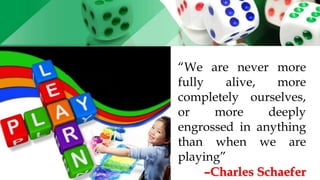
“We are never more
fully alive, more
completely ourselves,
or more deeply
engrossed in anything
than when we are
playing”
–Charles Schaefer
Time to Play!
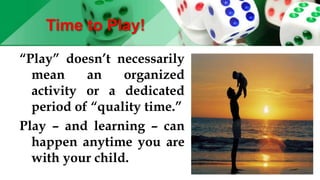
“Play” doesn’t necessarily
mean an organized
activity or a dedicated
period of “quality time.”
Play – and learning – can
happen anytime you are
with your child.
Play is universal for all children & the most
easily available outlet for children’s to
express their needs & feelings.
Just as the adults work, so does the child
plays; it is the business of the child.
Through play the child grows, learns &
ultimately matures.
It is pleasurable & enjoyable aspects of
child’s life and essential to promote growth
& development.
Play is the activity that has no serious motive
& from which there is no material gain.
Definition
Play is the work of children. It consists of
those activities performed for self-
amusement that have behavioral, social,
and psychomotor rewards. It is child-
directed, and the rewards come from
within the individual child; it is
enjoyable and spontaneous.
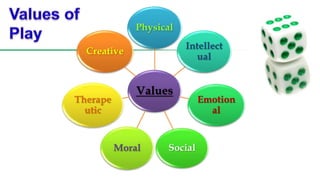
Values
Physical
Intellect
ual
Emotion
al
SocialMoral
Therape
utic
Creative
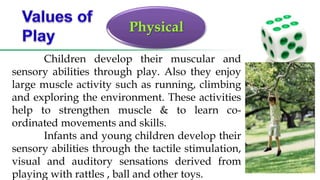
Physical
Children develop their muscular and
sensory abilities through play. Also they enjoy
large muscle activity such as running, climbing
and exploring the environment. These activities
help to strengthen muscle & to learn co-
ordinated movements and skills.
Infants and young children develop their
sensory abilities through the tactile stimulation,
visual and auditory sensations derived from
playing with rattles , ball and other toys.
Intellectual
Children learn various things while
playing like color, size, numbers. Creative
activity, problem solving, abstract thinking,
imagination, communication & speech
development occur during play.
Children improve their attention span
& concentration by playing. They can make
difference of reality & fantasy through play.
Emotional
Children expresses their fear,
anxiety, anger, joy etc. during
play. It reduces stress and strain
and removes irritability &
destructiveness, thus enhances
the coping ability. It is recreation
& diversion for children.
Social
Play helps in socialization children become a
social being through play. They learn
interaction with playmates by sharing,
understanding others & communicating. Play
lessens egocentrism. It help to increase the
language ability & improve social
relationship. It helps to learn rules of social
living & cultural activities.
Moral
Children learn moral values from their
parents, teachers, religious advisors,
other adults and peers. When children
play, cultural values such as honesty,
integrity, sportsmanship and
compassion are expected behaviors.
Children also learn to assume
responsibility for their own actions.
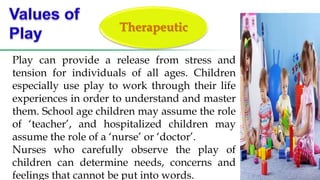
Therapeutic
Play can provide a release from stress and
tension for individuals of all ages. Children
especially use play to work through their life
experiences in order to understand and master
them. School age children may assume the role
of ‘teacher’, and hospitalized children may
assume the role of a ‘nurse’ or ‘doctor’.
Nurses who carefully observe the play of
children can determine needs, concerns and
feelings that cannot be put into words.
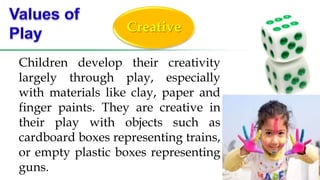
Creative
Children develop their creativity
largely through play, especially
with materials like clay, paper and
finger paints. They are creative in
their play with objects such as
cardboard boxes representing trains,
or empty plastic boxes representing
guns.
• Categories of play are not mutually exclusive;
different forms or categories of play may overlap.
• The pattern of child’s play can be categorized
accordingly into two
– Content
– Social forms
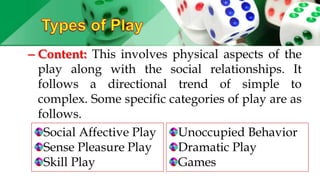
– Content: This involves physical aspects of the
play along with the social relationships. It
follows a directional trend of simple to
complex. Some specific categories of play are as
follows.
Social Affective Play
Sense Pleasure Play
Skill Play
Unoccupied Behavior
Dramatic Play
Games
– Content:
Play begins with social affective play, where in
infants take pleasure in relationships with
people. As the adults talk, touch, nuzzle etc.. to
get response from the infant the child soon
learns to provoke personal emotions /
responses with such behaviors smiling , cooing,
or initiating games & activities.
Social Affective Play
– Content:
A non social stimulating experience. Objects in the
environment like light & color, taste & odors, textures
and consistencies attract children’s attention
stimulates their senses & give pleasure.
Pleasurable experiences are derived from handling raw
materials ( water, sand & food…), body motions
(swinging, bouncing , rocking… ) & from other uses
of senses and abilities (smelling , humming..).
Sense Pleasure Play
– Content:
After infants develops the ability to grasp and
manipulates, they demonstrate & exercise their
newly acquired abilities through skill play.
Determination to practice a skill may be
evident. Pain and frustration may be felt. ( e.g.
bicycle riding)
Skill Play
– Content:
Here children are not playful but focuses their
attention on anything that strikes their interest.
Children may daydream, fiddle with cloths /
other objects or walks aimlessly. This is
different from onlooker play (who actively
observes others activity.)
Unoccupied Behavior
– Content:
Also known as symbolic / pretend play. Begins
in late infancy (11- 13 months) to preschool age.
By acting out events of daily life children learn
and practice the role and identities , modeled
by members of their family & society.
Dramatic Play
– Content:
Some video and card games are played by one child
alone. Games with rules are rarely played by children
younger than four years of age. Board games, card
games, and sports are enjoyed typically by school-age
children. In these games children learn to play by the
rules and to take turns. Older children enjoy games
with specific rules; however, younger children tend to
like games that allow them to change the rules.
Games
– Social forms: According to Parten & Newhall
the social forms of play behavior are as follows.
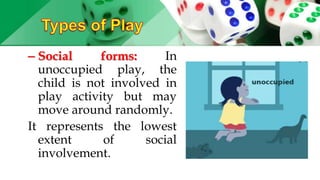
– Social forms: In
unoccupied play, the
child is not involved in
play activity but may
move around randomly.
It represents the lowest
extent of social
involvement.
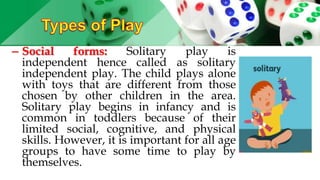
– Social forms: Solitary play is
independent hence called as solitary
independent play. The child plays alone
with toys that are different from those
chosen by other children in the area.
Solitary play begins in infancy and is
common in toddlers because of their
limited social, cognitive, and physical
skills. However, it is important for all age
groups to have some time to play by
themselves.
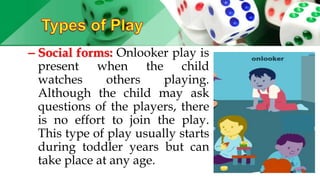
– Social forms: Onlooker play is
present when the child
watches others playing.
Although the child may ask
questions of the players, there
is no effort to join the play.
This type of play usually starts
during toddler years but can
take place at any age.
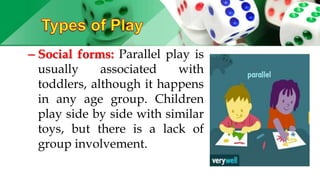
– Social forms: Parallel play is
usually associated with
toddlers, although it happens
in any age group. Children
play side by side with similar
toys, but there is a lack of
group involvement.
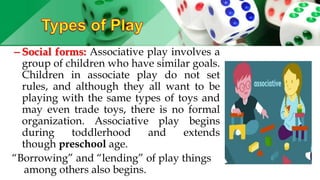
– Social forms: Associative play involves a
group of children who have similar goals.
Children in associate play do not set
rules, and although they all want to be
playing with the same types of toys and
may even trade toys, there is no formal
organization. Associative play begins
during toddlerhood and extends
though preschool age.
“Borrowing” and “lending” of play things
among others also begins.
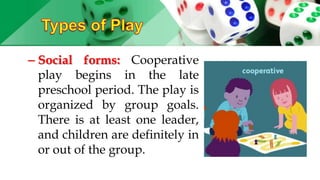
– Social forms: Cooperative
play begins in the late
preschool period. The play is
organized by group goals.
There is at least one leader,
and children are definitely in
or out of the group.
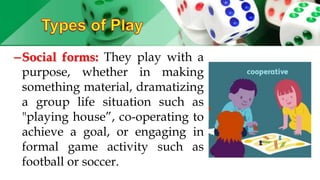
–Social forms: They play with a
purpose, whether in making
something material, dramatizing
a group life situation such as
"playing house”, co-operating to
achieve a goal, or engaging in
formal game activity such as
football or soccer.
• Factors Influencing
selection of play
materials
– Age
– Sex
– Ability of child
– Interests
– Likes & dislikes
– Culture
– Experience
– Personality
– Level of
intelligence
– Environment
• Characteristics of Play Materials
– Safe, washable, light weight, simple, durable, easy
to handle & non breakable
– Realistic, attractive & offer problem solving
opportunities
– No sharp edges & no removable parts
– Not over stimulating & frustrating
– Non toxic paints, not costly, non flammable & not
excessive noisy
– Avoid electrical plug play materials.
• Children must be taught the
following
– Correct use of toys
– Safe storing of toys in a space
with easy reach
– Keeping in good conditions
– Keeping older brothers &
sisters away from younger
ones.
• Suitable toys according to age
Birth through 6 months
• Babies like to look at people—following them with their
eyes. Typically, they prefer faces and bright colors.
• Things they can reach for, hold, suck on, shake, make
noise with—rattles, large rings, squeeze toys, teething
toys, soft dolls, textured balls, and vinyl and board books
• Things to listen to—books with nursery rhymes and
poems, and recordings of lullabies and simple songs.
• Things to look at—pictures of faces hung so baby can see
them and unbreakable mirrors
• Suitable toys according to age
7 to 12 months
• Things to play pretend with—baby dolls, puppets,
plastic and wood vehicles with wheels, and water toys
• Things to drop and take out—plastic bowls, large beads,
balls, and nesting toys
• Things to build with—large soft blocks and wooden
cubes
• Things to use their large muscles with—large balls, push
and pull toys, and low, soft things to crawl over
• Suitable toys according to age
Toddlers
• Things for solving problems—wood puzzles (with 4 to 12
pieces), blocks that snap together, objects to sort (by size,
shape, color, smell)
• Things for pretending and building—blocks, smaller (and
sturdy) transportation toys, construction sets, child-sized
furniture (kitchen sets, chairs, play food.
• Things to create with—large non-toxic, washable crayons
and markers, large paintbrushes and finger-paint, large
paper for drawing and painting, toddler-sized scissors
with blunt tips.
• Suitable toys according to age
Toddlers
• Picture books with more details
• CD and DVD players with a variety of music
• Things for using their large and small muscles—large
and small balls for kicking and throwing, ride-on
equipment (but probably not tricycles until children
are 3), tunnels, low climbers with soft material
underneath, and pounding and hammering toys
• Suitable toys according to age
Preschoolers
• Things for solving problems
• Things for pretending and building
• Things to create with
• Picture books, CD & DVD’s
• Things for large muscles
• Suitable toys according to age
Schoolers: Toys are popular up to middle
childhood. Then they like games rather than toys.
• Running, climbing, swinging
• Puzzles, chess
• Art & craft, music
• Organized sports
Therapeutic Play
• When a child is ill or traumatized the care plan
may include therapeutic play. Unlike normal
play in design and intent, therapeutic play is
guided by the health professional to meet the
physical and psychological needs of the child.
Because play is the language of children,
children who have difficulty putting their
thoughts in words can often speak clearly
through play therapy. There are three divisions
of therapeutic play, including:
Therapeutic Play
1. Energy release. Children release anxiety by
pounding, hitting, running, punching, or
shouting. Toddlers pound pegs with a
plastic hammer or pretend to cut wood with
a toy saw. An anxious preschooler pounds a
ball of modeling clay flat; a relaxed child
may build the clay into shapes. Balloons
tied over the bed of a school-age child or
adolescent can be punched.
Therapeutic Play
2. Dramatic play. Children act out or dramatize real-
life situations. They act out anxiety and emotional
stress from abuse, neglect, abandonment, and
various painful physical experiences. Imaginative
preschool children enjoy dramatic play. An
abused or wounded child might not communicate
the experience verbally but may be able to use an
anatomically correct doll to show what happened.
Therapeutic play can teach children about
medical procedures or help them work through
their feelings about what has happened to them in
the medical setting.
Therapeutic Play
3. Creative play. Some children are too angry or
fearful to act out their feelings through dramatic
play. However, they may be able to draw a
picture that expresses their emotions or
communicates what they know. To encourage
this expression children can be given blank
paper and crayons or markers and asked to
draw a picture about how they feel. Some
children are so concerned about a particular
body part that instead of drawing a self portrait,
they will draw only the body part that worries
them.
Therapeutic Play
Nurses Responsibilities
Organize play facilities for sick children
– Play space
– Age-appropriate toys
– Individual play materials can also be
permitted
– No fixed period of time
Therapeutic Play
Nurses Responsibilities
Involve other health team members and
family also
Interact and help the child to express the
feelings
Observe & record the child’s behavior
Protect children if their play become
aggressive
Teach the parents about the importance of
play
Therapeutic Play
Nurses Responsibilities
Assess the capacity of children to play
Assess the interest of the child
The maintenance of play materials
Babitha's Notes on play

Babitha's Notes on play

  • 1.
    By: Mrs. BabithaK Devu Assistant Professor, SMVDCoN
  • 2.
    “We are nevermore fully alive, more completely ourselves, or more deeply engrossed in anything than when we are playing” –Charles Schaefer
  • 3.
    Time to Play! “Play”doesn’t necessarily mean an organized activity or a dedicated period of “quality time.” Play – and learning – can happen anytime you are with your child.
  • 4.
    Play is universalfor all children & the most easily available outlet for children’s to express their needs & feelings. Just as the adults work, so does the child plays; it is the business of the child. Through play the child grows, learns & ultimately matures.
  • 5.
    It is pleasurable& enjoyable aspects of child’s life and essential to promote growth & development. Play is the activity that has no serious motive & from which there is no material gain.
  • 6.
    Definition Play is thework of children. It consists of those activities performed for self- amusement that have behavioral, social, and psychomotor rewards. It is child- directed, and the rewards come from within the individual child; it is enjoyable and spontaneous.
  • 8.
  • 9.
    Physical Children develop theirmuscular and sensory abilities through play. Also they enjoy large muscle activity such as running, climbing and exploring the environment. These activities help to strengthen muscle & to learn co- ordinated movements and skills. Infants and young children develop their sensory abilities through the tactile stimulation, visual and auditory sensations derived from playing with rattles , ball and other toys.
  • 10.
    Intellectual Children learn variousthings while playing like color, size, numbers. Creative activity, problem solving, abstract thinking, imagination, communication & speech development occur during play. Children improve their attention span & concentration by playing. They can make difference of reality & fantasy through play.
  • 11.
    Emotional Children expresses theirfear, anxiety, anger, joy etc. during play. It reduces stress and strain and removes irritability & destructiveness, thus enhances the coping ability. It is recreation & diversion for children.
  • 12.
    Social Play helps insocialization children become a social being through play. They learn interaction with playmates by sharing, understanding others & communicating. Play lessens egocentrism. It help to increase the language ability & improve social relationship. It helps to learn rules of social living & cultural activities.
  • 13.
    Moral Children learn moralvalues from their parents, teachers, religious advisors, other adults and peers. When children play, cultural values such as honesty, integrity, sportsmanship and compassion are expected behaviors. Children also learn to assume responsibility for their own actions.
  • 14.
    Therapeutic Play can providea release from stress and tension for individuals of all ages. Children especially use play to work through their life experiences in order to understand and master them. School age children may assume the role of ‘teacher’, and hospitalized children may assume the role of a ‘nurse’ or ‘doctor’. Nurses who carefully observe the play of children can determine needs, concerns and feelings that cannot be put into words.
  • 15.
    Creative Children develop theircreativity largely through play, especially with materials like clay, paper and finger paints. They are creative in their play with objects such as cardboard boxes representing trains, or empty plastic boxes representing guns.
  • 16.
    • Categories ofplay are not mutually exclusive; different forms or categories of play may overlap. • The pattern of child’s play can be categorized accordingly into two – Content – Social forms
  • 17.
    – Content: Thisinvolves physical aspects of the play along with the social relationships. It follows a directional trend of simple to complex. Some specific categories of play are as follows. Social Affective Play Sense Pleasure Play Skill Play Unoccupied Behavior Dramatic Play Games
  • 18.
    – Content: Play beginswith social affective play, where in infants take pleasure in relationships with people. As the adults talk, touch, nuzzle etc.. to get response from the infant the child soon learns to provoke personal emotions / responses with such behaviors smiling , cooing, or initiating games & activities. Social Affective Play
  • 19.
    – Content: A nonsocial stimulating experience. Objects in the environment like light & color, taste & odors, textures and consistencies attract children’s attention stimulates their senses & give pleasure. Pleasurable experiences are derived from handling raw materials ( water, sand & food…), body motions (swinging, bouncing , rocking… ) & from other uses of senses and abilities (smelling , humming..). Sense Pleasure Play
  • 20.
    – Content: After infantsdevelops the ability to grasp and manipulates, they demonstrate & exercise their newly acquired abilities through skill play. Determination to practice a skill may be evident. Pain and frustration may be felt. ( e.g. bicycle riding) Skill Play
  • 21.
    – Content: Here childrenare not playful but focuses their attention on anything that strikes their interest. Children may daydream, fiddle with cloths / other objects or walks aimlessly. This is different from onlooker play (who actively observes others activity.) Unoccupied Behavior
  • 22.
    – Content: Also knownas symbolic / pretend play. Begins in late infancy (11- 13 months) to preschool age. By acting out events of daily life children learn and practice the role and identities , modeled by members of their family & society. Dramatic Play
  • 23.
    – Content: Some videoand card games are played by one child alone. Games with rules are rarely played by children younger than four years of age. Board games, card games, and sports are enjoyed typically by school-age children. In these games children learn to play by the rules and to take turns. Older children enjoy games with specific rules; however, younger children tend to like games that allow them to change the rules. Games
  • 24.
    – Social forms:According to Parten & Newhall the social forms of play behavior are as follows.
  • 25.
    – Social forms:In unoccupied play, the child is not involved in play activity but may move around randomly. It represents the lowest extent of social involvement.
  • 26.
    – Social forms:Solitary play is independent hence called as solitary independent play. The child plays alone with toys that are different from those chosen by other children in the area. Solitary play begins in infancy and is common in toddlers because of their limited social, cognitive, and physical skills. However, it is important for all age groups to have some time to play by themselves.
  • 27.
    – Social forms:Onlooker play is present when the child watches others playing. Although the child may ask questions of the players, there is no effort to join the play. This type of play usually starts during toddler years but can take place at any age.
  • 28.
    – Social forms:Parallel play is usually associated with toddlers, although it happens in any age group. Children play side by side with similar toys, but there is a lack of group involvement.
  • 29.
    – Social forms:Associative play involves a group of children who have similar goals. Children in associate play do not set rules, and although they all want to be playing with the same types of toys and may even trade toys, there is no formal organization. Associative play begins during toddlerhood and extends though preschool age. “Borrowing” and “lending” of play things among others also begins.
  • 30.
    – Social forms:Cooperative play begins in the late preschool period. The play is organized by group goals. There is at least one leader, and children are definitely in or out of the group.
  • 31.
    –Social forms: Theyplay with a purpose, whether in making something material, dramatizing a group life situation such as "playing house”, co-operating to achieve a goal, or engaging in formal game activity such as football or soccer.
  • 32.
    • Factors Influencing selectionof play materials – Age – Sex – Ability of child – Interests – Likes & dislikes – Culture – Experience – Personality – Level of intelligence – Environment
  • 33.
    • Characteristics ofPlay Materials – Safe, washable, light weight, simple, durable, easy to handle & non breakable – Realistic, attractive & offer problem solving opportunities – No sharp edges & no removable parts – Not over stimulating & frustrating – Non toxic paints, not costly, non flammable & not excessive noisy – Avoid electrical plug play materials.
  • 34.
    • Children mustbe taught the following – Correct use of toys – Safe storing of toys in a space with easy reach – Keeping in good conditions – Keeping older brothers & sisters away from younger ones.
  • 35.
    • Suitable toysaccording to age Birth through 6 months • Babies like to look at people—following them with their eyes. Typically, they prefer faces and bright colors. • Things they can reach for, hold, suck on, shake, make noise with—rattles, large rings, squeeze toys, teething toys, soft dolls, textured balls, and vinyl and board books • Things to listen to—books with nursery rhymes and poems, and recordings of lullabies and simple songs. • Things to look at—pictures of faces hung so baby can see them and unbreakable mirrors
  • 36.
    • Suitable toysaccording to age 7 to 12 months • Things to play pretend with—baby dolls, puppets, plastic and wood vehicles with wheels, and water toys • Things to drop and take out—plastic bowls, large beads, balls, and nesting toys • Things to build with—large soft blocks and wooden cubes • Things to use their large muscles with—large balls, push and pull toys, and low, soft things to crawl over
  • 37.
    • Suitable toysaccording to age Toddlers • Things for solving problems—wood puzzles (with 4 to 12 pieces), blocks that snap together, objects to sort (by size, shape, color, smell) • Things for pretending and building—blocks, smaller (and sturdy) transportation toys, construction sets, child-sized furniture (kitchen sets, chairs, play food. • Things to create with—large non-toxic, washable crayons and markers, large paintbrushes and finger-paint, large paper for drawing and painting, toddler-sized scissors with blunt tips.
  • 38.
    • Suitable toysaccording to age Toddlers • Picture books with more details • CD and DVD players with a variety of music • Things for using their large and small muscles—large and small balls for kicking and throwing, ride-on equipment (but probably not tricycles until children are 3), tunnels, low climbers with soft material underneath, and pounding and hammering toys
  • 39.
    • Suitable toysaccording to age Preschoolers • Things for solving problems • Things for pretending and building • Things to create with • Picture books, CD & DVD’s • Things for large muscles
  • 40.
    • Suitable toysaccording to age Schoolers: Toys are popular up to middle childhood. Then they like games rather than toys. • Running, climbing, swinging • Puzzles, chess • Art & craft, music • Organized sports
  • 41.
    Therapeutic Play • Whena child is ill or traumatized the care plan may include therapeutic play. Unlike normal play in design and intent, therapeutic play is guided by the health professional to meet the physical and psychological needs of the child. Because play is the language of children, children who have difficulty putting their thoughts in words can often speak clearly through play therapy. There are three divisions of therapeutic play, including:
  • 42.
    Therapeutic Play 1. Energyrelease. Children release anxiety by pounding, hitting, running, punching, or shouting. Toddlers pound pegs with a plastic hammer or pretend to cut wood with a toy saw. An anxious preschooler pounds a ball of modeling clay flat; a relaxed child may build the clay into shapes. Balloons tied over the bed of a school-age child or adolescent can be punched.
  • 43.
    Therapeutic Play 2. Dramaticplay. Children act out or dramatize real- life situations. They act out anxiety and emotional stress from abuse, neglect, abandonment, and various painful physical experiences. Imaginative preschool children enjoy dramatic play. An abused or wounded child might not communicate the experience verbally but may be able to use an anatomically correct doll to show what happened. Therapeutic play can teach children about medical procedures or help them work through their feelings about what has happened to them in the medical setting.
  • 44.
    Therapeutic Play 3. Creativeplay. Some children are too angry or fearful to act out their feelings through dramatic play. However, they may be able to draw a picture that expresses their emotions or communicates what they know. To encourage this expression children can be given blank paper and crayons or markers and asked to draw a picture about how they feel. Some children are so concerned about a particular body part that instead of drawing a self portrait, they will draw only the body part that worries them.
  • 45.
    Therapeutic Play Nurses Responsibilities Organizeplay facilities for sick children – Play space – Age-appropriate toys – Individual play materials can also be permitted – No fixed period of time
  • 46.
    Therapeutic Play Nurses Responsibilities Involveother health team members and family also Interact and help the child to express the feelings Observe & record the child’s behavior Protect children if their play become aggressive Teach the parents about the importance of play
  • 47.
    Therapeutic Play Nurses Responsibilities Assessthe capacity of children to play Assess the interest of the child The maintenance of play materials