NORMAL PERIODONTIUM
Binaya Subedi
BDS 4TH BATCH
Chitwan Medical College
• Definition
It is the functional unit of
tissue supporting the tooth
including gingiva ,the
periodontal ligament, the
cementum and the alveolar
process .
Cementum
Cementum is defined as calcified avascular
mesenchymal tissue that forms the outer covering
of root.
The cementum is the parts of periodontium that
attaches teeth to the alveolar bone by anchoring
the periodontal ligament.
It extends from the CEJ to apex of root.
Introduction
It is light yellow in color than that of dentin.
It is less hard and less calcified than that of dentin.
It is more permeable than dentin.
It has more resistance to resorption than that of
bone.
Thickness – cervically (10-15micrometer)
-apically (150-200 micrometer)
Physical properties
Cementum consists of
•organic matter (50-55%)
• inorganic material and water (45-50%)
Organic matter of cementum consist of :
Type I collagen fiber
Non-collageneous protein(sialoprotein,osteopontin
etc.)
Polysachharides.
Main inorganic materials – Hydroxyapatite crystals
CHEMICAL PROPERTIES
SCHROEDER CLASSIFICATION
1. Acellular afibrillar cementum
2. Acellular extrinsic fiber cementum
3. Cellular intrinsic fiber cementum
4. Cellular mixed stratified cementum
5. Intermediate cementum
ACELLULAR AFIBRILLAR CEMENTUM
It neither contain cells nor extrinsic or intrinsic collagen fiber
It is found near the crown of the tooth as cervical cementum.
ACELLULAR EXTRINSIC FIBER CEMENTUM
• It is composed of densely packed bundles of Sharpey’s fibers.
• It is found in cervical third of the root.
CELLULAR INTRINSIC FIBER CEMENTUM
•It doesn’t have Sharpey’s fibers.
• It has fibers derived entirely from cementoblasts.
CELLULAR MIXED STRATIFIED CEMENTUM
• It is composed of Sharpey’s and intrinsic collagen fibers.
• It contains cells in its matrix.
INTERMEDIATE CEMENTUM
• Present between cellular cementum and dentin.
• It is seen in the apical regions of the posterior teeth and
rarely seen in deciduous or anterior teeth.
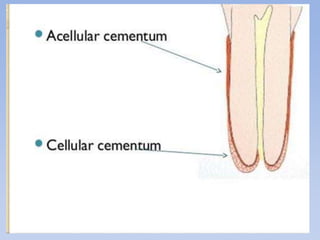
DIFFERENCE BETWEEN ACELLULAR AND CELLULAR CEMENTUM
ACELLULAR CEMENTUM
• First formed
• Present on the cervical
third or half of the root.
• It doesn’t contain cells.
• It is formed before the
tooth reaches the occlusal
plane.
• More calcified.
• Sharpey’s fibers are
present.
CELLULAR CEMENTUM
• Secondary formed.
• Mainly on apical third of the
root.
• It contains cells called
cementocytes.
• It is formed after the tooth
reaches the occlusal plane.
• Less calcified
• Sharpey’s fibers are absent.
1. ANCHORAGE
2. ADAPTATION
3. REPAIR
FUNCTIONS OF CEMENTUM
Cementum furnish a medium for attachment of collagen fibers that
binds the tooth to the alveolar bone.
ADAPTATION
Cementum may also be viewed as the tissue that makes the
functional adaptation of the tooth properly.
Deposition of cementum in the apical area can compensate for loss
of tooth substances from occlusal wear.
REPAIR
Damage to root such as fractures confined to cementum and
resorption can be repaired by deposition of the new cementum.
Repaired cementum resembles cellular cementum.
ANCHORAGE
HISTOLOGICAL STRUCTURES
Cementum covers the root dentin from CEJ to the root apex.
• It is thinnest at this junction (20-50 micrometer) but becomes
gradually thicker towards apical (150-200 micrometer)
• Two types of cells are functionally concerned with cementum
Cementoblasts
Cementocytes
• Cementoblasts line the root surface and when active,they
contain numerous mitochondria,well developed Golgi-bodies and
open- faced nuclei. However,in resting cementoblasts,these
cytological features becomes less prominent.
• Cementocytes are seen located in the lacunae in cementum
matrix and typically have numerous processes lying in canaliculi.
• As a result of continuous deposition of cementum,resting lines
known as Salter’s lines appears in cementum.
•
Acellular cementum lacks cementocytes whereas cellular
cementum has cementocytes.
• Cemetoblasts becomes entrapped in forming matrix and then
known as cementocytes.
3 patterns may be present.
1. In approx. 60% of teeth cementum overlapping the
cervical end of the enamel.
2. 30%of all tooth,cementum meets the cervical end of the
enamel in edge-to-edge pattern.
3. In approx. 10% of all teeth,cementum doesn’t meet
enamel where a zone of root dentin appears devoid of
cementum.
CEMENTOENAMEL JUNCTION (CEJ)
CEMENTAL ANOMALIES
Hypercementosis
• single tooth or all teeth in occlusion.
• May be localized or generalized.
• Localized hypercementosis are cemental spikes,
excementosis.
• Cemental spikes are rounded projections that develop by
deposition of cementum over degenerated epithelial rests
on the root surface.
• Cemental spikes results from extensive occlusal forces or
when orthodontic forces are applied.
•PAGETS DISEASE
• CHRONIC PERIAPICAL INFECTIONS
• NON-FUNCTIONAL TEETH
• GIGANTISM
Generalized Hypercementosis involves roots of all the teeth.
It is present in the following conditions:
•The width of cementum increases with age.
• The increase in width is greater in apical and
furcation area.
• Permeability of cementum decreases with age.
• Roughness occurs on almost all cemental
surface except in the apical area.
• Due to continuous deposition of cementum in
apical area leads to closure of apical foramen.
Age related changes in cementum
Ankylosis :
-When there is fusion of cementum and alveolar bone known as
ankylosis.
-No PDL in between cementum and bone.
CAUSES:
-Embedded teeth
-Trauma to deciduous teeth
-Faulty re-plantation of teeth
-Faulty transplantation of teeth
•Cementum is resistant to resorption than alveolar bone.
• Orthodontic tooth movement is possible.
CLINICAL CONSIDERATIONS
Periodontal ligament
• Composed of a complex vascular and highly vascular cellular
connective tissue that surrounds the tooth root and connects
it to the inner wall of the alveolar bone.
• Average width is 0.2 mm with considerable variations.
• PDL space is decreased in teeth that are not in function and
in unerrupted teeth and increased in teeth subjected to
hyperfunction.
Composition :
• Periodontal fibers
• Cellular elements
• Ground substance
Periodontal Fibers
• Most important are the principal fibers
- collagenous ; arranged in bundles ; follow wavy course
• Terminal portion is embedded into cementum and bone – Sharpey’s
fibers
• They calcify to significant degree and are associated to non
collagenous proteins typically found in bone and cementum
(osteopontin and bone sialoprotein)
• Principal fibers are mainly composed of type I collagen fiber ;
reticular fibers of type III ; basal lamina of type IV
• Collagen is responsible for maintenance of framework and tone of
tissue.
• Secondary fibers are eluanin and oxylatan
fibers.
• These are related to blood vessels.
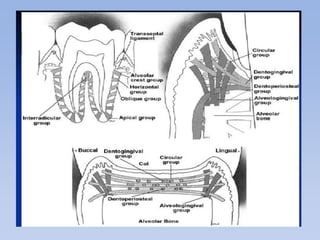
Principal fibers are arranged in six
groups :
1. Trans septal fibers
2. Alveolar crest fibers
3. Horizontal fibers
4. Oblique fibers
5. Apical fibers
6. Interradicular fibers
Trans septal group
• Extend interproximally over the alveolar bone crest and are
embedded in the cementum of adjacent teeth.
• They are reconstructed even after destruction of alveolar bone.
• Because they do not have osseous attachment they may be
considered as belonging to the gingiva .
Alveolar crest group
• Extend obliquely from cementum just beneath the JE to the
alveolar crest.
• Prevents the extrusion of tooth and resist lateral tooth
movement.
Horizontal group :
• Extend at right angle to the long axis of the tooth
from the cementum to alveolar bone.
Oblique group :
• They are the largest group of fiber in PDL.
• Extend from cementum in a coronal direction
obliquely to the bone.
• Bears vertical masticatory stress and transform them
into tension in the alveolar bone .
Apical group:
• These fibers radiate in a irregular manner from the
cementum to the bone in the apical region of the socket.
• They do not occur in incompletely formed root.
Interradicular group:
• They fan out from the cementum to the tooth in the
furcation area of multirooted teeth.
Cellular elements:
There are four types of cells:
1. connective tissue cells- CT cells includes
Formative : fibroblast,Cementoblast and osteocbast
Resorptive : Fibroblast ,Cementoclast and Osteoclast
2. epithelial rest cells- form a lacework, and considered as remnats
of HERS which disintegrate during root development
3. immune system cells-diminish in number with age by
degeneration or undergo calcification to become cementicles.
4. cells associated with neurovascular elements-includes
neutrophils, lymphocytes, macrophages, mast cells, eosinophils.
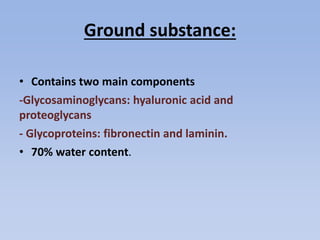
Ground substance:
• Contains two main components
-Glycosaminoglycans: hyaluronic acid and
proteoglycans
- Glycoproteins: fibronectin and laminin.
• 70% water content.
Functional of PDL:
1. Physical functions
• Protect vessles and nerves from injury by
mechanical forces.
• Transmission of occlusal forces to the bone.
• Attachment of teeth to the bone.
• Maintainence of gingival tissue in proper relation to
the teeth.
• Resistant to impact of occlusal forces.
2. Formative and remodeling function:
Cells of PDL help in formation and resorption of
cementum and bone which occurs in,
• Physiologic tooth movement
• In accommodation to periodontium to occlusal
forces
• The repair of injury.
PDL is constantly undergoing remodeling by breaking
older cells and fibers replaced by new ones.
3.Nutritional and sensory function:
• The PDL supplies nutrients to the cementum ,bone
and gingiva by the way of blood vessels and also
provide lymphatic drainage.
• PDL is supplied by sensory nerve fibers capable of
transferring tactile and pain sensation by trigeminal
pathway.
• These bundles of nerve fibers divide into single
myelinated fibers which ultimately lose their myelin
sheath & end in one of 4 type of neural termination.
• 1. free endings-pain perceptor
• 2. ruffini-like mechanoreceptors
• 3. coiled meissners corpulcles-tactile perceptor
• 4. spindle like pressure and vibration endings.
•
The alveolar process is defined as that part of the maxilla and the
mandible that forms and supports the sockets of the teeth.
FUNCTIONS OF ALVEOLAR BONE :
-Houses the roots of teeth
-Anchors the roots of teeth to the alveoli , which is achieved by the -
insertion of Sharpey ’s fibers into the alveolar bone proper.
-Helps to move the teeth for better occlusion.
-Helps to absorb and distribute occlusal forces generated during
tooth contact.
-Supplies vessels to periodontal ligament.
-Organizes eruption of primary and permanent teeth.
ALVEOLAR BONE
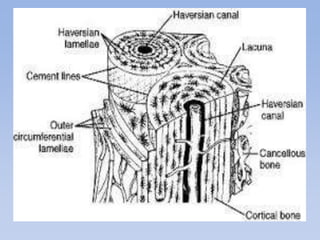
Structure of alveolar bone
The alveolar bone consists of :-
Inner and Outer cortical plates
The bone lining the socket
An interior portion of cancellous bone
According to function the alveolar process can
be divided into:
Alveolar Bone proper
- It surrounds the root of the tooth.
- It gives attachment to the principal fibers of the PDL.
- It is a thin lamella of bone.
- Principal fibers bundles embedded in the alveolar bone
proper are the sharpeys fibers.
- The bone which lines the socket in which sharpeys fibers
are embedded is known as the Bundle Bone.
- Bundle Bone is also referred as Lamina Dura because it
is radio-opaque.
- Bundle bone contains more calcium salts per unit area
than any other bone present in the alveolus.
- During mastication tension is produced on sharpeys
fibers.
- This tension stimulates the bundle bone & helps in its
maintenance.
- Alveolar bone proper is also called as cribriform plate
because it is perforated by many openings.
- The branches of the inter alveolar nerve & vessels pass
into the PDL through these openings.
Supporting Alveolar Bone
- is the bone that surrounds the alveolar bone proper &
gives support to the socket.
- It consist of :
(a) Cortical Plates :-
- It consist of compact bone.
- It forms the outer and inner plates of the
alveolar process.
- Cortical plates are thinner in maxilla.
- They are thicker in mandible.
- They are the thickest in the premolar & molar
regions of the mandible.
(b) Spongy Bone:-
- It is the bone which fills the space between the outer
and inner plates & the alveolar bone proper.
- It contains trabeculae of alveolar bone.
- It is surrounded by marrow that is rich in adipocytes and
pleuripotent mesenchymal cells.
- Spongy bone is the cancellous bone.
- Heavy trabeculae with bone marrow spaces are present
in the spongy bone.
- These bone marrow spaces contains blood forming
elements and osteogenic cells.
- Radiographically spongiosa of the alveolar process is
divided into two main types :-
Types :-
Type I:- The interdental and interradicular trabeculae
are regular and horizontal in a ladder like form.
- This type of arrangement is mostly present in the
mandible.
Type II :- There is no distinct pattern but there are more
number of the trabeculae per square centimeter.
This type of arrangement is mostly present in maxilla.
CRIBRIFORM PLATE
- The inner wall of the socket which forms the alveolar
bone proper is perforated by many foramina.
- They transmit nerves and blood vessels into the PDL.
- Therefore it is called as Cribriform plate.
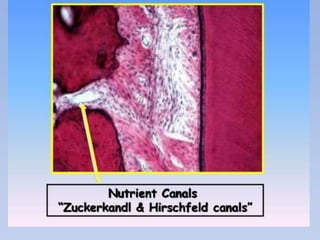
CANALS OF ZUCKERKANDL AND HIRSCHFELD
- They are known as Nutrient canals.
- They are present in inter radicular and interdental septa.
- They carry inter dental and inter radicular arteries,
veins, lymph vessels & nerves.
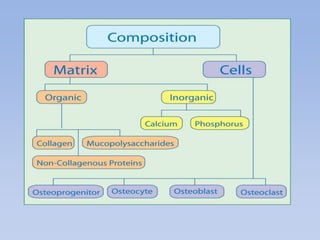
CELLS PRESENT IN THE FORMATION OF
BONE
1. Osteoblasts
2. Osteocytes
3. Osteoclasts
4. Osteo progenitor cells
5. Bone lining cells
Remodeling of Alveolar bone :-
Alveolar is rigid – but it is the least stable of the P.D.
tissues because it’s structure is in a constant
state of flux.
A considerable amount of internal remodeling
takes place by means of resorption and
formation.
It is regulated by local and systemic influences.
Local influences :-
- Functional requirements on the teeth.
- Age related changes in bone cells.
Systemic Influences
- Hormonal ; example :- Parathyroid hormone
- Calcitonin
- Vit. D3
Remodeling of the bone affect its :
- Height
- Contour
- Density
Remodeling is manifested in the following three
areas :-
- adjacent to the PDL
- in relation to the periosteum of the facial & lingual
plates
- along the endosteal surface of the marrow spaces.
Remodeling is the major pathway of bony
changes in
- shape
- resistance to forces
- repair of wounds &
- Ca & Phosphate homeostatis in the body.
Bone contains 99% of calcium ions of the body &
therefore is the major source of calcium release
when the calcium blood levels decreases – this is
monitored by parathyroid gland.
- The osteoclasts cells resorb organic matrix along
with hydroxyapatite.
- The breakdown of collagen from organic matrix
release various osteogenic substrates – they in turn
stimulates the differentiation of osteoblasts –
which deposit bone.
- This inter dependency of osteoblasts & osteoclasts
in remodeling is called coupling.
- Bone matrix that is laid down by osteoblasts is non
mineralized & is called osteoid.
While new osteoid is being deposited the older
osteoid located below the surface becomes
mineralized.
Bone Resorption
- Bone resorption is a complex process related to the
appearance of the eroded bone surfaces (Howships
Lacunae) & large multinucleated cells – osteoclasts.
- Osteoclasts originate from hematopoietic tissue.
- When osteoclasts are active they posses well developed
ruffled border from which hydrolytic enzymes are believed
to be secreted.
- These enzymes digest the organic portion of bone.
- Another mechanism of bone resorption consists of the
creation of an acidic environment on the bone surface –
leading to the dissolution of the mineral component of the
bone.
- This event can be produced by different conditions eg –
through action of the proton pump which demineralizes
bone & exposes the organic matrix.
- Then there is degradation of the exposed organic matrix to
its constituent – amino acids – by the action of released
enzymes such as acid phosphatase & cathepsine.
- Then there is sequestering of mineral ions & amino acids
within the osteoclasts.
- The activity of osteoclasts & morphology of the ruffled
border can be modified & regulated by hormones
such as parathormone indirectly & calcitonin.
AGE CHANGES
• In older individuals :
o Alveolar sockets appear jagged and uneven.
o The marrow spaces have fatty infiltration.
o The alveolar process in edentulous jaws decreases in size.
o Loss of maxillary bone is accompanied by increase in size of
the maxillary sinus.
o Internal trabecular arrangement is more open,which
indicates bone loss.
o The distance between the crest of the alveolar bone and CEJ
increases with age – approximately by 2.81 mm
SUMMARY
 PERIODONTIUM is specislized connective
tissue that surrounds and supports the tooth.
It consists of gingiva, cementum, periodontal
ligament and alveolar bone.
Each of these component of periodontium
have specific role which are important for the
maintenance of healthy periodontium and
adaptation through out lifetime.
Normal periodontium

Normal periodontium

  • 1.
    NORMAL PERIODONTIUM Binaya Subedi BDS4TH BATCH Chitwan Medical College
  • 2.
    • Definition It isthe functional unit of tissue supporting the tooth including gingiva ,the periodontal ligament, the cementum and the alveolar process .
  • 3.
  • 4.
    Cementum is definedas calcified avascular mesenchymal tissue that forms the outer covering of root. The cementum is the parts of periodontium that attaches teeth to the alveolar bone by anchoring the periodontal ligament. It extends from the CEJ to apex of root. Introduction
  • 5.
    It is lightyellow in color than that of dentin. It is less hard and less calcified than that of dentin. It is more permeable than dentin. It has more resistance to resorption than that of bone. Thickness – cervically (10-15micrometer) -apically (150-200 micrometer) Physical properties
  • 6.
    Cementum consists of •organicmatter (50-55%) • inorganic material and water (45-50%) Organic matter of cementum consist of : Type I collagen fiber Non-collageneous protein(sialoprotein,osteopontin etc.) Polysachharides. Main inorganic materials – Hydroxyapatite crystals CHEMICAL PROPERTIES
  • 7.
    SCHROEDER CLASSIFICATION 1. Acellularafibrillar cementum 2. Acellular extrinsic fiber cementum 3. Cellular intrinsic fiber cementum 4. Cellular mixed stratified cementum 5. Intermediate cementum
  • 8.
    ACELLULAR AFIBRILLAR CEMENTUM Itneither contain cells nor extrinsic or intrinsic collagen fiber It is found near the crown of the tooth as cervical cementum. ACELLULAR EXTRINSIC FIBER CEMENTUM • It is composed of densely packed bundles of Sharpey’s fibers. • It is found in cervical third of the root. CELLULAR INTRINSIC FIBER CEMENTUM •It doesn’t have Sharpey’s fibers. • It has fibers derived entirely from cementoblasts.
  • 9.
    CELLULAR MIXED STRATIFIEDCEMENTUM • It is composed of Sharpey’s and intrinsic collagen fibers. • It contains cells in its matrix. INTERMEDIATE CEMENTUM • Present between cellular cementum and dentin. • It is seen in the apical regions of the posterior teeth and rarely seen in deciduous or anterior teeth.
  • 11.
    DIFFERENCE BETWEEN ACELLULARAND CELLULAR CEMENTUM ACELLULAR CEMENTUM • First formed • Present on the cervical third or half of the root. • It doesn’t contain cells. • It is formed before the tooth reaches the occlusal plane. • More calcified. • Sharpey’s fibers are present. CELLULAR CEMENTUM • Secondary formed. • Mainly on apical third of the root. • It contains cells called cementocytes. • It is formed after the tooth reaches the occlusal plane. • Less calcified • Sharpey’s fibers are absent.
  • 12.
    1. ANCHORAGE 2. ADAPTATION 3.REPAIR FUNCTIONS OF CEMENTUM
  • 13.
    Cementum furnish amedium for attachment of collagen fibers that binds the tooth to the alveolar bone. ADAPTATION Cementum may also be viewed as the tissue that makes the functional adaptation of the tooth properly. Deposition of cementum in the apical area can compensate for loss of tooth substances from occlusal wear. REPAIR Damage to root such as fractures confined to cementum and resorption can be repaired by deposition of the new cementum. Repaired cementum resembles cellular cementum. ANCHORAGE
  • 14.
    HISTOLOGICAL STRUCTURES Cementum coversthe root dentin from CEJ to the root apex. • It is thinnest at this junction (20-50 micrometer) but becomes gradually thicker towards apical (150-200 micrometer) • Two types of cells are functionally concerned with cementum Cementoblasts Cementocytes • Cementoblasts line the root surface and when active,they contain numerous mitochondria,well developed Golgi-bodies and open- faced nuclei. However,in resting cementoblasts,these cytological features becomes less prominent.
  • 15.
    • Cementocytes areseen located in the lacunae in cementum matrix and typically have numerous processes lying in canaliculi. • As a result of continuous deposition of cementum,resting lines known as Salter’s lines appears in cementum. • Acellular cementum lacks cementocytes whereas cellular cementum has cementocytes. • Cemetoblasts becomes entrapped in forming matrix and then known as cementocytes.
  • 18.
    3 patterns maybe present. 1. In approx. 60% of teeth cementum overlapping the cervical end of the enamel. 2. 30%of all tooth,cementum meets the cervical end of the enamel in edge-to-edge pattern. 3. In approx. 10% of all teeth,cementum doesn’t meet enamel where a zone of root dentin appears devoid of cementum. CEMENTOENAMEL JUNCTION (CEJ)
  • 20.
    CEMENTAL ANOMALIES Hypercementosis • singletooth or all teeth in occlusion. • May be localized or generalized. • Localized hypercementosis are cemental spikes, excementosis. • Cemental spikes are rounded projections that develop by deposition of cementum over degenerated epithelial rests on the root surface. • Cemental spikes results from extensive occlusal forces or when orthodontic forces are applied.
  • 21.
    •PAGETS DISEASE • CHRONICPERIAPICAL INFECTIONS • NON-FUNCTIONAL TEETH • GIGANTISM Generalized Hypercementosis involves roots of all the teeth. It is present in the following conditions:
  • 22.
    •The width ofcementum increases with age. • The increase in width is greater in apical and furcation area. • Permeability of cementum decreases with age. • Roughness occurs on almost all cemental surface except in the apical area. • Due to continuous deposition of cementum in apical area leads to closure of apical foramen. Age related changes in cementum
  • 23.
    Ankylosis : -When thereis fusion of cementum and alveolar bone known as ankylosis. -No PDL in between cementum and bone. CAUSES: -Embedded teeth -Trauma to deciduous teeth -Faulty re-plantation of teeth -Faulty transplantation of teeth •Cementum is resistant to resorption than alveolar bone. • Orthodontic tooth movement is possible. CLINICAL CONSIDERATIONS
  • 24.
    Periodontal ligament • Composedof a complex vascular and highly vascular cellular connective tissue that surrounds the tooth root and connects it to the inner wall of the alveolar bone. • Average width is 0.2 mm with considerable variations. • PDL space is decreased in teeth that are not in function and in unerrupted teeth and increased in teeth subjected to hyperfunction.
  • 26.
    Composition : • Periodontalfibers • Cellular elements • Ground substance
  • 27.
    Periodontal Fibers • Mostimportant are the principal fibers - collagenous ; arranged in bundles ; follow wavy course • Terminal portion is embedded into cementum and bone – Sharpey’s fibers • They calcify to significant degree and are associated to non collagenous proteins typically found in bone and cementum (osteopontin and bone sialoprotein) • Principal fibers are mainly composed of type I collagen fiber ; reticular fibers of type III ; basal lamina of type IV • Collagen is responsible for maintenance of framework and tone of tissue.
  • 28.
    • Secondary fibersare eluanin and oxylatan fibers. • These are related to blood vessels.
  • 29.
    Principal fibers arearranged in six groups : 1. Trans septal fibers 2. Alveolar crest fibers 3. Horizontal fibers 4. Oblique fibers 5. Apical fibers 6. Interradicular fibers
  • 30.
    Trans septal group •Extend interproximally over the alveolar bone crest and are embedded in the cementum of adjacent teeth. • They are reconstructed even after destruction of alveolar bone. • Because they do not have osseous attachment they may be considered as belonging to the gingiva . Alveolar crest group • Extend obliquely from cementum just beneath the JE to the alveolar crest. • Prevents the extrusion of tooth and resist lateral tooth movement.
  • 31.
    Horizontal group : •Extend at right angle to the long axis of the tooth from the cementum to alveolar bone. Oblique group : • They are the largest group of fiber in PDL. • Extend from cementum in a coronal direction obliquely to the bone. • Bears vertical masticatory stress and transform them into tension in the alveolar bone .
  • 32.
    Apical group: • Thesefibers radiate in a irregular manner from the cementum to the bone in the apical region of the socket. • They do not occur in incompletely formed root. Interradicular group: • They fan out from the cementum to the tooth in the furcation area of multirooted teeth.
  • 34.
    Cellular elements: There arefour types of cells: 1. connective tissue cells- CT cells includes Formative : fibroblast,Cementoblast and osteocbast Resorptive : Fibroblast ,Cementoclast and Osteoclast 2. epithelial rest cells- form a lacework, and considered as remnats of HERS which disintegrate during root development 3. immune system cells-diminish in number with age by degeneration or undergo calcification to become cementicles. 4. cells associated with neurovascular elements-includes neutrophils, lymphocytes, macrophages, mast cells, eosinophils.
  • 35.
    Ground substance: • Containstwo main components -Glycosaminoglycans: hyaluronic acid and proteoglycans - Glycoproteins: fibronectin and laminin. • 70% water content.
  • 36.
    Functional of PDL: 1.Physical functions • Protect vessles and nerves from injury by mechanical forces. • Transmission of occlusal forces to the bone. • Attachment of teeth to the bone. • Maintainence of gingival tissue in proper relation to the teeth. • Resistant to impact of occlusal forces.
  • 37.
    2. Formative andremodeling function: Cells of PDL help in formation and resorption of cementum and bone which occurs in, • Physiologic tooth movement • In accommodation to periodontium to occlusal forces • The repair of injury. PDL is constantly undergoing remodeling by breaking older cells and fibers replaced by new ones.
  • 38.
    3.Nutritional and sensoryfunction: • The PDL supplies nutrients to the cementum ,bone and gingiva by the way of blood vessels and also provide lymphatic drainage. • PDL is supplied by sensory nerve fibers capable of transferring tactile and pain sensation by trigeminal pathway. • These bundles of nerve fibers divide into single myelinated fibers which ultimately lose their myelin sheath & end in one of 4 type of neural termination. • 1. free endings-pain perceptor • 2. ruffini-like mechanoreceptors • 3. coiled meissners corpulcles-tactile perceptor • 4. spindle like pressure and vibration endings. •
  • 39.
    The alveolar processis defined as that part of the maxilla and the mandible that forms and supports the sockets of the teeth. FUNCTIONS OF ALVEOLAR BONE : -Houses the roots of teeth -Anchors the roots of teeth to the alveoli , which is achieved by the - insertion of Sharpey ’s fibers into the alveolar bone proper. -Helps to move the teeth for better occlusion. -Helps to absorb and distribute occlusal forces generated during tooth contact. -Supplies vessels to periodontal ligament. -Organizes eruption of primary and permanent teeth. ALVEOLAR BONE
  • 41.
    Structure of alveolarbone The alveolar bone consists of :- Inner and Outer cortical plates The bone lining the socket An interior portion of cancellous bone
  • 43.
    According to functionthe alveolar process can be divided into: Alveolar Bone proper - It surrounds the root of the tooth. - It gives attachment to the principal fibers of the PDL. - It is a thin lamella of bone. - Principal fibers bundles embedded in the alveolar bone proper are the sharpeys fibers. - The bone which lines the socket in which sharpeys fibers are embedded is known as the Bundle Bone.
  • 44.
    - Bundle Boneis also referred as Lamina Dura because it is radio-opaque. - Bundle bone contains more calcium salts per unit area than any other bone present in the alveolus. - During mastication tension is produced on sharpeys fibers. - This tension stimulates the bundle bone & helps in its maintenance. - Alveolar bone proper is also called as cribriform plate because it is perforated by many openings. - The branches of the inter alveolar nerve & vessels pass into the PDL through these openings.
  • 45.
    Supporting Alveolar Bone -is the bone that surrounds the alveolar bone proper & gives support to the socket. - It consist of : (a) Cortical Plates :- - It consist of compact bone. - It forms the outer and inner plates of the alveolar process. - Cortical plates are thinner in maxilla. - They are thicker in mandible. - They are the thickest in the premolar & molar regions of the mandible.
  • 46.
    (b) Spongy Bone:- -It is the bone which fills the space between the outer and inner plates & the alveolar bone proper. - It contains trabeculae of alveolar bone. - It is surrounded by marrow that is rich in adipocytes and pleuripotent mesenchymal cells.
  • 47.
    - Spongy boneis the cancellous bone. - Heavy trabeculae with bone marrow spaces are present in the spongy bone. - These bone marrow spaces contains blood forming elements and osteogenic cells. - Radiographically spongiosa of the alveolar process is divided into two main types :-
  • 48.
    Types :- Type I:-The interdental and interradicular trabeculae are regular and horizontal in a ladder like form. - This type of arrangement is mostly present in the mandible. Type II :- There is no distinct pattern but there are more number of the trabeculae per square centimeter. This type of arrangement is mostly present in maxilla.
  • 50.
    CRIBRIFORM PLATE - Theinner wall of the socket which forms the alveolar bone proper is perforated by many foramina. - They transmit nerves and blood vessels into the PDL. - Therefore it is called as Cribriform plate.
  • 51.
    CANALS OF ZUCKERKANDLAND HIRSCHFELD - They are known as Nutrient canals. - They are present in inter radicular and interdental septa. - They carry inter dental and inter radicular arteries, veins, lymph vessels & nerves.
  • 53.
    CELLS PRESENT INTHE FORMATION OF BONE 1. Osteoblasts 2. Osteocytes 3. Osteoclasts 4. Osteo progenitor cells 5. Bone lining cells
  • 55.
    Remodeling of Alveolarbone :- Alveolar is rigid – but it is the least stable of the P.D. tissues because it’s structure is in a constant state of flux. A considerable amount of internal remodeling takes place by means of resorption and formation. It is regulated by local and systemic influences.
  • 56.
    Local influences :- -Functional requirements on the teeth. - Age related changes in bone cells. Systemic Influences - Hormonal ; example :- Parathyroid hormone - Calcitonin - Vit. D3
  • 57.
    Remodeling of thebone affect its : - Height - Contour - Density Remodeling is manifested in the following three areas :- - adjacent to the PDL - in relation to the periosteum of the facial & lingual plates - along the endosteal surface of the marrow spaces.
  • 58.
    Remodeling is themajor pathway of bony changes in - shape - resistance to forces - repair of wounds & - Ca & Phosphate homeostatis in the body.
  • 59.
    Bone contains 99%of calcium ions of the body & therefore is the major source of calcium release when the calcium blood levels decreases – this is monitored by parathyroid gland. - The osteoclasts cells resorb organic matrix along with hydroxyapatite. - The breakdown of collagen from organic matrix release various osteogenic substrates – they in turn stimulates the differentiation of osteoblasts – which deposit bone.
  • 60.
    - This interdependency of osteoblasts & osteoclasts in remodeling is called coupling. - Bone matrix that is laid down by osteoblasts is non mineralized & is called osteoid. While new osteoid is being deposited the older osteoid located below the surface becomes mineralized.
  • 61.
    Bone Resorption - Boneresorption is a complex process related to the appearance of the eroded bone surfaces (Howships Lacunae) & large multinucleated cells – osteoclasts. - Osteoclasts originate from hematopoietic tissue. - When osteoclasts are active they posses well developed ruffled border from which hydrolytic enzymes are believed to be secreted. - These enzymes digest the organic portion of bone.
  • 62.
    - Another mechanismof bone resorption consists of the creation of an acidic environment on the bone surface – leading to the dissolution of the mineral component of the bone. - This event can be produced by different conditions eg – through action of the proton pump which demineralizes bone & exposes the organic matrix. - Then there is degradation of the exposed organic matrix to its constituent – amino acids – by the action of released enzymes such as acid phosphatase & cathepsine. - Then there is sequestering of mineral ions & amino acids within the osteoclasts. - The activity of osteoclasts & morphology of the ruffled border can be modified & regulated by hormones such as parathormone indirectly & calcitonin.
  • 63.
    AGE CHANGES • Inolder individuals : o Alveolar sockets appear jagged and uneven. o The marrow spaces have fatty infiltration. o The alveolar process in edentulous jaws decreases in size. o Loss of maxillary bone is accompanied by increase in size of the maxillary sinus. o Internal trabecular arrangement is more open,which indicates bone loss. o The distance between the crest of the alveolar bone and CEJ increases with age – approximately by 2.81 mm
  • 64.
    SUMMARY  PERIODONTIUM isspecislized connective tissue that surrounds and supports the tooth. It consists of gingiva, cementum, periodontal ligament and alveolar bone. Each of these component of periodontium have specific role which are important for the maintenance of healthy periodontium and adaptation through out lifetime.