Wanderful Creations
CementumCementum
Contents:Contents:
• Definition.
• Physical and chemical properties.
• Development of Cementum.
• Classification of Cementum.
• Cells of Cementum.
• Incremental lines of Salter
• Age changes of Cementum.
• Clinical considerations.
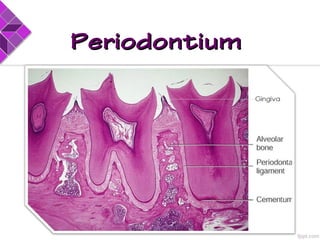
PeriodontiumPeriodontium
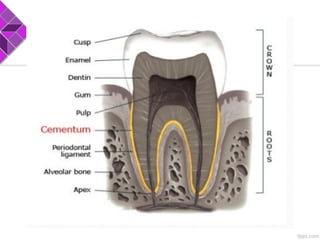
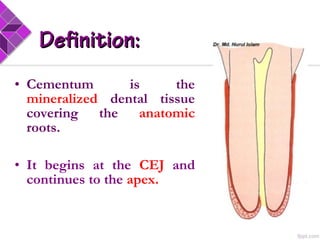
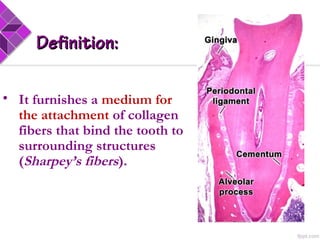
• Cementum is the
mineralized dental tissue
covering the anatomic
roots.
• It begins at the CEJ and
continues to the apex.
Definition:Definition:
• It furnishes a medium for
the attachment of collagen
fibers that bind the tooth to
surrounding structures
(Sharpey’s fibers).
Definition:Definition:
Physical properties:Physical properties:
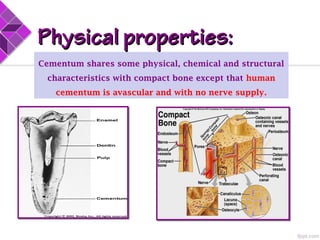
Cementum shares some physical, chemical and structural
characteristics with compact bone except that human
cementum is avascular and with no nerve supply.
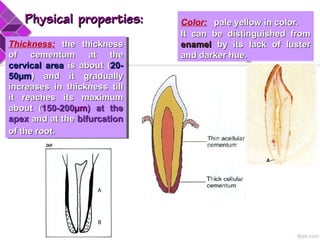
Physical properties:Physical properties: Color: pale yellow in color.pale yellow in color.
It can be distinguished fromIt can be distinguished from
enamelenamel by its lack of lusterby its lack of luster
and darker hue.and darker hue.
Thickness: the thicknessthe thickness
of cementum at theof cementum at the
cervical areacervical area is about (is about (20-20-
50µm50µm) and it gradually) and it gradually
increases in thickness tillincreases in thickness till
it reaches its maximumit reaches its maximum
about (about (150-200150-200µmµm) at the) at the
apexapex and at theand at the bifurcationbifurcation
of the root.of the root.
Thickness: the thicknessthe thickness
of cementum at theof cementum at the
cervical areacervical area is about (is about (20-20-
50µm50µm) and it gradually) and it gradually
increases in thickness tillincreases in thickness till
it reaches its maximumit reaches its maximum
about (about (150-200150-200µmµm) at the) at the
apexapex and at theand at the bifurcationbifurcation
of the root.of the root.
A
B
From
periodontal
side
From dentin
side
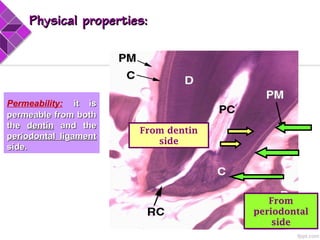
Permeability: it isit is
permeable from bothpermeable from both
thethe dentindentin and theand the
periodontal ligamentperiodontal ligament
side.side.
Physical properties:Physical properties:
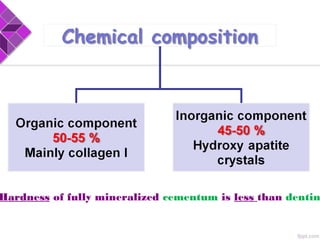
Hardness of fully mineralized cementum is less than dentin
The inorganic substances consist mainly of
calcium and phosphate in the form of
hydroxyapatite.
The organic portion consists mainly of collagen
and non-collagenous protein forming the ground
substance.
Chemical compositionChemical composition
CementogenesisCementogenesis
Cementum development has been
subdivided into:
A) Prefunctional stage:
- Matrix formation
- Mineralization
B) Functional stage:
There are 3 cell types responsible for the
cementogenesis:
 Cementoblasts
 Cementocytes
 Fibroblasts
CementogenesisCementogenesis
By/ Dr. Hesham Dameer
All of these cells are
derived from the
ectomesenchymal cells.
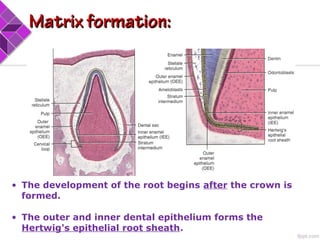
• The development of the root begins after the crown is
formed.
• The outer and inner dental epithelium forms the
Hertwig's epithelial root sheath.
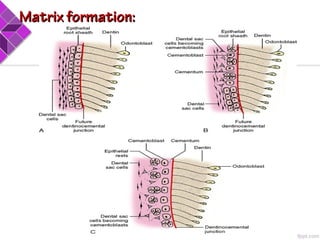
Matrix formation:Matrix formation:
 
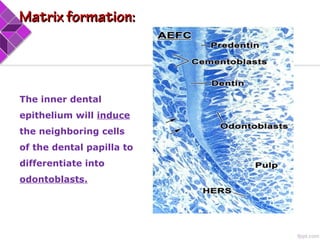
The inner dental
epithelium will induce
the neighboring cells
of the dental papilla to
differentiate into
odontoblasts.
Matrix formation:Matrix formation:
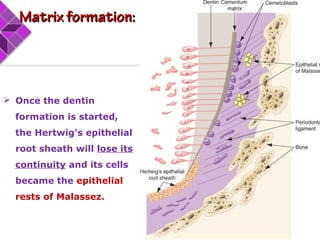
 Once the dentin
formation is started,
the Hertwig's epithelial
root sheath will lose its
continuity and its cells
became the epithelial
rests of Malassez.
Matrix formation:Matrix formation:
By/ Dr. Hesham Dameer
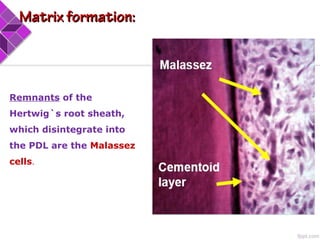
Remnants of the
Hertwig`s root sheath,
which disintegrate into
the PDL are the Malassez
cells.
Matrix formation:Matrix formation:
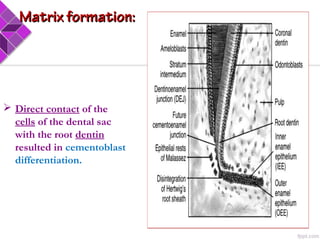
 Direct contact of the
cells of the dental sac
with the root dentin
resulted in cementoblast
differentiation.
Matrix formation:Matrix formation:
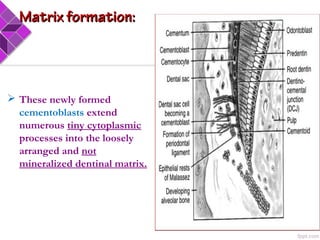
 These newly formed
cementoblasts extend
numerous tiny cytoplasmic
processes into the loosely
arranged and not
mineralized dentinal matrix.
Matrix formation:Matrix formation:
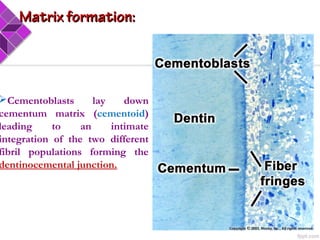
Cementoblasts lay down
cementum matrix (cementoid)
leading to an intimate
integration of the two different
fibril populations forming the
dentinocemental junction.
Matrix formation:Matrix formation:
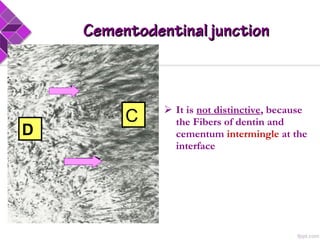
 It is not distinctive, because
the Fibers of dentin and
cementum intermingle at the
interface
C
D
Cementodentinal junctionCementodentinal junction
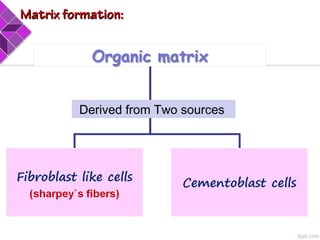
Derived from Two sources
Matrix formation:Matrix formation:
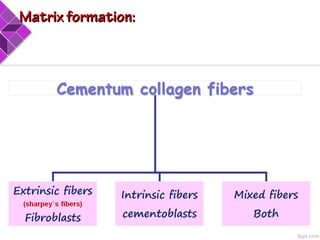
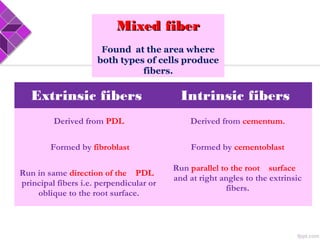
Extrinsic fibers Intrinsic fibers
Derived from PDL Derived from cementum.
Formed by fibroblast Formed by cementoblast
Run in same direction of the PDL
principal fibers i.e. perpendicular or
oblique to the root surface.
Run parallel to the root surface
and at right angles to the extrinsic
fibers.
Mixed fiberMixed fiber
Found at the area where
both types of cells produce
fibers.
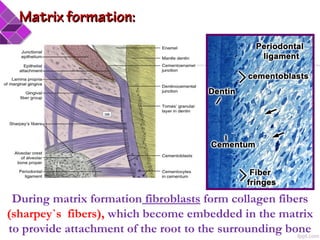
During matrix formation fibroblasts form collagen fibers
(sharpey`s fibers), which become embedded in the matrix
to provide attachment of the root to the surrounding bone
Matrix formation:Matrix formation:
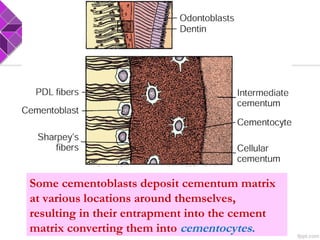
Some cementoblasts deposit cementum matrix
at various locations around themselves,
resulting in their entrapment into the cement
matrix converting them into cementocytes.
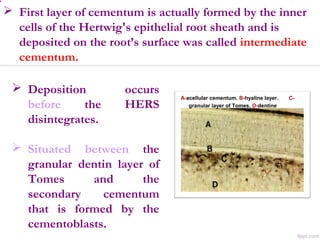
 First layer of cementum is actually formed by the inner
cells of the Hertwig's epithelial root sheath and is
deposited on the root’s surface was called intermediate
cementum.
 Deposition occurs
before the HERS
disintegrates.
 Situated between the
granular dentin layer of
Tomes and the
secondary cementum
that is formed by the
cementoblasts.
A-acellular cementum. B-hyaline layer.       C-
granular layer of Tomes. D-dentine
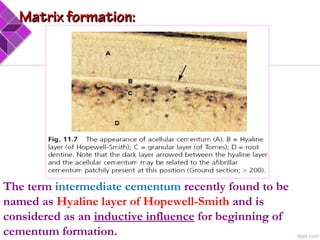
The term intermediate cementum recently found to be
named as Hyaline layer of Hopewell-Smith and is
considered as an inductive influence for beginning of
cementum formation.
Matrix formation:Matrix formation:
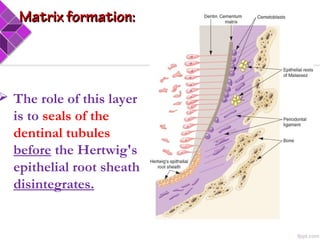
 The role of this layer
is to seals of the
dentinal tubules
before the Hertwig's
epithelial root sheath
disintegrates.
Matrix formation:Matrix formation:
CementogenesisCementogenesis
Cementum development has been
subdivided into:
A) Prefunctional stage:
- Matrix formation
- Mineralization
B) Functional stage:
Mineralization:Mineralization:
 It begins in the depth of the cementum matrix
(cementoid tissue), where, fine hydroxyapatite crystals
are deposited between and within the collagen fibrils.
 Mineralization of the outermost layer of the dentin
matrix (mantle dentin), appears to be delayed until the
implantation of the cementum matrix is established
and the dentinal matrix is completely covered with the
collagen fibrils of cementum.
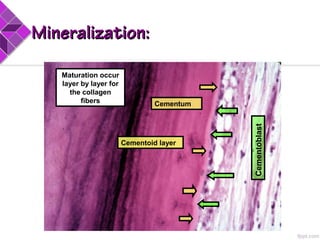
Cementum
Cementoid layer
Cementoblast
Maturation occur
layer by layer for
the collagen
fibers
Mineralization:Mineralization:
CementogenesisCementogenesis
Cementum development has been
subdivided into:
A) Prefunctional stage:
- Matrix formation
- Mineralization
B) Functional stage:
Functional stage:Functional stage:
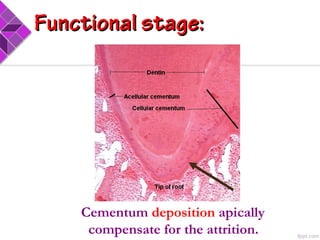
This started when the tooth is in
occlusion and continues throughout life.
It is an adaptive role in response to tooth
wear and movement and is associated with
repair and regeneration of periodontal
tissues.
Cementum deposition apically
compensate for the attrition.
Functional stage:Functional stage:
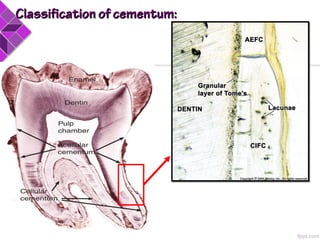
Classification of cementumClassification of cementum
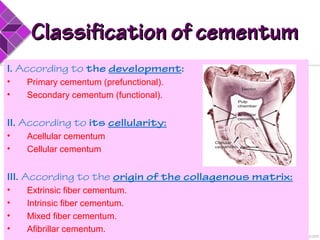
I. According to the development:
• Primary cementum (prefunctional).
• Secondary cementum (functional).
II. According to its cellularity:
• Acellular cementum
• Cellular cementum
III. According to the origin of the collagenous matrix:
• Extrinsic fiber cementum.
• Intrinsic fiber cementum.
• Mixed fiber cementum.
• Afibrillar cementum.
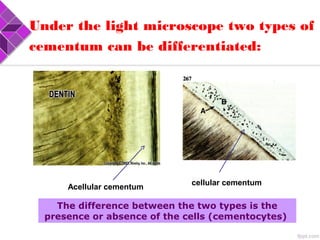
Under the light microscope two types of
cementum can be differentiated:
Acellular cementum
cellular cementum
The difference between the two types is the
presence or absence of the cells (cementocytes)
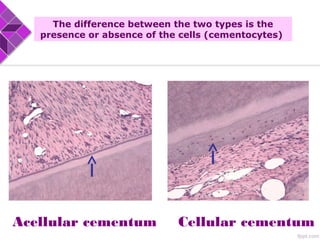
Acellular cementum Cellular cementum
The difference between the two types is the
presence or absence of the cells (cementocytes)
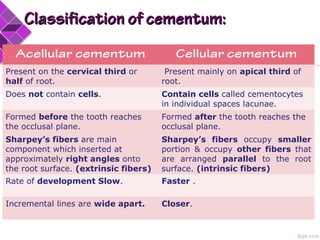
Classification of cementum:Classification of cementum:
Acellular cementum Cellular cementum
Present on the cervical third or
half of root.
Present mainly on apical third of
root.
Does not contain cells. Contain cells called cementocytes
in individual spaces lacunae.
Formed before the tooth reaches
the occlusal plane.
Formed after the tooth reaches the
occlusal plane.
Sharpey’s fibers are main
component which inserted at
approximately right angles onto
the root surface. (extrinsic fibers)
Sharpey’s fibers occupy smaller
portion & occupy other fibers that
are arranged parallel to the root
surface. (intrinsic fibers)
Rate of development Slow. Faster .
Incremental lines are wide apart. Closer.
Classification of cementum:Classification of cementum:
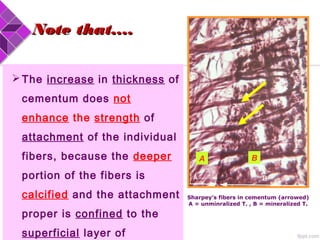
A B
Sharpey’s fibers in cementum (arrowed)
A = unminralized T. , B = mineralized T.
The increase in thickness of
cementum does not
enhance the strength of
attachment of the individual
fibers, because the deeper
portion of the fibers is
calcified and the attachment
proper is confined to the
superficial layer of
Note that....Note that....
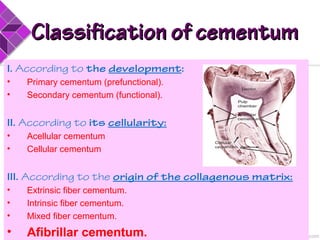
Classification of cementumClassification of cementum
I. According to the development:
• Primary cementum (prefunctional).
• Secondary cementum (functional).
II. According to its cellularity:
• Acellular cementum
• Cellular cementum
III. According to the origin of the collagenous matrix:
• Extrinsic fiber cementum.
• Intrinsic fiber cementum.
• Mixed fiber cementum.
• Afibrillar cementum.
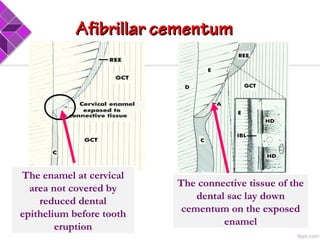
The enamel at cervical
area not covered by
reduced dental
epithelium before tooth
eruption
The connective tissue of the
dental sac lay down
cementum on the exposed
enamel
Afibrillar cementumAfibrillar cementum
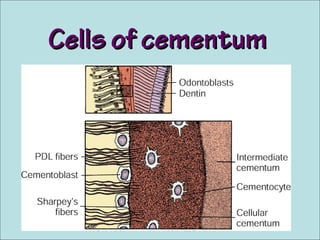
Cells of cementumCells of cementum
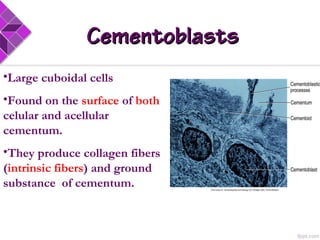
•Large cuboidal cells
•Found on the surface of both
celular and acellular
cementum.
•They produce collagen fibers
(intrinsic fibers) and ground
substance of cementum.
CementoblastsCementoblasts
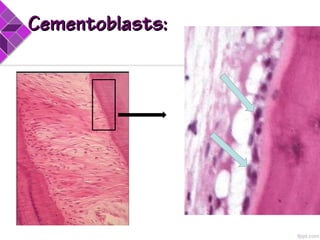
Cementoblasts:Cementoblasts:
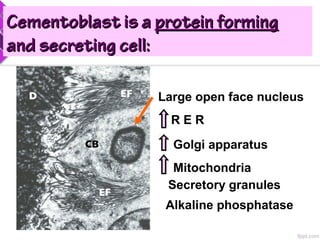
Cementoblast is aCementoblast is a protein formingprotein forming
and secreting cell:and secreting cell:
Large open face nucleus
R E R
Golgi apparatus
Mitochondria
Alkaline phosphatase
Secretory granules
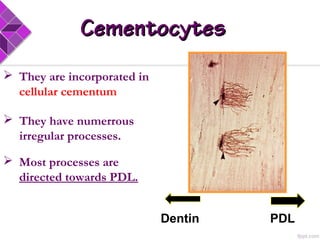
 They are incorporated in
cellular cementum
 They have numerrous
irregular processes.
 Most processes are
directed towards PDL.
CementocytesCementocytes
Dentin PDL
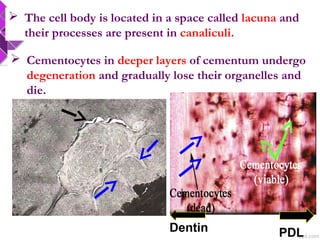
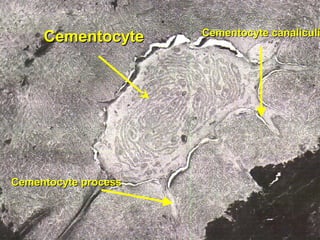
 The cell body is located in a space called lacuna and
their processes are present in canaliculi.
 Cementocytes in deeper layers of cementum undergo
degeneration and gradually lose their organelles and
die.
Dentin PDL
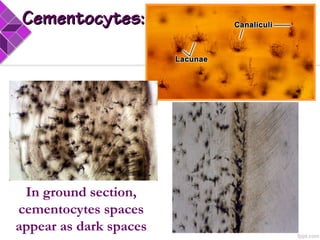
In ground section,
cementocytes spaces
appear as dark spaces
Cementocytes:Cementocytes:
CementocyteCementocyte Cementocyte canaliculiCementocyte canaliculi
Cementocyte processCementocyte process
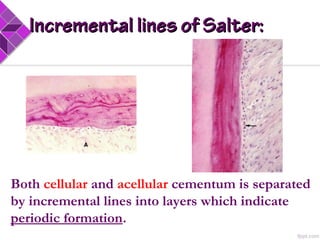
Both cellular and acellular cementum is separated
by incremental lines into layers which indicate
periodic formation.
Incremental lines of Salter:Incremental lines of Salter:
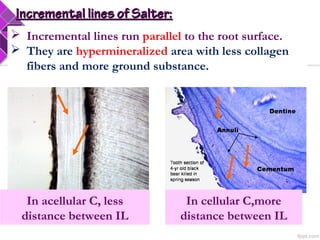
In acellular C, less
distance between IL
In cellular C,more
distance between IL
 Incremental lines run parallel to the root surface.
 They are hypermineralized area with less collagen
fibers and more ground substance.
Incremental lines of Salter:Incremental lines of Salter:
Cemento-enamel junctionCemento-enamel junction
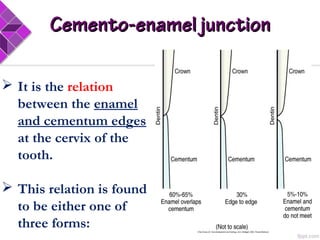
 It is the relation
between the enamel
and cementum edges
at the cervix of the
tooth.
 This relation is found
to be either one of
three forms:
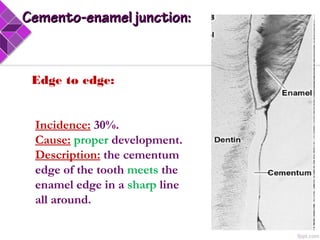
Edge to edge:
Incidence: 30%.
Cause: proper development.
Description: the cementum
edge of the tooth meets the
enamel edge in a sharp line
all around.
 
Cemento-enamel junction:Cemento-enamel junction:
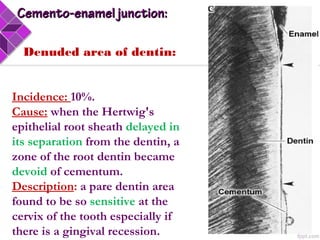
 Denuded area of dentin:
Incidence: 10%.
Cause: when the Hertwig's
epithelial root sheath delayed in
its separation from the dentin, a
zone of the root dentin became
devoid of cementum.
Description: a pare dentin area
found to be so sensitive at the
cervix of the tooth especially if
there is a gingival recession.
Cemento-enamel junction:Cemento-enamel junction:
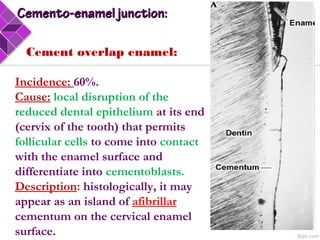
Cement overlap enamel:
Incidence: 60%.
Cause: local disruption of the
reduced dental epithelium at its end
(cervix of the tooth) that permits
follicular cells to come into contact
with the enamel surface and
differentiate into cementoblasts.
Description: histologically, it may
appear as an island of afibrillar
cementum on the cervical enamel
surface.
Cemento-enamel junction:Cemento-enamel junction:
Functions of cementumFunctions of cementum
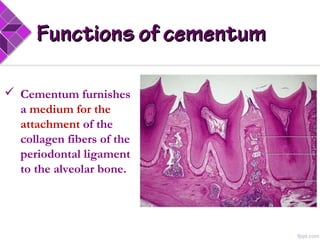
 Cementum furnishes
a medium for the
attachment of the
collagen fibers of the
periodontal ligament
to the alveolar bone.
Functions of cementumFunctions of cementum
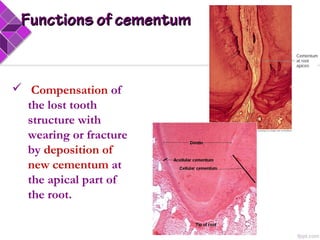
 Compensation of
the lost tooth
structure with
wearing or fracture
by deposition of
new cementum at
the apical part of
the root.
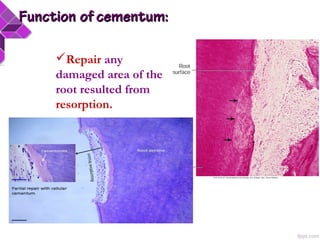
FunctionFunction of cementum:of cementum:
Repair any
damaged area of the
root resulted from
resorption.
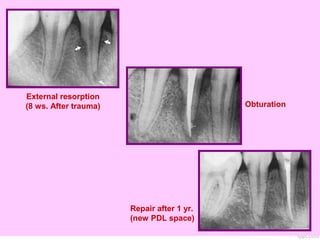
External resorption
(8 ws. After trauma) Obturation
Repair after 1 yr.
(new PDL space)
Age changesAge changes
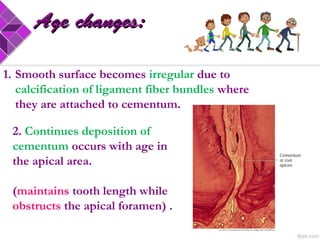
1. Smooth surface becomes irregular due to
calcification of ligament fiber bundles where
they are attached to cementum.
2. Continues deposition of
cementum occurs with age in
the apical area.
(maintains tooth length while
obstructs the apical foramen) .
Age changes:Age changes:
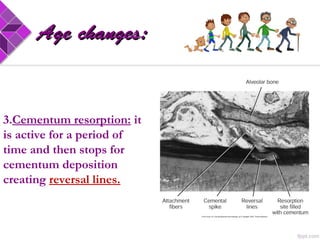
3.Cementum resorption: it
is active for a period of
time and then stops for
cementum deposition
creating reversal lines.
Age changes:Age changes:
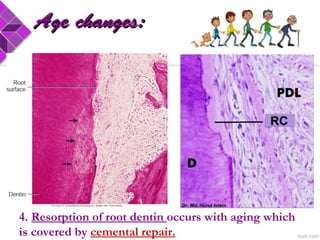
4. Resorption of root dentin occurs with aging which
is covered by cemental repair.
Age changes:Age changes:
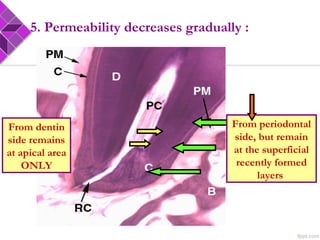
5. Permeability decreases gradually :
From periodontal
side, but remain
at the superficial
recently formed
layers
From dentin
side remains
at apical area
ONLY
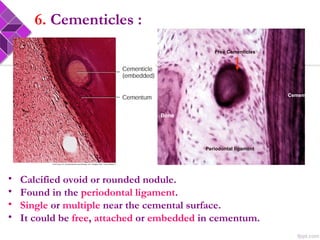
• Calcified ovoid or rounded nodule.
• Found in the periodontal ligament.
• Single or multiple near the cemental surface.
• It could be free, attached or embedded in cementum.
6. Cementicles :
Periodontal ligament
Cementum
Bone
Free Cementicles
HypercementosisHypercementosis
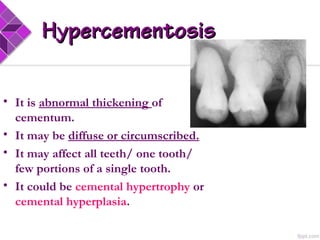
• It is abnormal thickening of
cementum.
• It may be diffuse or circumscribed.
• It may affect all teeth/ one tooth/
few portions of a single tooth.
• It could be cemental hypertrophy or
cemental hyperplasia.
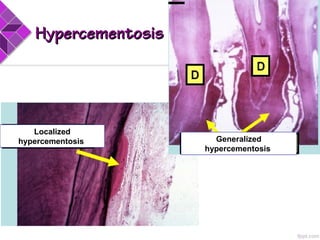
Localized
hypercementosis Generalized
hypercementosis
HypercementosisHypercementosis
 Cementum hypertrophy:Cementum hypertrophy:
It is physiologic thickening of the cementum found in
the good functioning teeth as a response to increase the
function of the tooth to improve the functional quality
through increase the root surface area and thus
permitting more periodontal fibers to be attached to the
tooth.
Cementum hyperplasia:Cementum hyperplasia:
It is overgrowth of the cementum in a non-functioning or
embedded tooth. It is characterized by the absence of
Sharpey's fibers.
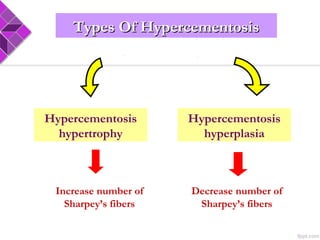
Hypercementosis
hyperplasia
Hypercementosis
hypertrophy
Increase number of
Sharpey’s fibers
Decrease number of
Sharpey’s fibers
Types Of HypercementosisTypes Of Hypercementosis
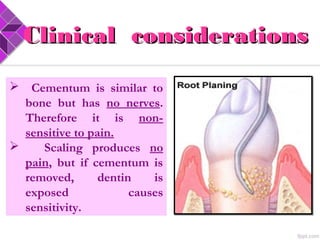
 Cementum is similar to
bone but has no nerves.
Therefore it is non-
sensitive to pain.
 Scaling produces no
pain, but if cementum is
removed, dentin is
exposed causes
sensitivity.
Clinical considerationsClinical considerations
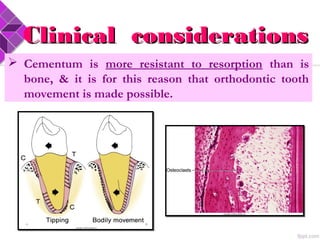
 Cementum is more resistant to resorption than is
bone, & it is for this reason that orthodontic tooth
movement is made possible.
Any questions ???

Cementum

  • 1.
  • 13.
  • 16.
    Contents:Contents: • Definition. • Physicaland chemical properties. • Development of Cementum. • Classification of Cementum. • Cells of Cementum. • Incremental lines of Salter • Age changes of Cementum. • Clinical considerations.
  • 17.
  • 18.
    • Cementum isthe mineralized dental tissue covering the anatomic roots. • It begins at the CEJ and continues to the apex. Definition:Definition:
  • 19.
    • It furnishesa medium for the attachment of collagen fibers that bind the tooth to surrounding structures (Sharpey’s fibers). Definition:Definition:
  • 20.
    Physical properties:Physical properties: Cementumshares some physical, chemical and structural characteristics with compact bone except that human cementum is avascular and with no nerve supply.
  • 21.
    Physical properties:Physical properties:Color: pale yellow in color.pale yellow in color. It can be distinguished fromIt can be distinguished from enamelenamel by its lack of lusterby its lack of luster and darker hue.and darker hue. Thickness: the thicknessthe thickness of cementum at theof cementum at the cervical areacervical area is about (is about (20-20- 50µm50µm) and it gradually) and it gradually increases in thickness tillincreases in thickness till it reaches its maximumit reaches its maximum about (about (150-200150-200µmµm) at the) at the apexapex and at theand at the bifurcationbifurcation of the root.of the root. Thickness: the thicknessthe thickness of cementum at theof cementum at the cervical areacervical area is about (is about (20-20- 50µm50µm) and it gradually) and it gradually increases in thickness tillincreases in thickness till it reaches its maximumit reaches its maximum about (about (150-200150-200µmµm) at the) at the apexapex and at theand at the bifurcationbifurcation of the root.of the root. A B
  • 22.
    From periodontal side From dentin side Permeability: itisit is permeable from bothpermeable from both thethe dentindentin and theand the periodontal ligamentperiodontal ligament side.side. Physical properties:Physical properties:
  • 23.
    Hardness of fullymineralized cementum is less than dentin
  • 24.
    The inorganic substancesconsist mainly of calcium and phosphate in the form of hydroxyapatite. The organic portion consists mainly of collagen and non-collagenous protein forming the ground substance. Chemical compositionChemical composition
  • 25.
  • 26.
    CementogenesisCementogenesis Cementum development hasbeen subdivided into: A) Prefunctional stage: - Matrix formation - Mineralization B) Functional stage:
  • 27.
    There are 3cell types responsible for the cementogenesis:  Cementoblasts  Cementocytes  Fibroblasts CementogenesisCementogenesis By/ Dr. Hesham Dameer All of these cells are derived from the ectomesenchymal cells.
  • 28.
    • The developmentof the root begins after the crown is formed. • The outer and inner dental epithelium forms the Hertwig's epithelial root sheath. Matrix formation:Matrix formation:
  • 29.
      The inner dental epitheliumwill induce the neighboring cells of the dental papilla to differentiate into odontoblasts. Matrix formation:Matrix formation:
  • 30.
     Once thedentin formation is started, the Hertwig's epithelial root sheath will lose its continuity and its cells became the epithelial rests of Malassez. Matrix formation:Matrix formation:
  • 31.
  • 32.
    By/ Dr. HeshamDameer Remnants of the Hertwig`s root sheath, which disintegrate into the PDL are the Malassez cells. Matrix formation:Matrix formation:
  • 33.
     Direct contactof the cells of the dental sac with the root dentin resulted in cementoblast differentiation. Matrix formation:Matrix formation:
  • 34.
     These newlyformed cementoblasts extend numerous tiny cytoplasmic processes into the loosely arranged and not mineralized dentinal matrix. Matrix formation:Matrix formation:
  • 35.
    Cementoblasts lay down cementummatrix (cementoid) leading to an intimate integration of the two different fibril populations forming the dentinocemental junction. Matrix formation:Matrix formation:
  • 36.
     It isnot distinctive, because the Fibers of dentin and cementum intermingle at the interface C D Cementodentinal junctionCementodentinal junction
  • 37.
    Derived from Twosources Matrix formation:Matrix formation:
  • 38.
  • 39.
    Extrinsic fibers Intrinsicfibers Derived from PDL Derived from cementum. Formed by fibroblast Formed by cementoblast Run in same direction of the PDL principal fibers i.e. perpendicular or oblique to the root surface. Run parallel to the root surface and at right angles to the extrinsic fibers. Mixed fiberMixed fiber Found at the area where both types of cells produce fibers.
  • 40.
    During matrix formationfibroblasts form collagen fibers (sharpey`s fibers), which become embedded in the matrix to provide attachment of the root to the surrounding bone Matrix formation:Matrix formation:
  • 41.
    Some cementoblasts depositcementum matrix at various locations around themselves, resulting in their entrapment into the cement matrix converting them into cementocytes.
  • 42.
     First layerof cementum is actually formed by the inner cells of the Hertwig's epithelial root sheath and is deposited on the root’s surface was called intermediate cementum.  Deposition occurs before the HERS disintegrates.  Situated between the granular dentin layer of Tomes and the secondary cementum that is formed by the cementoblasts. A-acellular cementum. B-hyaline layer.       C- granular layer of Tomes. D-dentine
  • 43.
    The term intermediatecementum recently found to be named as Hyaline layer of Hopewell-Smith and is considered as an inductive influence for beginning of cementum formation. Matrix formation:Matrix formation:
  • 44.
     The roleof this layer is to seals of the dentinal tubules before the Hertwig's epithelial root sheath disintegrates. Matrix formation:Matrix formation:
  • 45.
    CementogenesisCementogenesis Cementum development hasbeen subdivided into: A) Prefunctional stage: - Matrix formation - Mineralization B) Functional stage:
  • 46.
    Mineralization:Mineralization:  It beginsin the depth of the cementum matrix (cementoid tissue), where, fine hydroxyapatite crystals are deposited between and within the collagen fibrils.  Mineralization of the outermost layer of the dentin matrix (mantle dentin), appears to be delayed until the implantation of the cementum matrix is established and the dentinal matrix is completely covered with the collagen fibrils of cementum.
  • 47.
    Cementum Cementoid layer Cementoblast Maturation occur layerby layer for the collagen fibers Mineralization:Mineralization:
  • 48.
    CementogenesisCementogenesis Cementum development hasbeen subdivided into: A) Prefunctional stage: - Matrix formation - Mineralization B) Functional stage:
  • 49.
    Functional stage:Functional stage: Thisstarted when the tooth is in occlusion and continues throughout life. It is an adaptive role in response to tooth wear and movement and is associated with repair and regeneration of periodontal tissues.
  • 50.
    Cementum deposition apically compensatefor the attrition. Functional stage:Functional stage:
  • 51.
    Classification of cementumClassificationof cementum I. According to the development: • Primary cementum (prefunctional). • Secondary cementum (functional). II. According to its cellularity: • Acellular cementum • Cellular cementum III. According to the origin of the collagenous matrix: • Extrinsic fiber cementum. • Intrinsic fiber cementum. • Mixed fiber cementum. • Afibrillar cementum.
  • 52.
    Under the lightmicroscope two types of cementum can be differentiated: Acellular cementum cellular cementum The difference between the two types is the presence or absence of the cells (cementocytes)
  • 53.
    Acellular cementum Cellularcementum The difference between the two types is the presence or absence of the cells (cementocytes)
  • 54.
  • 55.
    Acellular cementum Cellularcementum Present on the cervical third or half of root. Present mainly on apical third of root. Does not contain cells. Contain cells called cementocytes in individual spaces lacunae. Formed before the tooth reaches the occlusal plane. Formed after the tooth reaches the occlusal plane. Sharpey’s fibers are main component which inserted at approximately right angles onto the root surface. (extrinsic fibers) Sharpey’s fibers occupy smaller portion & occupy other fibers that are arranged parallel to the root surface. (intrinsic fibers) Rate of development Slow. Faster . Incremental lines are wide apart. Closer. Classification of cementum:Classification of cementum:
  • 56.
    A B Sharpey’s fibersin cementum (arrowed) A = unminralized T. , B = mineralized T. The increase in thickness of cementum does not enhance the strength of attachment of the individual fibers, because the deeper portion of the fibers is calcified and the attachment proper is confined to the superficial layer of Note that....Note that....
  • 57.
    Classification of cementumClassificationof cementum I. According to the development: • Primary cementum (prefunctional). • Secondary cementum (functional). II. According to its cellularity: • Acellular cementum • Cellular cementum III. According to the origin of the collagenous matrix: • Extrinsic fiber cementum. • Intrinsic fiber cementum. • Mixed fiber cementum. • Afibrillar cementum.
  • 58.
    The enamel atcervical area not covered by reduced dental epithelium before tooth eruption The connective tissue of the dental sac lay down cementum on the exposed enamel Afibrillar cementumAfibrillar cementum
  • 59.
  • 60.
    •Large cuboidal cells •Foundon the surface of both celular and acellular cementum. •They produce collagen fibers (intrinsic fibers) and ground substance of cementum. CementoblastsCementoblasts
  • 61.
  • 62.
    Cementoblast is aCementoblastis a protein formingprotein forming and secreting cell:and secreting cell: Large open face nucleus R E R Golgi apparatus Mitochondria Alkaline phosphatase Secretory granules
  • 63.
     They areincorporated in cellular cementum  They have numerrous irregular processes.  Most processes are directed towards PDL. CementocytesCementocytes Dentin PDL
  • 64.
     The cellbody is located in a space called lacuna and their processes are present in canaliculi.  Cementocytes in deeper layers of cementum undergo degeneration and gradually lose their organelles and die. Dentin PDL
  • 65.
    In ground section, cementocytesspaces appear as dark spaces Cementocytes:Cementocytes:
  • 66.
    CementocyteCementocyte Cementocyte canaliculiCementocytecanaliculi Cementocyte processCementocyte process
  • 67.
    Both cellular andacellular cementum is separated by incremental lines into layers which indicate periodic formation. Incremental lines of Salter:Incremental lines of Salter:
  • 68.
    In acellular C,less distance between IL In cellular C,more distance between IL  Incremental lines run parallel to the root surface.  They are hypermineralized area with less collagen fibers and more ground substance. Incremental lines of Salter:Incremental lines of Salter:
  • 69.
    Cemento-enamel junctionCemento-enamel junction It is the relation between the enamel and cementum edges at the cervix of the tooth.  This relation is found to be either one of three forms:
  • 70.
    Edge to edge: Incidence:30%. Cause: proper development. Description: the cementum edge of the tooth meets the enamel edge in a sharp line all around.   Cemento-enamel junction:Cemento-enamel junction:
  • 71.
     Denuded area ofdentin: Incidence: 10%. Cause: when the Hertwig's epithelial root sheath delayed in its separation from the dentin, a zone of the root dentin became devoid of cementum. Description: a pare dentin area found to be so sensitive at the cervix of the tooth especially if there is a gingival recession. Cemento-enamel junction:Cemento-enamel junction:
  • 72.
    Cement overlap enamel: Incidence:60%. Cause: local disruption of the reduced dental epithelium at its end (cervix of the tooth) that permits follicular cells to come into contact with the enamel surface and differentiate into cementoblasts. Description: histologically, it may appear as an island of afibrillar cementum on the cervical enamel surface. Cemento-enamel junction:Cemento-enamel junction:
  • 73.
    Functions of cementumFunctionsof cementum  Cementum furnishes a medium for the attachment of the collagen fibers of the periodontal ligament to the alveolar bone.
  • 74.
    Functions of cementumFunctionsof cementum  Compensation of the lost tooth structure with wearing or fracture by deposition of new cementum at the apical part of the root.
  • 75.
    FunctionFunction of cementum:ofcementum: Repair any damaged area of the root resulted from resorption.
  • 76.
    External resorption (8 ws.After trauma) Obturation Repair after 1 yr. (new PDL space)
  • 77.
  • 78.
    1. Smooth surfacebecomes irregular due to calcification of ligament fiber bundles where they are attached to cementum. 2. Continues deposition of cementum occurs with age in the apical area. (maintains tooth length while obstructs the apical foramen) . Age changes:Age changes:
  • 79.
    3.Cementum resorption: it isactive for a period of time and then stops for cementum deposition creating reversal lines. Age changes:Age changes:
  • 80.
    4. Resorption ofroot dentin occurs with aging which is covered by cemental repair. Age changes:Age changes:
  • 81.
    5. Permeability decreasesgradually : From periodontal side, but remain at the superficial recently formed layers From dentin side remains at apical area ONLY
  • 82.
    • Calcified ovoidor rounded nodule. • Found in the periodontal ligament. • Single or multiple near the cemental surface. • It could be free, attached or embedded in cementum. 6. Cementicles : Periodontal ligament Cementum Bone Free Cementicles
  • 83.
    HypercementosisHypercementosis • It isabnormal thickening of cementum. • It may be diffuse or circumscribed. • It may affect all teeth/ one tooth/ few portions of a single tooth. • It could be cemental hypertrophy or cemental hyperplasia.
  • 84.
  • 85.
    HypercementosisHypercementosis  Cementum hypertrophy:Cementumhypertrophy: It is physiologic thickening of the cementum found in the good functioning teeth as a response to increase the function of the tooth to improve the functional quality through increase the root surface area and thus permitting more periodontal fibers to be attached to the tooth. Cementum hyperplasia:Cementum hyperplasia: It is overgrowth of the cementum in a non-functioning or embedded tooth. It is characterized by the absence of Sharpey's fibers.
  • 86.
    Hypercementosis hyperplasia Hypercementosis hypertrophy Increase number of Sharpey’sfibers Decrease number of Sharpey’s fibers Types Of HypercementosisTypes Of Hypercementosis
  • 87.
     Cementum issimilar to bone but has no nerves. Therefore it is non- sensitive to pain.  Scaling produces no pain, but if cementum is removed, dentin is exposed causes sensitivity. Clinical considerationsClinical considerations
  • 88.
    Clinical considerationsClinical considerations Cementum is more resistant to resorption than is bone, & it is for this reason that orthodontic tooth movement is made possible.
  • 89.

Editor's Notes

  • #32 Cementum formation occurs along the entire tooth. Hers- proliferation of ep cells located at the cervical loop of the enamel organ in the developing tooth