B I N A Y A S U B E D I
4 T H B A T C H B D S , 2 N D Y E A R
C H I T W A N M E D I C A L C O L L E G E
Temporary Denture
Base
Definition
 According to GPT a Temporary denture base is defined as,
“A temporary substance representing the base of the
denture which is used for making maxillomandibular
(jaw) relation records and for arrangement of teeth.”
 Also commonly known as;
 Base plate
 Temporary base
 Record base
 Trial base
Aims of Temporary Denture Base fabrication
 To support the occlusal rims and the artificial teeth
for clinical procedures like jaw relations and try-in.
 To get a clear idea about the contour, extent and
aesthetics of the denture.
Ideal Requirements
Elder (1955) postulated some ideal requirements:
 It should adapt to the tissues like a finished denture.
 The extent and the shape of the borders should resemble
to finished denture.
 It should be strong enough to withstand occlusal loads.
 It should be dimensionally stable.
 It should be suitable to allow teeth-arrangement.
 It should have pleasant color which should be contrasting
enough to be clearly demark the borders in the oral
cavity.
Contd.
 It shouldn’t be very thick. It should be rigid enough even
in thin sections.
NOTE: Practically, thickness shouldn’t exceed 2mm in
thickest part of the denture base.
 It should be non reactive to oral tissues.
Tucker in 1966 said that, “the base plate should not abrade
the surface of the cast during removal and placement.”
He also said that the base plate should bond to the
material used to block out undercuts so that the undercut
materials along with the base plate material form one
single temporary denture base.
Materials Used
Common materials used includes:
 Auto-polymerizing resins (chemically cured resins)
 Heat cure resin
 Thermoplastic resins
 Shellac
 Base plate wax (processing wax)
NOTE: Some base plates are lined with plastic materials
for increased stability and better tissue adaptation. These
are called as Stabilizers and these base plates are called
as Stabilized base Plates.
Stabilizers
Following materials can be used as stabilizers:
 Zinc Oxide Eugenol impression materials
 Elastomeric impression materials
 Soft and hard curing resins
Functions:
Stability
Adaptation
These materials extends into the undercuts thus
helps in easy removal.
Temporary Denture Base with
Self-Cure Resin
Self Cure Acrylic Resin
 It is also called as Cold-cure acrylic resin which are
similar to denture base resin used in final fabrication of
denture. It sets by chemical reaction, hence is
irreversible.
They can be manipulated using following techniques:
A. Sprinkle Technique
B. Dough Technique:
 Finger Adapted Dough Technique
 Stone mould dough technique
 Wax- Confined Dough Technique
Sprinkle Technique
Procedure:
 Powder and liquid are loaded in two different
dispensers. A small quantity of powder is sprinkled
over a part of the cast and is polymerized by
sprinkling drops of liquid over it.
 This process is continued until entire ridges and
associated landmarks are covered.
Advantages Disadvantages
 Better tissue
adaptation
 Minimal wastage of
materials
 Ease of use
 Even thickness can’t be
obtained.
 Porosities may be
unavoidable
 Time consuming
Advantages and Disadvantages
Finger Adapted Dough Technique
Procedure:
 Powder & liquid are mixed in a clean dry porcelain jar in 3:1 ratio by
volume.
Note: Ratio should be well maintained. If insufficient monomer is used,
excessive shrinkage, porosities and granularity may occur.
 During mixing, Polymer-monomer interaction occurs in 6 stages:
 Wet sand stage
 Stringy stage
 Dough stage
 Rubbery stage
 Stiff stage
Note: Material is very workable in Dough stage and is adapted over the
Separating medium applied surface of cast on this stage.
Contd..
 Manipulation is done on late stringy or dough stage when the
material is maximally workable. Material is kneaded in hand to get
the homogenous mix.
 The material is shaped into 2 mm thick sheet. Flattening of dough
can be done using a roller or a plaster mould or by pressing between
two glass slabs.
 Separating medium is applied over the cast, roller or a glass slab to
avoid stickiness.
 The rolled sheet of acrylic is adapted over the cast from the center to
periphery, this helps to avoid wrinkles.
 Excessive pressure shouldn’t be applied on the ridge areas as it
might lead to thinning of the denture base.
 Excessive material is cut with a B.P blade before it sets. The material
should be held in it’s position as shrinkage or warpage may occur
during polymerization.
 Set material is trimmed to get smooth surface & smooth margins
Stone mould Dough Technique
 This technique was introduced by Assad Zedic and
Yarmound in 1975.
Procedure:
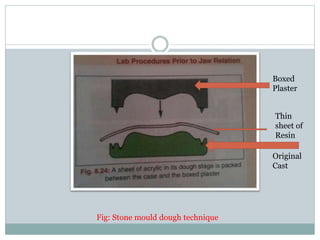
 Cast is boxed using boxing or modeling wax. Then proper mix
of dental plaster is poured in the boxed cast and boxed plaster
is prepared.
 Self-cure resin is mixed in a air tight jar, kneaded and rolled
into a thin sheet and placed between the cast and the boxed
plaster.
 It is then allowed to polymerize for 20 mins in a pressure pot
under 20 psi pressure. This helps to reduce porosities.
 Once polymerized, it is carefully removed, trimmed and then
polished.
Boxed
Plaster
Original
Cast
Thin
sheet of
Resin
Fig: Stone mould dough technique
Wax-Confined Dough Technique
 This technique was described by Laver and Freda. Here,
acrylic resin is used along with base plate wax to form a
temporary denture base.
Procedure:
 Separating medium is applied over the cast in 3 layers and
allowed to set for 10 minutes.
 Then a sheet of base plate wax is adapted over the entire cast.
At least 2mm relief is given in sulcus area.
 Self cure resin is then mixed in 2:1 ratio by volume. Small
amount of mixed resin is added along the sulcus, remaining
are added in tissue surface of the base plate wax.
 Base plate wax with unpolymerized resin is placed over the
cast. Pressure is applied until it attains 2mm thickness.
Contd..
Excess of resin coming out is contoured over the
sulcus area of the cast to form the rounded borders.
It is then is allowed to cure within a rubber bowl to
decrease the amount of surface porosities. Once
polymerized, borders are then trimmed and
polished.
Advantages:
 Base plate wax on outer surface gives better surface
finish.
 Acrylic on inner surface allows better tissue
adaptation.
Thank You!!

Temporary denture base

  • 1.
    B I NA Y A S U B E D I 4 T H B A T C H B D S , 2 N D Y E A R C H I T W A N M E D I C A L C O L L E G E Temporary Denture Base
  • 2.
    Definition  According toGPT a Temporary denture base is defined as, “A temporary substance representing the base of the denture which is used for making maxillomandibular (jaw) relation records and for arrangement of teeth.”  Also commonly known as;  Base plate  Temporary base  Record base  Trial base
  • 3.
    Aims of TemporaryDenture Base fabrication  To support the occlusal rims and the artificial teeth for clinical procedures like jaw relations and try-in.  To get a clear idea about the contour, extent and aesthetics of the denture.
  • 4.
    Ideal Requirements Elder (1955)postulated some ideal requirements:  It should adapt to the tissues like a finished denture.  The extent and the shape of the borders should resemble to finished denture.  It should be strong enough to withstand occlusal loads.  It should be dimensionally stable.  It should be suitable to allow teeth-arrangement.  It should have pleasant color which should be contrasting enough to be clearly demark the borders in the oral cavity.
  • 5.
    Contd.  It shouldn’tbe very thick. It should be rigid enough even in thin sections. NOTE: Practically, thickness shouldn’t exceed 2mm in thickest part of the denture base.  It should be non reactive to oral tissues. Tucker in 1966 said that, “the base plate should not abrade the surface of the cast during removal and placement.” He also said that the base plate should bond to the material used to block out undercuts so that the undercut materials along with the base plate material form one single temporary denture base.
  • 6.
    Materials Used Common materialsused includes:  Auto-polymerizing resins (chemically cured resins)  Heat cure resin  Thermoplastic resins  Shellac  Base plate wax (processing wax) NOTE: Some base plates are lined with plastic materials for increased stability and better tissue adaptation. These are called as Stabilizers and these base plates are called as Stabilized base Plates.
  • 7.
    Stabilizers Following materials canbe used as stabilizers:  Zinc Oxide Eugenol impression materials  Elastomeric impression materials  Soft and hard curing resins Functions: Stability Adaptation These materials extends into the undercuts thus helps in easy removal.
  • 8.
    Temporary Denture Basewith Self-Cure Resin
  • 9.
    Self Cure AcrylicResin  It is also called as Cold-cure acrylic resin which are similar to denture base resin used in final fabrication of denture. It sets by chemical reaction, hence is irreversible. They can be manipulated using following techniques: A. Sprinkle Technique B. Dough Technique:  Finger Adapted Dough Technique  Stone mould dough technique  Wax- Confined Dough Technique
  • 10.
    Sprinkle Technique Procedure:  Powderand liquid are loaded in two different dispensers. A small quantity of powder is sprinkled over a part of the cast and is polymerized by sprinkling drops of liquid over it.  This process is continued until entire ridges and associated landmarks are covered.
  • 11.
    Advantages Disadvantages  Bettertissue adaptation  Minimal wastage of materials  Ease of use  Even thickness can’t be obtained.  Porosities may be unavoidable  Time consuming Advantages and Disadvantages
  • 12.
    Finger Adapted DoughTechnique Procedure:  Powder & liquid are mixed in a clean dry porcelain jar in 3:1 ratio by volume. Note: Ratio should be well maintained. If insufficient monomer is used, excessive shrinkage, porosities and granularity may occur.  During mixing, Polymer-monomer interaction occurs in 6 stages:  Wet sand stage  Stringy stage  Dough stage  Rubbery stage  Stiff stage Note: Material is very workable in Dough stage and is adapted over the Separating medium applied surface of cast on this stage.
  • 13.
    Contd..  Manipulation isdone on late stringy or dough stage when the material is maximally workable. Material is kneaded in hand to get the homogenous mix.  The material is shaped into 2 mm thick sheet. Flattening of dough can be done using a roller or a plaster mould or by pressing between two glass slabs.  Separating medium is applied over the cast, roller or a glass slab to avoid stickiness.  The rolled sheet of acrylic is adapted over the cast from the center to periphery, this helps to avoid wrinkles.  Excessive pressure shouldn’t be applied on the ridge areas as it might lead to thinning of the denture base.  Excessive material is cut with a B.P blade before it sets. The material should be held in it’s position as shrinkage or warpage may occur during polymerization.  Set material is trimmed to get smooth surface & smooth margins
  • 14.
    Stone mould DoughTechnique  This technique was introduced by Assad Zedic and Yarmound in 1975. Procedure:  Cast is boxed using boxing or modeling wax. Then proper mix of dental plaster is poured in the boxed cast and boxed plaster is prepared.  Self-cure resin is mixed in a air tight jar, kneaded and rolled into a thin sheet and placed between the cast and the boxed plaster.  It is then allowed to polymerize for 20 mins in a pressure pot under 20 psi pressure. This helps to reduce porosities.  Once polymerized, it is carefully removed, trimmed and then polished.
  • 15.
  • 16.
    Wax-Confined Dough Technique This technique was described by Laver and Freda. Here, acrylic resin is used along with base plate wax to form a temporary denture base. Procedure:  Separating medium is applied over the cast in 3 layers and allowed to set for 10 minutes.  Then a sheet of base plate wax is adapted over the entire cast. At least 2mm relief is given in sulcus area.  Self cure resin is then mixed in 2:1 ratio by volume. Small amount of mixed resin is added along the sulcus, remaining are added in tissue surface of the base plate wax.  Base plate wax with unpolymerized resin is placed over the cast. Pressure is applied until it attains 2mm thickness.
  • 17.
    Contd.. Excess of resincoming out is contoured over the sulcus area of the cast to form the rounded borders. It is then is allowed to cure within a rubber bowl to decrease the amount of surface porosities. Once polymerized, borders are then trimmed and polished. Advantages:  Base plate wax on outer surface gives better surface finish.  Acrylic on inner surface allows better tissue adaptation.
  • 18.