- MAHAK RALLI
- IV/I
 Definition
 Factors affecting stability
 Checking for stability
 Conclusion
 Stability is defined as ‘the ability of a
denture to be firm, steady or constant, to
resist displacement by functional stresses
and not to be subjected to change of position
when forces are applied.’
-GPT
 It is the ability to withstand horizontal
forces.
 In simpler words stability is defined as “the
quality of a denture to resists displacement by
functional stresses.”
The qualities necessary to create and maintain
stability are dependent upon the following factors:
1. Quality of impression
2. Vertical height of residual ridge
3. Shape of palatal vault
4. Arch form
5. Quality of soft tissue covering ridge
6. Mandibular lingual flange
7. Occlusal plane
8. Teeth arrangement
9. Contour of polished surface
10. Orofacial musculature
 An impression should be as accurate as
possible.
 The impression surface should be smooth and
duplicate all the details accurately.
 It should be devoid of voids and any rough
surfaces
 The impression should not wrap on removal
 The impression should be dimensionally
stable and cast should be poured as soon as
possible.
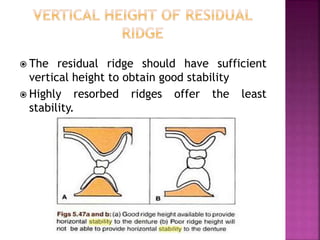
 The residual ridge should have sufficient
vertical height to obtain good stability
 Highly resorbed ridges offer the least
stability.
 A steep or high arched palate enhances the
stability :
- providing greater area of contact
- long inclines approaching at right angles to the
direction of force.
 Square arches tend to resist rotation of the
prosthesis better than the other arch forms.
 The ridge should provide a firm soft tissue
base with adequate submucosa to offer good
stability.
 Flabby tissues with excessive submucosa
offer poor stability.
•Lingual slopes approach 90 degree to occlusal plane
•Effectively resists horizontal forces
•The posterior lingual flanges extends more inferiorly
than anterior lingual flange
 The occlusal plane should be oriented
parallel to the ridge
 If occlusal plane is inclined then the sliding
forces may act on the denture to reduce its
stability
 The occlusal plane should divide the inter-
arch space equally.
 The maxillary rim should be parallel anteriorly
to the inter-pupillary line & posteriorly to the
ala- tragus line
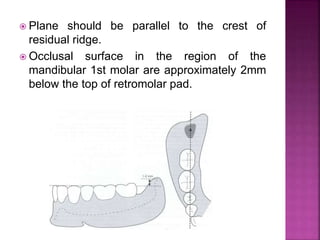
 Plane should be parallel to the crest of
residual ridge.
 Occlusal surface in the region of the
mandibular 1st molar are approximately 2mm
below the top of retromolar pad.
 The position of the teeth and their occlusion
play an important role in the stability of the
denture.
 Balanced occlusion facilitates the even
distribution of forces across the denture.
 Absence of balanced occlusion may produce
unbalanced, lever type forces on any one
side of the denture leading to loss of
stability.
 The arch curvature should correspond to:
- curvature of alveolar ridge
- facial contour
- Maxillary lip position
 Arranging the teeth in to a square arch form on a
tapering ovoid residual ridge causes canines to
be labial to crest of the maxillary ridge than the
incisors
 This results in bicuspids being more buccal to the
ridge than they should be.
 Working side occlusal pressure produces a
displacing tendency, the ridge crest acting as a
fulcrum
 Natural posterior maxillary teeth have a
buccal inclination and the mandibular teeth
have a normal lingual axis inclination
 The normal residual ridge resorption pattern
leads to an increase crossbite relationship
 Tendency to avoid cross bite arrangement
results in placing the maxillary teeth in
buccal position or mandibular teeth in lingual
to desired position
 Results in impaired stability
 In such cases the working side occlusal pressure
causes a displacing tendency because the line of
force is buccal to the fulcrum
 It should be in harmony with the maxillary
anterior tooth
 Errors in maxillary tooth position will be
transferred to the mandibular arch
 For maximum stability overbite should be as
minimum as possible
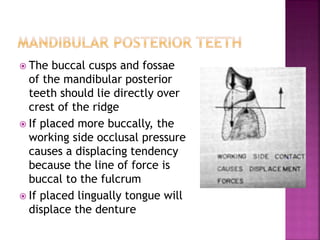
 The buccal cusps and fossae
of the mandibular posterior
teeth should lie directly over
crest of the ridge
 If placed more buccally, the
working side occlusal pressure
causes a displacing tendency
because the line of force is
buccal to the fulcrum
 If placed lingually tongue will
displace the denture
 The teeth in the denture should be arranged
in the neutral zone
 The neutral zone is defined as, “the
potential space between the lips and cheeks
on one side and the tongue on the other.
Natural or artificial teeth in this zone are
subject to equal and opposite forces from
the surrounding musculature.”
-GPT
 The polished surfaces of the denture should
be harmonious with the oral structures.
 They should not interfere with the action of
the oral musculature.
 From the cuspid to posterior aspect the
denture surface slopes slightly inward
creating space for buccal corridor.
 The over all concept should be in terms with
the neutral zone concept.
 The geometric design should be triangular.
 In cross section, the upper and lower denture
should appear as two triangles that
correspond to occlusal surface.
 Normally, tongue should rest on the lingual
flange and occlusal surface of the lower
teeth- aids in stability
 Occlusal harmony of opposing teeth enhance
stability.
 Premature contact during functional and
parafunctional activities will affect the
stability.
 Levator anguli oris
 Depressor anguli oris
 Incisivus
 Mentalis
 Genioglossus
 Mylohyoid
If not given proper freedom to function these
muscles can dislodge the denture. Proper
border moulding ensures proper extension of
these muscles
 Pressure is applied with the ball of finger in
premolar and molar region of each side
alternatively
 Pressure must be at right angle to occlusal
surface.
 if pressure on one side causes the denture to
tilt and raise on other side it indicates that
the teeth on the side to which pressure is
applied are outside the ridge
 Eating skill must be slowly developed and
refined
 Initially patient should have soft diet
 Patient should be instructed to divide normal
spoonful of food into half and place each half
posteriorly and bilaterally.
 Stability is cited as the most significant
property in providing physiological comfort
to the patient.
 It is important to know the factors affecting
stability
 The main factors cited were the occlusal
tissue and polished surfaces
 Though to fabricate perfectly stable denture
may not be truly possible we should still try
to achieve the maximum stability as possible
Stability in complete dentures

Stability in complete dentures

  • 1.
  • 2.
     Definition  Factorsaffecting stability  Checking for stability  Conclusion
  • 3.
     Stability isdefined as ‘the ability of a denture to be firm, steady or constant, to resist displacement by functional stresses and not to be subjected to change of position when forces are applied.’ -GPT
  • 4.
     It isthe ability to withstand horizontal forces.  In simpler words stability is defined as “the quality of a denture to resists displacement by functional stresses.”
  • 5.
    The qualities necessaryto create and maintain stability are dependent upon the following factors: 1. Quality of impression 2. Vertical height of residual ridge 3. Shape of palatal vault 4. Arch form 5. Quality of soft tissue covering ridge 6. Mandibular lingual flange 7. Occlusal plane 8. Teeth arrangement 9. Contour of polished surface 10. Orofacial musculature
  • 6.
     An impressionshould be as accurate as possible.  The impression surface should be smooth and duplicate all the details accurately.  It should be devoid of voids and any rough surfaces  The impression should not wrap on removal  The impression should be dimensionally stable and cast should be poured as soon as possible.
  • 7.
     The residualridge should have sufficient vertical height to obtain good stability  Highly resorbed ridges offer the least stability.
  • 8.
     A steepor high arched palate enhances the stability : - providing greater area of contact - long inclines approaching at right angles to the direction of force.
  • 9.
     Square archestend to resist rotation of the prosthesis better than the other arch forms.
  • 10.
     The ridgeshould provide a firm soft tissue base with adequate submucosa to offer good stability.  Flabby tissues with excessive submucosa offer poor stability.
  • 11.
    •Lingual slopes approach90 degree to occlusal plane •Effectively resists horizontal forces •The posterior lingual flanges extends more inferiorly than anterior lingual flange
  • 12.
     The occlusalplane should be oriented parallel to the ridge  If occlusal plane is inclined then the sliding forces may act on the denture to reduce its stability  The occlusal plane should divide the inter- arch space equally.  The maxillary rim should be parallel anteriorly to the inter-pupillary line & posteriorly to the ala- tragus line
  • 14.
     Plane shouldbe parallel to the crest of residual ridge.  Occlusal surface in the region of the mandibular 1st molar are approximately 2mm below the top of retromolar pad.
  • 17.
     The positionof the teeth and their occlusion play an important role in the stability of the denture.  Balanced occlusion facilitates the even distribution of forces across the denture.  Absence of balanced occlusion may produce unbalanced, lever type forces on any one side of the denture leading to loss of stability.
  • 18.
     The archcurvature should correspond to: - curvature of alveolar ridge - facial contour - Maxillary lip position  Arranging the teeth in to a square arch form on a tapering ovoid residual ridge causes canines to be labial to crest of the maxillary ridge than the incisors  This results in bicuspids being more buccal to the ridge than they should be.  Working side occlusal pressure produces a displacing tendency, the ridge crest acting as a fulcrum
  • 20.
     Natural posteriormaxillary teeth have a buccal inclination and the mandibular teeth have a normal lingual axis inclination  The normal residual ridge resorption pattern leads to an increase crossbite relationship  Tendency to avoid cross bite arrangement results in placing the maxillary teeth in buccal position or mandibular teeth in lingual to desired position  Results in impaired stability
  • 21.
     In suchcases the working side occlusal pressure causes a displacing tendency because the line of force is buccal to the fulcrum
  • 22.
     It shouldbe in harmony with the maxillary anterior tooth  Errors in maxillary tooth position will be transferred to the mandibular arch  For maximum stability overbite should be as minimum as possible
  • 23.
     The buccalcusps and fossae of the mandibular posterior teeth should lie directly over crest of the ridge  If placed more buccally, the working side occlusal pressure causes a displacing tendency because the line of force is buccal to the fulcrum  If placed lingually tongue will displace the denture
  • 24.
     The teethin the denture should be arranged in the neutral zone  The neutral zone is defined as, “the potential space between the lips and cheeks on one side and the tongue on the other. Natural or artificial teeth in this zone are subject to equal and opposite forces from the surrounding musculature.” -GPT
  • 25.
     The polishedsurfaces of the denture should be harmonious with the oral structures.  They should not interfere with the action of the oral musculature.  From the cuspid to posterior aspect the denture surface slopes slightly inward creating space for buccal corridor.  The over all concept should be in terms with the neutral zone concept.
  • 26.
     The geometricdesign should be triangular.  In cross section, the upper and lower denture should appear as two triangles that correspond to occlusal surface.  Normally, tongue should rest on the lingual flange and occlusal surface of the lower teeth- aids in stability  Occlusal harmony of opposing teeth enhance stability.  Premature contact during functional and parafunctional activities will affect the stability.
  • 27.
     Levator angulioris  Depressor anguli oris  Incisivus  Mentalis  Genioglossus  Mylohyoid If not given proper freedom to function these muscles can dislodge the denture. Proper border moulding ensures proper extension of these muscles
  • 28.
     Pressure isapplied with the ball of finger in premolar and molar region of each side alternatively  Pressure must be at right angle to occlusal surface.  if pressure on one side causes the denture to tilt and raise on other side it indicates that the teeth on the side to which pressure is applied are outside the ridge
  • 29.
     Eating skillmust be slowly developed and refined  Initially patient should have soft diet  Patient should be instructed to divide normal spoonful of food into half and place each half posteriorly and bilaterally.
  • 30.
     Stability iscited as the most significant property in providing physiological comfort to the patient.  It is important to know the factors affecting stability  The main factors cited were the occlusal tissue and polished surfaces  Though to fabricate perfectly stable denture may not be truly possible we should still try to achieve the maximum stability as possible