CEMENTUM
Dr. Raina Khanam
MDS 1st year DEPARTMENT OF PERIODONTICS
CONTENTS
 INTRODUCTION
 DEFINITION
 COMPOSITION
 PROPERTIES
 CLASSIFICATION
 PERMEABILITY OF CEMENTUM
 CEMENTOENAMEL JUNCTION
 CEMENTODENTINAL JUNCTION
 CLINICAL CONSIDERATIONS
#HYPERCEMENTOSIS
#CEMENTICLES
#CEMENTOMA
#CEMENTAL HYPERPLASIA AND
HYPERTROPHY
#ANKYLOSIS
# CENTAL RESORPTION
 CEMENTUM REPAIR
 EXPOSURE OF CEMENTUM TO ORAL
ENVIRONMENT
INTRODUCTION
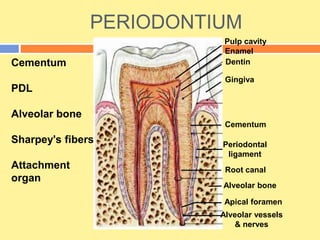
PERIODONTIUM
Cementum
PDL
Alveolar bone
Sharpey's fibers
Attachment
organ
Cementum
Periodontal
ligament
Alveolar bone
Apical foramen
Pulp cavity
Enamel
Dentin
Gingiva
Root canal
Alveolar vessels
& nerves
Definition
According to Carranza
“It is the calcified avascular mesenchymal tissue
that forms the outer covering of the anatomic
root.”
 Its primary function is to provide attachment to
the fibers of the periodontal ligament to the
roots of the teeth.
 first demonstrated microscopically in 1835 by
two pupils of Purkinje.
 begins at the cervical portion of the tooth at the
CEJ and continues to the apex of the root.
 It is also known as Substantia Ossea
 It is yellow in colour and is derived from the
dental follical.
 Unlike bone, it is avascular and does not have
the ability to remodel and is generally more
resistant to resorption than the bone.
CEMENTOGENESIS
 During tooth development the dental papilla gives
rise to odontoblasts and the dental pulp while the
dental follicle gives rise to Cementum, PDL and
alveolar bone.
 For cementogenesis to begin the Hertwig’s
epithelial root sheath must fragment.
 Once the root sheath disintegrates the underlying
newly formed dentine comes in contact with the
undifferentiated cells of the dental follicle.
This stimulates the activation of
cementoblasts which lay down the matrix
and begin cementogenesis.
COMPOSTION OF
CEMENTUM
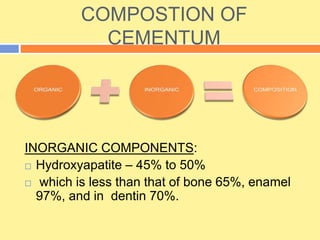
INORGANIC COMPONENTS:
 Hydroxyapatite – 45% to 50%
 which is less than that of bone 65%, enamel
97%, and in dentin 70%.
ORGANIC COMPONENTS
 Water-12%
 Organic- 23% and Inorganic-65%
 Type I collagen (up to 90%of organic content)
and protein polysaccharides (proteoglycans).
 Other collagen associated with cementum
include type III, V, VI and XII.
 Non-Collagenous proteins include–alkaline
phosphate, bone sialoprotein, fibronectin,
osteocalcin, osteonectin, Osteopontin,
proteoglycans, vitronectin and several growth
factors.
CELLS OF CEMENTUM
 Cementoblasts : They synthesize collagen
and protein polysaccharides that form the
organic matrix of Cementum.
 Cementocytes: During the formation of
Cementum, some cementoblasts become
incorporated into the cemental matrix. These
cells lie in spaces known as lacunae.
FIBERS OF CEMENTUM
 Extrinsic: They are incorporation of the
periodontal ligament fibers also known as
SHARPEY’S fibers. They run in the same
direction as the principle fibers.
 Intrinsic: They are produced by
cementoblasts and run parallel to the root
surface.
CLASSIFICATION
PRIMARY
SECONDARY
CELLULAR
ACELLULAR
EXTRINSIC
INTRINSIC
TIME OF
FORMATION
PRESENCE OR ABSENCE OF
CELLS
BASED ON FIBERS
ACELLULAR CEMENTUM
 It is first to be formed & covers approximately
the cervical third or half of the root.
 It does not contain any cells.
 This cementum is formed before the tooth
reaches the occlusal plane.
 Its thickness ranges from 30 to 230 µm.
 Sharpey’s fibers comprises most of the
structure of acellular cementum, which has a
principal role in supporting the tooth.
 Most fibres are inserted at approximately right
angles into the root surface & penetrate deep
into the cementum, while others enter from
several different directions.
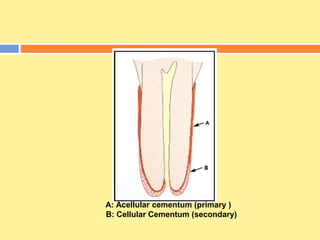
A: Acellular cementum (primary )
B: Cellular Cementum (secondary)
 Size, number & distribution of acellular
cementum increases with the function of teeth.
 Sharpey’s fibers are completely calcified in
acellular cementum, with the mineral crystals
oriented parallel to the fibrils as in dentin &
bone.
 In 10 – 50 µm wide zone near cementodentinal
junction, sharpey’s fibers are partially calcified.
CELLULAR CEMENTUM
 It is formed after the tooth reaches the occlusal
plane.
 It is more irregular and contains cells within its
matrix called cementocytes.
 The cementocytes are present in individual
spaces called lacunae that communicate with
each other through a system of anastomosing
canaliculi.
 It is less calcified than the acellular cementum.
 Sharpey’s fibers make up a smaller portion of
cellular cementum and are separated by collagen
fibers.
 Sharpey’s fibers may be completely or partially
calcified.
 It may have a central, uncalcified core surrounded
by a calcified border.
 Both acellular & cellular cementum are
arranged in lamellae separated by incremental
lines parallel to the long axis of the root
(Incremental lines of Salter).
 These lines represent “rest periods” in
cementum formation & are more mineralized
than the adjacent cementum.
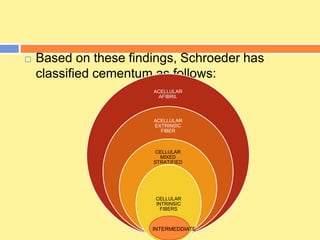
 Based on these findings, Schroeder has
classified cementum as follows:
ACELLULAR
AFIBRIL
ACELLULAR
EXTRINSIC
FIBER
CELLULAR
MIXED
STRATIFIED
CELLULAR
INTRINSIC
FIBERS
INTERMEDDIATE
ACELLULAR AFIBRILLAR CEMENTUM
(AAC)
 No cells, no extrinsic fibers, no intrinsic fibers,
except for a mineralized ground substance.
 It is a product of Cementoblasts. It is found in
coronal cementum with a thickness of 1 to
15µm.
ACELLULAR EXTRINSINC FIBER CEMENTUM
(AEFC):
 Composed entirely of densely packed bundles
of sharpey’s fibers.
 Lack cells. Its thickness is between 30 to
230µm.
 It is a product of fibroblasts & cementoblasts.
 It is found in the cervical third of roots in
CELLULAR MIXED STRATIFIED CEMENTUM
(CMSC):
 Composed of extrinsic, intrinsic fibers and
cells.
 co product of fibroblasts and Cementoblasts.
 Appears primarily in the apical third of the
roots, the apices and the Furcation areas.
 Its thickness ranges from 100 to 1000µm.
CELLULAR INTRINSINC FIBER CEMENTUM
(CIFC):
 It is composed of cells but no extrinsic collagen
fibers.
 It is a product of Cementoblasts.
 It fills resorption lacunae.
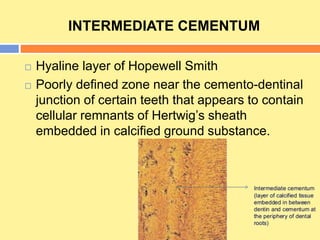
INTERMEDIATE CEMENTUM
 Hyaline layer of Hopewell Smith
 Poorly defined zone near the cemento-dentinal
junction of certain teeth that appears to contain
cellular remnants of Hertwig’s sheath
embedded in calcified ground substance.
PERMEABILITY OF
CEMENTUM
 In very young animals, acellular & cellular
cementum are very permeable & permit the
diffusion of dyes from pulp & external root
surface.
 In cellular cementum the canaliculi in some
areas are contiguous with dentinal tubuli.
 The permeability of cementum diminishes with
age.
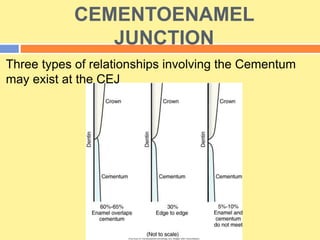
CEMENTOENAMEL
JUNCTION
Three types of relationships involving the Cementum
may exist at the CEJ
Three types:
 In about 60% to 65% cases cementum overlaps
enamel.
 In about 30% cases an edge to edge butt joint
exists.
 In about 5% to 10% cases enamel and cementum
fail to meet. In such cases gingival recession may
result in sensitivity due to exposed dentine
CEMENTODENTINAL
JUNCTION
 The terminal apical area of cementum where it
joins the internal root canal dentin.
 When root canal treatment is performed, the
obturating material should be at CDJ.
 No increase or decrease in the width of CDJ
with age; its width appears to remain relatively
stable; it is 2 to 3µm wide.
THICKNESS OF CEMENTUM
 Cementum deposition is a continuous process
that proceeds at varying rates throughout life.
 It is more rapid in apical regions, where it
compensates for tooth eruption, which itself
compensates for attrition.
 Thickness of cementum on the coronal half of
root varies from 16 to 60µm.
 It attains its greatest thickness in apical third &
in furcation areas(upto 150 – 200m).
 It is thicker in distal surfaces than in mesial
surfaces because of functional stimulation from
mesial drift over time.
AGE CHANGES IN
CEMENTUM
 Decreased permeability of cementum
 Width of cementum increases with age;
greater at the apical and furcation areas. This
may cause obstruction of apical foramen.
 The surface of cementum becomes irregular
due to calcification of fiber bundles attached to
the surface.
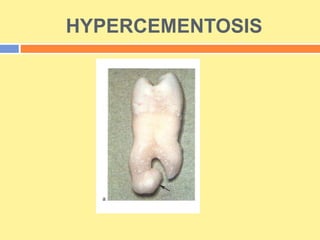
HYPERCEMENTOSIS
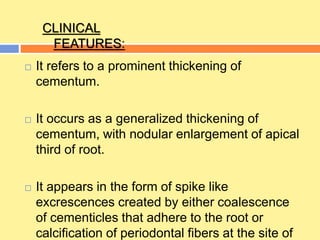
 It refers to a prominent thickening of
cementum.
 It occurs as a generalized thickening of
cementum, with nodular enlargement of apical
third of root.
 It appears in the form of spike like
excrescences created by either coalescence
of cementicles that adhere to the root or
calcification of periodontal fibers at the site of
CLINICAL
FEATURES:
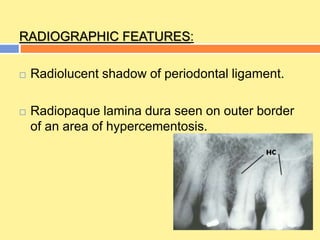
RADIOGRAPHIC FEATURES:
 Radiolucent shadow of periodontal ligament.
 Radiopaque lamina dura seen on outer border
of an area of hypercementosis.
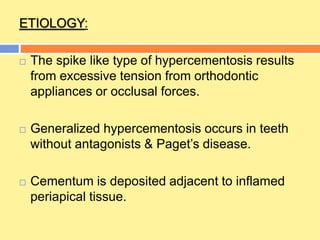
ETIOLOGY:
 The spike like type of hypercementosis results
from excessive tension from orthodontic
appliances or occlusal forces.
 Generalized hypercementosis occurs in teeth
without antagonists & Paget’s disease.
 Cementum is deposited adjacent to inflamed
periapical tissue.
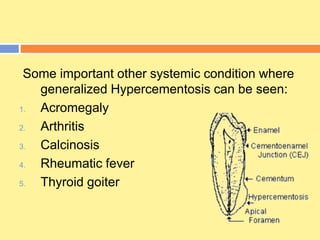
Some important other systemic condition where
generalized Hypercementosis can be seen:
1. Acromegaly
2. Arthritis
3. Calcinosis
4. Rheumatic fever
5. Thyroid goiter
CEMENTICLES
 These are globular masses of acellular
cementum
 Generally less than 0.5mm in diameter, round
lamellated cemental bodies that may lie free or
attached within the periodontal ligament.
 They exhibit concentric appositional layers of
afibrillar and/or fibrillar cementum.
 It is mostly found in aging persons or at the
Types
Free – with in PDL space
Attached- fused to cellular cementum
Interstitial –(totally incorporated in the cementum)
.
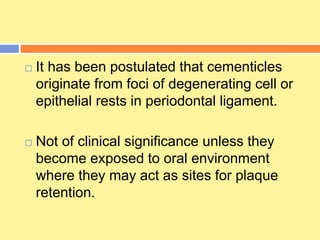
 It has been postulated that cementicles
originate from foci of degenerating cell or
epithelial rests in periodontal ligament.
 Not of clinical significance unless they
become exposed to oral environment
where they may act as sites for plaque
retention.
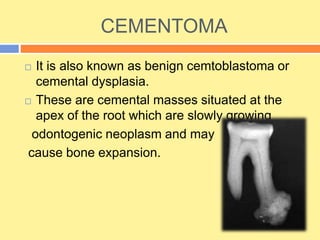
CEMENTOMA
 It is also known as benign cemtoblastoma or
cemental dysplasia.
 These are cemental masses situated at the
apex of the root which are slowly growing
odontogenic neoplasm and may
cause bone expansion.
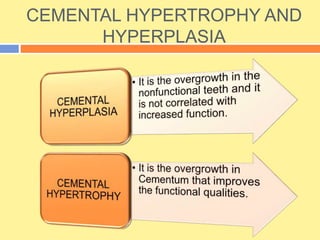
CEMENTAL HYPERTROPHY AND
HYPERPLASIA
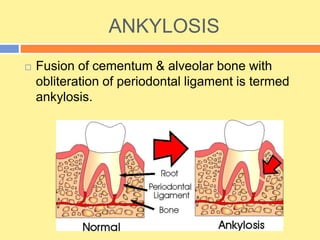
ANKYLOSIS
 Fusion of cementum & alveolar bone with
obliteration of periodontal ligament is termed
ankylosis.
CAUSES:
 Faulty replantation & transplantation of teeth in
which periodontal ligament is damaged.
 Embedded teeth.
 Chronic periapical infection.
 Trauma to deciduous teeth.
CLINICAL FEATURES:
 Ankylosed teeth lack physiologic mobility of normal
teeth.
 Ankylosed teeth have a special metallic percussion
sound & if ankylotic process continues, they will be
in infraocclusion.
RADIOGRAPHICALLY:
 Resorption lacunae are filled with bone, and
 the periodontal ligament space is missing.
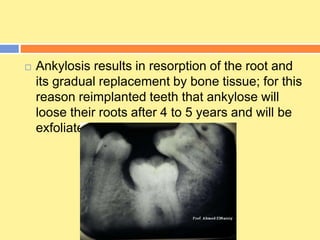
 Ankylosis results in resorption of the root and
its gradual replacement by bone tissue; for this
reason reimplanted teeth that ankylose will
loose their roots after 4 to 5 years and will be
exfoliated.
TREATMENT:
 No predictable treatment can be suggested.
 Treatment modalities range from a conservative
approach such as restorative intervention to surgical
extraction of affected tooth.
If a primary tooth was ankylosed,
If the onset is early
Extraction is recommended with placement of a
space maintainer.
If the onset is late
Can build up with composite to occlusal plan.
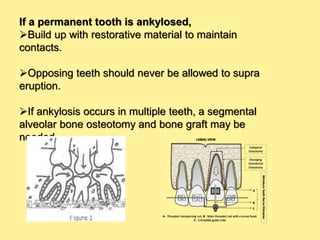
If a permanent tooth is ankylosed,
Build up with restorative material to maintain
contacts.
Opposing teeth should never be allowed to supra
eruption.
If ankylosis occurs in multiple teeth, a segmental
alveolar bone osteotomy and bone graft may be
needed.
CHANGES IN ANKYLOSED
TEETH
 As the periodontal ligament is replaced with
bone in ankylosed teeth proprioception is lost
because pressure receptors in the periodontal
ligament are deleted or do not function
correctly.
 Physiological drifting and eruption of teeth can
no longer occur and thus the ability of the teeth
and peridontium to adapt to altered force
levels or directions of force is greatly reduced.
CEMENTUM RESORPTION
- Trauma from occlusion
- Orthodontic movement
- pressure from malaligned
erupting teeth
- cyst ,tumor, embedded teeth
-replanted and transplanted teeth
- periapical and periodontal disease
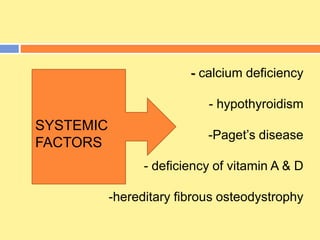
LOCAL
FACTORS
- calcium deficiency
- hypothyroidism
-Paget’s disease
- deficiency of vitamin A & D
-hereditary fibrous osteodystrophy
SYSTEMIC
FACTORS
CEMENTUM REPAIR
 It requires the presence of viable connective
tissue.
 If epithelium proliferates into an area of
resorption, repair will not take place.
 It can occur in devitalized as well as vital teeth.
Anatomic Repair:
The root outline is re-established as it was
before cemental resorption. Generally occurs
when the degree of destruction is low.
Functional Repair :
In the case of large cemental resorption or
destruction, repair does not re-establish the
same anatomic contour as before, because
only thin layers of acellular and cellular
cementum are deposited over the concavity
created by cemental resorption.
 To maintain the width of periodontal ligament,
the adjacent alveolar bone grows and takes the
shape of defect following the root surface. This
is done to improve the function of tooth, thus
called functional repair.
EXPOSURE OF CEMENTUM TO
ORAL ENVIRONMENT
 Cementum becomes exposed to the oral
environment in cases of:
Gingival Recession
Loss of attachment in pocket formation
 Bacterial invasion of cementum occurs
frequently in periodontal disease.
 Cementum caries can develop.
THANK YOU

Cementum

  • 1.
    CEMENTUM Dr. Raina Khanam MDS1st year DEPARTMENT OF PERIODONTICS
  • 2.
    CONTENTS  INTRODUCTION  DEFINITION COMPOSITION  PROPERTIES  CLASSIFICATION  PERMEABILITY OF CEMENTUM  CEMENTOENAMEL JUNCTION  CEMENTODENTINAL JUNCTION
  • 3.
     CLINICAL CONSIDERATIONS #HYPERCEMENTOSIS #CEMENTICLES #CEMENTOMA #CEMENTALHYPERPLASIA AND HYPERTROPHY #ANKYLOSIS # CENTAL RESORPTION  CEMENTUM REPAIR  EXPOSURE OF CEMENTUM TO ORAL ENVIRONMENT
  • 4.
  • 5.
    PERIODONTIUM Cementum PDL Alveolar bone Sharpey's fibers Attachment organ Cementum Periodontal ligament Alveolarbone Apical foramen Pulp cavity Enamel Dentin Gingiva Root canal Alveolar vessels & nerves
  • 6.
    Definition According to Carranza “Itis the calcified avascular mesenchymal tissue that forms the outer covering of the anatomic root.”
  • 7.
     Its primaryfunction is to provide attachment to the fibers of the periodontal ligament to the roots of the teeth.  first demonstrated microscopically in 1835 by two pupils of Purkinje.  begins at the cervical portion of the tooth at the CEJ and continues to the apex of the root.
  • 8.
     It isalso known as Substantia Ossea  It is yellow in colour and is derived from the dental follical.  Unlike bone, it is avascular and does not have the ability to remodel and is generally more resistant to resorption than the bone.
  • 9.
    CEMENTOGENESIS  During toothdevelopment the dental papilla gives rise to odontoblasts and the dental pulp while the dental follicle gives rise to Cementum, PDL and alveolar bone.  For cementogenesis to begin the Hertwig’s epithelial root sheath must fragment.  Once the root sheath disintegrates the underlying newly formed dentine comes in contact with the undifferentiated cells of the dental follicle.
  • 10.
    This stimulates theactivation of cementoblasts which lay down the matrix and begin cementogenesis.
  • 11.
    COMPOSTION OF CEMENTUM INORGANIC COMPONENTS: Hydroxyapatite – 45% to 50%  which is less than that of bone 65%, enamel 97%, and in dentin 70%.
  • 12.
    ORGANIC COMPONENTS  Water-12% Organic- 23% and Inorganic-65%  Type I collagen (up to 90%of organic content) and protein polysaccharides (proteoglycans).  Other collagen associated with cementum include type III, V, VI and XII.
  • 13.
     Non-Collagenous proteinsinclude–alkaline phosphate, bone sialoprotein, fibronectin, osteocalcin, osteonectin, Osteopontin, proteoglycans, vitronectin and several growth factors.
  • 14.
    CELLS OF CEMENTUM Cementoblasts : They synthesize collagen and protein polysaccharides that form the organic matrix of Cementum.  Cementocytes: During the formation of Cementum, some cementoblasts become incorporated into the cemental matrix. These cells lie in spaces known as lacunae.
  • 15.
    FIBERS OF CEMENTUM Extrinsic: They are incorporation of the periodontal ligament fibers also known as SHARPEY’S fibers. They run in the same direction as the principle fibers.  Intrinsic: They are produced by cementoblasts and run parallel to the root surface.
  • 16.
  • 17.
    ACELLULAR CEMENTUM  Itis first to be formed & covers approximately the cervical third or half of the root.  It does not contain any cells.  This cementum is formed before the tooth reaches the occlusal plane.  Its thickness ranges from 30 to 230 µm.
  • 18.
     Sharpey’s fiberscomprises most of the structure of acellular cementum, which has a principal role in supporting the tooth.  Most fibres are inserted at approximately right angles into the root surface & penetrate deep into the cementum, while others enter from several different directions.
  • 19.
    A: Acellular cementum(primary ) B: Cellular Cementum (secondary)
  • 20.
     Size, number& distribution of acellular cementum increases with the function of teeth.  Sharpey’s fibers are completely calcified in acellular cementum, with the mineral crystals oriented parallel to the fibrils as in dentin & bone.  In 10 – 50 µm wide zone near cementodentinal junction, sharpey’s fibers are partially calcified.
  • 21.
    CELLULAR CEMENTUM  Itis formed after the tooth reaches the occlusal plane.  It is more irregular and contains cells within its matrix called cementocytes.  The cementocytes are present in individual spaces called lacunae that communicate with each other through a system of anastomosing canaliculi.
  • 22.
     It isless calcified than the acellular cementum.  Sharpey’s fibers make up a smaller portion of cellular cementum and are separated by collagen fibers.  Sharpey’s fibers may be completely or partially calcified.  It may have a central, uncalcified core surrounded by a calcified border.
  • 23.
     Both acellular& cellular cementum are arranged in lamellae separated by incremental lines parallel to the long axis of the root (Incremental lines of Salter).  These lines represent “rest periods” in cementum formation & are more mineralized than the adjacent cementum.
  • 24.
     Based onthese findings, Schroeder has classified cementum as follows: ACELLULAR AFIBRIL ACELLULAR EXTRINSIC FIBER CELLULAR MIXED STRATIFIED CELLULAR INTRINSIC FIBERS INTERMEDDIATE
  • 25.
    ACELLULAR AFIBRILLAR CEMENTUM (AAC) No cells, no extrinsic fibers, no intrinsic fibers, except for a mineralized ground substance.  It is a product of Cementoblasts. It is found in coronal cementum with a thickness of 1 to 15µm.
  • 26.
    ACELLULAR EXTRINSINC FIBERCEMENTUM (AEFC):  Composed entirely of densely packed bundles of sharpey’s fibers.  Lack cells. Its thickness is between 30 to 230µm.  It is a product of fibroblasts & cementoblasts.  It is found in the cervical third of roots in
  • 27.
    CELLULAR MIXED STRATIFIEDCEMENTUM (CMSC):  Composed of extrinsic, intrinsic fibers and cells.  co product of fibroblasts and Cementoblasts.  Appears primarily in the apical third of the roots, the apices and the Furcation areas.  Its thickness ranges from 100 to 1000µm.
  • 28.
    CELLULAR INTRINSINC FIBERCEMENTUM (CIFC):  It is composed of cells but no extrinsic collagen fibers.  It is a product of Cementoblasts.  It fills resorption lacunae.
  • 29.
    INTERMEDIATE CEMENTUM  Hyalinelayer of Hopewell Smith  Poorly defined zone near the cemento-dentinal junction of certain teeth that appears to contain cellular remnants of Hertwig’s sheath embedded in calcified ground substance.
  • 30.
    PERMEABILITY OF CEMENTUM  Invery young animals, acellular & cellular cementum are very permeable & permit the diffusion of dyes from pulp & external root surface.  In cellular cementum the canaliculi in some areas are contiguous with dentinal tubuli.  The permeability of cementum diminishes with age.
  • 31.
    CEMENTOENAMEL JUNCTION Three types ofrelationships involving the Cementum may exist at the CEJ
  • 32.
    Three types:  Inabout 60% to 65% cases cementum overlaps enamel.  In about 30% cases an edge to edge butt joint exists.  In about 5% to 10% cases enamel and cementum fail to meet. In such cases gingival recession may result in sensitivity due to exposed dentine
  • 33.
    CEMENTODENTINAL JUNCTION  The terminalapical area of cementum where it joins the internal root canal dentin.  When root canal treatment is performed, the obturating material should be at CDJ.  No increase or decrease in the width of CDJ with age; its width appears to remain relatively stable; it is 2 to 3µm wide.
  • 34.
    THICKNESS OF CEMENTUM Cementum deposition is a continuous process that proceeds at varying rates throughout life.  It is more rapid in apical regions, where it compensates for tooth eruption, which itself compensates for attrition.  Thickness of cementum on the coronal half of root varies from 16 to 60µm.
  • 35.
     It attainsits greatest thickness in apical third & in furcation areas(upto 150 – 200m).  It is thicker in distal surfaces than in mesial surfaces because of functional stimulation from mesial drift over time.
  • 36.
    AGE CHANGES IN CEMENTUM Decreased permeability of cementum  Width of cementum increases with age; greater at the apical and furcation areas. This may cause obstruction of apical foramen.  The surface of cementum becomes irregular due to calcification of fiber bundles attached to the surface.
  • 37.
  • 38.
     It refersto a prominent thickening of cementum.  It occurs as a generalized thickening of cementum, with nodular enlargement of apical third of root.  It appears in the form of spike like excrescences created by either coalescence of cementicles that adhere to the root or calcification of periodontal fibers at the site of CLINICAL FEATURES:
  • 39.
    RADIOGRAPHIC FEATURES:  Radiolucentshadow of periodontal ligament.  Radiopaque lamina dura seen on outer border of an area of hypercementosis.
  • 40.
    ETIOLOGY:  The spikelike type of hypercementosis results from excessive tension from orthodontic appliances or occlusal forces.  Generalized hypercementosis occurs in teeth without antagonists & Paget’s disease.  Cementum is deposited adjacent to inflamed periapical tissue.
  • 41.
    Some important othersystemic condition where generalized Hypercementosis can be seen: 1. Acromegaly 2. Arthritis 3. Calcinosis 4. Rheumatic fever 5. Thyroid goiter
  • 42.
    CEMENTICLES  These areglobular masses of acellular cementum  Generally less than 0.5mm in diameter, round lamellated cemental bodies that may lie free or attached within the periodontal ligament.  They exhibit concentric appositional layers of afibrillar and/or fibrillar cementum.  It is mostly found in aging persons or at the
  • 43.
    Types Free – within PDL space Attached- fused to cellular cementum Interstitial –(totally incorporated in the cementum) .
  • 44.
     It hasbeen postulated that cementicles originate from foci of degenerating cell or epithelial rests in periodontal ligament.  Not of clinical significance unless they become exposed to oral environment where they may act as sites for plaque retention.
  • 45.
    CEMENTOMA  It isalso known as benign cemtoblastoma or cemental dysplasia.  These are cemental masses situated at the apex of the root which are slowly growing odontogenic neoplasm and may cause bone expansion.
  • 46.
  • 47.
    ANKYLOSIS  Fusion ofcementum & alveolar bone with obliteration of periodontal ligament is termed ankylosis.
  • 48.
    CAUSES:  Faulty replantation& transplantation of teeth in which periodontal ligament is damaged.  Embedded teeth.  Chronic periapical infection.  Trauma to deciduous teeth.
  • 49.
    CLINICAL FEATURES:  Ankylosedteeth lack physiologic mobility of normal teeth.  Ankylosed teeth have a special metallic percussion sound & if ankylotic process continues, they will be in infraocclusion. RADIOGRAPHICALLY:  Resorption lacunae are filled with bone, and  the periodontal ligament space is missing.
  • 50.
     Ankylosis resultsin resorption of the root and its gradual replacement by bone tissue; for this reason reimplanted teeth that ankylose will loose their roots after 4 to 5 years and will be exfoliated.
  • 51.
    TREATMENT:  No predictabletreatment can be suggested.  Treatment modalities range from a conservative approach such as restorative intervention to surgical extraction of affected tooth. If a primary tooth was ankylosed, If the onset is early Extraction is recommended with placement of a space maintainer. If the onset is late Can build up with composite to occlusal plan.
  • 52.
    If a permanenttooth is ankylosed, Build up with restorative material to maintain contacts. Opposing teeth should never be allowed to supra eruption. If ankylosis occurs in multiple teeth, a segmental alveolar bone osteotomy and bone graft may be needed.
  • 53.
    CHANGES IN ANKYLOSED TEETH As the periodontal ligament is replaced with bone in ankylosed teeth proprioception is lost because pressure receptors in the periodontal ligament are deleted or do not function correctly.  Physiological drifting and eruption of teeth can no longer occur and thus the ability of the teeth and peridontium to adapt to altered force levels or directions of force is greatly reduced.
  • 54.
    CEMENTUM RESORPTION - Traumafrom occlusion - Orthodontic movement - pressure from malaligned erupting teeth - cyst ,tumor, embedded teeth -replanted and transplanted teeth - periapical and periodontal disease LOCAL FACTORS
  • 55.
    - calcium deficiency -hypothyroidism -Paget’s disease - deficiency of vitamin A & D -hereditary fibrous osteodystrophy SYSTEMIC FACTORS
  • 56.
    CEMENTUM REPAIR  Itrequires the presence of viable connective tissue.  If epithelium proliferates into an area of resorption, repair will not take place.  It can occur in devitalized as well as vital teeth.
  • 57.
    Anatomic Repair: The rootoutline is re-established as it was before cemental resorption. Generally occurs when the degree of destruction is low. Functional Repair : In the case of large cemental resorption or destruction, repair does not re-establish the same anatomic contour as before, because only thin layers of acellular and cellular cementum are deposited over the concavity created by cemental resorption.
  • 58.
     To maintainthe width of periodontal ligament, the adjacent alveolar bone grows and takes the shape of defect following the root surface. This is done to improve the function of tooth, thus called functional repair.
  • 59.
    EXPOSURE OF CEMENTUMTO ORAL ENVIRONMENT  Cementum becomes exposed to the oral environment in cases of: Gingival Recession Loss of attachment in pocket formation  Bacterial invasion of cementum occurs frequently in periodontal disease.  Cementum caries can develop.
  • 60.

Editor's Notes

  • #6 The periodontium consist of investing nd supporting tissues of the tooth (gingiva, periodontal ligament, cementum and alveolar bone)
  • #7 Anatomic root: that portion of a tooth extending from the cervical line to its apical extremity.
  • #9 Why less resistant.
  • #24 Incremental lines of salter.