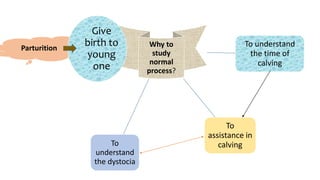
Why to
study
normal
process?
To understand
the time of
calving
To
assistance in
calvingTo
understand
the dystocia
Parturition
Give
birth to
young
one
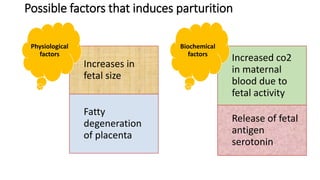
Possible factors that induces parturition
Increases in
fetal size
Fatty
degeneration
of placenta
Physiological
factors
Increased co2
in maternal
blood due to
fetal activity
Release of fetal
antigen
serotonin
Biochemical
factors
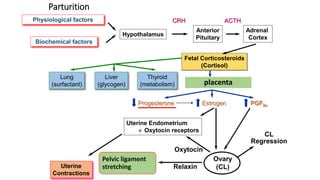
Parturition
Physiological factors
Biochemical factors
Hypothalamus
Anterior
Pituitary
Adrenal
Cortex
CRH ACTH
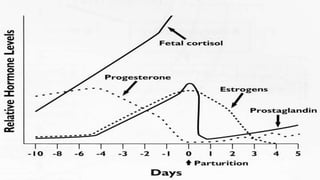
Fetal Corticosteroids
(Cortisol)
Lung
(surfactant)
Liver
(glycogen)
Thyroid
(metabolism)
Progesterone Estrogen PGF2a
Uterine
Contractions
Relaxin
Oxytocin
Uterine Endometrium
» Oxytocin receptors
Ovary
(CL)
CL
Regression
Pelvic ligament
stretching
placenta
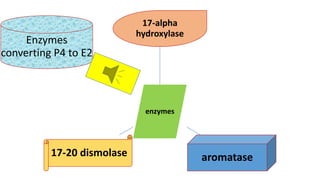
enzymes
17-alpha
hydroxylase
aromatase17-20 dismolase
Enzymes
converting P4 to E2
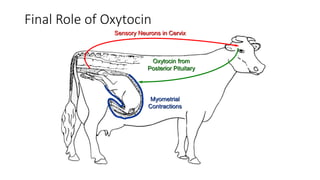
Final Role of Oxytocin
Sensory Neurons in Cervix
Oxytocin from
Posterior Pituitary
Myometrial
Contractions
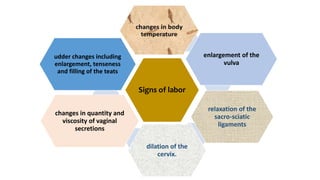
Signs of labor
enlargement of the
vulva
relaxation of the
sacro-sciatic
ligaments
dilation of the
cervix.
changes in quantity and
viscosity of vaginal
secretions
udder changes including
enlargement, tenseness
and filling of the teats
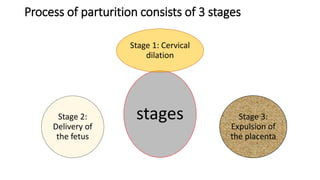
Process of parturition consists of 3 stages
stages
Stage 1: Cervical
dilation
Stage 3:
Expulsion of
the placenta
Stage 2:
Delivery of
the fetus
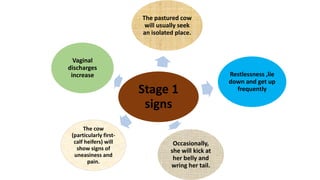
Stage 1
signs
The pastured cow
will usually seek
an isolated place.
Restlessness ,lie
down and get up
frequently
Occasionally,
she will kick at
her belly and
wring her tail.
The cow
(particularly first-
calf heifers) will
show signs of
uneasiness and
pain.
Vaginal
discharges
increase
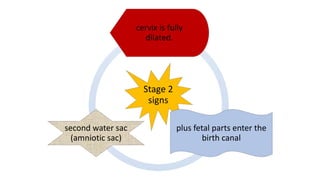
Stage 2
signs
cervix is fully
dilated.
plus fetal parts enter the
birth canal
second water sac
(amniotic sac)
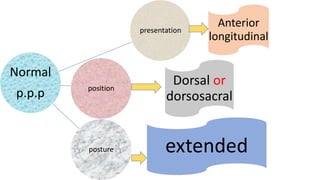
Normal
p.p.p
presentation
position
posture
Anterior
longitudinal
Dorsal or
dorsosacral
extended
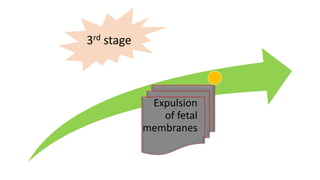
Expulsion
of fetal
membranes
3rd stage

Normal parturition process in large animals (bovine