Parturition and
induction
Chaiwat Jarassaeng
http://vet.kku.ac.th/chaiwat/teaching
Average length of gestation
Species Length in Days Avg. in Months*
Cattle 279-292 9
Goats 145-155 5
Sheep 144-151 5
Swine 112-115 3 mo. 3 wks. 3
days
Horse 330-342 11
*Average varies with animals and breeds.
What is Parturition?
 Act of process of giving birth
 Parturition
 Labor
 Delivery
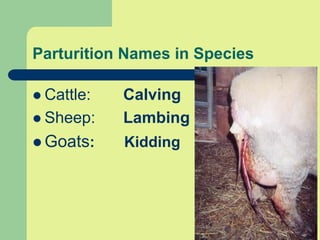
Parturition Names in Species
 Cattle: Calving
 Sheep: Lambing
 Goats: Kidding
Fetal control of parturition
 fetus controls time of parturition due to
stress response :
– lack of space
– lack of gas exchange
– lack of nutrients
Hormonal changes at the end of gestation
Fetal pituitary - hypothalamus axis essential
 increased stress from fetal nutritional demands
and placental insufficiency
 Hypothalamus release CRH
(Corticotropin releasing hormone)
 Anterior pituitary in turn releases ACTH
Hormonal changes at the end of gestation
Fetal adrenal gland
 in response to ACTH releases cortisol (corticosteroids)
– effects of cortisol on fetus
 Lung produces surfactants
 liver increases storage of glycogen
 thyroid increases metabolism
– effects of cortisol on placentome
 shift from progesterone to estradiol production
 progesterone decreases
 estrogen increases
 PGF increases
Hormonal changes at the end of gestation
Placentome hormones
 estradiol
– increase gap junctions in myometrium
 leads to better co-ordination and
communication among muscle cells in the
myometrium
 begin to get coordinated contractions toward
the cervix
– increase in uterine oxytocin receptors
– primes cervix to response to relaxin
– stimulates ovary to secrete relaxin and oxytocin
– acts with PGF to trigger CL regression
Hormonal changes at the end of gestation
 Placentome hormones
PGF
– regression of CL
– synthesis and release of oxytocin and
relaxin from ovary (in some species relaxin
from placenta)
– stimulates most of the contractions in the
uterus
Hormonal changes at the end of gestation
 progesterone
– shift from progesterone to estrogen production
leads to its decrease from the placentome
– PGF stimulates luteolysis so progesterone from
CL decreases
– release from "progesterone block“
Oxytocin
 stimulates final contractions of uterus but only once
fetal head enters cervix
Hormonal changes at the end of gestation
Relaxin
 comes from ovary or placenta
 synthesis stimulated by PGF
 stimulates softening of the cervical
connective tissue to cause dilation
 promotes elasticity of the pelvic ligaments
Signs of Approaching Parturition
 Distended abdomen
 Mammary development & milk secretion
 Swollen vulva and relaxed pelvic ligaments
 Mucous discharge
 Relentlessness and separation from group
 Labor and Contractions
Stages of Parturition
 Stage 1- Preparatory Stage (2 to 12 hours)
 Stage 2- Birthing Process (30 to 180 mins)
 Stage 3- Placenta Expulsion (1 hr to 12 hr)
Stage 1- preparatory stage
 Characterized by dilation of the cervix.
 Rhythmic contractions of the uterus.
 At the end of this stage, the cervix expands,
allowing the uterus and vagina to become a
continuous canal.
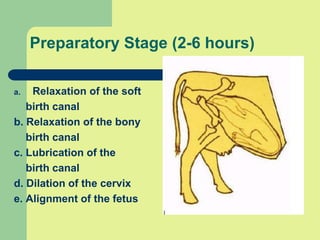
Preparatory Stage (2-6 hours)
a. Relaxation of the soft
birth canal
b. Relaxation of the bony
birth canal
c. Lubrication of the
birth canal
d. Dilation of the cervix
e. Alignment of the fetus
Stage 2- Birthing Process
 Increase in contractions with abdominal
pressing.
 The placenta, along with the head and
forelegs, are forced into the vagina (birth
canal).
 Presentation is forelegs first with the nose
resting on the forelegs.
– Anterior “head first”
Stage 2- Birthing Process
 Cow usually lying down
 Fetus enters birth canal
 Front feet and head
protrude first
 Calf delivery
completed
Stage 2- Birthing Process
– strong uterine contractions
– rupture of the allantochorion
– appearence of amnion
– maternal recumbency and straining
– not only uterine but abdominal contractions
as well
– rupture of the amnion and delivery
Stage 3- Placenta Expulsion
 Associated with uterine contractions
 Normally expelled within 12 hours
 Placenta of each species should be
expelled within the following time periods
– Cow and ewe - 8 to 24 hours
Stage 3- Placenta Expulsion
– uterine contractions decrease but continue
– chorionic villi loosen
– expulsion of placenta
– delayed in ruminants due to presence of
cotelydons separating independently
– suckling induces oxytocin release which
triggers further uterine contractions
Signs of Parturition in Cattle
 One week - mammary glands fill with milk,
tail head ligaments relax, and you will see a
waxing of teats.
 12-24 hours - frequent defecation and
urination, anorexia, looking for young, makes
a nest or seeks out an isolated area.
Cattle Parturition
– Parturition
 82% :- occur between noon and midnight,
placenta  eaten by cow
– Bonding
 heritability of maternal behavior :- low in
cattle, some breed -- more than the other
breed
 cow groom their calve -- early postpartum,
concentrating on the back and abdomen
Cattle Parturition
– Bonding (cont)
 critical period for formation of the cow-calf
bond -- the first few hours postpartum
– Suckling
 passive transfer of immunity to calves :-
poor in dystocia
Cattle Parturition
 Relaxation of the pelvic ligaments
 Relaxation of the vulva and perineum
 Enlargement and edema of the udder
 Mucoid discharge from the vagina and
dissolution of the cervical seal
 Segregation from the herd along with
restlessness and anorexia may be exhibited
in the last few hours before parturition and
heifers may show signs of abdominal pain.
Signs of Parturition in Sheep
 Ten days before lambing the ewes teats become
firm and full of milk, her vulva slackens and
becomes slightly swollen.
 Closer to lambing, the ewe's cervical seal passes
from the vulva as a thick, creamy, white mucus.
 In the final stages prior to lambing, the ewe
becomes anxious and uneasy and continually
switches from a reclining to a standing position.
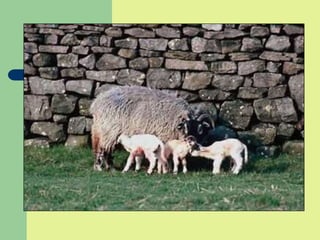
Sheep Parturition
– Licking and sucking
– Acceptance of the lamb
– Mutual recognition by the ewe and lamb
recognition of the lamb by the ewe : depend
on at least 3 senses : olfactory, auditory,
and vision
Goat Parturition
– When parturition approach, multiparous doe,
leave the herd -- seek a sheltered place, and
defend this area : lick the kid, vocalize
frequently
– Intensive maternal behavior -- short-lived
– the kid -- left the does to hide and the does
will rejoin the herd or stay
Induction of Parturition
 Indications and contraindications
 Criteria
 Methods
 Complications
Induction of Parturition in Cows
Indications
 To prevent dystocias due to feto-pelvic
disproportion.
 When programming calving and pasture availability.
 In the management of medical problems, such as
hydrops allantois.
 Abortion of small heifers under feedlot conditions
 When damaged to an engorged pendulous udder is
likely.
Induction of Parturition in Cows
Contraindications
 Should not be used in animals that are more than 2-3
weeks away from calving, as such, the breeding date
should be known.
 Corticosteroids should not be used to induce
parturition when there is a dead fetus in utero, e.g.
fetal mummification.
 Corticosteroids should not be used in animals with
known or latent infections because of their
immunosuppressive properties.
Induction of Parturition in Cows
Side effects
 The most common problem associated with
the induction of parturition in cows is
retention of the fetal membranes
Induction of Parturition in Cows
Short-acting Corticosteroids
 Dexamethasone (20 mg) or flumethasone (10
mg) IM
 is about 80% - 90% effective when administered
to cows within 2 weeks of full term.
 The interval from injection to parturition is about
48 hours ( 24-72 hours).
 The incidence of retention of the fetal
membranes is estimated to be about 75%.
Induction of Parturition in Cows
Long-acting Corticosteroids
 Dexamethasone trimethylacetate (20 mg) or
Betamethasone suspension 20 mg) I.M.
 30 days before term
 Parturition occurs about 15+8 days after injection
and is associated with a lower incidence (9 to 22%)
of retained fetal membranes .
Induction of Parturition in Cows
Long-acting Corticosteroids
 high incidence of calf mortality (17 to 45%) that is
thought to be associated with premature placental
separation and/or uterine inertia, and the colostrums
immunoglobulin concentration is reduced.
 Shorter calving patterns can be attained by injecting a
short acting corticosteroid or prostaglandin 7 to 12
days after the long-acting injection. Most cows tend to
calve 2 to 3 days later.
Induction of Parturition in Cows
Prostaglandins
 PGF2 alpha (Lutalyse®) (25 mg), Cloprostenol (Estrumate ®) (500
ug) and other synthetic analogs I.M. injection.
 Calving occurs 24 to 72 hours later in 90-100% of cows treated.
 are effective even when the fetus/placenta is not viable. Calf
viability is good if given less than 2 weeks prior to term.
 The incidence of retained fetal membrane is similar to the short
acting corticosteroids.
 Higher incidence of dystocia than with the corticosteroids.
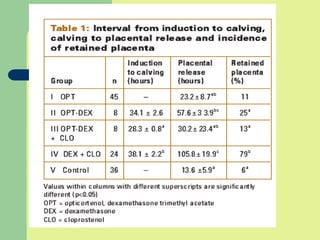
Induction of Parturition in Cows
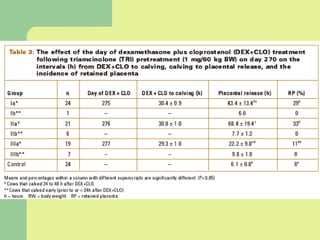
Corticosteroid-Prostaglandin Combination
 With this combination, calving occurs sooner
than for either drug alone (34.6+-1.4 hours).
 The incidence of retained fetal membranes is
equally as high as when each drug is used
alone.
 500 ug cloprostenol I.M. or 25 mg PGF2 alpha
(lutalyse ®) I.M. and 25 mg. dexamethasone I.M.
 The advantages may be outweighed by the cost.
Induction of Parturition in Cows
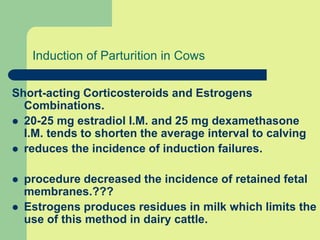
Short-acting Corticosteroids and Estrogens
Combinations.
 20-25 mg estradiol I.M. and 25 mg dexamethasone
I.M. tends to shorten the average interval to calving
 reduces the incidence of induction failures.
 procedure decreased the incidence of retained fetal
membranes.???
 Estrogens produces residues in milk which limits the
use of this method in dairy cattle.
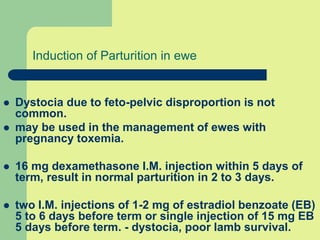
Induction of Parturition in ewe
 Dystocia due to feto-pelvic disproportion is not
common.
 may be used in the management of ewes with
pregnancy toxemia.
 16 mg dexamethasone I.M. injection within 5 days of
term, result in normal parturition in 2 to 3 days.
 two I.M. injections of 1-2 mg of estradiol benzoate (EB)
5 to 6 days before term or single injection of 15 mg EB
5 days before term. - dystocia, poor lamb survival.
Induction of Parturition in Goats
Advantages
 Improved kid survival, especially in severe weather
 Reduced kid and doe mortality because of better
observation by the owner and earlier intervention in
cases of dystocia.
 increased predictability of the time of parturition.
 Increased ability to obtain kids free of colostrum and
with minimal contact with the mother.
 This is important in disease control e.g. caprine
arthritis encephalitis and mycoplama.
Induction of Parturition in Goats
Disadvantages
 Owner reluctance to interfere with the normal
process.
 Increased responsibility on the owner to
keep accurate breeding records and to
guarantee no subsequent breedings,
accidental or otherwise.
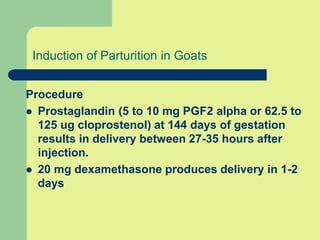
Induction of Parturition in Goats
Procedure
 Prostaglandin (5 to 10 mg PGF2 alpha or 62.5 to
125 ug cloprostenol) at 144 days of gestation
results in delivery between 27-35 hours after
injection.
 20 mg dexamethasone produces delivery in 1-2
days
Post- calving problems
 Haemorrhage
 Uterus rupture
 Uterine prolapse
 Milk fever
 Ketosis
 Retained placenta
 Metritis
 Downer’s cow syndrome
Haemorrhage
 Birth canal
 Rupture of tissue
 Broad ligament rupture
TX:
- Depended on degree
- Oxytocin
Uterus rupture
 High incidence in cattle and goat
 Fetopelvic disproportion
Diag: serosa, intestine, rumen
Tx: oxytocin
ABO
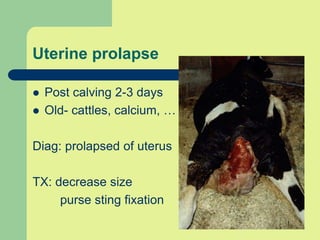
Uterine prolapse
 Post calving 2-3 days
 Old- cattles, calcium, …
Diag: prolapsed of uterus
TX: decrease size
purse sting fixation
Milk fever
 Calcium  3-7 %
 Vit D
 Depress, anorexia, low temp, recumbency
Tx: slow calcium IV
Ketosis
 2 wks PP
 Ketone bodies
 Milk drop.
 Feed drop.
TX: Dexa, Propylene glycol
BCS management before calving
Retained placenta
 Retained fetal membrane
 Low Vit E, Se, D
TX: oxytocin within 24 hrs
Manual removal??
ABC=> OTC
Prevent: ADE, Se supplement 2 wks before
calving
Metritis
 From retained fetal membrane
 Dystocia
 Vaginal discharge
Tx: OTC 1 g. infuse
Downer’s cow syndrome
 Low mineral (calcium)
 Acute mastitis
 Obturator damage
Tx: Calcium
Supportive

parturition10.ppt

  • 1.
  • 2.
    Average length ofgestation Species Length in Days Avg. in Months* Cattle 279-292 9 Goats 145-155 5 Sheep 144-151 5 Swine 112-115 3 mo. 3 wks. 3 days Horse 330-342 11 *Average varies with animals and breeds.
  • 3.
    What is Parturition? Act of process of giving birth  Parturition  Labor  Delivery
  • 4.
    Parturition Names inSpecies  Cattle: Calving  Sheep: Lambing  Goats: Kidding
  • 5.
    Fetal control ofparturition  fetus controls time of parturition due to stress response : – lack of space – lack of gas exchange – lack of nutrients
  • 6.
    Hormonal changes atthe end of gestation Fetal pituitary - hypothalamus axis essential  increased stress from fetal nutritional demands and placental insufficiency  Hypothalamus release CRH (Corticotropin releasing hormone)  Anterior pituitary in turn releases ACTH
  • 7.
    Hormonal changes atthe end of gestation Fetal adrenal gland  in response to ACTH releases cortisol (corticosteroids) – effects of cortisol on fetus  Lung produces surfactants  liver increases storage of glycogen  thyroid increases metabolism – effects of cortisol on placentome  shift from progesterone to estradiol production  progesterone decreases  estrogen increases  PGF increases
  • 8.
    Hormonal changes atthe end of gestation Placentome hormones  estradiol – increase gap junctions in myometrium  leads to better co-ordination and communication among muscle cells in the myometrium  begin to get coordinated contractions toward the cervix – increase in uterine oxytocin receptors – primes cervix to response to relaxin – stimulates ovary to secrete relaxin and oxytocin – acts with PGF to trigger CL regression
  • 9.
    Hormonal changes atthe end of gestation  Placentome hormones PGF – regression of CL – synthesis and release of oxytocin and relaxin from ovary (in some species relaxin from placenta) – stimulates most of the contractions in the uterus
  • 10.
    Hormonal changes atthe end of gestation  progesterone – shift from progesterone to estrogen production leads to its decrease from the placentome – PGF stimulates luteolysis so progesterone from CL decreases – release from "progesterone block“ Oxytocin  stimulates final contractions of uterus but only once fetal head enters cervix
  • 11.
    Hormonal changes atthe end of gestation Relaxin  comes from ovary or placenta  synthesis stimulated by PGF  stimulates softening of the cervical connective tissue to cause dilation  promotes elasticity of the pelvic ligaments
  • 13.
    Signs of ApproachingParturition  Distended abdomen  Mammary development & milk secretion  Swollen vulva and relaxed pelvic ligaments  Mucous discharge  Relentlessness and separation from group  Labor and Contractions
  • 14.
    Stages of Parturition Stage 1- Preparatory Stage (2 to 12 hours)  Stage 2- Birthing Process (30 to 180 mins)  Stage 3- Placenta Expulsion (1 hr to 12 hr)
  • 15.
    Stage 1- preparatorystage  Characterized by dilation of the cervix.  Rhythmic contractions of the uterus.  At the end of this stage, the cervix expands, allowing the uterus and vagina to become a continuous canal.
  • 16.
    Preparatory Stage (2-6hours) a. Relaxation of the soft birth canal b. Relaxation of the bony birth canal c. Lubrication of the birth canal d. Dilation of the cervix e. Alignment of the fetus
  • 17.
    Stage 2- BirthingProcess  Increase in contractions with abdominal pressing.  The placenta, along with the head and forelegs, are forced into the vagina (birth canal).  Presentation is forelegs first with the nose resting on the forelegs. – Anterior “head first”
  • 18.
    Stage 2- BirthingProcess  Cow usually lying down  Fetus enters birth canal  Front feet and head protrude first  Calf delivery completed
  • 19.
    Stage 2- BirthingProcess – strong uterine contractions – rupture of the allantochorion – appearence of amnion – maternal recumbency and straining – not only uterine but abdominal contractions as well – rupture of the amnion and delivery
  • 20.
    Stage 3- PlacentaExpulsion  Associated with uterine contractions  Normally expelled within 12 hours  Placenta of each species should be expelled within the following time periods – Cow and ewe - 8 to 24 hours
  • 21.
    Stage 3- PlacentaExpulsion – uterine contractions decrease but continue – chorionic villi loosen – expulsion of placenta – delayed in ruminants due to presence of cotelydons separating independently – suckling induces oxytocin release which triggers further uterine contractions
  • 24.
    Signs of Parturitionin Cattle  One week - mammary glands fill with milk, tail head ligaments relax, and you will see a waxing of teats.  12-24 hours - frequent defecation and urination, anorexia, looking for young, makes a nest or seeks out an isolated area.
  • 25.
    Cattle Parturition – Parturition 82% :- occur between noon and midnight, placenta  eaten by cow – Bonding  heritability of maternal behavior :- low in cattle, some breed -- more than the other breed  cow groom their calve -- early postpartum, concentrating on the back and abdomen
  • 26.
    Cattle Parturition – Bonding(cont)  critical period for formation of the cow-calf bond -- the first few hours postpartum – Suckling  passive transfer of immunity to calves :- poor in dystocia
  • 27.
    Cattle Parturition  Relaxationof the pelvic ligaments  Relaxation of the vulva and perineum  Enlargement and edema of the udder  Mucoid discharge from the vagina and dissolution of the cervical seal  Segregation from the herd along with restlessness and anorexia may be exhibited in the last few hours before parturition and heifers may show signs of abdominal pain.
  • 28.
    Signs of Parturitionin Sheep  Ten days before lambing the ewes teats become firm and full of milk, her vulva slackens and becomes slightly swollen.  Closer to lambing, the ewe's cervical seal passes from the vulva as a thick, creamy, white mucus.  In the final stages prior to lambing, the ewe becomes anxious and uneasy and continually switches from a reclining to a standing position.
  • 29.
    Sheep Parturition – Lickingand sucking – Acceptance of the lamb – Mutual recognition by the ewe and lamb recognition of the lamb by the ewe : depend on at least 3 senses : olfactory, auditory, and vision
  • 30.
    Goat Parturition – Whenparturition approach, multiparous doe, leave the herd -- seek a sheltered place, and defend this area : lick the kid, vocalize frequently – Intensive maternal behavior -- short-lived – the kid -- left the does to hide and the does will rejoin the herd or stay
  • 31.
    Induction of Parturition Indications and contraindications  Criteria  Methods  Complications
  • 32.
    Induction of Parturitionin Cows Indications  To prevent dystocias due to feto-pelvic disproportion.  When programming calving and pasture availability.  In the management of medical problems, such as hydrops allantois.  Abortion of small heifers under feedlot conditions  When damaged to an engorged pendulous udder is likely.
  • 33.
    Induction of Parturitionin Cows Contraindications  Should not be used in animals that are more than 2-3 weeks away from calving, as such, the breeding date should be known.  Corticosteroids should not be used to induce parturition when there is a dead fetus in utero, e.g. fetal mummification.  Corticosteroids should not be used in animals with known or latent infections because of their immunosuppressive properties.
  • 34.
    Induction of Parturitionin Cows Side effects  The most common problem associated with the induction of parturition in cows is retention of the fetal membranes
  • 35.
    Induction of Parturitionin Cows Short-acting Corticosteroids  Dexamethasone (20 mg) or flumethasone (10 mg) IM  is about 80% - 90% effective when administered to cows within 2 weeks of full term.  The interval from injection to parturition is about 48 hours ( 24-72 hours).  The incidence of retention of the fetal membranes is estimated to be about 75%.
  • 36.
    Induction of Parturitionin Cows Long-acting Corticosteroids  Dexamethasone trimethylacetate (20 mg) or Betamethasone suspension 20 mg) I.M.  30 days before term  Parturition occurs about 15+8 days after injection and is associated with a lower incidence (9 to 22%) of retained fetal membranes .
  • 37.
    Induction of Parturitionin Cows Long-acting Corticosteroids  high incidence of calf mortality (17 to 45%) that is thought to be associated with premature placental separation and/or uterine inertia, and the colostrums immunoglobulin concentration is reduced.  Shorter calving patterns can be attained by injecting a short acting corticosteroid or prostaglandin 7 to 12 days after the long-acting injection. Most cows tend to calve 2 to 3 days later.
  • 38.
    Induction of Parturitionin Cows Prostaglandins  PGF2 alpha (Lutalyse®) (25 mg), Cloprostenol (Estrumate ®) (500 ug) and other synthetic analogs I.M. injection.  Calving occurs 24 to 72 hours later in 90-100% of cows treated.  are effective even when the fetus/placenta is not viable. Calf viability is good if given less than 2 weeks prior to term.  The incidence of retained fetal membrane is similar to the short acting corticosteroids.  Higher incidence of dystocia than with the corticosteroids.
  • 39.
    Induction of Parturitionin Cows Corticosteroid-Prostaglandin Combination  With this combination, calving occurs sooner than for either drug alone (34.6+-1.4 hours).  The incidence of retained fetal membranes is equally as high as when each drug is used alone.  500 ug cloprostenol I.M. or 25 mg PGF2 alpha (lutalyse ®) I.M. and 25 mg. dexamethasone I.M.  The advantages may be outweighed by the cost.
  • 42.
    Induction of Parturitionin Cows Short-acting Corticosteroids and Estrogens Combinations.  20-25 mg estradiol I.M. and 25 mg dexamethasone I.M. tends to shorten the average interval to calving  reduces the incidence of induction failures.  procedure decreased the incidence of retained fetal membranes.???  Estrogens produces residues in milk which limits the use of this method in dairy cattle.
  • 43.
    Induction of Parturitionin ewe  Dystocia due to feto-pelvic disproportion is not common.  may be used in the management of ewes with pregnancy toxemia.  16 mg dexamethasone I.M. injection within 5 days of term, result in normal parturition in 2 to 3 days.  two I.M. injections of 1-2 mg of estradiol benzoate (EB) 5 to 6 days before term or single injection of 15 mg EB 5 days before term. - dystocia, poor lamb survival.
  • 44.
    Induction of Parturitionin Goats Advantages  Improved kid survival, especially in severe weather  Reduced kid and doe mortality because of better observation by the owner and earlier intervention in cases of dystocia.  increased predictability of the time of parturition.  Increased ability to obtain kids free of colostrum and with minimal contact with the mother.  This is important in disease control e.g. caprine arthritis encephalitis and mycoplama.
  • 45.
    Induction of Parturitionin Goats Disadvantages  Owner reluctance to interfere with the normal process.  Increased responsibility on the owner to keep accurate breeding records and to guarantee no subsequent breedings, accidental or otherwise.
  • 46.
    Induction of Parturitionin Goats Procedure  Prostaglandin (5 to 10 mg PGF2 alpha or 62.5 to 125 ug cloprostenol) at 144 days of gestation results in delivery between 27-35 hours after injection.  20 mg dexamethasone produces delivery in 1-2 days
  • 47.
    Post- calving problems Haemorrhage  Uterus rupture  Uterine prolapse  Milk fever  Ketosis  Retained placenta  Metritis  Downer’s cow syndrome
  • 48.
    Haemorrhage  Birth canal Rupture of tissue  Broad ligament rupture TX: - Depended on degree - Oxytocin
  • 49.
    Uterus rupture  Highincidence in cattle and goat  Fetopelvic disproportion Diag: serosa, intestine, rumen Tx: oxytocin ABO
  • 50.
    Uterine prolapse  Postcalving 2-3 days  Old- cattles, calcium, … Diag: prolapsed of uterus TX: decrease size purse sting fixation
  • 51.
    Milk fever  Calcium 3-7 %  Vit D  Depress, anorexia, low temp, recumbency Tx: slow calcium IV
  • 52.
    Ketosis  2 wksPP  Ketone bodies  Milk drop.  Feed drop. TX: Dexa, Propylene glycol BCS management before calving
  • 53.
    Retained placenta  Retainedfetal membrane  Low Vit E, Se, D TX: oxytocin within 24 hrs Manual removal?? ABC=> OTC Prevent: ADE, Se supplement 2 wks before calving
  • 54.
    Metritis  From retainedfetal membrane  Dystocia  Vaginal discharge Tx: OTC 1 g. infuse
  • 55.
    Downer’s cow syndrome Low mineral (calcium)  Acute mastitis  Obturator damage Tx: Calcium Supportive