Birth (Parturition)
       Three stages of Labour
1. Dilation of the cervix
2. Stage of Expulsion
3. The Afterbirth

•   During the final 3 months, uterus
    undergoes weak irregular contractions
•   When they are about 30 min apart this
    marks the beginning of labour
1st Stage- Dilation of the Cervix
• Onset of labour to complete dilation
• 8-9 hrs (1st child) 4hrs (subsequent children)
• Waves of contractions from top of uterus down
  to cervix (like peristalsis)
• With each contraction, muscle fibres of the
  uterus shorten and pull on the cervix
• This shortens the cervix until it no longer
  protrudes into the vagina, and begins to open
• Dilation allows foetus to move deeper into the
  mothers pelvis
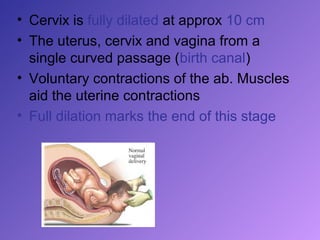
• Cervix is fully dilated at approx 10 cm
• The uterus, cervix and vagina from a
  single curved passage (birth canal)
• Voluntary contractions of the ab. Muscles
  aid the uterine contractions
• Full dilation marks the end of this stage
2nd Stage- Stage of Expulsion
• Often begins with breaking of the waters
• Lasts 20 min – 2 hrs
• Contraction of the uterus and abs, push
  the foetus through the vagina
• Babies head turns towards woman’s back
• Head advances with contraction and
  retracts in between
• Mothers pulse increases and she usually breaks
  out in a sweat
• Eventually head stretches the vagina and
  perineum
• Once emerged the head turns to face the
  woman’s hip, this allows the shoulders & body to
  pass through the birth canal
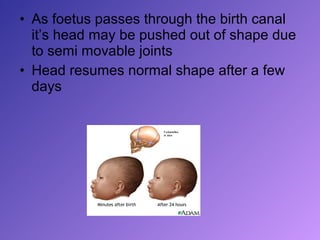
• As foetus passes through the birth canal
  it’s head may be pushed out of shape due
  to semi movable joints
• Head resumes normal shape after a few
  days
• Head first in 90% of births
• Head acts as a wedge
• Foetus may breath before birth is
  complete
3rd Stage- The Afterbirth
• Baby is still connected to amnion, chorion and
  placenta, which is still in the uterus
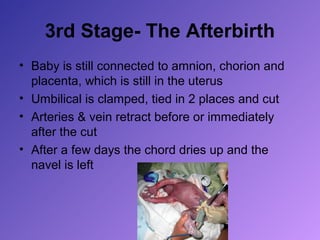
• Umbilical is clamped, tied in 2 places and cut
• Arteries & vein retract before or immediately
  after the cut
• After a few days the chord dries up and the
  navel is left
• At birth baby is covered in a waxy material
  called Vernix
• Vernix protects the babies skin from
  infection ( most removed)
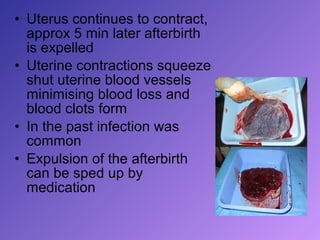
• Uterus continues to contract,
  approx 5 min later afterbirth
  is expelled
• Uterine contractions squeeze
  shut uterine blood vessels
  minimising blood loss and
  blood clots form
• In the past infection was
  common
• Expulsion of the afterbirth
  can be sped up by
  medication
Birth (parturition)

Birth (parturition)

  • 1.
    Birth (Parturition) Three stages of Labour 1. Dilation of the cervix 2. Stage of Expulsion 3. The Afterbirth • During the final 3 months, uterus undergoes weak irregular contractions • When they are about 30 min apart this marks the beginning of labour
  • 2.
    1st Stage- Dilationof the Cervix • Onset of labour to complete dilation • 8-9 hrs (1st child) 4hrs (subsequent children) • Waves of contractions from top of uterus down to cervix (like peristalsis) • With each contraction, muscle fibres of the uterus shorten and pull on the cervix • This shortens the cervix until it no longer protrudes into the vagina, and begins to open • Dilation allows foetus to move deeper into the mothers pelvis
  • 3.
    • Cervix isfully dilated at approx 10 cm • The uterus, cervix and vagina from a single curved passage (birth canal) • Voluntary contractions of the ab. Muscles aid the uterine contractions • Full dilation marks the end of this stage
  • 4.
    2nd Stage- Stageof Expulsion • Often begins with breaking of the waters • Lasts 20 min – 2 hrs • Contraction of the uterus and abs, push the foetus through the vagina • Babies head turns towards woman’s back • Head advances with contraction and retracts in between
  • 5.
    • Mothers pulseincreases and she usually breaks out in a sweat • Eventually head stretches the vagina and perineum • Once emerged the head turns to face the woman’s hip, this allows the shoulders & body to pass through the birth canal
  • 6.
    • As foetuspasses through the birth canal it’s head may be pushed out of shape due to semi movable joints • Head resumes normal shape after a few days
  • 7.
    • Head firstin 90% of births • Head acts as a wedge • Foetus may breath before birth is complete
  • 8.
    3rd Stage- TheAfterbirth • Baby is still connected to amnion, chorion and placenta, which is still in the uterus • Umbilical is clamped, tied in 2 places and cut • Arteries & vein retract before or immediately after the cut • After a few days the chord dries up and the navel is left
  • 9.
    • At birthbaby is covered in a waxy material called Vernix • Vernix protects the babies skin from infection ( most removed)
  • 10.
    • Uterus continuesto contract, approx 5 min later afterbirth is expelled • Uterine contractions squeeze shut uterine blood vessels minimising blood loss and blood clots form • In the past infection was common • Expulsion of the afterbirth can be sped up by medication