Deworming Procedure &
Doses for Different Species
Medicine Clinic I (MEDI-302), 1(0-1)
Dr. Zeeshan Ahmad Bhutta
Department of Clinical Sciences, Faculty of Veterinary Sciences,
Bahauddin Zakariya University, Multan, Pakistan
What is Deworming?
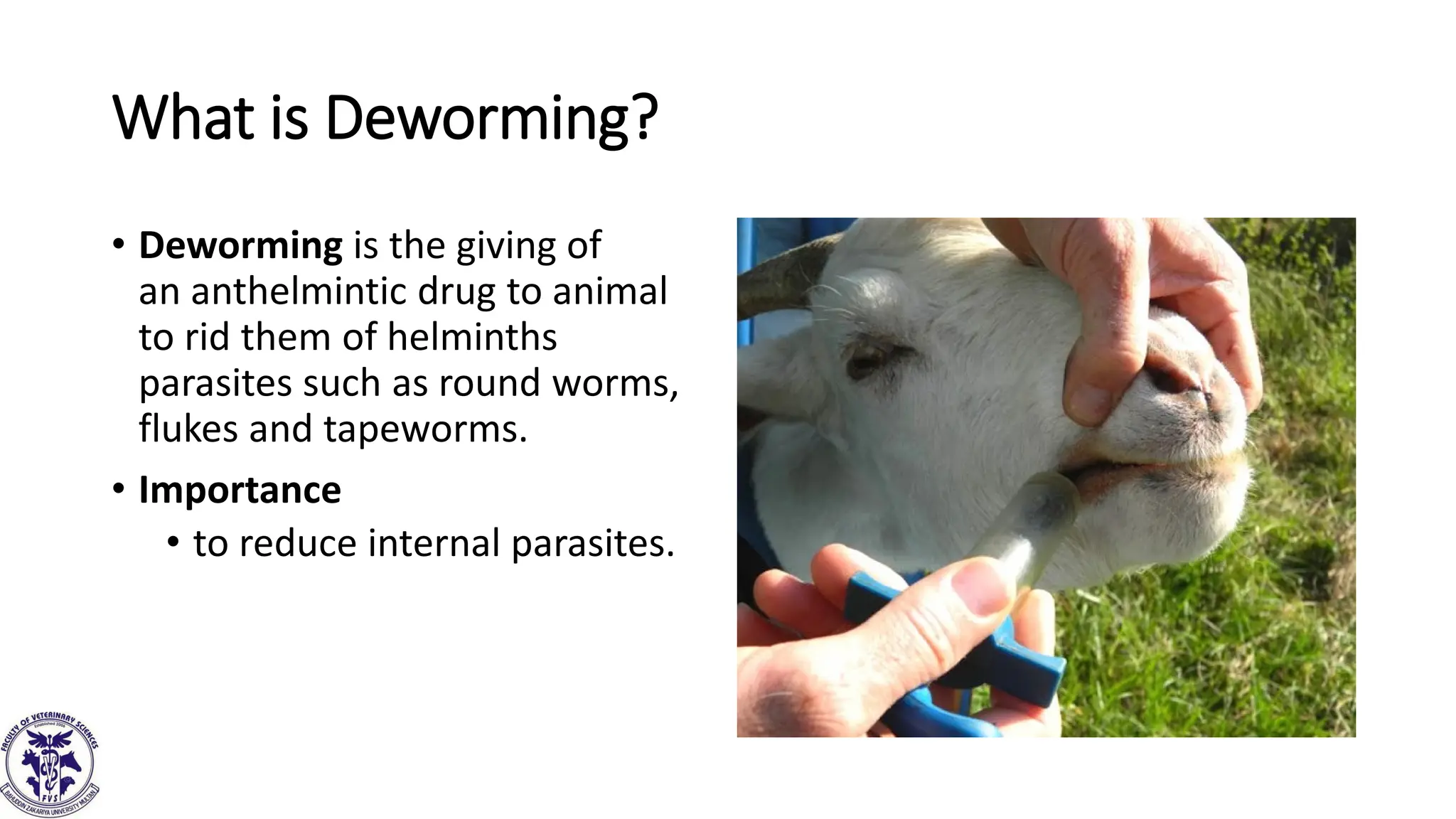
• Deworming is the giving of
an anthelmintic drug to animal
to rid them of helminths
parasites such as round worms,
flukes and tapeworms.
• Importance
• to reduce internal parasites.
Deworming in Large Animals
Horses
• current recommendation
• only be treated if they show signs of a heavy parasite load.
• Most adult horses develop immunity to parasites
• Horses with a high level of immunity don’t shed many eggs
• horses less than three years old are more susceptible to parasite
infection and are at greater risk of developing parasite-related
disease
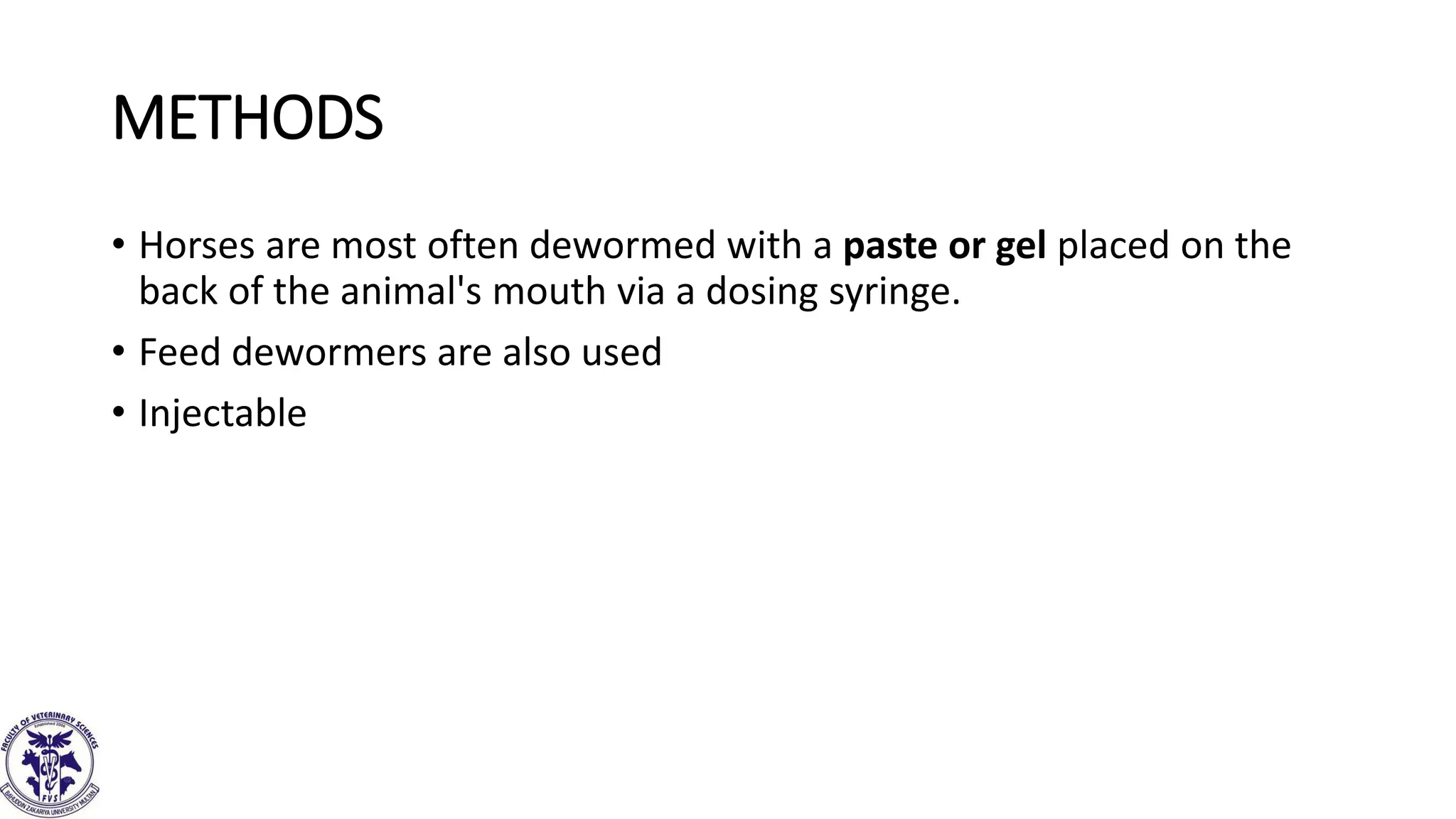
METHODS
• Horses are most often dewormed with a paste or gel placed on the
back of the animal's mouth via a dosing syringe.
• Feed dewormers are also used
• Injectable
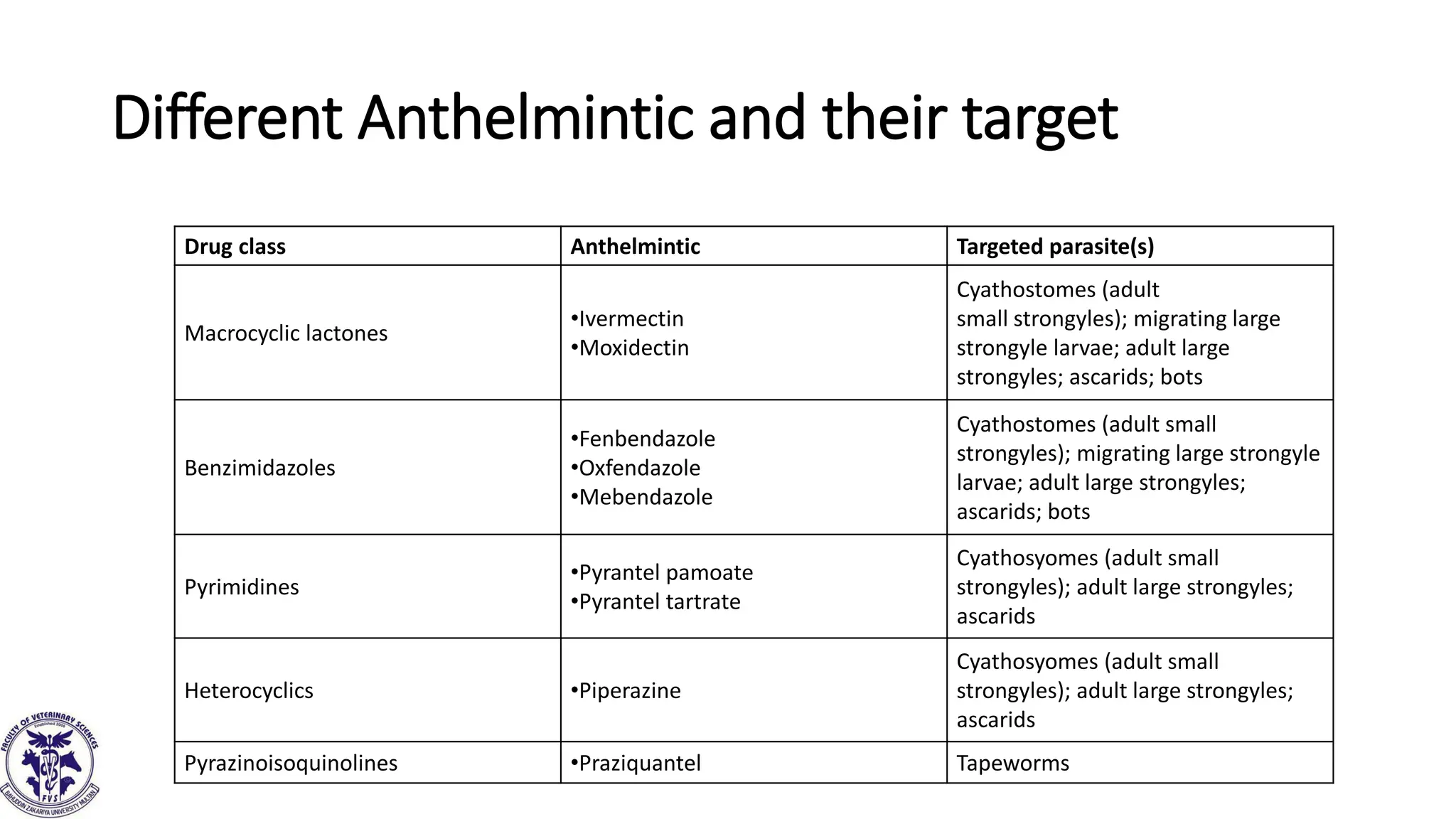
Different Anthelmintic and their target
Drug class Anthelmintic Targeted parasite(s)
Macrocyclic lactones
•Ivermectin
•Moxidectin
Cyathostomes (adult
small strongyles); migrating large
strongyle larvae; adult large
strongyles; ascarids; bots
Benzimidazoles
•Fenbendazole
•Oxfendazole
•Mebendazole
Cyathostomes (adult small
strongyles); migrating large strongyle
larvae; adult large strongyles;
ascarids; bots
Pyrimidines
•Pyrantel pamoate
•Pyrantel tartrate
Cyathosyomes (adult small
strongyles); adult large strongyles;
ascarids
Heterocyclics •Piperazine
Cyathosyomes (adult small
strongyles); adult large strongyles;
ascarids
Pyrazinoisoquinolines •Praziquantel Tapeworms
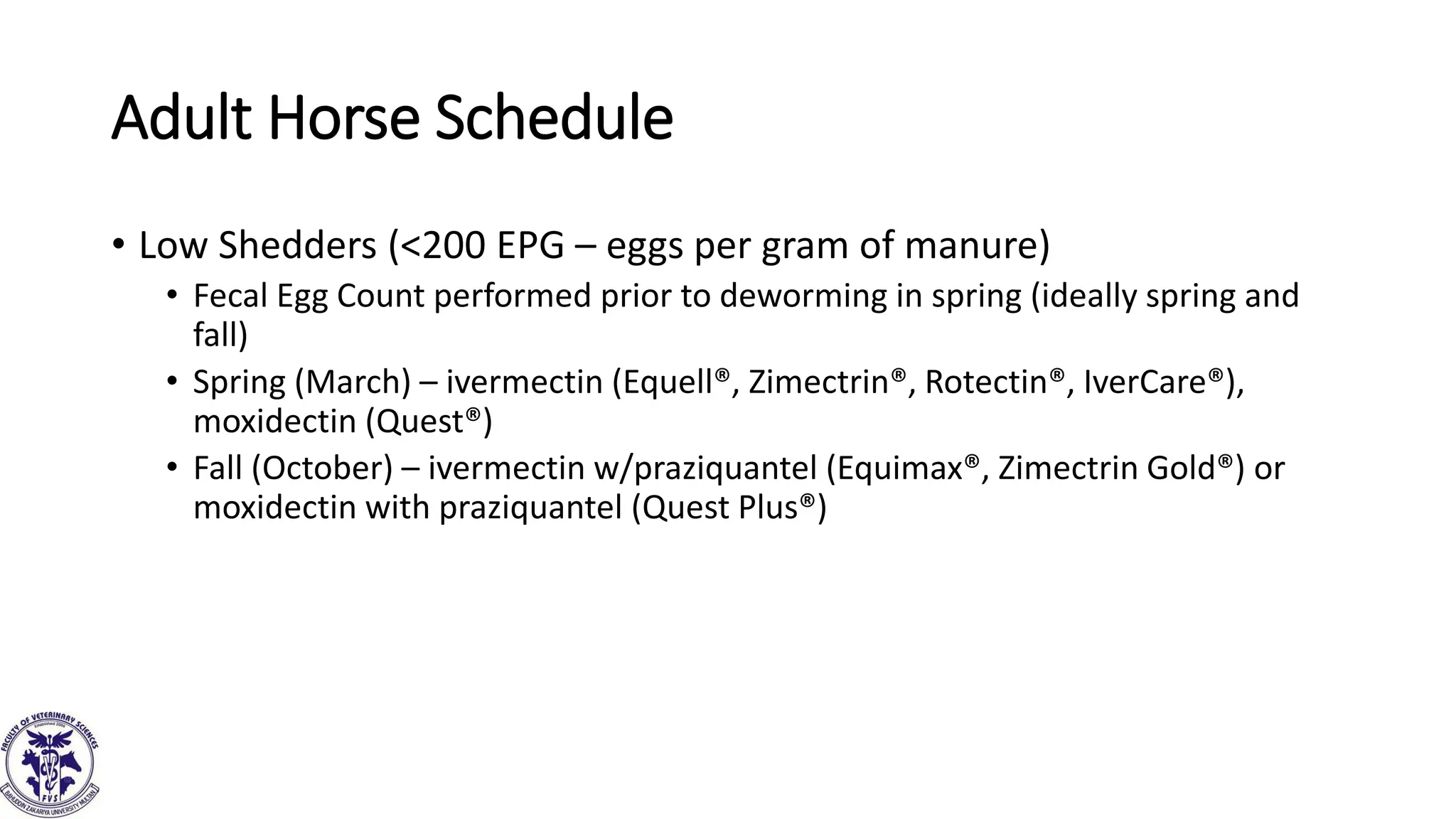
Adult Horse Schedule
• Low Shedders (<200 EPG – eggs per gram of manure)
• Fecal Egg Count performed prior to deworming in spring (ideally spring and
fall)
• Spring (March) – ivermectin (Equell®, Zimectrin®, Rotectin®, IverCare®),
moxidectin (Quest®)
• Fall (October) – ivermectin w/praziquantel (Equimax®, Zimectrin Gold®) or
moxidectin with praziquantel (Quest Plus®)
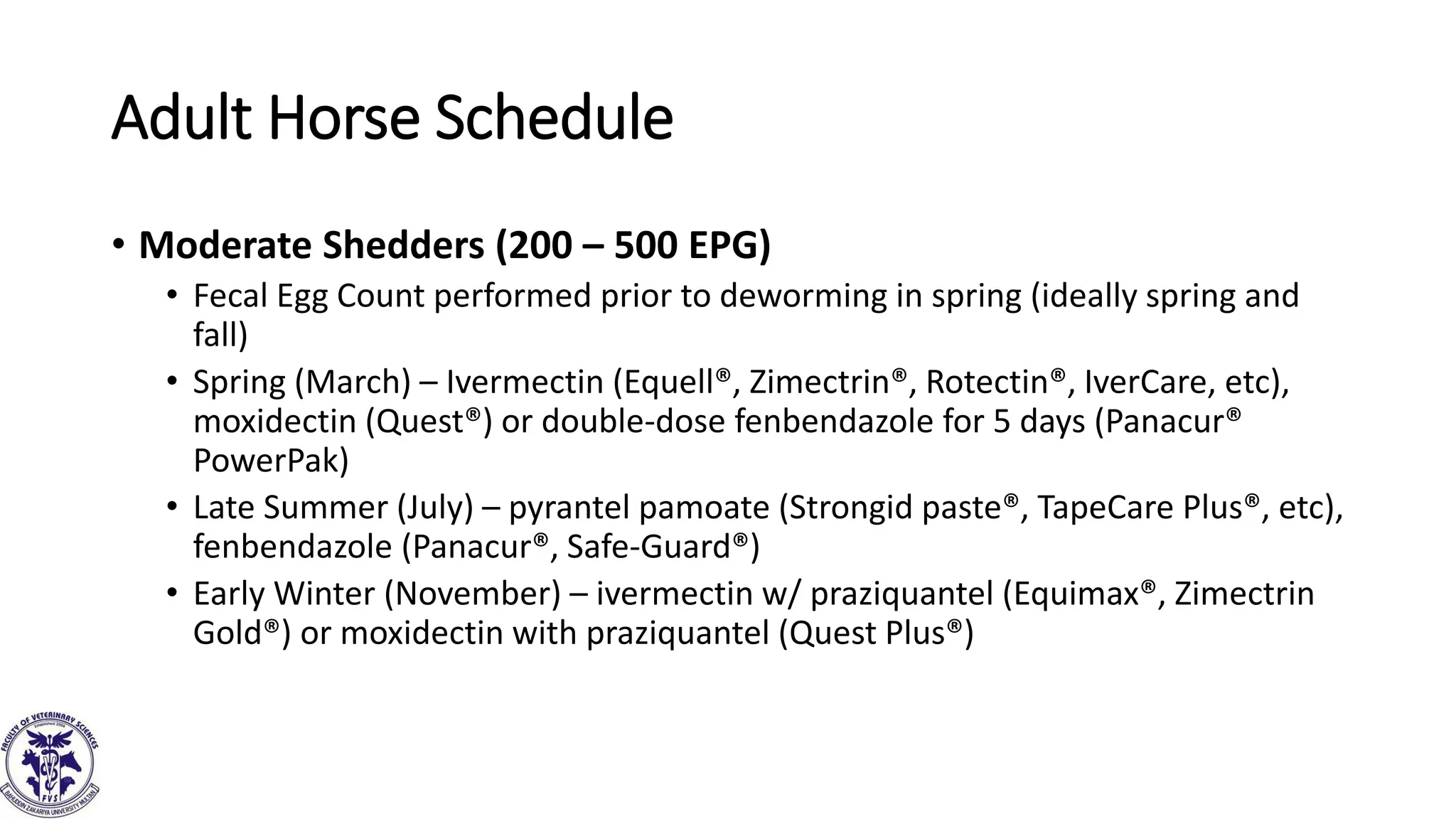
Adult Horse Schedule
• Moderate Shedders (200 – 500 EPG)
• Fecal Egg Count performed prior to deworming in spring (ideally spring and
fall)
• Spring (March) – Ivermectin (Equell®, Zimectrin®, Rotectin®, IverCare, etc),
moxidectin (Quest®) or double-dose fenbendazole for 5 days (Panacur®
PowerPak)
• Late Summer (July) – pyrantel pamoate (Strongid paste®, TapeCare Plus®, etc),
fenbendazole (Panacur®, Safe-Guard®)
• Early Winter (November) – ivermectin w/ praziquantel (Equimax®, Zimectrin
Gold®) or moxidectin with praziquantel (Quest Plus®)
Adult Horse Schedule
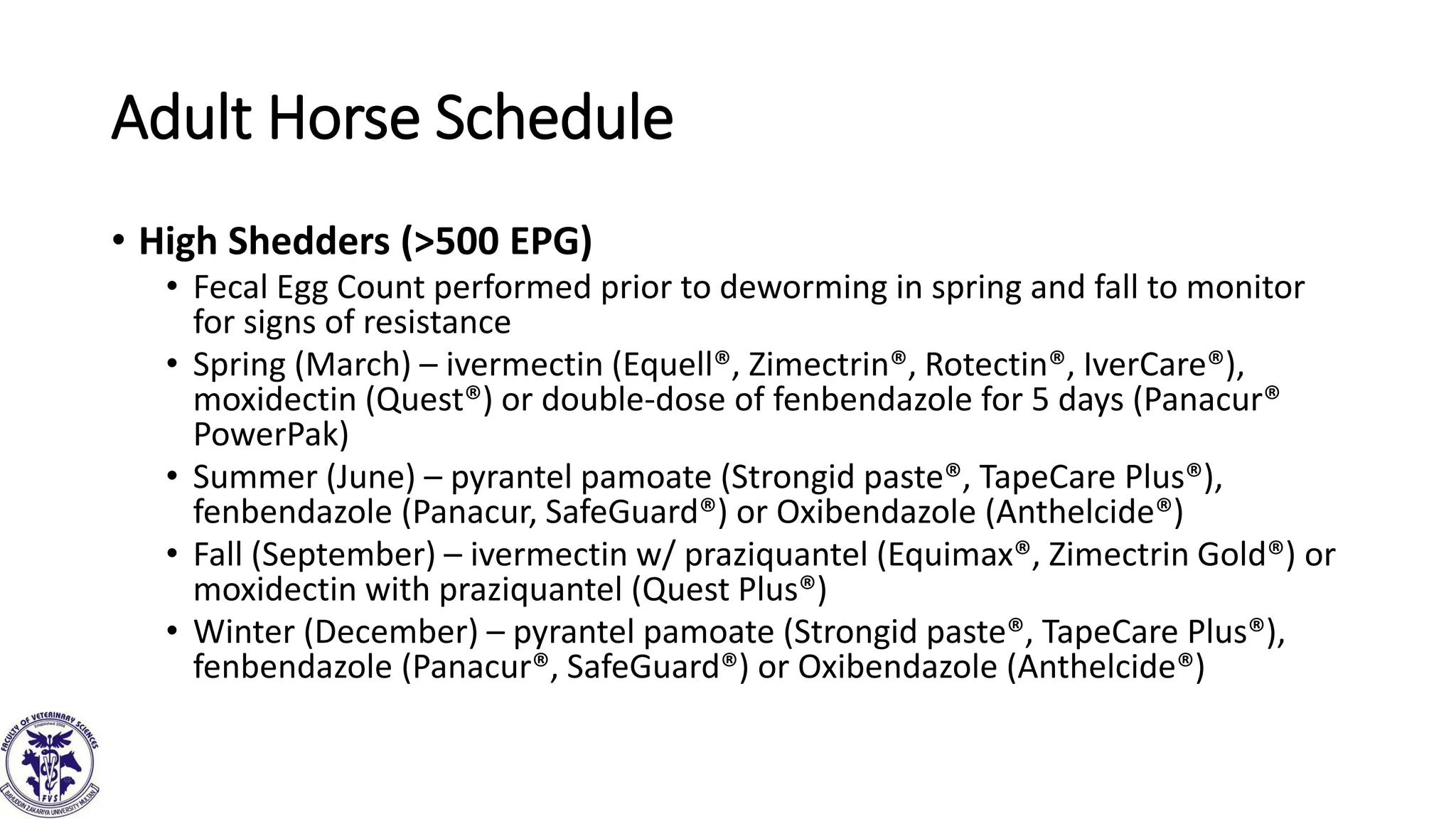
• High Shedders (>500 EPG)
• Fecal Egg Count performed prior to deworming in spring and fall to monitor
for signs of resistance
• Spring (March) – ivermectin (Equell®, Zimectrin®, Rotectin®, IverCare®),
moxidectin (Quest®) or double-dose of fenbendazole for 5 days (Panacur®
PowerPak)
• Summer (June) – pyrantel pamoate (Strongid paste®, TapeCare Plus®),
fenbendazole (Panacur, SafeGuard®) or Oxibendazole (Anthelcide®)
• Fall (September) – ivermectin w/ praziquantel (Equimax®, Zimectrin Gold®) or
moxidectin with praziquantel (Quest Plus®)
• Winter (December) – pyrantel pamoate (Strongid paste®, TapeCare Plus®),
fenbendazole (Panacur®, SafeGuard®) or Oxibendazole (Anthelcide®)
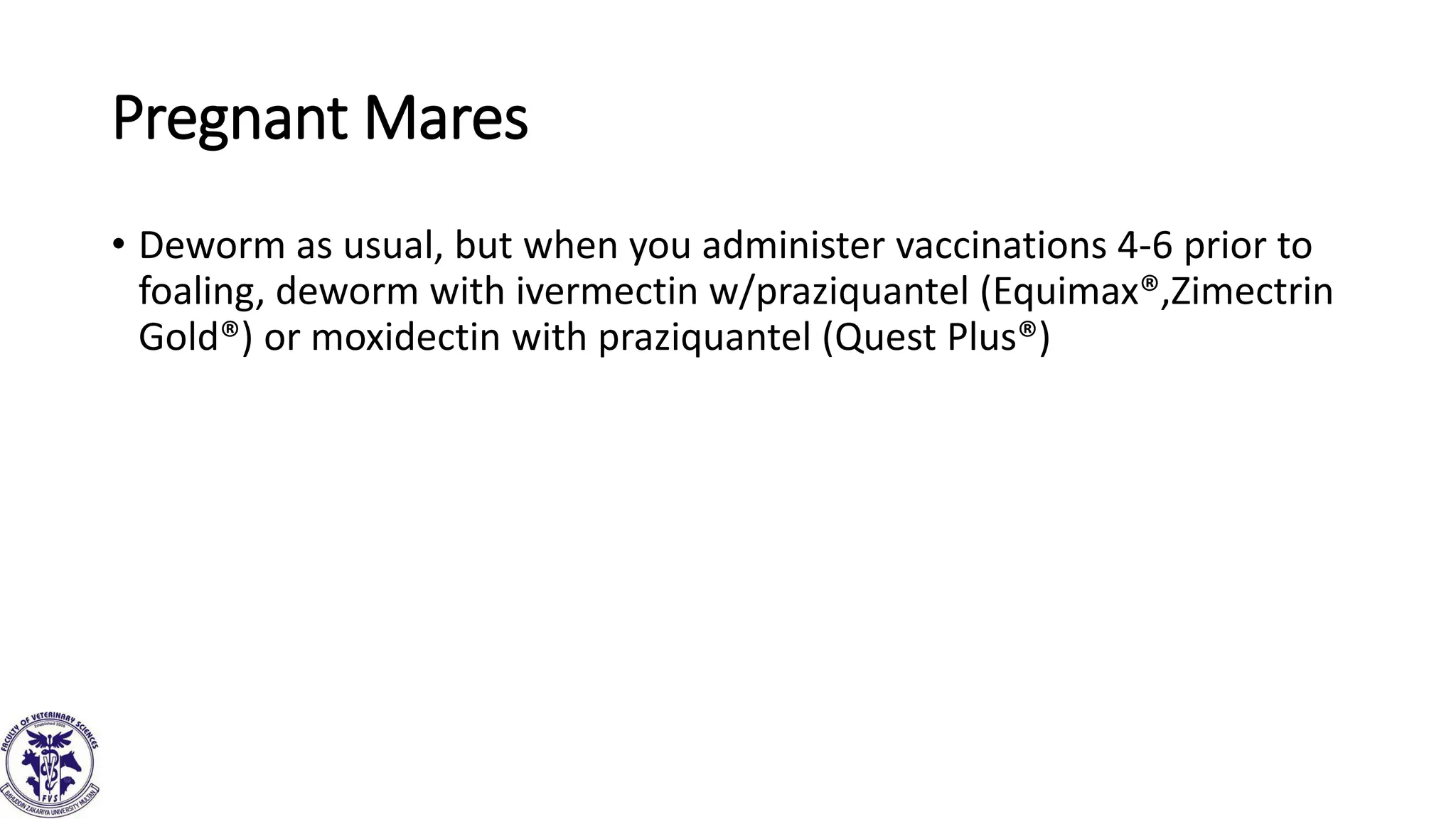
Pregnant Mares
• Deworm as usual, but when you administer vaccinations 4-6 prior to
foaling, deworm with ivermectin w/praziquantel (Equimax®,Zimectrin
Gold®) or moxidectin with praziquantel (Quest Plus®)
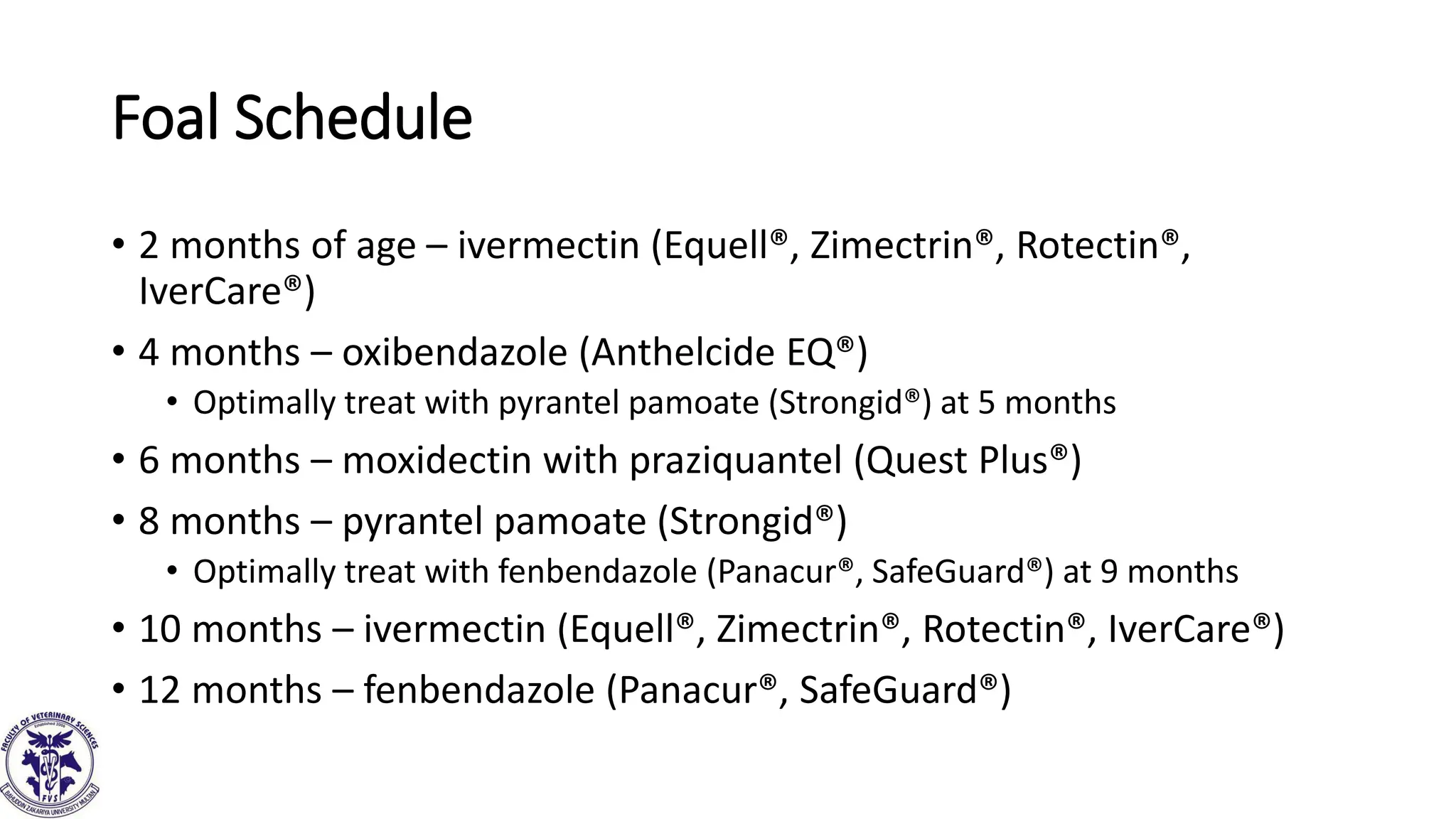
Foal Schedule
• 2 months of age – ivermectin (Equell®, Zimectrin®, Rotectin®,
IverCare®)
• 4 months – oxibendazole (Anthelcide EQ®)
• Optimally treat with pyrantel pamoate (Strongid®) at 5 months
• 6 months – moxidectin with praziquantel (Quest Plus®)
• 8 months – pyrantel pamoate (Strongid®)
• Optimally treat with fenbendazole (Panacur®, SafeGuard®) at 9 months
• 10 months – ivermectin (Equell®, Zimectrin®, Rotectin®, IverCare®)
• 12 months – fenbendazole (Panacur®, SafeGuard®)
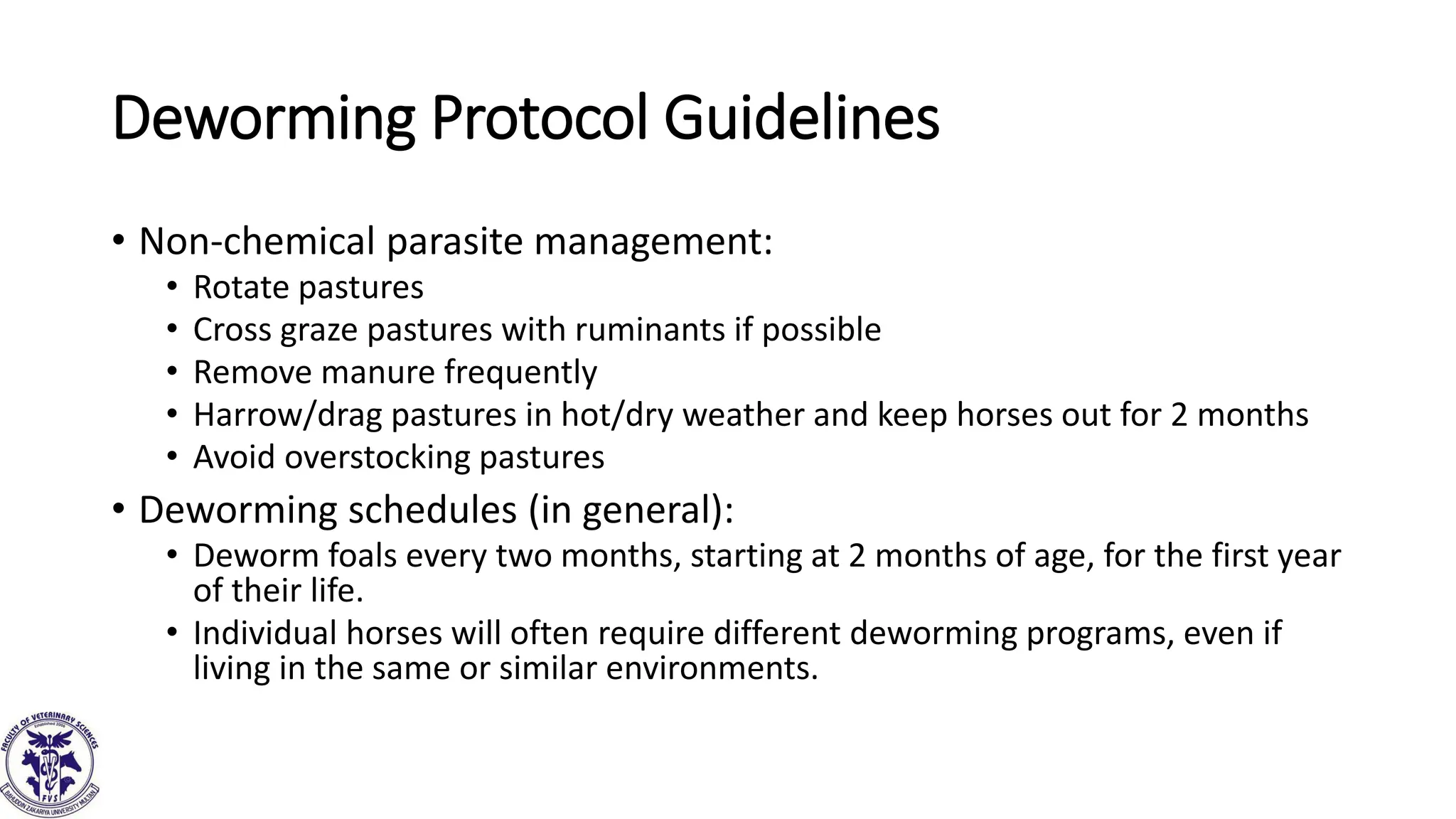
Deworming Protocol Guidelines
• Non-chemical parasite management:
• Rotate pastures
• Cross graze pastures with ruminants if possible
• Remove manure frequently
• Harrow/drag pastures in hot/dry weather and keep horses out for 2 months
• Avoid overstocking pastures
• Deworming schedules (in general):
• Deworm foals every two months, starting at 2 months of age, for the first year
of their life.
• Individual horses will often require different deworming programs, even if
living in the same or similar environments.
Deworming Protocol Guidelines
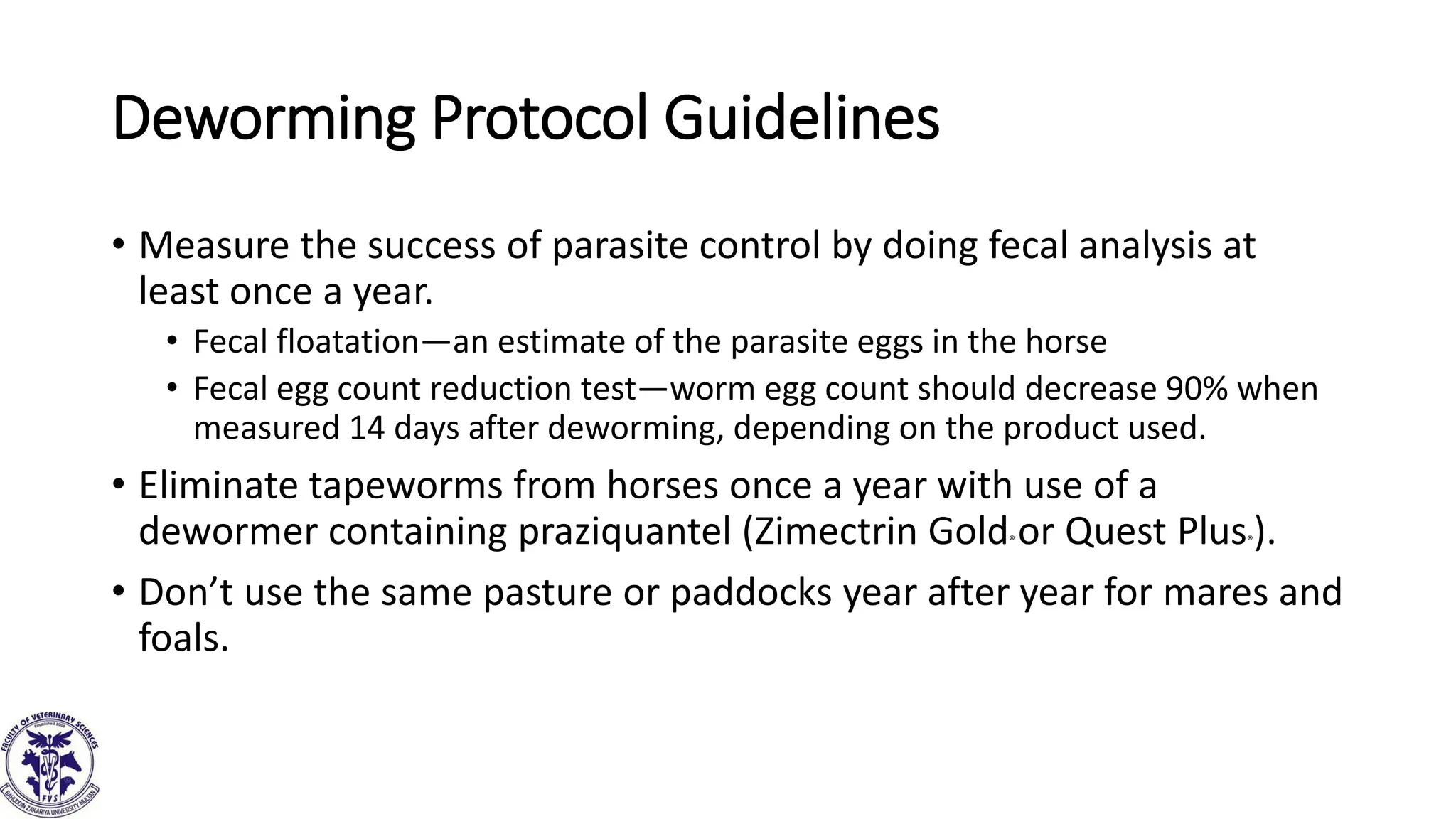
• Measure the success of parasite control by doing fecal analysis at
least once a year.
• Fecal floatation—an estimate of the parasite eggs in the horse
• Fecal egg count reduction test—worm egg count should decrease 90% when
measured 14 days after deworming, depending on the product used.
• Eliminate tapeworms from horses once a year with use of a
dewormer containing praziquantel (Zimectrin Gold® or Quest Plus®).
• Don’t use the same pasture or paddocks year after year for mares and
foals.
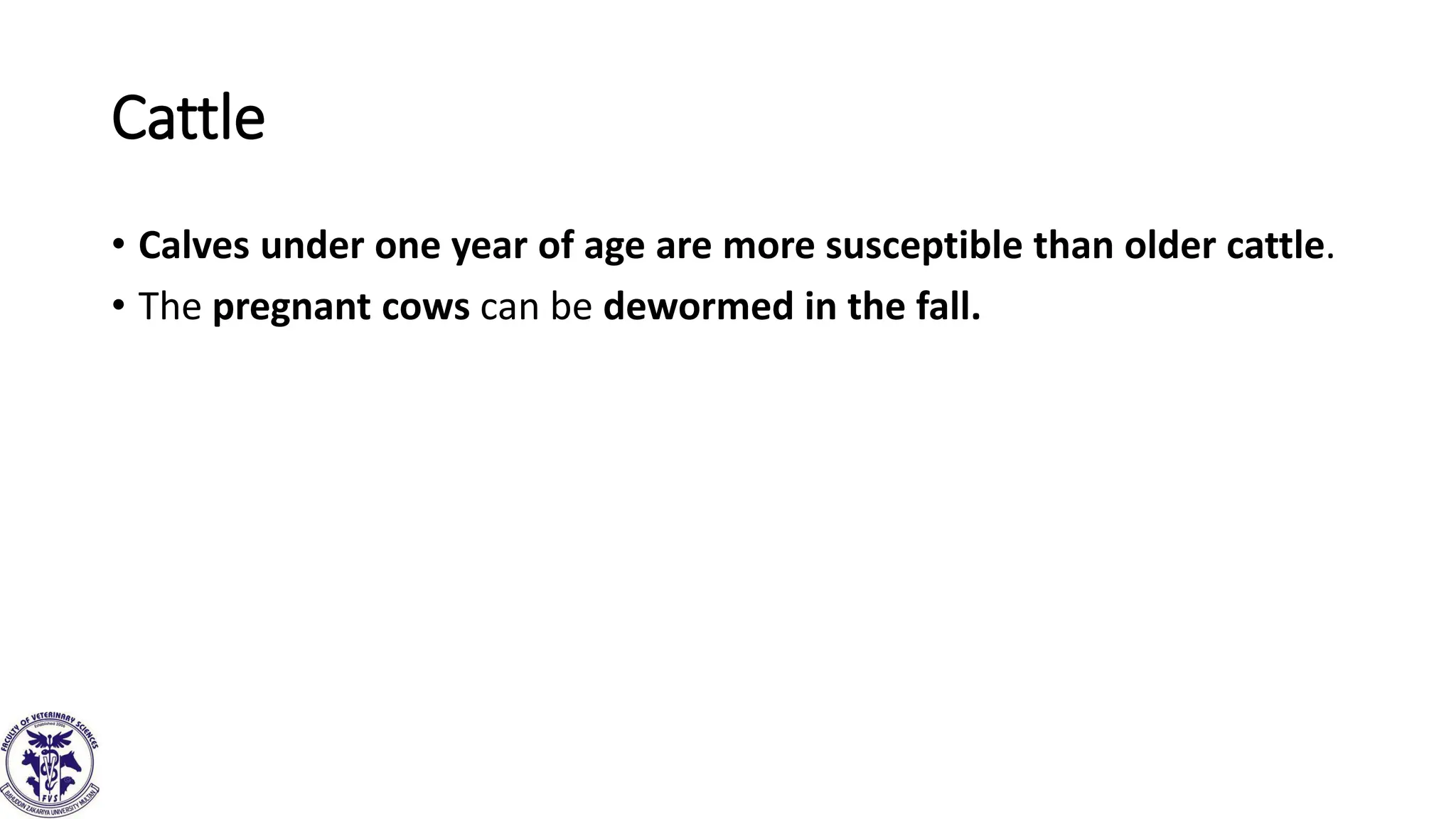
Cattle
• Calves under one year of age are more susceptible than older cattle.
• The pregnant cows can be dewormed in the fall.
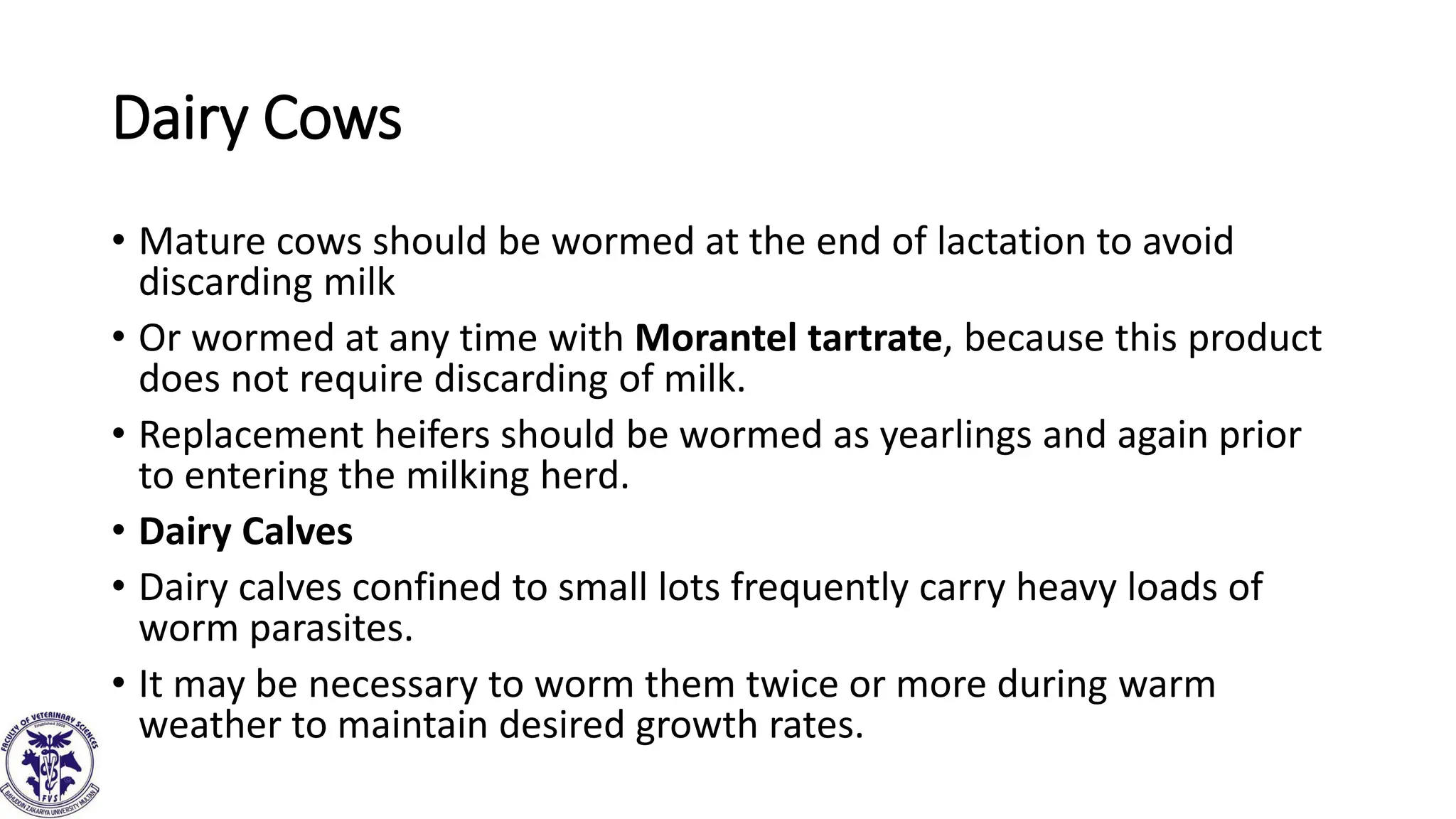
Dairy Cows
• Mature cows should be wormed at the end of lactation to avoid
discarding milk
• Or wormed at any time with Morantel tartrate, because this product
does not require discarding of milk.
• Replacement heifers should be wormed as yearlings and again prior
to entering the milking herd.
• Dairy Calves
• Dairy calves confined to small lots frequently carry heavy loads of
worm parasites.
• It may be necessary to worm them twice or more during warm
weather to maintain desired growth rates.
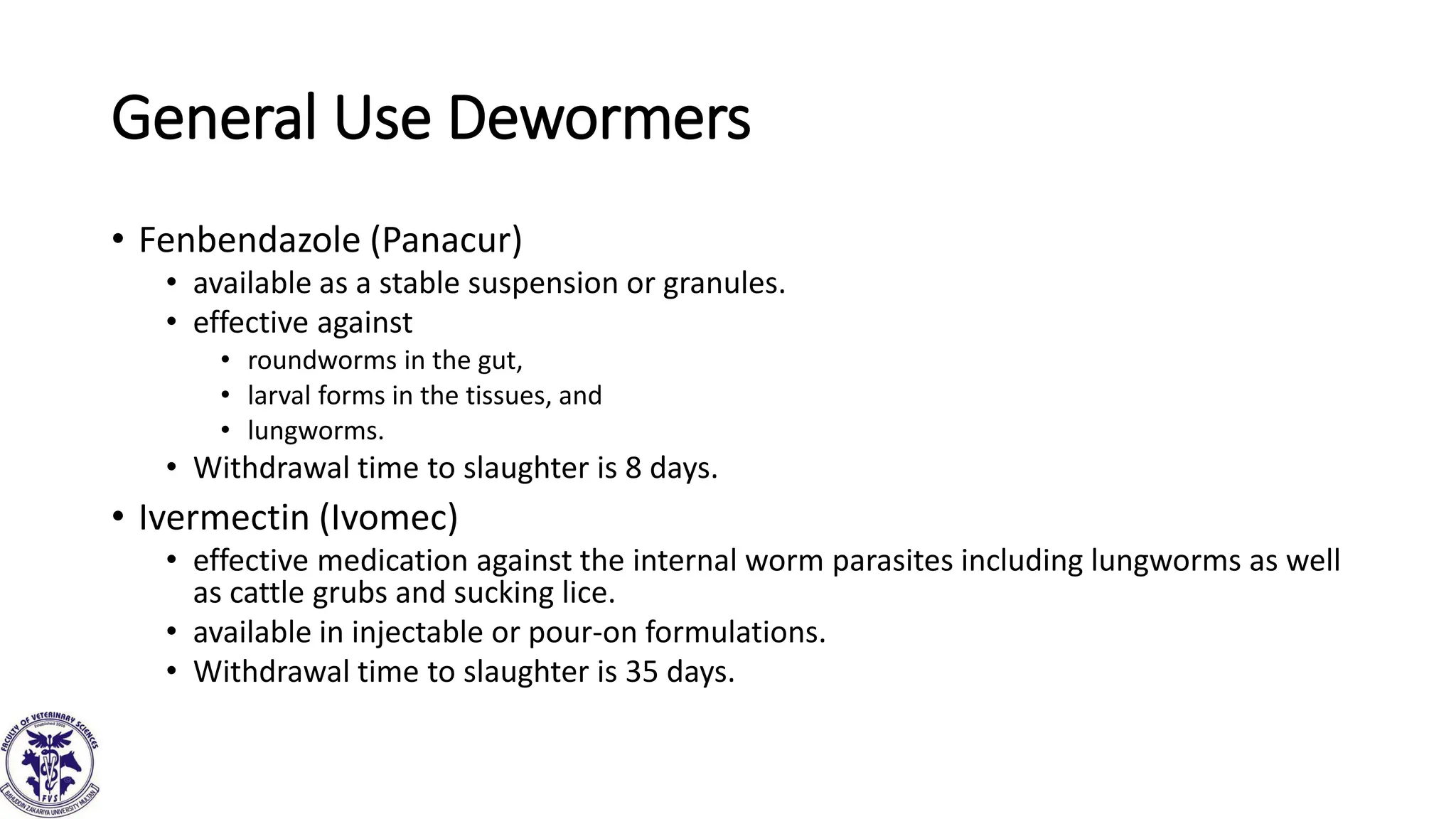
General Use Dewormers
• Fenbendazole (Panacur)
• available as a stable suspension or granules.
• effective against
• roundworms in the gut,
• larval forms in the tissues, and
• lungworms.
• Withdrawal time to slaughter is 8 days.
• Ivermectin (Ivomec)
• effective medication against the internal worm parasites including lungworms as well
as cattle grubs and sucking lice.
• available in injectable or pour-on formulations.
• Withdrawal time to slaughter is 35 days.
General Use Dewormers
• Levamisole (Levisol, Tramisol)
• Available in
• boluses,
• a paste for oral administration,
• as a pour-on
• an injectable form.
• effective against roundworms and lungworms.
• Withdrawal time is (orally) 2 days and (injected) 7 days.
• Morantel tartrate (Rumatel)
• comes in boluses or crumbles for oral use.
• It is effective against roundworms,
• 14-day withdrawal time to slaughter.
General Use Dewormers
• Thiabendazole (Omnizole)
• paste, boluses, suspension, or crumbles.
• effective against roundworms.
• Thiabendazole is approved for use in lactating cows and has a 96-hour milk discard
time
• Withdrawal time to slaughter is 3 days.
• Albendazole (Valbazen)
• paste or suspension.
• effective against all intestinal worms including tapeworms, and lungworms as well as
liver flukes.
• 27-day withdrawal for slaughter.
• should not be used in animals during the first 45 days of pregnancy
General Use Dewormers
• Oxfendazole (Synonthic)
• effective against intestinal parasites including tapeworms.
• available in the drench form.
Methods for Administration
• Orally
• drenching, with a dose syringe or with multiple dose equipment with a
backpack reservoir.
• Avoid getting any of the wormer into the lungs where it could initiate
pneumonia.
• Pour-on formulations
• direct application to the skin.
Cont.
• Injections
• The injections should be under the skin of the neck, not into the muscle.
• Do not inject more than 10 ml of drug in a single site
• Feed-Incorporated Materials
• Crumbles or granules that can be incorporated into the feed
• Boluses
• should be given with a balling gun to get them past the base of the tongue
Sheep and Goats
• Sheep and goats are susceptible to worms due to their close grazing
behavior.
• Lambs should be wormed at 8 weeks of age and again every 4-8
weeks until a year of age
• Ewes should be wormed 2-4 weeks before lambing.
• Does in early pregnancy should not be dewormed to avoid abortion.
• At least once a year, deworming should be performed in sheep and
goats
Dogs and Cats
• Worming schedules will vary depending on age.
• Deworm puppies and kittens at two, four, six and eight weeks of age,
then again at 12 and 16 weeks of age.
• Deworm again at six months and one year. Then deworm as an adult.
• Adults - Worming Dogs and Cats
• General Dog or Cat Worming: Twice a year for life.
• Newly Acquired Animals
• Deworm immediately and repeat in two weeks.
Birds
• It is recommended that all birds, whether they are breeders or pets,
inside or outside birds, are wormed four times a year.
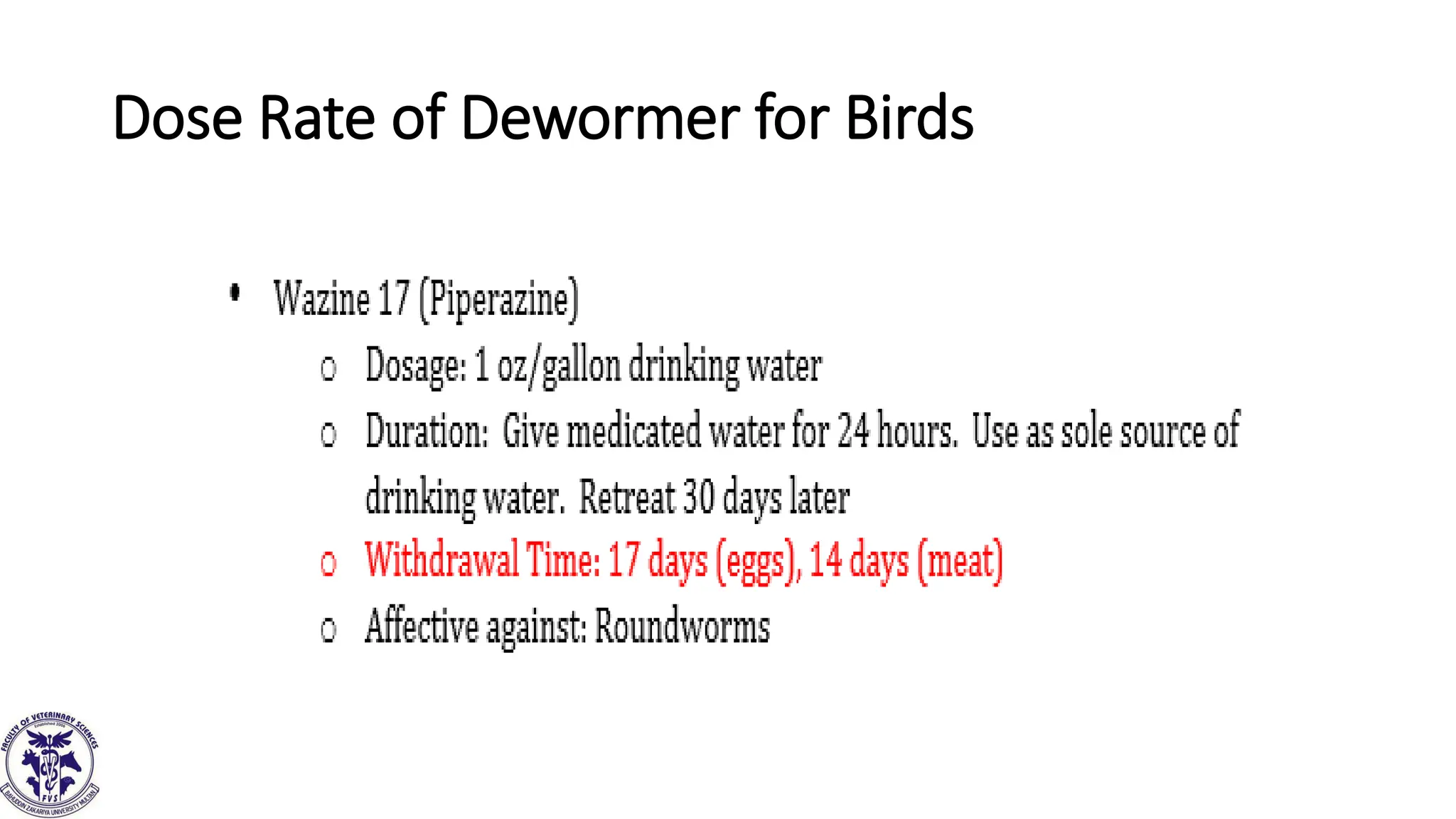
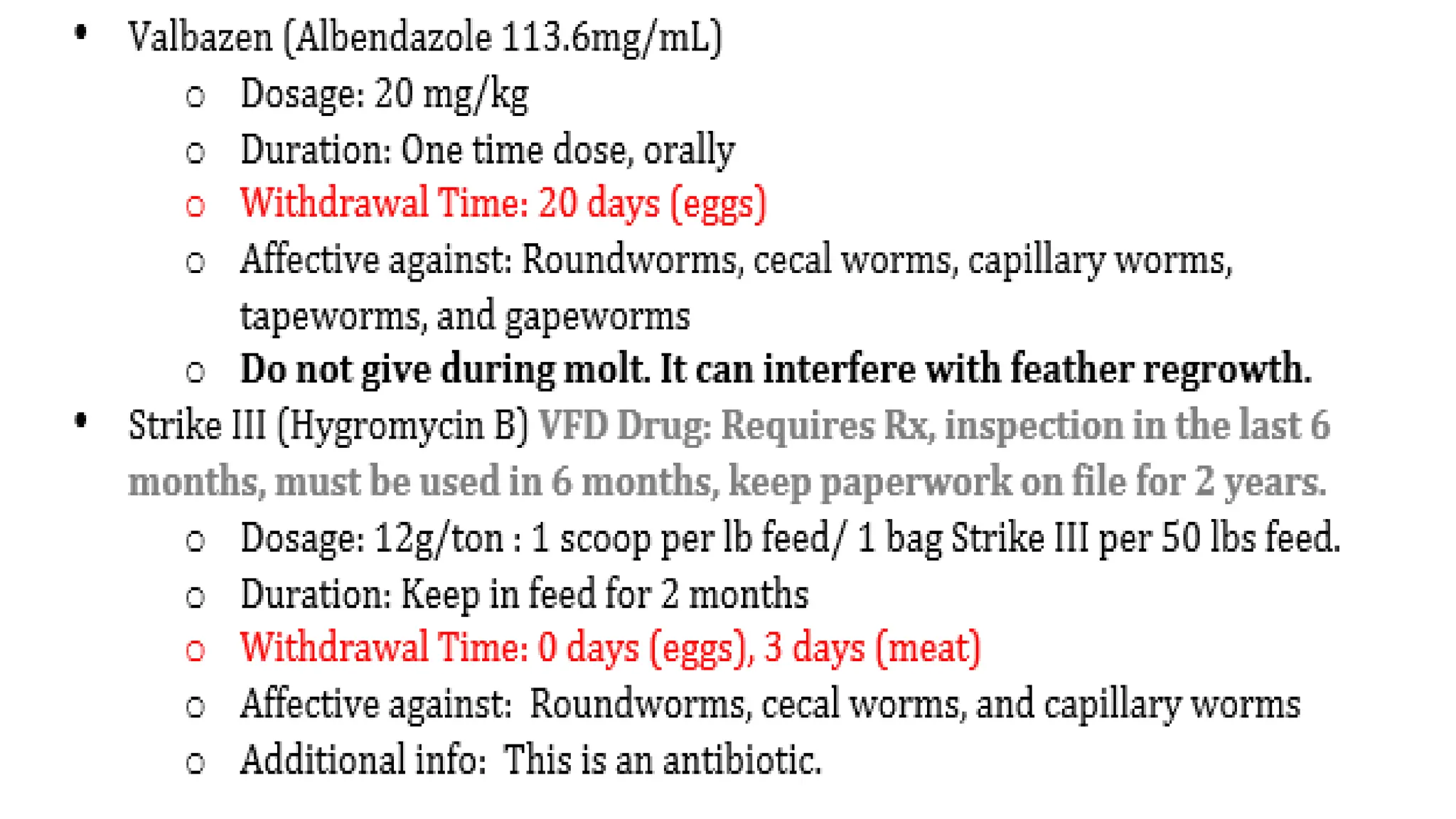
Dose Rate of Dewormer for Birds
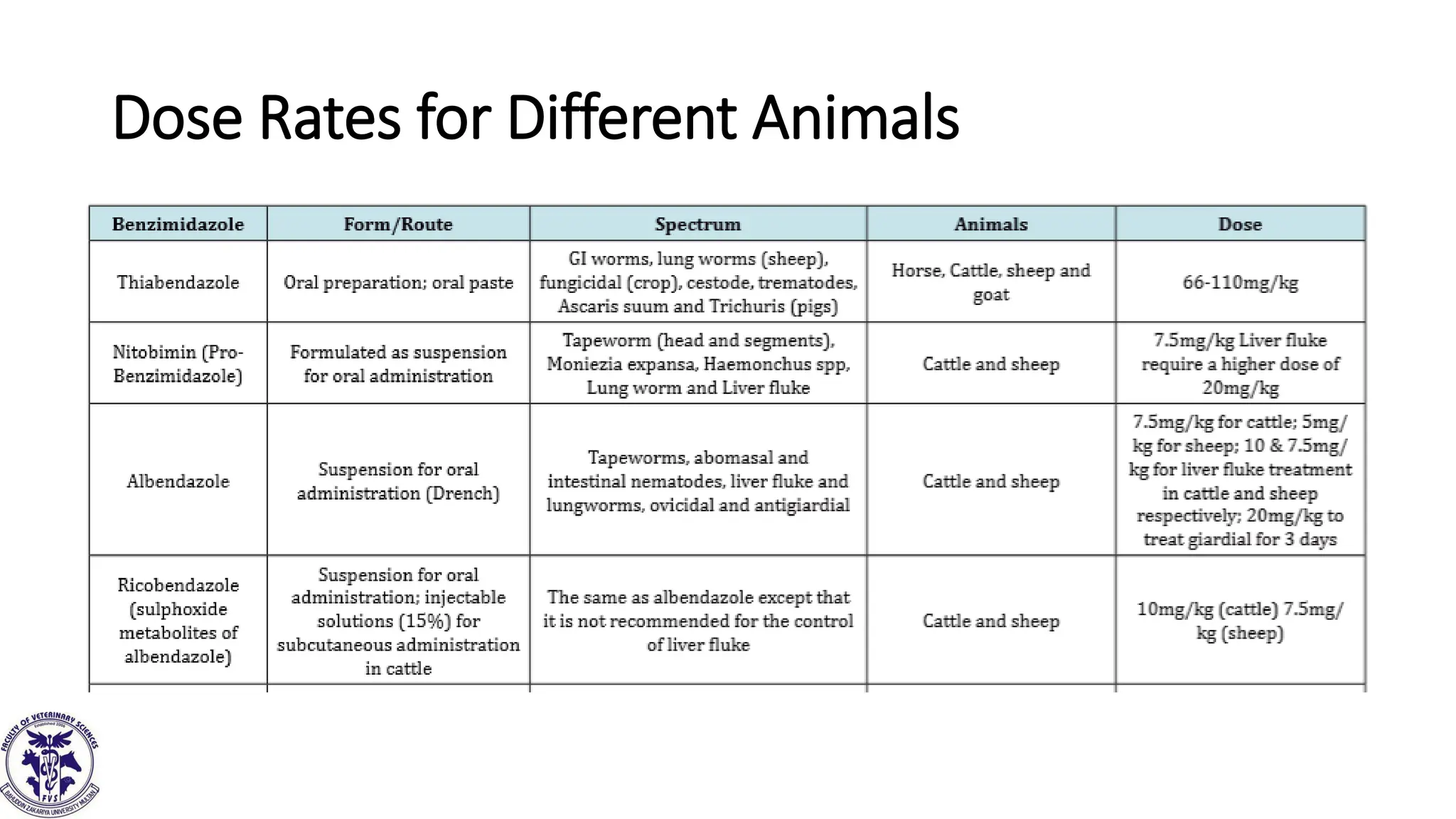
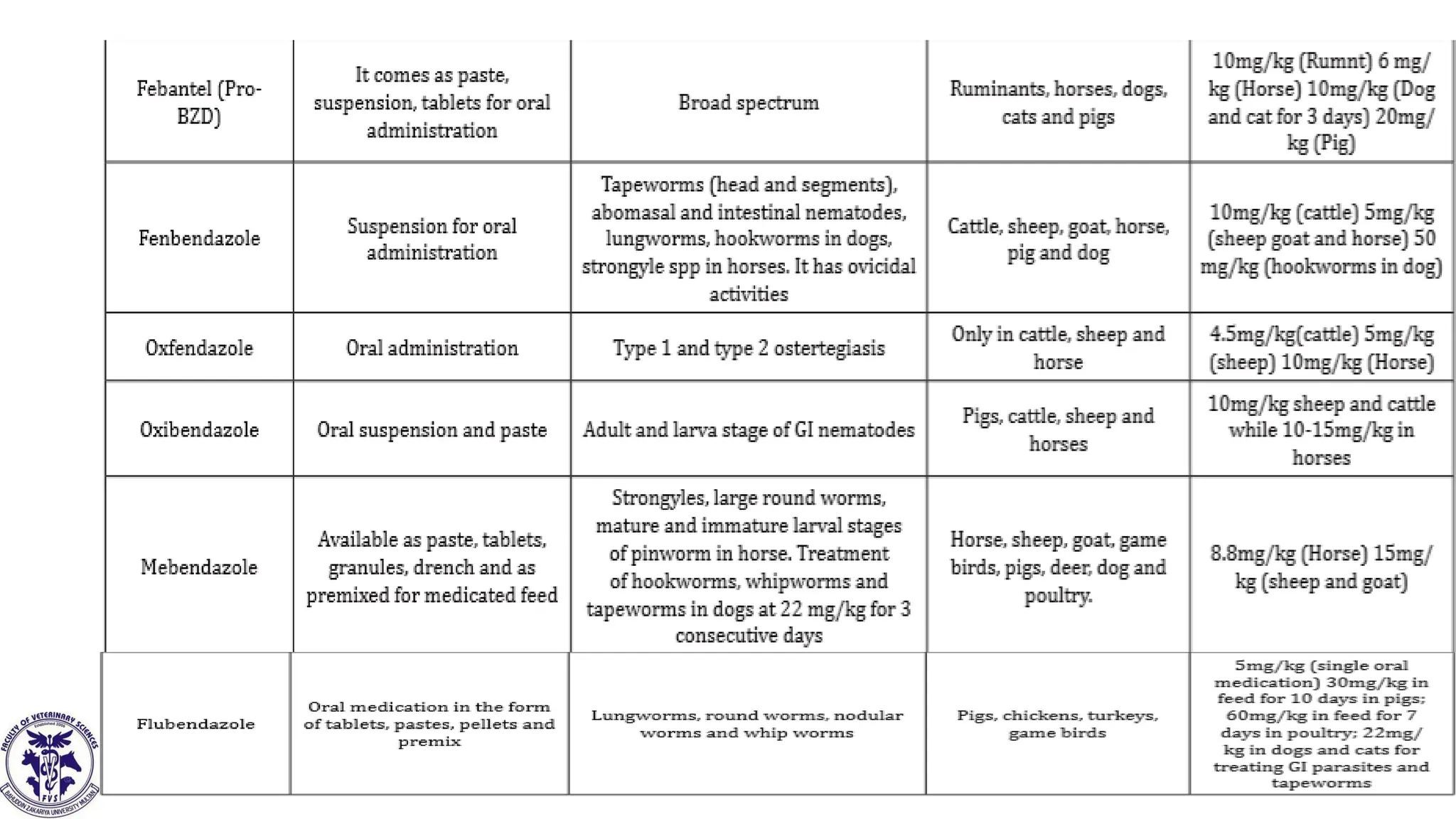
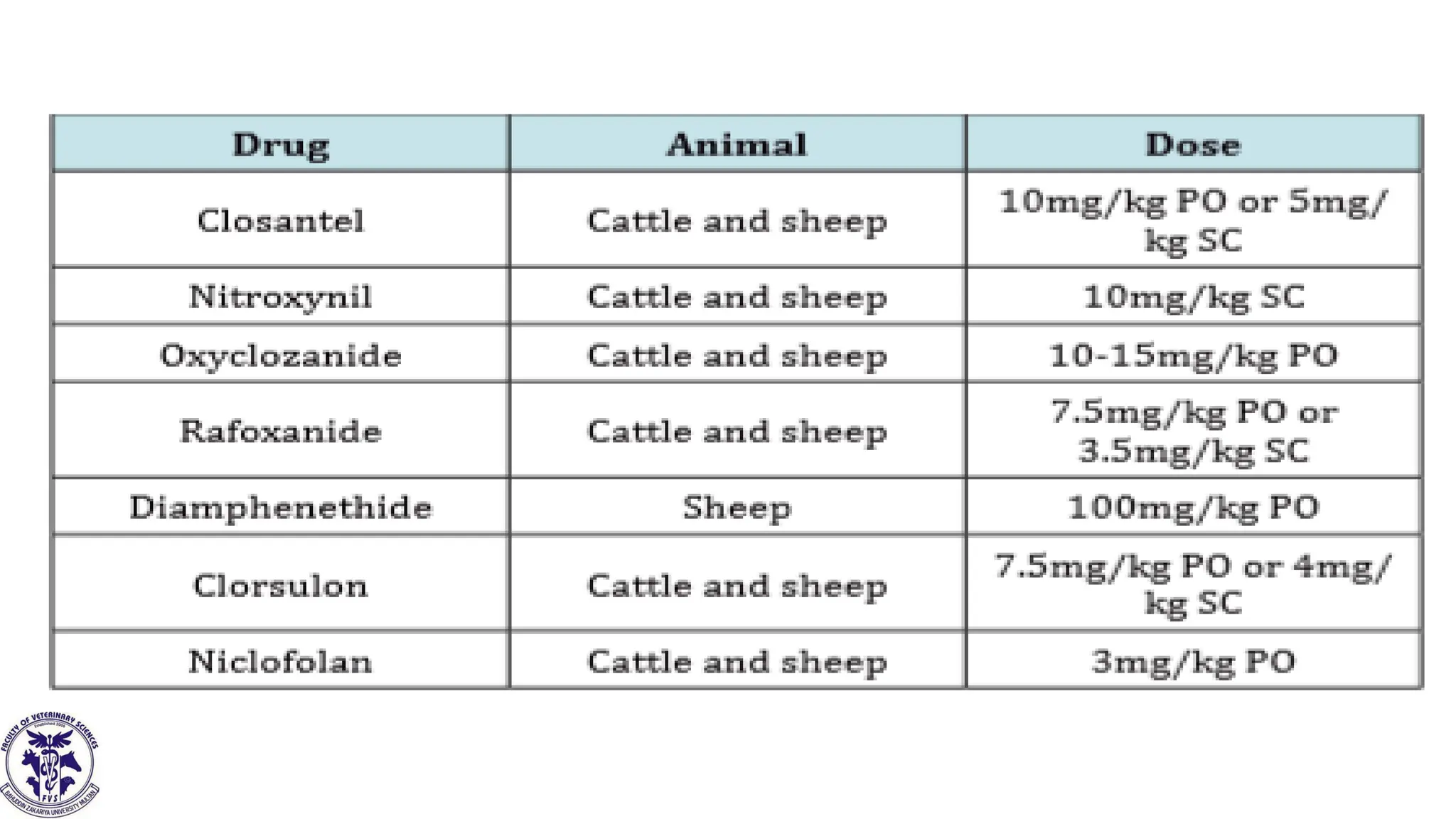
Dose Rates for Different Animals
Any Question?

Deworming Procedure & Doses for Different Species.pdf

  • 1.
    Deworming Procedure & Dosesfor Different Species Medicine Clinic I (MEDI-302), 1(0-1) Dr. Zeeshan Ahmad Bhutta Department of Clinical Sciences, Faculty of Veterinary Sciences, Bahauddin Zakariya University, Multan, Pakistan
  • 2.
    What is Deworming? •Deworming is the giving of an anthelmintic drug to animal to rid them of helminths parasites such as round worms, flukes and tapeworms. • Importance • to reduce internal parasites.
  • 3.
  • 4.
    Horses • current recommendation •only be treated if they show signs of a heavy parasite load. • Most adult horses develop immunity to parasites • Horses with a high level of immunity don’t shed many eggs • horses less than three years old are more susceptible to parasite infection and are at greater risk of developing parasite-related disease
  • 5.
    METHODS • Horses aremost often dewormed with a paste or gel placed on the back of the animal's mouth via a dosing syringe. • Feed dewormers are also used • Injectable
  • 6.
    Different Anthelmintic andtheir target Drug class Anthelmintic Targeted parasite(s) Macrocyclic lactones •Ivermectin •Moxidectin Cyathostomes (adult small strongyles); migrating large strongyle larvae; adult large strongyles; ascarids; bots Benzimidazoles •Fenbendazole •Oxfendazole •Mebendazole Cyathostomes (adult small strongyles); migrating large strongyle larvae; adult large strongyles; ascarids; bots Pyrimidines •Pyrantel pamoate •Pyrantel tartrate Cyathosyomes (adult small strongyles); adult large strongyles; ascarids Heterocyclics •Piperazine Cyathosyomes (adult small strongyles); adult large strongyles; ascarids Pyrazinoisoquinolines •Praziquantel Tapeworms
  • 7.
    Adult Horse Schedule •Low Shedders (<200 EPG – eggs per gram of manure) • Fecal Egg Count performed prior to deworming in spring (ideally spring and fall) • Spring (March) – ivermectin (Equell®, Zimectrin®, Rotectin®, IverCare®), moxidectin (Quest®) • Fall (October) – ivermectin w/praziquantel (Equimax®, Zimectrin Gold®) or moxidectin with praziquantel (Quest Plus®)
  • 8.
    Adult Horse Schedule •Moderate Shedders (200 – 500 EPG) • Fecal Egg Count performed prior to deworming in spring (ideally spring and fall) • Spring (March) – Ivermectin (Equell®, Zimectrin®, Rotectin®, IverCare, etc), moxidectin (Quest®) or double-dose fenbendazole for 5 days (Panacur® PowerPak) • Late Summer (July) – pyrantel pamoate (Strongid paste®, TapeCare Plus®, etc), fenbendazole (Panacur®, Safe-Guard®) • Early Winter (November) – ivermectin w/ praziquantel (Equimax®, Zimectrin Gold®) or moxidectin with praziquantel (Quest Plus®)
  • 9.
    Adult Horse Schedule •High Shedders (>500 EPG) • Fecal Egg Count performed prior to deworming in spring and fall to monitor for signs of resistance • Spring (March) – ivermectin (Equell®, Zimectrin®, Rotectin®, IverCare®), moxidectin (Quest®) or double-dose of fenbendazole for 5 days (Panacur® PowerPak) • Summer (June) – pyrantel pamoate (Strongid paste®, TapeCare Plus®), fenbendazole (Panacur, SafeGuard®) or Oxibendazole (Anthelcide®) • Fall (September) – ivermectin w/ praziquantel (Equimax®, Zimectrin Gold®) or moxidectin with praziquantel (Quest Plus®) • Winter (December) – pyrantel pamoate (Strongid paste®, TapeCare Plus®), fenbendazole (Panacur®, SafeGuard®) or Oxibendazole (Anthelcide®)
  • 10.
    Pregnant Mares • Dewormas usual, but when you administer vaccinations 4-6 prior to foaling, deworm with ivermectin w/praziquantel (Equimax®,Zimectrin Gold®) or moxidectin with praziquantel (Quest Plus®)
  • 11.
    Foal Schedule • 2months of age – ivermectin (Equell®, Zimectrin®, Rotectin®, IverCare®) • 4 months – oxibendazole (Anthelcide EQ®) • Optimally treat with pyrantel pamoate (Strongid®) at 5 months • 6 months – moxidectin with praziquantel (Quest Plus®) • 8 months – pyrantel pamoate (Strongid®) • Optimally treat with fenbendazole (Panacur®, SafeGuard®) at 9 months • 10 months – ivermectin (Equell®, Zimectrin®, Rotectin®, IverCare®) • 12 months – fenbendazole (Panacur®, SafeGuard®)
  • 12.
    Deworming Protocol Guidelines •Non-chemical parasite management: • Rotate pastures • Cross graze pastures with ruminants if possible • Remove manure frequently • Harrow/drag pastures in hot/dry weather and keep horses out for 2 months • Avoid overstocking pastures • Deworming schedules (in general): • Deworm foals every two months, starting at 2 months of age, for the first year of their life. • Individual horses will often require different deworming programs, even if living in the same or similar environments.
  • 13.
    Deworming Protocol Guidelines •Measure the success of parasite control by doing fecal analysis at least once a year. • Fecal floatation—an estimate of the parasite eggs in the horse • Fecal egg count reduction test—worm egg count should decrease 90% when measured 14 days after deworming, depending on the product used. • Eliminate tapeworms from horses once a year with use of a dewormer containing praziquantel (Zimectrin Gold® or Quest Plus®). • Don’t use the same pasture or paddocks year after year for mares and foals.
  • 14.
    Cattle • Calves underone year of age are more susceptible than older cattle. • The pregnant cows can be dewormed in the fall.
  • 15.
    Dairy Cows • Maturecows should be wormed at the end of lactation to avoid discarding milk • Or wormed at any time with Morantel tartrate, because this product does not require discarding of milk. • Replacement heifers should be wormed as yearlings and again prior to entering the milking herd. • Dairy Calves • Dairy calves confined to small lots frequently carry heavy loads of worm parasites. • It may be necessary to worm them twice or more during warm weather to maintain desired growth rates.
  • 16.
    General Use Dewormers •Fenbendazole (Panacur) • available as a stable suspension or granules. • effective against • roundworms in the gut, • larval forms in the tissues, and • lungworms. • Withdrawal time to slaughter is 8 days. • Ivermectin (Ivomec) • effective medication against the internal worm parasites including lungworms as well as cattle grubs and sucking lice. • available in injectable or pour-on formulations. • Withdrawal time to slaughter is 35 days.
  • 17.
    General Use Dewormers •Levamisole (Levisol, Tramisol) • Available in • boluses, • a paste for oral administration, • as a pour-on • an injectable form. • effective against roundworms and lungworms. • Withdrawal time is (orally) 2 days and (injected) 7 days. • Morantel tartrate (Rumatel) • comes in boluses or crumbles for oral use. • It is effective against roundworms, • 14-day withdrawal time to slaughter.
  • 18.
    General Use Dewormers •Thiabendazole (Omnizole) • paste, boluses, suspension, or crumbles. • effective against roundworms. • Thiabendazole is approved for use in lactating cows and has a 96-hour milk discard time • Withdrawal time to slaughter is 3 days. • Albendazole (Valbazen) • paste or suspension. • effective against all intestinal worms including tapeworms, and lungworms as well as liver flukes. • 27-day withdrawal for slaughter. • should not be used in animals during the first 45 days of pregnancy
  • 19.
    General Use Dewormers •Oxfendazole (Synonthic) • effective against intestinal parasites including tapeworms. • available in the drench form.
  • 20.
    Methods for Administration •Orally • drenching, with a dose syringe or with multiple dose equipment with a backpack reservoir. • Avoid getting any of the wormer into the lungs where it could initiate pneumonia. • Pour-on formulations • direct application to the skin.
  • 21.
    Cont. • Injections • Theinjections should be under the skin of the neck, not into the muscle. • Do not inject more than 10 ml of drug in a single site • Feed-Incorporated Materials • Crumbles or granules that can be incorporated into the feed • Boluses • should be given with a balling gun to get them past the base of the tongue
  • 22.
    Sheep and Goats •Sheep and goats are susceptible to worms due to their close grazing behavior. • Lambs should be wormed at 8 weeks of age and again every 4-8 weeks until a year of age • Ewes should be wormed 2-4 weeks before lambing. • Does in early pregnancy should not be dewormed to avoid abortion. • At least once a year, deworming should be performed in sheep and goats
  • 23.
    Dogs and Cats •Worming schedules will vary depending on age. • Deworm puppies and kittens at two, four, six and eight weeks of age, then again at 12 and 16 weeks of age. • Deworm again at six months and one year. Then deworm as an adult. • Adults - Worming Dogs and Cats • General Dog or Cat Worming: Twice a year for life. • Newly Acquired Animals • Deworm immediately and repeat in two weeks.
  • 24.
    Birds • It isrecommended that all birds, whether they are breeders or pets, inside or outside birds, are wormed four times a year.
  • 25.
    Dose Rate ofDewormer for Birds
  • 27.
    Dose Rates forDifferent Animals
  • 30.