NORMAL LABOUR
SALMAN KHAN
BATCH _L
08_206
WHAT ISWHAT IS
NORMAL LABOUR ?NORMAL LABOUR ?
NORMALNORMAL
LABOURLABOUR
Labour is defined as the onset of regular painful uterine contractions
with progressive cervical effacement and dilatation of the
cervix accompanied by descent of the presenting part.
DEFINITIONSDEFINITIONS
NORMAL LABOURNORMAL LABOUR
• Spontaneous expulsion,
• of a single,
• mature fetus (37 completed weeks – 42 weeks),
• presented by vertex,
• through the birth canal (i.e. vaginal delivery),
• within a reasonable time (not less than 3 hours or more than 18
hours),
• without complications to the mother,
• or the fetus
The following criteria should be present to call it normal labour
WHAT FACTORS INFLUENCEWHAT FACTORS INFLUENCE
PROGRESS OF LABOUR ?PROGRESS OF LABOUR ?
LABOUR AND DELIVERYLABOUR AND DELIVERY
FACTORS THAT INFLUENCEFACTORS THAT INFLUENCE
PROGRESS OF LABOURPROGRESS OF LABOUR
Passenger Passage
Power
THE NORMAL FEMALE PELVISTHE NORMAL FEMALE PELVIS
The important diameters of the female pelvis:
AnteroposteriorAnteroposterior ObliqueOblique TransverseTransverse
BRIMBRIM 11 – 11.511 – 11.5 1212 12.512.5
CAVITYCAVITY 1212 1212 1212
OUTLETOUTLET 12.512.5 1212 11- 11.511- 11.5
DiametersDiameters
(cm)(cm)
POWERPOWER ►► Contractions + Maternal
pushing
Uterine contractions:
1. Initiate by pacemakers ~ uterotubal junction
2. Contraction waves meet at the fundus
3. Contraction waves progress downward
 Shortening of muscle fibres
 Retractions
 intra uterine pressure
EXPULSION OF THE FETUS
Additional force
“maternal pushing”
Intra abdominal pressure
UTERINE CONTRACTIONUTERINE CONTRACTION
NORMAL CONTRACTION
1. Frequency ~ one in every 2 – 3 min
with at least 1 minute interval
2. Intensity ~ strong (> 50 mmHg)
3. Duration ~ 45 – 60 sec
Uterine contractions
LABOUR AND DELIVERY
WHAT INITIATE LABOURWHAT INITIATE LABOUR
““ONSET OF LABOUR”ONSET OF LABOUR”
NORMAL LABOURNORMAL LABOUR
• Hormonal factors
1) Estrogen theory
2) Progesterone withdrawal theory
3) Prostaglandins theory
4) Oxytocin theory
5) Fetal cortisol theory
• Mechanical factors
1) Uterine distension theory
2) Stretch of the lower uterine segment by the presenting near
term
Causes of Onset of Labour:
- It is unknown but the following theories were postulated:
NORMAL LABOUR AND DELIVERYNORMAL LABOUR AND DELIVERY
• Painful regular uterine contractions – as evidence by contraction at least one in ten
minutes
• Show – as evidence by mucus mixed with blood
• Rupture of membranes – as evidence by leaking liquor
• Progressive shortening and dilatation of the cervix
SYMPTOMS AND SIGNS OF LABOUR
Before labour begins, women usually notice one or more premonitory, or
warnings, signs that labour is about to begin.
They are:
“STAGES OF
LABOUR”
NORMAL LABOUR AND DELIVERYNORMAL LABOUR AND DELIVERY
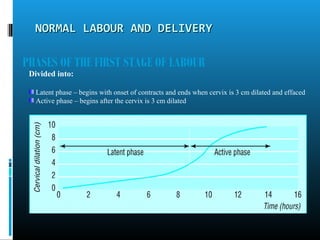
PHASES OF THE FIRST STAGE OF LABOUR
Divided into:
Latent phase – begins with onset of contracts and ends when cervix is 3 cm dilated and effaced
Active phase – begins after the cervix is 3 cm dilated
NORMAL LABOUR AND DELIVERYNORMAL LABOUR AND DELIVERY
LATENT PhaseLATENT Phase ACTIVE Phase
1. Begins with onset of contractions
2. Slow progress
3. Little cervical dilatation
4. Progressive cervical effacement
5. Ends once the cervix reaches 3
cm dilatation
6. Durations
~ 8 hours for nulliparae
~ 6 hours for multiparae
1. Active process
2. Begins after 3 cm of cervical
dilatation
3. Period of active cervical dilatation
(average rate 1 cm/hr)
4. S-shaped curve which is used to
define progress of labour
5. It has 3 component
a) acceleration - slow
b) maximum - fast
c) deceleration - slow
PHASES OF THE FIRST STAGE OF LABOUR
NORMAL LABOUR AND DELIVERYNORMAL LABOUR AND DELIVERY
Do Uterine Contractions Affect Fetal Heart Rate?
Uterine contractions can affect fetal heart rate by increasing or
decreasing that rate in association with any given contraction.
The three primary mechanisms by which uterine contractions can
cause a decrease in fetal heart rate are compression of:
· Fetal head
· Umbilical cord
· Uterine myometrial vessels
NORMAL LABOUR AND DELIVERYNORMAL LABOUR AND DELIVERY
SECOND STAGE OF LABOUR
1. Begins with FULL DILATATION and ends with DELIVERY OF THE
BABY.
2. It have TWO Phases
a) Propulsive phase – from full dilatation until presenting part has
descended
to the pelvic floor
b) Expulsive phase which ends with the delivery of the baby
Features of expulsive phase – 1) mother’s irresistible desire to
bear down
2) distension of perineum
3) dilatation of the anus
3. Average length
a) Primigravidae – 40 minutes
b) Multigravidae – 20 minutes
NORMAL LABOUR AND DELIVERYNORMAL LABOUR AND DELIVERY
PROGRESS OF SECOND STAGE OF LABOUR
Findings suggestive of satisfactory progress in second stage of labour
are:
- steady descent of fetus through birth canal;
- onset of expulsive (pushing) phase.
Findings suggestive of unsatisfactory progress in second stage of labour
are:
- lack of descent of fetus through birth canal;
- failure of expulsion during the late (expulsive) phase.
NORMAL LABOUR AND DELIVERYNORMAL LABOUR AND DELIVERY
THIRD STAGE OF LABOUR
1. Begins after DELIVERY of the baby and ends with DELIVERY OF THE
PLACENTA / MEMBRANES.
2. It have TWO Phases
a) Separation phase
b) Expulsion phase
3. Duration – usually 15 minutes or less (if actively managed).
4. Average blood loss – 150 to 250 ml.
 MANAGEMENT OF
LABOUR
NORMAL LABOUR AND DELIVERYNORMAL LABOUR AND DELIVERY
• To achieve delivery of a normal healthy child
• To anticipate, recognize and treat potential abnormal
conditions before significant hazard develops for the
mother or the fetus.
AIMS IN THE MANAGEMENT OF LABOUR
The AIMS include:
NORMAL LABOUR AND DELIVERYNORMAL LABOUR AND DELIVERY
• Diagnosis of labour
• Monitoring the progress of labour
• Ensuring maternal well-being
• Ensuring fetal well-being.
PRINCIPLES IN THE MANAGEMENT OF LABOUR
The principles include:
NORMAL LABOUR AND DELIVERYNORMAL LABOUR AND DELIVERY
MANAGEMENT
FIRST STAGE OF
LABOUR
NORMAL LABOUR AND DELIVERYNORMAL LABOUR AND DELIVERY
• On admission:
When the women presents at hospital, the woman’s antenatal record is reviewed to
discover whether there have been any abnormalities during her pregnancy. When there are
no records of antenatal care a complete history must be taken.
• General examination of the mother
a) General conditions – evaluate the mother general health condition. Look for pallor,
edema, abdominal scar (LSCS) and maternal height.
b) Vital signs – Blood pressure, pulse, respiration and temperature are taken and recorded
c) Heart and lungs
d) Urine analysis – for protein, sugar and ketones
MANAGEMENT OF THE FIRST STAGE OF LABOUR1
NORMAL LABOUR AND DELIVERYNORMAL LABOUR AND DELIVERY
• Abdominal examination:
a) A detailed abdominal examination should be carried out
and recorded.
b) Determine the presentation and position of the fetus and
also the engagement
c) Auscultate the fetal heart
d) Evaluate the uterine contraction
• Vaginal examination – the purpose is to
a) To make a positive diagnosis of labour
b) To make a positive identification of presentation
c) To determine whether the fetal head is engaged in case of
MANAGEMENT OF THE FIRST STAGE OF LABOUR2
NORMAL LABOUR AND DELIVERYNORMAL LABOUR AND DELIVERY
• Bowel preparation:
If there has been no bowel action for 24 hours or the rectum feels loaded
on vaginal examination an enema is given.
• Bladder care
A full bladder may initially prevent the fetal head from entering the
pelvic brim and later impede descent of the fetal head. It will also
inhibit effective uterine action.
The woman should be encouraged to empty her bladder every 1½ - 2
hours during labour.
The quantity of urine passed should be measured and recorded and a
specimen obtained for testing.
MANAGEMENT OF THE FIRST STAGE OF LABOUR3
NORMAL LABOUR AND DELIVERYNORMAL LABOUR AND DELIVERY
• Pain in labour
The pain experienced by the woman in labour is caused by the:
1): Uterine contractions and uterine ischaemia.
2): Cervical dilatation. Dilatation and stretching of the cervix and lower uterine
segment stimulate nerve ganglia and are a major source of pain.
3): Distention of the vagina and perineum. Marked distention of the vagina and
perineum occurs with fetal descent, especially during the second stage.
LABOUR PAIN– causes1
NORMAL LABOUR AND DELIVERYNORMAL LABOUR AND DELIVERY
PAIN RELIEF IN LABOUR – types
Three methods are in common use during labour:
1. Analgesic drugs (narcotics, e.g. pethidine) which
are given by intramuscularly injection.
2. Inhalation analgesia (e.g. Entonox).
3. Regional anaesthesia (e.g. epidural, spinal) that
blocks the sensory pain pathways.
NORMAL LABOUR AND DELIVERYNORMAL LABOUR AND DELIVERY
How To Monitor The Fetal Heart Rate?
 Auscultation methods
 Electronic monitoring ~ CTG
NORMAL LABOUR AND DELIVERYNORMAL LABOUR AND DELIVERY
MONITORING FETAL HEART
To detect fetal hypoxia
NORMAL
ABNORMAL
NORMAL LABOUR AND DELIVERYNORMAL LABOUR AND DELIVERY
RECORDING THE PROGRESS OF LABOUR
PATIENT INFORMATION
FETAL INFORMATION
~ fetal well being
LABOUR INFORMATION
~ Dilatation
~ Descent
~ Contraction
MEDICATIONS
MATERNAL INFORMATION
~ Well being
NORMAL LABOUR AND DELIVERYNORMAL LABOUR AND DELIVERY
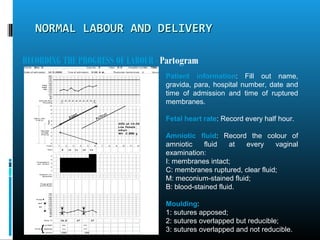
RECORDING THE PROGRESS OF LABOUR - Partogram
Patient information: Fill out name,
gravida, para, hospital number, date and
time of admission and time of ruptured
membranes.
Fetal heart rate: Record every half hour.
Amniotic fluid: Record the colour of
amniotic fluid at every vaginal
examination:
I: membranes intact;
C: membranes ruptured, clear fluid;
M: meconium-stained fluid;
B: blood-stained fluid.
Moulding:
1: sutures apposed;
2: sutures overlapped but reducible;
3: sutures overlapped and not reducible.
NORMAL LABOUR AND DELIVERYNORMAL LABOUR AND DELIVERY
RECORDING THE PROGRESS OF LABOUR - Partogram
Cervical dilatation: Assessed at every
vaginal examination and marked with a
cross (X). Begin plotting on the partograph
at 3 cm.
Station : recorded as a circle (O) at every
vaginal examination.
Contractions: Chart every half hour;
palpate the number of contractions in 10
minutes and their duration in seconds.
Less than 20 seconds:
Between 20 and 40 seconds:
More than 40 seconds:
Assess the progress of labour:
NORMAL LABOUR AND DELIVERYNORMAL LABOUR AND DELIVERY
RECORDING THE PROGRESS OF LABOUR - Partogram
Oxytocin: Record the amount of oxytocin
every 30 minutes when used.
Drugs given: Record any additional
drugs given – e.g. Pethidine
Pulse: Record every 30 minutes and
mark with a dot (●).
Blood pressure: Record every 4 hours
and mark with arrows ( )
Temperature: Record every 2 hours.
Protein, acetone and volume: Record
every time urine is passed.
Progress of maternal well being:
NORMAL LABOUR AND DELIVERYNORMAL LABOUR AND DELIVERY
• Maternal position:
With the exception of avoiding supine position, the mother may assume any comfortable
position for effective bearing down.
The semi-recumbent or supported sitting position, with the thighs abducted, is the posture
most commonly adopted
• Bearing down
With each contraction, the mother should be encouraged to bear down with expulsive
efforts
MANAGEMENT OF THE SECOND STAGE OF LABOUR1
Once the onset of the second stage has been confirmed a woman should
not be left without attendance. Accurate observation of progress is vital,
for the unexpected can always happen.
NORMAL LABOUR AND DELIVERYNORMAL LABOUR AND DELIVERY
• Observation during the second stage:
Four factors determine whether the second stage may be safely continued and these must
be carefully monitored throughout the second stage of labour.
1. Maternal conditions
Observation includes an appraisal of the mother’s ability to cope emotionally as well as an
assessment of her physical wellbeing. A maternal pulse rate is usually recorded quarter-
hourly and bloods pressure hourly
2. Fetal conditions - During the second stage, the fetal heart should be monitored either
continuously or after each contraction. stage may be associated with fetal distress.
The liquor amnii is observed for signs of meconium staining.
3. Uterine contractions - The strength, length and frequency of contractions should be
assessed continuously.
4. The progress of descent - The progress should be recorded approximately every 30
minutes during the second stage.
MANAGEMENT OF THE SECOND STAGE OF LABOUR2
NORMAL LABOUR AND DELIVERYNORMAL LABOUR AND DELIVERY
• CONDUCTING THE DELIVERY1
:
When delivery is imminent, the patient is usually placed in the dorsal position,
and the skin over the lower abdomen, vulva, anus and upper thigh is cleansed
with antiseptic solution and draped.
DELIVERY OF THE HEAD
1) Control the delivery of the head to prevent laceration
2) Performed episiotomy if requires
3) Cleared the airway after delivery of the had
MANAGEMENT OF THE SECOND STAGE OF LABOUR3
NORMAL LABOUR AND DELIVERYNORMAL LABOUR AND DELIVERY
• CONDUCTING THE DELIVERY2
:
DELIVERY OF THE SHOULDERS
Delivery of the anterior shoulder is aided by
gentle downward traction on the head.
The posterior shoulder is delivered by
elevating the head.
MANAGEMENT OF THE SECOND STAGE OF LABOUR3
NORMAL LABOUR AND DELIVERYNORMAL LABOUR AND DELIVERY
• CONDUCTING THE DELIVERY3
:
DELIVERY OF THE TRUNK
After the delivery of the shoulders the baby is grasped around the chest to aid the birth of the trunk.
Finally, the body is slowly extracted by traction on the shoulders and lifts the baby towards the
mother’s abdomen.
The time of delivery is noted.
CUTTING THE UMBILICAL CORD
After delivery, it is therefore usual to wait 15 to 20 seconds before clamping and cutting the umbilical
cord.
After cutting the cord a plastic crushing clamp is placed on the cord 1 to 2 cm from the umbilicus and
the cord is cut again 1 cm beyond the clamp.
MANAGEMENT OF THE SECOND STAGE OF LABOUR3
NORMAL LABOUR AND DELIVERYNORMAL LABOUR AND DELIVERY
• CONDUCTING THE DELIVERY4
:
IMMEDIATE CARE OF THE NEW BORN
Once the baby is breathing normally he should be dried and warmly wrapped to prevent
cooling and handle to the mother to hold, cuddle and enjoy.
If spontaneous respiration is not established soon after birth, resuscitation is the immediate
priority.
The Apgar’s score of the baby should be noted and
recorded.
MANAGEMENT OF THE SECOND STAGE OF LABOUR3
NORMAL LABOUR AND DELIVERYNORMAL LABOUR AND DELIVERY
MECHANISM OF LABOUR for occiput anterior
The “mechanism of labour” refers to the sequencing of
events related to posturing and positioning that allows the
baby to find the “easiest way out”.
For a normal mechanism of labour to occur, both the fetal
and maternal factors must be harmonious.
DEFINITION:
NORMAL LABOUR AND DELIVERYNORMAL LABOUR AND DELIVERY
MECHANISM OF LABOUR for occiput anterior
Events of mechanism of labour:
F: Flexion and descent
I: Internal rotation of the fetal head
C: Crowning
E: Extension
R: Restitution
I : Internal rotation of the shoulders
E: External rotation of the fetal head
L: Lateral flexion of the body
NORMAL LABOUR AND DELIVERYNORMAL LABOUR AND DELIVERY
MECHANISM OF LABOUR for occiput anterior (OA)
Flexion
Internal rotation
Crowning
Extension
Restitution
Internal rotation of shoulder
External rotation of head
Lateral flexion of body
Delivery
F
I
C
E
R
I
E
L
NORMAL LABOUR AND DELIVERYNORMAL LABOUR AND DELIVERY
MANAGEMENT
THIRD STAGE OF
LABOUR
NORMAL LABOUR AND DELIVERYNORMAL LABOUR AND DELIVERY
• BIRTH OF THE PLACENTA1
:
Delivery of the placenta occurs in two stages:
(1) separation of the placenta from the wall of the uterus and into the
lower uterine segment
and/or the vagina, and
(2) actual expulsion of the placenta out of the birth canal.
MANAGEMENT OF THE THIRD STAGE OF LABOUR
NORMAL LABOUR AND DELIVERYNORMAL LABOUR AND DELIVERY
• MECHANISM OF PLACENTA SEPARATION1
:
THE THIRD STAGE OF LABOUR
Two mechanisms of placental separation occurs:
1- Mathews-Duncan mechanism
The leading edge of the placenta
separates first and the placenta is
delivered with its raw surface
exposed.
2- Schultz mechanism
If the placenta is inserted at the
fundus and central area separates
first, the placenta inverts and draws
the membranes after it, covering the
raw surface (inverted umbrella)
LABOUR AND DELIVERYLABOUR AND DELIVERY
WHAT ARE THE SIGNS OFWHAT ARE THE SIGNS OF
PLACENTA SEPARATIONPLACENTA SEPARATION
NORMAL LABOUR AND DELIVERYNORMAL LABOUR AND DELIVERY
• BIRTH OF THE PLACENTA2
:
CLINICAL SIGNS OF PLACENTAL SEPARATION
Placental separation takes place within 5 minutes after the delivery of the infant. Signs suggesting that
detachment or separation has taken place include:
1. The uterus becomes globular and hard. This sign is the earliest to appear.
2. There is often a sudden gush of blood
3. The uterus rises in the abdomen because the placenta,
having separated, passes down into the lower segment
and vagina, where its bulk pushes the uterus upward.
4. Cord lengthening. This is the most reliable clinical sign
of placental separation.
MANAGEMENT OF THE THIRD STAGE OF LABOUR
NORMAL LABOUR AND DELIVERYNORMAL LABOUR AND DELIVERY
• BIRTH OF THE PLACENTA2
:
After the placental separation takes place the placenta can be delivered by
the:
1. Passive management – wait for spontaneous expulsion of placenta
2. Active management
MANAGEMENT OF THE THIRD STAGE OF LABOUR
LABOUR AND DELIVERYLABOUR AND DELIVERY
ACTIVE MANAGEMENT OFACTIVE MANAGEMENT OF
THE THIRD STAGE OF LABOURTHE THIRD STAGE OF LABOUR
NORMAL LABOUR AND DELIVERYNORMAL LABOUR AND DELIVERY
MANAGEMENT OF THE THIRD STAGE OF LABOUR
ACTIVE MANAGEMENT OF THE THIRD STAGE
Active management of the third stage (active delivery of the
placenta) helps prevent postpartum haemorrhage.
Active management of the third stage of labour includes:
~ use of oxytocin
~ controlled cord traction, and
~ uterine massage.
NORMAL LABOUR AND DELIVERYNORMAL LABOUR AND DELIVERY
MANAGEMENT OF THE THIRD STAGE OF LABOUR
ACTIVE MANAGEMENT OF THE THIRD STAGE
~ Use of oxytocin
Oxytocic drugs should be given with the birth of the anterior shoulder.
Syntocinon is the most used oxytocic known to be effective; the addition of
ergometrine may reduce blood loss.
SYNTOMETRINE (oxytocin 5 IU + ergometrine 0.5 mg) – widely used
NORMAL LABOUR AND DELIVERYNORMAL LABOUR AND DELIVERY
• BIRTH OF THE PLACENTA3
:
EXPULSION OF THE PLACENTA BY ACTIVE
MANAGEMENT
When these signs have appeared the placenta is ready for expression. If
the patient is awake, she is asked to bear down while gentle traction is
made on the umbilical cord.
The popular and effective method of delivering the placenta is by
Brandt-Andrews method.
MANAGEMENT OF THE THIRD STAGE OF LABOUR
NORMAL LABOUR AND DELIVERYNORMAL LABOUR AND DELIVERY
• BIRTH OF THE PLACENTA4
:
BRANDT’S ANDREW METHOD
Once the signs of placental separation have occurred the obstetrician assists
delivery of the placenta by controlled cord traction as described by Brandt-
Andrews’ method.
MANAGEMENT OF THE THIRD STAGE OF LABOUR
A) Controlled cord traction B) Delivery of the membranes
NORMAL LABOUR AND DELIVERYNORMAL LABOUR AND DELIVERY
• BIRTH OF THE PLACENTA5
:
EXAMINATION OF THE PLACENTA
The placenta, membranes, and umbilical cord should be examined for completeness and
for anomalies.
EXAMINATION OF THE PERINEUM
At the same time, the perineal region, vulva outlet, vaginal canal, and the cervix should be
carefully examined for lacerations.
If the perineum has been torn or an episiotomy made, tear or incision should be repaired
immediately.
MANAGEMENT OF THE THIRD STAGE OF LABOUR
MANAGEMENT AFTER
DELIVERY
NORMAL LABOUR AND DELIVERYNORMAL LABOUR AND DELIVERY
• EARLY POSTPARTUM MANAGEMENT:
The hours immediately following delivery and the birth of the placenta are a critical period as
postpartum haemorrhage can occurspostpartum haemorrhage can occurs due the relaxation of the uterus.
The patient is kept in the delivery suite for 1 hour postpartum under close observation. She is check
for bleeding, the blood pressure is measured, and the pulse is counted.
Before discharging the patient from the delivery suit it is mandatory:
• To check the uterus frequently to make sure it is firm and not relaxing.
• To remove any presence of intrauterine blood clots. The presence of these clots will interfere with
retraction and the normal haemostatic mechanism of the uterus.
• To look at the introitus to see that there is no haemorrhage.
• To keep the bladder empties because full bladder can also interfere with uterine retraction.
• To examine the baby to be certain that it is breathing well and that the colour and tone are normal.
IMMEDIATE MANAGEMENT AFTER THE DELIVERY
Normal Labour by Dr Salman

Normal Labour by Dr Salman

  • 2.
  • 3.
    WHAT ISWHAT IS NORMALLABOUR ?NORMAL LABOUR ?
  • 4.
    NORMALNORMAL LABOURLABOUR Labour is definedas the onset of regular painful uterine contractions with progressive cervical effacement and dilatation of the cervix accompanied by descent of the presenting part. DEFINITIONSDEFINITIONS
  • 5.
    NORMAL LABOURNORMAL LABOUR •Spontaneous expulsion, • of a single, • mature fetus (37 completed weeks – 42 weeks), • presented by vertex, • through the birth canal (i.e. vaginal delivery), • within a reasonable time (not less than 3 hours or more than 18 hours), • without complications to the mother, • or the fetus The following criteria should be present to call it normal labour
  • 6.
    WHAT FACTORS INFLUENCEWHATFACTORS INFLUENCE PROGRESS OF LABOUR ?PROGRESS OF LABOUR ?
  • 7.
    LABOUR AND DELIVERYLABOURAND DELIVERY FACTORS THAT INFLUENCEFACTORS THAT INFLUENCE PROGRESS OF LABOURPROGRESS OF LABOUR Passenger Passage Power
  • 8.
    THE NORMAL FEMALEPELVISTHE NORMAL FEMALE PELVIS The important diameters of the female pelvis: AnteroposteriorAnteroposterior ObliqueOblique TransverseTransverse BRIMBRIM 11 – 11.511 – 11.5 1212 12.512.5 CAVITYCAVITY 1212 1212 1212 OUTLETOUTLET 12.512.5 1212 11- 11.511- 11.5 DiametersDiameters (cm)(cm)
  • 9.
    POWERPOWER ►► Contractions+ Maternal pushing Uterine contractions: 1. Initiate by pacemakers ~ uterotubal junction 2. Contraction waves meet at the fundus 3. Contraction waves progress downward  Shortening of muscle fibres  Retractions  intra uterine pressure EXPULSION OF THE FETUS Additional force “maternal pushing” Intra abdominal pressure
  • 10.
    UTERINE CONTRACTIONUTERINE CONTRACTION NORMALCONTRACTION 1. Frequency ~ one in every 2 – 3 min with at least 1 minute interval 2. Intensity ~ strong (> 50 mmHg) 3. Duration ~ 45 – 60 sec Uterine contractions
  • 11.
    LABOUR AND DELIVERY WHATINITIATE LABOURWHAT INITIATE LABOUR ““ONSET OF LABOUR”ONSET OF LABOUR”
  • 12.
    NORMAL LABOURNORMAL LABOUR •Hormonal factors 1) Estrogen theory 2) Progesterone withdrawal theory 3) Prostaglandins theory 4) Oxytocin theory 5) Fetal cortisol theory • Mechanical factors 1) Uterine distension theory 2) Stretch of the lower uterine segment by the presenting near term Causes of Onset of Labour: - It is unknown but the following theories were postulated:
  • 13.
    NORMAL LABOUR ANDDELIVERYNORMAL LABOUR AND DELIVERY • Painful regular uterine contractions – as evidence by contraction at least one in ten minutes • Show – as evidence by mucus mixed with blood • Rupture of membranes – as evidence by leaking liquor • Progressive shortening and dilatation of the cervix SYMPTOMS AND SIGNS OF LABOUR Before labour begins, women usually notice one or more premonitory, or warnings, signs that labour is about to begin. They are:
  • 14.
  • 15.
    NORMAL LABOUR ANDDELIVERYNORMAL LABOUR AND DELIVERY PHASES OF THE FIRST STAGE OF LABOUR Divided into: Latent phase – begins with onset of contracts and ends when cervix is 3 cm dilated and effaced Active phase – begins after the cervix is 3 cm dilated
  • 16.
    NORMAL LABOUR ANDDELIVERYNORMAL LABOUR AND DELIVERY LATENT PhaseLATENT Phase ACTIVE Phase 1. Begins with onset of contractions 2. Slow progress 3. Little cervical dilatation 4. Progressive cervical effacement 5. Ends once the cervix reaches 3 cm dilatation 6. Durations ~ 8 hours for nulliparae ~ 6 hours for multiparae 1. Active process 2. Begins after 3 cm of cervical dilatation 3. Period of active cervical dilatation (average rate 1 cm/hr) 4. S-shaped curve which is used to define progress of labour 5. It has 3 component a) acceleration - slow b) maximum - fast c) deceleration - slow PHASES OF THE FIRST STAGE OF LABOUR
  • 17.
    NORMAL LABOUR ANDDELIVERYNORMAL LABOUR AND DELIVERY Do Uterine Contractions Affect Fetal Heart Rate? Uterine contractions can affect fetal heart rate by increasing or decreasing that rate in association with any given contraction. The three primary mechanisms by which uterine contractions can cause a decrease in fetal heart rate are compression of: · Fetal head · Umbilical cord · Uterine myometrial vessels
  • 18.
    NORMAL LABOUR ANDDELIVERYNORMAL LABOUR AND DELIVERY SECOND STAGE OF LABOUR 1. Begins with FULL DILATATION and ends with DELIVERY OF THE BABY. 2. It have TWO Phases a) Propulsive phase – from full dilatation until presenting part has descended to the pelvic floor b) Expulsive phase which ends with the delivery of the baby Features of expulsive phase – 1) mother’s irresistible desire to bear down 2) distension of perineum 3) dilatation of the anus 3. Average length a) Primigravidae – 40 minutes b) Multigravidae – 20 minutes
  • 19.
    NORMAL LABOUR ANDDELIVERYNORMAL LABOUR AND DELIVERY PROGRESS OF SECOND STAGE OF LABOUR Findings suggestive of satisfactory progress in second stage of labour are: - steady descent of fetus through birth canal; - onset of expulsive (pushing) phase. Findings suggestive of unsatisfactory progress in second stage of labour are: - lack of descent of fetus through birth canal; - failure of expulsion during the late (expulsive) phase.
  • 20.
    NORMAL LABOUR ANDDELIVERYNORMAL LABOUR AND DELIVERY THIRD STAGE OF LABOUR 1. Begins after DELIVERY of the baby and ends with DELIVERY OF THE PLACENTA / MEMBRANES. 2. It have TWO Phases a) Separation phase b) Expulsion phase 3. Duration – usually 15 minutes or less (if actively managed). 4. Average blood loss – 150 to 250 ml.
  • 21.
  • 22.
    NORMAL LABOUR ANDDELIVERYNORMAL LABOUR AND DELIVERY • To achieve delivery of a normal healthy child • To anticipate, recognize and treat potential abnormal conditions before significant hazard develops for the mother or the fetus. AIMS IN THE MANAGEMENT OF LABOUR The AIMS include:
  • 23.
    NORMAL LABOUR ANDDELIVERYNORMAL LABOUR AND DELIVERY • Diagnosis of labour • Monitoring the progress of labour • Ensuring maternal well-being • Ensuring fetal well-being. PRINCIPLES IN THE MANAGEMENT OF LABOUR The principles include:
  • 24.
    NORMAL LABOUR ANDDELIVERYNORMAL LABOUR AND DELIVERY MANAGEMENT FIRST STAGE OF LABOUR
  • 25.
    NORMAL LABOUR ANDDELIVERYNORMAL LABOUR AND DELIVERY • On admission: When the women presents at hospital, the woman’s antenatal record is reviewed to discover whether there have been any abnormalities during her pregnancy. When there are no records of antenatal care a complete history must be taken. • General examination of the mother a) General conditions – evaluate the mother general health condition. Look for pallor, edema, abdominal scar (LSCS) and maternal height. b) Vital signs – Blood pressure, pulse, respiration and temperature are taken and recorded c) Heart and lungs d) Urine analysis – for protein, sugar and ketones MANAGEMENT OF THE FIRST STAGE OF LABOUR1
  • 26.
    NORMAL LABOUR ANDDELIVERYNORMAL LABOUR AND DELIVERY • Abdominal examination: a) A detailed abdominal examination should be carried out and recorded. b) Determine the presentation and position of the fetus and also the engagement c) Auscultate the fetal heart d) Evaluate the uterine contraction • Vaginal examination – the purpose is to a) To make a positive diagnosis of labour b) To make a positive identification of presentation c) To determine whether the fetal head is engaged in case of MANAGEMENT OF THE FIRST STAGE OF LABOUR2
  • 27.
    NORMAL LABOUR ANDDELIVERYNORMAL LABOUR AND DELIVERY • Bowel preparation: If there has been no bowel action for 24 hours or the rectum feels loaded on vaginal examination an enema is given. • Bladder care A full bladder may initially prevent the fetal head from entering the pelvic brim and later impede descent of the fetal head. It will also inhibit effective uterine action. The woman should be encouraged to empty her bladder every 1½ - 2 hours during labour. The quantity of urine passed should be measured and recorded and a specimen obtained for testing. MANAGEMENT OF THE FIRST STAGE OF LABOUR3
  • 28.
    NORMAL LABOUR ANDDELIVERYNORMAL LABOUR AND DELIVERY • Pain in labour The pain experienced by the woman in labour is caused by the: 1): Uterine contractions and uterine ischaemia. 2): Cervical dilatation. Dilatation and stretching of the cervix and lower uterine segment stimulate nerve ganglia and are a major source of pain. 3): Distention of the vagina and perineum. Marked distention of the vagina and perineum occurs with fetal descent, especially during the second stage. LABOUR PAIN– causes1
  • 29.
    NORMAL LABOUR ANDDELIVERYNORMAL LABOUR AND DELIVERY PAIN RELIEF IN LABOUR – types Three methods are in common use during labour: 1. Analgesic drugs (narcotics, e.g. pethidine) which are given by intramuscularly injection. 2. Inhalation analgesia (e.g. Entonox). 3. Regional anaesthesia (e.g. epidural, spinal) that blocks the sensory pain pathways.
  • 30.
    NORMAL LABOUR ANDDELIVERYNORMAL LABOUR AND DELIVERY How To Monitor The Fetal Heart Rate?  Auscultation methods  Electronic monitoring ~ CTG
  • 31.
    NORMAL LABOUR ANDDELIVERYNORMAL LABOUR AND DELIVERY MONITORING FETAL HEART To detect fetal hypoxia NORMAL ABNORMAL
  • 32.
    NORMAL LABOUR ANDDELIVERYNORMAL LABOUR AND DELIVERY RECORDING THE PROGRESS OF LABOUR PATIENT INFORMATION FETAL INFORMATION ~ fetal well being LABOUR INFORMATION ~ Dilatation ~ Descent ~ Contraction MEDICATIONS MATERNAL INFORMATION ~ Well being
  • 33.
    NORMAL LABOUR ANDDELIVERYNORMAL LABOUR AND DELIVERY RECORDING THE PROGRESS OF LABOUR - Partogram Patient information: Fill out name, gravida, para, hospital number, date and time of admission and time of ruptured membranes. Fetal heart rate: Record every half hour. Amniotic fluid: Record the colour of amniotic fluid at every vaginal examination: I: membranes intact; C: membranes ruptured, clear fluid; M: meconium-stained fluid; B: blood-stained fluid. Moulding: 1: sutures apposed; 2: sutures overlapped but reducible; 3: sutures overlapped and not reducible.
  • 34.
    NORMAL LABOUR ANDDELIVERYNORMAL LABOUR AND DELIVERY RECORDING THE PROGRESS OF LABOUR - Partogram Cervical dilatation: Assessed at every vaginal examination and marked with a cross (X). Begin plotting on the partograph at 3 cm. Station : recorded as a circle (O) at every vaginal examination. Contractions: Chart every half hour; palpate the number of contractions in 10 minutes and their duration in seconds. Less than 20 seconds: Between 20 and 40 seconds: More than 40 seconds: Assess the progress of labour:
  • 35.
    NORMAL LABOUR ANDDELIVERYNORMAL LABOUR AND DELIVERY RECORDING THE PROGRESS OF LABOUR - Partogram Oxytocin: Record the amount of oxytocin every 30 minutes when used. Drugs given: Record any additional drugs given – e.g. Pethidine Pulse: Record every 30 minutes and mark with a dot (●). Blood pressure: Record every 4 hours and mark with arrows ( ) Temperature: Record every 2 hours. Protein, acetone and volume: Record every time urine is passed. Progress of maternal well being:
  • 36.
    NORMAL LABOUR ANDDELIVERYNORMAL LABOUR AND DELIVERY • Maternal position: With the exception of avoiding supine position, the mother may assume any comfortable position for effective bearing down. The semi-recumbent or supported sitting position, with the thighs abducted, is the posture most commonly adopted • Bearing down With each contraction, the mother should be encouraged to bear down with expulsive efforts MANAGEMENT OF THE SECOND STAGE OF LABOUR1 Once the onset of the second stage has been confirmed a woman should not be left without attendance. Accurate observation of progress is vital, for the unexpected can always happen.
  • 37.
    NORMAL LABOUR ANDDELIVERYNORMAL LABOUR AND DELIVERY • Observation during the second stage: Four factors determine whether the second stage may be safely continued and these must be carefully monitored throughout the second stage of labour. 1. Maternal conditions Observation includes an appraisal of the mother’s ability to cope emotionally as well as an assessment of her physical wellbeing. A maternal pulse rate is usually recorded quarter- hourly and bloods pressure hourly 2. Fetal conditions - During the second stage, the fetal heart should be monitored either continuously or after each contraction. stage may be associated with fetal distress. The liquor amnii is observed for signs of meconium staining. 3. Uterine contractions - The strength, length and frequency of contractions should be assessed continuously. 4. The progress of descent - The progress should be recorded approximately every 30 minutes during the second stage. MANAGEMENT OF THE SECOND STAGE OF LABOUR2
  • 38.
    NORMAL LABOUR ANDDELIVERYNORMAL LABOUR AND DELIVERY • CONDUCTING THE DELIVERY1 : When delivery is imminent, the patient is usually placed in the dorsal position, and the skin over the lower abdomen, vulva, anus and upper thigh is cleansed with antiseptic solution and draped. DELIVERY OF THE HEAD 1) Control the delivery of the head to prevent laceration 2) Performed episiotomy if requires 3) Cleared the airway after delivery of the had MANAGEMENT OF THE SECOND STAGE OF LABOUR3
  • 39.
    NORMAL LABOUR ANDDELIVERYNORMAL LABOUR AND DELIVERY • CONDUCTING THE DELIVERY2 : DELIVERY OF THE SHOULDERS Delivery of the anterior shoulder is aided by gentle downward traction on the head. The posterior shoulder is delivered by elevating the head. MANAGEMENT OF THE SECOND STAGE OF LABOUR3
  • 40.
    NORMAL LABOUR ANDDELIVERYNORMAL LABOUR AND DELIVERY • CONDUCTING THE DELIVERY3 : DELIVERY OF THE TRUNK After the delivery of the shoulders the baby is grasped around the chest to aid the birth of the trunk. Finally, the body is slowly extracted by traction on the shoulders and lifts the baby towards the mother’s abdomen. The time of delivery is noted. CUTTING THE UMBILICAL CORD After delivery, it is therefore usual to wait 15 to 20 seconds before clamping and cutting the umbilical cord. After cutting the cord a plastic crushing clamp is placed on the cord 1 to 2 cm from the umbilicus and the cord is cut again 1 cm beyond the clamp. MANAGEMENT OF THE SECOND STAGE OF LABOUR3
  • 41.
    NORMAL LABOUR ANDDELIVERYNORMAL LABOUR AND DELIVERY • CONDUCTING THE DELIVERY4 : IMMEDIATE CARE OF THE NEW BORN Once the baby is breathing normally he should be dried and warmly wrapped to prevent cooling and handle to the mother to hold, cuddle and enjoy. If spontaneous respiration is not established soon after birth, resuscitation is the immediate priority. The Apgar’s score of the baby should be noted and recorded. MANAGEMENT OF THE SECOND STAGE OF LABOUR3
  • 42.
    NORMAL LABOUR ANDDELIVERYNORMAL LABOUR AND DELIVERY MECHANISM OF LABOUR for occiput anterior The “mechanism of labour” refers to the sequencing of events related to posturing and positioning that allows the baby to find the “easiest way out”. For a normal mechanism of labour to occur, both the fetal and maternal factors must be harmonious. DEFINITION:
  • 43.
    NORMAL LABOUR ANDDELIVERYNORMAL LABOUR AND DELIVERY MECHANISM OF LABOUR for occiput anterior Events of mechanism of labour: F: Flexion and descent I: Internal rotation of the fetal head C: Crowning E: Extension R: Restitution I : Internal rotation of the shoulders E: External rotation of the fetal head L: Lateral flexion of the body
  • 44.
    NORMAL LABOUR ANDDELIVERYNORMAL LABOUR AND DELIVERY MECHANISM OF LABOUR for occiput anterior (OA) Flexion Internal rotation Crowning Extension Restitution Internal rotation of shoulder External rotation of head Lateral flexion of body Delivery F I C E R I E L
  • 45.
    NORMAL LABOUR ANDDELIVERYNORMAL LABOUR AND DELIVERY MANAGEMENT THIRD STAGE OF LABOUR
  • 46.
    NORMAL LABOUR ANDDELIVERYNORMAL LABOUR AND DELIVERY • BIRTH OF THE PLACENTA1 : Delivery of the placenta occurs in two stages: (1) separation of the placenta from the wall of the uterus and into the lower uterine segment and/or the vagina, and (2) actual expulsion of the placenta out of the birth canal. MANAGEMENT OF THE THIRD STAGE OF LABOUR
  • 47.
    NORMAL LABOUR ANDDELIVERYNORMAL LABOUR AND DELIVERY • MECHANISM OF PLACENTA SEPARATION1 : THE THIRD STAGE OF LABOUR Two mechanisms of placental separation occurs: 1- Mathews-Duncan mechanism The leading edge of the placenta separates first and the placenta is delivered with its raw surface exposed. 2- Schultz mechanism If the placenta is inserted at the fundus and central area separates first, the placenta inverts and draws the membranes after it, covering the raw surface (inverted umbrella)
  • 48.
    LABOUR AND DELIVERYLABOURAND DELIVERY WHAT ARE THE SIGNS OFWHAT ARE THE SIGNS OF PLACENTA SEPARATIONPLACENTA SEPARATION
  • 49.
    NORMAL LABOUR ANDDELIVERYNORMAL LABOUR AND DELIVERY • BIRTH OF THE PLACENTA2 : CLINICAL SIGNS OF PLACENTAL SEPARATION Placental separation takes place within 5 minutes after the delivery of the infant. Signs suggesting that detachment or separation has taken place include: 1. The uterus becomes globular and hard. This sign is the earliest to appear. 2. There is often a sudden gush of blood 3. The uterus rises in the abdomen because the placenta, having separated, passes down into the lower segment and vagina, where its bulk pushes the uterus upward. 4. Cord lengthening. This is the most reliable clinical sign of placental separation. MANAGEMENT OF THE THIRD STAGE OF LABOUR
  • 50.
    NORMAL LABOUR ANDDELIVERYNORMAL LABOUR AND DELIVERY • BIRTH OF THE PLACENTA2 : After the placental separation takes place the placenta can be delivered by the: 1. Passive management – wait for spontaneous expulsion of placenta 2. Active management MANAGEMENT OF THE THIRD STAGE OF LABOUR
  • 51.
    LABOUR AND DELIVERYLABOURAND DELIVERY ACTIVE MANAGEMENT OFACTIVE MANAGEMENT OF THE THIRD STAGE OF LABOURTHE THIRD STAGE OF LABOUR
  • 52.
    NORMAL LABOUR ANDDELIVERYNORMAL LABOUR AND DELIVERY MANAGEMENT OF THE THIRD STAGE OF LABOUR ACTIVE MANAGEMENT OF THE THIRD STAGE Active management of the third stage (active delivery of the placenta) helps prevent postpartum haemorrhage. Active management of the third stage of labour includes: ~ use of oxytocin ~ controlled cord traction, and ~ uterine massage.
  • 53.
    NORMAL LABOUR ANDDELIVERYNORMAL LABOUR AND DELIVERY MANAGEMENT OF THE THIRD STAGE OF LABOUR ACTIVE MANAGEMENT OF THE THIRD STAGE ~ Use of oxytocin Oxytocic drugs should be given with the birth of the anterior shoulder. Syntocinon is the most used oxytocic known to be effective; the addition of ergometrine may reduce blood loss. SYNTOMETRINE (oxytocin 5 IU + ergometrine 0.5 mg) – widely used
  • 54.
    NORMAL LABOUR ANDDELIVERYNORMAL LABOUR AND DELIVERY • BIRTH OF THE PLACENTA3 : EXPULSION OF THE PLACENTA BY ACTIVE MANAGEMENT When these signs have appeared the placenta is ready for expression. If the patient is awake, she is asked to bear down while gentle traction is made on the umbilical cord. The popular and effective method of delivering the placenta is by Brandt-Andrews method. MANAGEMENT OF THE THIRD STAGE OF LABOUR
  • 55.
    NORMAL LABOUR ANDDELIVERYNORMAL LABOUR AND DELIVERY • BIRTH OF THE PLACENTA4 : BRANDT’S ANDREW METHOD Once the signs of placental separation have occurred the obstetrician assists delivery of the placenta by controlled cord traction as described by Brandt- Andrews’ method. MANAGEMENT OF THE THIRD STAGE OF LABOUR A) Controlled cord traction B) Delivery of the membranes
  • 56.
    NORMAL LABOUR ANDDELIVERYNORMAL LABOUR AND DELIVERY • BIRTH OF THE PLACENTA5 : EXAMINATION OF THE PLACENTA The placenta, membranes, and umbilical cord should be examined for completeness and for anomalies. EXAMINATION OF THE PERINEUM At the same time, the perineal region, vulva outlet, vaginal canal, and the cervix should be carefully examined for lacerations. If the perineum has been torn or an episiotomy made, tear or incision should be repaired immediately. MANAGEMENT OF THE THIRD STAGE OF LABOUR
  • 57.
  • 58.
    NORMAL LABOUR ANDDELIVERYNORMAL LABOUR AND DELIVERY • EARLY POSTPARTUM MANAGEMENT: The hours immediately following delivery and the birth of the placenta are a critical period as postpartum haemorrhage can occurspostpartum haemorrhage can occurs due the relaxation of the uterus. The patient is kept in the delivery suite for 1 hour postpartum under close observation. She is check for bleeding, the blood pressure is measured, and the pulse is counted. Before discharging the patient from the delivery suit it is mandatory: • To check the uterus frequently to make sure it is firm and not relaxing. • To remove any presence of intrauterine blood clots. The presence of these clots will interfere with retraction and the normal haemostatic mechanism of the uterus. • To look at the introitus to see that there is no haemorrhage. • To keep the bladder empties because full bladder can also interfere with uterine retraction. • To examine the baby to be certain that it is breathing well and that the colour and tone are normal. IMMEDIATE MANAGEMENT AFTER THE DELIVERY