Management of
normal labour
Prof. Aboubakr Elnashar
Benha university Hospital, Egypt
elnashar53@hotmail.com
ABOUBAKR ELNASHAR
Contents
Introduction
Definitions
Mechanism
Aims
Principles
1st stage
2nd stage
3rd stage
4th stage
ABOUBAKR ELNASHAR
Definitions
Labour:
Regular involuntary coordinated, painful uterine
contractions associated with cervical
effacement and dilatation
• Regular frequent uterine contractions
+
• Cx changes (dilatation & effacement)
or
• SROM
Delivery:
Expulsion of the product of the conception after
fetal viability. ABOUBAKR ELNASHAR
ABOUBAKR ELNASHAR
Anterior
Pubis
Right Left
Occipital bone
MECHANISMS OF NORMAL LABOUR
Occiput anterior
ABOUBAKR ELNASHAR
Occiputo anterior positions
ABOUBAKR ELNASHAR
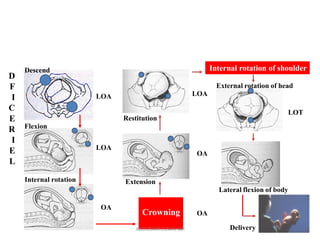
D: Descent
F: Flexion
I: Internal rotation of the fetal head
C: Crowning
E: Extension
R: Restitution
I : Internal rotation of the shoulders
E: External rotation of the fetal head
L: Lateral flexion of the body
ABOUBAKR ELNASHAR
Descend
Flexion
Internal rotation
Crowning
Extension
Restitution
Internal rotation of shoulder
External rotation of head
Lateral flexion of body
LOA
LOA
OA
LOA
OA
OA
LOT
Delivery
D
F
I
C
E
R
I
E
L
ABOUBAKR ELNASHAR
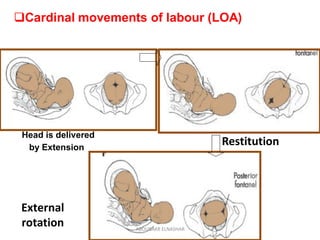
Cardinal movements of labour (LOA)
Head is delivered
by Extension
Restitution
External
rotation ABOUBAKR ELNASHAR
CROWNING OF THE HEAD
ABOUBAKR ELNASHAR
Head is delivered by EXTENSION
ABOUBAKR ELNASHAR
RESTITUTION
ABOUBAKR ELNASHAR
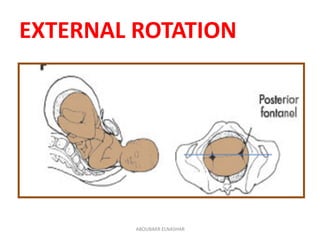
EXTERNAL ROTATION
ABOUBAKR ELNASHAR
• Delivery of a normal healthy child
• To anticipate, recognize and treat
potential abnormal conditions before
significant hazard develops for the
mother or the fetus.
AIMS
ABOUBAKR ELNASHAR
• Diagnosis of labour
• Monitoring the progress of labour
• Ensuring maternal well-being
• Ensuring fetal well-being.
PRINCIPLES
ABOUBAKR ELNASHAR
MANAGEMENT 1st STAGE
OF LABOUR
I. Assessment
II. Preparation and care
III. Partogram
ABOUBAKR ELNASHAR
I. Assessment
1. History:
1. Woman’s antenatal record is reviewed
2. No records of antenatal care: complete history .
2. Examination
a. General
a) Pallor, edema, abdominal scar (LSCS)
b) Vital signs: BP, pulse, RR and T
c) Heart and lungs
ABOUBAKR ELNASHAR
b. Abdominal examination:
a. Presentation and position and engagement
b. Auscultate the fetal heart
c. Evaluate the uterine contraction
ABOUBAKR ELNASHAR
ABOUBAKR ELNASHAR
c. Vaginal examination –
i) PP:
Presentation
Engagement, station
Position
ABOUBAKR ELNASHAR
ABOUBAKR ELNASHAR
ABOUBAKR ELNASHAR
ii) Membranes
Intact or absent: exclude cord prolapse after ROM
iii) Cx
Consistency, position
Dilatation
Effacement,
ABOUBAKR ELNASHAR
iv) Pelvis
Adequacy.
ABOUBAKR ELNASHAR
ABOUBAKR ELNASHAR
Do not do vaginal examination:
vaginal bleeding before the placenta previa is
excluded.
Sterile speculum examination:
suspected ROM, if the woman is not in labour.
Admission to labour ward:
Active labour:
Regular painful contractions and
cervical dilatation 3 cm
{less time in the labor ward
less intrapartum oxytocics
less analgesia}
ABOUBAKR ELNASHAR
3. Investigation
Urine:
Protein
Sugar
ketones
Blood:
CBC
RBS
Grouping
cross match for high risk patients.
ABOUBAKR ELNASHAR
II. Preparation and care
1. Bowel preparation:
 Indicated:
No bowel action for 24 h or
Rectum feels loaded on vaginal examination
 similar length of labor and most maternal and
neonatal outcomes
generates discomfort in women
ABOUBAKR ELNASHAR
2. Bladder care
 Encourage to empty bladder /1½ - 2 h.
{A full bladder:
prevent the fetal head from entering the pelvic brim
impede descent of the fetal head.
inhibit effective uterine action}.
 The quantity of urine should be measured and recorded
and a specimen obtained for testing.
3. Nutrition
 No food is permitted after labour is established
{prevent regurgitation and aspiration}
 Small amount of clear fluid or frozen pineapple, Ice chips
to moisten the mouth
 Maintain adequate hydration via intravenous routes
ABOUBAKR ELNASHAR
4. Perineal shaving
No
{is associated with similar maternal febrile
morbidity, wound infection, and neonatal
infection compared with just selective clipping of
hair}
ABOUBAKR ELNASHAR
Routine early ARM
Not recommended
{decrease duration of labor( 60 min, mostly
because of shorter 1st stage),
decrease use of oxytocin,
similar incidence of NRFHR monitoring
similar neonatal outcomes compared with
selective (later or no) AROM
26% increase in CD}
should be reserved for failure to progress
ABOUBAKR ELNASHAR
5. Position:
 Walk about or
in bed, as she wishes
 As long as the
patient is healthy
presentation normal
presenting part engaged
fetus in good condition
6. Pain relief
Severe: an analgesic
a) Opiate drugs. e.g. Pethidine IM/4 h
b) Inhalational analgesia e.g. Entonox
c) Epidural analagesia
ABOUBAKR ELNASHAR
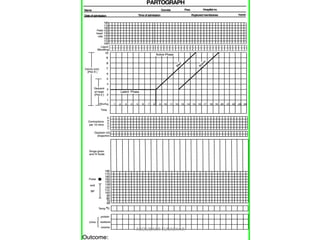
III. Monitoring the progress of labour
Once labour has become established, all events
during labour should be recorded on a partogram.
a) Well-being of the fetus
b) Well-being of the mother
c) Progress of the labour
Patient information:
name, gravida, para, hospital number, date and time
of admission and time of ruptured membranes.
ABOUBAKR ELNASHAR
PATIENT INFORMATION
FETAL INFORMATION
FHR
Am fluid
Moulding
LABOUR INFORMATION
Dilatation
Descent
Contraction
MEDICATIONS
syntocinon
drugs
IV fluids
MATERNAL INFORMATION
Pulse, BP, T
Urine: alb, ketones, vol
ABOUBAKR ELNASHAR
A. Condition of the fetus
I. FHR: every half hour.
II. Memb & Liq: every vaginal examination
I= intact,
A= abscent
C= clear,
M= meconium
B= blood,
III. Moudling:
0 (separated)
+ (touching)
++(overlap)
+++ (severe overlap)
ABOUBAKR ELNASHAR
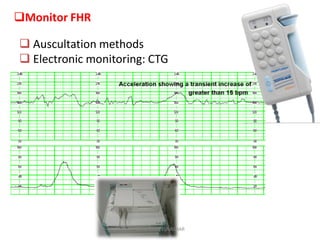
Monitor FHR
 Auscultation methods
 Electronic monitoring: CTG
ABOUBAKR ELNASHAR
NORMAL
ABNORMAL
ABOUBAKR ELNASHAR
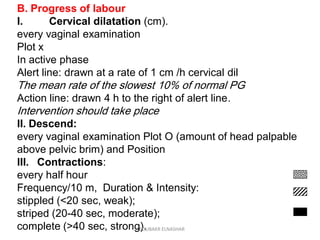
B. Progress of labour
I. Cervical dilatation (cm).
every vaginal examination
Plot x
In active phase
Alert line: drawn at a rate of 1 cm /h cervical dil
The mean rate of the slowest 10% of normal PG
Action line: drawn 4 h to the right of alert line.
Intervention should take place
II. Descend:
every vaginal examination Plot O (amount of head palpable
above pelvic brim) and Position
III. Contractions:
every half hour
Frequency/10 m, Duration & Intensity:
stippled (<20 sec, weak);
striped (20-40 sec, moderate);
complete (>40 sec, strong).ABOUBAKR ELNASHAR
Recording the progress of labour
frequency of cervical examinations.
Most studies: every 2 h.
{risk of chorioamnionitis increases with the increasing
number of examinations}.
ABOUBAKR ELNASHAR
C. Condition of the mother
I. Medications:
Oxytocin: amount /30 min
Drugs
IV Fluids
II. V/S:
B.P: /4 h
mark with arrows ( )
P: /30 min
mark with a dot (●).
T: /2 hours.
III. Urine:
every time urine is passed.
Vol, alb, ketones
ABOUBAKR ELNASHAR
ABOUBAKR ELNASHAR
WHO partogram, 2002
Simple & easy to use.
The latent phase has been removed .
Plotting on begins in the active phase when the cervix
is 4 cm dilated.
ABOUBAKR ELNASHAR
MANAGEMENT 2nd
STAGE OF
LABOUR
I. Preparation
II. Observation
III. Conduct of delivery
ABOUBAKR ELNASHAR
I. Preparation
1. Maternal position:
With the exception of avoiding supine position, the
mother may assume any comfortable position for
effective bearing down.
Semi-recumbent or
Supported sitting position, with the thighs abducted
2. PERINEAL CLEANSING
When delivery is imminent skin over the lower
abdomen, vulva, anus and upper thigh is cleansed
with antiseptic solution and draped.
ABOUBAKR ELNASHAR
ABOUBAKR ELNASHAR
POSITIONING FOR DELIVERY
ABOUBAKR ELNASHAR
PERINEAL CLEANSING
Need 6 swab balls
Clean sequentially
as shown by the
numbers
Clean according to
the direction
shown by the
Arrows
ABOUBAKR ELNASHAR
CREATE A STERILE FIELD
AROUND THE VAGINAL OPENING
ABOUBAKR ELNASHAR
II. Observation
1.Maternal conditions
Emotional condition
pulse quarter-hourly
bloods pressure hourly
2.Fetal conditions
FHR: either continuously or after each contraction.
Liquor: meconium staining.
3.Uterine contractions
Strength
Duration
Frequency, assessed continuously.
4.The progress of descent
every 30 minutes
ABOUBAKR ELNASHAR
III. CONDUCTING THE DELIVERY
1. DELIVERY OF THE HEAD
1) Control the delivery of the head to prevent
laceration
2) Episiotomy if required
3) Ritgen’s method
4) Clear the airway after delivery of the had
Modified Ritgen Maneuver
As crowning occurs: exert forward pressure on the chin of the
fetus through the perineum just in front of the coccyx.
Concurrently, the other hand exerts pressure superiorly against
the occiput ABOUBAKR ELNASHAR
• Instruct the mother to focus on her breathing. Have her
“breathe heavily” to help her stop pushing and prevent a
forceful birth.
ABOUBAKR ELNASHAR
• Ask the woman to pant or give
only small pushes with
contractions as the baby’s
head delivers
• To control birth of the head,
place the fingers of one hand
against the baby’s head to
keep it flexed (bent)
• Continue to gently support the
perineum as the baby’s head
delivers
ABOUBAKR ELNASHAR
DELIVERY OF THE HEAD
Head is delivered by extension
ABOUBAKR ELNASHAR
• Once the baby’s
head delivers, ask
the woman not to
push
• Suction the baby’s
mouth and nose
ABOUBAKR ELNASHAR
ABOUBAKR ELNASHAR
CORD AROUND THE NECK
Feel around the baby’s
neck for the umbilical cord
If the cord is around the
neck, attempt to slip it over
the baby’s head
If the cord is tight around
the neck, doubly clamp
and cut it before unwinding
it from around the neck
ABOUBAKR ELNASHAR
As the head emerges,
the baby will turn to one
side (for easier passage
of shoulders through
birth canal)
Note the time, if
possible
ABOUBAKR ELNASHAR
• Allow the baby’s head
to turn spontaneously.
• After the head turns,
place a hand on each
side of the baby’s
head.
• Tell the woman to push
gently with the next
contraction.
• Reduce tears by
delivering one
shoulder at a time
ABOUBAKR ELNASHAR
DELIVERY OF FETAL HEAD WITH
ROL POSITION
ABOUBAKR ELNASHAR
2. Delivery of the anterior shoulder
by gentle downward traction on the head.
In the direction of the axis of the body
ABOUBAKR ELNASHAR
3. DELIVERY OF POSTERIOR SHOULDER
by elevating the head.
Support the rest of the baby’s body with one hand as
it slides out
ABOUBAKR ELNASHAR
ABOUBAKR ELNASHAR
4. DELIVERY OF THE TRUNK
 After the delivery of the shoulders the baby is
grasped around the chest to aid the birth of the
trunk.
 Finally, the body is slowly extracted by traction
on the shoulders and lifts the baby towards the
mother’s abdomen.
 The time of delivery is noted.
ABOUBAKR ELNASHAR
BABY DELIVERED
ABOUBAKR ELNASHAR
FIRST BODY CONTACT OF MOTHER AND
BABY AND CORD CLAMPING
ABOUBAKR ELNASHAR
5. CLAMING AND CUTTING
THE UMBILICAL CORD
After delivery
wait 15 to 20 seconds before
clamping and cutting the
umbilical cord.
After cutting the cord a plastic
crushing clamp is placed on
the cord 1 to 2 cm from the
umbilicus and the cord is cut
again 1 cm beyond the clamp.
ABOUBAKR ELNASHAR
Clamping, cutting and tying Of
umbilical cord
ABOUBAKR ELNASHAR
ABOUBAKR ELNASHAR
EPISIOTOMY
Surgical incision into the perineum to enlarge
the space at the outlet
 Benefits:
1.Speed up the birth
2.Prevent Tearing
3.Protects against incontinence
4.Protects against pelvic floor relaxation
5.Heals easier than tears
Not proven
ABOUBAKR ELNASHAR
 No decrease
perineal damage
future vaginal prolapse
urinary incontinen
 Increase
3rd & 4th degree tears
anal sphincter muscle dysfunction.
ABOUBAKR ELNASHAR
Indications
Not routine
1. Sizeable babies with anticipation of shoulder
dystocia.
2. Shoulder dystocia.
3. Instrumental delivery (according to judgement)
4. Breech
5. Scarring from female genital mutilation or poorly
healed third or fourth degree tears
6. Fetal distress.
ABOUBAKR ELNASHAR
Types
Mediolateral rather than midline
(less 3rd and 4th degree perennial tear).
ABOUBAKR ELNASHAR
Good analgesia
(infiltration with xylocain )
Timing:
cause bleeding: not be
done too early. Wait
until perineum is
thinned out and
3–4 cm of the baby’s
head is visible during
contraction.
ABOUBAKR ELNASHAR
 IMMEDIATE CARE OF THE
NEW BORN
Once the baby is breathing normally
he should be dried and warmly
wrapped to prevent cooling and
handle to the mother to hold, cuddle
and enjoy.
If spontaneous respiration is not
established soon after birth,
resuscitation is the immediate
priority.
The Apgar’s score of the baby should
be noted and recorded.
ABOUBAKR ELNASHAR
Nonoperative interventions to decrease
operative birth in systematic reviews
(FIGO, 2012):
1. Continuous support for women during
childbirth by one-to-one birth attendants
2. Use of upright or lateral positions during
delivery compared with supine or lithotomy
3. Delaying pushing for 1–2 hours or until the
woman has a strong urge to push reduces the
need for rotational and midcavity interventions
ABOUBAKR ELNASHAR
Recommendations FIGO
(2012)
• Delivery facilities must offer everywoman
privacy and allow her to be accompanied by her
choice of a supportive person (husband, friend,
mother, relative, TBA)
• Psychosocial support, education,
communication, choice of position,
and pharmacological methods appropriately
used during the first stage are all useful in
relieving pain and distress in the second stage
of labor.
• Monitoring of FHR must be continued during
2nd stage to allow early detection of bradycardia.
ABOUBAKR ELNASHAR
• Routine episiotomy is harmful and should not
be practiced.
• Women should not be forced or encouraged to
push until they feel an urge to push.
• Fetal heart auscultation after every contraction.
• Local anesthetic should always be given for
any episiotomy, episiotomy/ laceration repair, or
forceps delivery.
ABOUBAKR ELNASHAR
MANAGEMENT 3rd
STAGE OF
LABOUR
I. Delivery of placenta
II. Examination of placenta and perineum
III. Repair of episeotomy
ABOUBAKR ELNASHAR
I. Delivery OF THE PLACENTA
two stages:
(1) Separation of the placenta from the wall of the
uterus and into the lower uterine segment
and/or the vagina, and
(2) Actual expulsion of the placenta out of the birth
canal.
ABOUBAKR ELNASHAR
MECHANISM OF PLACENTA SEPARATION1:
1-Mathews-Duncan
mechanism
The leading edge of
the placenta separates
first and the placenta
is delivered with its
raw surface exposed.
2- Schultz mechanism
If the placenta is inserted
at the fundus and central
area separates first, the
placenta inverts and
draws the membranes
after it, covering the raw
surface (inverted
umbrella)
ABOUBAKR ELNASHAR
ABOUBAKR ELNASHAR
SIGNS OF PLACENTALSEPARATION
within 5 minutes after the delivery of the infant.
1.The uterus becomes globular and hard. =earliest
to appear.
2.Sudden gush of blood
3.The uterus rises in the abdomen because the
placenta, having separated, passes down into
the lower segment and vagina, where its bulk
pushes the uterus upward.
4.Cord lengthening.
=most reliable clinical
ABOUBAKR ELNASHAR
. . . Physiological
Management
Active
Management
Uterotonic None or after
placenta delivered
With delivery of
anterior shoulder
or baby
Uterus Assessment of size
and tone
Assessment of size
and tone
Cord traction None Application of
controlled cord
traction* when
uterus contracted
Cord clamping Variable Early
*Gentle downward cord traction with countertraction on
the uterine body ABOUBAKR ELNASHAR
ACTIVE MANAGEMENT OF THE THIRD STAGE
Helps prevent postpartum haemorrhage.
includes:
1. use of oxytocin
2. controlled cord traction, and
3. uterine massage.
ABOUBAKR ELNASHAR
ABOUBAKR ELNASHAR
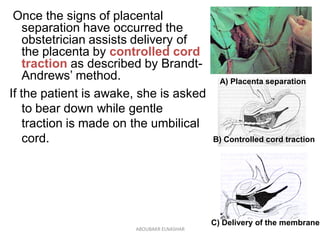
Once the signs of placental
separation have occurred the
obstetrician assists delivery of
the placenta by controlled cord
traction as described by Brandt-
Andrews’ method.
If the patient is awake, she is asked
to bear down while gentle
traction is made on the umbilical
cord.
A) Placenta separation
B) Controlled cord traction
C) Delivery of the membranes
ABOUBAKR ELNASHAR
ABOUBAKR ELNASHAR
ABOUBAKR ELNASHAR
II. EXAMINATION
1. OF THE PLACENTA
The placenta, membranes, and umbilical cord should
be examined for completeness and for anomalies.
2. OF THE PERINEUM
At the same time, the perineal region, vulva outlet,
vaginal canal, and the cervix should be carefully
examined for lacerations.
If the perineum has been torn or an episiotomy
made, tear or incision should be repaired
immediately.
ABOUBAKR ELNASHAR
III. REPAIR OF EPISIOTOMY
Suture as soon as possible after delivery to avoid
bleeding and infection (RCOG)
Start just above the apex
Use 3 layer technique, vaginal mucosa, perennial
muscle and perineal skin
Synthetic, absorbable (rapidly absorbable polyglactin
910) VICRYL RAPIDE begins to fall off 7-10 days post-
operatively
 reduced post partum perineal pain, dyspareunia,
although increased suture removal up to 3/12
For each layer use loose continuous non locking
suturing this will reduce pain and dyspareunia.
ABOUBAKR ELNASHAR
1. Identify apex
2. Begin suturing
1.0 cm above apex
3. Continuous sutures
4. Ends at the level of
vaginal opening
Continuous sutures Interrupted sutures Interrupted suture or
subcuticularABOUBAKR ELNASHAR
MANAGEMENT 4th
stage of labour
I. Observe
II. Check
ABOUBAKR ELNASHAR
The 2 hours after delivery
critical period {postpartum haemorrhage can
occurs due the relaxation of the uterus}.
I. Observation in delivery suite
Bleeding
blood pressure
pulse .
ABOUBAKR ELNASHAR
II. Check before discharging the patient from the
delivery
1. Uterus:
Frequently to make sure it is firm and not relaxing.
Remove any presence of intrauterine blood clots. {clots
interfere with retraction and the normal haemostatic
mechanism of the uterus}.
2. Introitus
to see that there is no hge.
3. Bladder
empty {full bladder can also interfere with uterine retraction}.
4. Baby
breathing well and that the colour and tone are normal.ABOUBAKR ELNASHAR
Thank you
Aboubakr elnashar
ABOUBAKR ELNASHAR

Management of normal labour

  • 1.
    Management of normal labour Prof.Aboubakr Elnashar Benha university Hospital, Egypt elnashar53@hotmail.com ABOUBAKR ELNASHAR
  • 2.
  • 3.
    Definitions Labour: Regular involuntary coordinated,painful uterine contractions associated with cervical effacement and dilatation • Regular frequent uterine contractions + • Cx changes (dilatation & effacement) or • SROM Delivery: Expulsion of the product of the conception after fetal viability. ABOUBAKR ELNASHAR
  • 4.
  • 5.
    Anterior Pubis Right Left Occipital bone MECHANISMSOF NORMAL LABOUR Occiput anterior ABOUBAKR ELNASHAR
  • 6.
  • 7.
    D: Descent F: Flexion I:Internal rotation of the fetal head C: Crowning E: Extension R: Restitution I : Internal rotation of the shoulders E: External rotation of the fetal head L: Lateral flexion of the body ABOUBAKR ELNASHAR
  • 8.
    Descend Flexion Internal rotation Crowning Extension Restitution Internal rotationof shoulder External rotation of head Lateral flexion of body LOA LOA OA LOA OA OA LOT Delivery D F I C E R I E L ABOUBAKR ELNASHAR
  • 9.
    Cardinal movements oflabour (LOA) Head is delivered by Extension Restitution External rotation ABOUBAKR ELNASHAR
  • 10.
    CROWNING OF THEHEAD ABOUBAKR ELNASHAR
  • 11.
    Head is deliveredby EXTENSION ABOUBAKR ELNASHAR
  • 12.
  • 13.
  • 14.
    • Delivery ofa normal healthy child • To anticipate, recognize and treat potential abnormal conditions before significant hazard develops for the mother or the fetus. AIMS ABOUBAKR ELNASHAR
  • 15.
    • Diagnosis oflabour • Monitoring the progress of labour • Ensuring maternal well-being • Ensuring fetal well-being. PRINCIPLES ABOUBAKR ELNASHAR
  • 16.
    MANAGEMENT 1st STAGE OFLABOUR I. Assessment II. Preparation and care III. Partogram ABOUBAKR ELNASHAR
  • 17.
    I. Assessment 1. History: 1.Woman’s antenatal record is reviewed 2. No records of antenatal care: complete history . 2. Examination a. General a) Pallor, edema, abdominal scar (LSCS) b) Vital signs: BP, pulse, RR and T c) Heart and lungs ABOUBAKR ELNASHAR
  • 18.
    b. Abdominal examination: a.Presentation and position and engagement b. Auscultate the fetal heart c. Evaluate the uterine contraction ABOUBAKR ELNASHAR
  • 19.
  • 20.
    c. Vaginal examination– i) PP: Presentation Engagement, station Position ABOUBAKR ELNASHAR
  • 21.
  • 22.
  • 23.
    ii) Membranes Intact orabsent: exclude cord prolapse after ROM iii) Cx Consistency, position Dilatation Effacement, ABOUBAKR ELNASHAR
  • 24.
  • 25.
  • 26.
    Do not dovaginal examination: vaginal bleeding before the placenta previa is excluded. Sterile speculum examination: suspected ROM, if the woman is not in labour. Admission to labour ward: Active labour: Regular painful contractions and cervical dilatation 3 cm {less time in the labor ward less intrapartum oxytocics less analgesia} ABOUBAKR ELNASHAR
  • 27.
  • 28.
    II. Preparation andcare 1. Bowel preparation:  Indicated: No bowel action for 24 h or Rectum feels loaded on vaginal examination  similar length of labor and most maternal and neonatal outcomes generates discomfort in women ABOUBAKR ELNASHAR
  • 29.
    2. Bladder care Encourage to empty bladder /1½ - 2 h. {A full bladder: prevent the fetal head from entering the pelvic brim impede descent of the fetal head. inhibit effective uterine action}.  The quantity of urine should be measured and recorded and a specimen obtained for testing. 3. Nutrition  No food is permitted after labour is established {prevent regurgitation and aspiration}  Small amount of clear fluid or frozen pineapple, Ice chips to moisten the mouth  Maintain adequate hydration via intravenous routes ABOUBAKR ELNASHAR
  • 30.
    4. Perineal shaving No {isassociated with similar maternal febrile morbidity, wound infection, and neonatal infection compared with just selective clipping of hair} ABOUBAKR ELNASHAR
  • 31.
    Routine early ARM Notrecommended {decrease duration of labor( 60 min, mostly because of shorter 1st stage), decrease use of oxytocin, similar incidence of NRFHR monitoring similar neonatal outcomes compared with selective (later or no) AROM 26% increase in CD} should be reserved for failure to progress ABOUBAKR ELNASHAR
  • 32.
    5. Position:  Walkabout or in bed, as she wishes  As long as the patient is healthy presentation normal presenting part engaged fetus in good condition 6. Pain relief Severe: an analgesic a) Opiate drugs. e.g. Pethidine IM/4 h b) Inhalational analgesia e.g. Entonox c) Epidural analagesia ABOUBAKR ELNASHAR
  • 33.
    III. Monitoring theprogress of labour Once labour has become established, all events during labour should be recorded on a partogram. a) Well-being of the fetus b) Well-being of the mother c) Progress of the labour Patient information: name, gravida, para, hospital number, date and time of admission and time of ruptured membranes. ABOUBAKR ELNASHAR
  • 34.
    PATIENT INFORMATION FETAL INFORMATION FHR Amfluid Moulding LABOUR INFORMATION Dilatation Descent Contraction MEDICATIONS syntocinon drugs IV fluids MATERNAL INFORMATION Pulse, BP, T Urine: alb, ketones, vol ABOUBAKR ELNASHAR
  • 35.
    A. Condition ofthe fetus I. FHR: every half hour. II. Memb & Liq: every vaginal examination I= intact, A= abscent C= clear, M= meconium B= blood, III. Moudling: 0 (separated) + (touching) ++(overlap) +++ (severe overlap) ABOUBAKR ELNASHAR
  • 36.
    Monitor FHR  Auscultationmethods  Electronic monitoring: CTG ABOUBAKR ELNASHAR
  • 37.
  • 38.
    B. Progress oflabour I. Cervical dilatation (cm). every vaginal examination Plot x In active phase Alert line: drawn at a rate of 1 cm /h cervical dil The mean rate of the slowest 10% of normal PG Action line: drawn 4 h to the right of alert line. Intervention should take place II. Descend: every vaginal examination Plot O (amount of head palpable above pelvic brim) and Position III. Contractions: every half hour Frequency/10 m, Duration & Intensity: stippled (<20 sec, weak); striped (20-40 sec, moderate); complete (>40 sec, strong).ABOUBAKR ELNASHAR
  • 39.
    Recording the progressof labour frequency of cervical examinations. Most studies: every 2 h. {risk of chorioamnionitis increases with the increasing number of examinations}. ABOUBAKR ELNASHAR
  • 40.
    C. Condition ofthe mother I. Medications: Oxytocin: amount /30 min Drugs IV Fluids II. V/S: B.P: /4 h mark with arrows ( ) P: /30 min mark with a dot (●). T: /2 hours. III. Urine: every time urine is passed. Vol, alb, ketones ABOUBAKR ELNASHAR
  • 41.
  • 42.
    WHO partogram, 2002 Simple& easy to use. The latent phase has been removed . Plotting on begins in the active phase when the cervix is 4 cm dilated. ABOUBAKR ELNASHAR
  • 43.
    MANAGEMENT 2nd STAGE OF LABOUR I.Preparation II. Observation III. Conduct of delivery ABOUBAKR ELNASHAR
  • 44.
    I. Preparation 1. Maternalposition: With the exception of avoiding supine position, the mother may assume any comfortable position for effective bearing down. Semi-recumbent or Supported sitting position, with the thighs abducted 2. PERINEAL CLEANSING When delivery is imminent skin over the lower abdomen, vulva, anus and upper thigh is cleansed with antiseptic solution and draped. ABOUBAKR ELNASHAR
  • 45.
  • 46.
  • 47.
    PERINEAL CLEANSING Need 6swab balls Clean sequentially as shown by the numbers Clean according to the direction shown by the Arrows ABOUBAKR ELNASHAR
  • 48.
    CREATE A STERILEFIELD AROUND THE VAGINAL OPENING ABOUBAKR ELNASHAR
  • 49.
    II. Observation 1.Maternal conditions Emotionalcondition pulse quarter-hourly bloods pressure hourly 2.Fetal conditions FHR: either continuously or after each contraction. Liquor: meconium staining. 3.Uterine contractions Strength Duration Frequency, assessed continuously. 4.The progress of descent every 30 minutes ABOUBAKR ELNASHAR
  • 50.
    III. CONDUCTING THEDELIVERY 1. DELIVERY OF THE HEAD 1) Control the delivery of the head to prevent laceration 2) Episiotomy if required 3) Ritgen’s method 4) Clear the airway after delivery of the had Modified Ritgen Maneuver As crowning occurs: exert forward pressure on the chin of the fetus through the perineum just in front of the coccyx. Concurrently, the other hand exerts pressure superiorly against the occiput ABOUBAKR ELNASHAR
  • 51.
    • Instruct themother to focus on her breathing. Have her “breathe heavily” to help her stop pushing and prevent a forceful birth. ABOUBAKR ELNASHAR
  • 52.
    • Ask thewoman to pant or give only small pushes with contractions as the baby’s head delivers • To control birth of the head, place the fingers of one hand against the baby’s head to keep it flexed (bent) • Continue to gently support the perineum as the baby’s head delivers ABOUBAKR ELNASHAR
  • 53.
    DELIVERY OF THEHEAD Head is delivered by extension ABOUBAKR ELNASHAR
  • 54.
    • Once thebaby’s head delivers, ask the woman not to push • Suction the baby’s mouth and nose ABOUBAKR ELNASHAR
  • 55.
  • 56.
    CORD AROUND THENECK Feel around the baby’s neck for the umbilical cord If the cord is around the neck, attempt to slip it over the baby’s head If the cord is tight around the neck, doubly clamp and cut it before unwinding it from around the neck ABOUBAKR ELNASHAR
  • 57.
    As the heademerges, the baby will turn to one side (for easier passage of shoulders through birth canal) Note the time, if possible ABOUBAKR ELNASHAR
  • 58.
    • Allow thebaby’s head to turn spontaneously. • After the head turns, place a hand on each side of the baby’s head. • Tell the woman to push gently with the next contraction. • Reduce tears by delivering one shoulder at a time ABOUBAKR ELNASHAR
  • 59.
    DELIVERY OF FETALHEAD WITH ROL POSITION ABOUBAKR ELNASHAR
  • 60.
    2. Delivery ofthe anterior shoulder by gentle downward traction on the head. In the direction of the axis of the body ABOUBAKR ELNASHAR
  • 61.
    3. DELIVERY OFPOSTERIOR SHOULDER by elevating the head. Support the rest of the baby’s body with one hand as it slides out ABOUBAKR ELNASHAR
  • 62.
  • 63.
    4. DELIVERY OFTHE TRUNK  After the delivery of the shoulders the baby is grasped around the chest to aid the birth of the trunk.  Finally, the body is slowly extracted by traction on the shoulders and lifts the baby towards the mother’s abdomen.  The time of delivery is noted. ABOUBAKR ELNASHAR
  • 64.
  • 65.
    FIRST BODY CONTACTOF MOTHER AND BABY AND CORD CLAMPING ABOUBAKR ELNASHAR
  • 66.
    5. CLAMING ANDCUTTING THE UMBILICAL CORD After delivery wait 15 to 20 seconds before clamping and cutting the umbilical cord. After cutting the cord a plastic crushing clamp is placed on the cord 1 to 2 cm from the umbilicus and the cord is cut again 1 cm beyond the clamp. ABOUBAKR ELNASHAR
  • 67.
    Clamping, cutting andtying Of umbilical cord ABOUBAKR ELNASHAR
  • 68.
  • 69.
    EPISIOTOMY Surgical incision intothe perineum to enlarge the space at the outlet  Benefits: 1.Speed up the birth 2.Prevent Tearing 3.Protects against incontinence 4.Protects against pelvic floor relaxation 5.Heals easier than tears Not proven ABOUBAKR ELNASHAR
  • 70.
     No decrease perinealdamage future vaginal prolapse urinary incontinen  Increase 3rd & 4th degree tears anal sphincter muscle dysfunction. ABOUBAKR ELNASHAR
  • 71.
    Indications Not routine 1. Sizeablebabies with anticipation of shoulder dystocia. 2. Shoulder dystocia. 3. Instrumental delivery (according to judgement) 4. Breech 5. Scarring from female genital mutilation or poorly healed third or fourth degree tears 6. Fetal distress. ABOUBAKR ELNASHAR
  • 72.
    Types Mediolateral rather thanmidline (less 3rd and 4th degree perennial tear). ABOUBAKR ELNASHAR
  • 73.
    Good analgesia (infiltration withxylocain ) Timing: cause bleeding: not be done too early. Wait until perineum is thinned out and 3–4 cm of the baby’s head is visible during contraction. ABOUBAKR ELNASHAR
  • 74.
     IMMEDIATE CAREOF THE NEW BORN Once the baby is breathing normally he should be dried and warmly wrapped to prevent cooling and handle to the mother to hold, cuddle and enjoy. If spontaneous respiration is not established soon after birth, resuscitation is the immediate priority. The Apgar’s score of the baby should be noted and recorded. ABOUBAKR ELNASHAR
  • 75.
    Nonoperative interventions todecrease operative birth in systematic reviews (FIGO, 2012): 1. Continuous support for women during childbirth by one-to-one birth attendants 2. Use of upright or lateral positions during delivery compared with supine or lithotomy 3. Delaying pushing for 1–2 hours or until the woman has a strong urge to push reduces the need for rotational and midcavity interventions ABOUBAKR ELNASHAR
  • 76.
    Recommendations FIGO (2012) • Deliveryfacilities must offer everywoman privacy and allow her to be accompanied by her choice of a supportive person (husband, friend, mother, relative, TBA) • Psychosocial support, education, communication, choice of position, and pharmacological methods appropriately used during the first stage are all useful in relieving pain and distress in the second stage of labor. • Monitoring of FHR must be continued during 2nd stage to allow early detection of bradycardia. ABOUBAKR ELNASHAR
  • 77.
    • Routine episiotomyis harmful and should not be practiced. • Women should not be forced or encouraged to push until they feel an urge to push. • Fetal heart auscultation after every contraction. • Local anesthetic should always be given for any episiotomy, episiotomy/ laceration repair, or forceps delivery. ABOUBAKR ELNASHAR
  • 78.
    MANAGEMENT 3rd STAGE OF LABOUR I.Delivery of placenta II. Examination of placenta and perineum III. Repair of episeotomy ABOUBAKR ELNASHAR
  • 79.
    I. Delivery OFTHE PLACENTA two stages: (1) Separation of the placenta from the wall of the uterus and into the lower uterine segment and/or the vagina, and (2) Actual expulsion of the placenta out of the birth canal. ABOUBAKR ELNASHAR
  • 80.
    MECHANISM OF PLACENTASEPARATION1: 1-Mathews-Duncan mechanism The leading edge of the placenta separates first and the placenta is delivered with its raw surface exposed. 2- Schultz mechanism If the placenta is inserted at the fundus and central area separates first, the placenta inverts and draws the membranes after it, covering the raw surface (inverted umbrella) ABOUBAKR ELNASHAR
  • 81.
  • 82.
    SIGNS OF PLACENTALSEPARATION within5 minutes after the delivery of the infant. 1.The uterus becomes globular and hard. =earliest to appear. 2.Sudden gush of blood 3.The uterus rises in the abdomen because the placenta, having separated, passes down into the lower segment and vagina, where its bulk pushes the uterus upward. 4.Cord lengthening. =most reliable clinical ABOUBAKR ELNASHAR
  • 83.
    . . .Physiological Management Active Management Uterotonic None or after placenta delivered With delivery of anterior shoulder or baby Uterus Assessment of size and tone Assessment of size and tone Cord traction None Application of controlled cord traction* when uterus contracted Cord clamping Variable Early *Gentle downward cord traction with countertraction on the uterine body ABOUBAKR ELNASHAR
  • 84.
    ACTIVE MANAGEMENT OFTHE THIRD STAGE Helps prevent postpartum haemorrhage. includes: 1. use of oxytocin 2. controlled cord traction, and 3. uterine massage. ABOUBAKR ELNASHAR
  • 85.
  • 86.
    Once the signsof placental separation have occurred the obstetrician assists delivery of the placenta by controlled cord traction as described by Brandt- Andrews’ method. If the patient is awake, she is asked to bear down while gentle traction is made on the umbilical cord. A) Placenta separation B) Controlled cord traction C) Delivery of the membranes ABOUBAKR ELNASHAR
  • 87.
  • 88.
  • 89.
    II. EXAMINATION 1. OFTHE PLACENTA The placenta, membranes, and umbilical cord should be examined for completeness and for anomalies. 2. OF THE PERINEUM At the same time, the perineal region, vulva outlet, vaginal canal, and the cervix should be carefully examined for lacerations. If the perineum has been torn or an episiotomy made, tear or incision should be repaired immediately. ABOUBAKR ELNASHAR
  • 90.
    III. REPAIR OFEPISIOTOMY Suture as soon as possible after delivery to avoid bleeding and infection (RCOG) Start just above the apex Use 3 layer technique, vaginal mucosa, perennial muscle and perineal skin Synthetic, absorbable (rapidly absorbable polyglactin 910) VICRYL RAPIDE begins to fall off 7-10 days post- operatively  reduced post partum perineal pain, dyspareunia, although increased suture removal up to 3/12 For each layer use loose continuous non locking suturing this will reduce pain and dyspareunia. ABOUBAKR ELNASHAR
  • 91.
    1. Identify apex 2.Begin suturing 1.0 cm above apex 3. Continuous sutures 4. Ends at the level of vaginal opening Continuous sutures Interrupted sutures Interrupted suture or subcuticularABOUBAKR ELNASHAR
  • 92.
    MANAGEMENT 4th stage oflabour I. Observe II. Check ABOUBAKR ELNASHAR
  • 93.
    The 2 hoursafter delivery critical period {postpartum haemorrhage can occurs due the relaxation of the uterus}. I. Observation in delivery suite Bleeding blood pressure pulse . ABOUBAKR ELNASHAR
  • 94.
    II. Check beforedischarging the patient from the delivery 1. Uterus: Frequently to make sure it is firm and not relaxing. Remove any presence of intrauterine blood clots. {clots interfere with retraction and the normal haemostatic mechanism of the uterus}. 2. Introitus to see that there is no hge. 3. Bladder empty {full bladder can also interfere with uterine retraction}. 4. Baby breathing well and that the colour and tone are normal.ABOUBAKR ELNASHAR
  • 95.