
Gestational Trophoblastic
Disease (GTD)
WAQAR ULLAH
08-207
Introduction
What is GTD ?
 It is a clinical term used to indicate closely
related conditions characterized by active
abnormal proliferation of trophoblastic cells
It is too among the rare human
malignancies that can be cured
even in the presence of widespread
metastases
Which does it include?
It includes a spectrum of interrelated
tumors, including
hydatidiform mole (HM) 80 % of cases
invasive mole (IM) 12-15%
Choriocarcinoma (CH) 5-8%
Placental-site trophoblastic tumor
(PSTT, borderline, very rare)
Relationship of HM. IM. CH
hydatidiform therapeutic or
mole spontaneous abortion
term pregnancy
ectopic
invasion mole choriocarcinoma.
Hydatidiform mole
Hydatidiform mole
Hydatidiform mole
It is a neoplastic
proliferation of
the trophoblast
in which the
terminal villi
are
transformed
into vesicles
filled with clear
viscid material.
 It is usually benign but has
malignant potentiality.
 Incidence:
 south east Asia is 1/500-600
 the US and Europe:1/500-2000
 China:1/1238
Classification
It is divided into two classification
complete hydatidiform mole
partial hydatidiform mole
complete hydatidiform mole(CHM):
 the entire
uterus
filled with
abnormal
vesicles,
no signs of
fetus.
partial hydatidiform mole
 partial
hydatidiform
mole with
evidence of
a conceptus.
Etiology
Though it is not known a number of
associated factors have been noted:
age:>45 years women are 10 times
more likely to develop HM than
those younger.
Previous hx of HM
Previous misscarriage
Excessive smoking
abnormal fertilization process:
the fertilization of a normal ovum
with a duplicated haploid
sperm:46XX
the fertilization of an empty egg by
two sperms(dispermy):46XY
Complete Mole, Pathogenesis
Duplication 46XX
Empty ovum
23X
Diandric diploidy
Androgenesis
Paternal
chromosomes only
Complete Mole, Pathogenesis
46XX
Empty ovum
23X
Dispermic diploidy
Paternal
chromosomes only
23X 23X
23X
Partial Mole, Pathogenesis
69XXY
Normal ovum
23X
Dispermic triploidy
Paternal extra set
23Y 23X
23Y 23X
23X
Pathologic findings
complete hydatidiform mole
pathology
Complete moles lack identifiable
embryonic or fetal tissues, and
the chorionic villi exhibit
generalized hydatidiform swelling
and diffuse trophoblastic
hyperplasia.
Gross
we see a mass of
vesicles, vary in
size, grape-like
with stems, blood
and clot filling the
inter-vesicle space
Microscopic(complete mole)
Cytotrophoblast &
syncytiotrophoblast
hyperplasia(variable)
Avascularity
No fetal parts
partial hydatidiform mole
It are characterized by the following
pathologic features :
Chorionic villi if varying size with
focal hydatidiform swelling and
cavitation.
It contain identifiable embryonic or
fetal tissues.
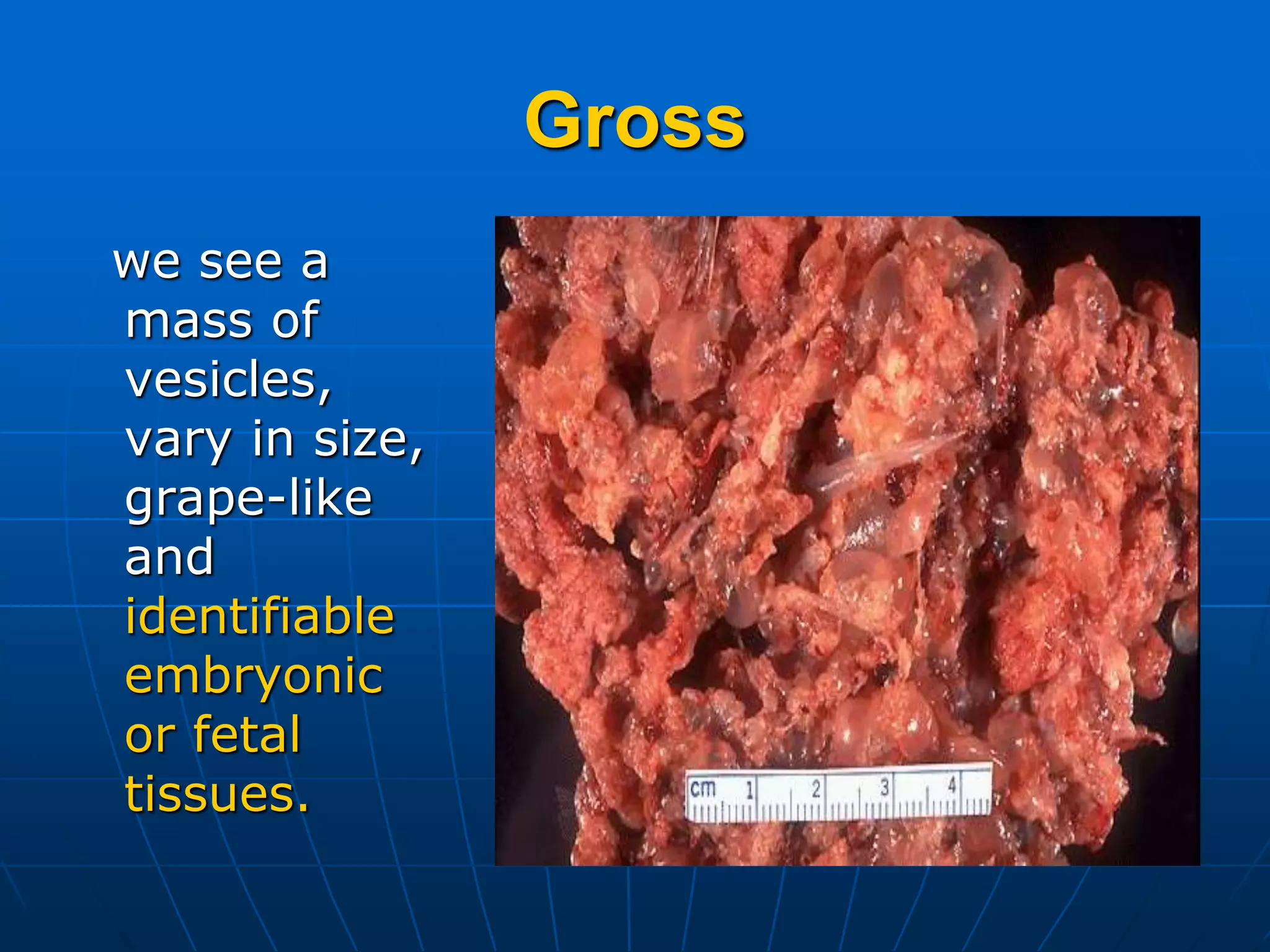
Gross
we see a
mass of
vesicles,
vary in size,
grape-like
and
identifiable
embryonic
or fetal
tissues.
Microscopic(partial mole)
Vesicles have certain degree
of vascularity till fetal death
Fetal parts
Syncytiotrophoblast
hyperplasia
Fetal hand demonstrating syndactyly. The fetus had a triploid karyotype, and the chorionic
tissues were a partial mole
Feature Partial mole Complete mole
Karyotype
Most commonly
69, XXX or - XXY
Most commonly
46, XX or -,XY
Pathology
Fetus Often present Absent
Amnion, fetal RBC Usually present Absent
Villous edema Variable, focal Diffuse
Trophoblastic proliferation Focal, slight-moderate Diffuse, slight-severe
Clinical presentation
Diagnosis Missed abortion Molar gestation
Uterine size Small for dates 50% large for dates
Theca lutein cysts Rare 25-30%
Medical complications Rare 10-25%
Features Of Partial And Complete Hydatidiform Moles
HYDATIFORM MOLE
CLINICAL FEATURES
Vaginal bleeding (anemia) 97%
Excessive uterine size 50%
Theco-lutein ovarian cysts 50%
Preeclampsia 27%
Hyperemesis 25%
Hyperthyroidism 7%
Trophoblastic embolization 2%
(respiratory distress)
signs
1) abnormally
enlarged and
soft uterus
2) absence of
braxton hicks
contractions
3) Bilateral ovarian
enlargement
4) Absence of fetal
parts on palpation
5) Pre eclampsia
6) Hyperthyrodism
Diagnosis
suspicion:
abnormal bleeding after amenorrhea
inappropriately enlarged uterus;
absence of fetal heart sounds or
could not feel fetal parts by palpation
between 16-20th week
hyperemesis gravidarum
bilateral ovarian cysts
Hydatidiform Mole
 Diagnosis:
• Serum hCG levels:
 Serum hCG levels of greater than 92 000
IU/l associated with absent fetal heart beat
indicate a diagnosis of complete
hydatidiform moles (Romero et al, 1985)
 Serum hCG level decreases quickly if the
patient has an abortion, but it does not in
molar pregnancy
Ultrasonography:
 It is a reliable and sensitive technique for the
diagnosis of complete molar pregnancy. Because
the chorionic villi exhibit diffuse hydatidiform
swelling. Complete moles produce a characteristic
vesicular sonographic pattern, usually referred to
as a “snowstorm” pattern.
 Ultrasonography may also
contribute to the diagnosis of
partial molar pregnancy by
demonstrating focal cystic spaces
in the placental tissues and an
increase in the transverse
diameter of the gestational sac.
Differential diagnosis
abortion;
multiple pregnancy;
polyhydramnios
Hydatidiform Mole
 Management:
Complete history and physical examination
Investigations
Medical and surgical care
1
3
2
Hydatidiform Mole
 Management:
• History and physcal examination:
 Should aim to rule out the classic
symptoms and signs that would lead to a
diagnosis of:
• severe anemia
• dehydration
• preeclampsia
• thyrotoxicosis
The patient should be stabilized
hemodynamically 
Hydatidiform Mole
 Management:
• Investigations:
 Laboratory:
 Pre-evacuation hCG
 Complete blood count
 Electrolytes, BUN, creatinine
 Liver function tests
 Thyroid function tests
 Imaging:
 Pelvic ultrasound
 Chest x-ray
Hydatidiform Mole
 Management:
• Medical care:
 Correction of:
 Anemia
 Dehydration
 Hyperthyroidism
 hypertension
Hydatidiform Mole
 Management: Surgical care:
Suction curettage (with
oxytocin or prostaglandin
infusion)
Hysterectomy
•The method of choice
•Increased risk of medical
complications
•Associated with a markedly
decreased rate of malignant
sequelae (3.5%) when compared
with suction evacuation.
Mangement
suction & curretage
 Under GA.
 Cervix dilation till 12mm.and S&C induced
to the uterine cavity.
 I.V oxytocin infusion is started .
 S&C started by negative pressure of about
60 to 70cmHg.
 The curette is genteelly rotated to ovoid
perforation of the soft uterus, and the
majority of the molar tissue is evacuated
rapidly ,and the uterine size decreases
F0llow-up
 After the uterus has been evacuated :
 About 90% of cases ,the trophoblastic tissue
die out completely.
 About 10% of cases the trophoblastic tissue
does not die out completely and may persist
or recur as : invasive mole or
choriocarcinoma.
Follow-up
 So it is important that women who
have had a hydatidiform mole:
 should have close follow-up by serum
hCG levels after the evacuation of the
uterus,
To ensure early recognition of persistent
trophoblastic tissue .
F0llow-up
 After a molar pregnancy ,the hCG
levels will usually have returned to non
pregnant levels by 4 to 6 weeks after
evacuation.
 The follow-up is recommended for 2
years in cases of complete moles, and 6
months of cases of partial moles after
the evacuation of uterus.
F0llow-up
 Serial quantitative measurement of
serum hCG level at weekly
intervals, after evacuation of moles
till 4 to 5 weeks when the hCG
become normal. Then every other
week .When the titer gets negative
the measurements are done every
month fore 1 year.
chemotherapy
 Indication of chemotherapy after
the evacuation of the hydatidiform
mole in:
 Serum hCG >20000 i.u/L , at any
time after evacuation of mole.
 Raised hCG at 4 to 6 weeks after
evacuation of mole.
F0llow-up
 Evidence of metastases
,hepatic,brain,and pulmonary.
 Persistent uterine hemorrhage
after evacuation of mole with
raised hCG levels.
pregnancy
 To achieve effective follow-up ,the
pregnancy is better to be avoided ,and also
the use of oral contraceptive pills until the
hCG levels returns to normal after the
evacuation of the mole.
 Early diagnosis of persistent trophoblastic
disease ensures a good prognosis and an
effective system of follow-up.
Invasion Mole
Introduction
 Invasion Mole arises from HM
 it has malignant potentialities,
invades the myometrium and
penetrates the uterine wall,
extends into the broad ligament
or peritoneal cavity.
 in half or more of all cases
invasive mole metastasizes
through the peripheral
circulation to distant sites,
mostly to the lung.
Pathologic findings
 excessive trophoblastic
proliferation and
invasiveness
 the degree of anaplasia is
variable: completely benign-
--highly malignant
differentiation between invasive
mole and choriocarcinoma lies in
whether the villous pattern is
preserved:
if we see villi, it must be
invasion mole;
if we can’t see villi, it is
choriocarcinoma.
Clinical course
Symptoms caused by primary lesions
vaginal bleeding
pelvic examination reveals delayed
involution of the uterus, persisting
cyst .
abdominal pain
intra-abdominal hemorrhage,
penetration of the uterus .
 Metastatic symptoms
• cough, hemoptysis---positive X-ray
signs
• profuse vaginal bleeding---vaginal
or cervical metastasis, we can see
bluish nodule in vaginal
• headache, nausea, vomit, paralysis
or coma—it is caused by cerebral
lesion.
Diagnosis
history and clinical manifestation
hCG assay:
diagnosis suspected if hCG titers
persist to be high 12 weeks after
evacuation of a HM, or once
regress to normal range but rise
rapidly.
possible reasons : retained HM
pregnancy
huge theca-lutein cyst persist
when we remove these reasons
we can diagnosis invasive mole
other measurement
ultrasound
X-ray
Prophylaxis
 respond well to chemotherapeutic
agents
 main causes of death:
hemorrhage, metastasis and
infection
Treatment:
Identical to that for
choriocarcinoma
Choriocarcinoma
It is highly malignant GTT
It may follow HM,
invasion mole, abortion,
normal pregnancy, ectopic
pregnancy.
Pathologic findings
Gross inspection
 irregular or circumscribed
hemorrhagic growth in the uterine
wall
ulcerating surface opens into the
endometrial cavity (rarely
embedded in myometrium)
penetration into broad ligament or
the peritoneal cavity
dark red blood:.it is filled
metastatic nodules
ulcerating
surface opens
into the
endometrial
cavity (rarely
embedded in
myometrium)
Histologic findings
 we see masses of anaplastic
trophblastic cells in microscopy;
 invasion into the uterine wall,
destroying vessels, muscle tissue
 prominent necrosis and
hemorrhage
 villi can not be recognized
 spread through circulation
Clinical Manifestations
 irregular bleeding after
preceding gestation;
 malignant tumor cells enter the
circulation through the open
blood vessels and are
transported to lungs, brain or to
other distant sites.
 metastatic symptoms
 pulmonary lesions
 cerebral lesions
 metastatic nodule in the vagina,
vulva or cervix ,it is bluish
nodule filled dark red blood.
Diagnosis
 Diagnosis must be suspected as
a possible reason for continued
(irregular) bleeding after any
form of pregnancy.
 we assay hCG , the time of hCG
change into normal is different in
various diseases.
FIGO Staging
 STAGE
I. Confined to the uterus
II. Outside of uterus, limited to genital structures
III. Extends to lungs +- genital tract involvement
IV. All other metastatic sites
Who Orgnaization prognostic scoring system for gestational trophoblastic neoplasia
Prognostic factor 0 1 2 4
Age <39 >39 _ -
Antecedent pregnancy Hydatidiform Abortion , ectipic Term pregnancy -
Interval (months) <4 4-6 7-12 >12
hCG level (IU/liter) <10 10-10 10-10 >10
ABO blood groups
(female/male)
O/A B A/O AB
Largest tumor (cm) <3 3-5 >5 _
Site of metastasis _ Spleen, kidney Gastrointestinal tract, liver Brain
Number of metastases _ 1-3 4-8 >8
Prior chemotherapy _ _ Single drug Multiple
druge
The total score is obtained by adding the individual scores for each prognostic factor . Total score
:<4 , low risk ; 5-7 , intermediate risk ;>8 , high risk .
Interval :between antecedent pregnancy and start of chemotherapy.
Treatment
highly sensitive to chemotherapy,
which is invariably the treatment
choice.
surgery has little place (because of
the high vascularity and the
effectiveness of chemotherapy). it is
indicated for tumor resistant to
chemotherapy and single metastases
persisting despite chemotherapy.
Chemotherapy
most often used drugs
 methotrexate (MTX)
 actinomycin D (Act-D)
 5-fluorouracil (5-Fu)
 vincristine (VCR)
 cyclophosphamide (CTX)
 chlo-ranbucil, etc
principles
 low-risk patients are usually treated with a
single agent
 medium-risk patients are usually treated
with ABACA regimen with 80-90% survival
rate. (Etoposide,
Methotrexate,Hydroxyurea,6-
mercaptopurine,Actinomycin-d,Folinic acid)
 High-risk No. of regimens are used.most
common
EMA/CO(etoposide,methotrexate,actinomy
cin-d,cyclophosphamide,vincristine)
Operation
unresponsive or drug fails to
reach the tumor;
if the tumor can be eradicated
by drug therapy, esp.in young
women, there is no reason to
remove the uterus;
the ovaries need not be
removed.
Follow-up examinations
 at 1-month interval for 1 year:
at 3-month interval for 2 years
 at 1-year interval for 3 years
 at 2-year interval afterwards.
pelvic examination
chest X-ray film
hCG
Placental-Site Trophoblastic Tumor
(PSTT)
 Originate from intermediate cytotrophoblast
cells
 Secrete human placental lactogen (hPL)
 B-hCG often normal
 Less vascular invasion, necrosis and
hemorrhage than choriocarcinoma
 Lymphatic spread
 Arise months to years after term pregnancy
but can occur after spontaneous abortion or
molar pregnancy
Placental-Site Trophoblastic Tumor
(PSTT)
 Most common symptom is vaginal bleeding
 Tend to:
- Remain in uterus
- Disseminate late
- Produce low levels of B-hCG compared to
other GTN
- Be resistant to chemotherapy (treat with
surgery)
Gestational trophoblastic disease (gtd.version gao)

Gestational trophoblastic disease (gtd.version gao)

  • 2.
  • 3.
    Introduction What is GTD?  It is a clinical term used to indicate closely related conditions characterized by active abnormal proliferation of trophoblastic cells It is too among the rare human malignancies that can be cured even in the presence of widespread metastases
  • 4.
    Which does itinclude? It includes a spectrum of interrelated tumors, including hydatidiform mole (HM) 80 % of cases invasive mole (IM) 12-15% Choriocarcinoma (CH) 5-8% Placental-site trophoblastic tumor (PSTT, borderline, very rare)
  • 5.
    Relationship of HM.IM. CH hydatidiform therapeutic or mole spontaneous abortion term pregnancy ectopic invasion mole choriocarcinoma.
  • 6.
  • 7.
  • 8.
    Hydatidiform mole It isa neoplastic proliferation of the trophoblast in which the terminal villi are transformed into vesicles filled with clear viscid material.
  • 9.
     It isusually benign but has malignant potentiality.  Incidence:  south east Asia is 1/500-600  the US and Europe:1/500-2000  China:1/1238
  • 10.
    Classification It is dividedinto two classification complete hydatidiform mole partial hydatidiform mole
  • 11.
    complete hydatidiform mole(CHM): the entire uterus filled with abnormal vesicles, no signs of fetus.
  • 12.
    partial hydatidiform mole partial hydatidiform mole with evidence of a conceptus.
  • 13.
    Etiology Though it isnot known a number of associated factors have been noted: age:>45 years women are 10 times more likely to develop HM than those younger. Previous hx of HM Previous misscarriage Excessive smoking
  • 14.
    abnormal fertilization process: thefertilization of a normal ovum with a duplicated haploid sperm:46XX the fertilization of an empty egg by two sperms(dispermy):46XY
  • 15.
    Complete Mole, Pathogenesis Duplication46XX Empty ovum 23X Diandric diploidy Androgenesis Paternal chromosomes only
  • 16.
    Complete Mole, Pathogenesis 46XX Emptyovum 23X Dispermic diploidy Paternal chromosomes only 23X 23X 23X
  • 17.
    Partial Mole, Pathogenesis 69XXY Normalovum 23X Dispermic triploidy Paternal extra set 23Y 23X 23Y 23X 23X
  • 18.
  • 19.
    complete hydatidiform mole pathology Completemoles lack identifiable embryonic or fetal tissues, and the chorionic villi exhibit generalized hydatidiform swelling and diffuse trophoblastic hyperplasia.
  • 20.
    Gross we see amass of vesicles, vary in size, grape-like with stems, blood and clot filling the inter-vesicle space
  • 21.
  • 22.
    partial hydatidiform mole Itare characterized by the following pathologic features : Chorionic villi if varying size with focal hydatidiform swelling and cavitation. It contain identifiable embryonic or fetal tissues.
  • 23.
    Gross we see a massof vesicles, vary in size, grape-like and identifiable embryonic or fetal tissues.
  • 24.
    Microscopic(partial mole) Vesicles havecertain degree of vascularity till fetal death Fetal parts Syncytiotrophoblast hyperplasia
  • 25.
    Fetal hand demonstratingsyndactyly. The fetus had a triploid karyotype, and the chorionic tissues were a partial mole
  • 27.
    Feature Partial moleComplete mole Karyotype Most commonly 69, XXX or - XXY Most commonly 46, XX or -,XY Pathology Fetus Often present Absent Amnion, fetal RBC Usually present Absent Villous edema Variable, focal Diffuse Trophoblastic proliferation Focal, slight-moderate Diffuse, slight-severe Clinical presentation Diagnosis Missed abortion Molar gestation Uterine size Small for dates 50% large for dates Theca lutein cysts Rare 25-30% Medical complications Rare 10-25% Features Of Partial And Complete Hydatidiform Moles
  • 28.
    HYDATIFORM MOLE CLINICAL FEATURES Vaginalbleeding (anemia) 97% Excessive uterine size 50% Theco-lutein ovarian cysts 50% Preeclampsia 27% Hyperemesis 25% Hyperthyroidism 7% Trophoblastic embolization 2% (respiratory distress)
  • 29.
    signs 1) abnormally enlarged and softuterus 2) absence of braxton hicks contractions
  • 30.
    3) Bilateral ovarian enlargement 4)Absence of fetal parts on palpation 5) Pre eclampsia 6) Hyperthyrodism
  • 31.
    Diagnosis suspicion: abnormal bleeding afteramenorrhea inappropriately enlarged uterus; absence of fetal heart sounds or could not feel fetal parts by palpation between 16-20th week hyperemesis gravidarum bilateral ovarian cysts
  • 32.
    Hydatidiform Mole  Diagnosis: •Serum hCG levels:  Serum hCG levels of greater than 92 000 IU/l associated with absent fetal heart beat indicate a diagnosis of complete hydatidiform moles (Romero et al, 1985)  Serum hCG level decreases quickly if the patient has an abortion, but it does not in molar pregnancy
  • 33.
    Ultrasonography:  It isa reliable and sensitive technique for the diagnosis of complete molar pregnancy. Because the chorionic villi exhibit diffuse hydatidiform swelling. Complete moles produce a characteristic vesicular sonographic pattern, usually referred to as a “snowstorm” pattern.
  • 34.
     Ultrasonography mayalso contribute to the diagnosis of partial molar pregnancy by demonstrating focal cystic spaces in the placental tissues and an increase in the transverse diameter of the gestational sac.
  • 35.
  • 36.
    Hydatidiform Mole  Management: Completehistory and physical examination Investigations Medical and surgical care 1 3 2
  • 37.
    Hydatidiform Mole  Management: •History and physcal examination:  Should aim to rule out the classic symptoms and signs that would lead to a diagnosis of: • severe anemia • dehydration • preeclampsia • thyrotoxicosis The patient should be stabilized hemodynamically 
  • 38.
    Hydatidiform Mole  Management: •Investigations:  Laboratory:  Pre-evacuation hCG  Complete blood count  Electrolytes, BUN, creatinine  Liver function tests  Thyroid function tests  Imaging:  Pelvic ultrasound  Chest x-ray
  • 39.
    Hydatidiform Mole  Management: •Medical care:  Correction of:  Anemia  Dehydration  Hyperthyroidism  hypertension
  • 40.
    Hydatidiform Mole  Management:Surgical care: Suction curettage (with oxytocin or prostaglandin infusion) Hysterectomy •The method of choice •Increased risk of medical complications •Associated with a markedly decreased rate of malignant sequelae (3.5%) when compared with suction evacuation.
  • 41.
    Mangement suction & curretage Under GA.  Cervix dilation till 12mm.and S&C induced to the uterine cavity.  I.V oxytocin infusion is started .  S&C started by negative pressure of about 60 to 70cmHg.  The curette is genteelly rotated to ovoid perforation of the soft uterus, and the majority of the molar tissue is evacuated rapidly ,and the uterine size decreases
  • 43.
    F0llow-up  After theuterus has been evacuated :  About 90% of cases ,the trophoblastic tissue die out completely.  About 10% of cases the trophoblastic tissue does not die out completely and may persist or recur as : invasive mole or choriocarcinoma.
  • 44.
    Follow-up  So itis important that women who have had a hydatidiform mole:  should have close follow-up by serum hCG levels after the evacuation of the uterus, To ensure early recognition of persistent trophoblastic tissue .
  • 45.
    F0llow-up  After amolar pregnancy ,the hCG levels will usually have returned to non pregnant levels by 4 to 6 weeks after evacuation.  The follow-up is recommended for 2 years in cases of complete moles, and 6 months of cases of partial moles after the evacuation of uterus.
  • 46.
    F0llow-up  Serial quantitativemeasurement of serum hCG level at weekly intervals, after evacuation of moles till 4 to 5 weeks when the hCG become normal. Then every other week .When the titer gets negative the measurements are done every month fore 1 year.
  • 47.
    chemotherapy  Indication ofchemotherapy after the evacuation of the hydatidiform mole in:  Serum hCG >20000 i.u/L , at any time after evacuation of mole.  Raised hCG at 4 to 6 weeks after evacuation of mole.
  • 48.
    F0llow-up  Evidence ofmetastases ,hepatic,brain,and pulmonary.  Persistent uterine hemorrhage after evacuation of mole with raised hCG levels.
  • 49.
    pregnancy  To achieveeffective follow-up ,the pregnancy is better to be avoided ,and also the use of oral contraceptive pills until the hCG levels returns to normal after the evacuation of the mole.  Early diagnosis of persistent trophoblastic disease ensures a good prognosis and an effective system of follow-up.
  • 50.
  • 51.
    Introduction  Invasion Molearises from HM  it has malignant potentialities, invades the myometrium and penetrates the uterine wall, extends into the broad ligament or peritoneal cavity.
  • 52.
     in halfor more of all cases invasive mole metastasizes through the peripheral circulation to distant sites, mostly to the lung.
  • 53.
    Pathologic findings  excessivetrophoblastic proliferation and invasiveness  the degree of anaplasia is variable: completely benign- --highly malignant
  • 54.
    differentiation between invasive moleand choriocarcinoma lies in whether the villous pattern is preserved: if we see villi, it must be invasion mole; if we can’t see villi, it is choriocarcinoma.
  • 55.
    Clinical course Symptoms causedby primary lesions vaginal bleeding pelvic examination reveals delayed involution of the uterus, persisting cyst . abdominal pain intra-abdominal hemorrhage, penetration of the uterus .
  • 56.
     Metastatic symptoms •cough, hemoptysis---positive X-ray signs • profuse vaginal bleeding---vaginal or cervical metastasis, we can see bluish nodule in vaginal • headache, nausea, vomit, paralysis or coma—it is caused by cerebral lesion.
  • 57.
    Diagnosis history and clinicalmanifestation hCG assay: diagnosis suspected if hCG titers persist to be high 12 weeks after evacuation of a HM, or once regress to normal range but rise rapidly.
  • 58.
    possible reasons :retained HM pregnancy huge theca-lutein cyst persist when we remove these reasons we can diagnosis invasive mole other measurement ultrasound X-ray
  • 59.
    Prophylaxis  respond wellto chemotherapeutic agents  main causes of death: hemorrhage, metastasis and infection
  • 60.
    Treatment: Identical to thatfor choriocarcinoma
  • 61.
    Choriocarcinoma It is highlymalignant GTT It may follow HM, invasion mole, abortion, normal pregnancy, ectopic pregnancy.
  • 62.
    Pathologic findings Gross inspection irregular or circumscribed hemorrhagic growth in the uterine wall ulcerating surface opens into the endometrial cavity (rarely embedded in myometrium) penetration into broad ligament or the peritoneal cavity dark red blood:.it is filled metastatic nodules
  • 63.
  • 64.
    Histologic findings  wesee masses of anaplastic trophblastic cells in microscopy;  invasion into the uterine wall, destroying vessels, muscle tissue  prominent necrosis and hemorrhage  villi can not be recognized  spread through circulation
  • 65.
    Clinical Manifestations  irregularbleeding after preceding gestation;  malignant tumor cells enter the circulation through the open blood vessels and are transported to lungs, brain or to other distant sites.
  • 66.
     metastatic symptoms pulmonary lesions  cerebral lesions  metastatic nodule in the vagina, vulva or cervix ,it is bluish nodule filled dark red blood.
  • 67.
    Diagnosis  Diagnosis mustbe suspected as a possible reason for continued (irregular) bleeding after any form of pregnancy.  we assay hCG , the time of hCG change into normal is different in various diseases.
  • 69.
    FIGO Staging  STAGE I.Confined to the uterus II. Outside of uterus, limited to genital structures III. Extends to lungs +- genital tract involvement IV. All other metastatic sites
  • 70.
    Who Orgnaization prognosticscoring system for gestational trophoblastic neoplasia Prognostic factor 0 1 2 4 Age <39 >39 _ - Antecedent pregnancy Hydatidiform Abortion , ectipic Term pregnancy - Interval (months) <4 4-6 7-12 >12 hCG level (IU/liter) <10 10-10 10-10 >10 ABO blood groups (female/male) O/A B A/O AB Largest tumor (cm) <3 3-5 >5 _ Site of metastasis _ Spleen, kidney Gastrointestinal tract, liver Brain Number of metastases _ 1-3 4-8 >8 Prior chemotherapy _ _ Single drug Multiple druge The total score is obtained by adding the individual scores for each prognostic factor . Total score :<4 , low risk ; 5-7 , intermediate risk ;>8 , high risk . Interval :between antecedent pregnancy and start of chemotherapy.
  • 71.
    Treatment highly sensitive tochemotherapy, which is invariably the treatment choice. surgery has little place (because of the high vascularity and the effectiveness of chemotherapy). it is indicated for tumor resistant to chemotherapy and single metastases persisting despite chemotherapy.
  • 72.
    Chemotherapy most often useddrugs  methotrexate (MTX)  actinomycin D (Act-D)  5-fluorouracil (5-Fu)  vincristine (VCR)  cyclophosphamide (CTX)  chlo-ranbucil, etc
  • 73.
    principles  low-risk patientsare usually treated with a single agent  medium-risk patients are usually treated with ABACA regimen with 80-90% survival rate. (Etoposide, Methotrexate,Hydroxyurea,6- mercaptopurine,Actinomycin-d,Folinic acid)  High-risk No. of regimens are used.most common EMA/CO(etoposide,methotrexate,actinomy cin-d,cyclophosphamide,vincristine)
  • 74.
    Operation unresponsive or drugfails to reach the tumor; if the tumor can be eradicated by drug therapy, esp.in young women, there is no reason to remove the uterus; the ovaries need not be removed.
  • 75.
    Follow-up examinations  at1-month interval for 1 year: at 3-month interval for 2 years  at 1-year interval for 3 years  at 2-year interval afterwards. pelvic examination chest X-ray film hCG
  • 76.
    Placental-Site Trophoblastic Tumor (PSTT) Originate from intermediate cytotrophoblast cells  Secrete human placental lactogen (hPL)  B-hCG often normal  Less vascular invasion, necrosis and hemorrhage than choriocarcinoma  Lymphatic spread  Arise months to years after term pregnancy but can occur after spontaneous abortion or molar pregnancy
  • 77.
    Placental-Site Trophoblastic Tumor (PSTT) Most common symptom is vaginal bleeding  Tend to: - Remain in uterus - Disseminate late - Produce low levels of B-hCG compared to other GTN - Be resistant to chemotherapy (treat with surgery)