


WAJIHA SAJID
BATCH L
• Contraception, birth control or fertility control refers
to the methods or devices used to prevent
pregnancy.
• Planning and provision of birth control is called
family planning.
Reversible methods
– Barrier Methods
– Hormonal Methods
1. Oral Contraceptive Pills
2. Injectable
Contraceptives
3. Contraceptive patch
4. Vaginal Ring
– Intrauterine Devices
– Emergency methods
– Miscellaneous methods
Irreversible/permanent
methods/sterilization
• Tubal ligation
• Vasectomy
 Aim of the method is to prevent the sperm from
meeting the ovum.
• Condoms
• Female Condoms
• Cervical Cap
• Diaphragm
• Vaginal sponge
• Spermicides
preventthedepositionof semenintovagina
• Advantages
• Protect against STDs
• Readily available
• Inexpensive
• Allow male partner to
be involved in
contraception
• Disadvantages
• Failure rate is 2% with
perfect use
• Require responsible
attitude on the part of
male
• Polyurethane sheath
intended for one-time
use with two flexible
rings.
• Acts as a barrier to
passage of semen into
vagina
Advantages
• Protects against STDs
• Can be inserted up to 8
hrs before intercourse
• Sheath coated on inside
with silicone based
lubricant
Disadvantages
• More expensive than
condoms
• Low acceptability,
difficult to place
• Failure rate: 5% perfect
use21% typical use
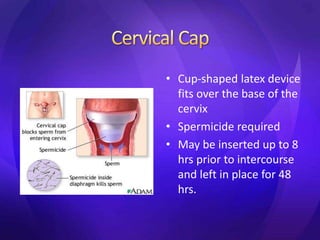
• Cup-shaped latex device
fits over the base of the
cervix
• Spermicide required
• May be inserted up to 8
hrs prior to intercourse
and left in place for 48
hrs.
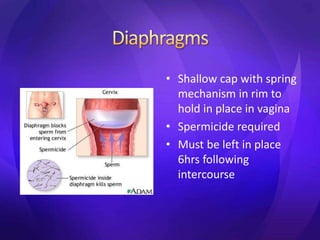
• Shallow cap with spring
mechanism in rim to
hold in place in vagina
• Spermicide required
• Must be left in place
6hrs following
intercourse
Advantages
• Non-hormonal
contraception controlled
by woman
Disadvantages
• High failure rate: perfect
use 6%, typical use 16%
• Prolonged use can
increase risk of UTIs
• Requires professional
fitting and training
• Can develop odor if not
properly cleaned
• Can cause vaginal
erosions
• Toxic shock syndrome
• Requires additional
spermicide for repeated
use in case of diaphragm
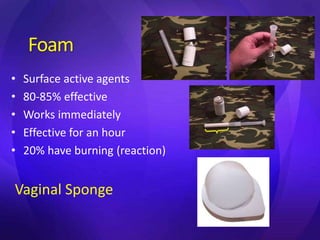
Foam
• Surface active agents
• 80-85% effective
• Works immediately
• Effective for an hour
• 20% have burning (reaction)
Vaginal Sponge
• Combined Oral Contraceptive Pills
• Progestin-Only Contraceptive Pills
• Extended cycle combined oral contraceptive
pills
• Post coital pills for Emergency Contraception
• Once a month pills (quinestrol+progestogen)
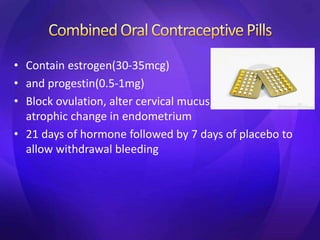
• Contain estrogen(30-35mcg)
• and progestin(0.5-1mg)
• Block ovulation, alter cervical mucus, stimulate
atrophic change in endometrium
• 21 days of hormone followed by 7 days of placebo to
allow withdrawal bleeding
Advantages:
• Failure rate less than 0.3%
with perfect use (8% typical
use)
• Fertility returns rapidly
• Bleeding is decreased
• Greater cycle predictability
• Decreased risk of benign
breast disease, PID, ovarian
and endometrial cancers,
ectopic pregnancy
Disadvantages:
• Increased risk of stroke,
acute MI, venous
thromboembolic disease
• Increased risk of hepatic
adenoma, cervical cancer,
breast cancer
• Do not protect against STDs
• When used with antibiotics
or anticonvulsants, efficacy
may be decreased
• Nausea
• Headache
• Weight gain
• Suppress lactation
• Vomiting
• Dizziness
• Mastalgia
• Hypertension
• Mood changes
• Decreased libido
• Increased triglycerides
• Severe depression
• Spotting, breakthrough
bleeding
• Abnormal vaginal
bleeding of unknown
etiology
• Cerebrovascular disease
• Congenital hyperlipidemia
• History of breast cancer
• Ischemic heart disease
• Migraine
• Active viral hepatitis
• Diabetes >20 years OR
with severe vascular
disease, nephropathy,
retinopathy, neuropathy
• Severe hypertension
• Hepatic neoplasm
• Thrombophlebitis,
thromboembolic disease,
known thrombogenic
mutations
• Suppresses ovulation, has variable dampening effect
on mid cycle peaks of LH and FSH, increases cervical
mucus viscosity, leads to atrophic endometrium,
reduces cilia motility in the fallopian tube
**MUST BE TAKEN AT THE SAME TIME EVERY DAY**
Advantages:
• Risk of serious
complications to which
estrogen contributes is
greatly reduced
• Decreased
dysmenorrhea,
menstrual blood loss
• Fertility returns
immediately after
cessation
Disadvantages:
• Does not protect
against STDs
• these are COCPs packaged to reduce or eliminate
the withdrawal bleeding that occurs once every
28 days in traditionally packaged COCPs.
Extended cycle use of COCPs may also be called
menstrual suppression
• vaginal ring and the contraceptive patchhave
been studied for extended cycle use, and the
monthly combined injectable contraceptive may
similarly eliminate bleeding
• Menorrhagia
• Dysmenorrhea
• Endometriosis
• Menstrual migraines
• Irregular periods
• Iron-deficiency anemia
• Some seizure disorders
• Menstrual flares of rheumatoid arthritis
• Coagulation defects
• Vasomotor symptoms of perimenopause
• Acne
• Hirsutism
• Polycystic ovary syndrome
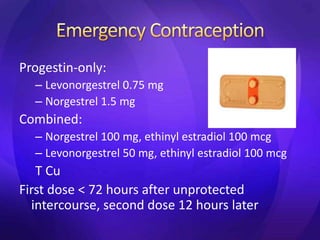
Progestin-only:
– Levonorgestrel 0.75 mg
– Norgestrel 1.5 mg
Combined:
– Norgestrel 100 mg, ethinyl estradiol 100 mcg
– Levonorgestrel 50 mg, ethinyl estradiol 100 mcg
T Cu
First dose < 72 hours after unprotected
intercourse, second dose 12 hours later
Depo-Provera
• Injectable Contraceptives
• Progestin-only: Depo-
medroxyprogesterone
acetate (DMPA) 150 mg
IM every 12 weeks
• Alters endometrial
lining, thickens cervical
mucus and blocks LH
surge preventing
ovulation
Advantages
• Extremely effective. Failure rate 0.3% with perfect
use, 3% with typical use.
• Efficacy is not altered by varying weight nor use of
concurrent medications nor sickness/diarrhea
• Decreased anemia, dysmenorrhea
• Decreased risk of endometrial and ovarian ca, PID,
ectopics
• Safe for use in breast-feeding mothers
• Does not produce serious side effects of estrogen:
OK to use in patients with diabetes, lipid disorders,
complicated migraines, h/o cerebrovascular
accidents/Coronary Artery Disease/Congestive Heart
Failure, SLE, peripheral vascular disease
Disadvantages
• Involves injections and remembering to visit doctor
every 3 months
• Persistent irregular bleeding
• Delayed return to fertility
• Weight gain-about 5 lbs in first year.
• Depression
• Apply once weekly for 3
weeks. Placebo is one
patch-free week during
which withdrawal
bleeding occurs
• Blocks LH surge
(preventing ovulation),
thickens cervical mucus,
alters endometrial
lining
• Ethyl vinyl acetate ring
• Ethinyl estradiol 0.015
mg/day +etonogestrel
0.12 mg/day
• Inserted intravaginally for
three weeks
• Thickens cervical mucus,
alters endometrial lining,
blocks LH surge
preventing ovulation
– vaginitis
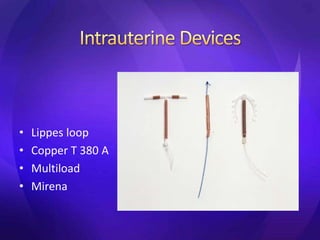
• Lippes loop
• Copper T 380 A
• Multiload
• Mirena
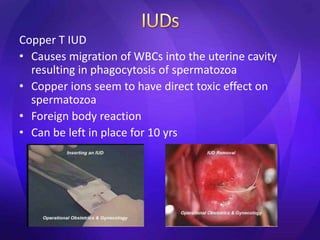
Copper T IUD
• Causes migration of WBCs into the uterine cavity
resulting in phagocytosis of spermatozoa
• Copper ions seem to have direct toxic effect on
spermatozoa
• Foreign body reaction
• Can be left in place for 10 yrs
• Releases 20 mcg LNG (levonorgestrel) per day into
uterine cavity for 5 years
• Inhibits fertilization: anovulation, thickens cervical
mucus, inhibits sperm and ovum motility and
function
• Can be left in place for 5 years
Advantages:
 Efficacy. Failure rate w/ perfect use 0.1-0.6%, typical
use 0.1-0.8%
 Long-term
 Reversible
 Most cost-effective
 No systemic side effects
 Mirena only: decreased menorrhagia, dysmenorrhea,
anemia
 Do not interfere with lactation
**
• Increased risk of PID (only at insertion)
• Bleeding
• Risk of perforation with insertion
• Cramping and pain at insertion
• May be expelled unnoticed
• No STD protection
• Ectopic pregnancy
• Vaginal bleeding of unknown etiology
• Current cervicitis or PID
• Known or suspected pregnancy
• Uterine anatomy interfering w/ placement
• Mirena only: Current DVT
• Copper only: Allergy to copper or Wilson’s disease
• Gynecologic or breast malignancy
• Previous ectopic pregnancy
• Within first 10 days of menstrual cycle
• Within first week after delivery
• 6 to 8 weeks after the delivery
• Coitus interruptus (literally "interrupted sexual
intercourse"), is the practice of ending sexual
intercourse ("pulling out") before ejaculation
• Symptothermic method
• Safe period (rhythm method)
• Basal body temperature method
• Cervical mucous method
Sterilization
 Sterilization :female bilateral tubal ligation and male
vasectomy are permenant method of contraception
and highly effective.
• They are generally chosen by relatively older couple
who are sure that they completed their family.
 Also individual who carry a genetic disorder may
choose to be sterlized.
 Sterilization methods include:
1- Vasectomy in males.
2- Tubal Ligation in females .
Bilateral Tubal Ligation
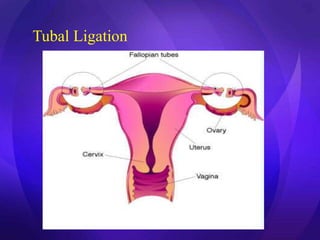
 This involve mechanically blockage of both
fallopian tube to prevent the sperm reaching and
fertilizing the oocyte
 sterilization performed by laparoscopically(under
GA) or through a suprapubic “mini-laparotomy”
During caesarean section
 Failure rate: 0.5%
Tubal Ligation
Tubal Ligation
Advantages:
• intended to be
permanent
• highly effective
• safe
• quick recovery
• lack of significant long-
term side effects
• cost effective
Disadvantage:
possibility of patient regret
• difficult to reverse
• future pregnancy could
require assisted
reproductive technology
(such as Invitro
Fertilization)
• more expensive than
vasectomy
Vasectomy
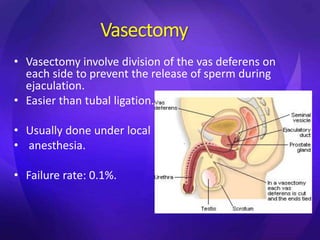
• Vasectomy involve division of the vas deferens on
each side to prevent the release of sperm during
ejaculation.
• Easier than tubal ligation.
• Usually done under local
• anesthesia.
• Failure rate: 0.1%.
Vasectomy
• Advantages:
• permanent,effective,safe, quick recovery
• lack of significant long-term side effects
• cost effective; less expensive than tubal ligation
Disadvantages:
• reversal is difficult, often unsuccessful
• not effective until all sperm cleared from the
reproductive tract (may take up to 12 w)
• no protection from STD
Cont.
Complication of vasectomy:
• Immediately bleeding, wound infection
• At the cut of vas deferns small lump will apear as a
result of a local inflammation response this is
called sperm granuloma it needs surgical excision.
• some men develop anti-sperm antibody following
vasectomy
THANK YOU

Contraception by Dr wajiha sajid

  • 2.
  • 3.
    • Contraception, birthcontrol or fertility control refers to the methods or devices used to prevent pregnancy. • Planning and provision of birth control is called family planning.
  • 4.
    Reversible methods – BarrierMethods – Hormonal Methods 1. Oral Contraceptive Pills 2. Injectable Contraceptives 3. Contraceptive patch 4. Vaginal Ring – Intrauterine Devices – Emergency methods – Miscellaneous methods Irreversible/permanent methods/sterilization • Tubal ligation • Vasectomy
  • 5.
     Aim ofthe method is to prevent the sperm from meeting the ovum. • Condoms • Female Condoms • Cervical Cap • Diaphragm • Vaginal sponge • Spermicides
  • 6.
    preventthedepositionof semenintovagina • Advantages •Protect against STDs • Readily available • Inexpensive • Allow male partner to be involved in contraception • Disadvantages • Failure rate is 2% with perfect use • Require responsible attitude on the part of male
  • 7.
    • Polyurethane sheath intendedfor one-time use with two flexible rings. • Acts as a barrier to passage of semen into vagina
  • 8.
    Advantages • Protects againstSTDs • Can be inserted up to 8 hrs before intercourse • Sheath coated on inside with silicone based lubricant Disadvantages • More expensive than condoms • Low acceptability, difficult to place • Failure rate: 5% perfect use21% typical use
  • 9.
    • Cup-shaped latexdevice fits over the base of the cervix • Spermicide required • May be inserted up to 8 hrs prior to intercourse and left in place for 48 hrs.
  • 10.
    • Shallow capwith spring mechanism in rim to hold in place in vagina • Spermicide required • Must be left in place 6hrs following intercourse
  • 11.
    Advantages • Non-hormonal contraception controlled bywoman Disadvantages • High failure rate: perfect use 6%, typical use 16% • Prolonged use can increase risk of UTIs • Requires professional fitting and training • Can develop odor if not properly cleaned • Can cause vaginal erosions • Toxic shock syndrome • Requires additional spermicide for repeated use in case of diaphragm
  • 12.
    Foam • Surface activeagents • 80-85% effective • Works immediately • Effective for an hour • 20% have burning (reaction) Vaginal Sponge
  • 13.
    • Combined OralContraceptive Pills • Progestin-Only Contraceptive Pills • Extended cycle combined oral contraceptive pills • Post coital pills for Emergency Contraception • Once a month pills (quinestrol+progestogen)
  • 14.
    • Contain estrogen(30-35mcg) •and progestin(0.5-1mg) • Block ovulation, alter cervical mucus, stimulate atrophic change in endometrium • 21 days of hormone followed by 7 days of placebo to allow withdrawal bleeding
  • 15.
    Advantages: • Failure rateless than 0.3% with perfect use (8% typical use) • Fertility returns rapidly • Bleeding is decreased • Greater cycle predictability • Decreased risk of benign breast disease, PID, ovarian and endometrial cancers, ectopic pregnancy Disadvantages: • Increased risk of stroke, acute MI, venous thromboembolic disease • Increased risk of hepatic adenoma, cervical cancer, breast cancer • Do not protect against STDs • When used with antibiotics or anticonvulsants, efficacy may be decreased
  • 16.
    • Nausea • Headache •Weight gain • Suppress lactation • Vomiting • Dizziness • Mastalgia • Hypertension • Mood changes • Decreased libido • Increased triglycerides • Severe depression • Spotting, breakthrough bleeding
  • 17.
    • Abnormal vaginal bleedingof unknown etiology • Cerebrovascular disease • Congenital hyperlipidemia • History of breast cancer • Ischemic heart disease • Migraine • Active viral hepatitis • Diabetes >20 years OR with severe vascular disease, nephropathy, retinopathy, neuropathy • Severe hypertension • Hepatic neoplasm • Thrombophlebitis, thromboembolic disease, known thrombogenic mutations
  • 18.
    • Suppresses ovulation,has variable dampening effect on mid cycle peaks of LH and FSH, increases cervical mucus viscosity, leads to atrophic endometrium, reduces cilia motility in the fallopian tube **MUST BE TAKEN AT THE SAME TIME EVERY DAY**
  • 19.
    Advantages: • Risk ofserious complications to which estrogen contributes is greatly reduced • Decreased dysmenorrhea, menstrual blood loss • Fertility returns immediately after cessation Disadvantages: • Does not protect against STDs
  • 20.
    • these areCOCPs packaged to reduce or eliminate the withdrawal bleeding that occurs once every 28 days in traditionally packaged COCPs. Extended cycle use of COCPs may also be called menstrual suppression • vaginal ring and the contraceptive patchhave been studied for extended cycle use, and the monthly combined injectable contraceptive may similarly eliminate bleeding
  • 21.
    • Menorrhagia • Dysmenorrhea •Endometriosis • Menstrual migraines • Irregular periods • Iron-deficiency anemia • Some seizure disorders • Menstrual flares of rheumatoid arthritis • Coagulation defects • Vasomotor symptoms of perimenopause • Acne • Hirsutism • Polycystic ovary syndrome
  • 22.
    Progestin-only: – Levonorgestrel 0.75mg – Norgestrel 1.5 mg Combined: – Norgestrel 100 mg, ethinyl estradiol 100 mcg – Levonorgestrel 50 mg, ethinyl estradiol 100 mcg T Cu First dose < 72 hours after unprotected intercourse, second dose 12 hours later
  • 23.
  • 24.
    • Injectable Contraceptives •Progestin-only: Depo- medroxyprogesterone acetate (DMPA) 150 mg IM every 12 weeks • Alters endometrial lining, thickens cervical mucus and blocks LH surge preventing ovulation
  • 25.
    Advantages • Extremely effective.Failure rate 0.3% with perfect use, 3% with typical use. • Efficacy is not altered by varying weight nor use of concurrent medications nor sickness/diarrhea • Decreased anemia, dysmenorrhea • Decreased risk of endometrial and ovarian ca, PID, ectopics • Safe for use in breast-feeding mothers
  • 26.
    • Does notproduce serious side effects of estrogen: OK to use in patients with diabetes, lipid disorders, complicated migraines, h/o cerebrovascular accidents/Coronary Artery Disease/Congestive Heart Failure, SLE, peripheral vascular disease Disadvantages • Involves injections and remembering to visit doctor every 3 months • Persistent irregular bleeding • Delayed return to fertility • Weight gain-about 5 lbs in first year. • Depression
  • 27.
    • Apply onceweekly for 3 weeks. Placebo is one patch-free week during which withdrawal bleeding occurs • Blocks LH surge (preventing ovulation), thickens cervical mucus, alters endometrial lining
  • 28.
    • Ethyl vinylacetate ring • Ethinyl estradiol 0.015 mg/day +etonogestrel 0.12 mg/day • Inserted intravaginally for three weeks • Thickens cervical mucus, alters endometrial lining, blocks LH surge preventing ovulation – vaginitis
  • 29.
    • Lippes loop •Copper T 380 A • Multiload • Mirena
  • 30.
    Copper T IUD •Causes migration of WBCs into the uterine cavity resulting in phagocytosis of spermatozoa • Copper ions seem to have direct toxic effect on spermatozoa • Foreign body reaction • Can be left in place for 10 yrs
  • 31.
    • Releases 20mcg LNG (levonorgestrel) per day into uterine cavity for 5 years • Inhibits fertilization: anovulation, thickens cervical mucus, inhibits sperm and ovum motility and function • Can be left in place for 5 years
  • 32.
    Advantages:  Efficacy. Failurerate w/ perfect use 0.1-0.6%, typical use 0.1-0.8%  Long-term  Reversible  Most cost-effective  No systemic side effects  Mirena only: decreased menorrhagia, dysmenorrhea, anemia  Do not interfere with lactation **
  • 33.
    • Increased riskof PID (only at insertion) • Bleeding • Risk of perforation with insertion • Cramping and pain at insertion • May be expelled unnoticed • No STD protection • Ectopic pregnancy
  • 34.
    • Vaginal bleedingof unknown etiology • Current cervicitis or PID • Known or suspected pregnancy • Uterine anatomy interfering w/ placement • Mirena only: Current DVT • Copper only: Allergy to copper or Wilson’s disease • Gynecologic or breast malignancy • Previous ectopic pregnancy
  • 35.
    • Within first10 days of menstrual cycle • Within first week after delivery • 6 to 8 weeks after the delivery
  • 36.
    • Coitus interruptus(literally "interrupted sexual intercourse"), is the practice of ending sexual intercourse ("pulling out") before ejaculation • Symptothermic method • Safe period (rhythm method) • Basal body temperature method • Cervical mucous method
  • 37.
    Sterilization  Sterilization :femalebilateral tubal ligation and male vasectomy are permenant method of contraception and highly effective. • They are generally chosen by relatively older couple who are sure that they completed their family.  Also individual who carry a genetic disorder may choose to be sterlized.  Sterilization methods include: 1- Vasectomy in males. 2- Tubal Ligation in females .
  • 38.
    Bilateral Tubal Ligation This involve mechanically blockage of both fallopian tube to prevent the sperm reaching and fertilizing the oocyte  sterilization performed by laparoscopically(under GA) or through a suprapubic “mini-laparotomy” During caesarean section  Failure rate: 0.5%
  • 39.
  • 40.
    Tubal Ligation Advantages: • intendedto be permanent • highly effective • safe • quick recovery • lack of significant long- term side effects • cost effective Disadvantage: possibility of patient regret • difficult to reverse • future pregnancy could require assisted reproductive technology (such as Invitro Fertilization) • more expensive than vasectomy
  • 41.
    Vasectomy • Vasectomy involvedivision of the vas deferens on each side to prevent the release of sperm during ejaculation. • Easier than tubal ligation. • Usually done under local • anesthesia. • Failure rate: 0.1%.
  • 42.
    Vasectomy • Advantages: • permanent,effective,safe,quick recovery • lack of significant long-term side effects • cost effective; less expensive than tubal ligation Disadvantages: • reversal is difficult, often unsuccessful • not effective until all sperm cleared from the reproductive tract (may take up to 12 w) • no protection from STD
  • 43.
    Cont. Complication of vasectomy: •Immediately bleeding, wound infection • At the cut of vas deferns small lump will apear as a result of a local inflammation response this is called sperm granuloma it needs surgical excision. • some men develop anti-sperm antibody following vasectomy
  • 44.