Chapter 5
SPECIAL DISTRIBUTIONS
• Discrete distribution; Binomial, Poisson; point
probability and interval; Binomial and Poisson table;
applications.
• Continuous distribution; Normal distribution; interval
probability; table and application, emphasize on
P(z1<Z<z2), P(Z<z) and P(Z>z).
• Introduction to t-distribution.
1
2
Learning Outcomes
• describe characteristics of Binomial distribution
• solve problems related to Binomial distribution
3
Binomial Distribution
• The binomial distribution is the discrete probability distribution of the
number of successes in a sequence of n independent yes/no experiments,
each of which yields success with probability p.
• Characteristics of the Binomial Distribution:
1. The experiment consists of n identical trials.
2. Each trial has only one of the two possible mutually exclusive
outcomes, success or a failure.
3. The trials are independent, thus we must sample with replacement.
4. The probability of success is denoted by p and that of failure by q, and
p + q=1. The probabilities p and q remain constant for each trial.
• Examples:
 The probability of a defective laptop manufactured at a firm is 0.05
in a random sample of ten.
p = 0.05, n = 10
The outcome to which the question refers
is called a success
4
Binomial Distribution
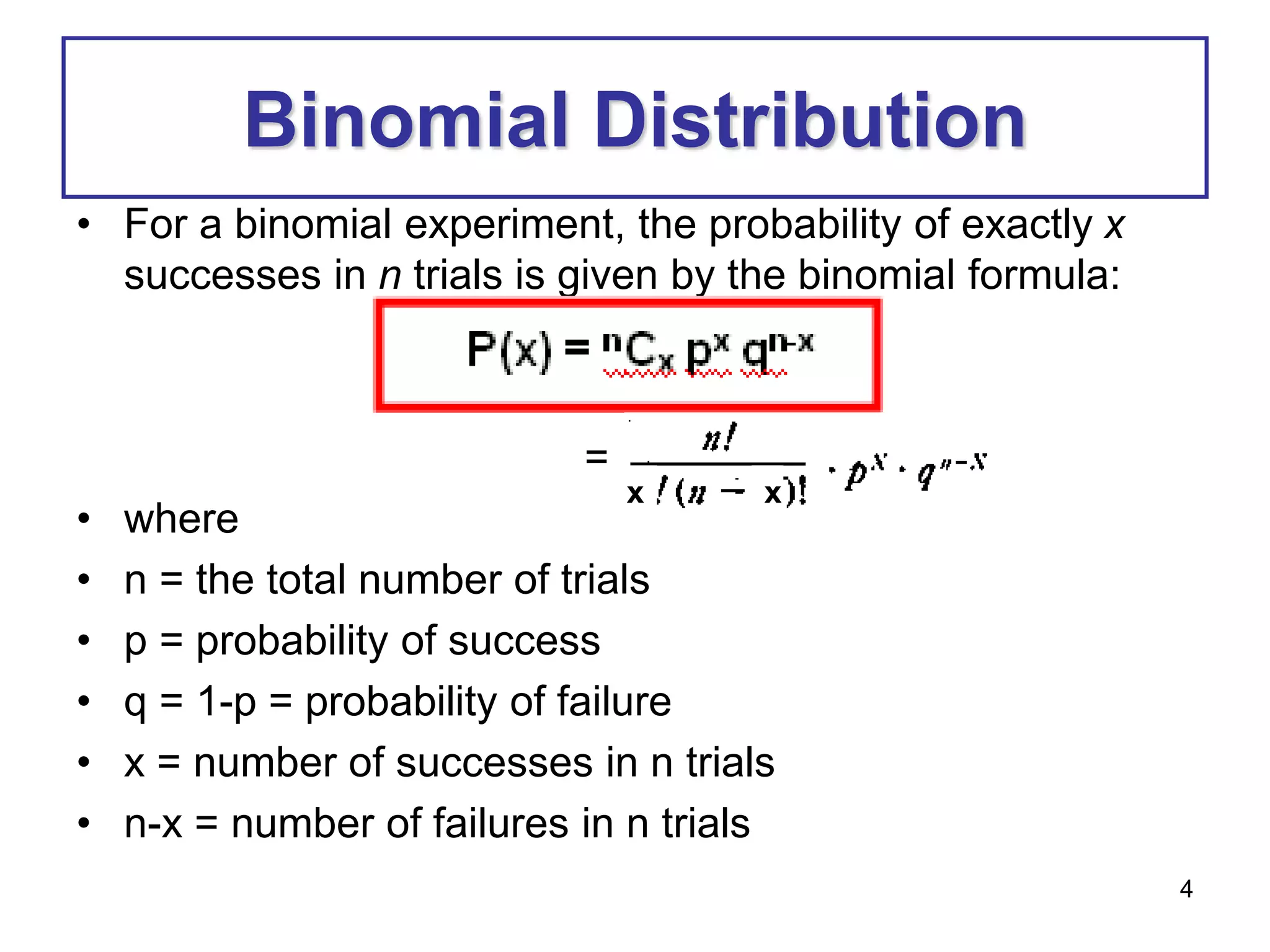
• For a binomial experiment, the probability of exactly x
successes in n trials is given by the binomial formula:
=
• where
• n = the total number of trials
• p = probability of success
• q = 1-p = probability of failure
• x = number of successes in n trials
• n-x = number of failures in n trials
x
x x
5
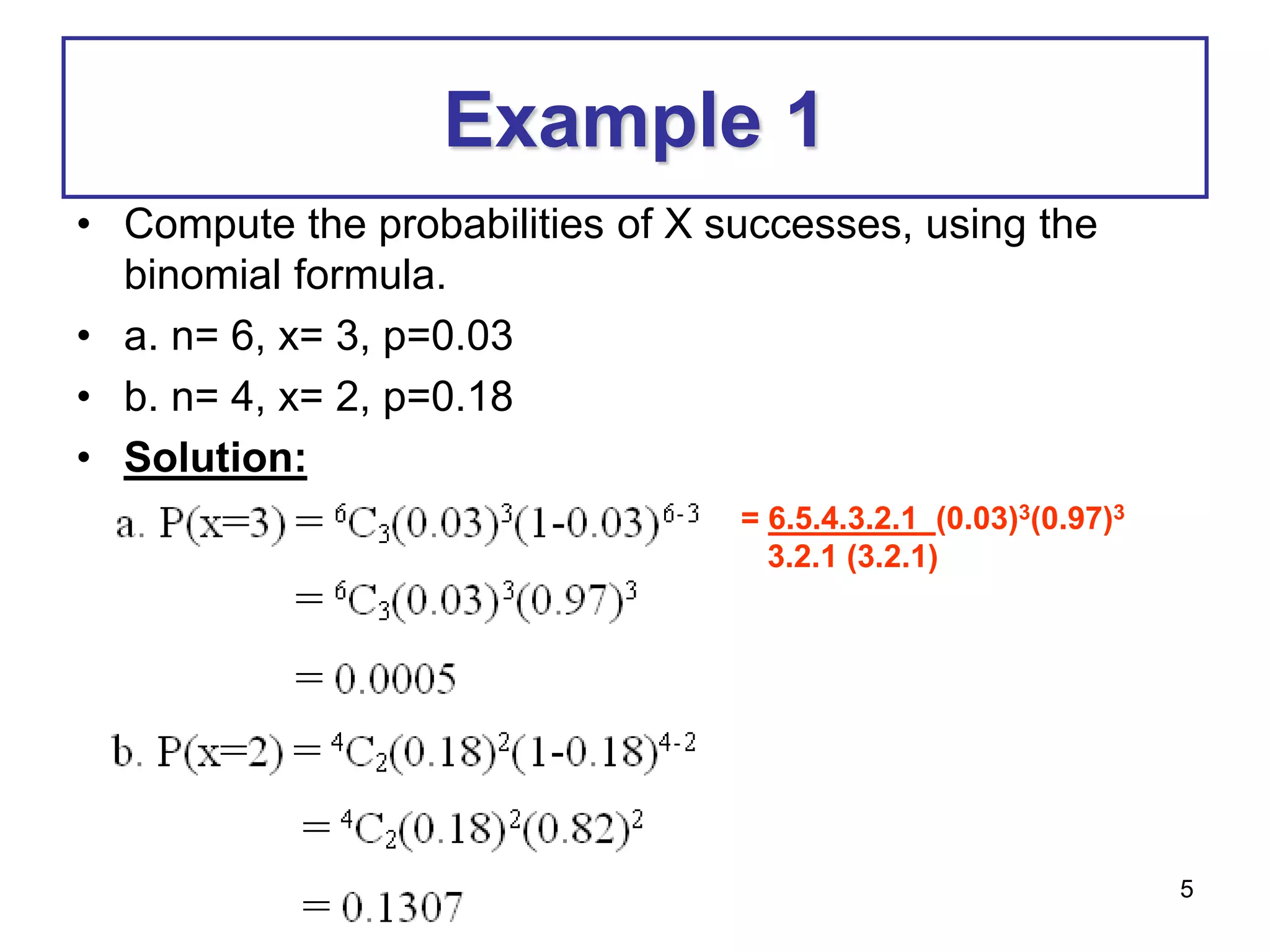
Example 1
• Compute the probabilities of X successes, using the
binomial formula.
• a. n= 6, x= 3, p=0.03
• b. n= 4, x= 2, p=0.18
• Solution:
= 6.5.4.3.2.1 (0.03)3(0.97)3
3.2.1 (3.2.1)
6
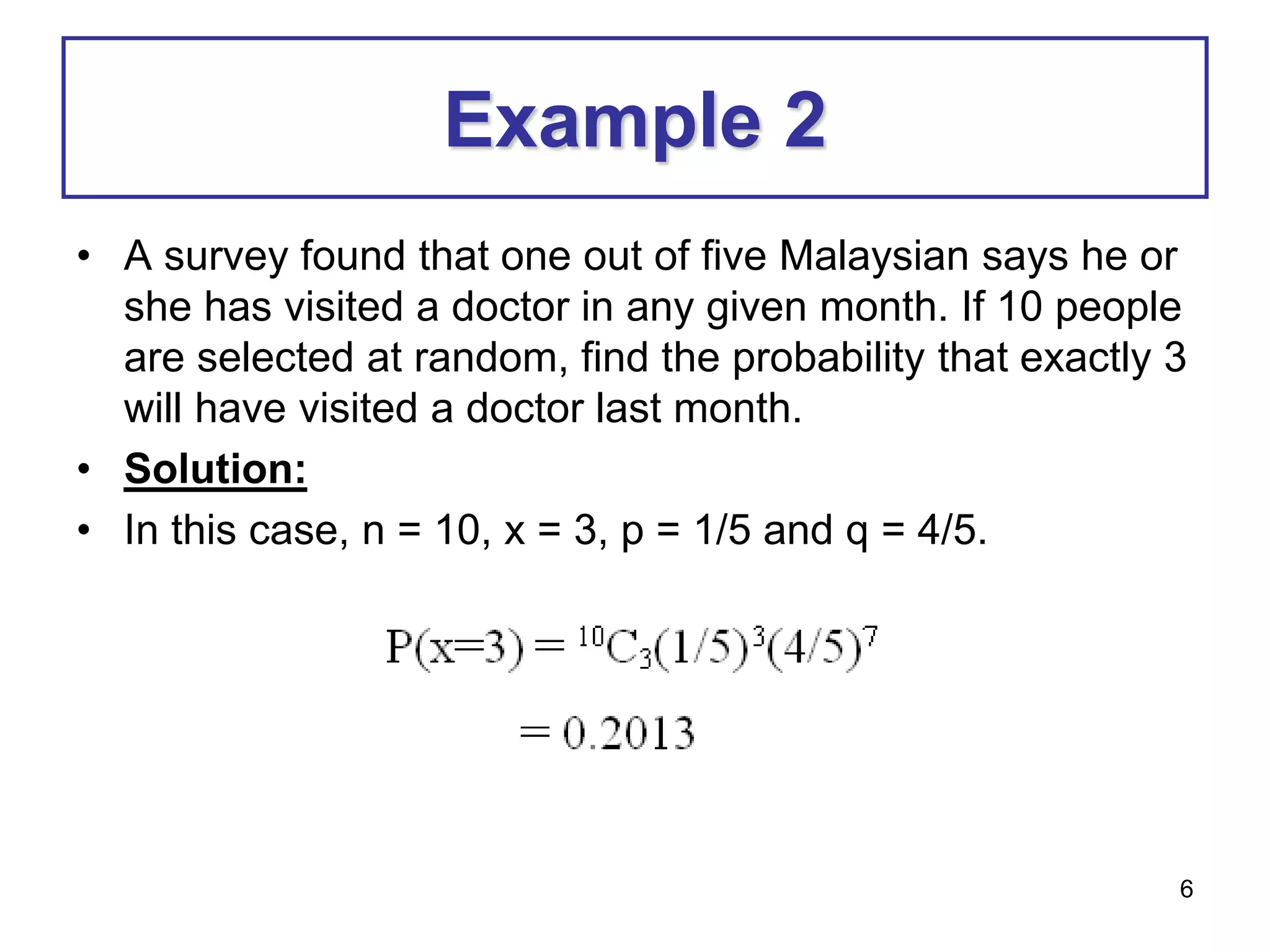
Example 2
• A survey found that one out of five Malaysian says he or
she has visited a doctor in any given month. If 10 people
are selected at random, find the probability that exactly 3
will have visited a doctor last month.
• Solution:
• In this case, n = 10, x = 3, p = 1/5 and q = 4/5.
7
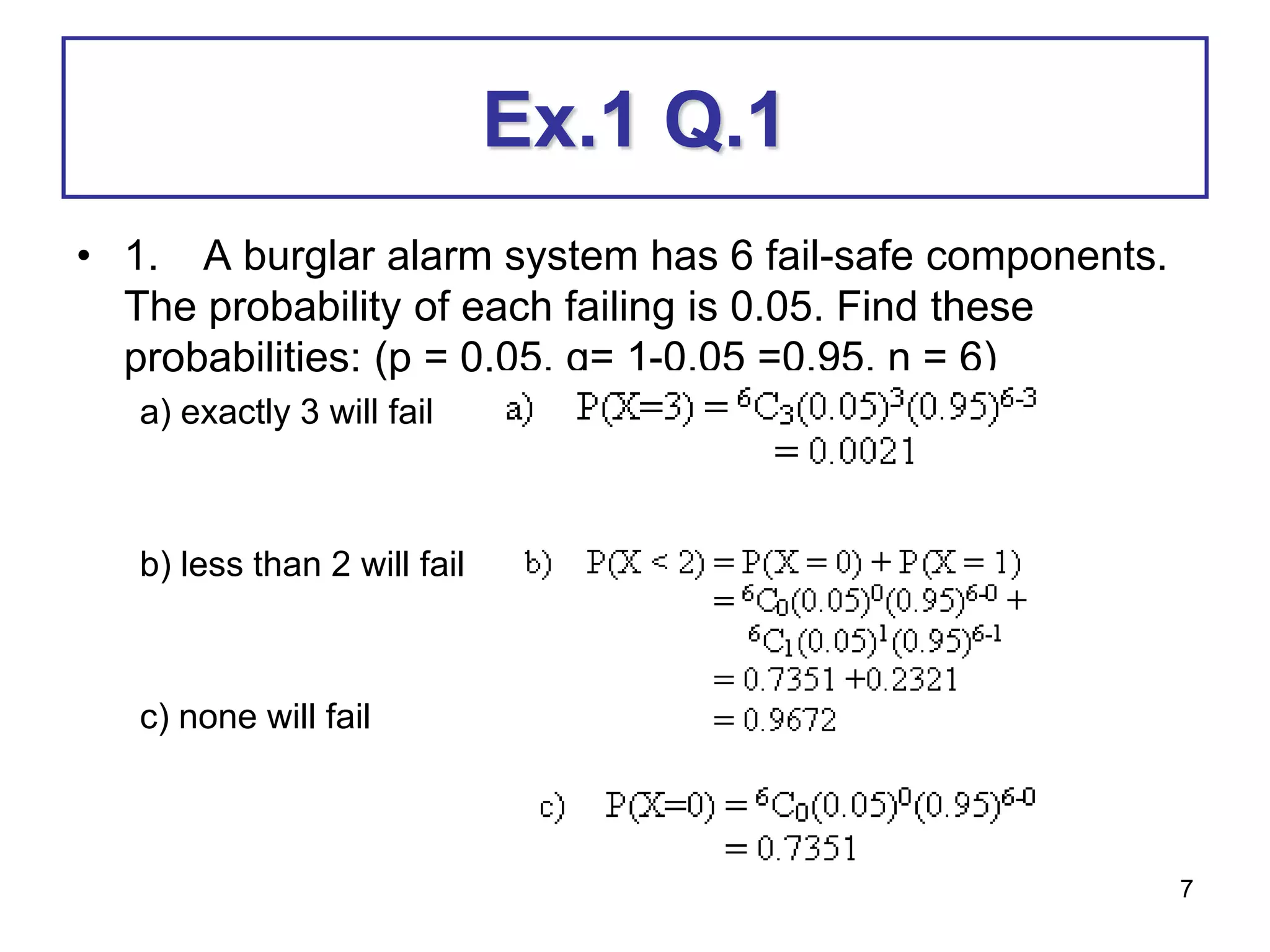
Ex.1 Q.1
• 1. A burglar alarm system has 6 fail-safe components.
The probability of each failing is 0.05. Find these
probabilities: (p = 0.05, q= 1-0.05 =0.95, n = 6)
a) exactly 3 will fail
b) less than 2 will fail
c) none will fail
8
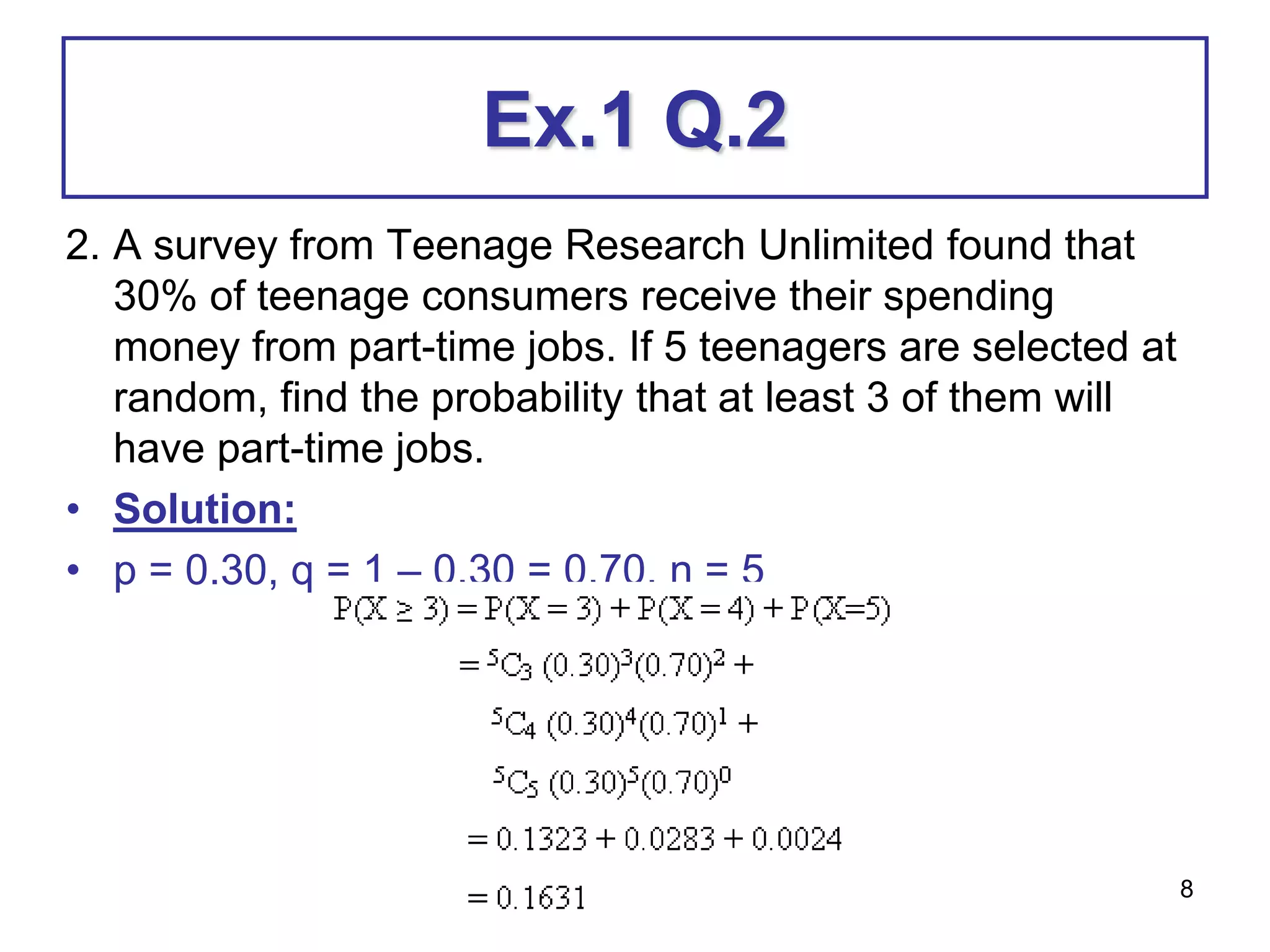
Ex.1 Q.2
2. A survey from Teenage Research Unlimited found that
30% of teenage consumers receive their spending
money from part-time jobs. If 5 teenagers are selected at
random, find the probability that at least 3 of them will
have part-time jobs.
• Solution:
• p = 0.30, q = 1 – 0.30 = 0.70, n = 5
9
Ex.1 Q.3
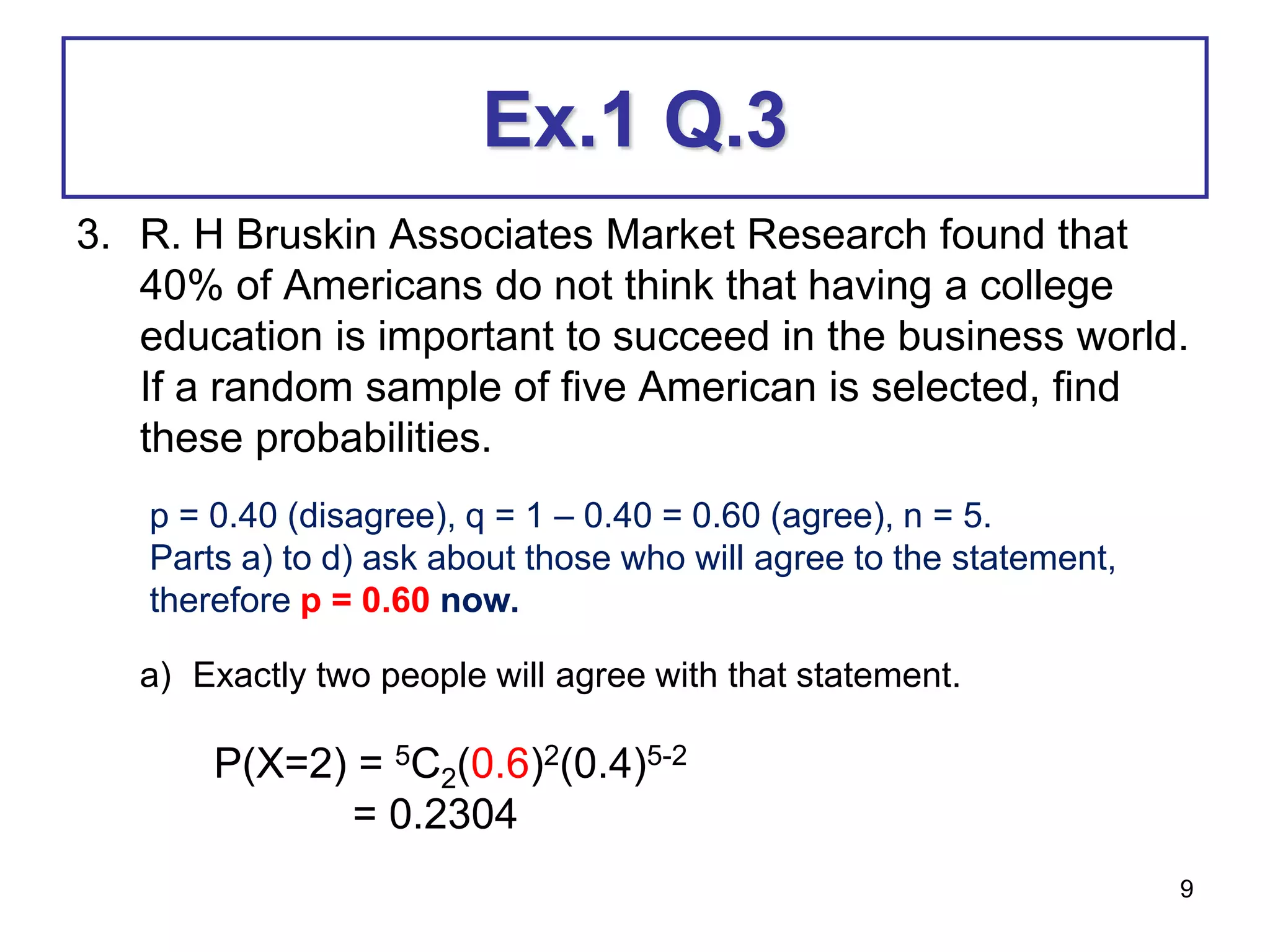
3. R. H Bruskin Associates Market Research found that
40% of Americans do not think that having a college
education is important to succeed in the business world.
If a random sample of five American is selected, find
these probabilities.
a) Exactly two people will agree with that statement.
p = 0.40 (disagree), q = 1 – 0.40 = 0.60 (agree), n = 5.
Parts a) to d) ask about those who will agree to the statement,
therefore p = 0.60 now.
P(X=2) = 5C2(0.6)2(0.4)5-2
= 0.2304
10
Ex.1 Q.3
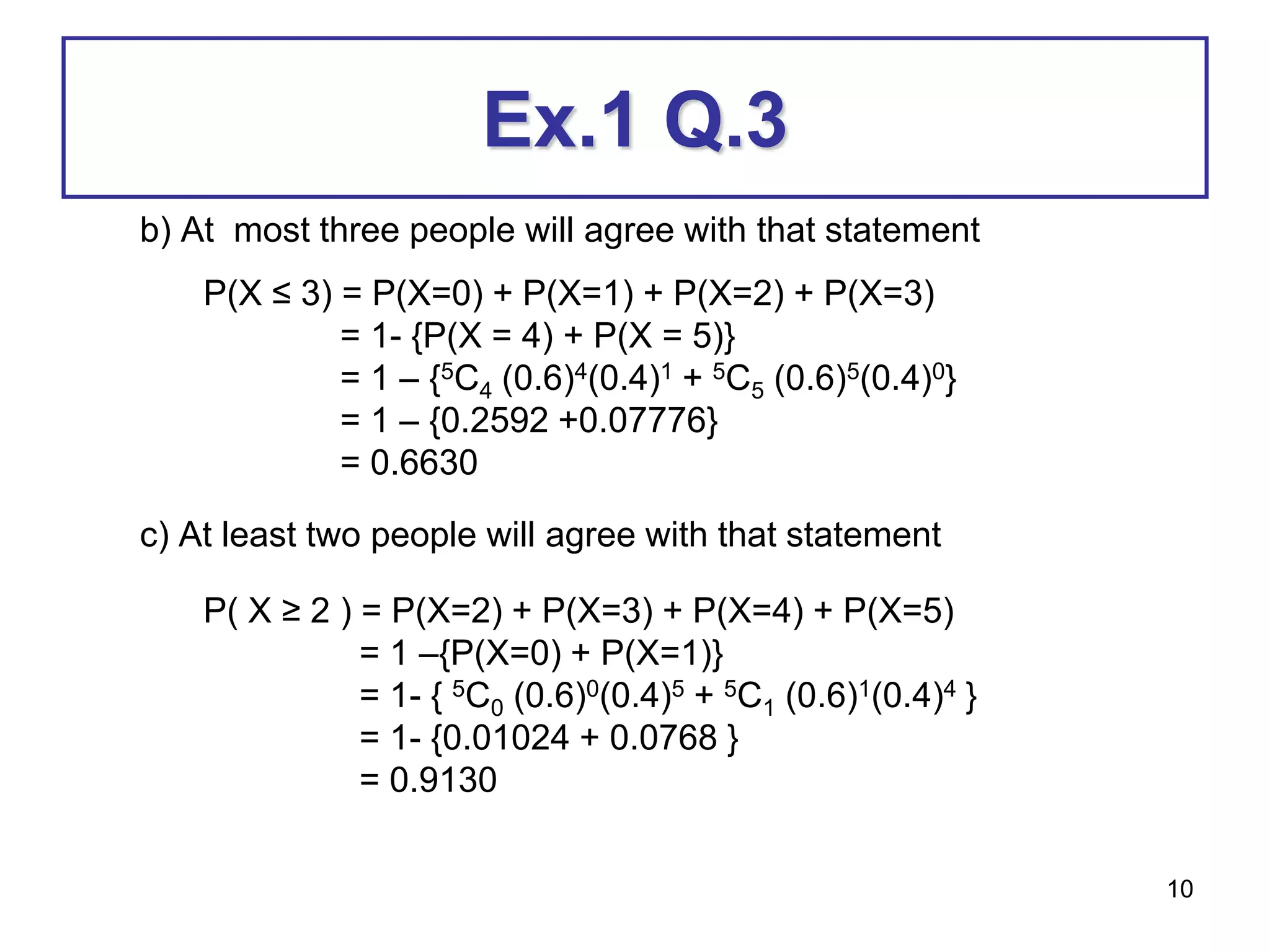
b) At most three people will agree with that statement
c) At least two people will agree with that statement
P(X ≤ 3) = P(X=0) + P(X=1) + P(X=2) + P(X=3)
= 1- {P(X = 4) + P(X = 5)}
= 1 – {5C4 (0.6)4(0.4)1 + 5C5 (0.6)5(0.4)0}
= 1 – {0.2592 +0.07776}
= 0.6630
P( X ≥ 2 ) = P(X=2) + P(X=3) + P(X=4) + P(X=5)
= 1 –{P(X=0) + P(X=1)}
= 1- { 5C0 (0.6)0(0.4)5 + 5C1 (0.6)1(0.4)4 }
= 1- {0.01024 + 0.0768 }
= 0.9130
11
Ex.1 Q.3
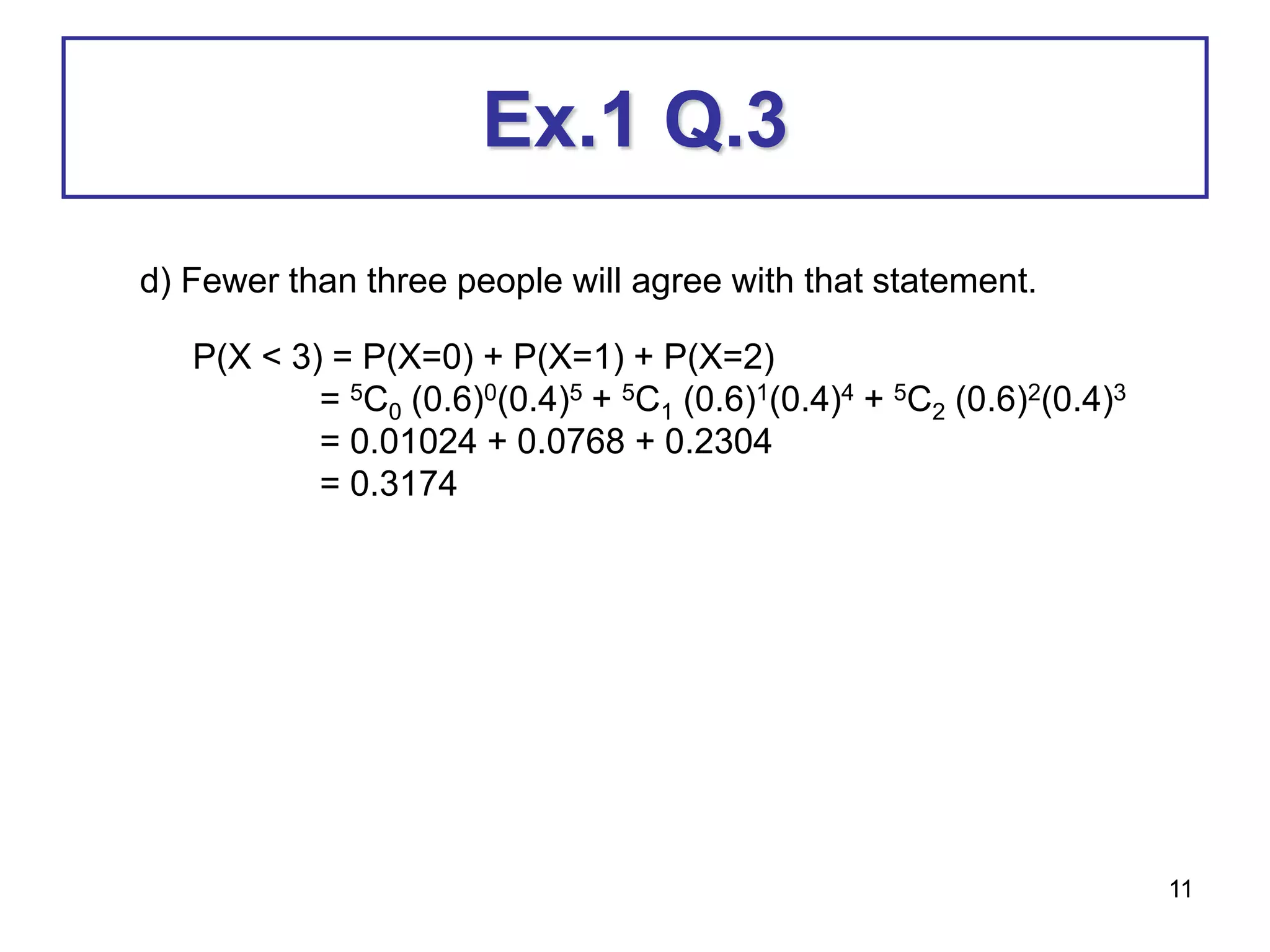
d) Fewer than three people will agree with that statement.
P(X < 3) = P(X=0) + P(X=1) + P(X=2)
= 5C0 (0.6)0(0.4)5 + 5C1 (0.6)1(0.4)4 + 5C2 (0.6)2(0.4)3
= 0.01024 + 0.0768 + 0.2304
= 0.3174
12
Ex.1 Q.4
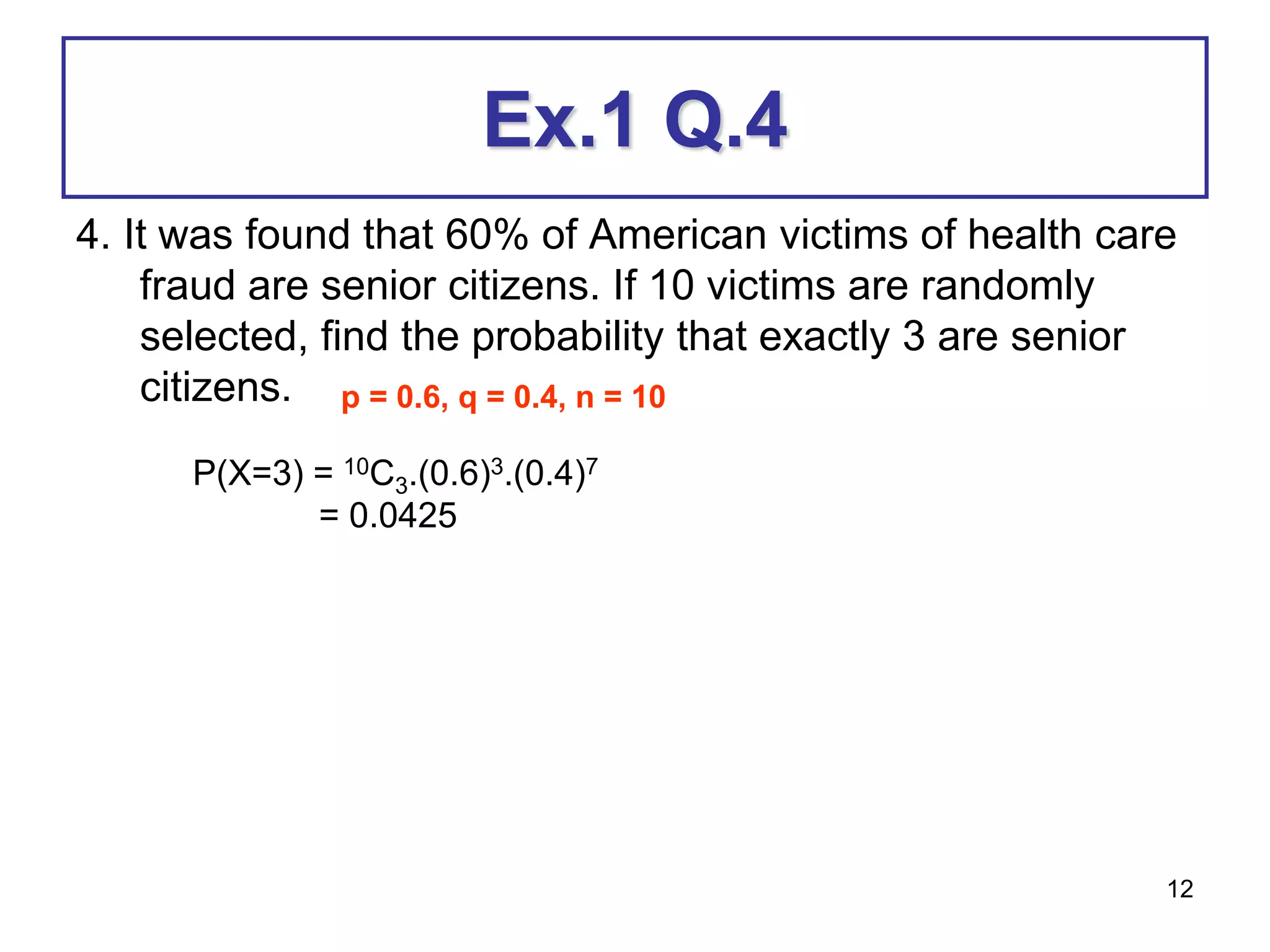
4. It was found that 60% of American victims of health care
fraud are senior citizens. If 10 victims are randomly
selected, find the probability that exactly 3 are senior
citizens. p = 0.6, q = 0.4, n = 10
P(X=3) = 10C3.(0.6)3.(0.4)7
= 0.0425
13
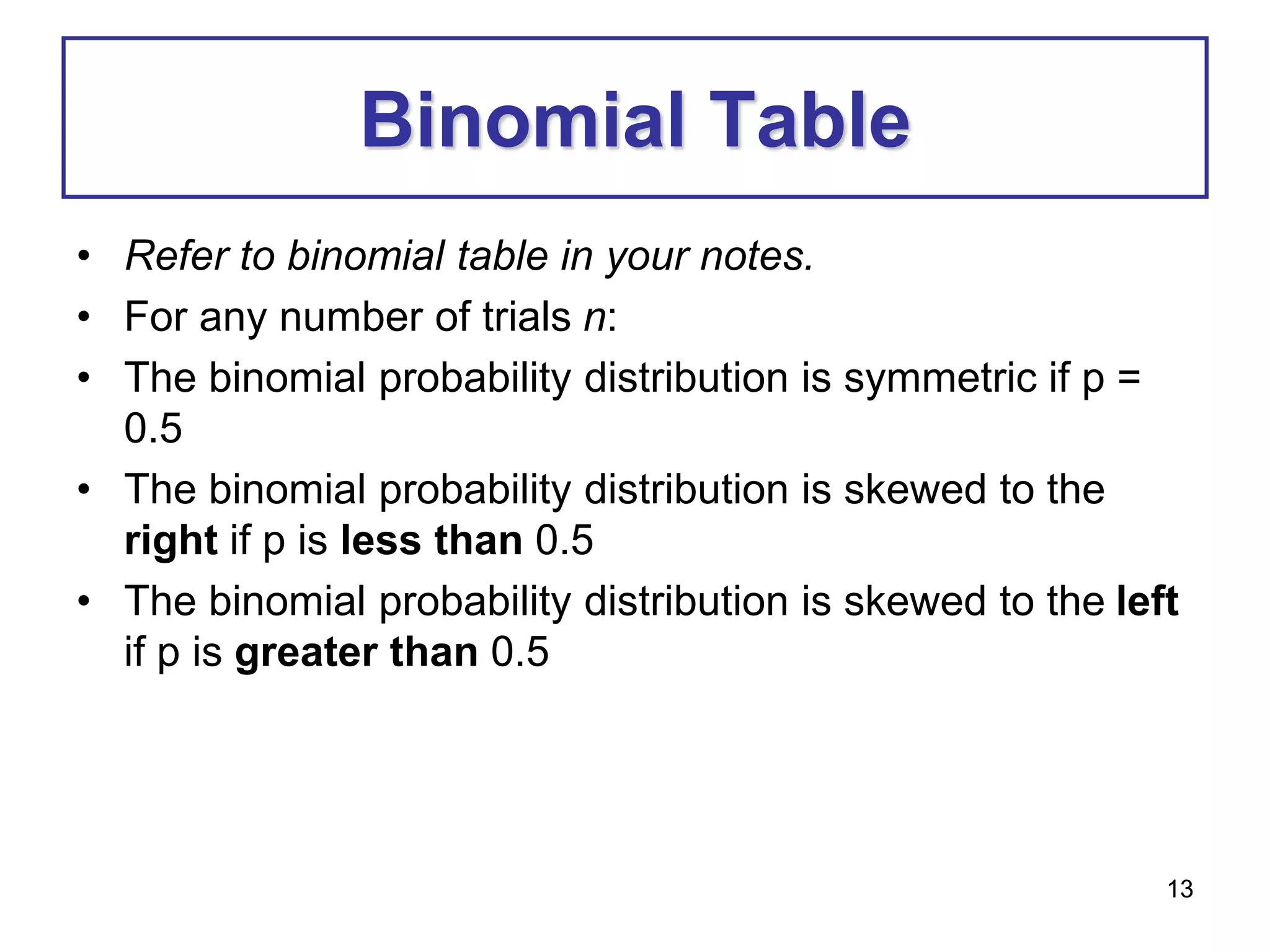
Binomial Table
• Refer to binomial table in your notes.
• For any number of trials n:
• The binomial probability distribution is symmetric if p =
0.5
• The binomial probability distribution is skewed to the
right if p is less than 0.5
• The binomial probability distribution is skewed to the left
if p is greater than 0.5
14
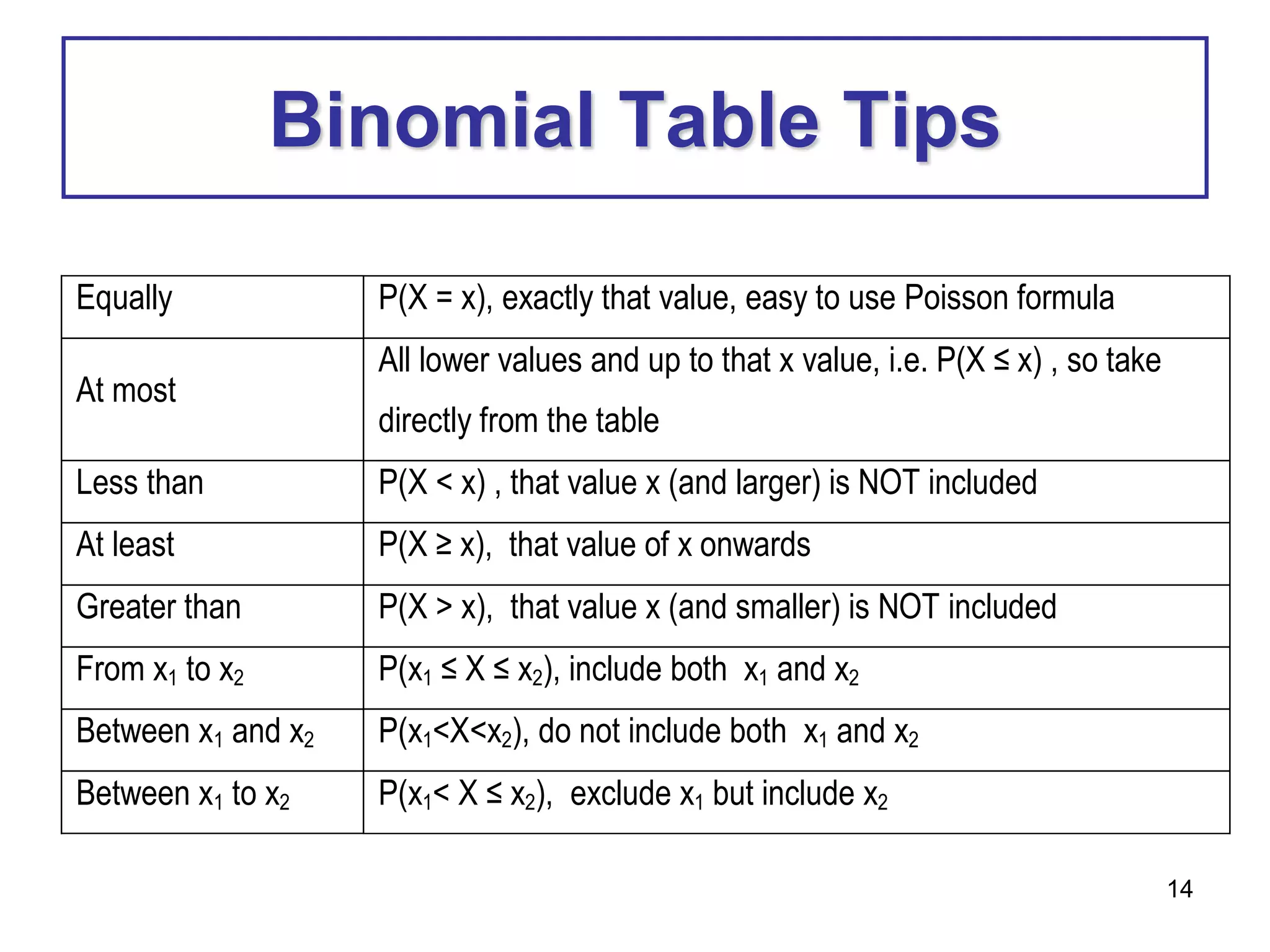
Binomial Table Tips
Equally P(X = x), exactly that value, easy to use Poisson formula
At most
All lower values and up to that x value, i.e. P(X ≤ x) , so take
directly from the table
Less than P(X < x) , that value x (and larger) is NOT included
At least P(X ≥ x), that value of x onwards
Greater than P(X > x), that value x (and smaller) is NOT included
From x1 to x2 P(x1 ≤ X ≤ x2), include both x1 and x2
Between x1 and x2 P(x1<X<x2), do not include both x1 and x2
Between x1 to x2 P(x1< X ≤ x2), exclude x1 but include x2
15
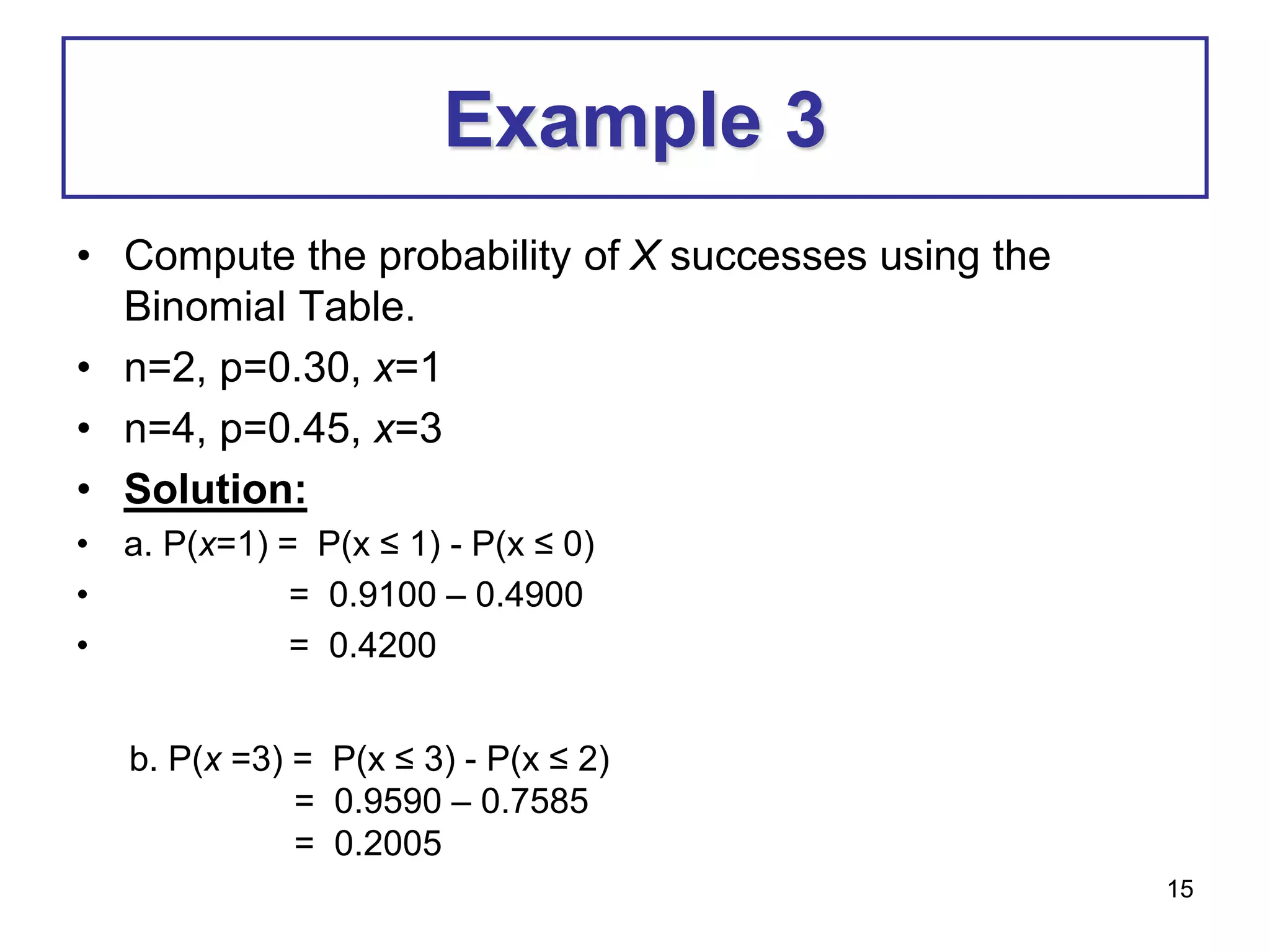
Example 3
• Compute the probability of X successes using the
Binomial Table.
• n=2, p=0.30, x=1
• n=4, p=0.45, x=3
• Solution:
• a. P(x=1) = P(x ≤ 1) - P(x ≤ 0)
• = 0.9100 – 0.4900
• = 0.4200
b. P(x =3) = P(x ≤ 3) - P(x ≤ 2)
= 0.9590 – 0.7585
= 0.2005
16
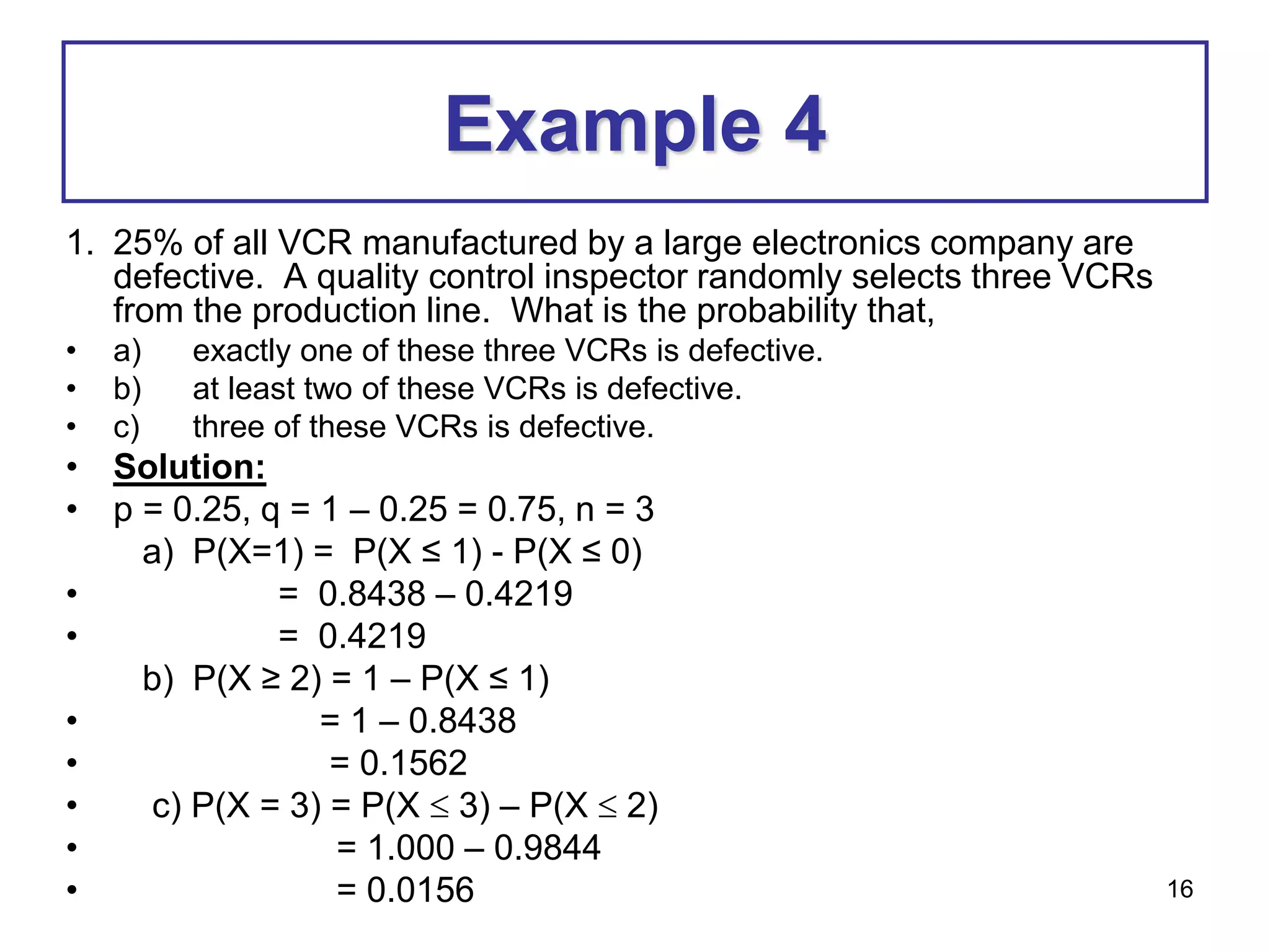
Example 4
1. 25% of all VCR manufactured by a large electronics company are
defective. A quality control inspector randomly selects three VCRs
from the production line. What is the probability that,
• a) exactly one of these three VCRs is defective.
• b) at least two of these VCRs is defective.
• c) three of these VCRs is defective.
• Solution:
• p = 0.25, q = 1 – 0.25 = 0.75, n = 3
a) P(X=1) = P(X ≤ 1) - P(X ≤ 0)
• = 0.8438 – 0.4219
• = 0.4219
b) P(X ≥ 2) = 1 – P(X ≤ 1)
• = 1 – 0.8438
• = 0.1562
• c) P(X = 3) = P(X  3) – P(X  2)
• = 1.000 – 0.9844
• = 0.0156
17
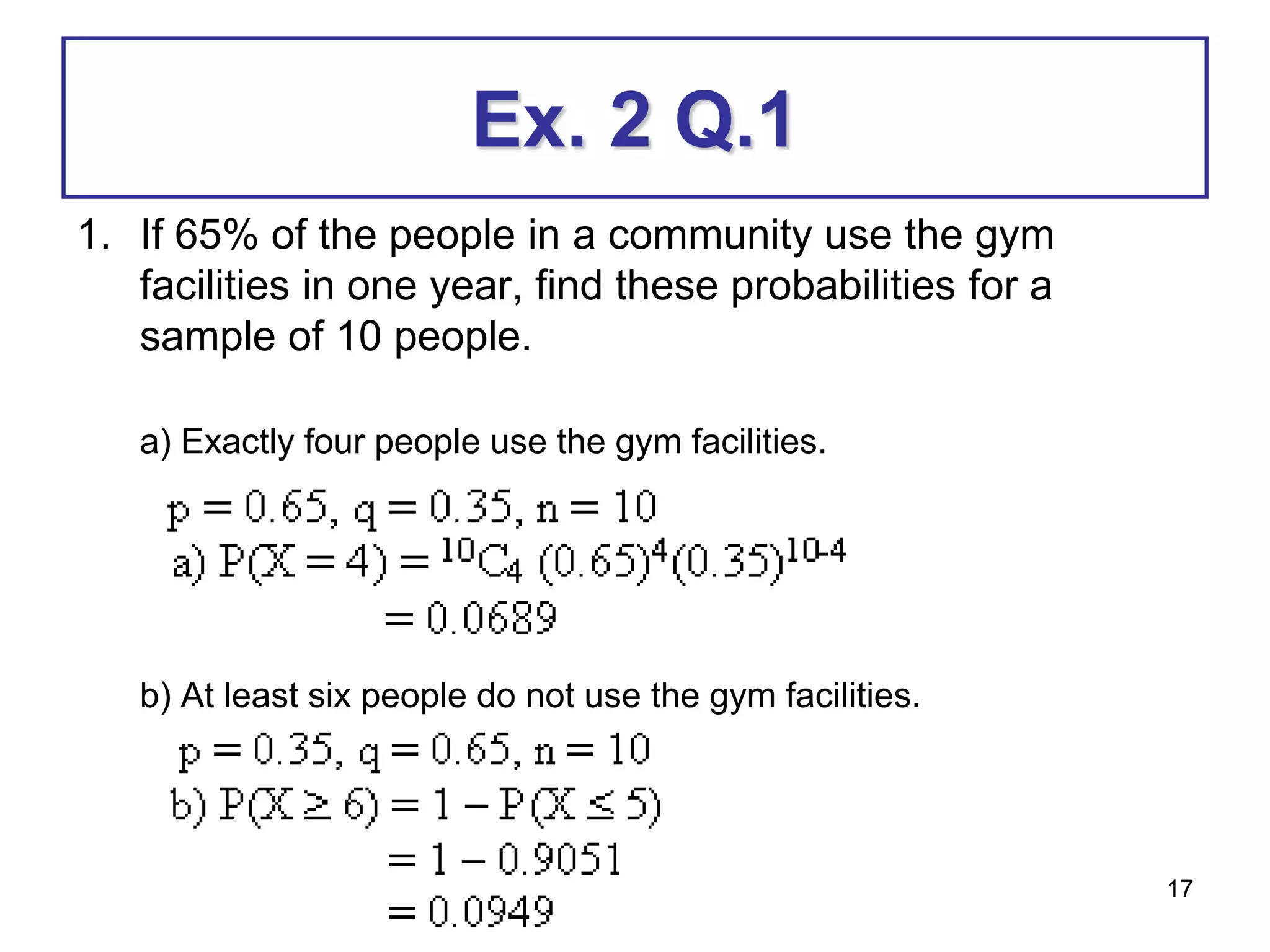
Ex. 2 Q.1
1. If 65% of the people in a community use the gym
facilities in one year, find these probabilities for a
sample of 10 people.
a) Exactly four people use the gym facilities.
b) At least six people do not use the gym facilities.
18
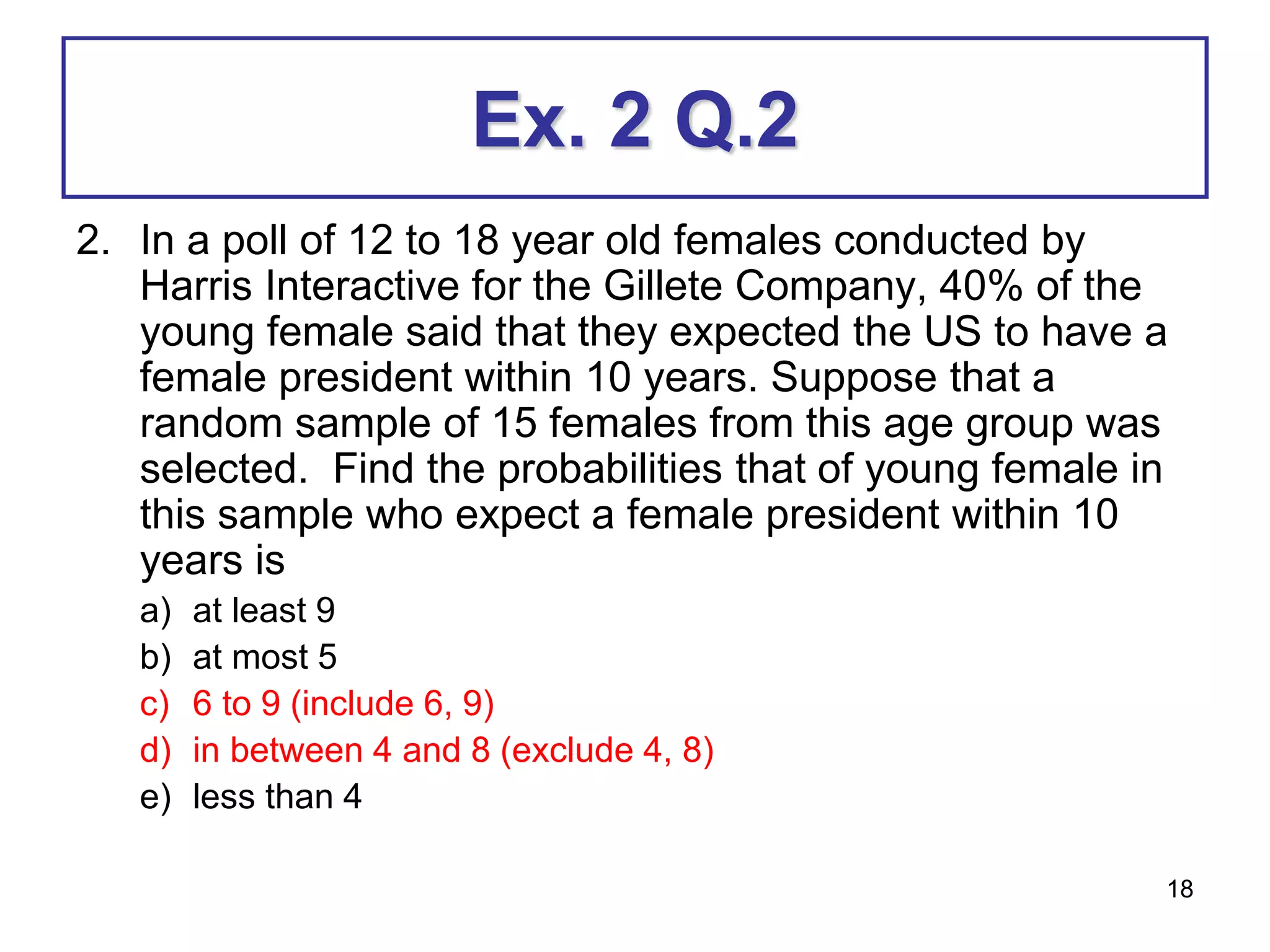
Ex. 2 Q.2
2. In a poll of 12 to 18 year old females conducted by
Harris Interactive for the Gillete Company, 40% of the
young female said that they expected the US to have a
female president within 10 years. Suppose that a
random sample of 15 females from this age group was
selected. Find the probabilities that of young female in
this sample who expect a female president within 10
years is
a) at least 9
b) at most 5
c) 6 to 9 (include 6, 9)
d) in between 4 and 8 (exclude 4, 8)
e) less than 4
19
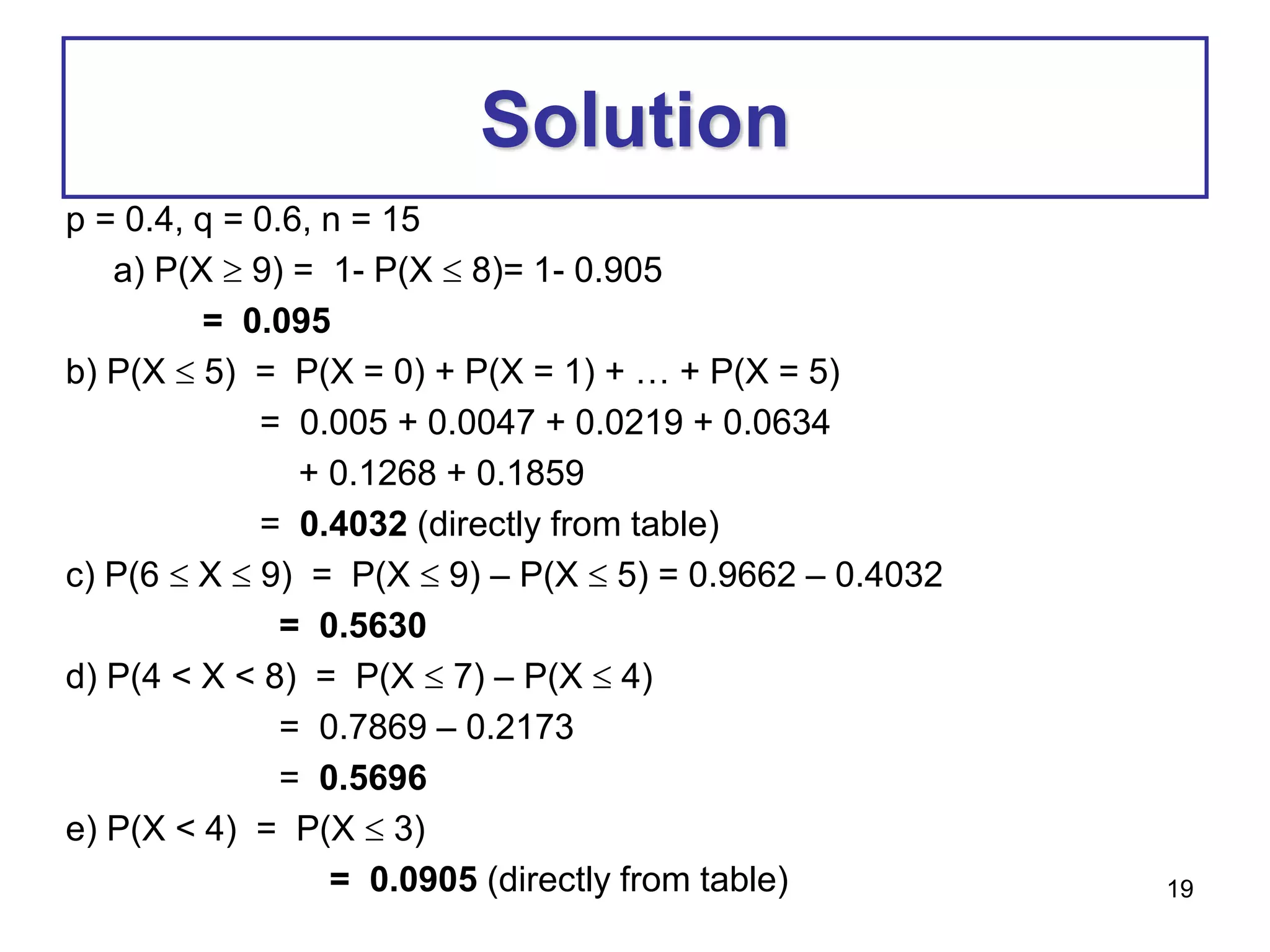
Solution
p = 0.4, q = 0.6, n = 15
a) P(X  9) = 1- P(X  8)= 1- 0.905
= 0.095
b) P(X  5) = P(X = 0) + P(X = 1) + … + P(X = 5)
= 0.005 + 0.0047 + 0.0219 + 0.0634
+ 0.1268 + 0.1859
= 0.4032 (directly from table)
c) P(6  X  9) = P(X  9) – P(X  5) = 0.9662 – 0.4032
= 0.5630
d) P(4 < X < 8) = P(X  7) – P(X  4)
= 0.7869 – 0.2173
= 0.5696
e) P(X < 4) = P(X  3)
= 0.0905 (directly from table)
20
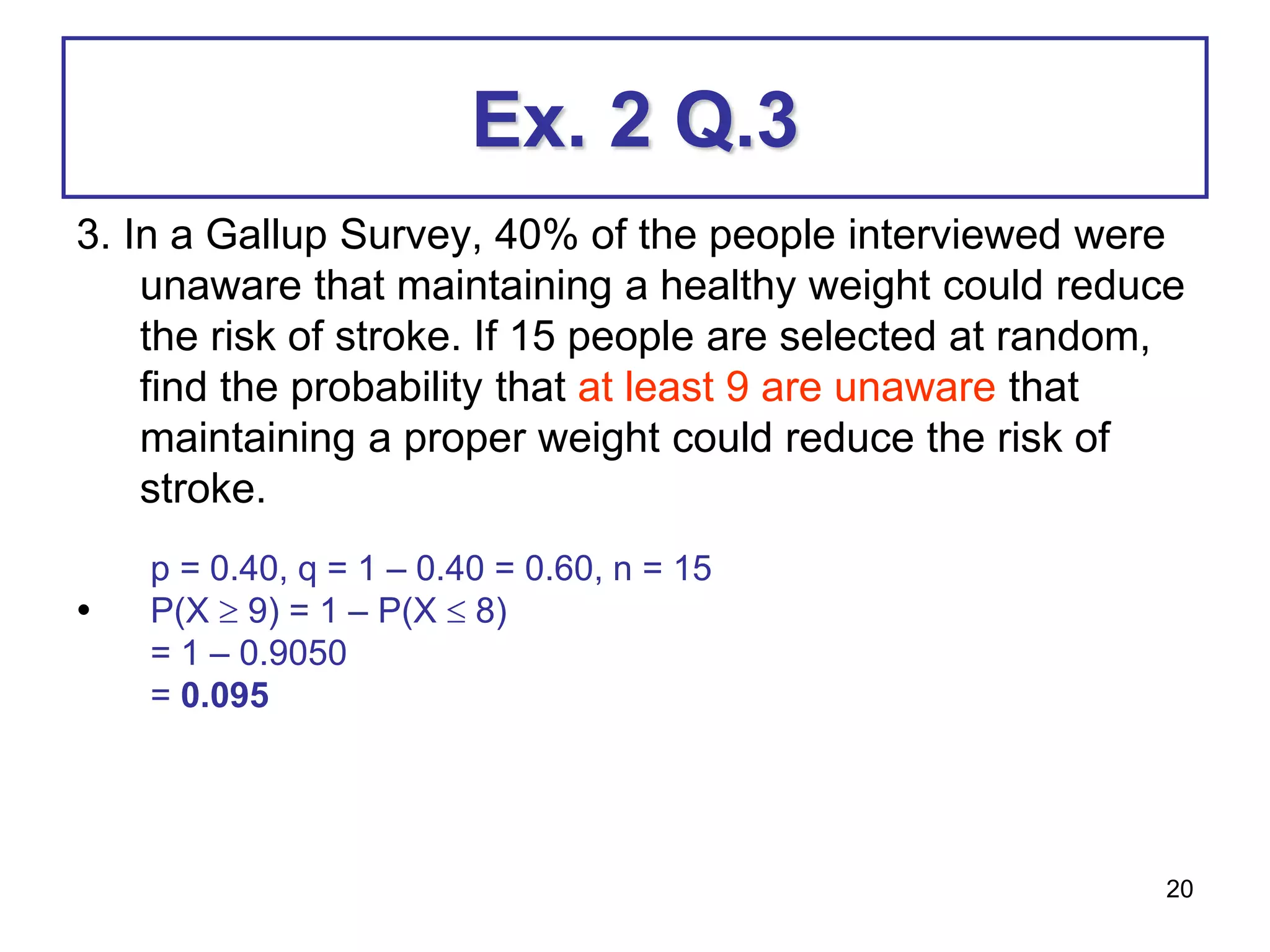
Ex. 2 Q.3
3. In a Gallup Survey, 40% of the people interviewed were
unaware that maintaining a healthy weight could reduce
the risk of stroke. If 15 people are selected at random,
find the probability that at least 9 are unaware that
maintaining a proper weight could reduce the risk of
stroke.
•
p = 0.40, q = 1 – 0.40 = 0.60, n = 15
P(X  9) = 1 – P(X  8)
= 1 – 0.9050
= 0.095
21
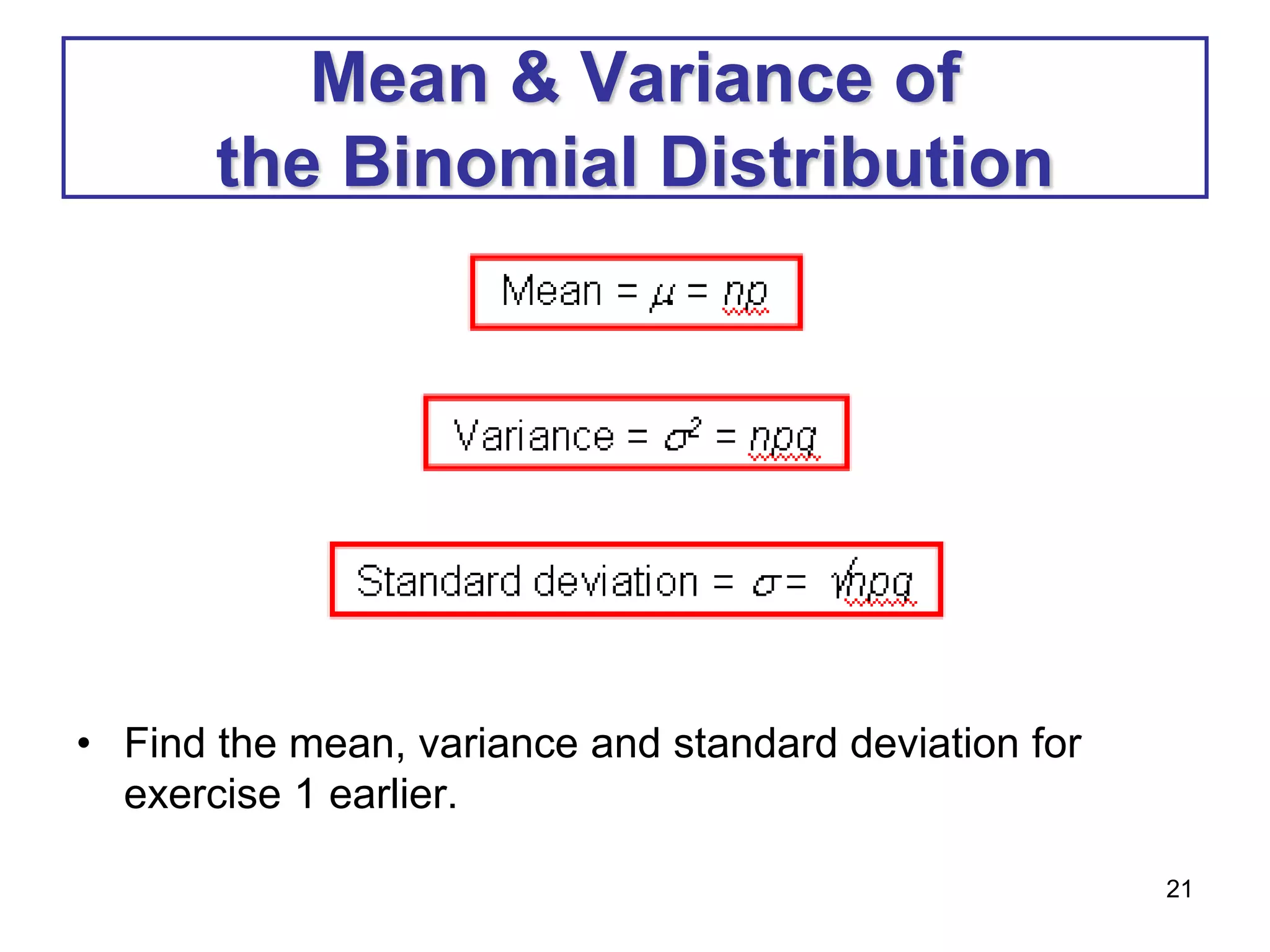
Mean & Variance of
the Binomial Distribution
• Find the mean, variance and standard deviation for
exercise 1 earlier.
22
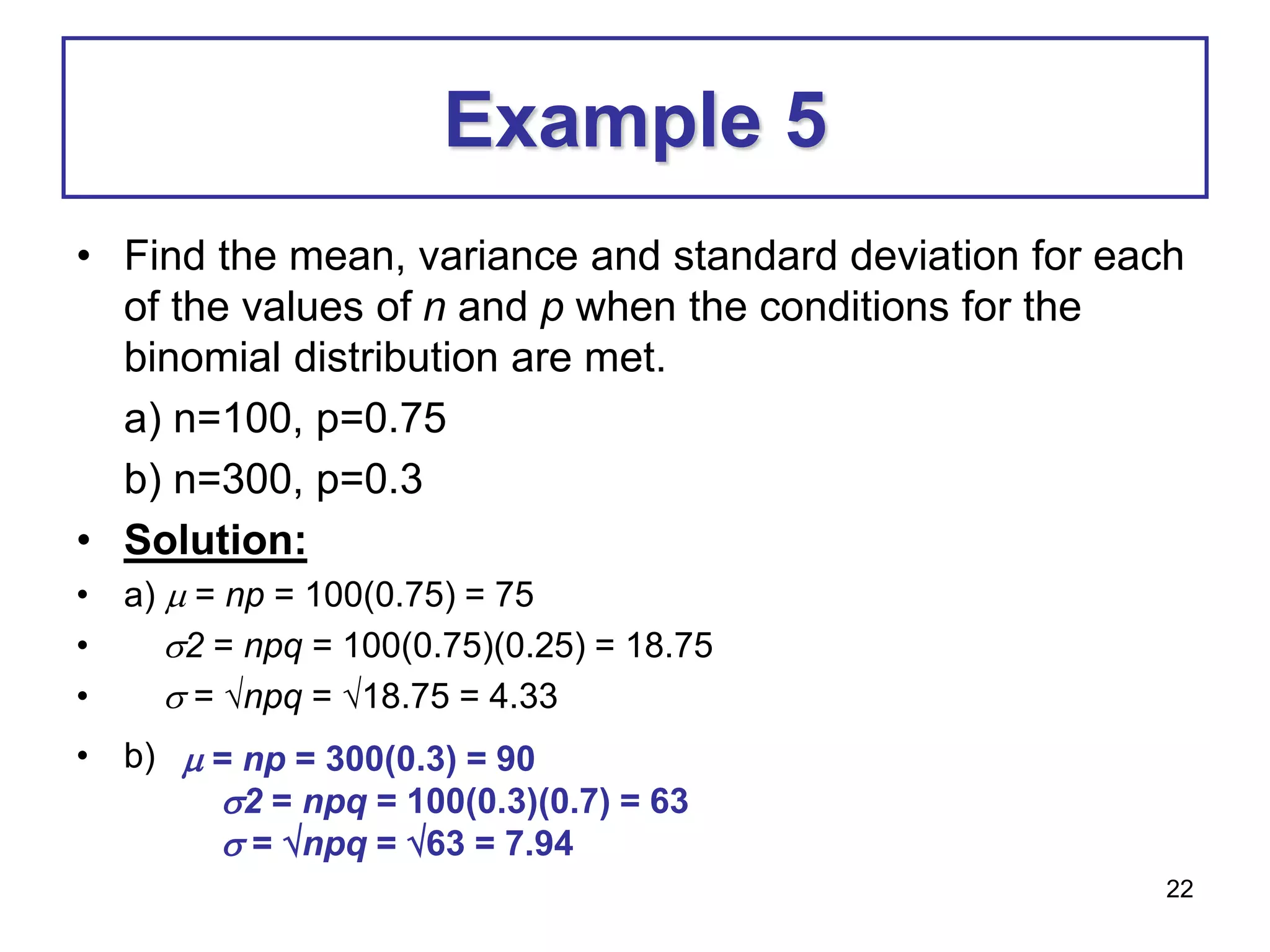
Example 5
• Find the mean, variance and standard deviation for each
of the values of n and p when the conditions for the
binomial distribution are met.
a) n=100, p=0.75
b) n=300, p=0.3
• Solution:
• a)  = np = 100(0.75) = 75
• 2 = npq = 100(0.75)(0.25) = 18.75
•  = npq = 18.75 = 4.33
• b)  = np = 300(0.3) = 90
2 = npq = 100(0.3)(0.7) = 63
 = npq = 63 = 7.94
23
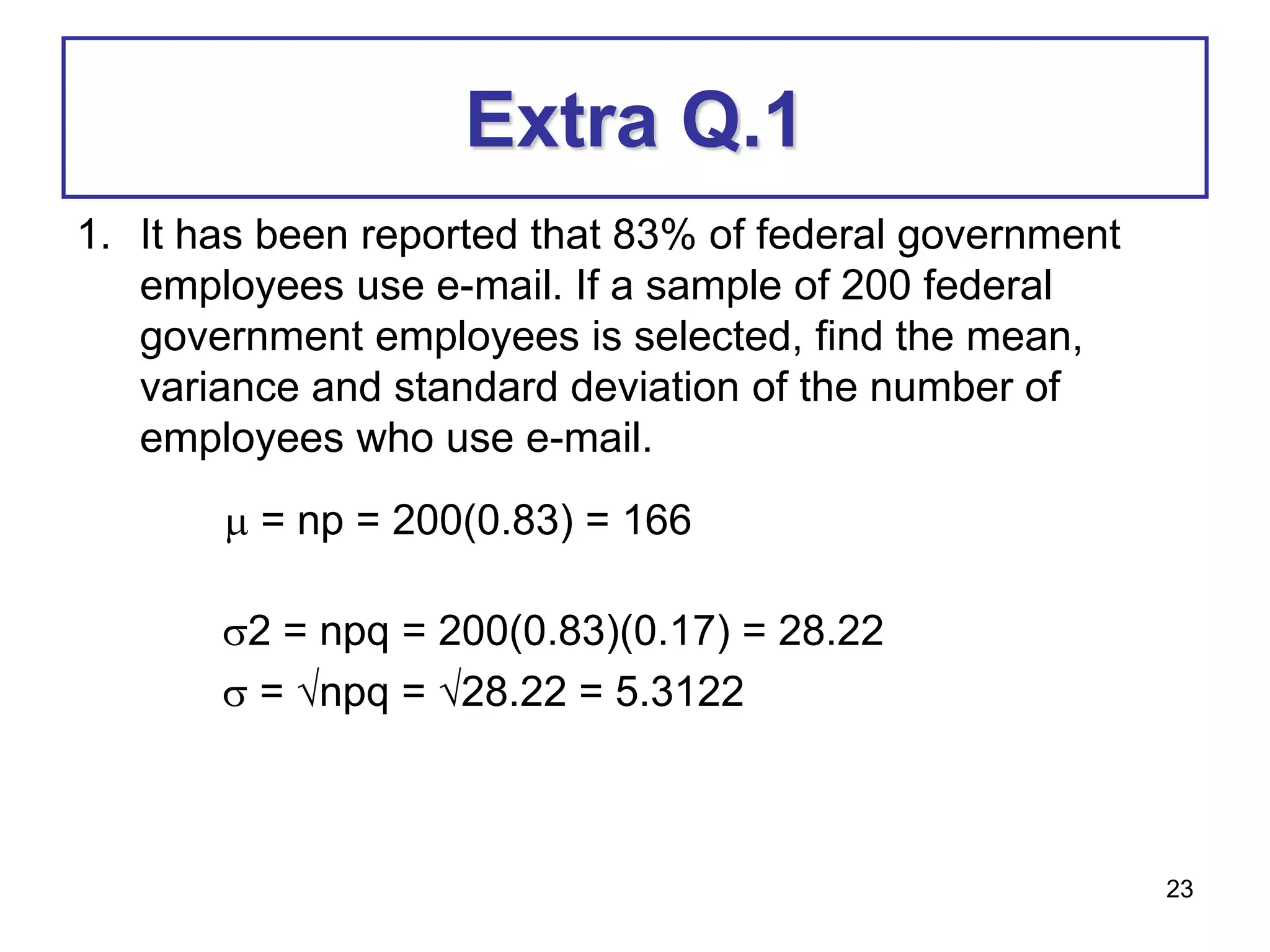
Extra Q.1
1. It has been reported that 83% of federal government
employees use e-mail. If a sample of 200 federal
government employees is selected, find the mean,
variance and standard deviation of the number of
employees who use e-mail.
 = np = 200(0.83) = 166
2 = npq = 200(0.83)(0.17) = 28.22
 = npq = 28.22 = 5.3122
24
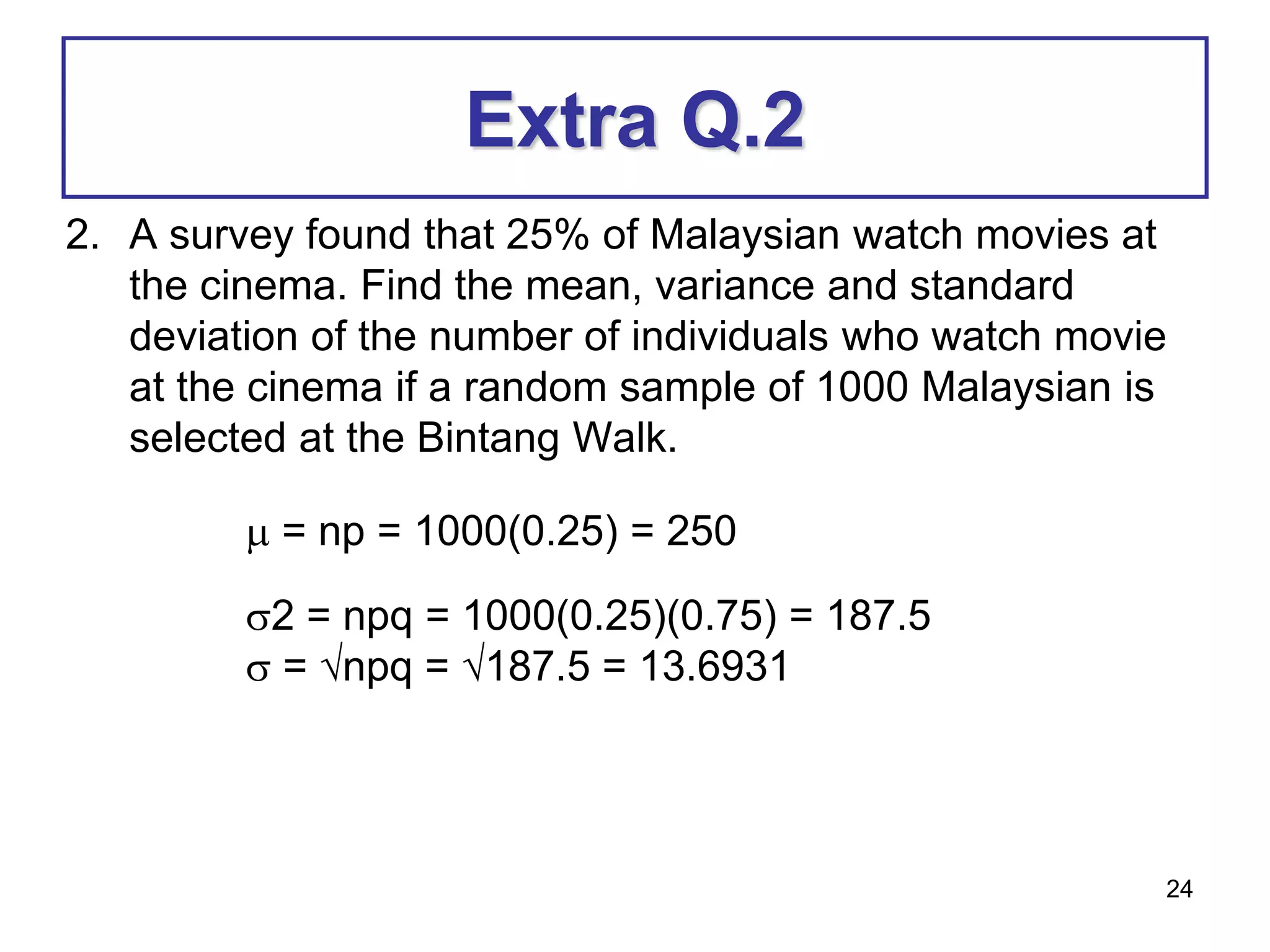
Extra Q.2
2. A survey found that 25% of Malaysian watch movies at
the cinema. Find the mean, variance and standard
deviation of the number of individuals who watch movie
at the cinema if a random sample of 1000 Malaysian is
selected at the Bintang Walk.
 = np = 1000(0.25) = 250
2 = npq = 1000(0.25)(0.75) = 187.5
 = npq = 187.5 = 13.6931
25
Poisson Distribution
• The Poisson distribution depends only on the average
number of occurrences per unit time or space, (lambda)
• The Poisson probability distribution is useful when n is
large and p is small.
Conditions for Poisson:
•x is a discrete random variable
•The occurrences are random
•The occurrences are independent
26
Poisson Distribution
Examples of application:
• The number of accidents that occur on a highway given
during a one-week period. (time)
• The number of customers entering a grocery store
during a one-hour interval.
• The number of television sets sold at a department store
during a given week.
• The number of typing errors per page. (space)
• A certain type of fabric made contains an average 0.5
defects per 500 yards.
27
Poisson Distribution
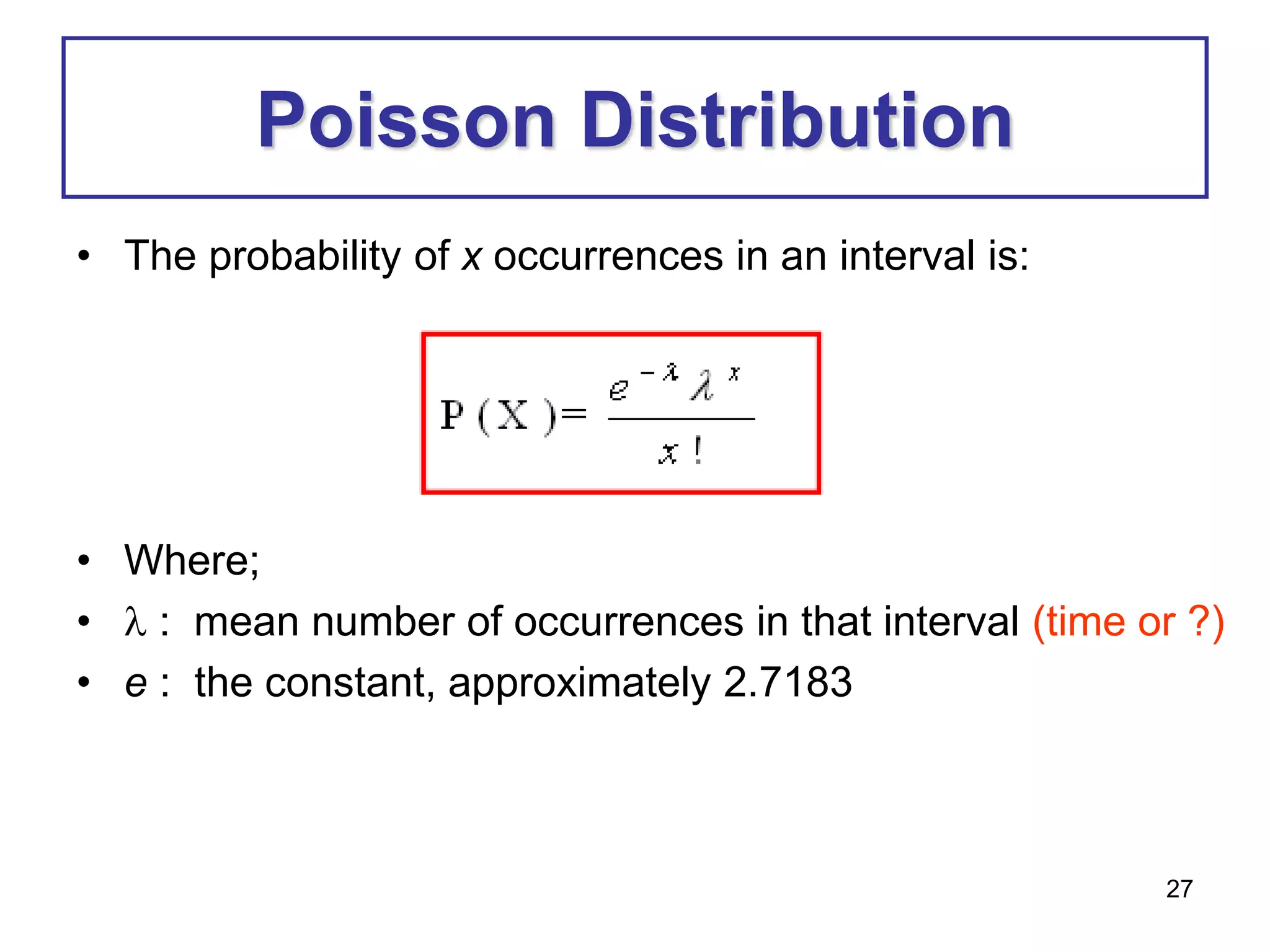
• The probability of x occurrences in an interval is:
• Where;
•  : mean number of occurrences in that interval (time or ?)
• e : the constant, approximately 2.7183
28
Example 7
• Find each probability P(X; ), using the Poisson formula
– P(5;4)
– P(2;4)
• Solution:
• a. P(X=5) = e-4(45)/5!
• = 0.1563
• b. P(X=2) = e-4(42)/2!
= 0.1465
29
Example 8
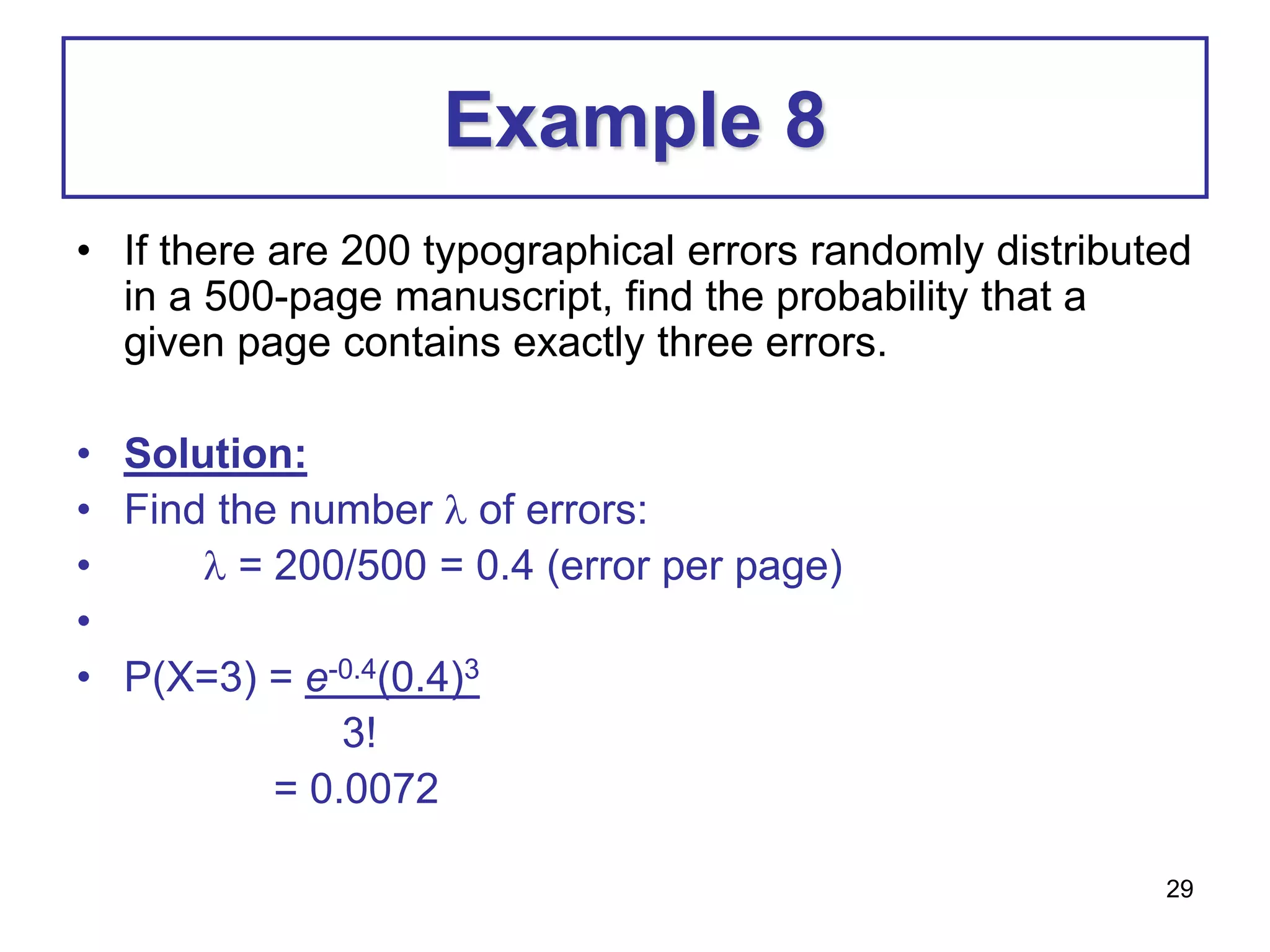
• If there are 200 typographical errors randomly distributed
in a 500-page manuscript, find the probability that a
given page contains exactly three errors.
• Solution:
• Find the number  of errors:
•  = 200/500 = 0.4 (error per page)
•
• P(X=3) = e-0.4(0.4)3
3!
= 0.0072
30
Ex.3 Q.1
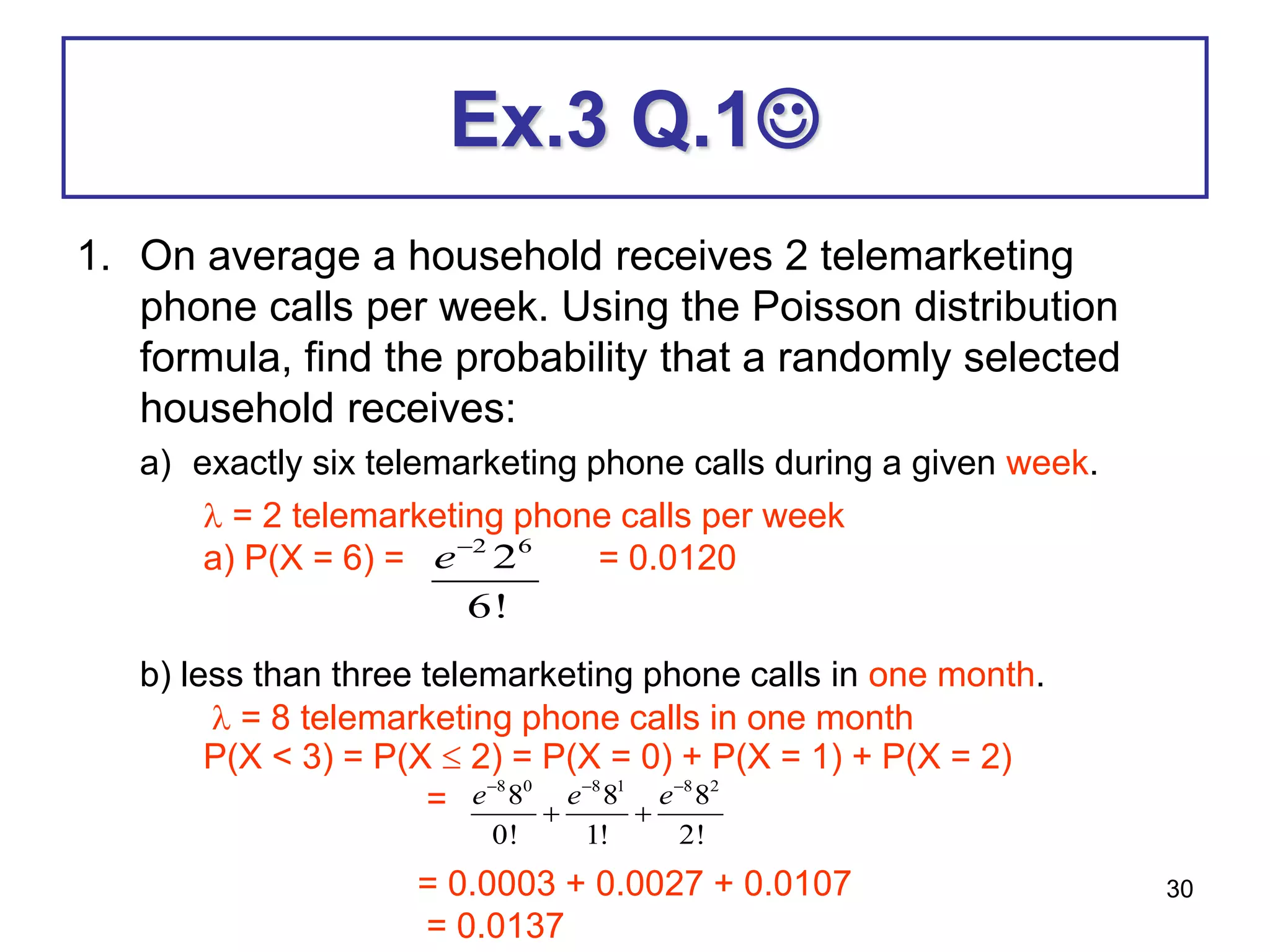
1. On average a household receives 2 telemarketing
phone calls per week. Using the Poisson distribution
formula, find the probability that a randomly selected
household receives:
a) exactly six telemarketing phone calls during a given week.
b) less than three telemarketing phone calls in one month.
 = 2 telemarketing phone calls per week
a) P(X = 6) = = 0.0120
 = 8 telemarketing phone calls in one month
P(X < 3) = P(X  2) = P(X = 0) + P(X = 1) + P(X = 2)
=
= 0.0003 + 0.0027 + 0.0107
= 0.0137
8 0 8 1 8 2
8 8 8
0! 1! 2!
e e e
  
 
2 6
2
6!
e
31
Using Poisson Table
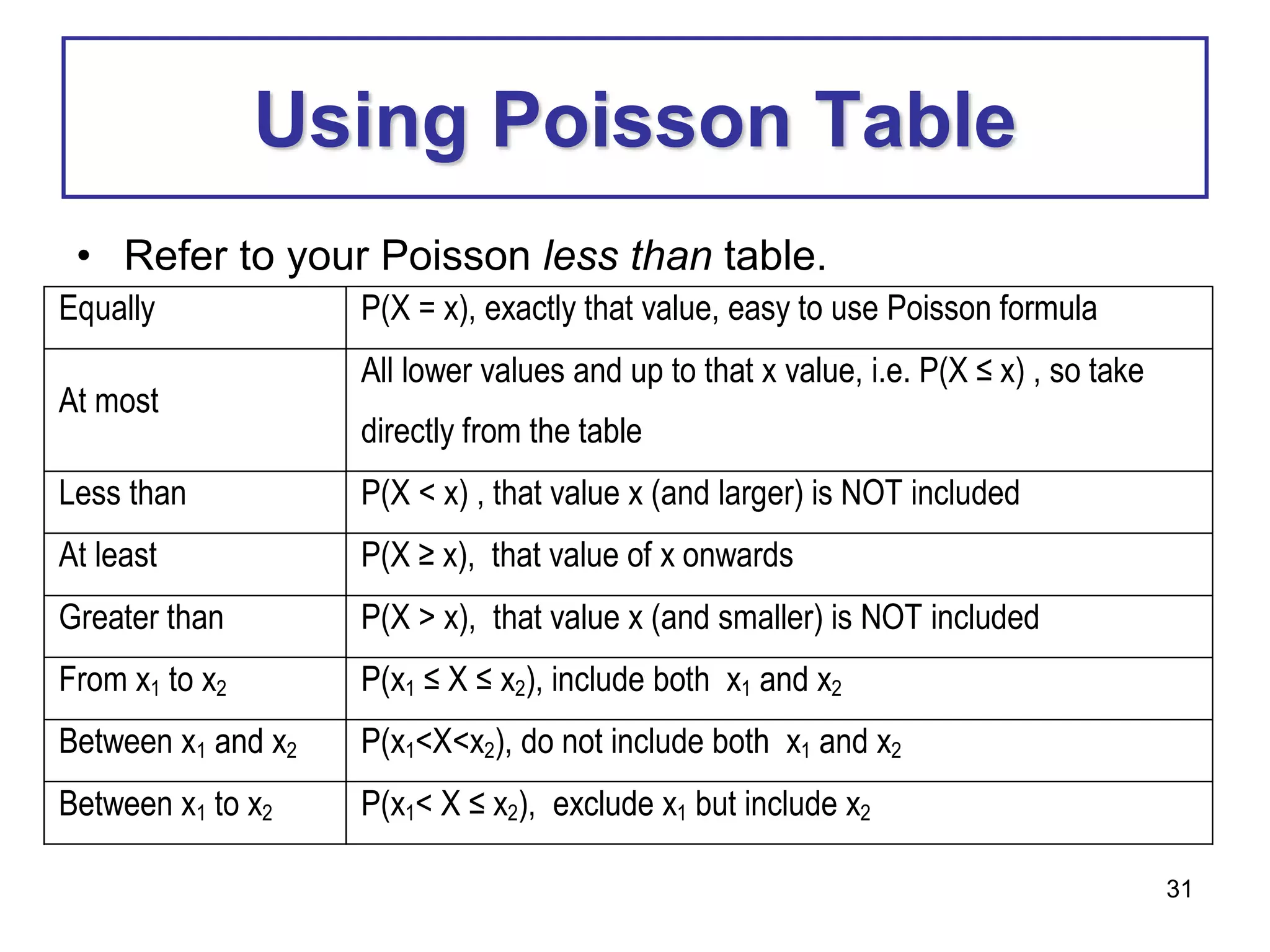
• Refer to your Poisson less than table.
Equally P(X = x), exactly that value, easy to use Poisson formula
At most
All lower values and up to that x value, i.e. P(X ≤ x) , so take
directly from the table
Less than P(X < x) , that value x (and larger) is NOT included
At least P(X ≥ x), that value of x onwards
Greater than P(X > x), that value x (and smaller) is NOT included
From x1 to x2 P(x1 ≤ X ≤ x2), include both x1 and x2
Between x1 and x2 P(x1<X<x2), do not include both x1 and x2
Between x1 to x2 P(x1< X ≤ x2), exclude x1 but include x2
32
Example 9
• Find the probability P(X; ); using Poisson table
• P(10;7)
• P(9;8)
• Solution:
• a) P(X = 10) = P(X  10) – P(X  9)
• = 0.9015 – 0.8305
• = 0.0710
• b) P(X = 9) = P(X  9) – P(X  8)
= 0.7166 – 0.5925
= 0.1241
= (e-8.89)/9!
33
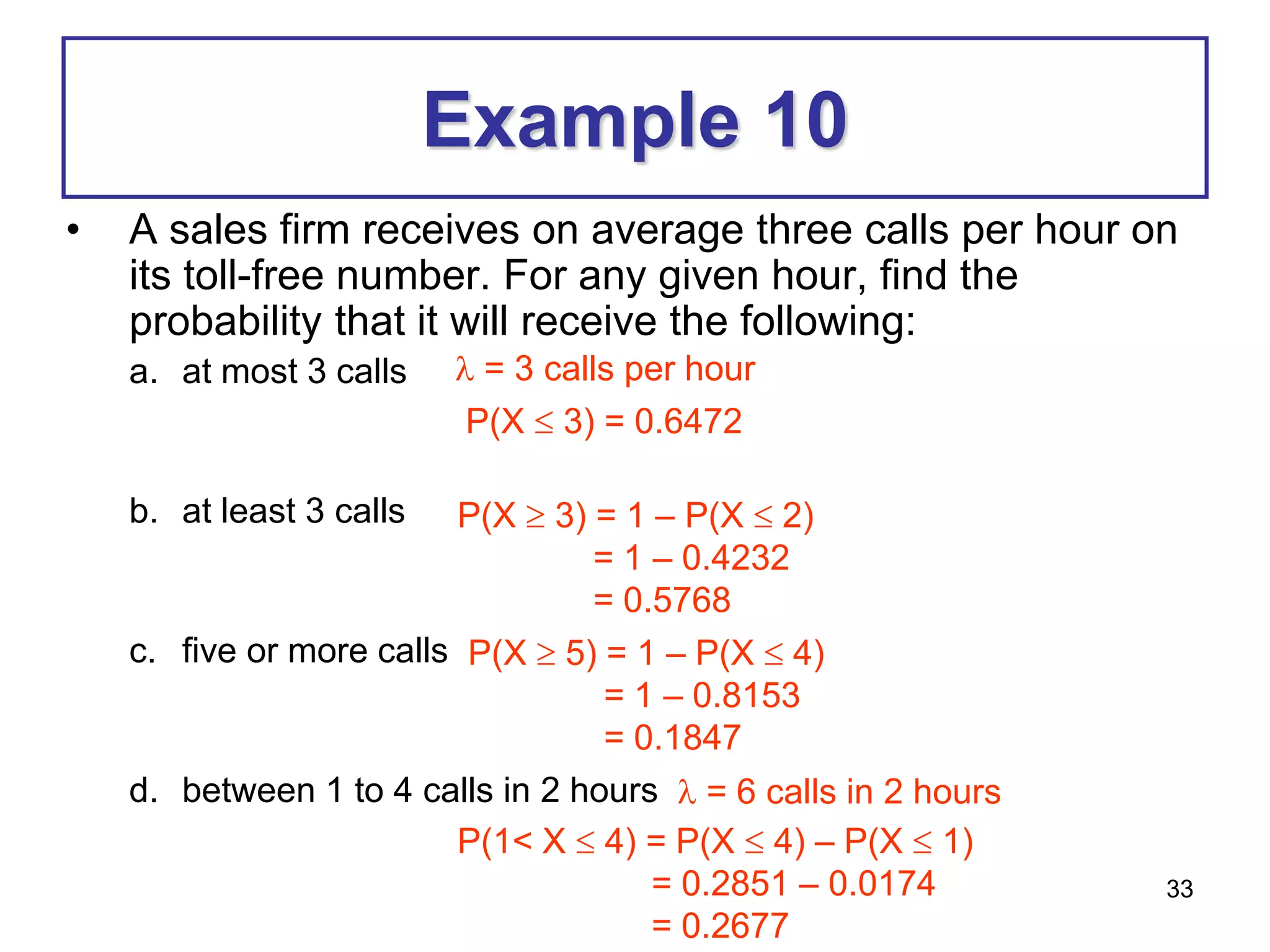
Example 10
• A sales firm receives on average three calls per hour on
its toll-free number. For any given hour, find the
probability that it will receive the following:
a. at most 3 calls
b. at least 3 calls
c. five or more calls
d. between 1 to 4 calls in 2 hours
 = 3 calls per hour
P(X  3) = 0.6472
P(X  3) = 1 – P(X  2)
= 1 – 0.4232
= 0.5768
P(X  5) = 1 – P(X  4)
= 1 – 0.8153
= 0.1847
 = 6 calls in 2 hours
P(1< X  4) = P(X  4) – P(X  1)
= 0.2851 – 0.0174
= 0.2677
34
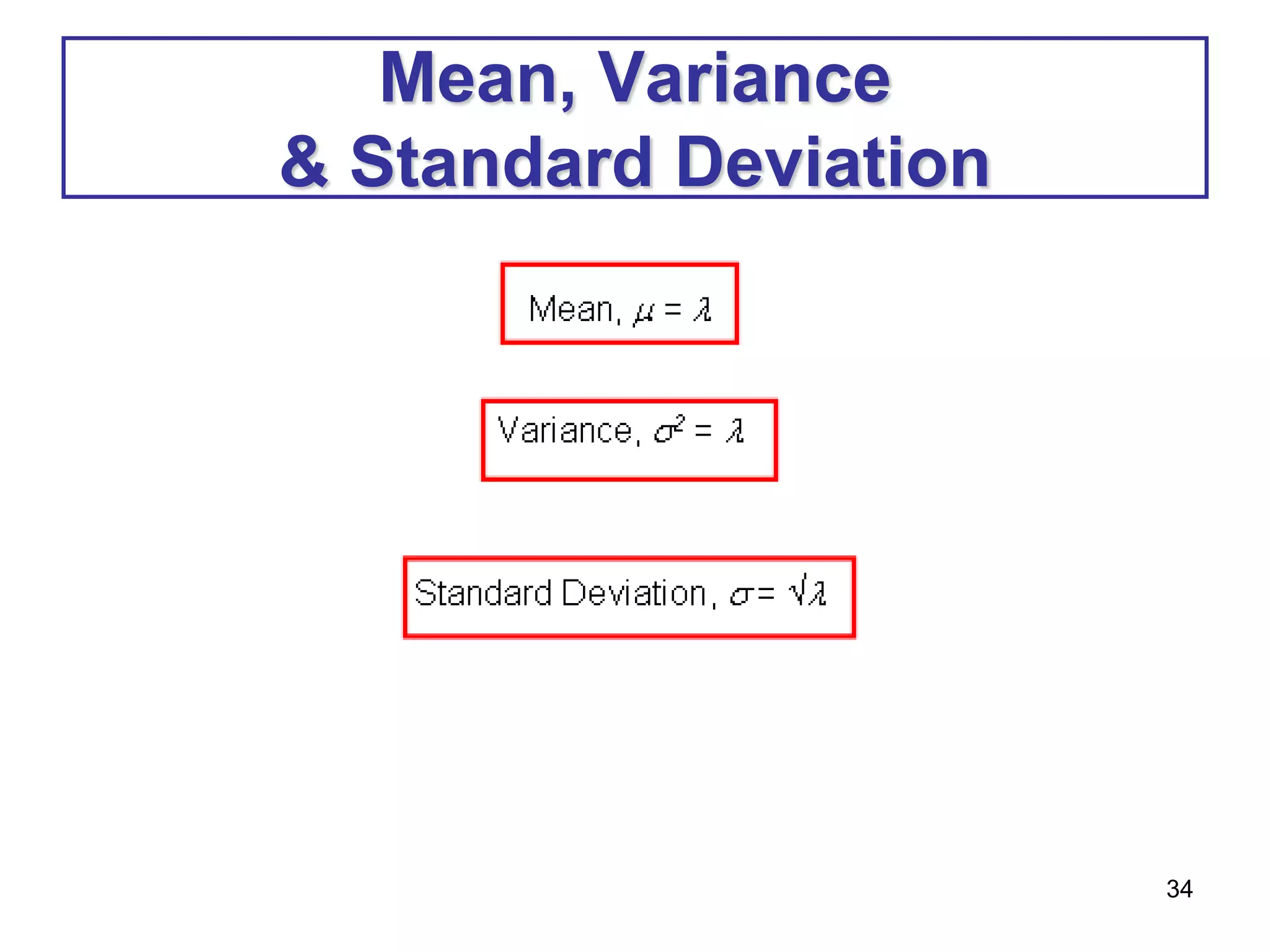
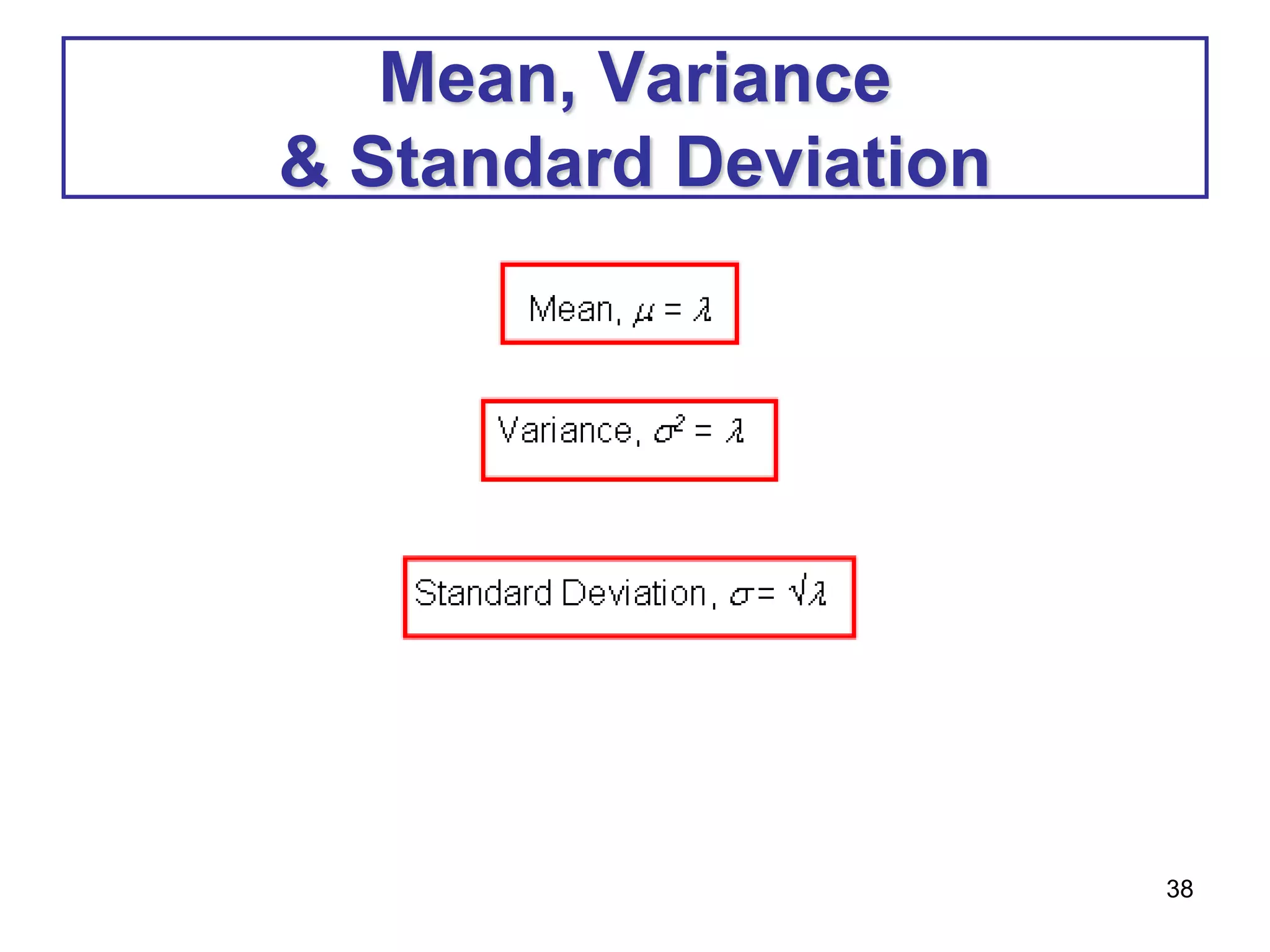
Mean, Variance
& Standard Deviation
35
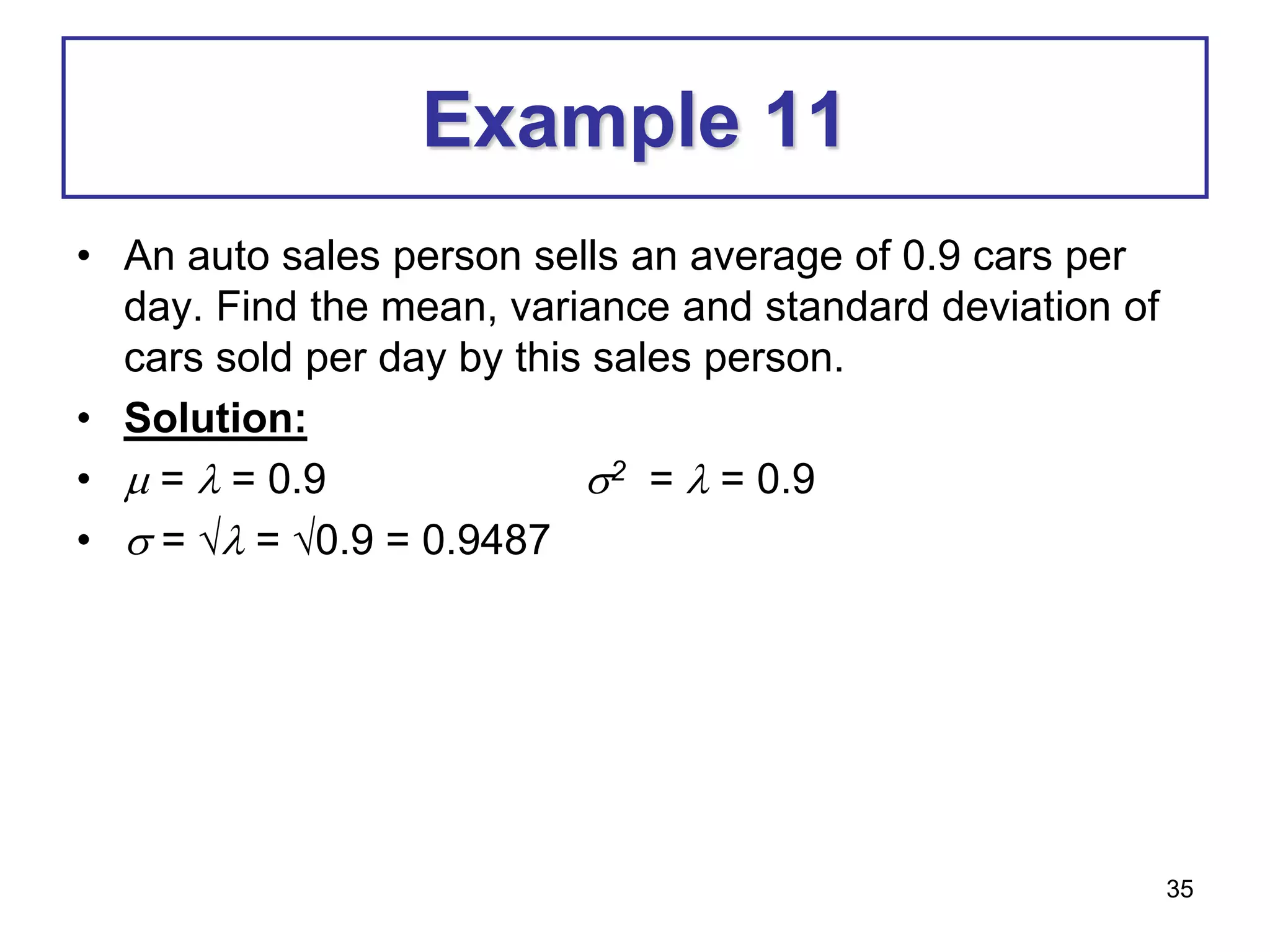
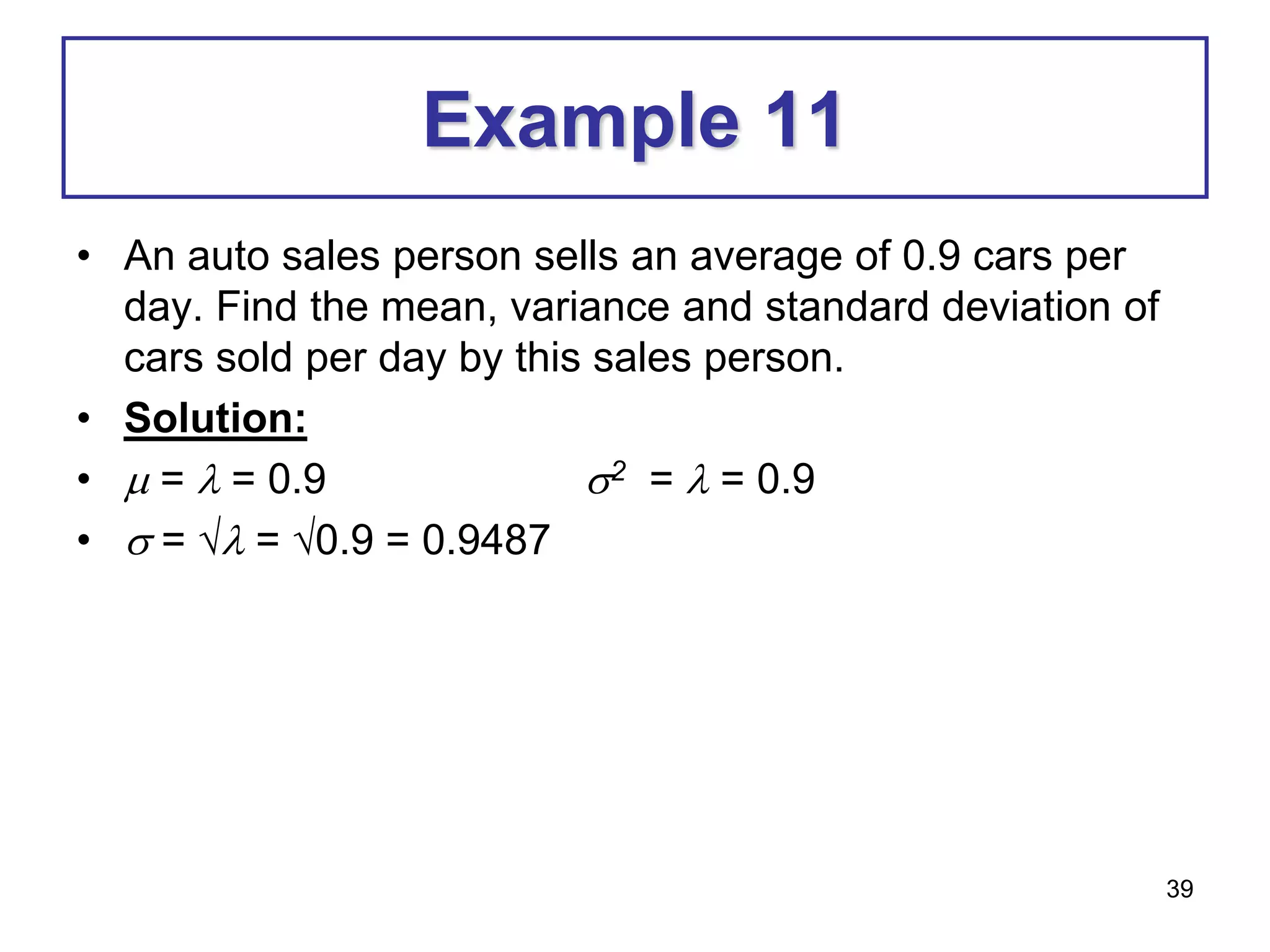
Example 11
• An auto sales person sells an average of 0.9 cars per
day. Find the mean, variance and standard deviation of
cars sold per day by this sales person.
• Solution:
•  =  = 0.9 2 =  = 0.9
•  =  = 0.9 = 0.9487
36
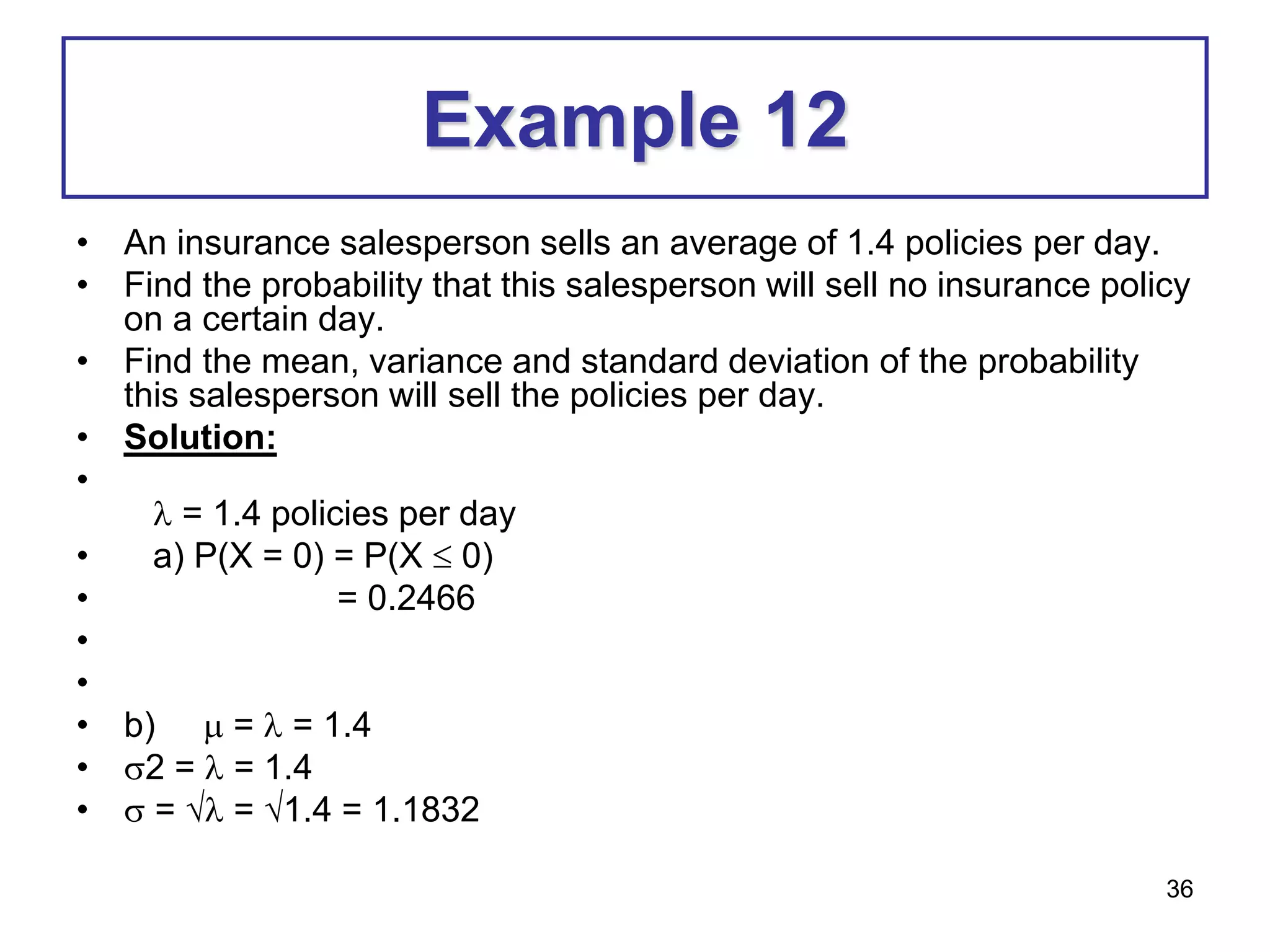
Example 12
• An insurance salesperson sells an average of 1.4 policies per day.
• Find the probability that this salesperson will sell no insurance policy
on a certain day.
• Find the mean, variance and standard deviation of the probability
this salesperson will sell the policies per day.
• Solution:
•
 = 1.4 policies per day
• a) P(X = 0) = P(X  0)
• = 0.2466
•
•
• b)  =  = 1.4
• 2 =  = 1.4
•  =  = 1.4 = 1.1832
37
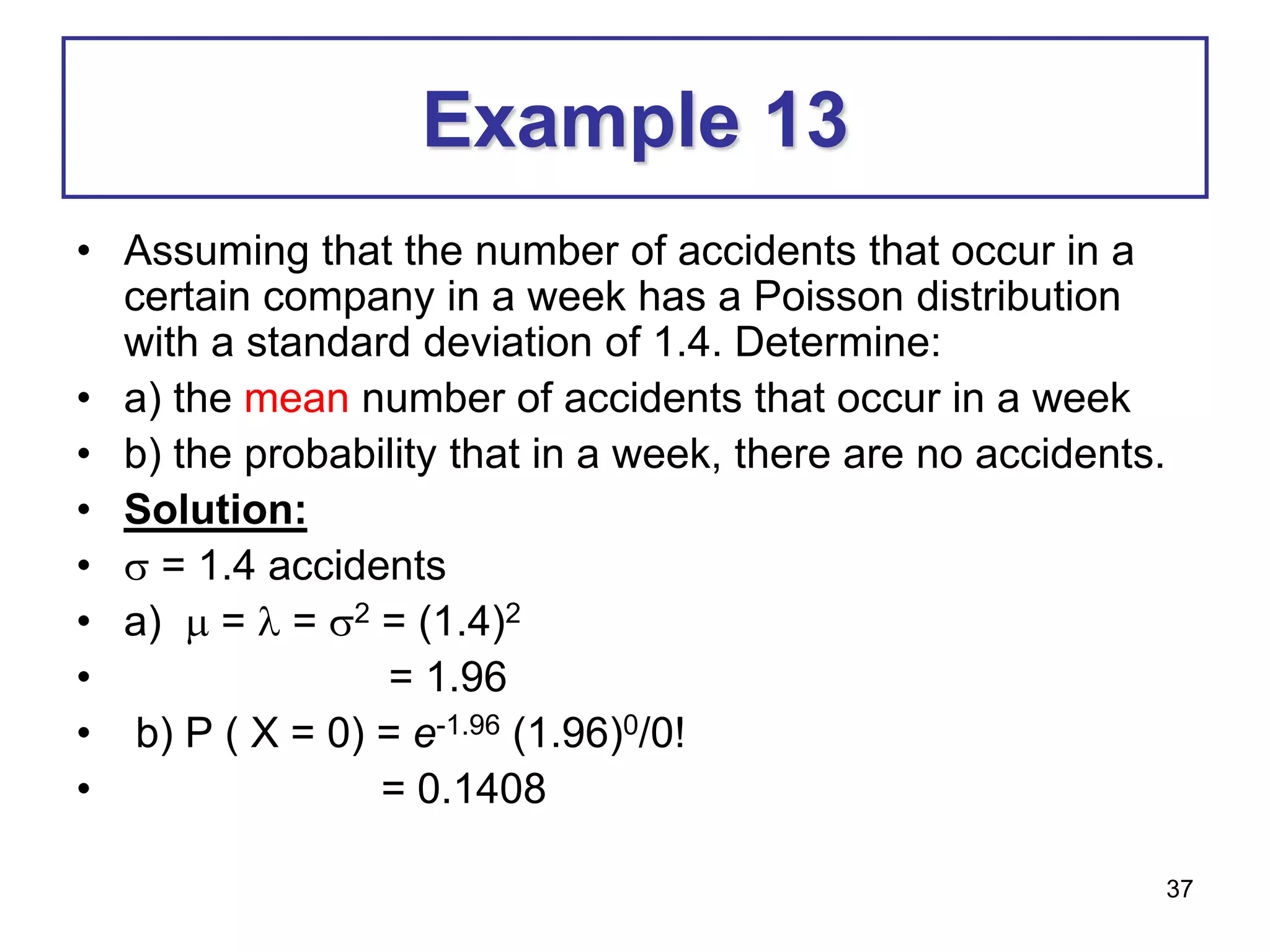
Example 13
• Assuming that the number of accidents that occur in a
certain company in a week has a Poisson distribution
with a standard deviation of 1.4. Determine:
• a) the mean number of accidents that occur in a week
• b) the probability that in a week, there are no accidents.
• Solution:
•  = 1.4 accidents
• a)  =  = 2 = (1.4)2
• = 1.96
• b) P ( X = 0) = e-1.96 (1.96)0/0!
• = 0.1408
38
Mean, Variance
& Standard Deviation
39
Example 11
• An auto sales person sells an average of 0.9 cars per
day. Find the mean, variance and standard deviation of
cars sold per day by this sales person.
• Solution:
•  =  = 0.9 2 =  = 0.9
•  =  = 0.9 = 0.9487
40
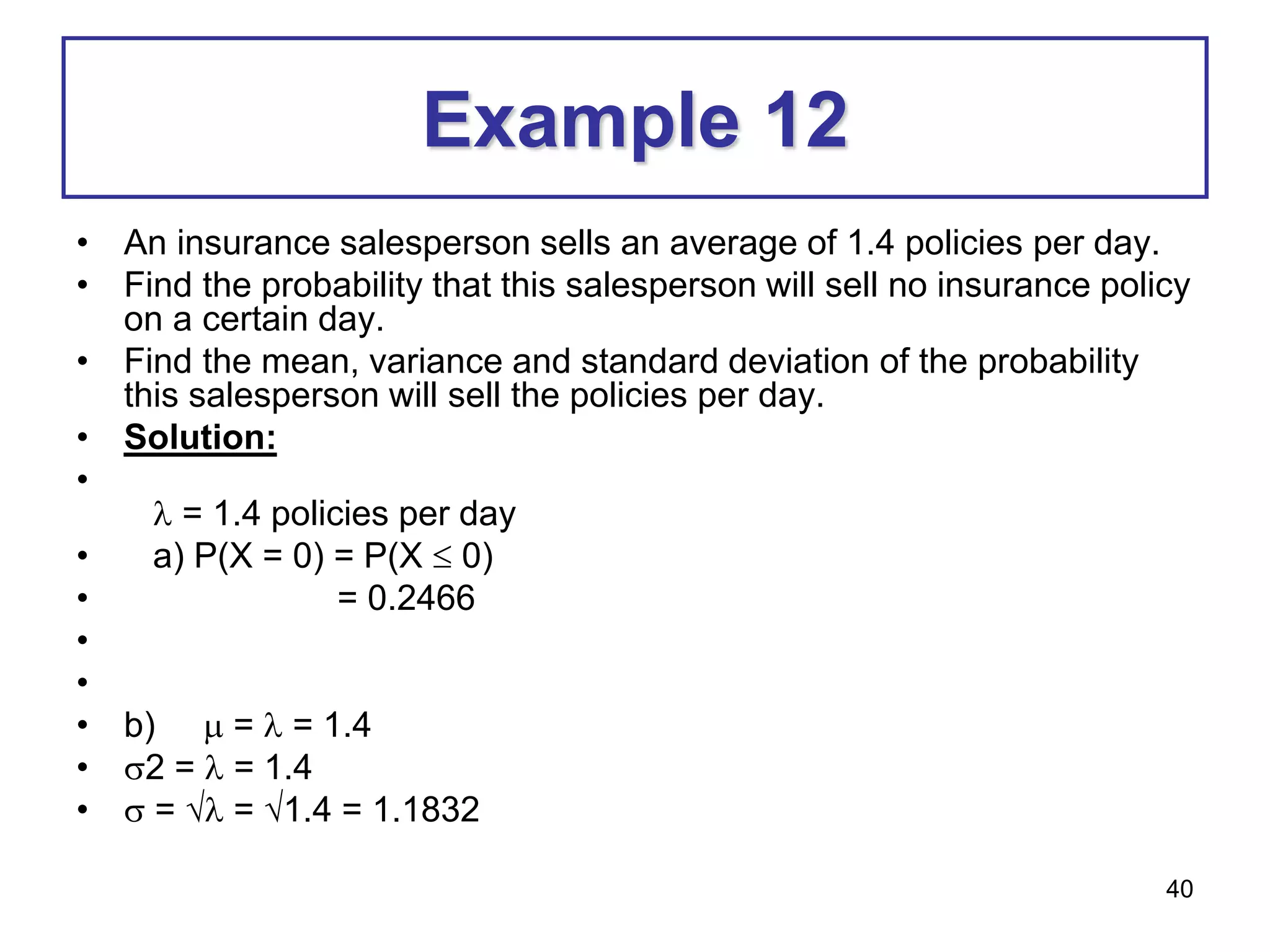
Example 12
• An insurance salesperson sells an average of 1.4 policies per day.
• Find the probability that this salesperson will sell no insurance policy
on a certain day.
• Find the mean, variance and standard deviation of the probability
this salesperson will sell the policies per day.
• Solution:
•
 = 1.4 policies per day
• a) P(X = 0) = P(X  0)
• = 0.2466
•
•
• b)  =  = 1.4
• 2 =  = 1.4
•  =  = 1.4 = 1.1832
41
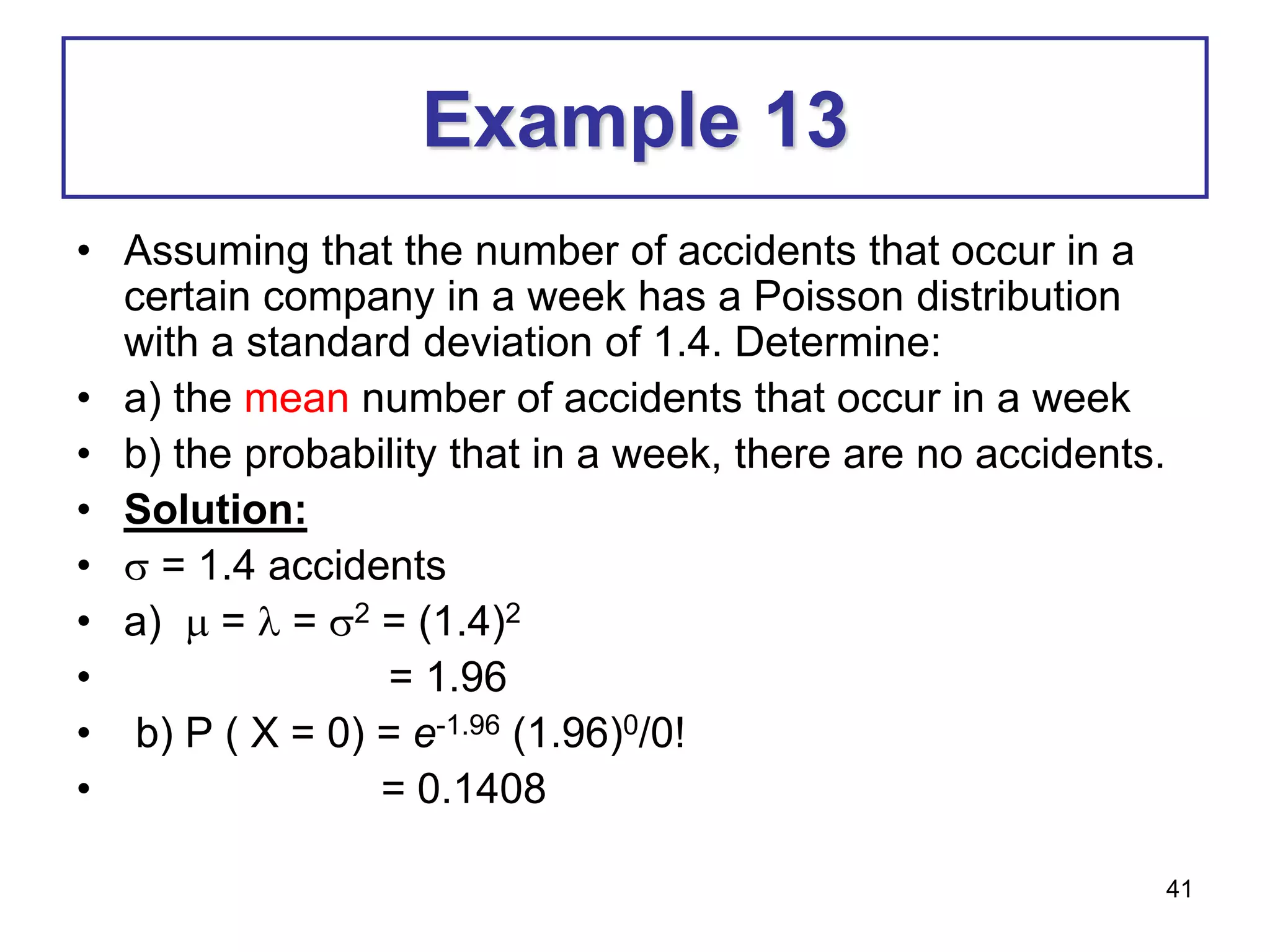
Example 13
• Assuming that the number of accidents that occur in a
certain company in a week has a Poisson distribution
with a standard deviation of 1.4. Determine:
• a) the mean number of accidents that occur in a week
• b) the probability that in a week, there are no accidents.
• Solution:
•  = 1.4 accidents
• a)  =  = 2 = (1.4)2
• = 1.96
• b) P ( X = 0) = e-1.96 (1.96)0/0!
• = 0.1408
42
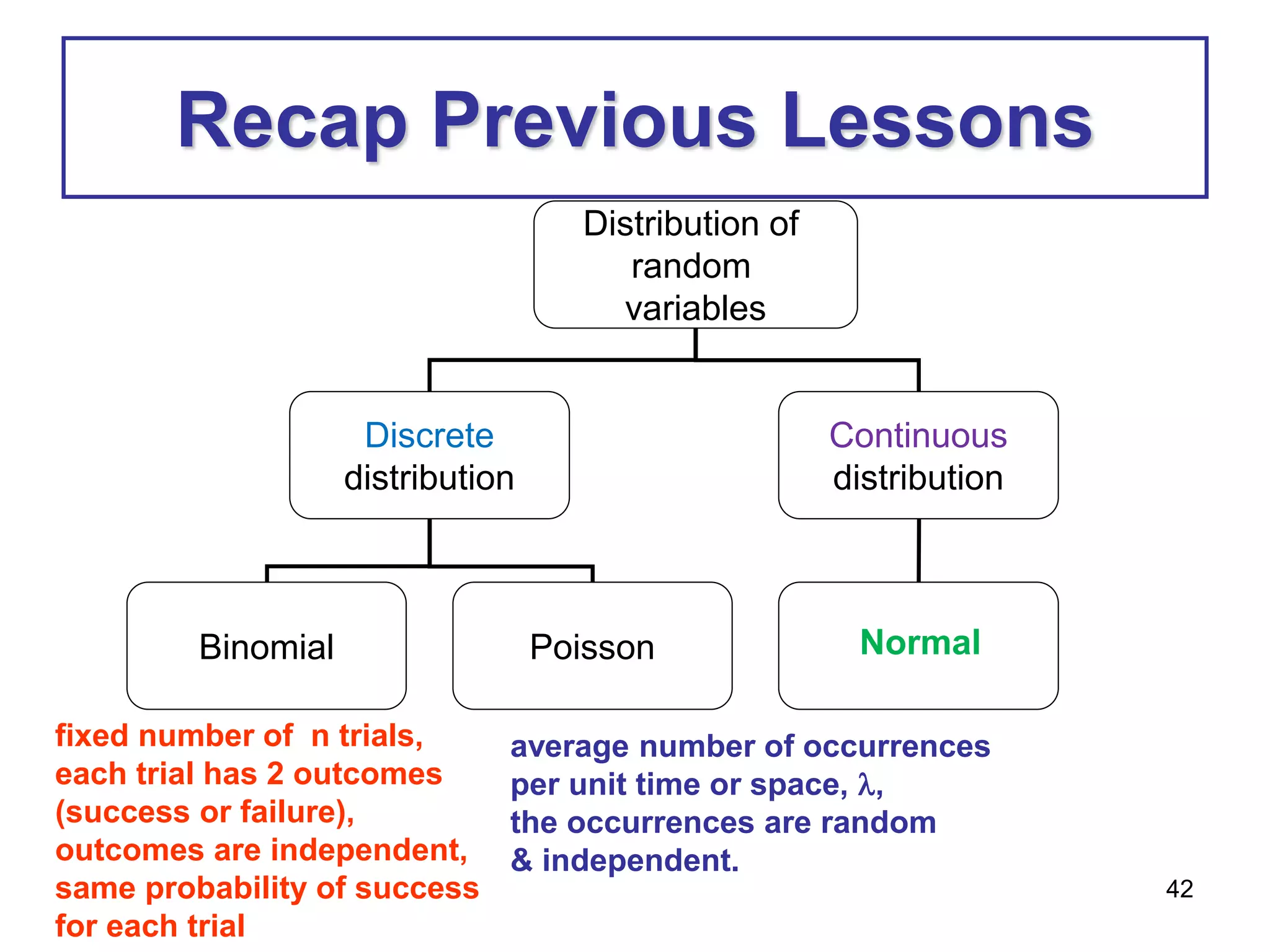
Recap Previous Lessons
Distribution of
random
variables
Discrete
distribution
Continuous
distribution
Binomial Poisson Normal
fixed number of n trials,
each trial has 2 outcomes
(success or failure),
outcomes are independent,
same probability of success
for each trial
average number of occurrences
per unit time or space, ,
the occurrences are random
& independent.
43
Continuous Probability
Distribution
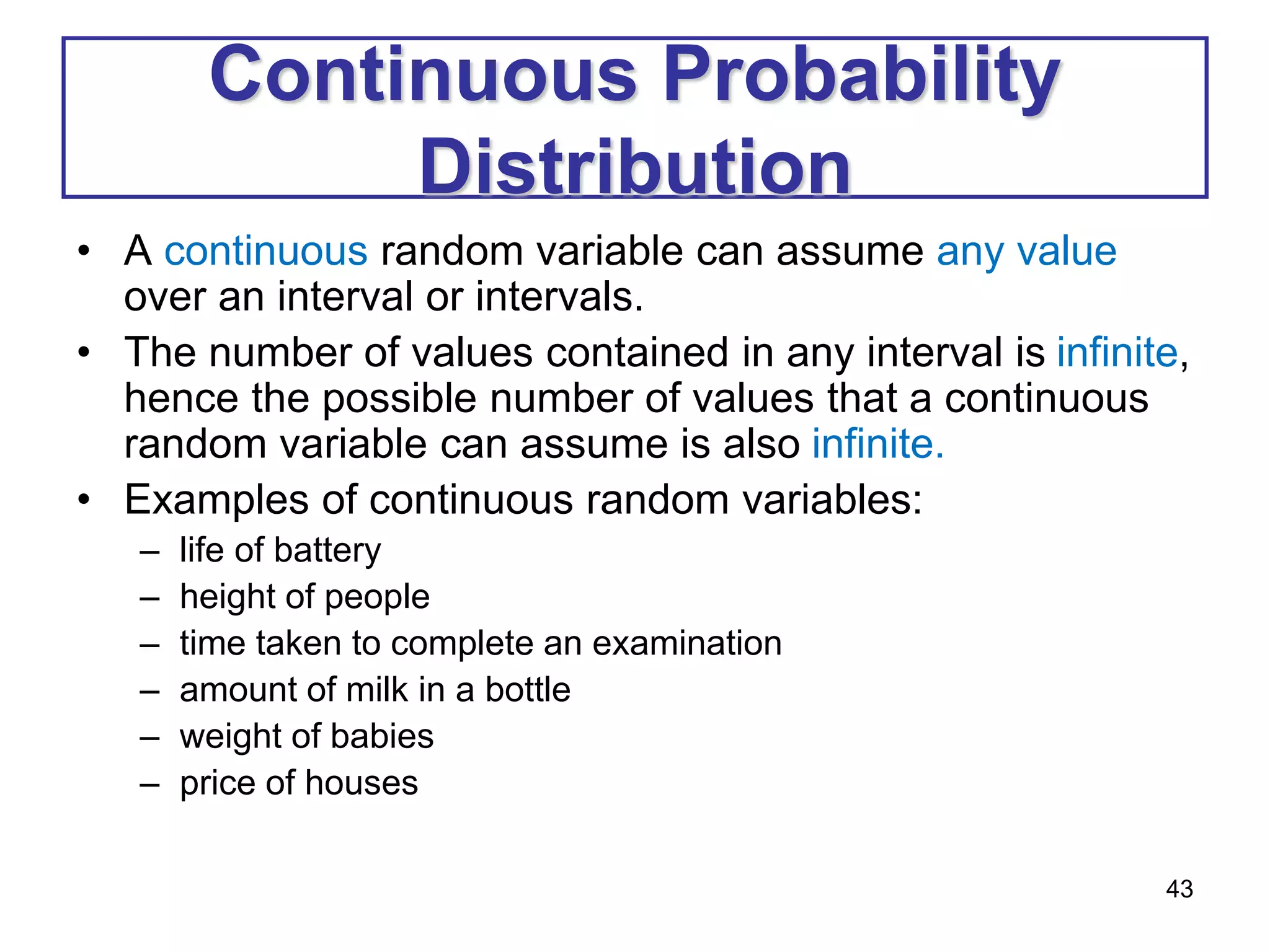
• A continuous random variable can assume any value
over an interval or intervals.
• The number of values contained in any interval is infinite,
hence the possible number of values that a continuous
random variable can assume is also infinite.
• Examples of continuous random variables:
– life of battery
– height of people
– time taken to complete an examination
– amount of milk in a bottle
– weight of babies
– price of houses
44
Continuous Probability
Distribution
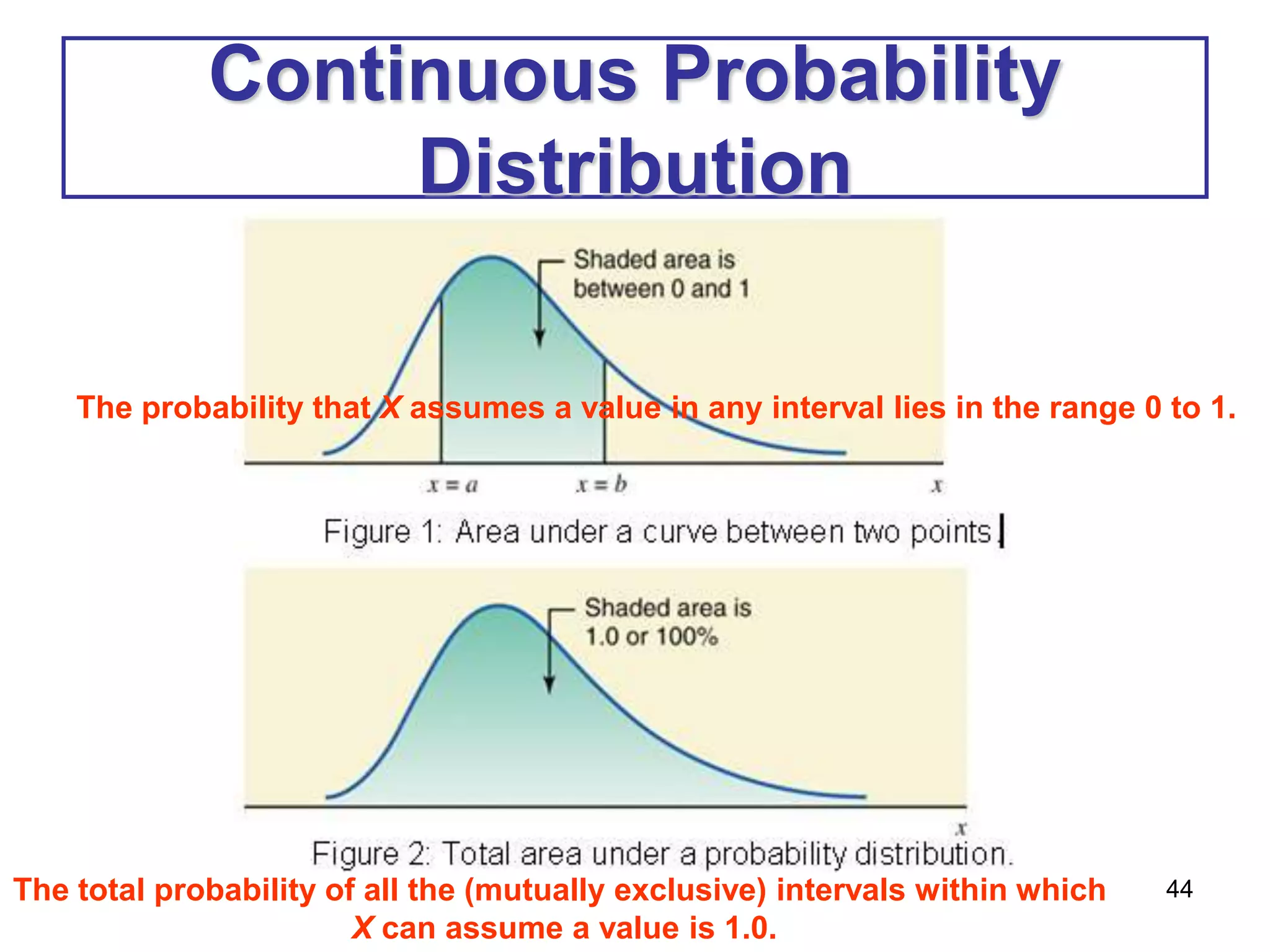
The total probability of all the (mutually exclusive) intervals within which
X can assume a value is 1.0.
The probability that X assumes a value in any interval lies in the range 0 to 1.
45
Normal Distribution
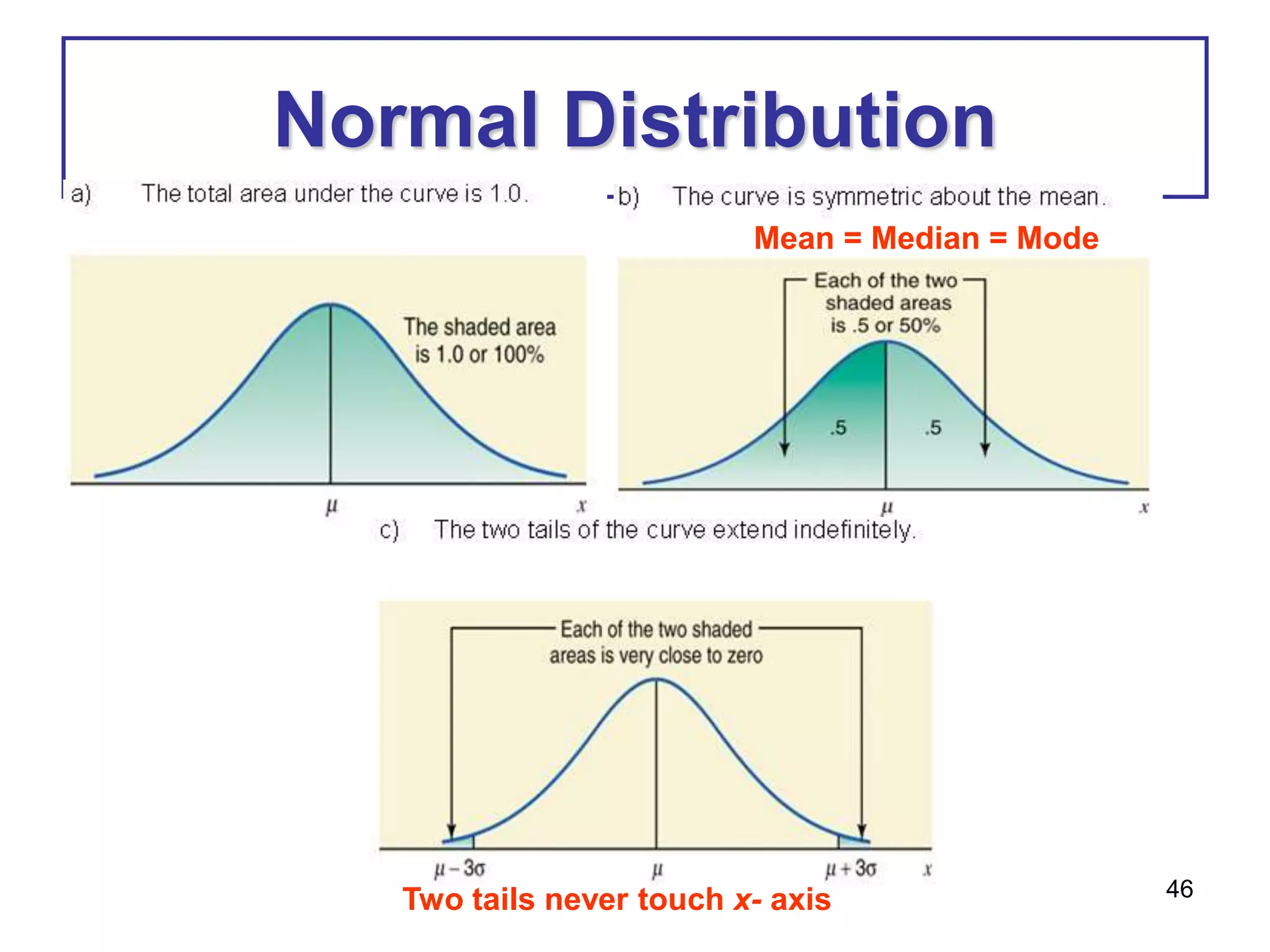
• The normal distribution is the most important and most
widely used of all probability distributions.
• A large number of phenomena in the real world are
normally distributed either exactly or approximately.
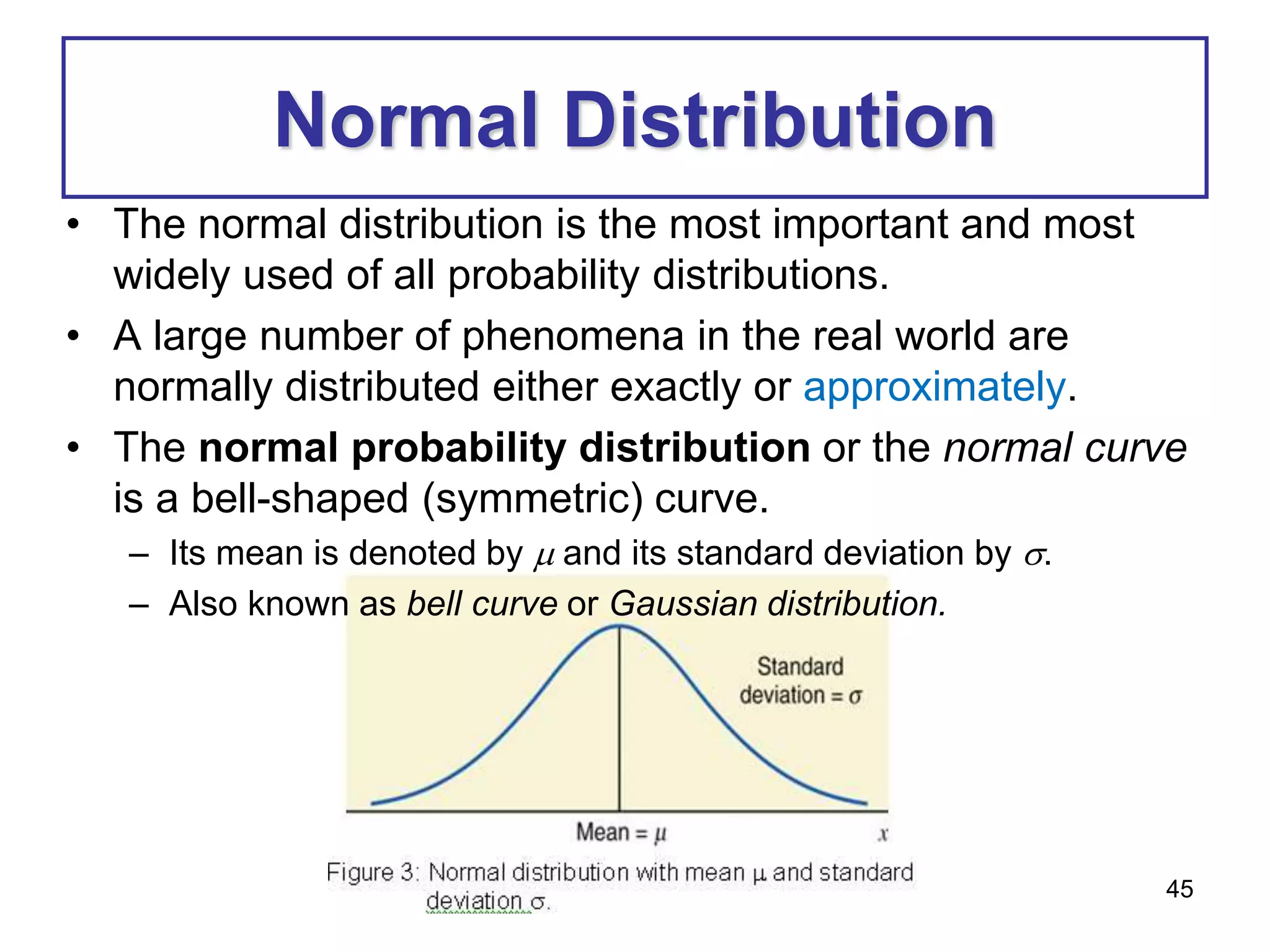
• The normal probability distribution or the normal curve
is a bell-shaped (symmetric) curve.
– Its mean is denoted by  and its standard deviation by .
– Also known as bell curve or Gaussian distribution.
46
Normal Distribution
Mean = Median = Mode
Two tails never touch x- axis
47
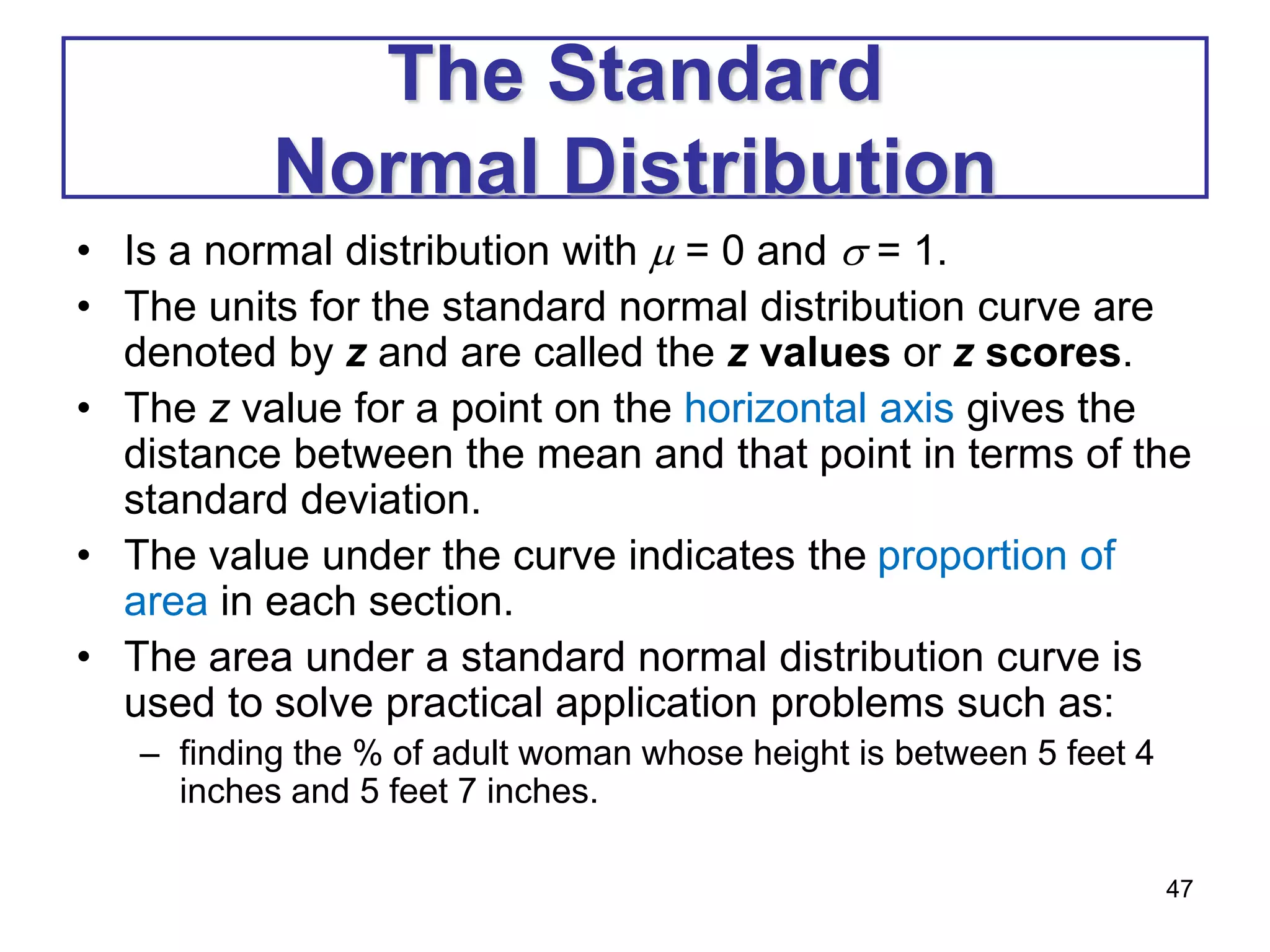
The Standard
Normal Distribution
• Is a normal distribution with  = 0 and  = 1.
• The units for the standard normal distribution curve are
denoted by z and are called the z values or z scores.
• The z value for a point on the horizontal axis gives the
distance between the mean and that point in terms of the
standard deviation.
• The value under the curve indicates the proportion of
area in each section.
• The area under a standard normal distribution curve is
used to solve practical application problems such as:
– finding the % of adult woman whose height is between 5 feet 4
inches and 5 feet 7 inches.
48
The Standard
Normal Distribution
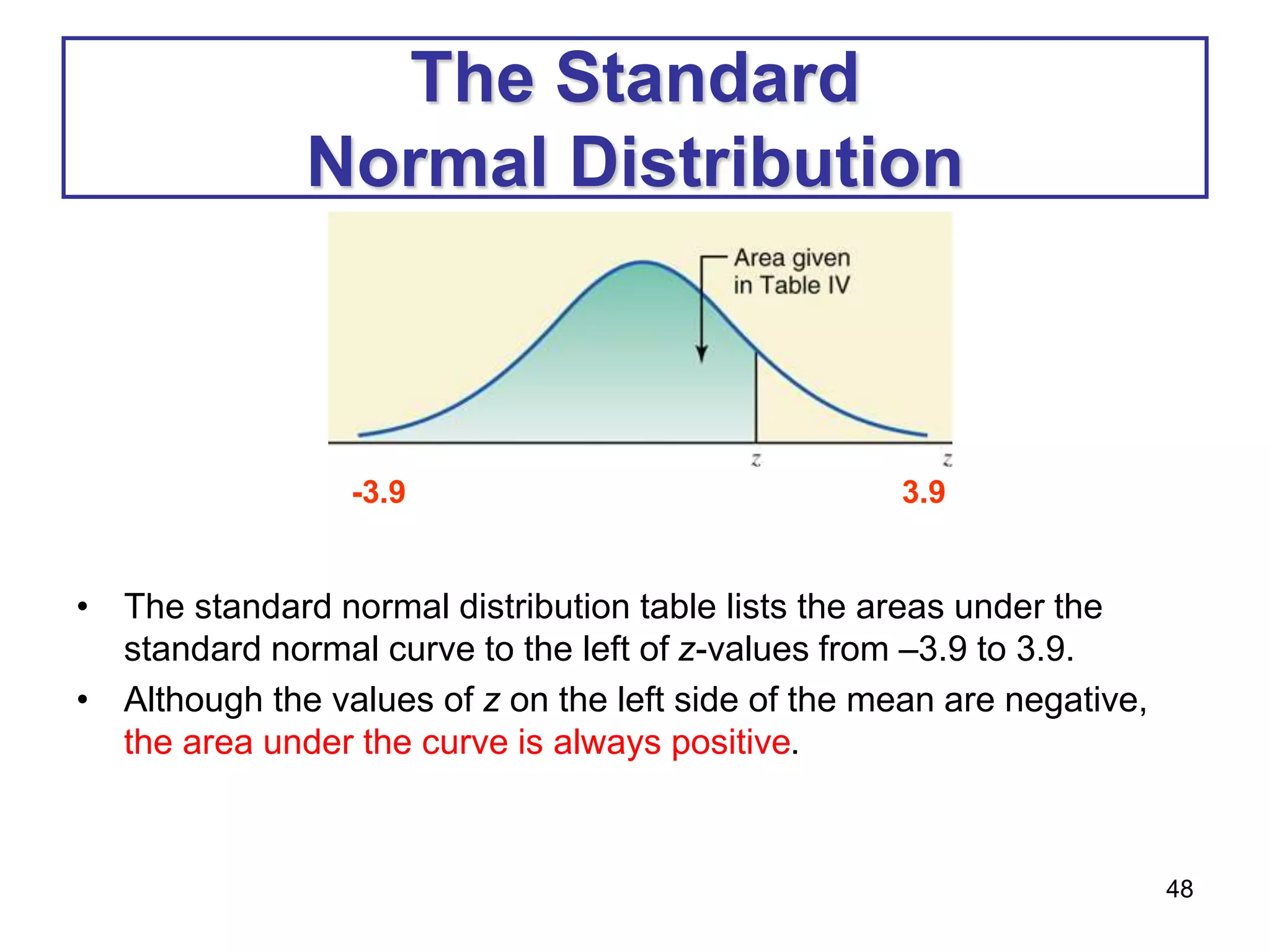
• The standard normal distribution table lists the areas under the
standard normal curve to the left of z-values from –3.9 to 3.9.
• Although the values of z on the left side of the mean are negative,
the area under the curve is always positive.
-3.9 3.9
49
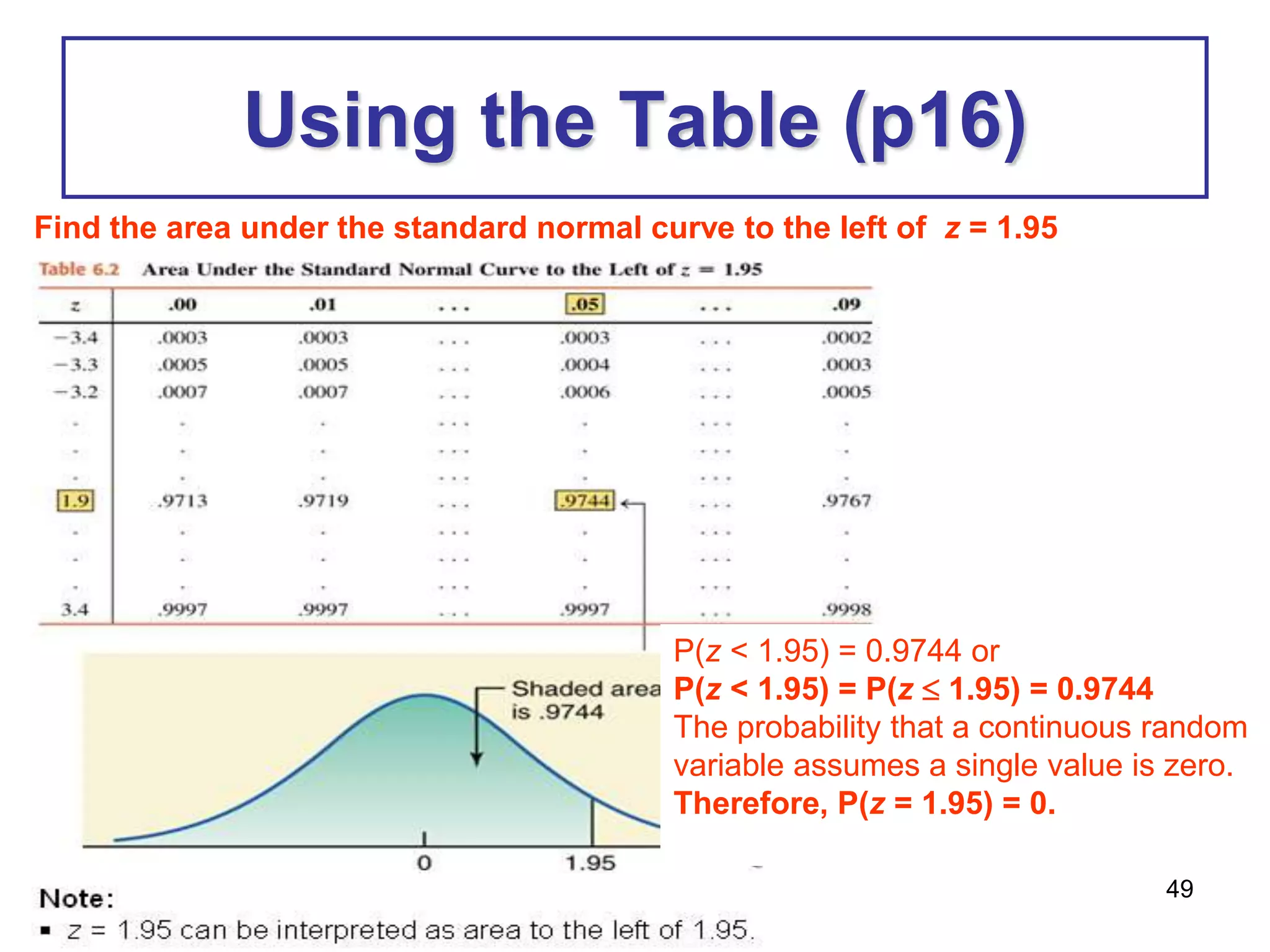
Using the Table (p16)
Find the area under the standard normal curve to the left of z = 1.95
P(z < 1.95) = 0.9744 or
P(z < 1.95) = P(z  1.95) = 0.9744
The probability that a continuous random
variable assumes a single value is zero.
Therefore, P(z = 1.95) = 0.
50
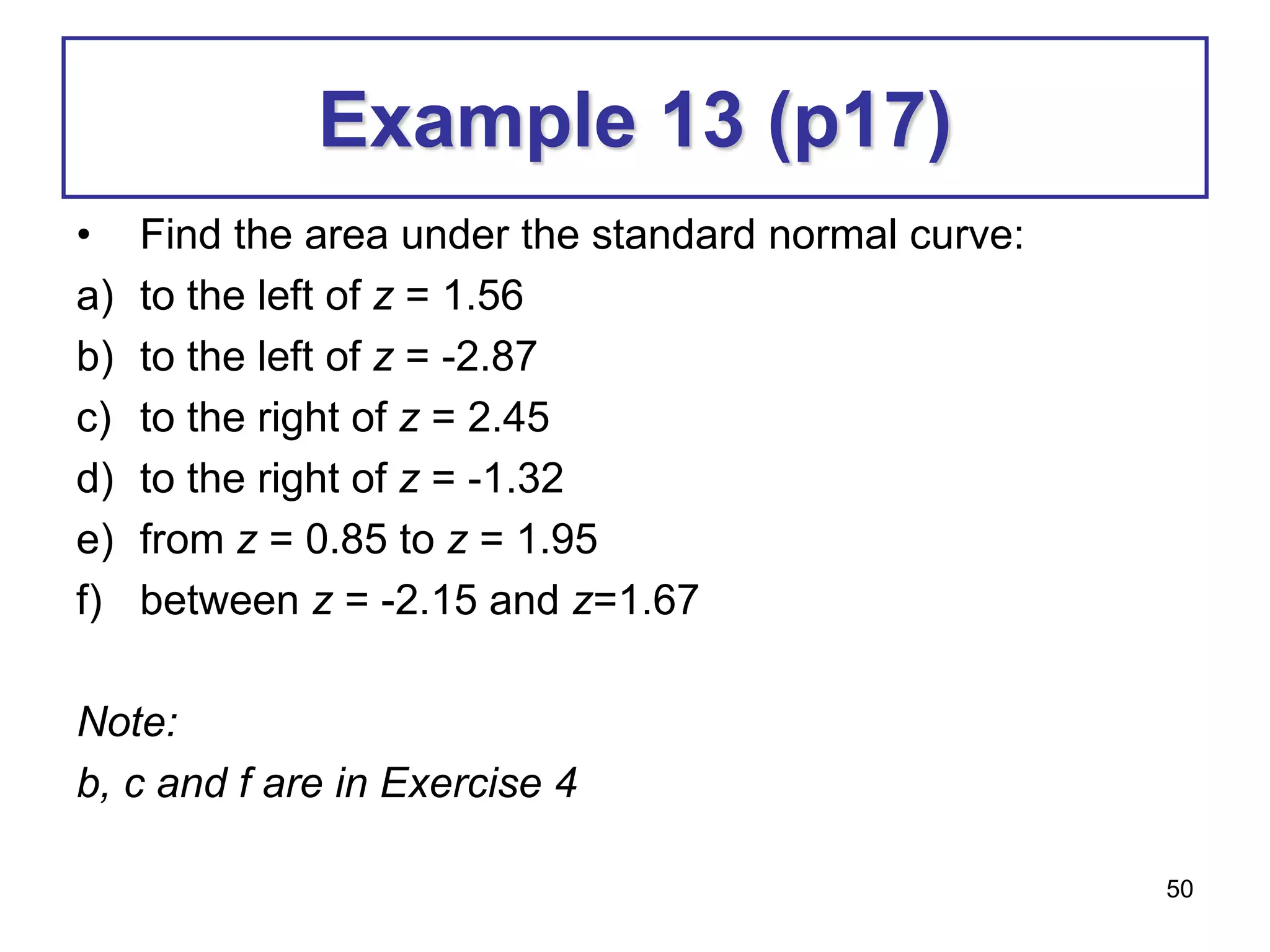
Example 13 (p17)
• Find the area under the standard normal curve:
a) to the left of z = 1.56
b) to the left of z = -2.87
c) to the right of z = 2.45
d) to the right of z = -1.32
e) from z = 0.85 to z = 1.95
f) between z = -2.15 and z=1.67
Note:
b, c and f are in Exercise 4
51
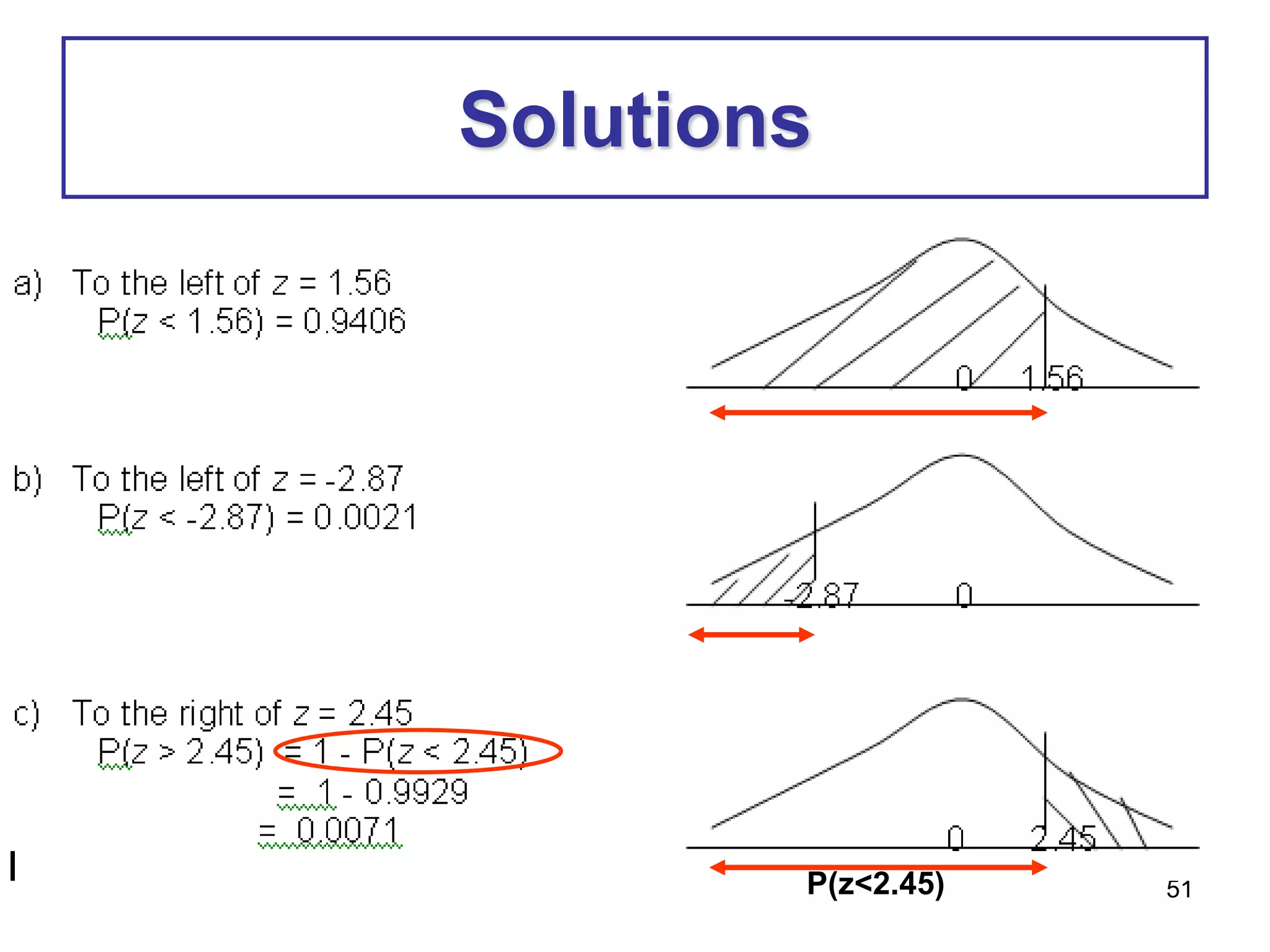
Solutions
P(z<2.45)
52
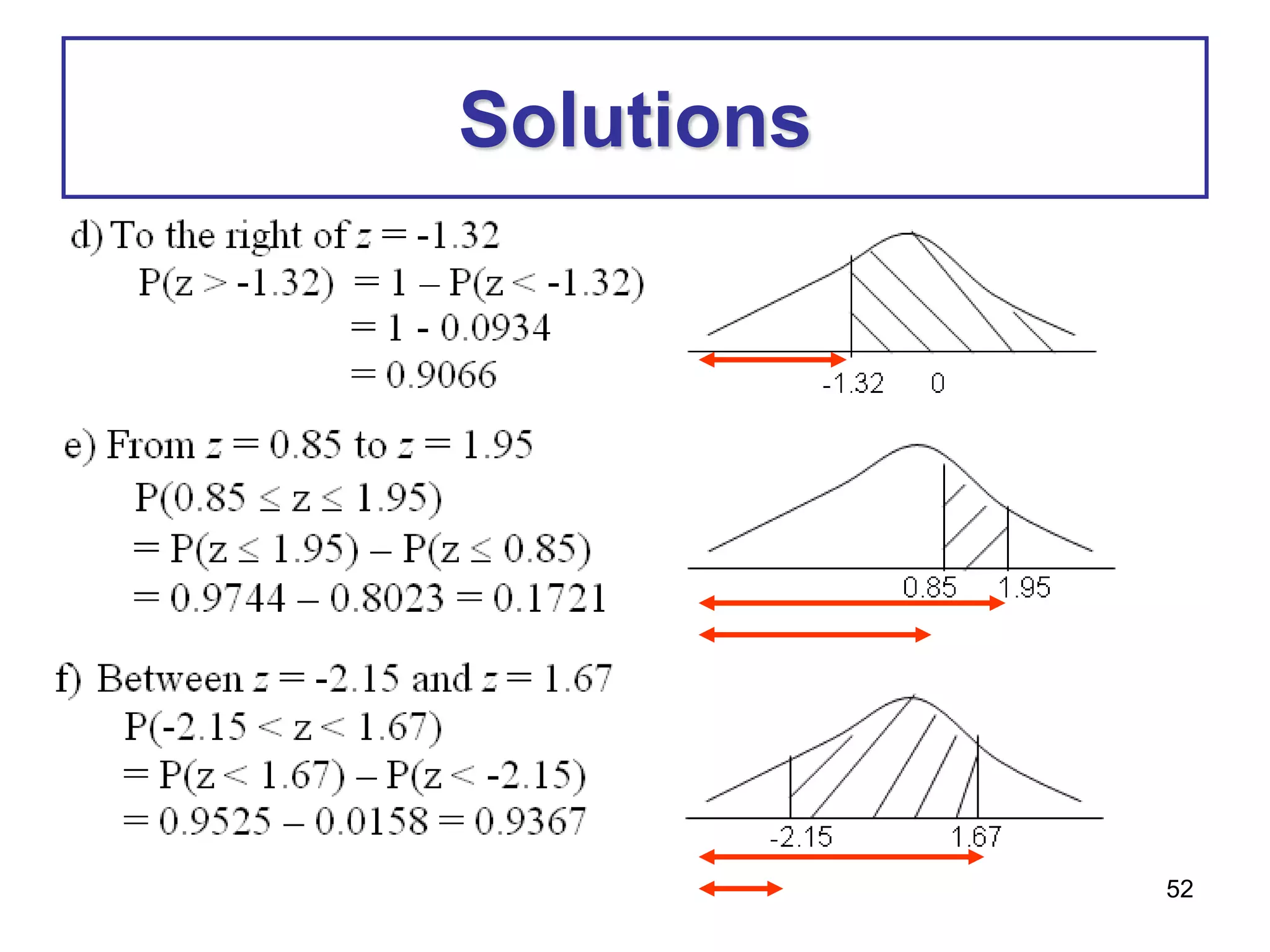
Solutions
53
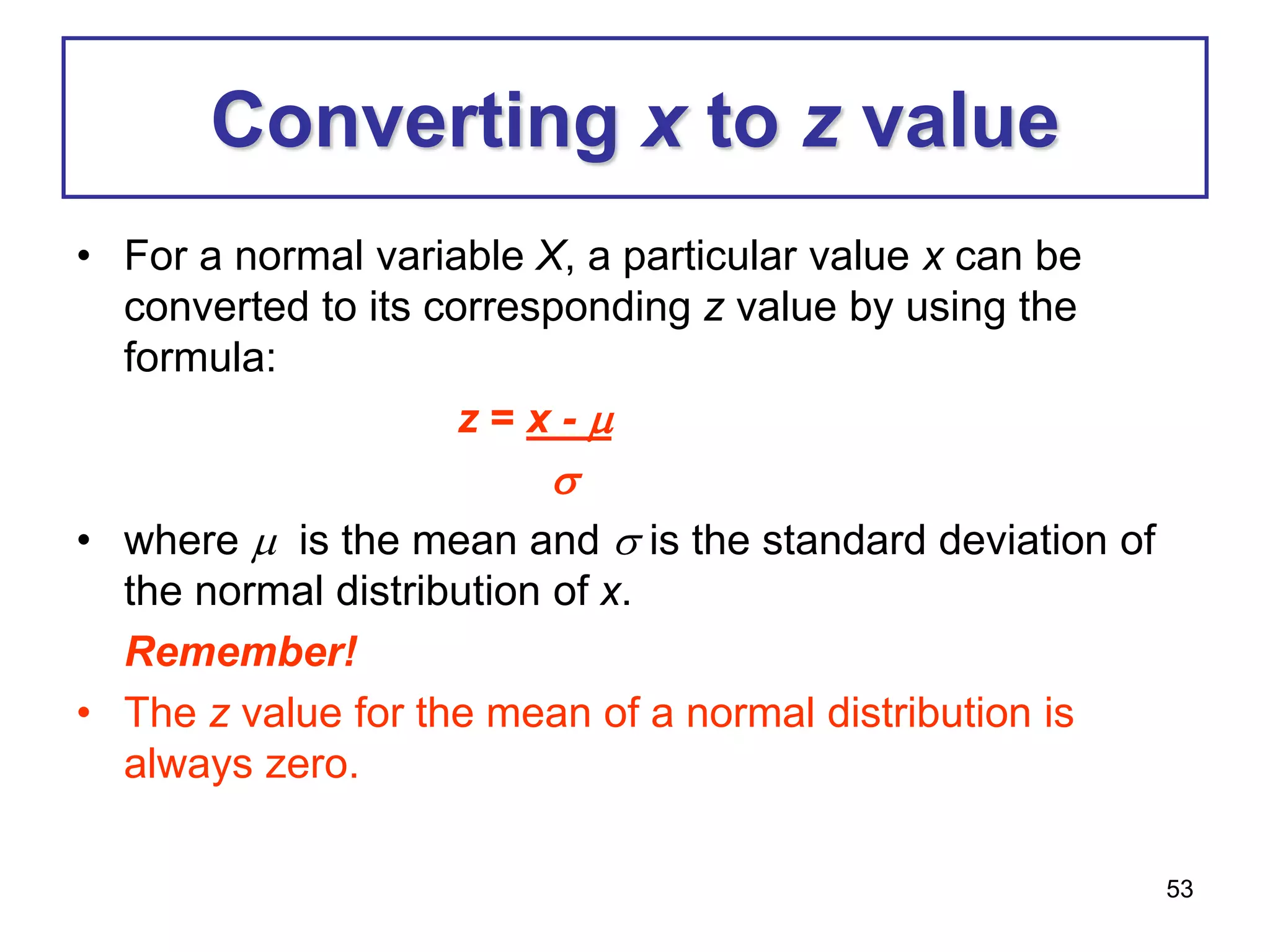
Converting x to z value
• For a normal variable X, a particular value x can be
converted to its corresponding z value by using the
formula:
z = x - 

• where  is the mean and  is the standard deviation of
the normal distribution of x.
Remember!
• The z value for the mean of a normal distribution is
always zero.
54
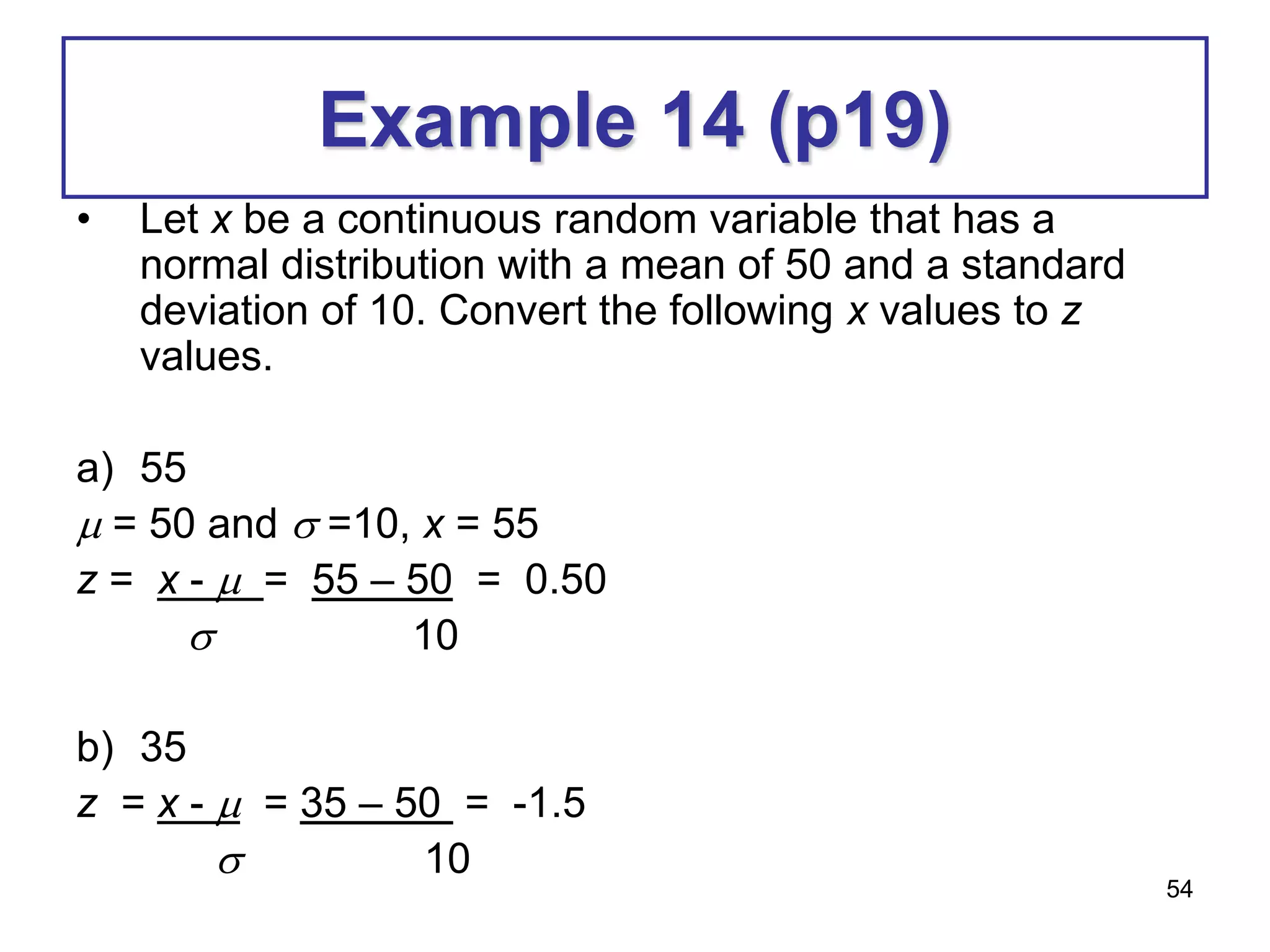
Example 14 (p19)
• Let x be a continuous random variable that has a
normal distribution with a mean of 50 and a standard
deviation of 10. Convert the following x values to z
values.
a) 55
 = 50 and  =10, x = 55
z = x -  = 55 – 50 = 0.50
 10
b) 35
z = x -  = 35 – 50 = -1.5
 10
55
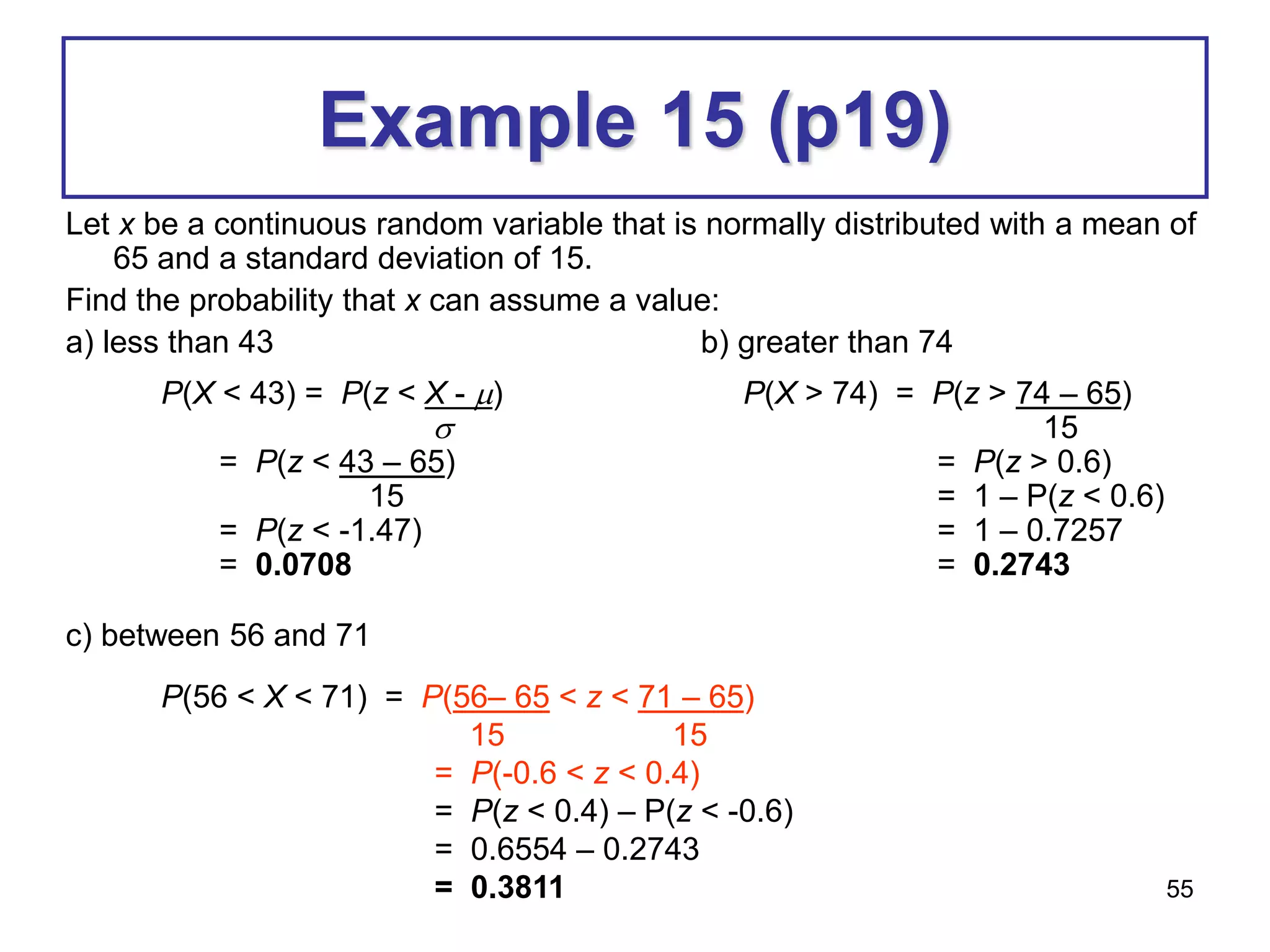
Example 15 (p19)
Let x be a continuous random variable that is normally distributed with a mean of
65 and a standard deviation of 15.
Find the probability that x can assume a value:
a) less than 43 b) greater than 74
c) between 56 and 71
P(56 < X < 71) = P(56– 65 < z < 71 – 65)
15 15
= P(-0.6 < z < 0.4)
= P(z < 0.4) – P(z < -0.6)
= 0.6554 – 0.2743
= 0.3811
P(X < 43) = P(z < X - )

= P(z < 43 – 65)
15
= P(z < -1.47)
= 0.0708
P(X > 74) = P(z > 74 – 65)
15
= P(z > 0.6)
= 1 – P(z < 0.6)
= 1 – 0.7257
= 0.2743
56
Exercise 5 (p20) 
1. Let X denote the time takes to run a road race. Suppose X is
approximately normally distributed with mean of 190 minutes and
standard deviation of 21 minutes. If one runner is selected at
random, what is the probability that this runner will complete this
road race:
a) in less than 150 minutes?
b) in 205 to 245 minutes?
P(X < 150) = P(z < 150 - 190)
21
= P(z < -1.9)
= 0.0287
P(205 < X < 245) = P[(205-190 )<z < 245 - 190)]
21 21
= P(0.71 <z < 2.62)
= P(z < 2.62) - P(z < 0.71)
= 0.9956 – 0.7611
= 0.2345
57
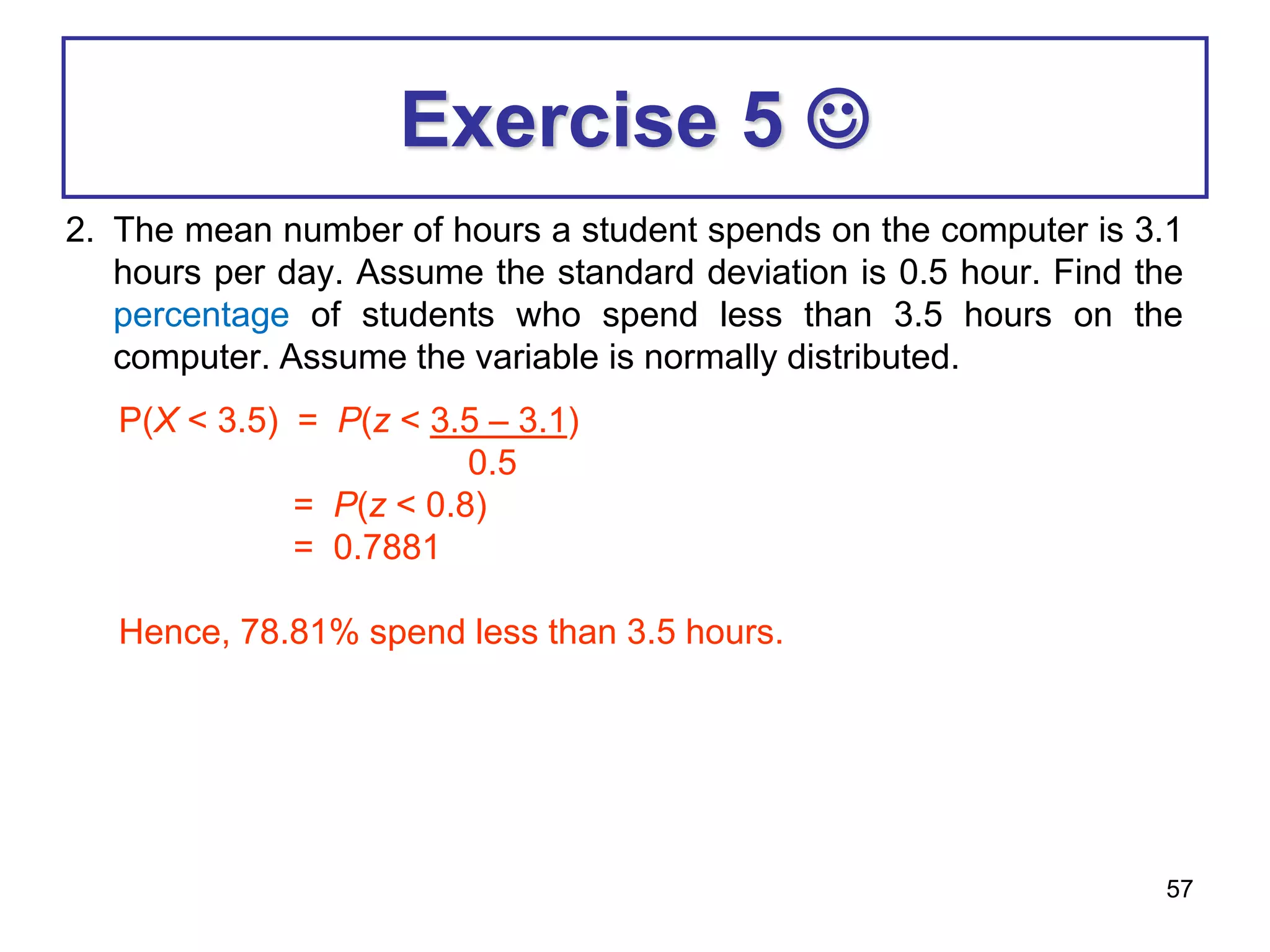
Exercise 5 
2. The mean number of hours a student spends on the computer is 3.1
hours per day. Assume the standard deviation is 0.5 hour. Find the
percentage of students who spend less than 3.5 hours on the
computer. Assume the variable is normally distributed.
P(X < 3.5) = P(z < 3.5 – 3.1)
0.5
= P(z < 0.8)
= 0.7881
Hence, 78.81% spend less than 3.5 hours.
58
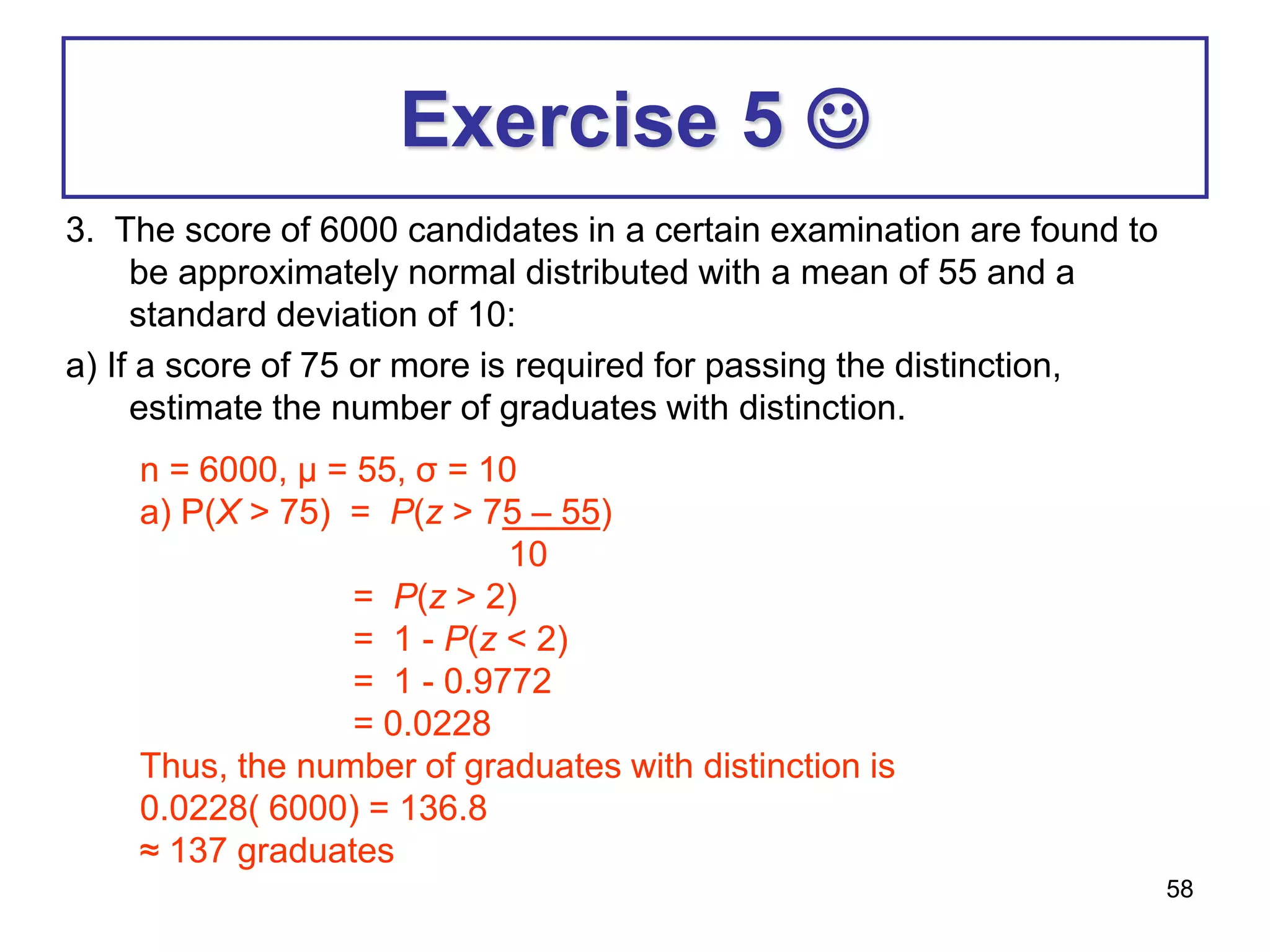
Exercise 5 
3. The score of 6000 candidates in a certain examination are found to
be approximately normal distributed with a mean of 55 and a
standard deviation of 10:
a) If a score of 75 or more is required for passing the distinction,
estimate the number of graduates with distinction.
n = 6000, μ = 55, σ = 10
a) P(X > 75) = P(z > 75 – 55)
10
= P(z > 2)
= 1 - P(z < 2)
= 1 - 0.9772
= 0.0228
Thus, the number of graduates with distinction is
0.0228( 6000) = 136.8
≈ 137 graduates
59
Exercise 5 
b) Calculate the probability that a candidate selected at random has a
score between 45 and 65
P(45 < X < 65) = P[(45 – 55) <z < 65 – 55)]
10 10
= P( -1 < z < 1)
= P (z<1) – P(z<-1)
= 0.8413 – 0.1587
= 0.6826
= 10
µ = 55 65
45
z
µ = 0
- values + values
1
-1
60
Introduction to t-distribution
• The t distribution is very similar to the standardized
normal distribution.
– Both distributions are bell-shaped and symmetrical.
• However, the t distribution has more area in the tails and
less in the centre than does the standard normal
distribution.
– This is because  is unknown and s is used to estimate it.
• Because the value of  is uncertain, the values of t that
are observed will be more variable than for z.
61
t-distribution
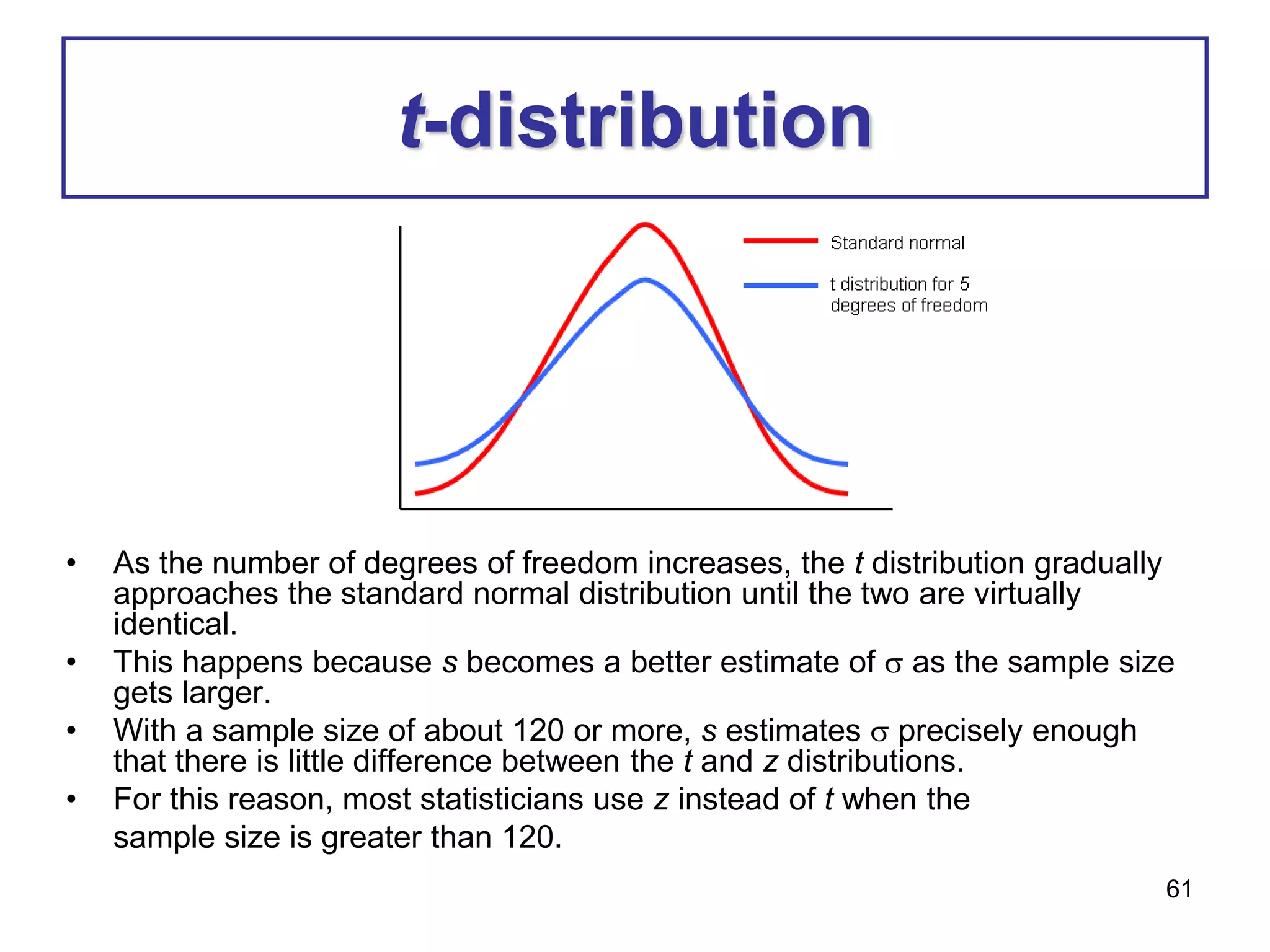
• As the number of degrees of freedom increases, the t distribution gradually
approaches the standard normal distribution until the two are virtually
identical.
• This happens because s becomes a better estimate of  as the sample size
gets larger.
• With a sample size of about 120 or more, s estimates  precisely enough
that there is little difference between the t and z distributions.
• For this reason, most statisticians use z instead of t when the
sample size is greater than 120.
62
Summary
You should now be able to:
• describe characteristics and parameters of normal distribution
• determine z value and probability using the standard normal
distribution table.
• solve problems related to normal distribution (complete the
exercises!)
Next Lesson W12 L23: Read notes!
• 6.0 SAMPLING DISTRIBUTION
• 6.1 Population data, sample data, population size, sample size,
probability sample.
• 6.2 Histogram of all the probability mean, polygon and frequency
curve.

Chapter 5.pptx

  • 1.
    Chapter 5 SPECIAL DISTRIBUTIONS •Discrete distribution; Binomial, Poisson; point probability and interval; Binomial and Poisson table; applications. • Continuous distribution; Normal distribution; interval probability; table and application, emphasize on P(z1<Z<z2), P(Z<z) and P(Z>z). • Introduction to t-distribution. 1
  • 2.
    2 Learning Outcomes • describecharacteristics of Binomial distribution • solve problems related to Binomial distribution
  • 3.
    3 Binomial Distribution • Thebinomial distribution is the discrete probability distribution of the number of successes in a sequence of n independent yes/no experiments, each of which yields success with probability p. • Characteristics of the Binomial Distribution: 1. The experiment consists of n identical trials. 2. Each trial has only one of the two possible mutually exclusive outcomes, success or a failure. 3. The trials are independent, thus we must sample with replacement. 4. The probability of success is denoted by p and that of failure by q, and p + q=1. The probabilities p and q remain constant for each trial. • Examples:  The probability of a defective laptop manufactured at a firm is 0.05 in a random sample of ten. p = 0.05, n = 10 The outcome to which the question refers is called a success
  • 4.
    4 Binomial Distribution • Fora binomial experiment, the probability of exactly x successes in n trials is given by the binomial formula: = • where • n = the total number of trials • p = probability of success • q = 1-p = probability of failure • x = number of successes in n trials • n-x = number of failures in n trials x x x
  • 5.
    5 Example 1 • Computethe probabilities of X successes, using the binomial formula. • a. n= 6, x= 3, p=0.03 • b. n= 4, x= 2, p=0.18 • Solution: = 6.5.4.3.2.1 (0.03)3(0.97)3 3.2.1 (3.2.1)
  • 6.
    6 Example 2 • Asurvey found that one out of five Malaysian says he or she has visited a doctor in any given month. If 10 people are selected at random, find the probability that exactly 3 will have visited a doctor last month. • Solution: • In this case, n = 10, x = 3, p = 1/5 and q = 4/5.
  • 7.
    7 Ex.1 Q.1 • 1.A burglar alarm system has 6 fail-safe components. The probability of each failing is 0.05. Find these probabilities: (p = 0.05, q= 1-0.05 =0.95, n = 6) a) exactly 3 will fail b) less than 2 will fail c) none will fail
  • 8.
    8 Ex.1 Q.2 2. Asurvey from Teenage Research Unlimited found that 30% of teenage consumers receive their spending money from part-time jobs. If 5 teenagers are selected at random, find the probability that at least 3 of them will have part-time jobs. • Solution: • p = 0.30, q = 1 – 0.30 = 0.70, n = 5
  • 9.
    9 Ex.1 Q.3 3. R.H Bruskin Associates Market Research found that 40% of Americans do not think that having a college education is important to succeed in the business world. If a random sample of five American is selected, find these probabilities. a) Exactly two people will agree with that statement. p = 0.40 (disagree), q = 1 – 0.40 = 0.60 (agree), n = 5. Parts a) to d) ask about those who will agree to the statement, therefore p = 0.60 now. P(X=2) = 5C2(0.6)2(0.4)5-2 = 0.2304
  • 10.
    10 Ex.1 Q.3 b) Atmost three people will agree with that statement c) At least two people will agree with that statement P(X ≤ 3) = P(X=0) + P(X=1) + P(X=2) + P(X=3) = 1- {P(X = 4) + P(X = 5)} = 1 – {5C4 (0.6)4(0.4)1 + 5C5 (0.6)5(0.4)0} = 1 – {0.2592 +0.07776} = 0.6630 P( X ≥ 2 ) = P(X=2) + P(X=3) + P(X=4) + P(X=5) = 1 –{P(X=0) + P(X=1)} = 1- { 5C0 (0.6)0(0.4)5 + 5C1 (0.6)1(0.4)4 } = 1- {0.01024 + 0.0768 } = 0.9130
  • 11.
    11 Ex.1 Q.3 d) Fewerthan three people will agree with that statement. P(X < 3) = P(X=0) + P(X=1) + P(X=2) = 5C0 (0.6)0(0.4)5 + 5C1 (0.6)1(0.4)4 + 5C2 (0.6)2(0.4)3 = 0.01024 + 0.0768 + 0.2304 = 0.3174
  • 12.
    12 Ex.1 Q.4 4. Itwas found that 60% of American victims of health care fraud are senior citizens. If 10 victims are randomly selected, find the probability that exactly 3 are senior citizens. p = 0.6, q = 0.4, n = 10 P(X=3) = 10C3.(0.6)3.(0.4)7 = 0.0425
  • 13.
    13 Binomial Table • Referto binomial table in your notes. • For any number of trials n: • The binomial probability distribution is symmetric if p = 0.5 • The binomial probability distribution is skewed to the right if p is less than 0.5 • The binomial probability distribution is skewed to the left if p is greater than 0.5
  • 14.
    14 Binomial Table Tips EquallyP(X = x), exactly that value, easy to use Poisson formula At most All lower values and up to that x value, i.e. P(X ≤ x) , so take directly from the table Less than P(X < x) , that value x (and larger) is NOT included At least P(X ≥ x), that value of x onwards Greater than P(X > x), that value x (and smaller) is NOT included From x1 to x2 P(x1 ≤ X ≤ x2), include both x1 and x2 Between x1 and x2 P(x1<X<x2), do not include both x1 and x2 Between x1 to x2 P(x1< X ≤ x2), exclude x1 but include x2
  • 15.
    15 Example 3 • Computethe probability of X successes using the Binomial Table. • n=2, p=0.30, x=1 • n=4, p=0.45, x=3 • Solution: • a. P(x=1) = P(x ≤ 1) - P(x ≤ 0) • = 0.9100 – 0.4900 • = 0.4200 b. P(x =3) = P(x ≤ 3) - P(x ≤ 2) = 0.9590 – 0.7585 = 0.2005
  • 16.
    16 Example 4 1. 25%of all VCR manufactured by a large electronics company are defective. A quality control inspector randomly selects three VCRs from the production line. What is the probability that, • a) exactly one of these three VCRs is defective. • b) at least two of these VCRs is defective. • c) three of these VCRs is defective. • Solution: • p = 0.25, q = 1 – 0.25 = 0.75, n = 3 a) P(X=1) = P(X ≤ 1) - P(X ≤ 0) • = 0.8438 – 0.4219 • = 0.4219 b) P(X ≥ 2) = 1 – P(X ≤ 1) • = 1 – 0.8438 • = 0.1562 • c) P(X = 3) = P(X  3) – P(X  2) • = 1.000 – 0.9844 • = 0.0156
  • 17.
    17 Ex. 2 Q.1 1.If 65% of the people in a community use the gym facilities in one year, find these probabilities for a sample of 10 people. a) Exactly four people use the gym facilities. b) At least six people do not use the gym facilities.
  • 18.
    18 Ex. 2 Q.2 2.In a poll of 12 to 18 year old females conducted by Harris Interactive for the Gillete Company, 40% of the young female said that they expected the US to have a female president within 10 years. Suppose that a random sample of 15 females from this age group was selected. Find the probabilities that of young female in this sample who expect a female president within 10 years is a) at least 9 b) at most 5 c) 6 to 9 (include 6, 9) d) in between 4 and 8 (exclude 4, 8) e) less than 4
  • 19.
    19 Solution p = 0.4,q = 0.6, n = 15 a) P(X  9) = 1- P(X  8)= 1- 0.905 = 0.095 b) P(X  5) = P(X = 0) + P(X = 1) + … + P(X = 5) = 0.005 + 0.0047 + 0.0219 + 0.0634 + 0.1268 + 0.1859 = 0.4032 (directly from table) c) P(6  X  9) = P(X  9) – P(X  5) = 0.9662 – 0.4032 = 0.5630 d) P(4 < X < 8) = P(X  7) – P(X  4) = 0.7869 – 0.2173 = 0.5696 e) P(X < 4) = P(X  3) = 0.0905 (directly from table)
  • 20.
    20 Ex. 2 Q.3 3.In a Gallup Survey, 40% of the people interviewed were unaware that maintaining a healthy weight could reduce the risk of stroke. If 15 people are selected at random, find the probability that at least 9 are unaware that maintaining a proper weight could reduce the risk of stroke. • p = 0.40, q = 1 – 0.40 = 0.60, n = 15 P(X  9) = 1 – P(X  8) = 1 – 0.9050 = 0.095
  • 21.
    21 Mean & Varianceof the Binomial Distribution • Find the mean, variance and standard deviation for exercise 1 earlier.
  • 22.
    22 Example 5 • Findthe mean, variance and standard deviation for each of the values of n and p when the conditions for the binomial distribution are met. a) n=100, p=0.75 b) n=300, p=0.3 • Solution: • a)  = np = 100(0.75) = 75 • 2 = npq = 100(0.75)(0.25) = 18.75 •  = npq = 18.75 = 4.33 • b)  = np = 300(0.3) = 90 2 = npq = 100(0.3)(0.7) = 63  = npq = 63 = 7.94
  • 23.
    23 Extra Q.1 1. Ithas been reported that 83% of federal government employees use e-mail. If a sample of 200 federal government employees is selected, find the mean, variance and standard deviation of the number of employees who use e-mail.  = np = 200(0.83) = 166 2 = npq = 200(0.83)(0.17) = 28.22  = npq = 28.22 = 5.3122
  • 24.
    24 Extra Q.2 2. Asurvey found that 25% of Malaysian watch movies at the cinema. Find the mean, variance and standard deviation of the number of individuals who watch movie at the cinema if a random sample of 1000 Malaysian is selected at the Bintang Walk.  = np = 1000(0.25) = 250 2 = npq = 1000(0.25)(0.75) = 187.5  = npq = 187.5 = 13.6931
  • 25.
    25 Poisson Distribution • ThePoisson distribution depends only on the average number of occurrences per unit time or space, (lambda) • The Poisson probability distribution is useful when n is large and p is small. Conditions for Poisson: •x is a discrete random variable •The occurrences are random •The occurrences are independent
  • 26.
    26 Poisson Distribution Examples ofapplication: • The number of accidents that occur on a highway given during a one-week period. (time) • The number of customers entering a grocery store during a one-hour interval. • The number of television sets sold at a department store during a given week. • The number of typing errors per page. (space) • A certain type of fabric made contains an average 0.5 defects per 500 yards.
  • 27.
    27 Poisson Distribution • Theprobability of x occurrences in an interval is: • Where; •  : mean number of occurrences in that interval (time or ?) • e : the constant, approximately 2.7183
  • 28.
    28 Example 7 • Findeach probability P(X; ), using the Poisson formula – P(5;4) – P(2;4) • Solution: • a. P(X=5) = e-4(45)/5! • = 0.1563 • b. P(X=2) = e-4(42)/2! = 0.1465
  • 29.
    29 Example 8 • Ifthere are 200 typographical errors randomly distributed in a 500-page manuscript, find the probability that a given page contains exactly three errors. • Solution: • Find the number  of errors: •  = 200/500 = 0.4 (error per page) • • P(X=3) = e-0.4(0.4)3 3! = 0.0072
  • 30.
    30 Ex.3 Q.1 1. Onaverage a household receives 2 telemarketing phone calls per week. Using the Poisson distribution formula, find the probability that a randomly selected household receives: a) exactly six telemarketing phone calls during a given week. b) less than three telemarketing phone calls in one month.  = 2 telemarketing phone calls per week a) P(X = 6) = = 0.0120  = 8 telemarketing phone calls in one month P(X < 3) = P(X  2) = P(X = 0) + P(X = 1) + P(X = 2) = = 0.0003 + 0.0027 + 0.0107 = 0.0137 8 0 8 1 8 2 8 8 8 0! 1! 2! e e e      2 6 2 6! e
  • 31.
    31 Using Poisson Table •Refer to your Poisson less than table. Equally P(X = x), exactly that value, easy to use Poisson formula At most All lower values and up to that x value, i.e. P(X ≤ x) , so take directly from the table Less than P(X < x) , that value x (and larger) is NOT included At least P(X ≥ x), that value of x onwards Greater than P(X > x), that value x (and smaller) is NOT included From x1 to x2 P(x1 ≤ X ≤ x2), include both x1 and x2 Between x1 and x2 P(x1<X<x2), do not include both x1 and x2 Between x1 to x2 P(x1< X ≤ x2), exclude x1 but include x2
  • 32.
    32 Example 9 • Findthe probability P(X; ); using Poisson table • P(10;7) • P(9;8) • Solution: • a) P(X = 10) = P(X  10) – P(X  9) • = 0.9015 – 0.8305 • = 0.0710 • b) P(X = 9) = P(X  9) – P(X  8) = 0.7166 – 0.5925 = 0.1241 = (e-8.89)/9!
  • 33.
    33 Example 10 • Asales firm receives on average three calls per hour on its toll-free number. For any given hour, find the probability that it will receive the following: a. at most 3 calls b. at least 3 calls c. five or more calls d. between 1 to 4 calls in 2 hours  = 3 calls per hour P(X  3) = 0.6472 P(X  3) = 1 – P(X  2) = 1 – 0.4232 = 0.5768 P(X  5) = 1 – P(X  4) = 1 – 0.8153 = 0.1847  = 6 calls in 2 hours P(1< X  4) = P(X  4) – P(X  1) = 0.2851 – 0.0174 = 0.2677
  • 34.
  • 35.
    35 Example 11 • Anauto sales person sells an average of 0.9 cars per day. Find the mean, variance and standard deviation of cars sold per day by this sales person. • Solution: •  =  = 0.9 2 =  = 0.9 •  =  = 0.9 = 0.9487
  • 36.
    36 Example 12 • Aninsurance salesperson sells an average of 1.4 policies per day. • Find the probability that this salesperson will sell no insurance policy on a certain day. • Find the mean, variance and standard deviation of the probability this salesperson will sell the policies per day. • Solution: •  = 1.4 policies per day • a) P(X = 0) = P(X  0) • = 0.2466 • • • b)  =  = 1.4 • 2 =  = 1.4 •  =  = 1.4 = 1.1832
  • 37.
    37 Example 13 • Assumingthat the number of accidents that occur in a certain company in a week has a Poisson distribution with a standard deviation of 1.4. Determine: • a) the mean number of accidents that occur in a week • b) the probability that in a week, there are no accidents. • Solution: •  = 1.4 accidents • a)  =  = 2 = (1.4)2 • = 1.96 • b) P ( X = 0) = e-1.96 (1.96)0/0! • = 0.1408
  • 38.
  • 39.
    39 Example 11 • Anauto sales person sells an average of 0.9 cars per day. Find the mean, variance and standard deviation of cars sold per day by this sales person. • Solution: •  =  = 0.9 2 =  = 0.9 •  =  = 0.9 = 0.9487
  • 40.
    40 Example 12 • Aninsurance salesperson sells an average of 1.4 policies per day. • Find the probability that this salesperson will sell no insurance policy on a certain day. • Find the mean, variance and standard deviation of the probability this salesperson will sell the policies per day. • Solution: •  = 1.4 policies per day • a) P(X = 0) = P(X  0) • = 0.2466 • • • b)  =  = 1.4 • 2 =  = 1.4 •  =  = 1.4 = 1.1832
  • 41.
    41 Example 13 • Assumingthat the number of accidents that occur in a certain company in a week has a Poisson distribution with a standard deviation of 1.4. Determine: • a) the mean number of accidents that occur in a week • b) the probability that in a week, there are no accidents. • Solution: •  = 1.4 accidents • a)  =  = 2 = (1.4)2 • = 1.96 • b) P ( X = 0) = e-1.96 (1.96)0/0! • = 0.1408
  • 42.
    42 Recap Previous Lessons Distributionof random variables Discrete distribution Continuous distribution Binomial Poisson Normal fixed number of n trials, each trial has 2 outcomes (success or failure), outcomes are independent, same probability of success for each trial average number of occurrences per unit time or space, , the occurrences are random & independent.
  • 43.
    43 Continuous Probability Distribution • Acontinuous random variable can assume any value over an interval or intervals. • The number of values contained in any interval is infinite, hence the possible number of values that a continuous random variable can assume is also infinite. • Examples of continuous random variables: – life of battery – height of people – time taken to complete an examination – amount of milk in a bottle – weight of babies – price of houses
  • 44.
    44 Continuous Probability Distribution The totalprobability of all the (mutually exclusive) intervals within which X can assume a value is 1.0. The probability that X assumes a value in any interval lies in the range 0 to 1.
  • 45.
    45 Normal Distribution • Thenormal distribution is the most important and most widely used of all probability distributions. • A large number of phenomena in the real world are normally distributed either exactly or approximately. • The normal probability distribution or the normal curve is a bell-shaped (symmetric) curve. – Its mean is denoted by  and its standard deviation by . – Also known as bell curve or Gaussian distribution.
  • 46.
    46 Normal Distribution Mean =Median = Mode Two tails never touch x- axis
  • 47.
    47 The Standard Normal Distribution •Is a normal distribution with  = 0 and  = 1. • The units for the standard normal distribution curve are denoted by z and are called the z values or z scores. • The z value for a point on the horizontal axis gives the distance between the mean and that point in terms of the standard deviation. • The value under the curve indicates the proportion of area in each section. • The area under a standard normal distribution curve is used to solve practical application problems such as: – finding the % of adult woman whose height is between 5 feet 4 inches and 5 feet 7 inches.
  • 48.
    48 The Standard Normal Distribution •The standard normal distribution table lists the areas under the standard normal curve to the left of z-values from –3.9 to 3.9. • Although the values of z on the left side of the mean are negative, the area under the curve is always positive. -3.9 3.9
  • 49.
    49 Using the Table(p16) Find the area under the standard normal curve to the left of z = 1.95 P(z < 1.95) = 0.9744 or P(z < 1.95) = P(z  1.95) = 0.9744 The probability that a continuous random variable assumes a single value is zero. Therefore, P(z = 1.95) = 0.
  • 50.
    50 Example 13 (p17) •Find the area under the standard normal curve: a) to the left of z = 1.56 b) to the left of z = -2.87 c) to the right of z = 2.45 d) to the right of z = -1.32 e) from z = 0.85 to z = 1.95 f) between z = -2.15 and z=1.67 Note: b, c and f are in Exercise 4
  • 51.
  • 52.
  • 53.
    53 Converting x toz value • For a normal variable X, a particular value x can be converted to its corresponding z value by using the formula: z = x -   • where  is the mean and  is the standard deviation of the normal distribution of x. Remember! • The z value for the mean of a normal distribution is always zero.
  • 54.
    54 Example 14 (p19) •Let x be a continuous random variable that has a normal distribution with a mean of 50 and a standard deviation of 10. Convert the following x values to z values. a) 55  = 50 and  =10, x = 55 z = x -  = 55 – 50 = 0.50  10 b) 35 z = x -  = 35 – 50 = -1.5  10
  • 55.
    55 Example 15 (p19) Letx be a continuous random variable that is normally distributed with a mean of 65 and a standard deviation of 15. Find the probability that x can assume a value: a) less than 43 b) greater than 74 c) between 56 and 71 P(56 < X < 71) = P(56– 65 < z < 71 – 65) 15 15 = P(-0.6 < z < 0.4) = P(z < 0.4) – P(z < -0.6) = 0.6554 – 0.2743 = 0.3811 P(X < 43) = P(z < X - )  = P(z < 43 – 65) 15 = P(z < -1.47) = 0.0708 P(X > 74) = P(z > 74 – 65) 15 = P(z > 0.6) = 1 – P(z < 0.6) = 1 – 0.7257 = 0.2743
  • 56.
    56 Exercise 5 (p20) 1. Let X denote the time takes to run a road race. Suppose X is approximately normally distributed with mean of 190 minutes and standard deviation of 21 minutes. If one runner is selected at random, what is the probability that this runner will complete this road race: a) in less than 150 minutes? b) in 205 to 245 minutes? P(X < 150) = P(z < 150 - 190) 21 = P(z < -1.9) = 0.0287 P(205 < X < 245) = P[(205-190 )<z < 245 - 190)] 21 21 = P(0.71 <z < 2.62) = P(z < 2.62) - P(z < 0.71) = 0.9956 – 0.7611 = 0.2345
  • 57.
    57 Exercise 5  2.The mean number of hours a student spends on the computer is 3.1 hours per day. Assume the standard deviation is 0.5 hour. Find the percentage of students who spend less than 3.5 hours on the computer. Assume the variable is normally distributed. P(X < 3.5) = P(z < 3.5 – 3.1) 0.5 = P(z < 0.8) = 0.7881 Hence, 78.81% spend less than 3.5 hours.
  • 58.
    58 Exercise 5  3.The score of 6000 candidates in a certain examination are found to be approximately normal distributed with a mean of 55 and a standard deviation of 10: a) If a score of 75 or more is required for passing the distinction, estimate the number of graduates with distinction. n = 6000, μ = 55, σ = 10 a) P(X > 75) = P(z > 75 – 55) 10 = P(z > 2) = 1 - P(z < 2) = 1 - 0.9772 = 0.0228 Thus, the number of graduates with distinction is 0.0228( 6000) = 136.8 ≈ 137 graduates
  • 59.
    59 Exercise 5  b)Calculate the probability that a candidate selected at random has a score between 45 and 65 P(45 < X < 65) = P[(45 – 55) <z < 65 – 55)] 10 10 = P( -1 < z < 1) = P (z<1) – P(z<-1) = 0.8413 – 0.1587 = 0.6826 = 10 µ = 55 65 45 z µ = 0 - values + values 1 -1
  • 60.
    60 Introduction to t-distribution •The t distribution is very similar to the standardized normal distribution. – Both distributions are bell-shaped and symmetrical. • However, the t distribution has more area in the tails and less in the centre than does the standard normal distribution. – This is because  is unknown and s is used to estimate it. • Because the value of  is uncertain, the values of t that are observed will be more variable than for z.
  • 61.
    61 t-distribution • As thenumber of degrees of freedom increases, the t distribution gradually approaches the standard normal distribution until the two are virtually identical. • This happens because s becomes a better estimate of  as the sample size gets larger. • With a sample size of about 120 or more, s estimates  precisely enough that there is little difference between the t and z distributions. • For this reason, most statisticians use z instead of t when the sample size is greater than 120.
  • 62.
    62 Summary You should nowbe able to: • describe characteristics and parameters of normal distribution • determine z value and probability using the standard normal distribution table. • solve problems related to normal distribution (complete the exercises!) Next Lesson W12 L23: Read notes! • 6.0 SAMPLING DISTRIBUTION • 6.1 Population data, sample data, population size, sample size, probability sample. • 6.2 Histogram of all the probability mean, polygon and frequency curve.