Assessment in
learning 2
Presented by Christine R. Parin
Get to know about me 😊
Christine R. Parin
21 years old
Educational Background:
jhs: Malinao Ilaya Nhs 2016-2020
shs: Quezonian Educational College 2020-2022
college: Bachelor of secondary education major
in english
Norm-Referenced Vs.
Criterion-Referenced
Assessment
Topic:
Background
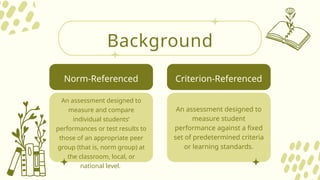
An assessment designed to
measure and compare
individual students’
performances or test results to
those of an appropriate peer
group (that is, norm group) at
the classroom, local, or
national level.
An assessment designed to
measure student
performance against a fixed
set of predetermined criteria
or learning standards.
Norm-Referenced Criterion-Referenced
At the end of this lesson, the learners should be
able to:
 Define Norm-Referenced and Criterion-
Referenced Assessment
 Determine its the strengths and weaknesses
 Differentiate Norm-Referenced Assessment
from Criterion-Referenced Assessment
Objectives
Norm-referenced assessment
Compares a student’s performance against other students (a
national group or other “norm”).
• Student performance is assessed relative to the other
students.
• Describes student’s performance or progress in relation to
others of the same peer group, age Or ability.
• Assessment to determine how a person performed in
comparison with that of a group.
Norm-referenced assessment
• May look at cross-school achievements to compare achievement
in particular
• groups, subjects and years wit local and national levels of
attainment
• Compare an individual's performance to the performance of other
people/Group.
• (Accomplished statistically by “norming” the test with large
numbers of people.)
• Require varying item difficulties. • ▪ Assume not everybody is
going to “GET IT”, Discriminate those who “GOT IT” from those who
didn’t.
Norm-referenced assessment
Used for ...
• College placement
• Competition comparisons
• Comparing apples & oranges (countries, states, school
districts)
• Examples: Usually multiple choice
• Jennie’s score in the periodical exams is below the mean
• Rose ranked 5th in the unit test in Physics
• Lisa’s percentile rank in the Math achievement test is 88.
Norm-referenced assessment
advantages
• Compares students' performances against similar groups
across the nation
• Proven track record of reliability and dependable rank order
from highest to lowest
• Broad coverage of academic standards
• Easy to administer
• Shows student performance relative to group.
• Ensures a “spread” between top and bottom of the class for
clear
• grade setting
Norm-referenced assessment
disadvantages
• Results are limited e to a classroom teacher
• Opportunity to learn may not exist
• Expensive and time consuming
• Scoring could be flawed
Criterion-referenced assessment
• Measures A Student’s Performance Against A Goal, Specific
Objective, Or Standard.
• Student Performance Is Assessed Against A Set Of Predetermined
Standards.
• Compares An Individual's Performance To The Acceptable Standard
Of Performance
• For Those Tasks.
• Designed To Measure Student Performance Against A Fix Set Of
Predetermined Criteria
• For A Specific Grade Level.
• Helps The Teacher That The Student Has Learned Specific
Information
Criterion-referenced assessment
Examples:
(End of unit test; Quizzes; vocabulary test;
summer reading test; home work)
• Jhoanna can construct a pie graph with 75%
accuracy
• Mikha scored 7 out of 10 in the spelling test
• Sheena can encode an article with no more
than 5 errors in spelling
Criterion-referenced assessment
•Applications/Used for .........
• Measuring Performance & Assigning
Grades(certification Of Skills)
• Diagnostic Purposes: Individual Skill Deficiencies
• Motivation
• Influencing Study Habits
• Improving Classroom Effectiveness (Evaluation And
Revision Of Instruction)
Criterion-referenced assessment
advantages
• Measures Student Performance Against A Specific
Curriculum Standard
• Sets Minimum Performance Expectations.
• Demonstrate What Students Can And Cannot Do In
Relation To Important Content-area Standards.
• Pre- And Post Assessment To Inform Instruction
• Identifies The Strengths And Weaknesses To A
Specific Curriculum
• Easy To Administer
Criterion-referenced assessment
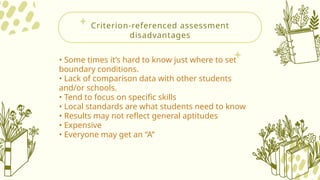
disadvantages
• Some times it’s hard to know just where to set
boundary conditions.
• Lack of comparison data with other students
and/or schools.
• Tend to focus on specific skills
• Local standards are what students need to know
• Results may not reflect general aptitudes
• Expensive
• Everyone may get an “A”
https://tophat.com/glossary/n/norm-referenced-asses
sment
/
https://uoa.custhelp.com/app/answers/detail/a_id/154
50/~/criterion-referenced-assessment#:~:text=Criterio
n%2Dreferenced%20assessment%20means%20that,ti
me%20the%20assignment%20is%20set
.
References
Thank
You

Norm-Referenced-Vs.-Criterion-Referenced.pptx

  • 1.
  • 2.
    Get to knowabout me 😊 Christine R. Parin 21 years old Educational Background: jhs: Malinao Ilaya Nhs 2016-2020 shs: Quezonian Educational College 2020-2022 college: Bachelor of secondary education major in english
  • 3.
  • 4.
    Background An assessment designedto measure and compare individual students’ performances or test results to those of an appropriate peer group (that is, norm group) at the classroom, local, or national level. An assessment designed to measure student performance against a fixed set of predetermined criteria or learning standards. Norm-Referenced Criterion-Referenced
  • 5.
    At the endof this lesson, the learners should be able to:  Define Norm-Referenced and Criterion- Referenced Assessment  Determine its the strengths and weaknesses  Differentiate Norm-Referenced Assessment from Criterion-Referenced Assessment Objectives
  • 6.
    Norm-referenced assessment Compares astudent’s performance against other students (a national group or other “norm”). • Student performance is assessed relative to the other students. • Describes student’s performance or progress in relation to others of the same peer group, age Or ability. • Assessment to determine how a person performed in comparison with that of a group.
  • 7.
    Norm-referenced assessment • Maylook at cross-school achievements to compare achievement in particular • groups, subjects and years wit local and national levels of attainment • Compare an individual's performance to the performance of other people/Group. • (Accomplished statistically by “norming” the test with large numbers of people.) • Require varying item difficulties. • ▪ Assume not everybody is going to “GET IT”, Discriminate those who “GOT IT” from those who didn’t.
  • 8.
    Norm-referenced assessment Used for... • College placement • Competition comparisons • Comparing apples & oranges (countries, states, school districts) • Examples: Usually multiple choice • Jennie’s score in the periodical exams is below the mean • Rose ranked 5th in the unit test in Physics • Lisa’s percentile rank in the Math achievement test is 88.
  • 9.
    Norm-referenced assessment advantages • Comparesstudents' performances against similar groups across the nation • Proven track record of reliability and dependable rank order from highest to lowest • Broad coverage of academic standards • Easy to administer • Shows student performance relative to group. • Ensures a “spread” between top and bottom of the class for clear • grade setting
  • 10.
    Norm-referenced assessment disadvantages • Resultsare limited e to a classroom teacher • Opportunity to learn may not exist • Expensive and time consuming • Scoring could be flawed
  • 11.
    Criterion-referenced assessment • MeasuresA Student’s Performance Against A Goal, Specific Objective, Or Standard. • Student Performance Is Assessed Against A Set Of Predetermined Standards. • Compares An Individual's Performance To The Acceptable Standard Of Performance • For Those Tasks. • Designed To Measure Student Performance Against A Fix Set Of Predetermined Criteria • For A Specific Grade Level. • Helps The Teacher That The Student Has Learned Specific Information
  • 12.
    Criterion-referenced assessment Examples: (End ofunit test; Quizzes; vocabulary test; summer reading test; home work) • Jhoanna can construct a pie graph with 75% accuracy • Mikha scored 7 out of 10 in the spelling test • Sheena can encode an article with no more than 5 errors in spelling
  • 13.
    Criterion-referenced assessment •Applications/Used for......... • Measuring Performance & Assigning Grades(certification Of Skills) • Diagnostic Purposes: Individual Skill Deficiencies • Motivation • Influencing Study Habits • Improving Classroom Effectiveness (Evaluation And Revision Of Instruction)
  • 14.
    Criterion-referenced assessment advantages • MeasuresStudent Performance Against A Specific Curriculum Standard • Sets Minimum Performance Expectations. • Demonstrate What Students Can And Cannot Do In Relation To Important Content-area Standards. • Pre- And Post Assessment To Inform Instruction • Identifies The Strengths And Weaknesses To A Specific Curriculum • Easy To Administer
  • 15.
    Criterion-referenced assessment disadvantages • Sometimes it’s hard to know just where to set boundary conditions. • Lack of comparison data with other students and/or schools. • Tend to focus on specific skills • Local standards are what students need to know • Results may not reflect general aptitudes • Expensive • Everyone may get an “A”
  • 16.
  • 17.