Here are the responses to the statements in 1/2 sheet of paper:
1. Clarity of focus
2. Designing backwards
3. High expectations
4. Expanded opportunities
5. Valid
6. Reliable
7. Fair
8. Innovative
9. Reflective
10. Multi-literate
“TAILOR-ICULUM”
• The classwill be divided into four (4)
groups. Each group will be given a plastic
straw. Your task is to tailor yourselves
with your members starting from the
upper part of your shirt down to your
pants. After tailoring yourselves together
with your group, you are going to
perform your yell. You will only be given
10 mins. to do the task.
•W. Spady(1994) definedOBE as clearly
focusing, and organizing everything in the
educational system around the essential for
all the students to do successfully at the end
of their learning experiences.
• It is a student-centered approach to
education that focuses on the intended
learning outcomes resulting from instruction-
Nicholson, 2011
4.
1 What dowe want these students to
learn?
2. Why do we want students to learn
these things?
3. How can we best help students to
learn these things?
4. How will you know when the
students have learned?
5.
Spady premised thatin Outcomes-Based
Education;
All students can learn and succeed, but not
at the same time or in the same way.
Successful learning promotes even more
successful leaning.
Schools and teachers control the conditions
that will determine if the students are
successful in school learning.
6.
Four Essential Principlesin OBE
Principle 1: Clarity of Focus
A clear picture on what teachers want
students to learn is the primary principle in
OBE. Teachers should bear in mind that the
outcome of teaching is learning. This is like
looking straight ahead so that the target will be
reached.
7.
Four Essential Principlesin OBE
Principle 2: Designing Backwards
At the beginning of a curriculum design, the
learning outcome has to be clearly defined.
What to achieve at the end of formal schooling
is determined at the beginning . Decisions are
always traced back to desired results.
8.
Four Essential Principlesin OBE
Principle 3: High Expectations
Establishing high expectations, challenging
standards of performance will encourage
students to learn better. This is parallel to
Thorndike’s Law of Effect, which says that
success reinforces learning, motivates,
builds confidences and encourages learners
to do better.
9.
Four Essential Principlesin OBE
Principle 4: Expanded Opportunities
In OBE all students are expected to excel,
hence equal expanded opportunities should
be provided. As advocates of multiple
intelligences say, “every child has a genius in
him/herself, hence is capable of doing the
best”.
10.
Teaching-Learning in OBE
Teachingis teaching if learners learn. Learning
measured by its outcome. Whatever approach to
teaching is used, the intent should focus on
learning rather than on teaching.
11.
Teacher must preparestudents
adequately. This can be done if the
teachers know what they want the
students to learn and what learning
outcomes to achieve. Prerequisite
knowledge is important, thus a review is
necessary at the start of a lesson.
12.
Teacher must createa positive
learning environment. Students
should feel, that regardless of
individual uniqueness, the teacher is
always there to help. Teacher and student
relationship is very important. The
classroom atmosphere should provide
respect for diverse kind of learners.
13.
Teacher must helptheir students
to understand , what they have to
learn, why they should learn it (what
use it will be now and in the future)
and how will they know that they have
learned.
14.
Teacher must usea variety of teaching
methods. The most appropriate strategy
should be used taking into account the
learning outcome teachers want the
students to achieve. Also to consider are the
contents, the characteristic of the students,
the resources available and the teaching skill
of the teacher. Even if OBE is learner-centered,
sometimes more direct, time-tested methods
of teaching will be appropriate.
15.
Teacher must providestudents with
enough opportunities to use the new
knowledge and skills that they gain.
When students do this, they can explore
with new learning, correct errors and adjust
their thinking. Application of learning is
encourage rather than mere accumulation of
these.
16.
Teacher must helpstudents
to bring each learning to a
personal closure that will make the,
aware of what they learned. .
17.
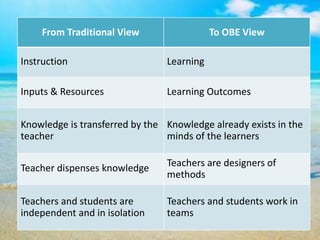
From Traditional ViewTo OBE View
Instruction Learning
Inputs & Resources Learning Outcomes
Knowledge is transferred by the
teacher
Knowledge already exists in the
minds of the learners
Teacher dispenses knowledge Teachers are designers of
methods
Teachers and students are
independent and in isolation
Teachers and students work in
teams
18.
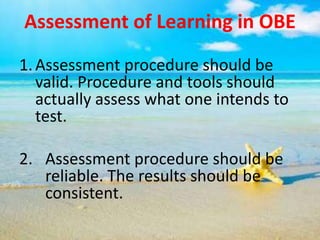
Assessment of Learningin OBE
1.Assessment procedure should be
valid. Procedure and tools should
actually assess what one intends to
test.
2. Assessment procedure should be
reliable. The results should be
consistent.
19.
3. Assessment procedureshould be
fair. Cultural background and other
factors should not influence
assessment procedure.
4. Assessment should reflect the
knowledge and skills that are
important to the students.
20.
6. Assessment shouldtell both the
teachers. and students are
progressing.
7. Assessment should support every
student’s opportunity to learn
things that are important.
21.
7. Assessment shouldallow individuality
or uniqueness to be demonstrated.
8. Assessment should be
comprehensive to cover a wide range
of learning outcomes.
22.
Learner’s Responsibility for
Learning
•In OBE, students are responsible for their
own learning and progress. Nobody can
learn for the learner. It is only the learner
himself/herself who can drive
himself/herself to learn, thus learning is a
personal matter.
23.
• One ofthe great benefits of OBE is that it
makes students aware of what they
should be learning, why they are learning
it, what they are actually learning, and
what they should do when they are
learning.
24.
As a student,
1.What do I have to learn?
2. Why do I have to learn it?
3. What will I be doing while I am learning?
4. How will I know that I am learning, what
I should be learning?
5. Will I have any say in what I learn?
6. How will I be assessed?
25.
“ISKRAMBOL-iculum”
The class willbe divided into three (3) groups
with 8 members each. Each member of the
group will have their corresponding letter. All
you have to do is to answer what is asked in the
question by arranging the letters to form a new
word. Remember, changing the letters with your
co-member is prohibited. You should arrange it
by yourselves.
CLUE: All answers are 8-letter word.
26.
1. OBE isanchored and focuses on what? It is
the end target of OBE.
2. The teaching-learning in OBE shows shifts
from traditional to OBE view. In traditional view
they focuses merely on instruction or teaching
what was written in the book while, in OBE they
focuses on what?
3. In enhanced teacher education curriculum
anchored on OBE, who are their focused whom
should be innovative, reflective, multi-literate
they are the ideal ______.
MAIN RULE:
To proceedto the next level you must defeat
your opponent being in the same level as you
thru “jack-en-poy”.
REMEMBER!!!
Being in any level you are in, failed to win, will
go back again to the first stage (worm)
2.) Teacher Lizawants to know if her
students have learned throughout her
discussion. She use varied assessment
tools and procedure that is
appropriate for her learners. In this
way, do you think Teacher Liza will
know if her students achieved the
learning outcomes?
3.) Teacher Joansets high and
challenging standards in order to
encourage students to engage deeply
with the learning and to achieve the
ILO. This principle in OBE which is
expanded opportunities is a necessary
predicate of successful learning.
35.
DIRECTIONS: In a½ sheet of paper, enumerate
what is asked in the following statements.
1-4. Give the four fundamental principles of
OBE
5-7. Give atleast 3 principles of assessment of
learning outcomes in OBE.
8-10. Give atleast 3 competencies of ideal
graduates.