



Non- Violence in Educational
Setting
Factors Contributing to Non
Violence at Schools
By
M.VIJAYALAKSHMI
Assistant Professor
Objectives
At the end of the course the student teacher will
1. Understand the concept of peace education.
2. Understand the dynamics of transformation of
violence into Peace.
3. Understand the nature of conflicts and their
resolution.
4. Imbibe the knowledge, attitudes and skills
needed to achieve and sustain a global culture
of peace.
5. Adopt peace education in the curriculum.
Unit - 3:
Non- Violence in Educational Setting
3.1 Factors Contributing to Non Violence at
Schools.
3.2 Violence and Aggression - Perception of
Threat and Aggressive Behavior.
3.3 Rejection and Withdrawal - Measures to
bring about nonviolence in schools Strategies
that can be adopted in school.
3.4 Individuals and long term solutions to
maintain non- violence.
Unit - 3:
Non- Violence in Educational Setting
3.1 Factors Contributing to Non
Violence at Schools.
School-Based Violence Programs
Four ways to decrease school violence from
an institutional point of view:
1.Parent and community involvement
2.Character education
3.Violence prevention and conflict resolution
curricula
4.Bullying prevention
Parent and Community Involvement
Parent involvement encourages a more
constructive learning environment by creating
goals for parents in the home and teachers in the
school that work to enhance both environments
and are consistent in their objectives.
Increased involvement by parents has been
shown to provide better teacher satisfaction,
improved parent understanding of school
policies, better parent-child communication, and
more successful and effective school programs.
Character Education
Character education is the notion that schools
have to take a direct role in teaching values to
children.
In elementary school, character education
should achieve three objectives:
1.Promote development away from egocentrism
and excessive individualism and toward
cooperative relationships and mutual respect.
2.Foster the growth of moral agency—the
capacity to think, feel and act morally.
3. Develop in the classroom and in the school a
moral community based on fairness, caring
and participation—such a community being a
moral end in itself as well as a support system
for the character development of each
individual student.
There are four processes in the classroom to
achieve these goals:
1.Building self-esteem and a sense of
community
2.Learning to work together and to help others
3.Thinking about the outcomes of one’s
behavior and it s impact on others
4.Learning to make decisions that reflect group
input and are participatory
Violence Prevention and Conflict Resolution
Curricula
These approaches teach children to use
alternatives to violence when resolving
interpersonal conflicts.
1.Programs that teach children conflict
resolution strategies
2.Actual conflict resolution teams headed up by
students who patrol the school grounds and
can provide conflict resolution as a way of
reducing tension before the conflict is
reported to the school authorities.
3. Films, role-plays and simulations may be used.
4. Parents might also become involved and
conflict resolution might be extended to
problems in the home.
5. Topics may include, anger management,
learning to identify and express feelings about
others, discussing issues related to racial,
ethnic and gender differences and learning to
cope with stress.
Bullying Prevention Programs
Bullying prevention programs are schoolwide
zero-tolerance policies.
The programs include improved adult
supervision
Classroom rules against bullying
Positive and negative consequences for
following and violating rules, respectively,
interventions with the bullies and the victims
Meetings with parents of bullies and victims
Regular classroom meetings to discuss ways of
dealing with bullying
Effective programs have significantly reduced
the rate of bullying and have led to much
better school climates
Additional Approaches to Decreasing School
Violence
A no-tolerance policy for any sort of a
dangerous weapon
Frequent searches for weapons in lockers and
weapons detection at the school entryway
Suitable activities after school
Programs to give children and adolescents an
opportunity to stay after school under
supervision to improve their scholastic
performance
Work in the community through help from the
school
Anti-gang programs and to maintain dress
codes that forbid the use of gang
paraphernalia.
Self-esteem programs for children who suffer
from low self-esteem
Initiate programs to provide services to
children from violent homes and their families
Assertiveness training for children
Aggression is an action that enhances the
aggressor while it minimizes and violated the
rights of others
Intent of aggressive behavior is to humiliate and
dominate
Passive behaviors are self-denying and inhibiting,
as a person’s own rights are disregarded and he
or she gives in to demands of others
Assertiveness is a “win-win” behavior in which an
individual can stand up for their own rights in
such a way that the rights of others are not
disregarded
The Relationship between Family Deterioration
and School Violence
17% of all homicides in the U. S. occur within a
family situation
When parents use harsh physical means to
discipline their children, children learn that
battering and physical aggression are normal
ways of expressing frustration and resolving
problems
Children who demonstrate physically
aggressive and antisocial behaviors and have
developmental and academic problems before
age 9 display more aggressive tendencies as
adults than do individuals who do not
demonstrate early behavioral and educational
problems
It is believed that abuse and neglect by
parents model the way a child is likely to
interact with others
Schools are one of the earliest social
situations in which children may feel
vulnerable, inadequate, angry, less intelligent,
ignored and a host of other emotions that
may result in early aggression
Educators must be proactive and demand that
some of the funds spent on school safety
efforts be allocated to support educators’ time
to reflect on the emotional wellbeing of each
student
Too often, children who begin to act out in the
classroom are placed in special education
classes and are classified as “Severely
Emotionally Disturbed, following a serious
offense, as the path of least resistance.”
Children who act out do not fare well in
special education classes and can disrupt a
truly disabled population of students
Education must also include the emotional
attributes of moral maturity, such as
conscience, self-respect, empathy and self-
control.
School Violence in Rural Communities
It is often thought that rural means nonviolent
and that violence only takes place in the urban
schools and communities with large inner cities,
but the reality is that many school killings have
taken place in small, reasonably affluent
communities with well-regarded schools
It is often thought that poverty is an urban plight,
but rural schools often suffer from extreme
underfunding by poor rural counties that hope to
provide more but lack the tax base to do so
In rural communities, people often know one
another over a lifetime
Rural communities have problems with school
violence and often have a more difficult time
dealing with those problems than do urban
schools
Rural communities are often ill equipped for
the people who have different cultures,
religious beliefs, languages and strong ideas
about the seriousness and importance of
education
Many of the same programs suggested for
other schools must be implemented
New ways of funding schools must be devised
so that rural schools are not resource-poor
schools
Contributing Factors in School Violence
• Home environment – violence at home may
literally beget violence in the child, as parents
who fight each other will exhibit behaviors
that will be imbibed by the child
• Depression – lack of an outlet for a highly
emotional child can lead to depression and
subsequently will manifest itself as violent
behavior
• Weapons – the accessibility to and ease of
purchase of weapons makes this a
compounding factor in the spread of violence
• Stress and anxiety – violence can occur when
stress and anxiety are present usually caused
by a lack of an acceptable normative method
of conflict and problem resolution. Constant
stress caused by pressures of school and work
can exacerbate the problem of violence
• Media effect- the pervasive appearance of
violence and depictions of violence in movies
and television shows also contribute, as
children tend to imitate what they see on the
television and the big screen
• Group effect – peer pressure and the need for
acceptance within a group, especially if the
group is violence prone, can have an effect on
members becoming violent.
• Lack of counseling- lack of counseling and
guidance, albeit also hand in hand with proper
care and affection to individual needs can
make children prone to violence
• No guidance in difficulties- the lack of an
effective way of mentoring a child to deal with
problems and difficulties can lead the child to
become frustrated and therefore express this
in a violent manner.
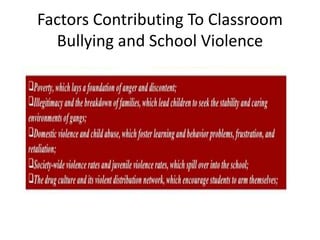
Factors Contributing To Classroom
Bullying and School Violence
The World Report on Violence against Children
identifies the main forms of violence as
follows:
• physical and psychological punishment;
• bullying;
• sexual and gender-based violence;
• external violence: effects of gangs, conflict
situations, weapons and fighting.
Actions to Stop Violence in Schools
1. Advocate a holistic approach involving
students, school staff, parents and the
community
2. Make your students your partners in
preventing violence
3. Use constructive discipline techniques and
methods
4. Be an active and effective force to stop
bullying
5. Be a positive role model by speaking out
against sexual and gender-based violence
respond to life’s challenges constructively
6. Be an advocate for school safety mechanisms
7. Provide safe and welcoming spaces for
students
8. Learn violence prevention and conflict
resolution skills and teach them to students
9. Recognize violence and discrimination against
students with disabilities, and those from
indigenous, minority and other marginalized
communities
Sources are taken from
•Slidesharenet.com
•Web sources
Non- Violence in Educational Setting

Non- Violence in Educational Setting

  • 1.
    Non- Violence inEducational Setting Factors Contributing to Non Violence at Schools By M.VIJAYALAKSHMI Assistant Professor
  • 2.
    Objectives At the endof the course the student teacher will 1. Understand the concept of peace education. 2. Understand the dynamics of transformation of violence into Peace. 3. Understand the nature of conflicts and their resolution. 4. Imbibe the knowledge, attitudes and skills needed to achieve and sustain a global culture of peace. 5. Adopt peace education in the curriculum.
  • 3.
    Unit - 3: Non-Violence in Educational Setting 3.1 Factors Contributing to Non Violence at Schools. 3.2 Violence and Aggression - Perception of Threat and Aggressive Behavior. 3.3 Rejection and Withdrawal - Measures to bring about nonviolence in schools Strategies that can be adopted in school. 3.4 Individuals and long term solutions to maintain non- violence.
  • 4.
    Unit - 3: Non-Violence in Educational Setting 3.1 Factors Contributing to Non Violence at Schools.
  • 5.
    School-Based Violence Programs Fourways to decrease school violence from an institutional point of view: 1.Parent and community involvement 2.Character education 3.Violence prevention and conflict resolution curricula 4.Bullying prevention
  • 6.
    Parent and CommunityInvolvement Parent involvement encourages a more constructive learning environment by creating goals for parents in the home and teachers in the school that work to enhance both environments and are consistent in their objectives. Increased involvement by parents has been shown to provide better teacher satisfaction, improved parent understanding of school policies, better parent-child communication, and more successful and effective school programs.
  • 7.
    Character Education Character educationis the notion that schools have to take a direct role in teaching values to children. In elementary school, character education should achieve three objectives: 1.Promote development away from egocentrism and excessive individualism and toward cooperative relationships and mutual respect. 2.Foster the growth of moral agency—the capacity to think, feel and act morally.
  • 8.
    3. Develop inthe classroom and in the school a moral community based on fairness, caring and participation—such a community being a moral end in itself as well as a support system for the character development of each individual student.
  • 9.
    There are fourprocesses in the classroom to achieve these goals: 1.Building self-esteem and a sense of community 2.Learning to work together and to help others 3.Thinking about the outcomes of one’s behavior and it s impact on others 4.Learning to make decisions that reflect group input and are participatory
  • 10.
    Violence Prevention andConflict Resolution Curricula These approaches teach children to use alternatives to violence when resolving interpersonal conflicts. 1.Programs that teach children conflict resolution strategies 2.Actual conflict resolution teams headed up by students who patrol the school grounds and can provide conflict resolution as a way of reducing tension before the conflict is reported to the school authorities.
  • 11.
    3. Films, role-playsand simulations may be used. 4. Parents might also become involved and conflict resolution might be extended to problems in the home. 5. Topics may include, anger management, learning to identify and express feelings about others, discussing issues related to racial, ethnic and gender differences and learning to cope with stress.
  • 12.
    Bullying Prevention Programs Bullyingprevention programs are schoolwide zero-tolerance policies. The programs include improved adult supervision Classroom rules against bullying
  • 13.
    Positive and negativeconsequences for following and violating rules, respectively, interventions with the bullies and the victims Meetings with parents of bullies and victims Regular classroom meetings to discuss ways of dealing with bullying Effective programs have significantly reduced the rate of bullying and have led to much better school climates
  • 14.
    Additional Approaches toDecreasing School Violence A no-tolerance policy for any sort of a dangerous weapon Frequent searches for weapons in lockers and weapons detection at the school entryway Suitable activities after school Programs to give children and adolescents an opportunity to stay after school under supervision to improve their scholastic performance
  • 15.
    Work in thecommunity through help from the school Anti-gang programs and to maintain dress codes that forbid the use of gang paraphernalia. Self-esteem programs for children who suffer from low self-esteem Initiate programs to provide services to children from violent homes and their families
  • 16.
    Assertiveness training forchildren Aggression is an action that enhances the aggressor while it minimizes and violated the rights of others Intent of aggressive behavior is to humiliate and dominate Passive behaviors are self-denying and inhibiting, as a person’s own rights are disregarded and he or she gives in to demands of others Assertiveness is a “win-win” behavior in which an individual can stand up for their own rights in such a way that the rights of others are not disregarded
  • 17.
    The Relationship betweenFamily Deterioration and School Violence 17% of all homicides in the U. S. occur within a family situation When parents use harsh physical means to discipline their children, children learn that battering and physical aggression are normal ways of expressing frustration and resolving problems
  • 18.
    Children who demonstratephysically aggressive and antisocial behaviors and have developmental and academic problems before age 9 display more aggressive tendencies as adults than do individuals who do not demonstrate early behavioral and educational problems It is believed that abuse and neglect by parents model the way a child is likely to interact with others
  • 19.
    Schools are oneof the earliest social situations in which children may feel vulnerable, inadequate, angry, less intelligent, ignored and a host of other emotions that may result in early aggression Educators must be proactive and demand that some of the funds spent on school safety efforts be allocated to support educators’ time to reflect on the emotional wellbeing of each student
  • 20.
    Too often, childrenwho begin to act out in the classroom are placed in special education classes and are classified as “Severely Emotionally Disturbed, following a serious offense, as the path of least resistance.” Children who act out do not fare well in special education classes and can disrupt a truly disabled population of students Education must also include the emotional attributes of moral maturity, such as conscience, self-respect, empathy and self- control.
  • 21.
    School Violence inRural Communities It is often thought that rural means nonviolent and that violence only takes place in the urban schools and communities with large inner cities, but the reality is that many school killings have taken place in small, reasonably affluent communities with well-regarded schools It is often thought that poverty is an urban plight, but rural schools often suffer from extreme underfunding by poor rural counties that hope to provide more but lack the tax base to do so
  • 22.
    In rural communities,people often know one another over a lifetime Rural communities have problems with school violence and often have a more difficult time dealing with those problems than do urban schools Rural communities are often ill equipped for the people who have different cultures, religious beliefs, languages and strong ideas about the seriousness and importance of education
  • 23.
    Many of thesame programs suggested for other schools must be implemented New ways of funding schools must be devised so that rural schools are not resource-poor schools
  • 25.
    Contributing Factors inSchool Violence • Home environment – violence at home may literally beget violence in the child, as parents who fight each other will exhibit behaviors that will be imbibed by the child • Depression – lack of an outlet for a highly emotional child can lead to depression and subsequently will manifest itself as violent behavior
  • 26.
    • Weapons –the accessibility to and ease of purchase of weapons makes this a compounding factor in the spread of violence • Stress and anxiety – violence can occur when stress and anxiety are present usually caused by a lack of an acceptable normative method of conflict and problem resolution. Constant stress caused by pressures of school and work can exacerbate the problem of violence
  • 27.
    • Media effect-the pervasive appearance of violence and depictions of violence in movies and television shows also contribute, as children tend to imitate what they see on the television and the big screen • Group effect – peer pressure and the need for acceptance within a group, especially if the group is violence prone, can have an effect on members becoming violent.
  • 28.
    • Lack ofcounseling- lack of counseling and guidance, albeit also hand in hand with proper care and affection to individual needs can make children prone to violence • No guidance in difficulties- the lack of an effective way of mentoring a child to deal with problems and difficulties can lead the child to become frustrated and therefore express this in a violent manner.
  • 29.
    Factors Contributing ToClassroom Bullying and School Violence
  • 31.
    The World Reporton Violence against Children identifies the main forms of violence as follows: • physical and psychological punishment; • bullying; • sexual and gender-based violence; • external violence: effects of gangs, conflict situations, weapons and fighting.
  • 32.
    Actions to StopViolence in Schools 1. Advocate a holistic approach involving students, school staff, parents and the community 2. Make your students your partners in preventing violence 3. Use constructive discipline techniques and methods 4. Be an active and effective force to stop bullying
  • 33.
    5. Be apositive role model by speaking out against sexual and gender-based violence respond to life’s challenges constructively 6. Be an advocate for school safety mechanisms 7. Provide safe and welcoming spaces for students 8. Learn violence prevention and conflict resolution skills and teach them to students 9. Recognize violence and discrimination against students with disabilities, and those from indigenous, minority and other marginalized communities
  • 35.
    Sources are takenfrom •Slidesharenet.com •Web sources