WHEN LEARNING IS
PURPOSEFUL,
CREATIVITY BLOSSOMS,
WHEN CREATIVITY
BLOSSOMS,
THINKING ENAMATES,
WHEN THINKING ENAMATES,
KNOWLEDGE IS FULLY LIT,
WHEN KNOWLEDGE IS FULLY
LIT,
ECONOMY FLOURISHES.
:- BY DR. APJ ABDUL KALAM
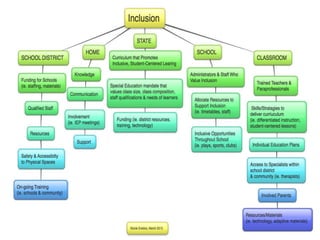
INCLUSIVE EDUCATION
MEANING
• “Inclusive Education is defined
as a learning environment that
promotes the full personal,
academic and professional
development of all learners
irrespective of race, class,
colour, gender, disability, sexual
preference, learning styles and
language.”
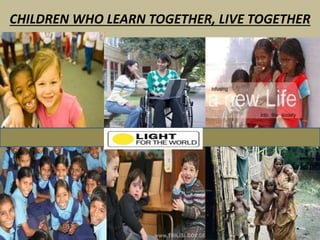
CHILDREN WHO LEARN TOGETHER, LIVE TOGETHER
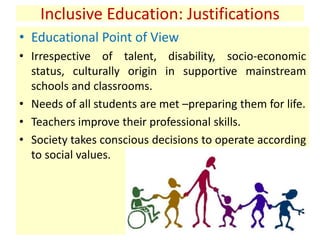
Inclusive Education: Justifications
• Educational Point of View
• Irrespective of talent, disability, socio-economic
status, culturally origin in supportive mainstream
schools and classrooms.
• Needs of all students are met –preparing them for life.
• Teachers improve their professional skills.
• Society takes conscious decisions to operate according
to social values.
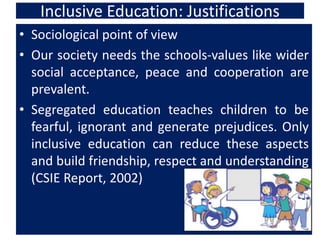
Inclusive Education: Justifications
• Sociological point of view
• Our society needs the schools-values like wider
social acceptance, peace and cooperation are
prevalent.
• Segregated education teaches children to be
fearful, ignorant and generate prejudices. Only
inclusive education can reduce these aspects
and build friendship, respect and understanding
(CSIE Report, 2002)
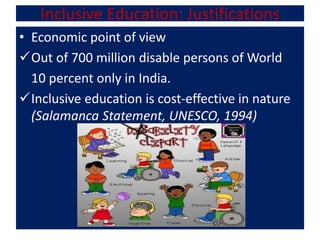
Inclusive Education: Justifications
• Economic point of view
Out of 700 million disable persons of World
10 percent only in India.
Inclusive education is cost-effective in nature
(Salamanca Statement, UNESCO, 1994)
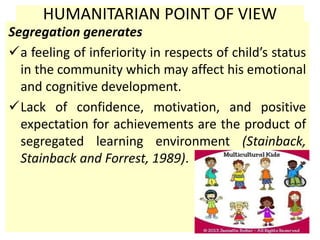
HUMANITARIAN POINT OF VIEW
Segregation generates
a feeling of inferiority in respects of child’s status
in the community which may affect his emotional
and cognitive development.
Lack of confidence, motivation, and positive
expectation for achievements are the product of
segregated learning environment (Stainback,
Stainback and Forrest, 1989).
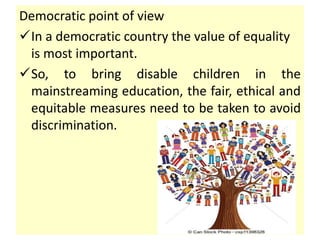
Democratic point of view
In a democratic country the value of equality
is most important.
So, to bring disable children in the
mainstreaming education, the fair, ethical and
equitable measures need to be taken to avoid
discrimination.
• Key Provisions for Inclusive Education
Constitution of India :
• Article 45: Free and compulsory education for
all children up to 14 years, changed to ECCE up to 6
years age (86th amendment of Constitution)
• Article 21 A: Right to Education Act, 2009-
Fundamental right of all children aged 6-14 to get
equitable, free and quality education
Education for All, 1990:
Intensifies that large numbers of vulnerable
and marginalized group of learners were
excluded from the education system
worldwide.
It made its vision of education as a broader
concept (EFA) than schooling including women
literacy, lifelong education etc
National Policy on Education-1986 and POA1992:
Gives emphasis on the removal of disparities
and equalize educational opportunities by
attending to the specific needs of those who
have been denied equality.
The Salamanca Conference, UNESCO, 1994:
School should accommodate all children regardless of
their physical, intellectual, social, linguistic or other
conditions.
Includes:
 disabled and gifted children,
 street and working children from remote or nomadic
population,
 children from linguistic, ethnic or cultural minorities
and
 children from other disadvantaged or marginalized
areas of groups.
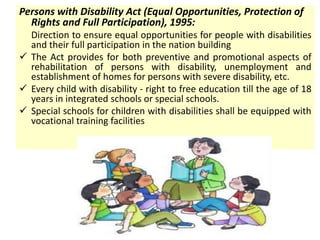
Persons with Disability Act (Equal Opportunities, Protection of
Rights and Full Participation), 1995:
Direction to ensure equal opportunities for people with disabilities
and their full participation in the nation building
 The Act provides for both preventive and promotional aspects of
rehabilitation of persons with disability, unemployment and
establishment of homes for persons with severe disability, etc.
 Every child with disability - right to free education till the age of 18
years in integrated schools or special schools.
 Special schools for children with disabilities shall be equipped with
vocational training facilities
The National Trust Act (1999) :
To facilitate the realization of equal
opportunities, protection of rights and full
participation of persons with disability.
World Education Forum in Dakar, Senegal (2000):
Education must take into account -the most
disadvantaged including working children,
remote rural dwellers, nomads, ethnic and
linguistic minority children, affected by
conflicts, HIV-AIDS, hunger and poor health and
those with special learning needs.
Biwako Millennium Framework for Action,
UNESCAP (2002):
The framework envisages that major barriers
to the provision of quality education for
children with disabilities.
These barriers can be overcome through
policy, planning, implementation of strategies
and allocation of resources (BMF-UNESCAP,
2002).
The National Action Plan for Inclusion in
Education of Children and Youth with
Disabilities (IECYD)-2005:
The goal of the Action Plan is –“to ensure the
inclusion of children and youth with disabilities
in all available general educational settings, by
providing them with a learning environment
that is available, accessible, affordable and
appropriate.”
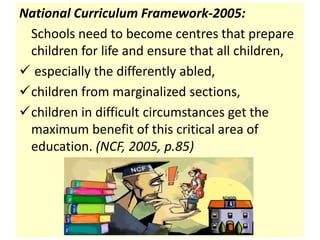
National Curriculum Framework-2005:
Schools need to become centres that prepare
children for life and ensure that all children,
 especially the differently abled,
children from marginalized sections,
children in difficult circumstances get the
maximum benefit of this critical area of
education. (NCF, 2005, p.85)
National Policy for Persons with Disabilities, 2006:
The National Policy recognizes the fact that a
majority of persons with disabilities can lead a
better quality of life if they have equal
opportunities and effective access to
rehabilitation measures
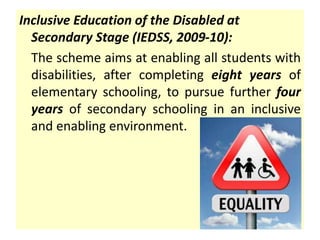
Inclusive Education of the Disabled at
Secondary Stage (IEDSS, 2009-10):
The scheme aims at enabling all students with
disabilities, after completing eight years of
elementary schooling, to pursue further four
years of secondary schooling in an inclusive
and enabling environment.
RTE- SSA’s Policy on Inclusion (2001 & 2012):
SSA has adopted a zero rejection policy. This
means that no child having special needs should
be deprived of the right to education and taught
in an environment, which is best, suited to
his/her learning needs (MHRD,GoI,2011).
Every child with special needs should be placed in
the neighborhood schools, with needed support
services
Children with special needs need to be facilitated
to acquire certain skills that will enable them to
access elementary education
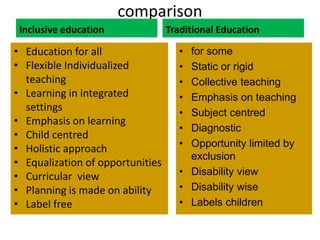
comparison
Inclusive education
• Education for all
• Flexible Individualized
teaching
• Learning in integrated
settings
• Emphasis on learning
• Child centred
• Holistic approach
• Equalization of opportunities
• Curricular view
• Planning is made on ability
• Label free
Traditional Education
• for some
• Static or rigid
• Collective teaching
• Emphasis on teaching
• Subject centred
• Diagnostic
• Opportunity limited by
exclusion
• Disability view
• Disability wise
• Labels children
PRINCIPLES OF INCLUSIVE EDUCATION
No discrimination with students
Equal educational opportunity to all
School adapt to the need of student
Equal educational benefits for all students
The student’s views are listened to and taken
seriously
Individual differences between students are a
source of richness and diversity, and not a
problem
PRACTICE OF INCLUSIVE EDUCATION
The practice of developing inclusive schools involves
Understanding Inclusion as a continuing process,
not a one time event.
 strengthening and sustaining the participation of all
students, teachers, parents and community members in
the work of the school.
Restructuring the cultures, policies and practices in
schools to respond to the diversity of pupils within their
locality.
Providing an accessible curriculum and appropriate
training programmes for all (teachers and students).
Identifying and providing support for staff as well as
students.
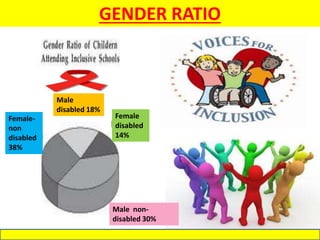
GENDER RATIO
Male
disabled 18%
Female
disabled
14%
Male non-
disabled 30%
Female-
non
disabled
38%
NEED AND IMPORTANCE
To fulfill the constitutional responsibilities
To enable children to stay with their families
For the development of healthy citizenship
For achieving the universalization
Developing feeling of self respect
For the use of modern technology
For social equality
Self reliant
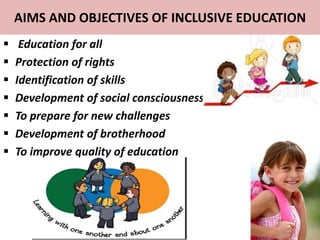
AIMS AND OBJECTIVES OF INCLUSIVE EDUCATION
 Education for all
 Protection of rights
 Identification of skills
 Development of social consciousness
 To prepare for new challenges
 Development of brotherhood
 To improve quality of education
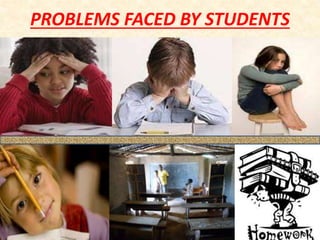
PROBLEMS FACED BY STUDENTS
Inferiority complex
Lack of understanding
Adjustment problem
Isolated and
segregated
Lag behind
Feeling of Extra burden
Insecurity
Lack of expression
Introvert nature
Negative approach
Shyness
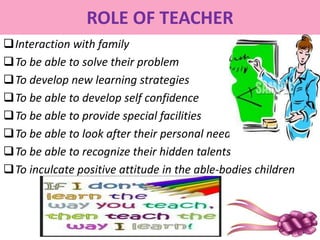
ROLE OF TEACHER
Interaction with family
To be able to solve their problem
To develop new learning strategies
To be able to develop self confidence
To be able to provide special facilities
To be able to look after their personal needs
To be able to recognize their hidden talents
To inculcate positive attitude in the able-bodies children
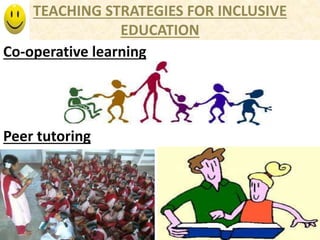
TEACHING STRATEGIES FOR INCLUSIVE
EDUCATION
Co-operative learning
Peer tutoring
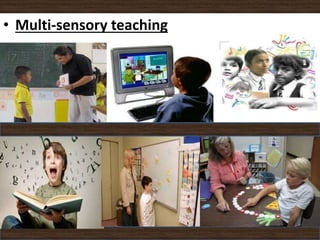
• Multi-sensory teaching
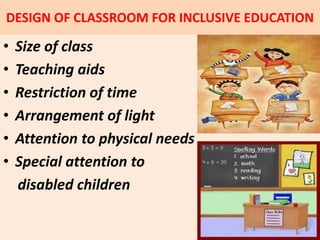
DESIGN OF CLASSROOM FOR INCLUSIVE EDUCATION
• Size of class
• Teaching aids
• Restriction of time
• Arrangement of light
• Attention to physical needs
• Special attention to
disabled children
REFORMS IN CURRICULUM
• Use of teaching Aids
• Simple curriculum
• Adequate facilities
• Participation in games
• Co-operative curriculum
• Providing reading material
• Participation in co-curricular activities
• Multi-level and flexible curriculum
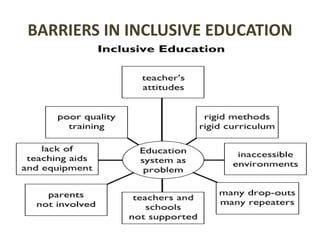
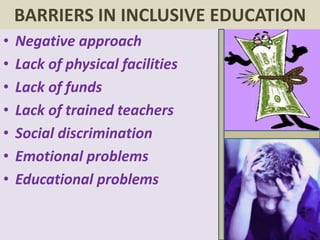
BARRIERS IN INCLUSIVE EDUCATION
• Negative approach
• Lack of physical facilities
• Lack of funds
• Lack of trained teachers
• Social discrimination
• Emotional problems
• Educational problems
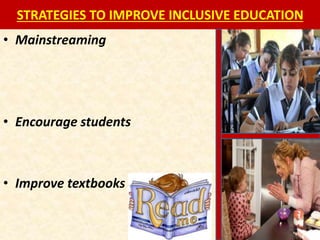
STRATEGIES TO IMPROVE INCLUSIVE EDUCATION
• Mainstreaming
• Encourage students
• Improve textbooks
..
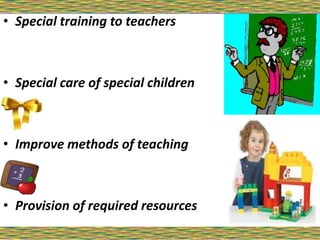
• Special training to teachers
• Special care of special children
• Improve methods of teaching
• Provision of required resources
Peer Tutoring: Typically, a
higher performing student is
paired with a lower
performing student to review
critical academic or behavioral
concepts:

Inclusive education

  • 4.
    WHEN LEARNING IS PURPOSEFUL, CREATIVITYBLOSSOMS, WHEN CREATIVITY BLOSSOMS, THINKING ENAMATES, WHEN THINKING ENAMATES, KNOWLEDGE IS FULLY LIT, WHEN KNOWLEDGE IS FULLY LIT, ECONOMY FLOURISHES. :- BY DR. APJ ABDUL KALAM
  • 5.
  • 6.
    MEANING • “Inclusive Educationis defined as a learning environment that promotes the full personal, academic and professional development of all learners irrespective of race, class, colour, gender, disability, sexual preference, learning styles and language.”
  • 7.
    CHILDREN WHO LEARNTOGETHER, LIVE TOGETHER
  • 9.
    Inclusive Education: Justifications •Educational Point of View • Irrespective of talent, disability, socio-economic status, culturally origin in supportive mainstream schools and classrooms. • Needs of all students are met –preparing them for life. • Teachers improve their professional skills. • Society takes conscious decisions to operate according to social values.
  • 10.
    Inclusive Education: Justifications •Sociological point of view • Our society needs the schools-values like wider social acceptance, peace and cooperation are prevalent. • Segregated education teaches children to be fearful, ignorant and generate prejudices. Only inclusive education can reduce these aspects and build friendship, respect and understanding (CSIE Report, 2002)
  • 11.
    Inclusive Education: Justifications •Economic point of view Out of 700 million disable persons of World 10 percent only in India. Inclusive education is cost-effective in nature (Salamanca Statement, UNESCO, 1994)
  • 12.
    HUMANITARIAN POINT OFVIEW Segregation generates a feeling of inferiority in respects of child’s status in the community which may affect his emotional and cognitive development. Lack of confidence, motivation, and positive expectation for achievements are the product of segregated learning environment (Stainback, Stainback and Forrest, 1989).
  • 13.
    Democratic point ofview In a democratic country the value of equality is most important. So, to bring disable children in the mainstreaming education, the fair, ethical and equitable measures need to be taken to avoid discrimination.
  • 14.
    • Key Provisionsfor Inclusive Education Constitution of India : • Article 45: Free and compulsory education for all children up to 14 years, changed to ECCE up to 6 years age (86th amendment of Constitution) • Article 21 A: Right to Education Act, 2009- Fundamental right of all children aged 6-14 to get equitable, free and quality education
  • 15.
    Education for All,1990: Intensifies that large numbers of vulnerable and marginalized group of learners were excluded from the education system worldwide. It made its vision of education as a broader concept (EFA) than schooling including women literacy, lifelong education etc
  • 16.
    National Policy onEducation-1986 and POA1992: Gives emphasis on the removal of disparities and equalize educational opportunities by attending to the specific needs of those who have been denied equality.
  • 17.
    The Salamanca Conference,UNESCO, 1994: School should accommodate all children regardless of their physical, intellectual, social, linguistic or other conditions. Includes:  disabled and gifted children,  street and working children from remote or nomadic population,  children from linguistic, ethnic or cultural minorities and  children from other disadvantaged or marginalized areas of groups.
  • 19.
    Persons with DisabilityAct (Equal Opportunities, Protection of Rights and Full Participation), 1995: Direction to ensure equal opportunities for people with disabilities and their full participation in the nation building  The Act provides for both preventive and promotional aspects of rehabilitation of persons with disability, unemployment and establishment of homes for persons with severe disability, etc.  Every child with disability - right to free education till the age of 18 years in integrated schools or special schools.  Special schools for children with disabilities shall be equipped with vocational training facilities
  • 20.
    The National TrustAct (1999) : To facilitate the realization of equal opportunities, protection of rights and full participation of persons with disability. World Education Forum in Dakar, Senegal (2000): Education must take into account -the most disadvantaged including working children, remote rural dwellers, nomads, ethnic and linguistic minority children, affected by conflicts, HIV-AIDS, hunger and poor health and those with special learning needs.
  • 21.
    Biwako Millennium Frameworkfor Action, UNESCAP (2002): The framework envisages that major barriers to the provision of quality education for children with disabilities. These barriers can be overcome through policy, planning, implementation of strategies and allocation of resources (BMF-UNESCAP, 2002).
  • 22.
    The National ActionPlan for Inclusion in Education of Children and Youth with Disabilities (IECYD)-2005: The goal of the Action Plan is –“to ensure the inclusion of children and youth with disabilities in all available general educational settings, by providing them with a learning environment that is available, accessible, affordable and appropriate.”
  • 23.
    National Curriculum Framework-2005: Schoolsneed to become centres that prepare children for life and ensure that all children,  especially the differently abled, children from marginalized sections, children in difficult circumstances get the maximum benefit of this critical area of education. (NCF, 2005, p.85)
  • 24.
    National Policy forPersons with Disabilities, 2006: The National Policy recognizes the fact that a majority of persons with disabilities can lead a better quality of life if they have equal opportunities and effective access to rehabilitation measures
  • 25.
    Inclusive Education ofthe Disabled at Secondary Stage (IEDSS, 2009-10): The scheme aims at enabling all students with disabilities, after completing eight years of elementary schooling, to pursue further four years of secondary schooling in an inclusive and enabling environment.
  • 26.
    RTE- SSA’s Policyon Inclusion (2001 & 2012): SSA has adopted a zero rejection policy. This means that no child having special needs should be deprived of the right to education and taught in an environment, which is best, suited to his/her learning needs (MHRD,GoI,2011). Every child with special needs should be placed in the neighborhood schools, with needed support services Children with special needs need to be facilitated to acquire certain skills that will enable them to access elementary education
  • 27.
    comparison Inclusive education • Educationfor all • Flexible Individualized teaching • Learning in integrated settings • Emphasis on learning • Child centred • Holistic approach • Equalization of opportunities • Curricular view • Planning is made on ability • Label free Traditional Education • for some • Static or rigid • Collective teaching • Emphasis on teaching • Subject centred • Diagnostic • Opportunity limited by exclusion • Disability view • Disability wise • Labels children
  • 28.
    PRINCIPLES OF INCLUSIVEEDUCATION No discrimination with students Equal educational opportunity to all School adapt to the need of student Equal educational benefits for all students The student’s views are listened to and taken seriously Individual differences between students are a source of richness and diversity, and not a problem
  • 29.
    PRACTICE OF INCLUSIVEEDUCATION The practice of developing inclusive schools involves Understanding Inclusion as a continuing process, not a one time event.  strengthening and sustaining the participation of all students, teachers, parents and community members in the work of the school. Restructuring the cultures, policies and practices in schools to respond to the diversity of pupils within their locality. Providing an accessible curriculum and appropriate training programmes for all (teachers and students). Identifying and providing support for staff as well as students.
  • 31.
    GENDER RATIO Male disabled 18% Female disabled 14% Malenon- disabled 30% Female- non disabled 38%
  • 33.
    NEED AND IMPORTANCE Tofulfill the constitutional responsibilities To enable children to stay with their families For the development of healthy citizenship For achieving the universalization Developing feeling of self respect For the use of modern technology For social equality Self reliant
  • 34.
    AIMS AND OBJECTIVESOF INCLUSIVE EDUCATION  Education for all  Protection of rights  Identification of skills  Development of social consciousness  To prepare for new challenges  Development of brotherhood  To improve quality of education
  • 35.
  • 36.
    PROBLEMS FACED BYSTUDENTS Inferiority complex Lack of understanding Adjustment problem Isolated and segregated Lag behind Feeling of Extra burden Insecurity Lack of expression Introvert nature Negative approach Shyness
  • 37.
    ROLE OF TEACHER Interactionwith family To be able to solve their problem To develop new learning strategies To be able to develop self confidence To be able to provide special facilities To be able to look after their personal needs To be able to recognize their hidden talents To inculcate positive attitude in the able-bodies children
  • 38.
    TEACHING STRATEGIES FORINCLUSIVE EDUCATION Co-operative learning Peer tutoring
  • 39.
  • 40.
    DESIGN OF CLASSROOMFOR INCLUSIVE EDUCATION • Size of class • Teaching aids • Restriction of time • Arrangement of light • Attention to physical needs • Special attention to disabled children
  • 41.
    REFORMS IN CURRICULUM •Use of teaching Aids • Simple curriculum • Adequate facilities • Participation in games • Co-operative curriculum • Providing reading material • Participation in co-curricular activities • Multi-level and flexible curriculum
  • 42.
  • 43.
    BARRIERS IN INCLUSIVEEDUCATION • Negative approach • Lack of physical facilities • Lack of funds • Lack of trained teachers • Social discrimination • Emotional problems • Educational problems
  • 44.
    STRATEGIES TO IMPROVEINCLUSIVE EDUCATION • Mainstreaming • Encourage students • Improve textbooks
  • 45.
    .. • Special trainingto teachers • Special care of special children • Improve methods of teaching • Provision of required resources
  • 47.
    Peer Tutoring: Typically,a higher performing student is paired with a lower performing student to review critical academic or behavioral concepts: