MOUNT TABOR TRAINING COLLEGE
PATHANAPURAM
TOPIC: VALUE EDUCATION- METHODS AND
TECHNIQUES
Submitted By: Submitted To:
Jissy Abraham Dr. George Varghese
EDU-12 :LEARNER IN THE EDUCATIONAL
PERSPECTIVE
Jissy Abraham
II year B.Ed Mathematics
Reg.No :18019303006
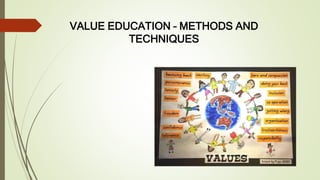
VALUE EDUCATION – METHODS AND
TECHNIQUES
VALUE EDUCATION
According to C. V. Good —
”Value-education is the
aggregate of all the process
by means of which a
person develops abilities,
attitudes and other forms
of behaviour of the
positive values in the
society in which he lives.”
METHODS
OF
VALUE EDUCATION
1. Direct method:
Value education can be imparted to the students
directly in the class room. In this method the
teacher can explain discuss and illustrate values
through stories, biographies of great men, morals
and real life situations. Direct interaction of teacher
and students is possible in this method.
2.Indirect method:
Value education can be imparted indirectly
through existing curricular and co-curricular
activities without separating the period in the
time table. Different teaching subjects will
develop the values like free enquiry, scientific
temper, appreciation of diversities, inter-
dependence of people, logical thinking etc.
Different co-curricular activities will develop
certain values like co-operation, team-spirit,
fellow-feeling, tolerance, democratic living etc.
among the students.
OF
VALUE EDUCATION
1.Classroom learning activities
The strategies should be used with any of the
following sources of value education
● Stories
●Biographies
●Extracts form essays, articles, classics and news
paper
●Parables,proverbs,quotations and poems
● Value/moral dilemmas
●Classroom incidents/anecdotes/conflicts.
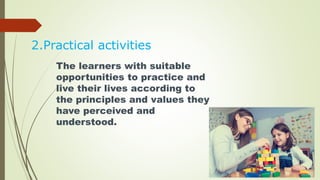
2.Practical activities
The learners with suitable
opportunities to practice and
live their lives according to
the principles and values they
have perceived and
understood.
3.Incidental learning
An incident is an episode or experience in the life
of an individual or group. It consists in identifying
the wrong or right actions of an individual or group,
either pre-planned to occur or observed by
accident, and reprimanding or rewarding those
concerned.
4.Inculcation Approach
Students are forced to act according to
specific desired values. A positive and
negative reinforcement by the teacher
helps value inculcation. This can be
done by a teacher 's natural actions and
responses.
5.Awareness Approach
This approach helps students to become aware
and identify their own values. The students are
encouraged to share their experiences.
6. Moral Reasoning Approach
The teachers setup learning experiences
which will facilitate moral development.
Through placing themselves in a role and
experiencing the process of deciding,
students can begin to see moral decisions in
a larger framework than their single point of
view. It consists of the students discussing a
dilemma and by reasoning they attain a
higher level of knowledge.
7.Analysis Approach
The group or individuals are
encouraged to study social value
problems
8.Value Clarification Approach
It helps students use both rational thinking and
emotional awareness to examine personal behavior
patterns and classify and actualize values.
9.Commitment Approach
It enables the students to perceive themselves not
merely as passive reactors or as free individuals
but as inner-relative members of social group and
system.
10.Union Approach
The purpose is help students to perceive
themselves and act not as separate
egos but as par of a larger inter-related
whole- the human race the world, the
cosmos.
Value education methods and techniques

Value education methods and techniques

  • 1.
    MOUNT TABOR TRAININGCOLLEGE PATHANAPURAM TOPIC: VALUE EDUCATION- METHODS AND TECHNIQUES Submitted By: Submitted To: Jissy Abraham Dr. George Varghese
  • 2.
    EDU-12 :LEARNER INTHE EDUCATIONAL PERSPECTIVE Jissy Abraham II year B.Ed Mathematics Reg.No :18019303006
  • 3.
    VALUE EDUCATION –METHODS AND TECHNIQUES
  • 4.
    VALUE EDUCATION According toC. V. Good — ”Value-education is the aggregate of all the process by means of which a person develops abilities, attitudes and other forms of behaviour of the positive values in the society in which he lives.”
  • 5.
  • 6.
    1. Direct method: Valueeducation can be imparted to the students directly in the class room. In this method the teacher can explain discuss and illustrate values through stories, biographies of great men, morals and real life situations. Direct interaction of teacher and students is possible in this method.
  • 7.
    2.Indirect method: Value educationcan be imparted indirectly through existing curricular and co-curricular activities without separating the period in the time table. Different teaching subjects will develop the values like free enquiry, scientific temper, appreciation of diversities, inter- dependence of people, logical thinking etc. Different co-curricular activities will develop certain values like co-operation, team-spirit, fellow-feeling, tolerance, democratic living etc. among the students.
  • 8.
  • 9.
    1.Classroom learning activities Thestrategies should be used with any of the following sources of value education ● Stories ●Biographies ●Extracts form essays, articles, classics and news paper ●Parables,proverbs,quotations and poems ● Value/moral dilemmas ●Classroom incidents/anecdotes/conflicts.
  • 10.
    2.Practical activities The learnerswith suitable opportunities to practice and live their lives according to the principles and values they have perceived and understood.
  • 11.
    3.Incidental learning An incidentis an episode or experience in the life of an individual or group. It consists in identifying the wrong or right actions of an individual or group, either pre-planned to occur or observed by accident, and reprimanding or rewarding those concerned.
  • 12.
    4.Inculcation Approach Students areforced to act according to specific desired values. A positive and negative reinforcement by the teacher helps value inculcation. This can be done by a teacher 's natural actions and responses. 5.Awareness Approach This approach helps students to become aware and identify their own values. The students are encouraged to share their experiences.
  • 13.
    6. Moral ReasoningApproach The teachers setup learning experiences which will facilitate moral development. Through placing themselves in a role and experiencing the process of deciding, students can begin to see moral decisions in a larger framework than their single point of view. It consists of the students discussing a dilemma and by reasoning they attain a higher level of knowledge.
  • 14.
    7.Analysis Approach The groupor individuals are encouraged to study social value problems 8.Value Clarification Approach It helps students use both rational thinking and emotional awareness to examine personal behavior patterns and classify and actualize values.
  • 15.
    9.Commitment Approach It enablesthe students to perceive themselves not merely as passive reactors or as free individuals but as inner-relative members of social group and system. 10.Union Approach The purpose is help students to perceive themselves and act not as separate egos but as par of a larger inter-related whole- the human race the world, the cosmos.