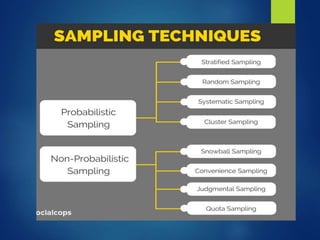
Non- probability
sampling
PRESENTATION BY:-
REHAMAN.M
MBA(STUDENT)
Non- probability sampling
Non-probability sampling is a sampling
technique where the samples are gathered in
a process that does not give all the
individuals in the population equal chances
of being selected.
Convenience Sampling:-
Convenience
sampling is probably the most common
of all sampling techniques. With
convenience sampling, the samples are
selected because they are accessible to
the researcher. Subjects are chosen
simply because they are easy to recruit.
This technique is considered easiest,
cheapest and least time consuming.
Consecutive Sampling:-
Consecutive
sampling
is very similar to convenience sampling
except that it seeks to include all accessible
subjects as part of the sample. This non-
probability sampling technique can be
considered as the best of all non-
probability samples because it includes all
subjects that are available that makes the
sample a better representation of the entire
population.
Quota Sampling:-
Quota sampling
is a sampling methodology wherein
data is collected from a homogeneous
group. It involves a two-step process
where two variables can be used to
filter information from the population. It
can easily be administered and helps in
quick comparison.
Steps to select Quota
sampling
1. Divide the population into strata or
groups of individuals that are similar
(homogeneous) in some way that is
important to the response.
2. Choose a separate sample from each
stratum. This does not have to be a
random sample
3. Combine these sample to form a Quota
sample
Example for Quota sampling
Example: 1-
If basis of the quota is college year
level and the researcher needs equal
representation, with a sample size of 100, he
must select 25 1st year students, another 25 2nd
year students, 25 3rd year and 25 4th year
students. The bases of the quota are usually age,
gender, education, race, religion and
socioeconomic status.
Example 2-
Suppose a researchers is interested in
the shopping preference of consumers at a local
mall. Since he believes men and women have
different preference, the researcher decides to
stratify(sub group) the population by gender.
From past data, he knows that roughly 60% of
mall shoppers are female. He wants a sample size
200. To get a proportional sample, he decide to
sample 120 females and 80 males.
To save time, he post a sign in the mall to
solicit volunteers. He include 120 females
volunteers and 80 male volunteers in his sample
Advantages of Quota
sampling:-
1. Sample Can be controlled for
certain Characteristics
2. Low cost
3. Fast
4. No sampling Fame
Dis-advantages of Quota
sampling:-
1. Not a good representation
2. Impossible to assess error
3. Biased sample
When to Use Quota Samples?
1. it allows the researchers to sample a subgroup that is
of great interest to the study. If a study aims to
investigate a trait or a characteristic of a certain
subgroup.
2. Researchers can use quota sampling to study a
characteristic of a particular subgroup, or observe
relationships between different subgroups.
3. Quota sampling can also be used at times when
detailed accuracy is not important.
4. when the company is short of time or the budget of
the person who is researching on the topic is limited.
Judgmental Sampling:-
Judgmental sampling
is more commonly known as purposive
sampling. In this type of sampling, subjects are
chosen to be part of the sample with a specific
purpose in mind. With judgmental sampling,
the researcher believes that some subjects are
more fit for the research compared to other
individuals. This is the reason why they are
purposively chosen as subjects.
Snowball Sampling:-
Snowball
sampling is usually done when there is a
very small population size. In this type of
sampling, the researcher asks the initial
subject to identify another potential
subject who also meets the criteria of the
research. The downside of using a
snowball sample is that it is hardly
representative of the population.
When to Use Non-Probability Sampling
1. This type of sampling can be used when demonstrating that a
particular trait exists in the population.
2. It can also be used when the researcher aims to do a qualitative
, pilot or exploratory study.
3. It can be used when the research does not aim to generate results
that will be used to create generalizations pertaining to the entire
population.
4. It is also useful when the researcher has limited budget, time and
workforce.
5. It can be used when randomization is impossible like when the
population is almost limitless.
6. This technique can also be used in an initial study which will be
carried out again using a randomized, probability sampling.
Terminology used in
research
Sampling Error:-
The degree to which the results from the sample
deviate from those that would be obtained from the entire
population, because of random error in the selection of respondent
and the corresponding reduction in reliability
Sampling Frame:-
A listing that should include all those in the
population to be sampled and exclude all those who are not in the
population
Sample:-
The population researched in a particular study. Usually,
attempts are made to select a "sample population" that is considered
representative of groups of people to whom results will be
generalized or transferred
Survey:-
A research tool that includes at least one question which is
either open-ended or close-ended and employs an oral or written
method for asking these questions
Control Group:-
The group in an experimental design that receives
either no treatment or a different treatment from the experimental
group. This group can thus be compared to the experimental group.
Controlled Experiment:-
An experimental design with two or
more randomly selected groups [an experimental group and control
group] in which the researcher controls or introduces the
independent variable and measures the dependent variable at least
two times
Population:-
The target group under investigation. The
population is the entire set under consideration. Samples are drawn
from populations.
Random Sampling:-
A process used in research to draw a sample
of a population strictly by chance, yielding no discernible pattern
beyond chance
Thank You

Non-Probability Sampling

  • 1.
  • 3.
    Non- probability sampling Non-probabilitysampling is a sampling technique where the samples are gathered in a process that does not give all the individuals in the population equal chances of being selected.
  • 4.
    Convenience Sampling:- Convenience sampling isprobably the most common of all sampling techniques. With convenience sampling, the samples are selected because they are accessible to the researcher. Subjects are chosen simply because they are easy to recruit. This technique is considered easiest, cheapest and least time consuming.
  • 5.
    Consecutive Sampling:- Consecutive sampling is verysimilar to convenience sampling except that it seeks to include all accessible subjects as part of the sample. This non- probability sampling technique can be considered as the best of all non- probability samples because it includes all subjects that are available that makes the sample a better representation of the entire population.
  • 6.
    Quota Sampling:- Quota sampling isa sampling methodology wherein data is collected from a homogeneous group. It involves a two-step process where two variables can be used to filter information from the population. It can easily be administered and helps in quick comparison.
  • 7.
    Steps to selectQuota sampling 1. Divide the population into strata or groups of individuals that are similar (homogeneous) in some way that is important to the response. 2. Choose a separate sample from each stratum. This does not have to be a random sample 3. Combine these sample to form a Quota sample
  • 8.
    Example for Quotasampling Example: 1- If basis of the quota is college year level and the researcher needs equal representation, with a sample size of 100, he must select 25 1st year students, another 25 2nd year students, 25 3rd year and 25 4th year students. The bases of the quota are usually age, gender, education, race, religion and socioeconomic status.
  • 9.
    Example 2- Suppose aresearchers is interested in the shopping preference of consumers at a local mall. Since he believes men and women have different preference, the researcher decides to stratify(sub group) the population by gender. From past data, he knows that roughly 60% of mall shoppers are female. He wants a sample size 200. To get a proportional sample, he decide to sample 120 females and 80 males. To save time, he post a sign in the mall to solicit volunteers. He include 120 females volunteers and 80 male volunteers in his sample
  • 10.
    Advantages of Quota sampling:- 1.Sample Can be controlled for certain Characteristics 2. Low cost 3. Fast 4. No sampling Fame
  • 11.
    Dis-advantages of Quota sampling:- 1.Not a good representation 2. Impossible to assess error 3. Biased sample
  • 12.
    When to UseQuota Samples? 1. it allows the researchers to sample a subgroup that is of great interest to the study. If a study aims to investigate a trait or a characteristic of a certain subgroup. 2. Researchers can use quota sampling to study a characteristic of a particular subgroup, or observe relationships between different subgroups. 3. Quota sampling can also be used at times when detailed accuracy is not important. 4. when the company is short of time or the budget of the person who is researching on the topic is limited.
  • 13.
    Judgmental Sampling:- Judgmental sampling ismore commonly known as purposive sampling. In this type of sampling, subjects are chosen to be part of the sample with a specific purpose in mind. With judgmental sampling, the researcher believes that some subjects are more fit for the research compared to other individuals. This is the reason why they are purposively chosen as subjects.
  • 14.
    Snowball Sampling:- Snowball sampling isusually done when there is a very small population size. In this type of sampling, the researcher asks the initial subject to identify another potential subject who also meets the criteria of the research. The downside of using a snowball sample is that it is hardly representative of the population.
  • 15.
    When to UseNon-Probability Sampling 1. This type of sampling can be used when demonstrating that a particular trait exists in the population. 2. It can also be used when the researcher aims to do a qualitative , pilot or exploratory study. 3. It can be used when the research does not aim to generate results that will be used to create generalizations pertaining to the entire population. 4. It is also useful when the researcher has limited budget, time and workforce. 5. It can be used when randomization is impossible like when the population is almost limitless. 6. This technique can also be used in an initial study which will be carried out again using a randomized, probability sampling.
  • 16.
    Terminology used in research SamplingError:- The degree to which the results from the sample deviate from those that would be obtained from the entire population, because of random error in the selection of respondent and the corresponding reduction in reliability Sampling Frame:- A listing that should include all those in the population to be sampled and exclude all those who are not in the population
  • 17.
    Sample:- The population researchedin a particular study. Usually, attempts are made to select a "sample population" that is considered representative of groups of people to whom results will be generalized or transferred Survey:- A research tool that includes at least one question which is either open-ended or close-ended and employs an oral or written method for asking these questions Control Group:- The group in an experimental design that receives either no treatment or a different treatment from the experimental group. This group can thus be compared to the experimental group.
  • 18.
    Controlled Experiment:- An experimentaldesign with two or more randomly selected groups [an experimental group and control group] in which the researcher controls or introduces the independent variable and measures the dependent variable at least two times Population:- The target group under investigation. The population is the entire set under consideration. Samples are drawn from populations. Random Sampling:- A process used in research to draw a sample of a population strictly by chance, yielding no discernible pattern beyond chance
  • 19.