POPULATION, CENSUS AND
SAMPLING
ITS MEANING AND
ADVANTAGES
PRESENTER
NIRMALA K
1st M.Com
Under the guidance of
Sundar B. N.
Asst. Prof. & Course Co-ordinator
GFGCW, PG Studies in Commerce
Holenarasipura
CONTENT
 Introduction
 Data collection of population , census and
sampling.
1. Meaning
2. Example
3. Advantages
 How are samples collected
 Conclusion
 Reference
INTRODUCTION
Data collection of population, census and sample
 Statistical is the science of data there are several
method of data collection . Here we shall focus on 3
months i.e population ,census and sample.
 A population may be studied by using one of two
approaches. i.e Taking a census or selecting sample.
 The census of India is conducted once in every 10
years and the 1st census in India was held on 1881.
 The national sample survey came in to being in 1950
to collect information through sample surveys on
verity of socio- economic aspects.
MEANING OF POPULATION
Using statistical tools for the population is very
popular because it can be easely collect the data on
the population of a place in such as size , age and
sex composition , geographical distribution and socio
– economic features.
i.e All the people who have the id proofs is the
population.
ADVANTAGES OF POPULATION
 BETTER USE OF RESOURSES
If the population is above the optimum size ,
the country will be able to make better use of
resourses.
 INCREASE SIZE OF MARKET
The size of market will increase , it should
enable firms to take more benefits of economic
scale.
 EXTRE DEMAND
More demand will be generated and this may
lead to introduction of new technology.
CENSUS
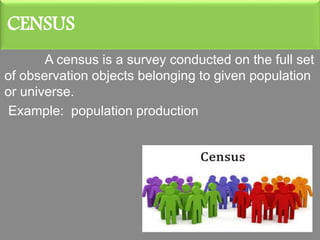
A census is a survey conducted on the full set
of observation objects belonging to given population
or universe.
Example: population production
Advantages of census
1 Results are more accurate and reliable.
2 Intensive ( the investor gather a lot of knowledge).
3. Suitable for different units.
4. Increase confidence interval.
5. Maximum chance of identifying of negative
feedback
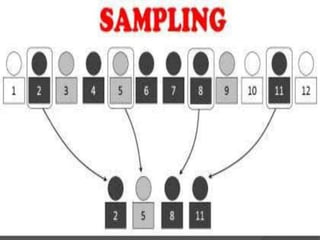
SAMPLING
Sampling is the selection of a subset of
individuals from statistical population to estimate
characteristics of the whole population.
 Example: 1)The top 10 students in the class are the sample.
2)Top 50 results are selected.
ADVANTAGES OF SAMPLING
 Less time consuming in sampling.
 There is high scope for sampling.
 Accuracy of data is high.
 Suitable in limited resources.
 Low cost of sampling.
 It helps in checking census results.
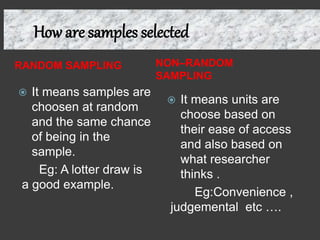
How are samples selected
RANDOM SAMPLING NON–RANDOM
SAMPLING
 It means samples are
choosen at random
and the same chance
of being in the
sample.
Eg: A lotter draw is
a good example.
 It means units are
choose based on
their ease of access
and also based on
what researcher
thinks .
Eg:Convenience ,
judgemental etc ….
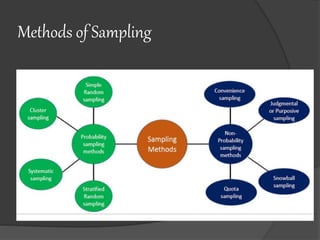
Methods of Sampling
CONCLUSION
Here finally conclude that using a sample in
research saves mainly on money and time. If a
suitable sampling stratagy is used. Higher
population growth supplies more work force in the
market and at last censuse prpviding detailed
information on the demogrophic, social aspects of
the population.
REFERENCE
 Population meaning and advantages (retrieved
from http://www.yourarticlelibrary.com) date: 27/04/21
 Census meaning and advantages (retrieved from
http://byjus.com) date: 27/04/21
 Sampling meaning and advantages (retrieved
fromhttp://www.accontlearning.com) date: 27/04/21
/

POPULATION, CENSUS AND SAMPLING ITS MEANING AND ADVANTAGES

  • 1.
    POPULATION, CENSUS AND SAMPLING ITSMEANING AND ADVANTAGES PRESENTER NIRMALA K 1st M.Com Under the guidance of Sundar B. N. Asst. Prof. & Course Co-ordinator GFGCW, PG Studies in Commerce Holenarasipura
  • 2.
    CONTENT  Introduction  Datacollection of population , census and sampling. 1. Meaning 2. Example 3. Advantages  How are samples collected  Conclusion  Reference
  • 3.
    INTRODUCTION Data collection ofpopulation, census and sample  Statistical is the science of data there are several method of data collection . Here we shall focus on 3 months i.e population ,census and sample.  A population may be studied by using one of two approaches. i.e Taking a census or selecting sample.  The census of India is conducted once in every 10 years and the 1st census in India was held on 1881.  The national sample survey came in to being in 1950 to collect information through sample surveys on verity of socio- economic aspects.
  • 4.
    MEANING OF POPULATION Usingstatistical tools for the population is very popular because it can be easely collect the data on the population of a place in such as size , age and sex composition , geographical distribution and socio – economic features. i.e All the people who have the id proofs is the population.
  • 5.
    ADVANTAGES OF POPULATION BETTER USE OF RESOURSES If the population is above the optimum size , the country will be able to make better use of resourses.  INCREASE SIZE OF MARKET The size of market will increase , it should enable firms to take more benefits of economic scale.  EXTRE DEMAND More demand will be generated and this may lead to introduction of new technology.
  • 6.
    CENSUS A census isa survey conducted on the full set of observation objects belonging to given population or universe. Example: population production
  • 7.
    Advantages of census 1Results are more accurate and reliable. 2 Intensive ( the investor gather a lot of knowledge). 3. Suitable for different units. 4. Increase confidence interval. 5. Maximum chance of identifying of negative feedback
  • 8.
    SAMPLING Sampling is theselection of a subset of individuals from statistical population to estimate characteristics of the whole population.  Example: 1)The top 10 students in the class are the sample. 2)Top 50 results are selected.
  • 10.
    ADVANTAGES OF SAMPLING Less time consuming in sampling.  There is high scope for sampling.  Accuracy of data is high.  Suitable in limited resources.  Low cost of sampling.  It helps in checking census results.
  • 11.
    How are samplesselected RANDOM SAMPLING NON–RANDOM SAMPLING  It means samples are choosen at random and the same chance of being in the sample. Eg: A lotter draw is a good example.  It means units are choose based on their ease of access and also based on what researcher thinks . Eg:Convenience , judgemental etc ….
  • 12.
  • 13.
    CONCLUSION Here finally concludethat using a sample in research saves mainly on money and time. If a suitable sampling stratagy is used. Higher population growth supplies more work force in the market and at last censuse prpviding detailed information on the demogrophic, social aspects of the population.
  • 14.
    REFERENCE  Population meaningand advantages (retrieved from http://www.yourarticlelibrary.com) date: 27/04/21  Census meaning and advantages (retrieved from http://byjus.com) date: 27/04/21  Sampling meaning and advantages (retrieved fromhttp://www.accontlearning.com) date: 27/04/21 /