Sampling and its
types
Meaning
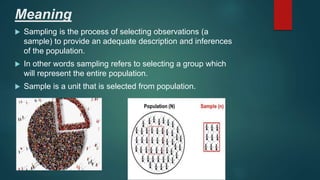
 Sampling is the process of selecting observations (a
sample) to provide an adequate description and inferences
of the population.
 In other words sampling refers to selecting a group which
will represent the entire population.
 Sample is a unit that is selected from population.
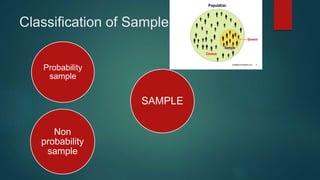
Classification of Sample
Probability
sample
Non
probability
sample
SAMPLE
Probability Sample
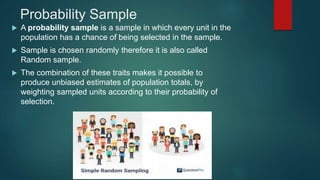
 A probability sample is a sample in which every unit in the
population has a chance of being selected in the sample.
 Sample is chosen randomly therefore it is also called
Random sample.
 The combination of these traits makes it possible to
produce unbiased estimates of population totals, by
weighting sampled units according to their probability of
selection.
Probability Sampling
Simple random
sampling
Stratified
random
sampling
Clusture
sampling
Systematic
sampling
Simple Random Sample
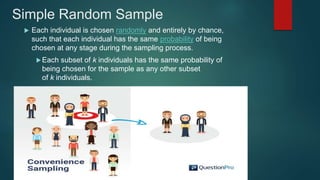
 Each individual is chosen randomly and entirely by chance,
such that each individual has the same probability of being
chosen at any stage during the sampling process.
Each subset of k individuals has the same probability of
being chosen for the sample as any other subset
of k individuals.
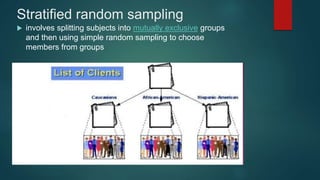
Stratified random sampling
 involves splitting subjects into mutually exclusive groups
and then using simple random sampling to choose
members from groups
Systematic Sampling
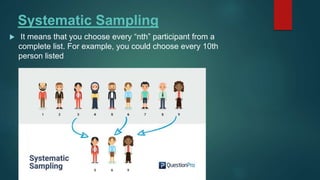
 It means that you choose every “nth” participant from a
complete list. For example, you could choose every 10th
person listed
Cluster Random Sampling
 It is a way to randomly select participants from a list that is
too large for simple random sampling.
 For example, if you wanted to choose 1000 participants
from the entire population of the U.S., it is likely impossible
to get a complete list of everyone. Instead, the researcher
randomly selects areas (i.e. cities or counties) and
randomly selects from within those boundaries.
Non Probability sampling
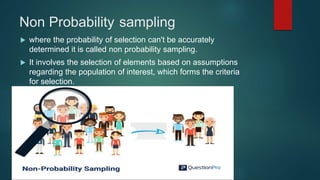
 where the probability of selection can't be accurately
determined it is called non probability sampling.
 It involves the selection of elements based on assumptions
regarding the population of interest, which forms the criteria
for selection.
Non probability sampling types
Convenience Snowball
Quota Purposive
Convenience sample
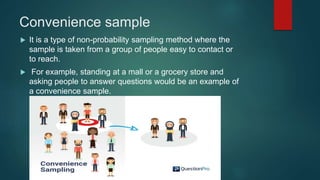
 It is a type of non-probability sampling method where the
sample is taken from a group of people easy to contact or
to reach.
 For example, standing at a mall or a grocery store and
asking people to answer questions would be an example of
a convenience sample.
Quota sampling
 A population is first segmented into mutually exclusive sub-
groups, just as in stratified sampling.
 Then judgment is used to select the subjects or units from
each segment based on a specified proportion.
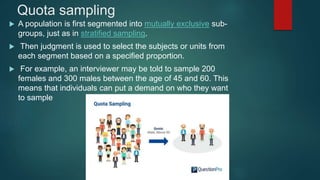
 For example, an interviewer may be told to sample 200
females and 300 males between the age of 45 and 60. This
means that individuals can put a demand on who they want
to sample
Purposive sampling
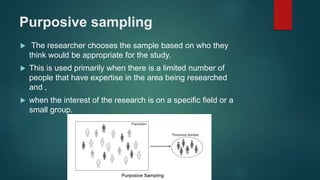
 The researcher chooses the sample based on who they
think would be appropriate for the study.
 This is used primarily when there is a limited number of
people that have expertise in the area being researched
and ,
 when the interest of the research is on a specific field or a
small group.
Snowball sampling
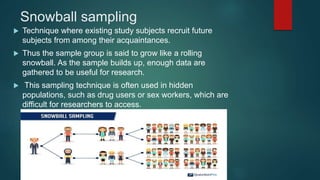
 Technique where existing study subjects recruit future
subjects from among their acquaintances.
 Thus the sample group is said to grow like a rolling
snowball. As the sample builds up, enough data are
gathered to be useful for research.
 This sampling technique is often used in hidden
populations, such as drug users or sex workers, which are
difficult for researchers to access.
Thankyou..

Sampling and its types

  • 1.
  • 2.
    Meaning  Sampling isthe process of selecting observations (a sample) to provide an adequate description and inferences of the population.  In other words sampling refers to selecting a group which will represent the entire population.  Sample is a unit that is selected from population.
  • 4.
  • 5.
    Probability Sample  Aprobability sample is a sample in which every unit in the population has a chance of being selected in the sample.  Sample is chosen randomly therefore it is also called Random sample.  The combination of these traits makes it possible to produce unbiased estimates of population totals, by weighting sampled units according to their probability of selection.
  • 6.
  • 7.
    Simple Random Sample Each individual is chosen randomly and entirely by chance, such that each individual has the same probability of being chosen at any stage during the sampling process. Each subset of k individuals has the same probability of being chosen for the sample as any other subset of k individuals.
  • 8.
    Stratified random sampling involves splitting subjects into mutually exclusive groups and then using simple random sampling to choose members from groups
  • 9.
    Systematic Sampling  Itmeans that you choose every “nth” participant from a complete list. For example, you could choose every 10th person listed
  • 10.
    Cluster Random Sampling It is a way to randomly select participants from a list that is too large for simple random sampling.  For example, if you wanted to choose 1000 participants from the entire population of the U.S., it is likely impossible to get a complete list of everyone. Instead, the researcher randomly selects areas (i.e. cities or counties) and randomly selects from within those boundaries.
  • 11.
    Non Probability sampling where the probability of selection can't be accurately determined it is called non probability sampling.  It involves the selection of elements based on assumptions regarding the population of interest, which forms the criteria for selection.
  • 12.
    Non probability samplingtypes Convenience Snowball Quota Purposive
  • 13.
    Convenience sample  Itis a type of non-probability sampling method where the sample is taken from a group of people easy to contact or to reach.  For example, standing at a mall or a grocery store and asking people to answer questions would be an example of a convenience sample.
  • 14.
    Quota sampling  Apopulation is first segmented into mutually exclusive sub- groups, just as in stratified sampling.  Then judgment is used to select the subjects or units from each segment based on a specified proportion.  For example, an interviewer may be told to sample 200 females and 300 males between the age of 45 and 60. This means that individuals can put a demand on who they want to sample
  • 15.
    Purposive sampling  Theresearcher chooses the sample based on who they think would be appropriate for the study.  This is used primarily when there is a limited number of people that have expertise in the area being researched and ,  when the interest of the research is on a specific field or a small group.
  • 16.
    Snowball sampling  Techniquewhere existing study subjects recruit future subjects from among their acquaintances.  Thus the sample group is said to grow like a rolling snowball. As the sample builds up, enough data are gathered to be useful for research.  This sampling technique is often used in hidden populations, such as drug users or sex workers, which are difficult for researchers to access.
  • 17.