Nuclear Magnetic Resonance
-Roll no:-3
Introduction
• Nuclear Magnetic Resonance (NMR) is a
spectroscopy technique which is based on the
absorption of electron magnetic radiation in the
radio frequency region by nuclei of atoms.
• The radio frequency radiation has the frequency
range of 4-900 MHz corresponded to the
wavelength region of 75-0.5 m.
• For example we can have NMR signals for the
following atoms:-
• 1H and 13C.
Uses of NMR
• To record differences in the magnetic
properties of various magnetic nuclei present.
• To study different kind of environment within
the molecule.
• To study which atoms are present in
neighbouring groups.
• To deduce the position of nuclei within the
molecule.
Spinning Nucleus (Principle)
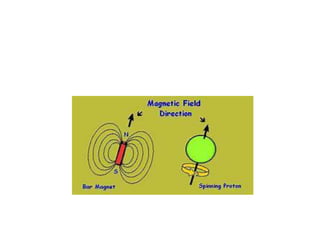
• Nucleus of the hydrogen atom(proton)
behaves as a tiny spinning bar magnet as it
possesses both electric charge and mechanical
spin.
• Any spinning charged body , generate a
magnetic field.
Effect of an external magnetic field
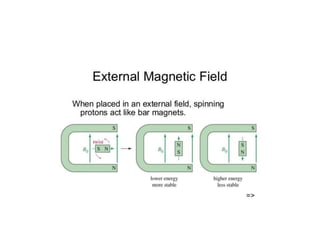
• Proton responds to the influence of an
external magnetic field by aligning itself with
that field.
• Proton can only adopt two orientations to the
external magnetic field.
• Aligned with the field (lower energy state or
parallel).
• Opposed to the field (higher energy state or
antiparallel).
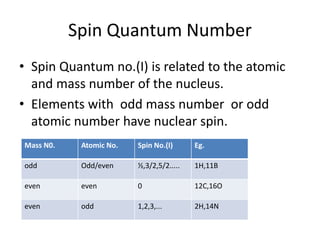
Spin Quantum Number
• Spin Quantum no.(I) is related to the atomic
and mass number of the nucleus.
• Elements with odd mass number or odd
atomic number have nuclear spin.
Mass N0. Atomic No. Spin No.(I) Eg.
odd Odd/even ½,3/2,5/2..... 1H,11B
even even 0 12C,16O
even odd 1,2,3,... 2H,14N
Shielding and Deshielding
Upfield:-
The nucleus feels weaker magnetic field.
Shielding:-
A nucleus whose chemical shift has been
decreased due to the addition of electron
density , magnetic induction or other effects.
Deshielding
• Downfield:-
• The nucleus feels stronger magnetic feild.
• Deshielding:-
• A nucleus whose chemical shift has been
increased due to removal of electron density,
magnetic induction or other effects.
Chemical Shift
• Chemical shift is difference between the
absorption position of the sample proton and
absorption position of reference standard.
• Variation of position of NMR absorption due
to the electronic shielding and deshielding.
Measurement of chemical Shift
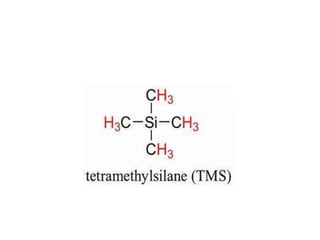
• For protons and 13C ,the accepted reference is
Tetramethylsilane , TMS.
• Low boiling point.
• Soluble in most organic solvents.
• Not soluble in water.
• The chemical shift numbers (signals) of Hs depend on
the surrounding (neighbours) atoms.
• The higher chemical shift are for most deshielded Hs
and lower chemical shift are for most shielded Hs.
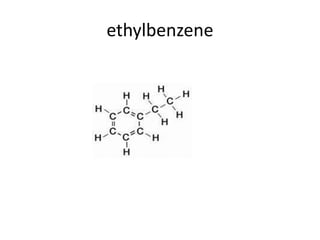
• In the above spectrum which is for ethylbenzene that
Hs in the benzene ring are highly deshielded giving the
NMR signal around 7.1 ppm.
• The Hs in CH2 are close to the benzene ring appearing
at 2.6 ppm.
• The Hs in Ch3 are far away from the benzene ring ,
more shielded , giving NMR signal at 1.6 ppm.
1H NMR chemical shift
• Protons in different environments experience
different degrees of shielding and have
different chemical shifts.
ethylbenzene
electronegativity
• The chemical shift simply increases as the
electronegativity of the attached element
increases.
• The greater the electronegativity of the
substituents , the more deshielding of protons
and hence greater is the chemical shift of
those protons.
Interpretation of NMR spectra
• Numbers of signals- indicates how many
different kind of protons presents.
• Position of signals-indicates magnetic
environments of protons.
• Relative intensity of signals-proportional to
numbers of protons present.
• Splitting of signals- indicates the number of
nearby nuclei usually protons.
1H NMR – number of signals
• The number of NMR signals equals the
number of different types of protons in a
compound.
• Protons in different environments give
different NMR signals.
• Equivalent protons give the NMR signal.
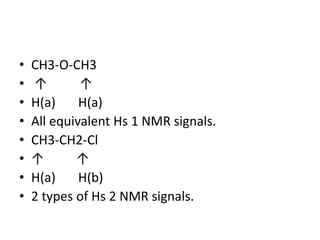
• CH3-O-CH3
• ↑ ↑
• H(a) H(a)
• All equivalent Hs 1 NMR signals.
• CH3-CH2-Cl
• ↑ ↑
• H(a) H(b)
• 2 types of Hs 2 NMR signals.
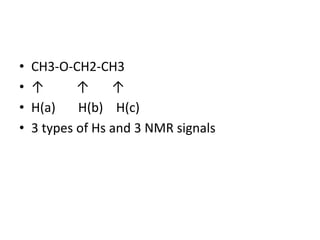
• CH3-O-CH2-CH3
• ↑ ↑ ↑
• H(a) H(b) H(c)
• 3 types of Hs and 3 NMR signals
1H NMR –Positions of signals
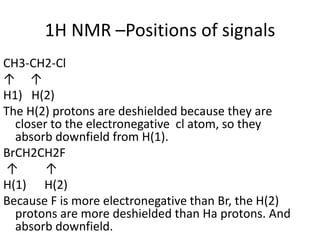
CH3-CH2-Cl
↑ ↑
H1) H(2)
The H(2) protons are deshielded because they are
closer to the electronegative cl atom, so they
absorb downfield from H(1).
BrCH2CH2F
↑ ↑
H(1) H(2)
Because F is more electronegative than Br, the H(2)
protons are more deshielded than Ha protons. And
absorb downfield.
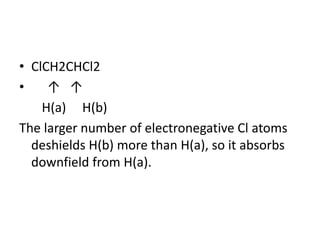
• ClCH2CHCl2
• ↑ ↑
H(a) H(b)
The larger number of electronegative Cl atoms
deshields H(b) more than H(a), so it absorbs
downfield from H(a).
1H NMR- Intensity of signals
• The area under an NMR signal is proportional
to the number of absorbing protons.
• An NMR spectrometer automatically
integrates the area under the peaks , and
prints out a stepped curve on the spectrum.
• Modern NMR spectrometers automatically
calculate and plot the value of each integral in
arbitrary units.
Example
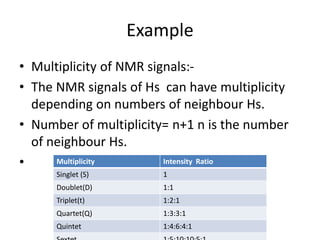
• Multiplicity of NMR signals:-
• The NMR signals of Hs can have multiplicity
depending on numbers of neighbour Hs.
• Number of multiplicity= n+1 n is the number
of neighbour Hs.
• Multiplicity Intensity Ratio
Singlet (S) 1
Doublet(D) 1:1
Triplet(t) 1:2:1
Quartet(Q) 1:3:3:1
Quintet 1:4:6:4:1
Spin- Spin Coupling
• Splitting in other words.
• Protons on nearby carbons will interact and
split (division) each others resonance into
multiple peaks (multiples) n+1 rule:-
• Equivalent protons that have n equivalent
protons on the adjacent carbon will be split
into n+1 peaks.
Limitations of NMR
• It is limited to the measurement of nuclei
with magnetic moments.
• It may be less sensitive than other
spectroscopic and chromatograhic methods of
analyses.
• Requires computer modelling- time
consuming and expensive.
Applications of NMR
• Material Science:- A powerful tool in research of polymer
chemistry and physics.
• Chemical Analysis:- A matured technique for chemical
identification of chemicals whether synthetic or natural.
• Hydrogen bonding :-A unique technique for the DIRECT
detection of hydrogen bonding interactions.
• Drug screening and design :-Particularly useful for
identifying drug leads and determining the conformations
of the compounds bound to enzymes, receptors, and other
proteins.
• Protein hydration :-A power tool for the detection of
interior water and its interaction with biomacromolecules.
THANK YOU

Nmr 2

  • 1.
  • 2.
    Introduction • Nuclear MagneticResonance (NMR) is a spectroscopy technique which is based on the absorption of electron magnetic radiation in the radio frequency region by nuclei of atoms. • The radio frequency radiation has the frequency range of 4-900 MHz corresponded to the wavelength region of 75-0.5 m. • For example we can have NMR signals for the following atoms:- • 1H and 13C.
  • 3.
    Uses of NMR •To record differences in the magnetic properties of various magnetic nuclei present. • To study different kind of environment within the molecule. • To study which atoms are present in neighbouring groups. • To deduce the position of nuclei within the molecule.
  • 4.
    Spinning Nucleus (Principle) •Nucleus of the hydrogen atom(proton) behaves as a tiny spinning bar magnet as it possesses both electric charge and mechanical spin. • Any spinning charged body , generate a magnetic field.
  • 6.
    Effect of anexternal magnetic field • Proton responds to the influence of an external magnetic field by aligning itself with that field. • Proton can only adopt two orientations to the external magnetic field. • Aligned with the field (lower energy state or parallel). • Opposed to the field (higher energy state or antiparallel).
  • 8.
    Spin Quantum Number •Spin Quantum no.(I) is related to the atomic and mass number of the nucleus. • Elements with odd mass number or odd atomic number have nuclear spin. Mass N0. Atomic No. Spin No.(I) Eg. odd Odd/even ½,3/2,5/2..... 1H,11B even even 0 12C,16O even odd 1,2,3,... 2H,14N
  • 9.
    Shielding and Deshielding Upfield:- Thenucleus feels weaker magnetic field. Shielding:- A nucleus whose chemical shift has been decreased due to the addition of electron density , magnetic induction or other effects.
  • 10.
    Deshielding • Downfield:- • Thenucleus feels stronger magnetic feild. • Deshielding:- • A nucleus whose chemical shift has been increased due to removal of electron density, magnetic induction or other effects.
  • 11.
    Chemical Shift • Chemicalshift is difference between the absorption position of the sample proton and absorption position of reference standard. • Variation of position of NMR absorption due to the electronic shielding and deshielding.
  • 12.
    Measurement of chemicalShift • For protons and 13C ,the accepted reference is Tetramethylsilane , TMS. • Low boiling point. • Soluble in most organic solvents. • Not soluble in water.
  • 13.
    • The chemicalshift numbers (signals) of Hs depend on the surrounding (neighbours) atoms. • The higher chemical shift are for most deshielded Hs and lower chemical shift are for most shielded Hs. • In the above spectrum which is for ethylbenzene that Hs in the benzene ring are highly deshielded giving the NMR signal around 7.1 ppm. • The Hs in CH2 are close to the benzene ring appearing at 2.6 ppm. • The Hs in Ch3 are far away from the benzene ring , more shielded , giving NMR signal at 1.6 ppm.
  • 15.
    1H NMR chemicalshift • Protons in different environments experience different degrees of shielding and have different chemical shifts.
  • 16.
  • 17.
    electronegativity • The chemicalshift simply increases as the electronegativity of the attached element increases. • The greater the electronegativity of the substituents , the more deshielding of protons and hence greater is the chemical shift of those protons.
  • 18.
    Interpretation of NMRspectra • Numbers of signals- indicates how many different kind of protons presents. • Position of signals-indicates magnetic environments of protons. • Relative intensity of signals-proportional to numbers of protons present. • Splitting of signals- indicates the number of nearby nuclei usually protons.
  • 19.
    1H NMR –number of signals • The number of NMR signals equals the number of different types of protons in a compound. • Protons in different environments give different NMR signals. • Equivalent protons give the NMR signal.
  • 20.
    • CH3-O-CH3 • ↑↑ • H(a) H(a) • All equivalent Hs 1 NMR signals. • CH3-CH2-Cl • ↑ ↑ • H(a) H(b) • 2 types of Hs 2 NMR signals.
  • 21.
    • CH3-O-CH2-CH3 • ↑↑ ↑ • H(a) H(b) H(c) • 3 types of Hs and 3 NMR signals
  • 22.
    1H NMR –Positionsof signals CH3-CH2-Cl ↑ ↑ H1) H(2) The H(2) protons are deshielded because they are closer to the electronegative cl atom, so they absorb downfield from H(1). BrCH2CH2F ↑ ↑ H(1) H(2) Because F is more electronegative than Br, the H(2) protons are more deshielded than Ha protons. And absorb downfield.
  • 23.
    • ClCH2CHCl2 • ↑↑ H(a) H(b) The larger number of electronegative Cl atoms deshields H(b) more than H(a), so it absorbs downfield from H(a).
  • 24.
    1H NMR- Intensityof signals • The area under an NMR signal is proportional to the number of absorbing protons. • An NMR spectrometer automatically integrates the area under the peaks , and prints out a stepped curve on the spectrum. • Modern NMR spectrometers automatically calculate and plot the value of each integral in arbitrary units.
  • 25.
    Example • Multiplicity ofNMR signals:- • The NMR signals of Hs can have multiplicity depending on numbers of neighbour Hs. • Number of multiplicity= n+1 n is the number of neighbour Hs. • Multiplicity Intensity Ratio Singlet (S) 1 Doublet(D) 1:1 Triplet(t) 1:2:1 Quartet(Q) 1:3:3:1 Quintet 1:4:6:4:1
  • 26.
    Spin- Spin Coupling •Splitting in other words. • Protons on nearby carbons will interact and split (division) each others resonance into multiple peaks (multiples) n+1 rule:- • Equivalent protons that have n equivalent protons on the adjacent carbon will be split into n+1 peaks.
  • 27.
    Limitations of NMR •It is limited to the measurement of nuclei with magnetic moments. • It may be less sensitive than other spectroscopic and chromatograhic methods of analyses. • Requires computer modelling- time consuming and expensive.
  • 28.
    Applications of NMR •Material Science:- A powerful tool in research of polymer chemistry and physics. • Chemical Analysis:- A matured technique for chemical identification of chemicals whether synthetic or natural. • Hydrogen bonding :-A unique technique for the DIRECT detection of hydrogen bonding interactions. • Drug screening and design :-Particularly useful for identifying drug leads and determining the conformations of the compounds bound to enzymes, receptors, and other proteins. • Protein hydration :-A power tool for the detection of interior water and its interaction with biomacromolecules.
  • 29.