PRESENTATION ON:
NUCLEAR MAGNETIC RESONANCE
SPECTROSCOPY (NMR)
INTEGRAL UNIVERSITY,LUCKNOW
Session: 2016-2017
Presented by: Under the guidence of:
Mohd Muztaba
M.Pharm Mr. Paramdeep Bagga
Pharmacology
INTRODUCTION
 Nuclear magnetic resonance spectroscopy(NMR) is a powerful
analytical technique used to characterize organic molecules by
identifying carbon-hydrogen frameworks within molecules.
 It is a research technique that exploits the magnetic properties
of certain atomic nuclei.
 It determines the physical and chemical properties of atoms or
the molecules in which they are contained.
Types of NMR
• Two common types of NMR spectroscopy are used to
characterize organic structure:
– 1H NMR:- Used to determine the type and number of H
atoms in a molecule
– 13C NMR:- Used to determine the type of carbon atoms in
the molecule
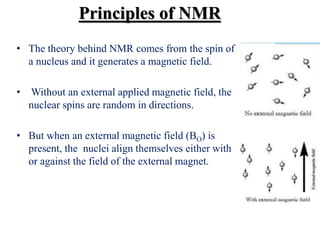
• The theory behind NMR comes from the spin of
a nucleus and it generates a magnetic field.
• Without an external applied magnetic field, the
nuclear spins are random in directions.
• But when an external magnetic field (BO) is
present, the nuclei align themselves either with
or against the field of the external magnet.
Principles of NMR
 If an external magnetic field is applied, an energy
transfer (∆E) is possible between ground state to excited
state
 When the spin returns to its ground state level, the
absorbed radiofrequency energy is emitted at the same
frequency level.
 The emitted radiofrequency signal gives the NMR
spectrum of the concerned nucleus.
APPLICATION
 It is use to identification of structrul isomertism
eg. n-propanol ,isopropanol
 Identification of H bonding
 Use for determination of aromaticities of compound
 NMR technique use to distinguish betweeen cis and trans
isomer
 Detection of Electronegative atom
 Detection of some double bond character due to resonance
We hope you liked our presentation.
• Thank you! 

Nmr mujtaba

  • 1.
    PRESENTATION ON: NUCLEAR MAGNETICRESONANCE SPECTROSCOPY (NMR) INTEGRAL UNIVERSITY,LUCKNOW Session: 2016-2017 Presented by: Under the guidence of: Mohd Muztaba M.Pharm Mr. Paramdeep Bagga Pharmacology
  • 2.
    INTRODUCTION  Nuclear magneticresonance spectroscopy(NMR) is a powerful analytical technique used to characterize organic molecules by identifying carbon-hydrogen frameworks within molecules.  It is a research technique that exploits the magnetic properties of certain atomic nuclei.  It determines the physical and chemical properties of atoms or the molecules in which they are contained.
  • 3.
    Types of NMR •Two common types of NMR spectroscopy are used to characterize organic structure: – 1H NMR:- Used to determine the type and number of H atoms in a molecule – 13C NMR:- Used to determine the type of carbon atoms in the molecule
  • 4.
    • The theorybehind NMR comes from the spin of a nucleus and it generates a magnetic field. • Without an external applied magnetic field, the nuclear spins are random in directions. • But when an external magnetic field (BO) is present, the nuclei align themselves either with or against the field of the external magnet. Principles of NMR
  • 5.
     If anexternal magnetic field is applied, an energy transfer (∆E) is possible between ground state to excited state  When the spin returns to its ground state level, the absorbed radiofrequency energy is emitted at the same frequency level.  The emitted radiofrequency signal gives the NMR spectrum of the concerned nucleus.
  • 6.
    APPLICATION  It isuse to identification of structrul isomertism eg. n-propanol ,isopropanol  Identification of H bonding  Use for determination of aromaticities of compound  NMR technique use to distinguish betweeen cis and trans isomer  Detection of Electronegative atom  Detection of some double bond character due to resonance
  • 7.
    We hope youliked our presentation. • Thank you! 