Dr.Safia A. Alrezami
*They are type of antibiotic which inhibition protein synthesis.
*it is bactericidal.
*Used to suspicion sepsis and other infection.
*Used in combination with B-lactum in therapy.
*Dosage form : injection (vial) ,tab ,cream ,oint, solution for skin apply.
*Teratogenicity for pregnant women.
Drugs in this class
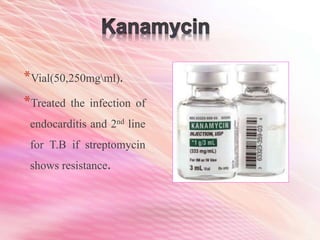
*Vial(50,250mgml).
*Treated the infection of
endocarditis and 2nd line
for T.B if streptomycin
shows resistance.
* Vial(400mgml)
* Agonist endocarditis and
2nd line for T.B if
streptomycin shows
resistance, also in
tularemia.
* Vial(400mgml)
* Treated sepsis ,meningitis
and pneumonia
* topical (cream ,oint ,
solution 0.1-. 0.3%
* Used in burns , wounds,
skin lesion.
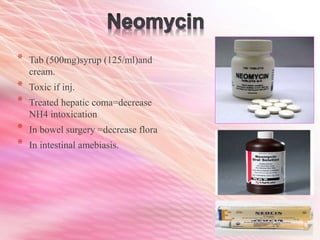
* Tab (500mg)syrup (125/ml)and
cream.
* Toxic if inj.
* Treated hepatic coma=decrease
NH4 intoxication
* In bowel surgery =decrease flora
* In intestinal amebiasis.
The main side effects are
1.Autotoxicity 2.Nephrotoxicity
1.With penicillin
Aminoglycoside + penicillin =
Inactivation of AGS
How?
* This happen when penicillin destroy the rind of
Aminoglycoside.
Solution :
* Don’t mix in one syringe or in the same time just
separate 2 hours between two drugs.
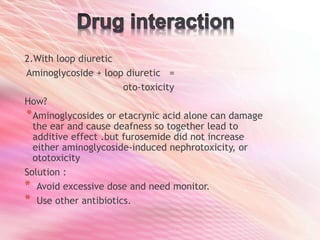
2.With loop diuretic
Aminoglycoside + loop diuretic =
oto-toxicity
How?
*Aminoglycosides or etacrynic acid alone can damage
the ear and cause deafness so together lead to
additive effect .but furosemide did not increase
either aminoglycoside-induced nephrotoxicity, or
ototoxicity
Solution :
* Avoid excessive dose and need monitor.
* Use other antibiotics.
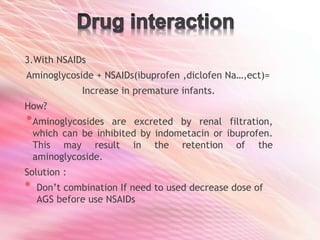
3.With NSAIDs
Aminoglycoside + NSAIDs(ibuprofen ,diclofen Na…,ect)=
Increase in premature infants.
How?
*Aminoglycosides are excreted by renal filtration,
which can be inhibited by indometacin or ibuprofen.
This may result in the retention of the
aminoglycoside.
Solution :
* Don’t combination If need to used decrease dose of
AGS before use NSAIDs
4.With cephalosporin
Aminoglycoside + cephalosporin=
Nephrotoxicity .
How?
*The nephrotoxic effects of gentamicin and tobramycin are
well documented, and some (mostly older) cephalosporins
are known to be nephrotoxic, especially in high dose.
However, it appears that doses that are well tolerated
separately can be nephrotoxic when given together.
Solution :
*Monitor aminoglycoside concentrations and kidney function.
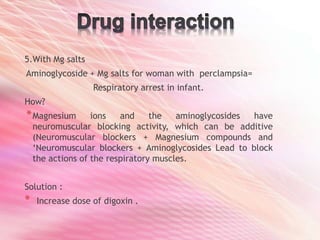
5.With Mg salts
Aminoglycoside + Mg salts for woman with perclampsia=
Respiratory arrest in infant.
How?
*Magnesium ions and the aminoglycosides have
neuromuscular blocking activity, which can be additive
(Neuromuscular blockers + Magnesium compounds and
‘Neuromuscular blockers + Aminoglycosides Lead to block
the actions of the respiratory muscles.
Solution :
* Increase dose of digoxin .
6.With digoxin
Aminoglycoside + digoxin=
decrease conc. Of digoxin.
Solution :
* Increase dose of digoxin .
*MEDfacts POCKETGUIDE OF DRUGINTERACTIONS.
*Martindale36.
*katzung BASIC& CLINICAL PHARMACOLOGY(2007).
*Stockley’s DrugInteractions.
THANK YOU FOR LISTENING

Aminoglycoside

  • 1.
  • 2.
    *They are typeof antibiotic which inhibition protein synthesis. *it is bactericidal. *Used to suspicion sepsis and other infection. *Used in combination with B-lactum in therapy. *Dosage form : injection (vial) ,tab ,cream ,oint, solution for skin apply. *Teratogenicity for pregnant women. Drugs in this class
  • 3.
    *Vial(50,250mgml). *Treated the infectionof endocarditis and 2nd line for T.B if streptomycin shows resistance.
  • 4.
    * Vial(400mgml) * Agonistendocarditis and 2nd line for T.B if streptomycin shows resistance, also in tularemia.
  • 5.
    * Vial(400mgml) * Treatedsepsis ,meningitis and pneumonia * topical (cream ,oint , solution 0.1-. 0.3% * Used in burns , wounds, skin lesion.
  • 6.
    * Tab (500mg)syrup(125/ml)and cream. * Toxic if inj. * Treated hepatic coma=decrease NH4 intoxication * In bowel surgery =decrease flora * In intestinal amebiasis.
  • 7.
    The main sideeffects are 1.Autotoxicity 2.Nephrotoxicity
  • 8.
    1.With penicillin Aminoglycoside +penicillin = Inactivation of AGS How? * This happen when penicillin destroy the rind of Aminoglycoside. Solution : * Don’t mix in one syringe or in the same time just separate 2 hours between two drugs.
  • 9.
    2.With loop diuretic Aminoglycoside+ loop diuretic = oto-toxicity How? *Aminoglycosides or etacrynic acid alone can damage the ear and cause deafness so together lead to additive effect .but furosemide did not increase either aminoglycoside-induced nephrotoxicity, or ototoxicity Solution : * Avoid excessive dose and need monitor. * Use other antibiotics.
  • 10.
    3.With NSAIDs Aminoglycoside +NSAIDs(ibuprofen ,diclofen Na…,ect)= Increase in premature infants. How? *Aminoglycosides are excreted by renal filtration, which can be inhibited by indometacin or ibuprofen. This may result in the retention of the aminoglycoside. Solution : * Don’t combination If need to used decrease dose of AGS before use NSAIDs
  • 11.
    4.With cephalosporin Aminoglycoside +cephalosporin= Nephrotoxicity . How? *The nephrotoxic effects of gentamicin and tobramycin are well documented, and some (mostly older) cephalosporins are known to be nephrotoxic, especially in high dose. However, it appears that doses that are well tolerated separately can be nephrotoxic when given together. Solution : *Monitor aminoglycoside concentrations and kidney function.
  • 12.
    5.With Mg salts Aminoglycoside+ Mg salts for woman with perclampsia= Respiratory arrest in infant. How? *Magnesium ions and the aminoglycosides have neuromuscular blocking activity, which can be additive (Neuromuscular blockers + Magnesium compounds and ‘Neuromuscular blockers + Aminoglycosides Lead to block the actions of the respiratory muscles. Solution : * Increase dose of digoxin .
  • 13.
    6.With digoxin Aminoglycoside +digoxin= decrease conc. Of digoxin. Solution : * Increase dose of digoxin .
  • 14.
    *MEDfacts POCKETGUIDE OFDRUGINTERACTIONS. *Martindale36. *katzung BASIC& CLINICAL PHARMACOLOGY(2007). *Stockley’s DrugInteractions.
  • 15.
    THANK YOU FORLISTENING