



Cairo university 
Faculty of pharmacy 
Analytical chemistry 
department
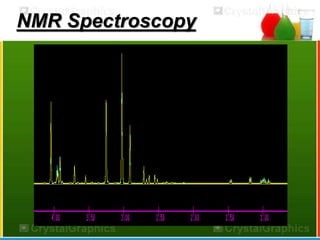
NMR Spectroscopy
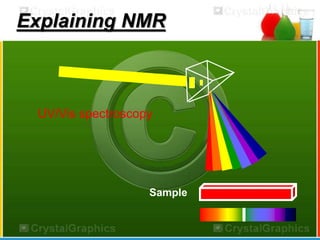
Explaining NMR 
UV/Vis spectroscopy 
Sample
Nuclear magnetic resonance 
spectroscopy 
• Def. :-known as NMR spectroscopy, is a 
research technique that exploits the 
magnetic properties of certain a certain 
atomic nuclei. 
• . It determines the physical and chemical 
properties of atoms in which they are 
contained.
•Basic NMR techniques:- 
1-The NMR sample is prepared in a 
thin-walled glass tube - a NMR tube. 
2-When placed in a magnetic field, 
NMR active nuclei (such as 1H 
or 13C) absorb electromagnetic 
radiation .
• Now we have to answer an important 
question, on which phenomenon it relies ? 
• As an answer for this question we will ay it 
depends on nuclear magnetic resonance. 
• Importance :- 
1-Can provide detailed information about the 
structure, dynamics, reaction state, and 
chemical environment of molecules. 
2-is used by chemists and biochemists to 
investigate the properties of organic 
molecules at a frequency characteristic of 
the isotope.
•Now it is time to talk about the chemical 
shift. 
• What is chemical shift? 
•Chemical shift:-is the resonant frequency of a 
nucleus relative to a standard, this standard 
is often tetramethylsilane, Si(CH3)4, 
abbreviated TMS.
Example of the chemical shift: 
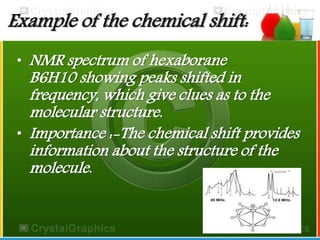
• NMR spectrum of hexaborane 
B6H10 showing peaks shifted in 
frequency, which give clues as to the 
molecular structure. 
• Importance :-The chemical shift provides 
information about the structure of the 
molecule.
• Do you remember spin-spin coupling? 
• It a special type of it. This coupling arises 
from the interaction of different spin states 
through the chemical bonds of a molecule 
and results in the splitting of NMR signals. 
• Importance:-it provides detailed insight 
into the connectivity of atoms in a 
molecule.
NMR analysis applications 
1-Chemical structure analysis of liquids and 
dissolved solids 
2-Deformulation of products 
3-Quantification of mixture components
NMR analysis capabilities : 
1- Quantitative NMR Analysis (qNMR) 
2-solid State Nuclear Magnetic Resonance 
3-Solution State NMR 
4-NMR Chemical Composition 
5-Elucidation
.NMR analysis expertise 
laboratories provide clients analytical 
data regarding the type, quantity and 
arrangement of atoms in chemical 
systems, liquids and solids.
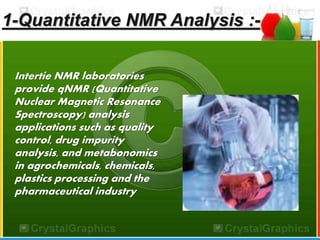
1-Quantitative NMR Analysis :- 
Intertie NMR laboratories 
provide qNMR (Quantitative 
Nuclear Magnetic Resonance 
Spectroscopy) analysis 
applications such as quality 
control, drug impurity 
analysis, and metabonomics 
in agrochemicals, chemicals, 
plastics processing and the 
pharmaceutical industry
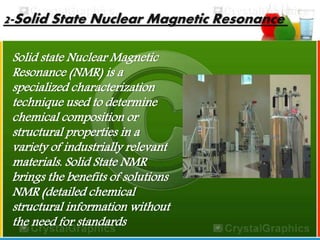
2-Solid State Nuclear Magnetic Resonance 
Solid state Nuclear Magnetic 
Resonance (NMR) is a 
specialized characterization 
technique used to determine 
chemical composition or 
structural properties in a 
variety of industrially relevant 
materials. Solid State NMR 
brings the benefits of solutions 
NMR (detailed chemical 
structural information without 
the need for standards
Determination of catalyst 
Heterogeneous catalysts used for 
chemical manufacture, petroleum 
processes, purification, and air 
separation 
Determine framework 
composition of zeolites and changes 
with activation or use 
Identify adsorbed species in 
porous materials 
Characterize key functionalities in 
insoluble residues
• Correlation spectroscopy:- 
• 
is one of several types of two-dimensional 
nuclear magnetic resonance (NMR) 
spectroscopy .This type of NMR experiment is 
best known by its acronym . 
• Biomolecular NMR spectroscopy:- 
• A-proteins:-Much of the innovation within 
NMR spectroscopy has been within the field 
of protein NMR spectroscopy, an important 
technique in structural biology .
• B-Nuculeic acids :- 
• is the use of NMR spectroscopy to obtain 
information about the structure and 
dynamics of polynuculeic acid, such 
as DNA or RNA. 
• Note :-Nucleic acid and protein NMR 
spectroscopy are similar but differences exist. 
Nucleic acids have a smaller percentage of 
hydrogen atoms, which are the atoms usually 
observed in NMR spectroscopy.
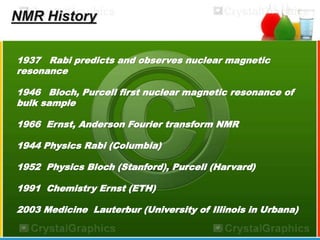
NMR History 
1937 Rabi predicts and observes nuclear magnetic 
resonance 
1946 Bloch, Purcell first nuclear magnetic resonance of 
bulk sample 
1966 Ernst, Anderson Fourier transform NMR 
1944 Physics Rabi (Columbia) 
1952 Physics Bloch (Stanford), Purcell (Harvard) 
1991 Chemistry Ernst (ETH) 
2003 Medicine Lauterbur (University of Illinois in Urbana)
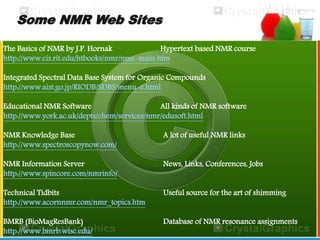
Some NMR Web Sites 
The Basics of NMR by J.P. Hornak Hypertext based NMR course 
http://www.cis.rit.edu/htbooks/nmr/nmr-main.htm 
Integrated Spectral Data Base System for Organic Compounds 
http://www.aist.go.jp/RIODB/SDBS/menu-e.html 
Educational NMR Software All kinds of NMR software 
http://www.york.ac.uk/depts/chem/services/nmr/edusoft.html 
NMR Knowledge Base A lot of useful NMR links 
http://www.spectroscopynow.com/ 
NMR Information Server News, Links, Conferences, Jobs 
http://www.spincore.com/nmrinfo/ 
Technical Tidbits Useful source for the art of shimming 
http://www.acornnmr.com/nmr_topics.htm 
BMRB (BioMagResBank) Database of NMR resonance assignments 
http://www.bmrb.wisc.edu/
To 
Our doctors 
Dr /ghada moustafa 
Dr /esraa fawaaz
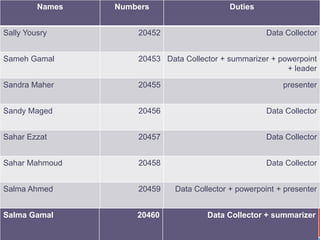
Names Numbers Duties 
Sally Yousry 20452 Data Collector 
Data Collector + summarizer + powerpoint 
+ leader 
Sameh Gamal 20453 
Sandra Maher 20455 presenter 
Sandy Maged 20456 Data Collector 
Sahar Ezzat 20457 Data Collector 
Sahar Mahmoud 20458 Data Collector 
Salma Ahmed 20459 Data Collector + powerpoint + presenter 
Salma Gamal 20460 Data Collector + summarizer

Analytical NMR

  • 1.
    Cairo university Facultyof pharmacy Analytical chemistry department
  • 2.
  • 3.
    Explaining NMR UV/Visspectroscopy Sample
  • 4.
    Nuclear magnetic resonance spectroscopy • Def. :-known as NMR spectroscopy, is a research technique that exploits the magnetic properties of certain a certain atomic nuclei. • . It determines the physical and chemical properties of atoms in which they are contained.
  • 5.
    •Basic NMR techniques:- 1-The NMR sample is prepared in a thin-walled glass tube - a NMR tube. 2-When placed in a magnetic field, NMR active nuclei (such as 1H or 13C) absorb electromagnetic radiation .
  • 6.
    • Now wehave to answer an important question, on which phenomenon it relies ? • As an answer for this question we will ay it depends on nuclear magnetic resonance. • Importance :- 1-Can provide detailed information about the structure, dynamics, reaction state, and chemical environment of molecules. 2-is used by chemists and biochemists to investigate the properties of organic molecules at a frequency characteristic of the isotope.
  • 7.
    •Now it istime to talk about the chemical shift. • What is chemical shift? •Chemical shift:-is the resonant frequency of a nucleus relative to a standard, this standard is often tetramethylsilane, Si(CH3)4, abbreviated TMS.
  • 8.
    Example of thechemical shift: • NMR spectrum of hexaborane B6H10 showing peaks shifted in frequency, which give clues as to the molecular structure. • Importance :-The chemical shift provides information about the structure of the molecule.
  • 9.
    • Do youremember spin-spin coupling? • It a special type of it. This coupling arises from the interaction of different spin states through the chemical bonds of a molecule and results in the splitting of NMR signals. • Importance:-it provides detailed insight into the connectivity of atoms in a molecule.
  • 10.
    NMR analysis applications 1-Chemical structure analysis of liquids and dissolved solids 2-Deformulation of products 3-Quantification of mixture components
  • 11.
    NMR analysis capabilities: 1- Quantitative NMR Analysis (qNMR) 2-solid State Nuclear Magnetic Resonance 3-Solution State NMR 4-NMR Chemical Composition 5-Elucidation
  • 12.
    .NMR analysis expertise laboratories provide clients analytical data regarding the type, quantity and arrangement of atoms in chemical systems, liquids and solids.
  • 13.
    1-Quantitative NMR Analysis:- Intertie NMR laboratories provide qNMR (Quantitative Nuclear Magnetic Resonance Spectroscopy) analysis applications such as quality control, drug impurity analysis, and metabonomics in agrochemicals, chemicals, plastics processing and the pharmaceutical industry
  • 14.
    2-Solid State NuclearMagnetic Resonance Solid state Nuclear Magnetic Resonance (NMR) is a specialized characterization technique used to determine chemical composition or structural properties in a variety of industrially relevant materials. Solid State NMR brings the benefits of solutions NMR (detailed chemical structural information without the need for standards
  • 15.
    Determination of catalyst Heterogeneous catalysts used for chemical manufacture, petroleum processes, purification, and air separation Determine framework composition of zeolites and changes with activation or use Identify adsorbed species in porous materials Characterize key functionalities in insoluble residues
  • 16.
    • Correlation spectroscopy:- • is one of several types of two-dimensional nuclear magnetic resonance (NMR) spectroscopy .This type of NMR experiment is best known by its acronym . • Biomolecular NMR spectroscopy:- • A-proteins:-Much of the innovation within NMR spectroscopy has been within the field of protein NMR spectroscopy, an important technique in structural biology .
  • 17.
    • B-Nuculeic acids:- • is the use of NMR spectroscopy to obtain information about the structure and dynamics of polynuculeic acid, such as DNA or RNA. • Note :-Nucleic acid and protein NMR spectroscopy are similar but differences exist. Nucleic acids have a smaller percentage of hydrogen atoms, which are the atoms usually observed in NMR spectroscopy.
  • 18.
    NMR History 1937Rabi predicts and observes nuclear magnetic resonance 1946 Bloch, Purcell first nuclear magnetic resonance of bulk sample 1966 Ernst, Anderson Fourier transform NMR 1944 Physics Rabi (Columbia) 1952 Physics Bloch (Stanford), Purcell (Harvard) 1991 Chemistry Ernst (ETH) 2003 Medicine Lauterbur (University of Illinois in Urbana)
  • 19.
    Some NMR WebSites The Basics of NMR by J.P. Hornak Hypertext based NMR course http://www.cis.rit.edu/htbooks/nmr/nmr-main.htm Integrated Spectral Data Base System for Organic Compounds http://www.aist.go.jp/RIODB/SDBS/menu-e.html Educational NMR Software All kinds of NMR software http://www.york.ac.uk/depts/chem/services/nmr/edusoft.html NMR Knowledge Base A lot of useful NMR links http://www.spectroscopynow.com/ NMR Information Server News, Links, Conferences, Jobs http://www.spincore.com/nmrinfo/ Technical Tidbits Useful source for the art of shimming http://www.acornnmr.com/nmr_topics.htm BMRB (BioMagResBank) Database of NMR resonance assignments http://www.bmrb.wisc.edu/
  • 22.
    To Our doctors Dr /ghada moustafa Dr /esraa fawaaz
  • 23.
    Names Numbers Duties Sally Yousry 20452 Data Collector Data Collector + summarizer + powerpoint + leader Sameh Gamal 20453 Sandra Maher 20455 presenter Sandy Maged 20456 Data Collector Sahar Ezzat 20457 Data Collector Sahar Mahmoud 20458 Data Collector Salma Ahmed 20459 Data Collector + powerpoint + presenter Salma Gamal 20460 Data Collector + summarizer