Solar Photovoltaics and  Distributed Generation National Joint Apprenticeship and Training Committee for the Electrical Industry
Market Drivers for Renewable Energy and Distributed Generation Increasing costs and dependence on imported energy from unfriendly countries Environmental impacts from fossil fuel use – pollution and global warming Electric utility restructuring and deregulation Net metering and interconnection rules Legislative mandates for new generation – renewable portfolio standards Utility surcharges and public benefit funds Federal, state and other incentives – rebates, tax credits, production incentives and tradable renewable energy credits Financing, power purchase agreements and energy services contracts Increasing public awareness and interest
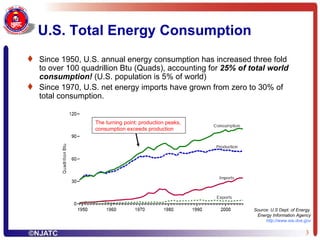
U.S. Total Energy Consumption Since 1950, U.S. annual energy consumption has increased three fold to over 100 quadrillion Btu (Quads), accounting for  25% of total world consumption!  (U.S. population is 5% of world) Since 1970, U.S. net energy imports have grown from zero to 30% of total consumption. Source: U.S Dept. of Energy  Energy Information Agency http:// www.eia.doe.gov The turning point: production peaks,  consumption exceeds production
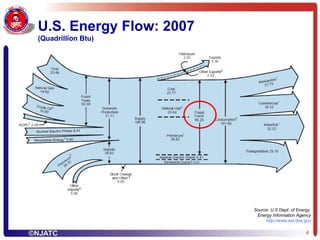
U.S. Energy Flow: 2007 (Quadrillion Btu) Source: U.S Dept. of Energy  Energy Information Agency http:// www.eia.doe.gov
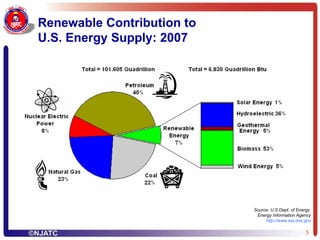
Renewable Contribution to  U.S. Energy Supply: 2007 Source: U.S Dept. of Energy  Energy Information Agency http:// www.eia.doe.gov
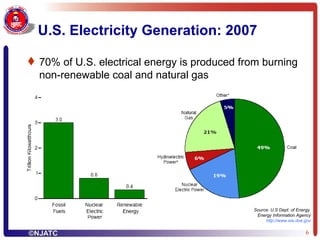
U.S. Electricity Generation: 2007 70% of U.S. electrical energy is produced from burning non-renewable coal and natural gas Source: U.S Dept. of Energy  Energy Information Agency http:// www.eia.doe.gov
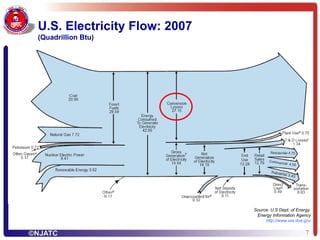
U.S. Electricity Flow: 2007 (Quadrillion Btu) Source: U.S Dept. of Energy  Energy Information Agency http:// www.eia.doe.gov
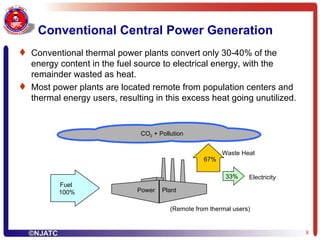
Conventional Central Power Generation Conventional thermal power plants convert only 30-40% of the energy content in the fuel source to electrical energy, with the remainder wasted as heat.  Most power plants are located remote from population centers and thermal energy users, resulting in this excess heat going unutilized. Electricity 33% Fuel  100% 67% Waste Heat CO 2  + Pollution Power  Plant  (Remote from thermal users)
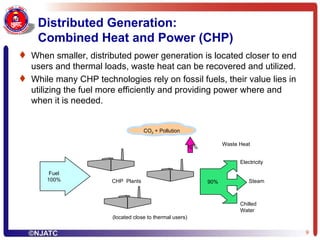
Distributed Generation:  Combined Heat and Power (CHP) When smaller, distributed power generation is located closer to end users and thermal loads, waste heat can be recovered and utilized. While many CHP technologies rely on fossil fuels, their value lies in utilizing the fuel more efficiently and providing power where and when it is needed. Fuel 100% Steam Electricity Chilled Water 90% 10% Waste Heat CO 2  + Pollution CHP  Plants (located close to thermal users)
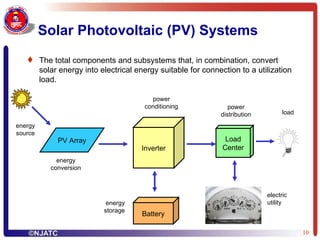
Solar Photovoltaic (PV) Systems The total components and subsystems that, in combination, convert solar energy into electrical energy suitable for connection to a utilization load. load energy source power conditioning energy conversion Inverter PV Array power distribution Load Center Battery energy storage electric utility
Types of Photovoltaic Systems  Stand-Alone Systems Operate independent of the utility grid Utility-Interactive (Grid-Connected) Systems Operate interconnected (in parallel) with the utility grid, a bi-directional interface is required Bi-Modal Systems May operate in either utility-interactive or stand-alone mode, but not concurrently
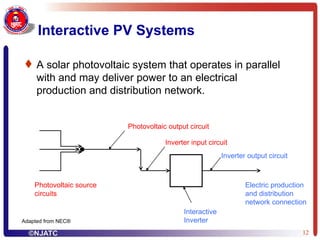
Interactive PV Systems A solar photovoltaic system that operates in parallel with and may deliver power to an electrical production and distribution network. Adapted from NEC ® Electric production and distribution network connection Interactive Inverter Photovoltaic source circuits Photovoltaic output circuit Inverter output circuit Inverter input circuit
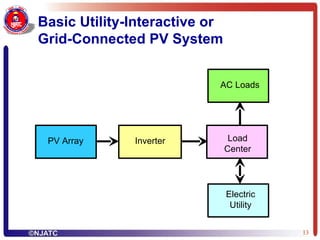
Basic Utility-Interactive or  Grid-Connected PV System Load Center PV Array Inverter AC Loads Electric Utility
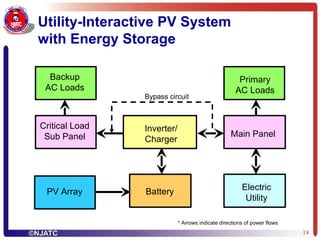
Utility-Interactive PV System  with Energy Storage PV Array Inverter/ Charger Battery Critical Load Sub Panel Backup AC Loads * Arrows indicate directions of power flows Bypass circuit Main Panel Primary AC Loads Electric Utility
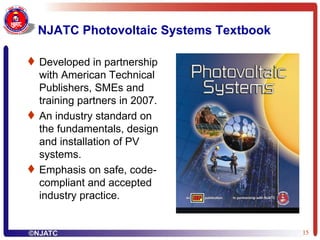
NJATC Photovoltaic Systems Textbook Developed in partnership with American Technical Publishers, SMEs and training partners in 2007. An industry standard on the fundamentals, design and installation of PV systems. Emphasis on safe, code-compliant and accepted industry practice.
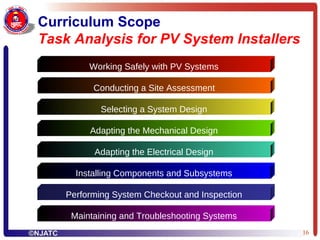
Curriculum Scope Task Analysis for PV System Installers Working Safely with PV Systems Conducting a Site Assessment Selecting a System Design Adapting the Mechanical Design Adapting the Electrical Design Installing Components and Subsystems Maintaining and Troubleshooting Systems Performing System Checkout and Inspection
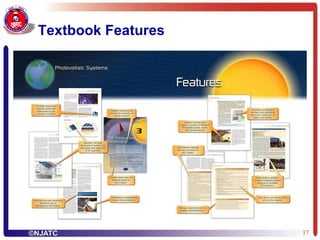
Textbook Features
Textbook Features Full-color, durable hard-bound book; 15 chapters, 450 pages, including appendix and glossary. Detailed, full-color illustrations depict the principles of PV systems, and testing and measurement procedures. Photographs are used extensively to detail components used in PV installations, and to exemplify best installation practices.  Factoids contain technical tips or background information.  Vignettes highlight cases studies, additional technical, historical or safety information that supplement the text material.
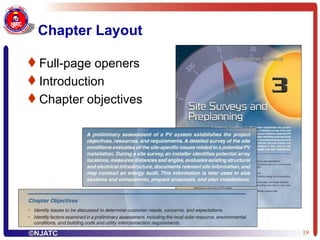
Chapter Layout Full-page openers Introduction Chapter objectives
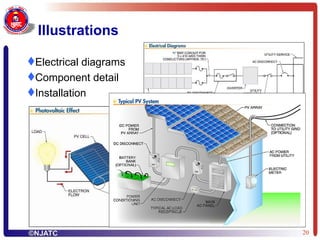
Illustrations Electrical diagrams Component detail Installation
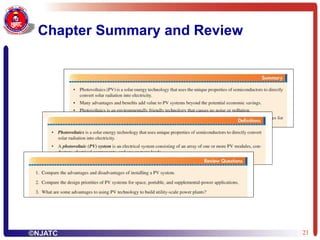
Chapter Summary and Review
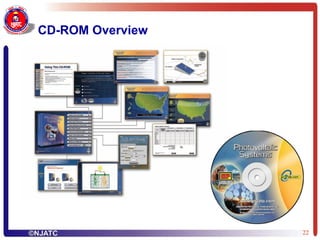
CD-ROM Overview
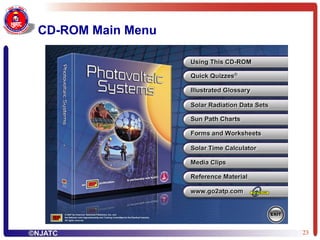
CD-ROM Main Menu
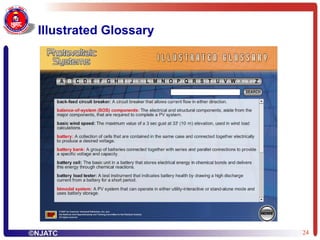
Illustrated Glossary
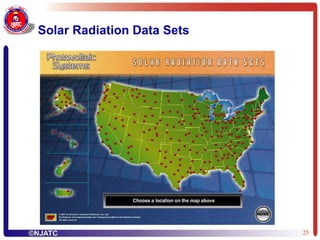
Solar Radiation Data Sets
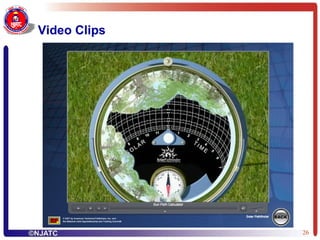
Video Clips
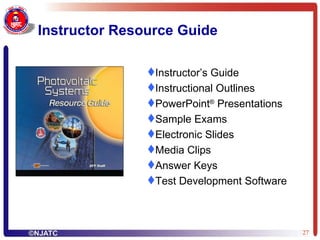
Instructor Resource Guide Instructor’s Guide Instructional Outlines PowerPoint ®  Presentations Sample Exams Electronic Slides Media Clips Answer Keys Test Development Software
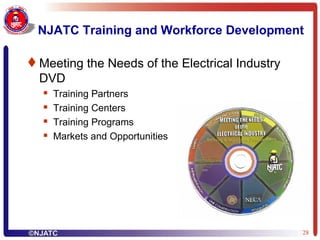
NJATC Training and Workforce Development Meeting the Needs of the Electrical Industry DVD  Training Partners Training Centers Training Programs Markets and Opportunities
NJATC Solar Industry Training Partners Sharp Electronics World’s leading PV module manufacturer www.sharp-usa.com/solar Sunwize Technologies Largest U.S. distributor of PV products  www.sunwize.com Contact: David Love, 888-870-9493 [email_address]
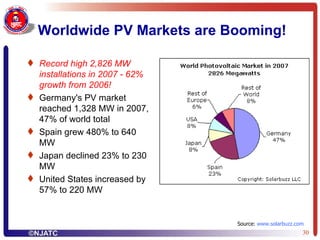
Worldwide PV Markets are Booming! Record high 2,826 MW installations in 2007 - 62% growth from 2006!   Germany's PV market reached 1,328 MW in 2007, 47% of world total Spain grew 480% to 640 MW Japan declined 23% to 230 MW United States increased by 57% to 220 MW Source:  www.solarbuzz.com
Show Me the Money The PV industry raised nearly $10 billion in 2007  84 identified financial transactions accounted for $7.5 billion in 2007, including $5.3 billion from equity financing $2.2 billion from debt financing The PV industry generated $17.2 billion in global revenues in 2007 $30 billion expected by 2012 Source:  www.solarbuzz.com
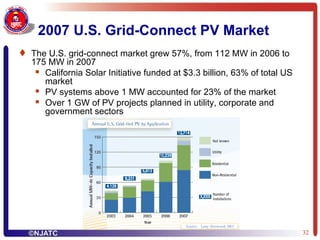
2007 U.S. Grid-Connect PV Market The U.S. grid-connect market grew 57%, from 112 MW in 2006 to 175 MW in 2007 California Solar Initiative funded at $3.3 billion, 63% of total US market  PV systems above 1 MW accounted for 23% of the market Over 1 GW of PV projects planned in utility, corporate and government sectors
Solar Big-Box Boom Big-box stores across the country are going green and investing in PV systems and energy efficiency measures. Safeway plans to install solar arrays on the roofs of 23 stores as part of a broad renewable energy initiative.  Wal-Mart plans installations at 22 stores across California and Hawaii, totaling 20 MW, meeting about 30% of energy use. Best Buy plans PV installations on 35 stores in 2008. Others with announced plans include Staples, Target, Home Depot and Costco.
Financial Incentives for PV Installations Rebate programs  Typically based on $/watt of PV capacity installed Offered by states, local government and utilities; qualified participation   Federal tax credits, depreciation Production incentives, feed-in tariffs Grants and loans Sales and property tax exemptions
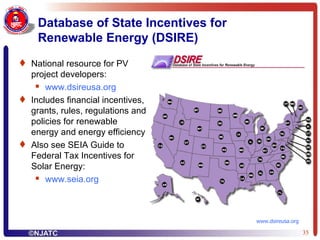
Database of State Incentives for Renewable Energy (DSIRE) National resource for PV project developers: www.dsireusa.org Includes financial incentives, grants, rules, regulations and policies for renewable energy and energy efficiency Also see SEIA Guide to Federal Tax Incentives for Solar Energy: www.seia.org www.dsireusa.org
Power Purchase Agreements (PPA) A legal contract between an electricity generator and a purchaser of energy. Used by owners of power generation assets to raise financing and capital, and create revenue streams. Depends on accurately defining costs and performance, typically based on unit energy price and escalation factor. In 2007, 50% of non-residential photovoltaic installations in the U.S. used a PPA, and expected to exceed 90% by 2009. Major financial and venture capital firms are accelerating investments in PV markets.
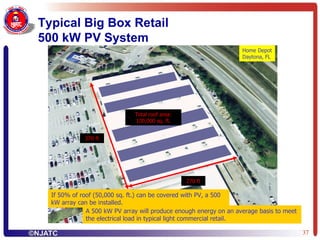
Typical Big Box Retail 500 kW PV System  Home Depot Daytona, FL Total roof area: 100,000 sq. ft. If 50% of roof (50,000 sq. ft.) can be covered with PV, a 500 kW array can be installed. A 500 kW PV array will produce enough energy on an average basis to meet the electrical load in typical light commercial retail. 270 ft 370 ft
Estimating Tools PVWATTS: http:// rredc.nrel.gov/solar/codes_algs/PVWATTS / Clean Power Estimator http://www.clean-power.com / http://www.clean-power.com/nyserda / On-Grid Solar www.ongrid.net Back of Napkin: DC Rating x 75% = Peak AC Output (kW) 75% factor includes inverter efficiency, losses and temperature derating AC Output x peak sun hours = Energy Production (kWh)
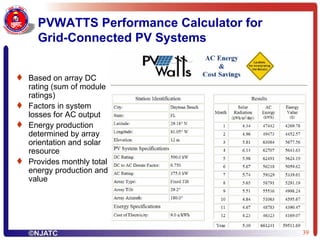
PVWATTS Performance Calculator for Grid-Connected PV Systems Based on array DC rating (sum of module ratings) Factors in system losses for AC output Energy production determined by array orientation and solar resource Provides monthly total energy production and value
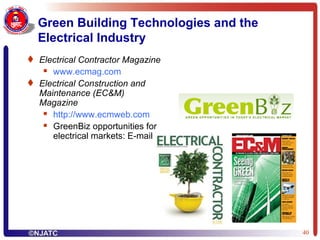
Green Building Technologies and the Electrical Industry Electrical Contractor Magazine www.ecmag.com Electrical Construction and Maintenance (EC&M) Magazine http:// www.ecmweb.com GreenBiz opportunities for electrical markets: E-mail
Leadership in Energy and Environmental Design (LEED) (LEED) Green Building Rating System™  National benchmark for the design, construction, and operation of high performance green buildings Over 50% of LEED points can be attained by work under the scope of the electrical contractor: Building automation Lighting controls Energy management  Photovoltaics and other renewable and distributed energy systems www.usgbc.org/leed /
Leadership in Energy and Environmental Design (LEED) LEED certified buildings: have lower operating costs and increased value  are healthy and comfortable for their occupants  reduce waste sent to landfills  conserve energy and water  reduce harmful greenhouse gas emissions  qualify for tax rebates, zoning allowances and other incentives in hundreds of cities  demonstrate an owner's commitment to environmental stewardship and social responsibility www.usgbc.org/leed /
NABCEP PV Installer Certification North American Board of Certified Energy Practitioners (NABCEP) Voluntary credential for PV professionals Not a contractor’s license A job task analysis for PV installations is the basis for the certification program and examination content Becoming increasingly important to participate in this industry Over 500 individuals certified nationwide Electrical industry is encouraged to attain certification www.nabcep.org
NABCEP Entry Requirements Due to numerous issues, the NJATC/IBEW/NECA have gained NABCEP board approval to modify candidate entry requirements for installation experience. Qualfied JWs will be able to take exam based on “installation training equivalent” – to be defined by special committee. Will include compulsory hands-on training and independent recognition for such training programs Qualifying candidates will be permitted to take exam in September 2009, look for details early next year
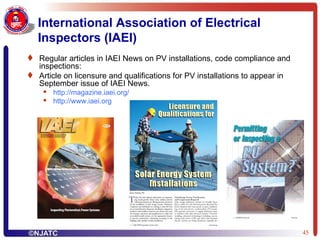
International Association of Electrical Inspectors (IAEI) Regular articles in IAEI News on PV installations, code compliance and inspections: Article on licensure and qualifications for PV installations to appear in September issue of IAEI News. http:// magazine.iaei.org / http:// www.iaei.org
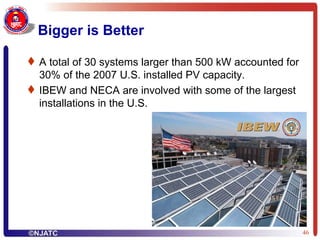
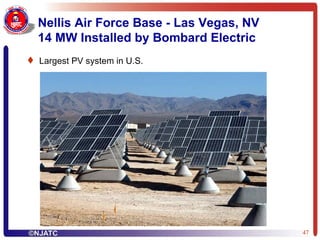
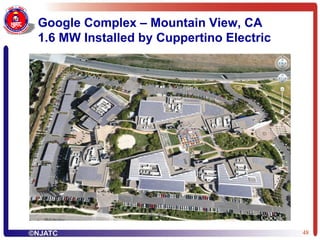
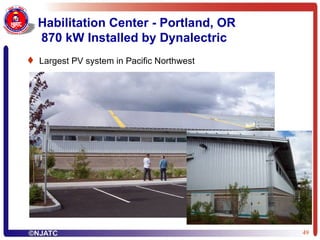
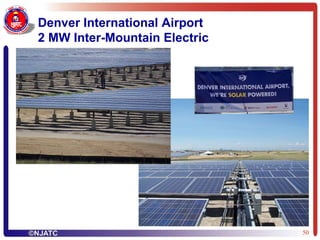
Bigger is Better A total of 30 systems larger than 500 kW accounted for 30% of the 2007 U.S. installed PV capacity. IBEW and NECA are involved with some of the largest installations in the U.S.
Nellis Air Force Base - Las Vegas, NV 14 MW Installed by Bombard Electric Largest PV system in U.S.
Google Complex – Mountain View, CA 1.6 MW Installed by Cuppertino Electric
Habilitation Center - Portland, OR   870 kW Installed by Dynalectric Largest PV system in Pacific Northwest
Denver International Airport 2 MW Inter-Mountain Electric
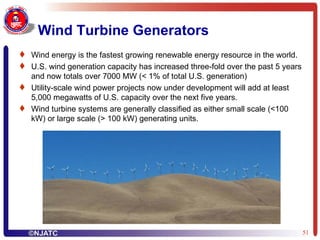
Wind Turbine Generators Wind energy is the fastest growing renewable energy resource in the world.  U.S. wind generation capacity has increased three-fold over the past 5 years and now totals over 7000 MW (< 1% of total U.S. generation)  Utility-scale wind power projects now under development will add at least 5,000 megawatts of U.S. capacity over the next five years. Wind turbine systems are generally classified as either small scale (<100 kW) or large scale (> 100 kW) generating units.
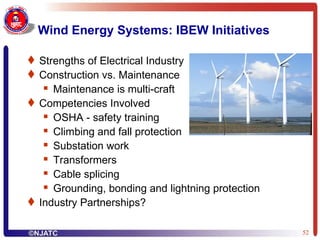
Wind Energy Systems: IBEW Initiatives Strengths of Electrical Industry Construction vs. Maintenance Maintenance is multi-craft Competencies Involved OSHA - safety training Climbing and fall protection Substation work Transformers Cable splicing Grounding, bonding and lightning protection Industry Partnerships?
Contact Information Jim Dunlop, NJATC Curriculum Specialist 321-704-1097 [email_address] Presentation Downloads: http:// www.njatc.org / http://www.farm-energy.ca/IReF/   Bill Ball, NJATC Dir. of Inside Curriculum: 812-853-3564 [email_address]

Njatc Pv Powerpoint Acte Naae

  • 1.
    Solar Photovoltaics and Distributed Generation National Joint Apprenticeship and Training Committee for the Electrical Industry
  • 2.
    Market Drivers forRenewable Energy and Distributed Generation Increasing costs and dependence on imported energy from unfriendly countries Environmental impacts from fossil fuel use – pollution and global warming Electric utility restructuring and deregulation Net metering and interconnection rules Legislative mandates for new generation – renewable portfolio standards Utility surcharges and public benefit funds Federal, state and other incentives – rebates, tax credits, production incentives and tradable renewable energy credits Financing, power purchase agreements and energy services contracts Increasing public awareness and interest
  • 3.
    U.S. Total EnergyConsumption Since 1950, U.S. annual energy consumption has increased three fold to over 100 quadrillion Btu (Quads), accounting for 25% of total world consumption! (U.S. population is 5% of world) Since 1970, U.S. net energy imports have grown from zero to 30% of total consumption. Source: U.S Dept. of Energy Energy Information Agency http:// www.eia.doe.gov The turning point: production peaks, consumption exceeds production
  • 4.
    U.S. Energy Flow:2007 (Quadrillion Btu) Source: U.S Dept. of Energy Energy Information Agency http:// www.eia.doe.gov
  • 5.
    Renewable Contribution to U.S. Energy Supply: 2007 Source: U.S Dept. of Energy Energy Information Agency http:// www.eia.doe.gov
  • 6.
    U.S. Electricity Generation:2007 70% of U.S. electrical energy is produced from burning non-renewable coal and natural gas Source: U.S Dept. of Energy Energy Information Agency http:// www.eia.doe.gov
  • 7.
    U.S. Electricity Flow:2007 (Quadrillion Btu) Source: U.S Dept. of Energy Energy Information Agency http:// www.eia.doe.gov
  • 8.
    Conventional Central PowerGeneration Conventional thermal power plants convert only 30-40% of the energy content in the fuel source to electrical energy, with the remainder wasted as heat. Most power plants are located remote from population centers and thermal energy users, resulting in this excess heat going unutilized. Electricity 33% Fuel 100% 67% Waste Heat CO 2 + Pollution Power Plant (Remote from thermal users)
  • 9.
    Distributed Generation: Combined Heat and Power (CHP) When smaller, distributed power generation is located closer to end users and thermal loads, waste heat can be recovered and utilized. While many CHP technologies rely on fossil fuels, their value lies in utilizing the fuel more efficiently and providing power where and when it is needed. Fuel 100% Steam Electricity Chilled Water 90% 10% Waste Heat CO 2 + Pollution CHP Plants (located close to thermal users)
  • 10.
    Solar Photovoltaic (PV)Systems The total components and subsystems that, in combination, convert solar energy into electrical energy suitable for connection to a utilization load. load energy source power conditioning energy conversion Inverter PV Array power distribution Load Center Battery energy storage electric utility
  • 11.
    Types of PhotovoltaicSystems Stand-Alone Systems Operate independent of the utility grid Utility-Interactive (Grid-Connected) Systems Operate interconnected (in parallel) with the utility grid, a bi-directional interface is required Bi-Modal Systems May operate in either utility-interactive or stand-alone mode, but not concurrently
  • 12.
    Interactive PV SystemsA solar photovoltaic system that operates in parallel with and may deliver power to an electrical production and distribution network. Adapted from NEC ® Electric production and distribution network connection Interactive Inverter Photovoltaic source circuits Photovoltaic output circuit Inverter output circuit Inverter input circuit
  • 13.
    Basic Utility-Interactive or Grid-Connected PV System Load Center PV Array Inverter AC Loads Electric Utility
  • 14.
    Utility-Interactive PV System with Energy Storage PV Array Inverter/ Charger Battery Critical Load Sub Panel Backup AC Loads * Arrows indicate directions of power flows Bypass circuit Main Panel Primary AC Loads Electric Utility
  • 15.
    NJATC Photovoltaic SystemsTextbook Developed in partnership with American Technical Publishers, SMEs and training partners in 2007. An industry standard on the fundamentals, design and installation of PV systems. Emphasis on safe, code-compliant and accepted industry practice.
  • 16.
    Curriculum Scope TaskAnalysis for PV System Installers Working Safely with PV Systems Conducting a Site Assessment Selecting a System Design Adapting the Mechanical Design Adapting the Electrical Design Installing Components and Subsystems Maintaining and Troubleshooting Systems Performing System Checkout and Inspection
  • 17.
  • 18.
    Textbook Features Full-color,durable hard-bound book; 15 chapters, 450 pages, including appendix and glossary. Detailed, full-color illustrations depict the principles of PV systems, and testing and measurement procedures. Photographs are used extensively to detail components used in PV installations, and to exemplify best installation practices. Factoids contain technical tips or background information. Vignettes highlight cases studies, additional technical, historical or safety information that supplement the text material.
  • 19.
    Chapter Layout Full-pageopeners Introduction Chapter objectives
  • 20.
    Illustrations Electrical diagramsComponent detail Installation
  • 21.
  • 22.
  • 23.
  • 24.
  • 25.
  • 26.
  • 27.
    Instructor Resource GuideInstructor’s Guide Instructional Outlines PowerPoint ® Presentations Sample Exams Electronic Slides Media Clips Answer Keys Test Development Software
  • 28.
    NJATC Training andWorkforce Development Meeting the Needs of the Electrical Industry DVD Training Partners Training Centers Training Programs Markets and Opportunities
  • 29.
    NJATC Solar IndustryTraining Partners Sharp Electronics World’s leading PV module manufacturer www.sharp-usa.com/solar Sunwize Technologies Largest U.S. distributor of PV products www.sunwize.com Contact: David Love, 888-870-9493 [email_address]
  • 30.
    Worldwide PV Marketsare Booming! Record high 2,826 MW installations in 2007 - 62% growth from 2006! Germany's PV market reached 1,328 MW in 2007, 47% of world total Spain grew 480% to 640 MW Japan declined 23% to 230 MW United States increased by 57% to 220 MW Source: www.solarbuzz.com
  • 31.
    Show Me theMoney The PV industry raised nearly $10 billion in 2007 84 identified financial transactions accounted for $7.5 billion in 2007, including $5.3 billion from equity financing $2.2 billion from debt financing The PV industry generated $17.2 billion in global revenues in 2007 $30 billion expected by 2012 Source: www.solarbuzz.com
  • 32.
    2007 U.S. Grid-ConnectPV Market The U.S. grid-connect market grew 57%, from 112 MW in 2006 to 175 MW in 2007 California Solar Initiative funded at $3.3 billion, 63% of total US market PV systems above 1 MW accounted for 23% of the market Over 1 GW of PV projects planned in utility, corporate and government sectors
  • 33.
    Solar Big-Box BoomBig-box stores across the country are going green and investing in PV systems and energy efficiency measures. Safeway plans to install solar arrays on the roofs of 23 stores as part of a broad renewable energy initiative. Wal-Mart plans installations at 22 stores across California and Hawaii, totaling 20 MW, meeting about 30% of energy use. Best Buy plans PV installations on 35 stores in 2008. Others with announced plans include Staples, Target, Home Depot and Costco.
  • 34.
    Financial Incentives forPV Installations Rebate programs Typically based on $/watt of PV capacity installed Offered by states, local government and utilities; qualified participation Federal tax credits, depreciation Production incentives, feed-in tariffs Grants and loans Sales and property tax exemptions
  • 35.
    Database of StateIncentives for Renewable Energy (DSIRE) National resource for PV project developers: www.dsireusa.org Includes financial incentives, grants, rules, regulations and policies for renewable energy and energy efficiency Also see SEIA Guide to Federal Tax Incentives for Solar Energy: www.seia.org www.dsireusa.org
  • 36.
    Power Purchase Agreements(PPA) A legal contract between an electricity generator and a purchaser of energy. Used by owners of power generation assets to raise financing and capital, and create revenue streams. Depends on accurately defining costs and performance, typically based on unit energy price and escalation factor. In 2007, 50% of non-residential photovoltaic installations in the U.S. used a PPA, and expected to exceed 90% by 2009. Major financial and venture capital firms are accelerating investments in PV markets.
  • 37.
    Typical Big BoxRetail 500 kW PV System Home Depot Daytona, FL Total roof area: 100,000 sq. ft. If 50% of roof (50,000 sq. ft.) can be covered with PV, a 500 kW array can be installed. A 500 kW PV array will produce enough energy on an average basis to meet the electrical load in typical light commercial retail. 270 ft 370 ft
  • 38.
    Estimating Tools PVWATTS:http:// rredc.nrel.gov/solar/codes_algs/PVWATTS / Clean Power Estimator http://www.clean-power.com / http://www.clean-power.com/nyserda / On-Grid Solar www.ongrid.net Back of Napkin: DC Rating x 75% = Peak AC Output (kW) 75% factor includes inverter efficiency, losses and temperature derating AC Output x peak sun hours = Energy Production (kWh)
  • 39.
    PVWATTS Performance Calculatorfor Grid-Connected PV Systems Based on array DC rating (sum of module ratings) Factors in system losses for AC output Energy production determined by array orientation and solar resource Provides monthly total energy production and value
  • 40.
    Green Building Technologiesand the Electrical Industry Electrical Contractor Magazine www.ecmag.com Electrical Construction and Maintenance (EC&M) Magazine http:// www.ecmweb.com GreenBiz opportunities for electrical markets: E-mail
  • 41.
    Leadership in Energyand Environmental Design (LEED) (LEED) Green Building Rating System™ National benchmark for the design, construction, and operation of high performance green buildings Over 50% of LEED points can be attained by work under the scope of the electrical contractor: Building automation Lighting controls Energy management Photovoltaics and other renewable and distributed energy systems www.usgbc.org/leed /
  • 42.
    Leadership in Energyand Environmental Design (LEED) LEED certified buildings: have lower operating costs and increased value are healthy and comfortable for their occupants reduce waste sent to landfills conserve energy and water reduce harmful greenhouse gas emissions qualify for tax rebates, zoning allowances and other incentives in hundreds of cities demonstrate an owner's commitment to environmental stewardship and social responsibility www.usgbc.org/leed /
  • 43.
    NABCEP PV InstallerCertification North American Board of Certified Energy Practitioners (NABCEP) Voluntary credential for PV professionals Not a contractor’s license A job task analysis for PV installations is the basis for the certification program and examination content Becoming increasingly important to participate in this industry Over 500 individuals certified nationwide Electrical industry is encouraged to attain certification www.nabcep.org
  • 44.
    NABCEP Entry RequirementsDue to numerous issues, the NJATC/IBEW/NECA have gained NABCEP board approval to modify candidate entry requirements for installation experience. Qualfied JWs will be able to take exam based on “installation training equivalent” – to be defined by special committee. Will include compulsory hands-on training and independent recognition for such training programs Qualifying candidates will be permitted to take exam in September 2009, look for details early next year
  • 45.
    International Association ofElectrical Inspectors (IAEI) Regular articles in IAEI News on PV installations, code compliance and inspections: Article on licensure and qualifications for PV installations to appear in September issue of IAEI News. http:// magazine.iaei.org / http:// www.iaei.org
  • 46.
    Bigger is BetterA total of 30 systems larger than 500 kW accounted for 30% of the 2007 U.S. installed PV capacity. IBEW and NECA are involved with some of the largest installations in the U.S.
  • 47.
    Nellis Air ForceBase - Las Vegas, NV 14 MW Installed by Bombard Electric Largest PV system in U.S.
  • 48.
    Google Complex –Mountain View, CA 1.6 MW Installed by Cuppertino Electric
  • 49.
    Habilitation Center -Portland, OR 870 kW Installed by Dynalectric Largest PV system in Pacific Northwest
  • 50.
    Denver International Airport2 MW Inter-Mountain Electric
  • 51.
    Wind Turbine GeneratorsWind energy is the fastest growing renewable energy resource in the world. U.S. wind generation capacity has increased three-fold over the past 5 years and now totals over 7000 MW (< 1% of total U.S. generation) Utility-scale wind power projects now under development will add at least 5,000 megawatts of U.S. capacity over the next five years. Wind turbine systems are generally classified as either small scale (<100 kW) or large scale (> 100 kW) generating units.
  • 52.
    Wind Energy Systems:IBEW Initiatives Strengths of Electrical Industry Construction vs. Maintenance Maintenance is multi-craft Competencies Involved OSHA - safety training Climbing and fall protection Substation work Transformers Cable splicing Grounding, bonding and lightning protection Industry Partnerships?
  • 53.
    Contact Information JimDunlop, NJATC Curriculum Specialist 321-704-1097 [email_address] Presentation Downloads: http:// www.njatc.org / http://www.farm-energy.ca/IReF/ Bill Ball, NJATC Dir. of Inside Curriculum: 812-853-3564 [email_address]