Integrating Wind and Solar Energy in
India for a
Smart Grid Platform

Farhan Beg

With Support and
Editorial by
Mr Peter Meissen
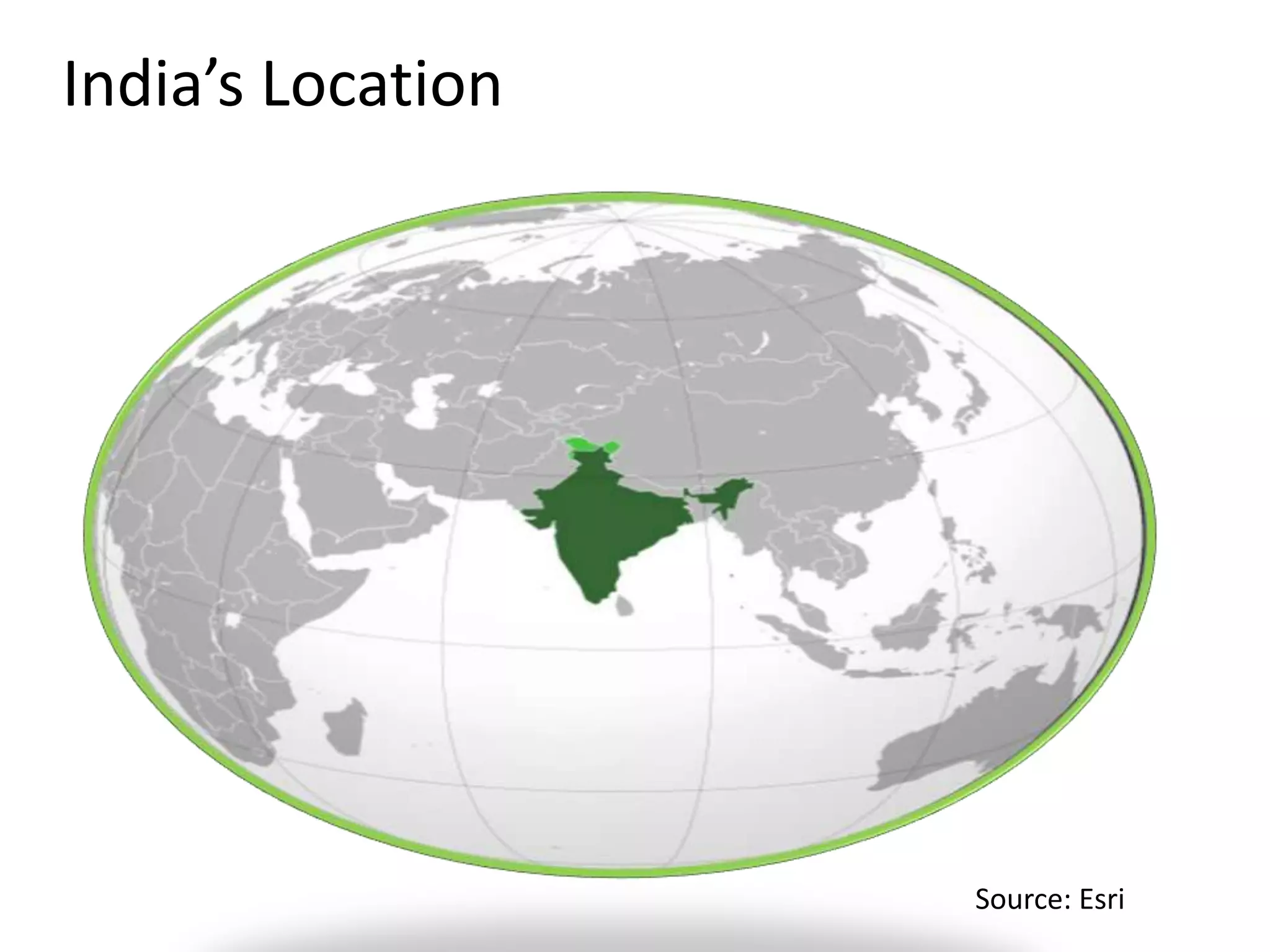
India’s Location

Source: Esri
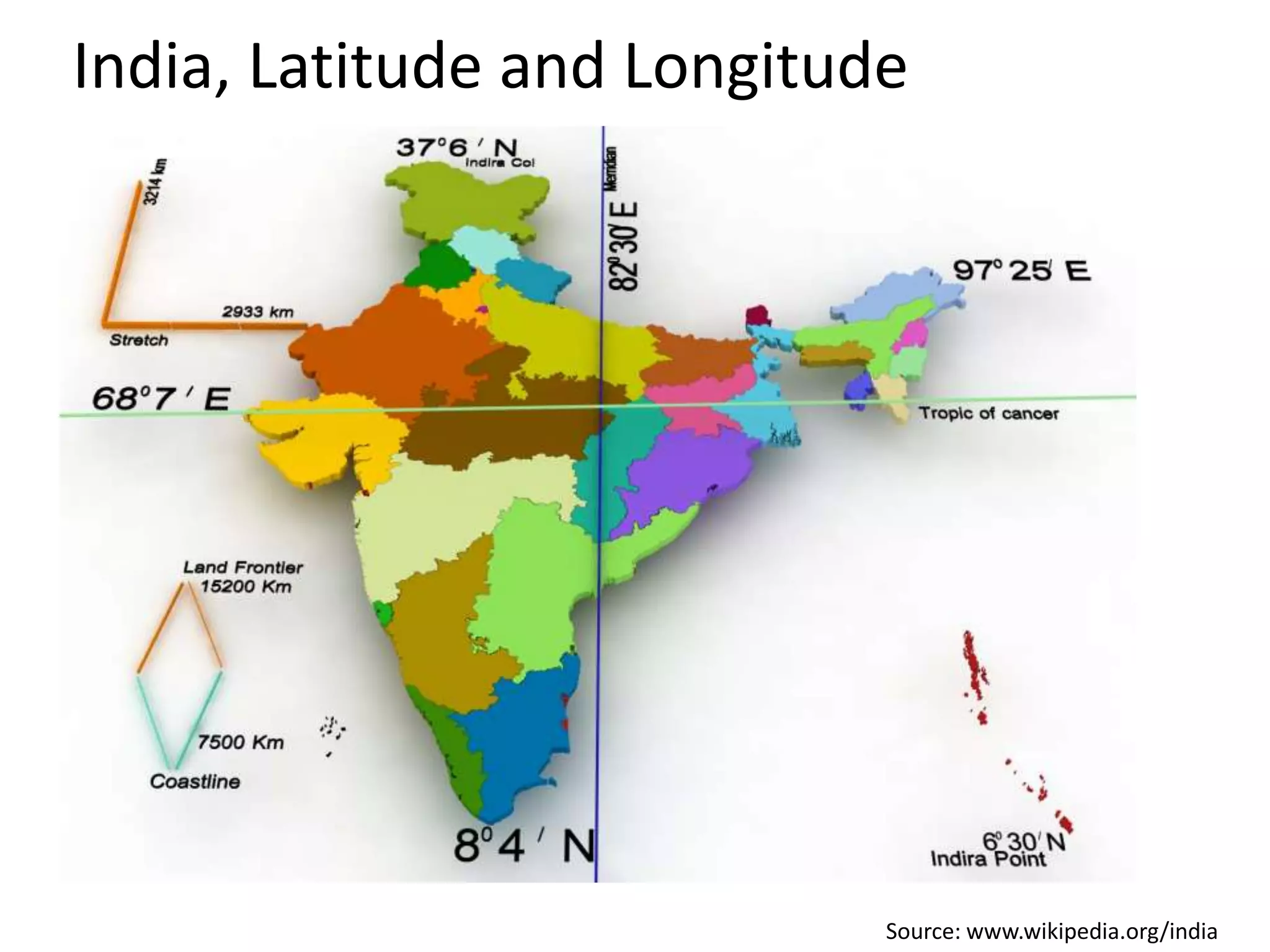
India, Latitude and Longitude

Source: www.wikipedia.org/india
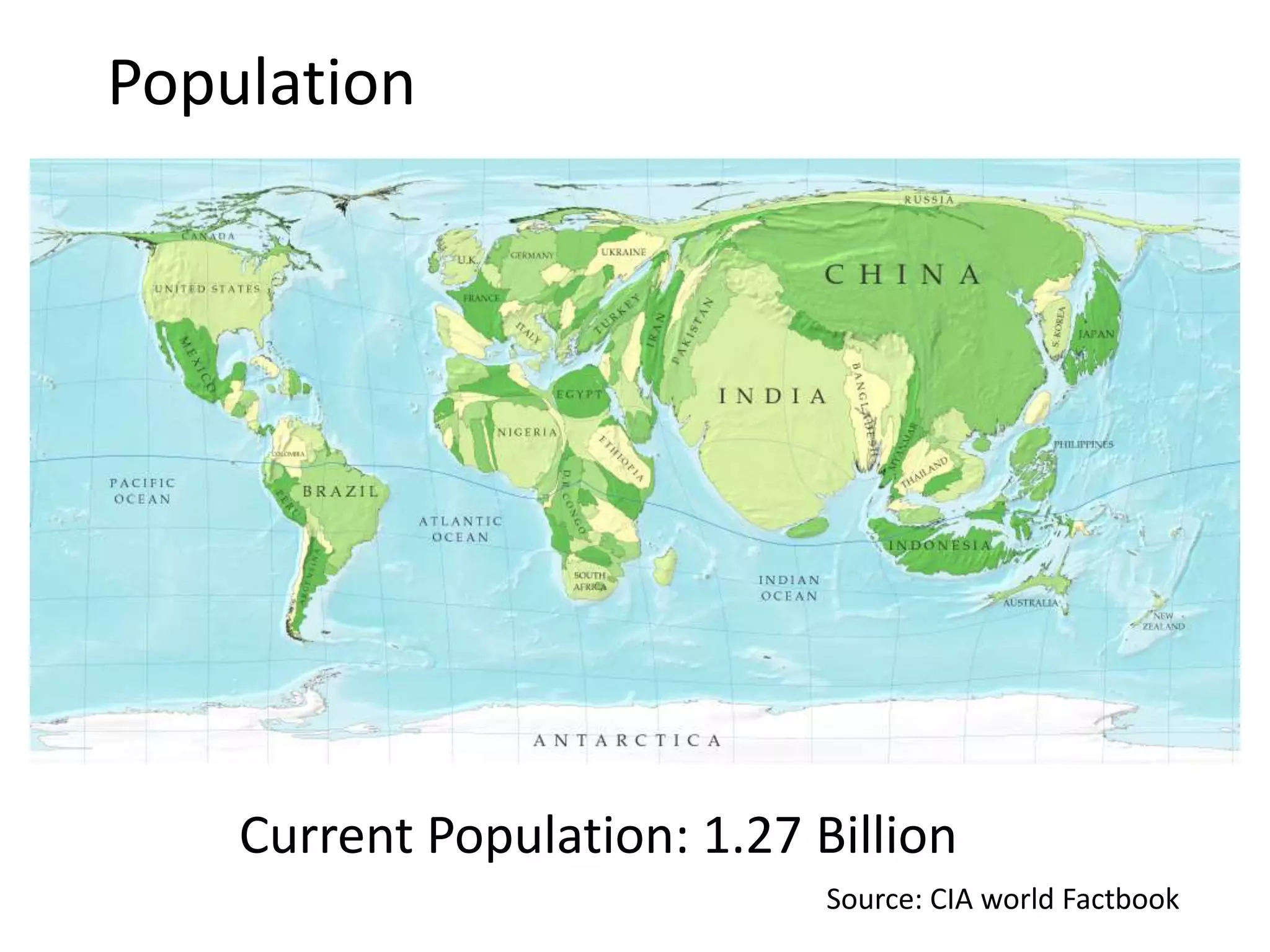
Population

Current Population: 1.27 Billion
Source: CIA world Factbook
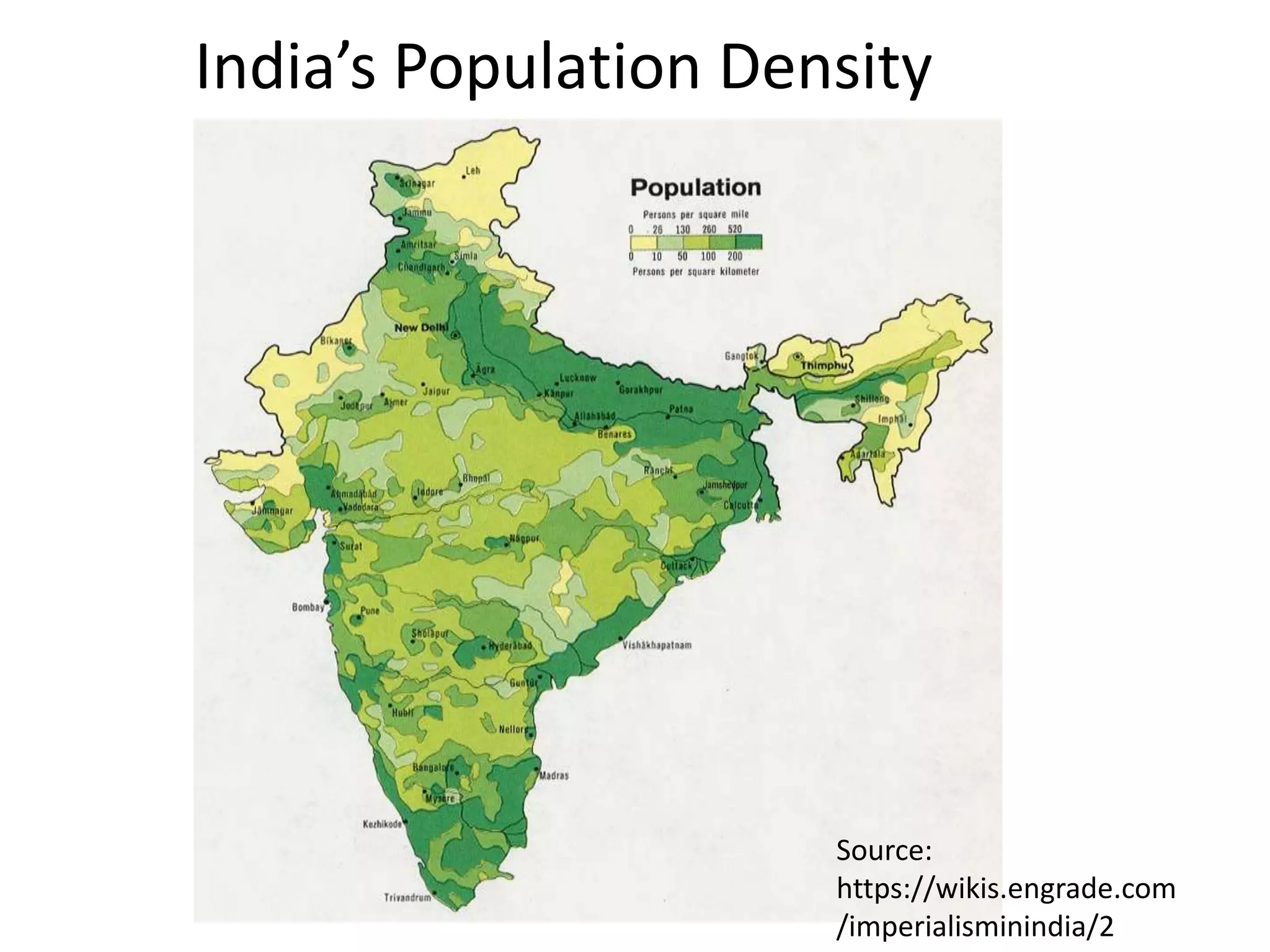
India’s Population Density

Source:
https://wikis.engrade.com
/imperialisminindia/2
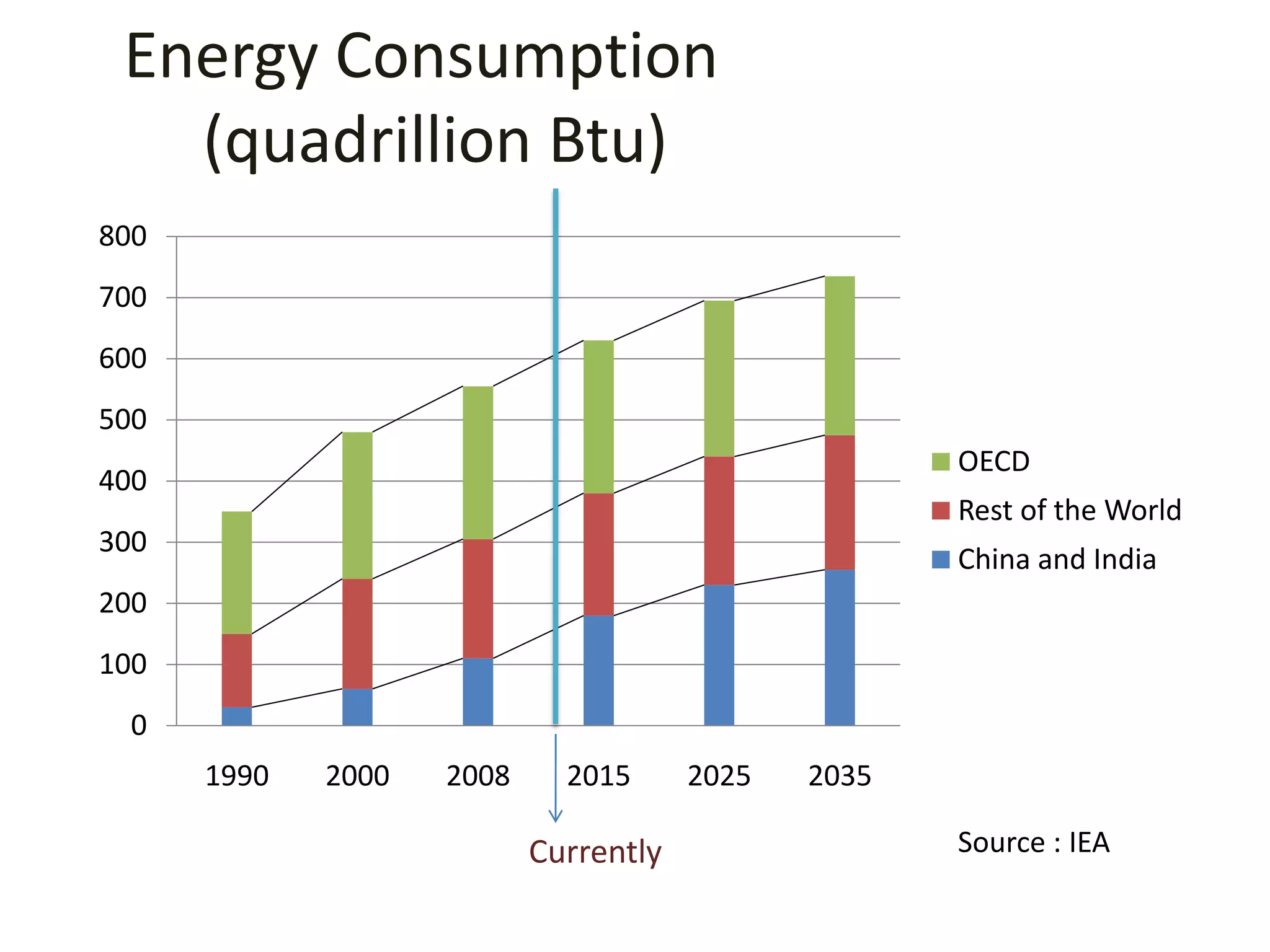
Energy Consumption
(quadrillion Btu)
800
700
600
500
OECD

400

Rest of the World

300

China and India

200
100
0

1990

2000

2008

2015

Currently

2025

2035
Source : IEA
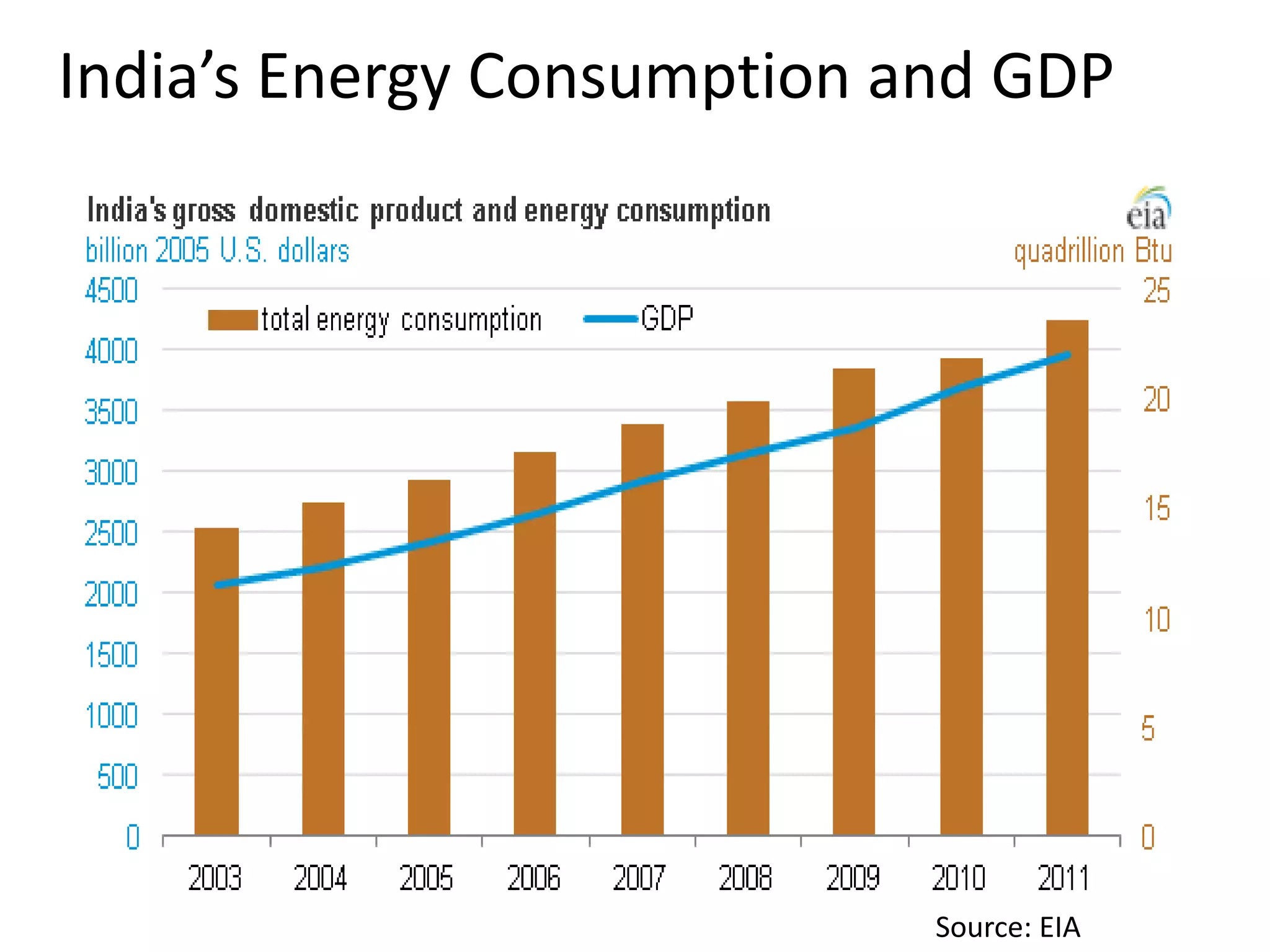
India’s Energy Consumption and GDP

Source: EIA
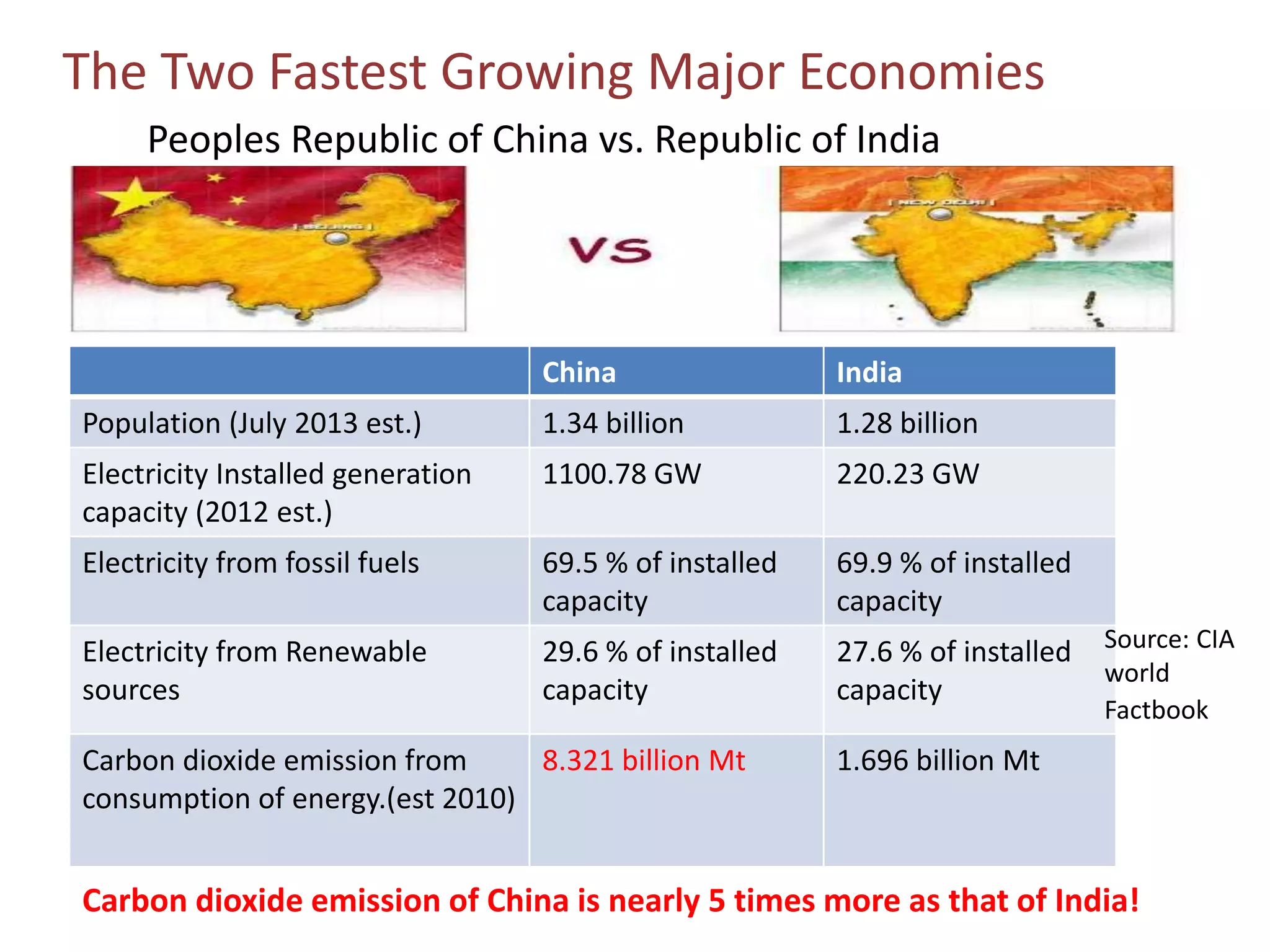
The Two Fastest Growing Major Economies
Peoples Republic of China vs. Republic of India

China

India

Population (July 2013 est.)

1.34 billion

1.28 billion

Electricity Installed generation
capacity (2012 est.)

1100.78 GW

220.23 GW

Electricity from fossil fuels

69.5 % of installed
capacity

69.9 % of installed
capacity

Electricity from Renewable
sources

29.6 % of installed
capacity

27.6 % of installed
capacity

Carbon dioxide emission from
8.321 billion Mt
consumption of energy.(est 2010)

Source: CIA
world
Factbook

1.696 billion Mt

Carbon dioxide emission of China is nearly 5 times more as that of India!
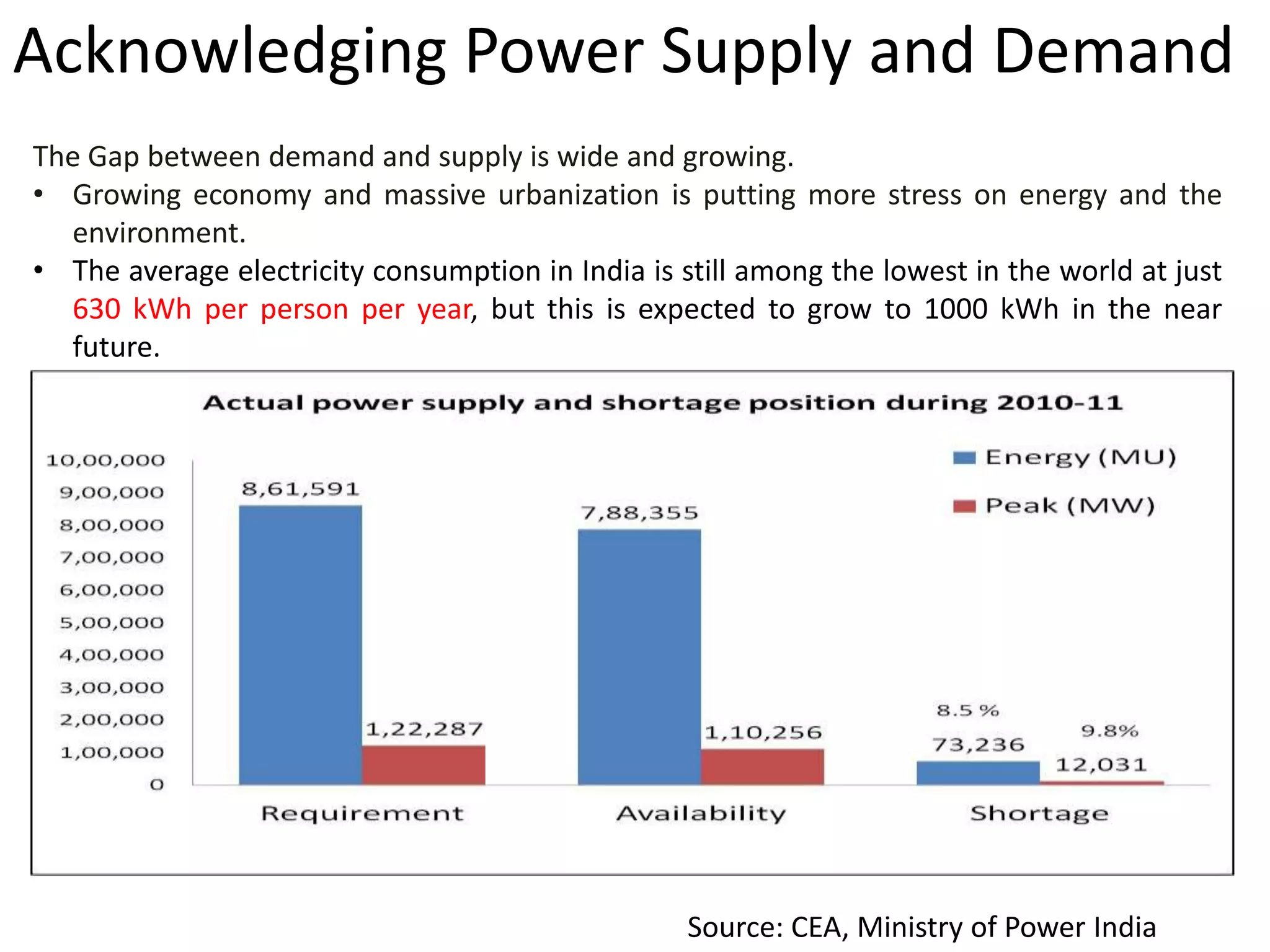
Acknowledging Power Supply and Demand
The Gap between demand and supply is wide and growing.
• Growing economy and massive urbanization is putting more stress on energy and the
environment.
• The average electricity consumption in India is still among the lowest in the world at just
630 kWh per person per year, but this is expected to grow to 1000 kWh in the near
future.

Source: CEA, Ministry of Power India
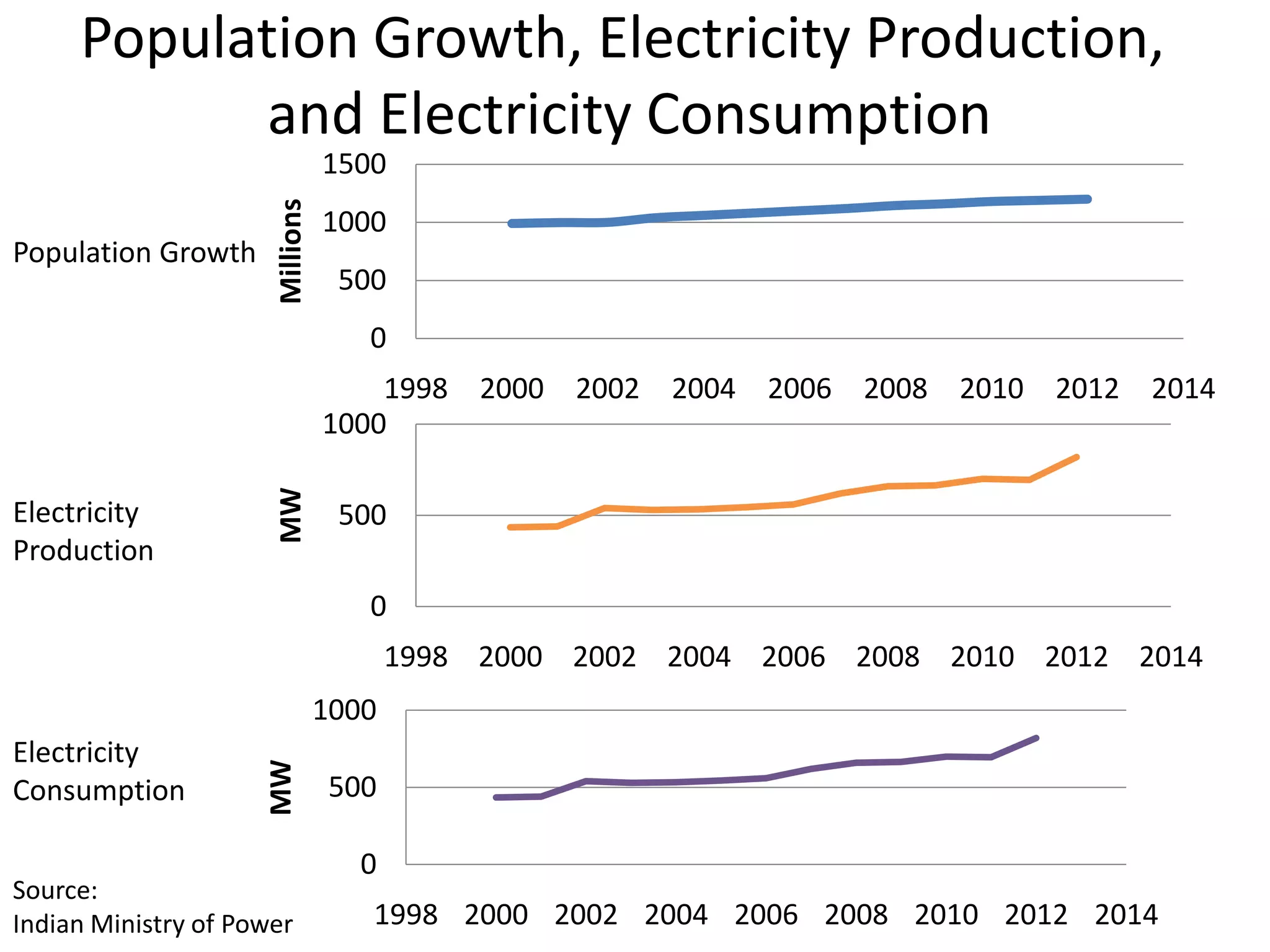
Population Growth, Electricity Production,
and Electricity Consumption
Population Growth

Millions

1500
1000
500
0

Electricity
Production

MW

1998 2000 2002 2004 2006 2008 2010 2012 2014
1000

500
0
1998 2000 2002 2004 2006 2008 2010 2012 2014

Electricity
Consumption

MW

1000

Source:
Indian Ministry of Power

500
0
1998 2000 2002 2004 2006 2008 2010 2012 2014
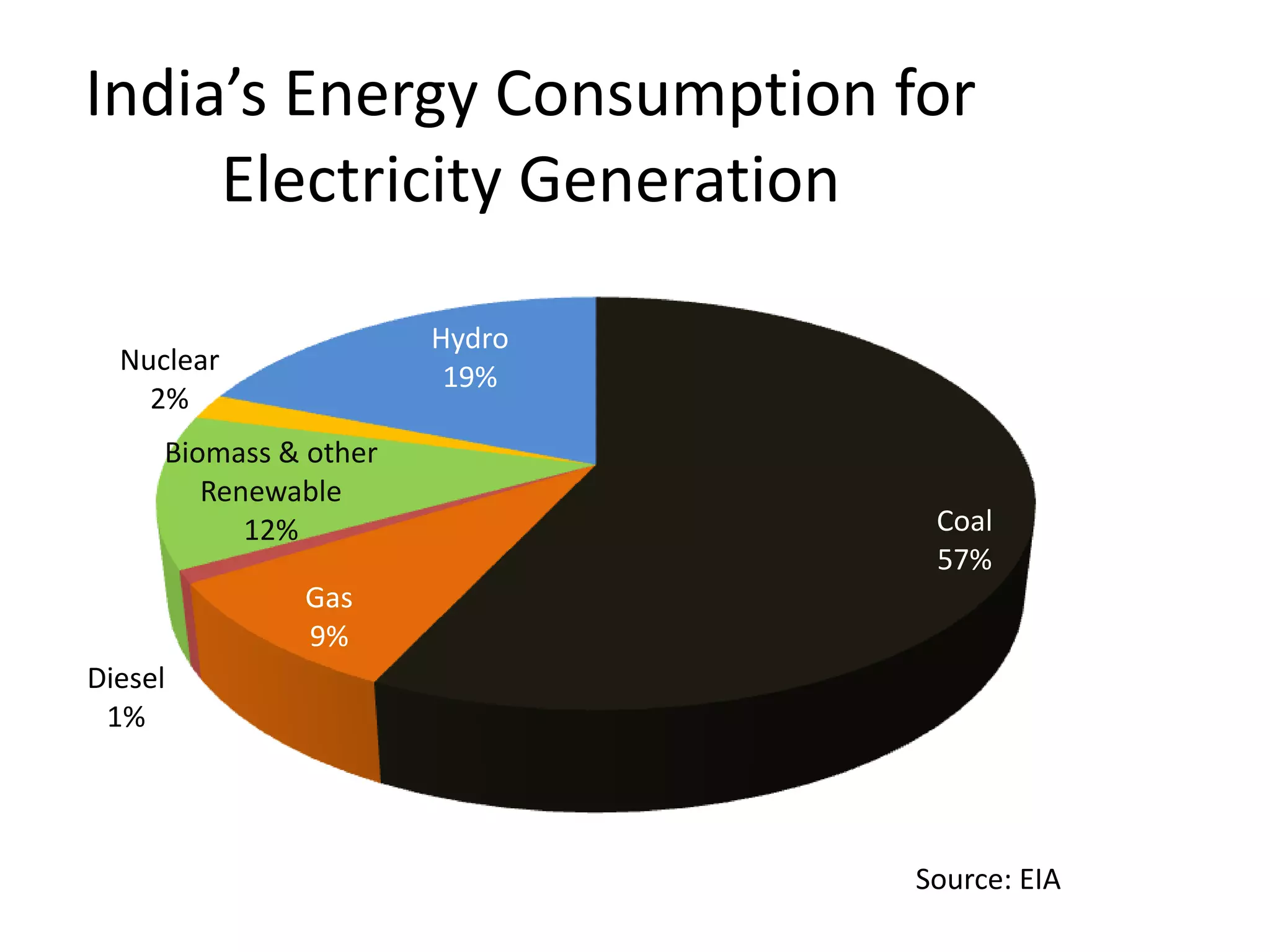
India’s Energy Consumption for
Electricity Generation
Hydro
19%

Nuclear
2%
Biomass & other
Renewable
12%

Coal
57%

Gas
9%

Diesel
1%

Source: EIA
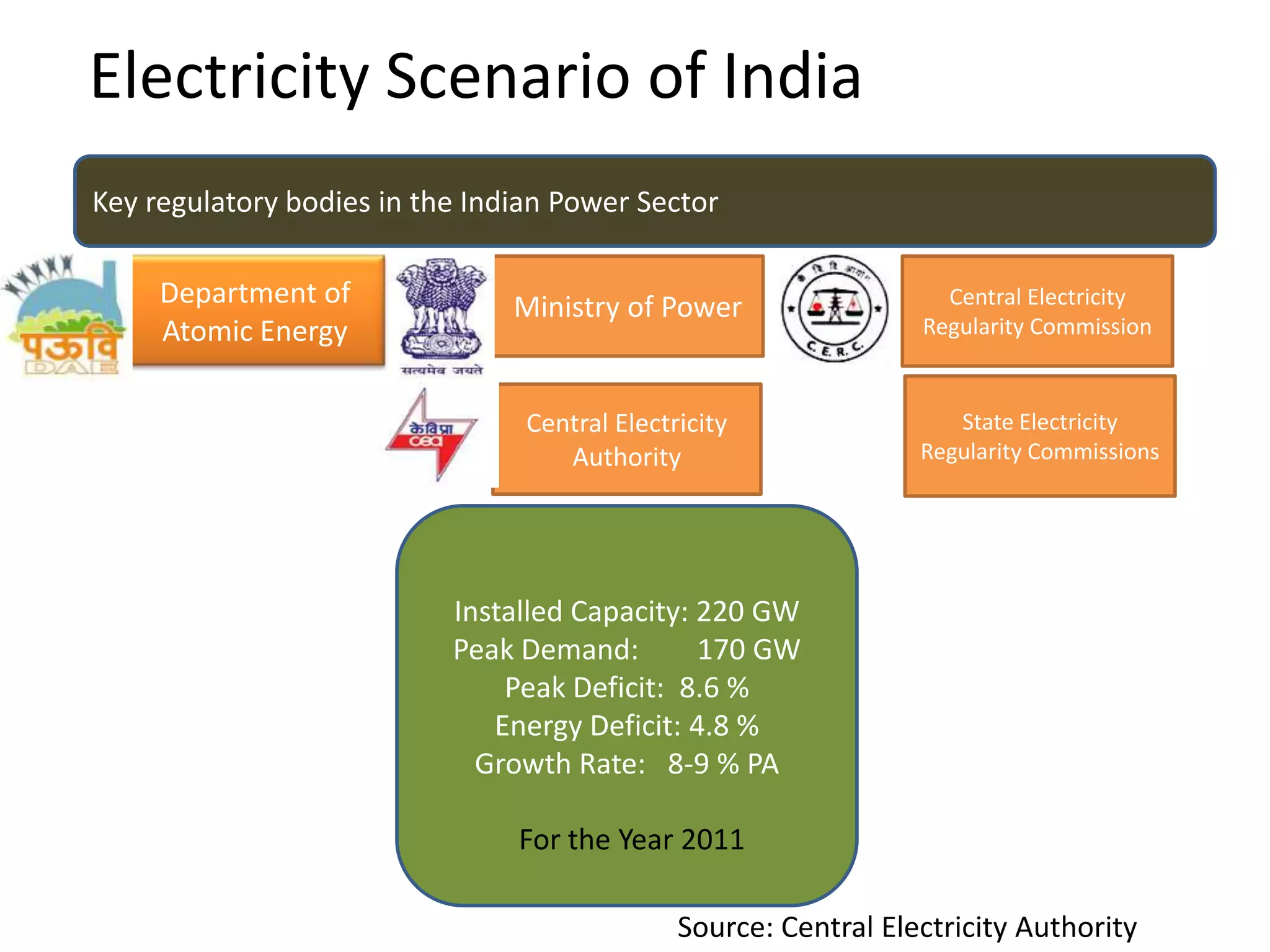
Electricity Scenario of India
Key regulatory bodies in the Indian Power Sector
Department of
Atomic Energy

Ministry of Power

Central Electricity
Regularity Commission

Central Electricity
Authority

State Electricity
Regularity Commissions

Installed Capacity: 220 GW
Peak Demand:
170 GW
Peak Deficit: 8.6 %
Energy Deficit: 4.8 %
Growth Rate: 8-9 % PA
For the Year 2011
Source: Central Electricity Authority
Issues Facing India’s Power Sector
Generation Side

Transmission
Side

Distribution Side
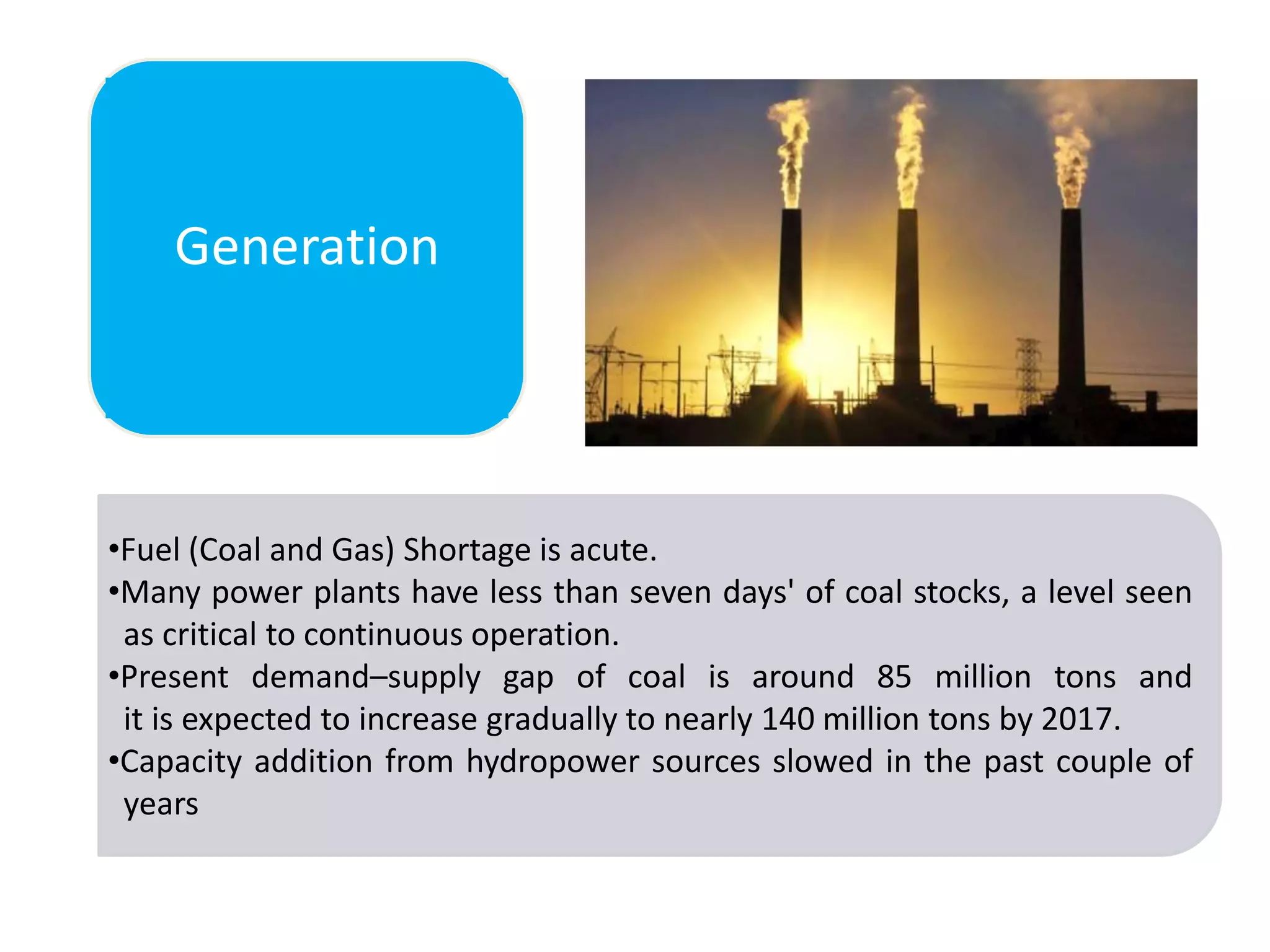
Generation

•Fuel (Coal and Gas) Shortage is acute.
•Many power plants have less than seven days' of coal stocks, a level seen
as critical to continuous operation.
•Present demand–supply gap of coal is around 85 million tons and
it is expected to increase gradually to nearly 140 million tons by 2017.
•Capacity addition from hydropower sources slowed in the past couple of
years
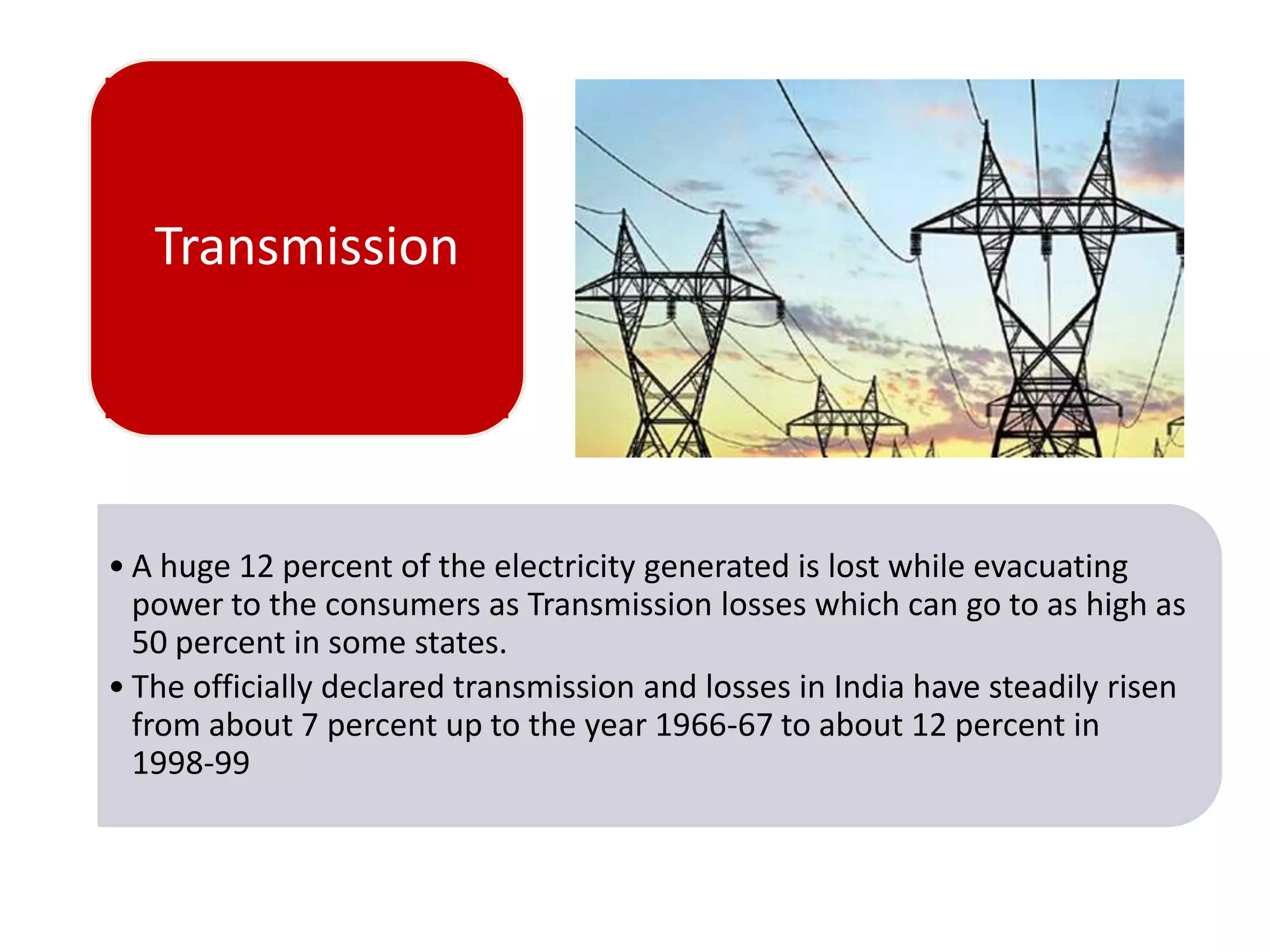
Transmission

• A huge 12 percent of the electricity generated is lost while evacuating
power to the consumers as Transmission losses which can go to as high as
50 percent in some states.
• The officially declared transmission and losses in India have steadily risen
from about 7 percent up to the year 1966-67 to about 12 percent in
1998-99
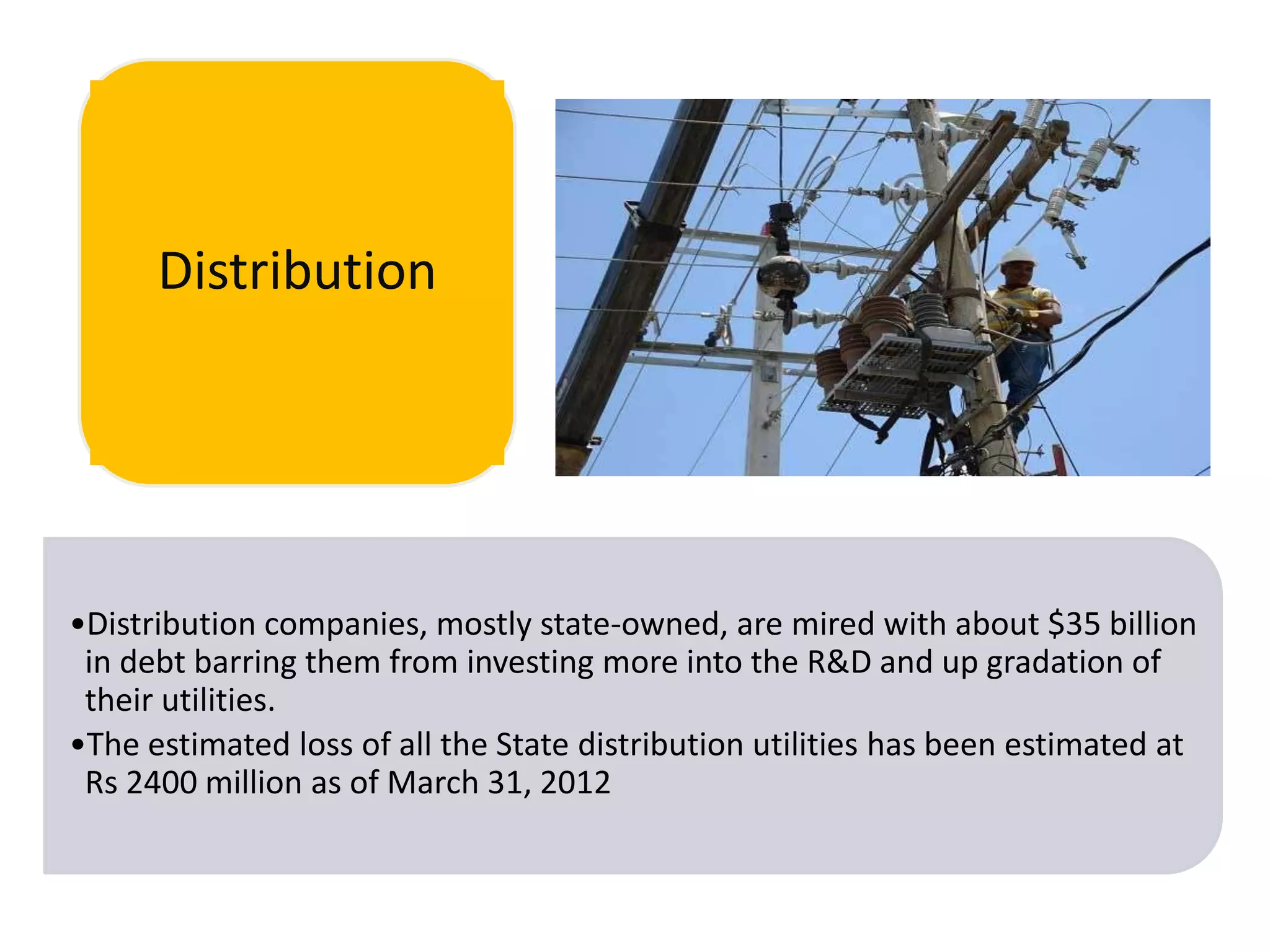
Distribution

•Distribution companies, mostly state-owned, are mired with about $35 billion
in debt barring them from investing more into the R&D and up gradation of
their utilities.
•The estimated loss of all the State distribution utilities has been estimated at
Rs 2400 million as of March 31, 2012
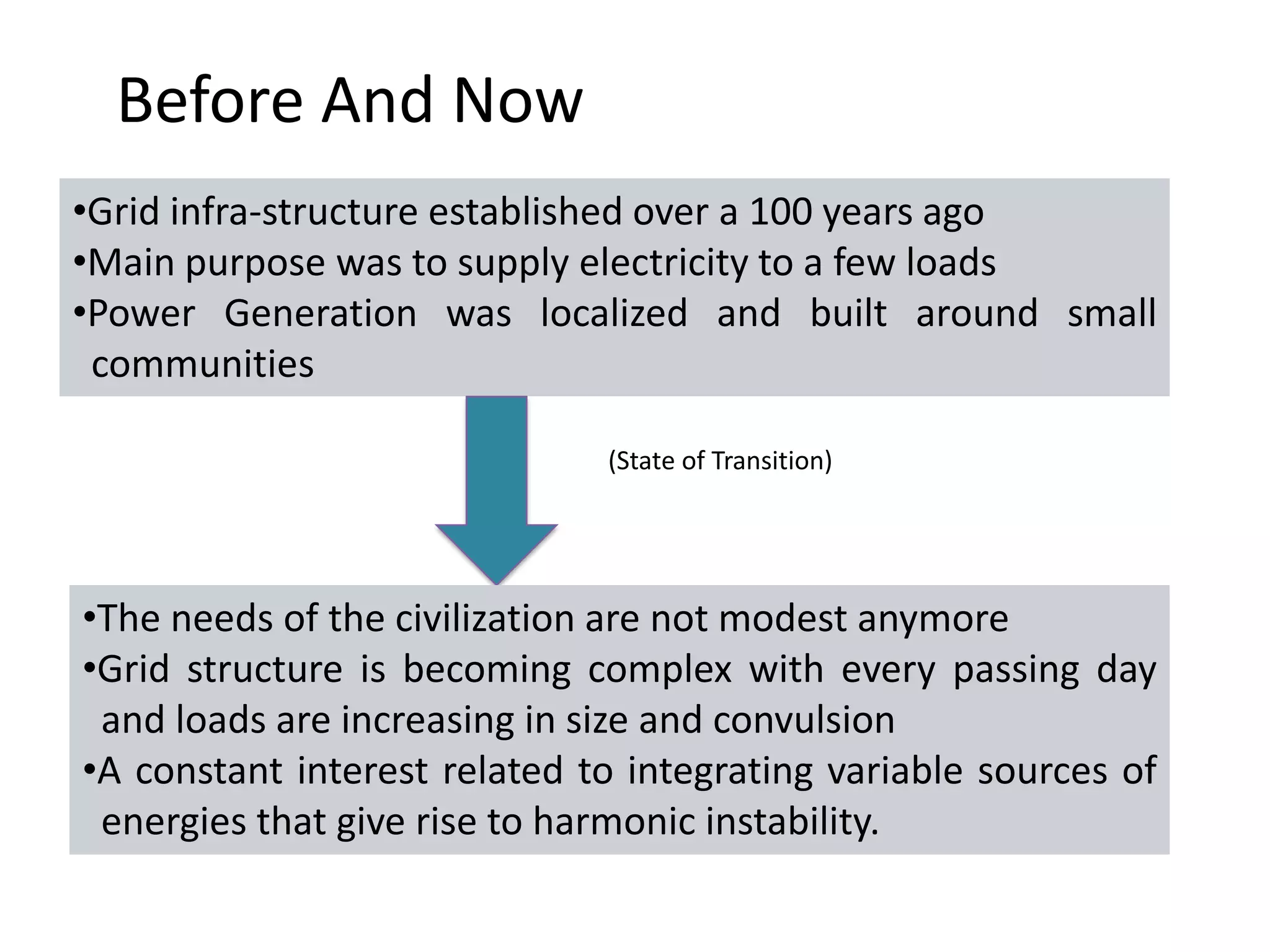
Before And Now
•Grid infra-structure established over a 100 years ago
•Main purpose was to supply electricity to a few loads
•Power Generation was localized and built around small
communities
(State of Transition)

•The needs of the civilization are not modest anymore
•Grid structure is becoming complex with every passing day
and loads are increasing in size and convulsion
•A constant interest related to integrating variable sources of
energies that give rise to harmonic instability.
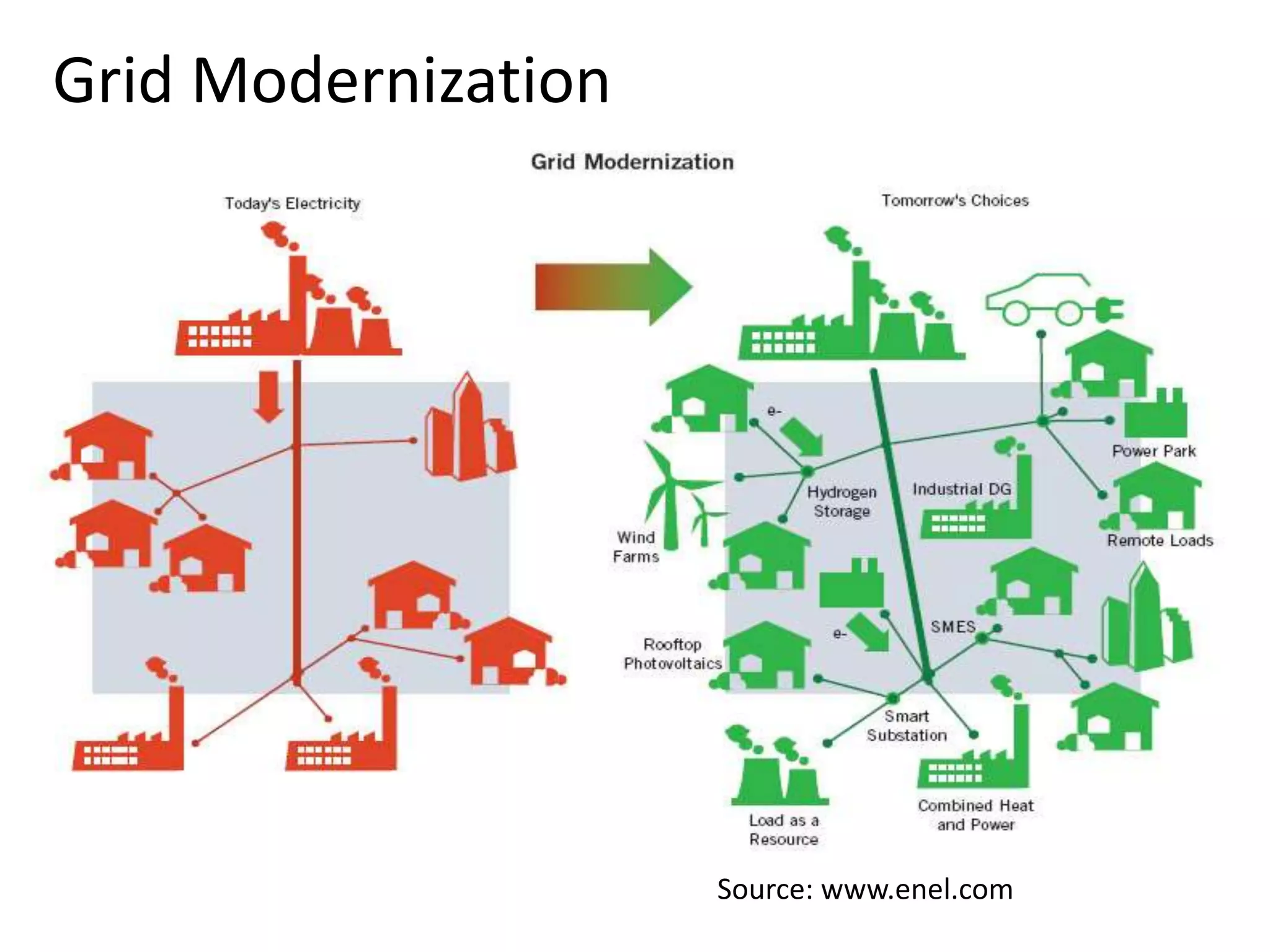
Grid Modernization

w

Source: www.enel.com
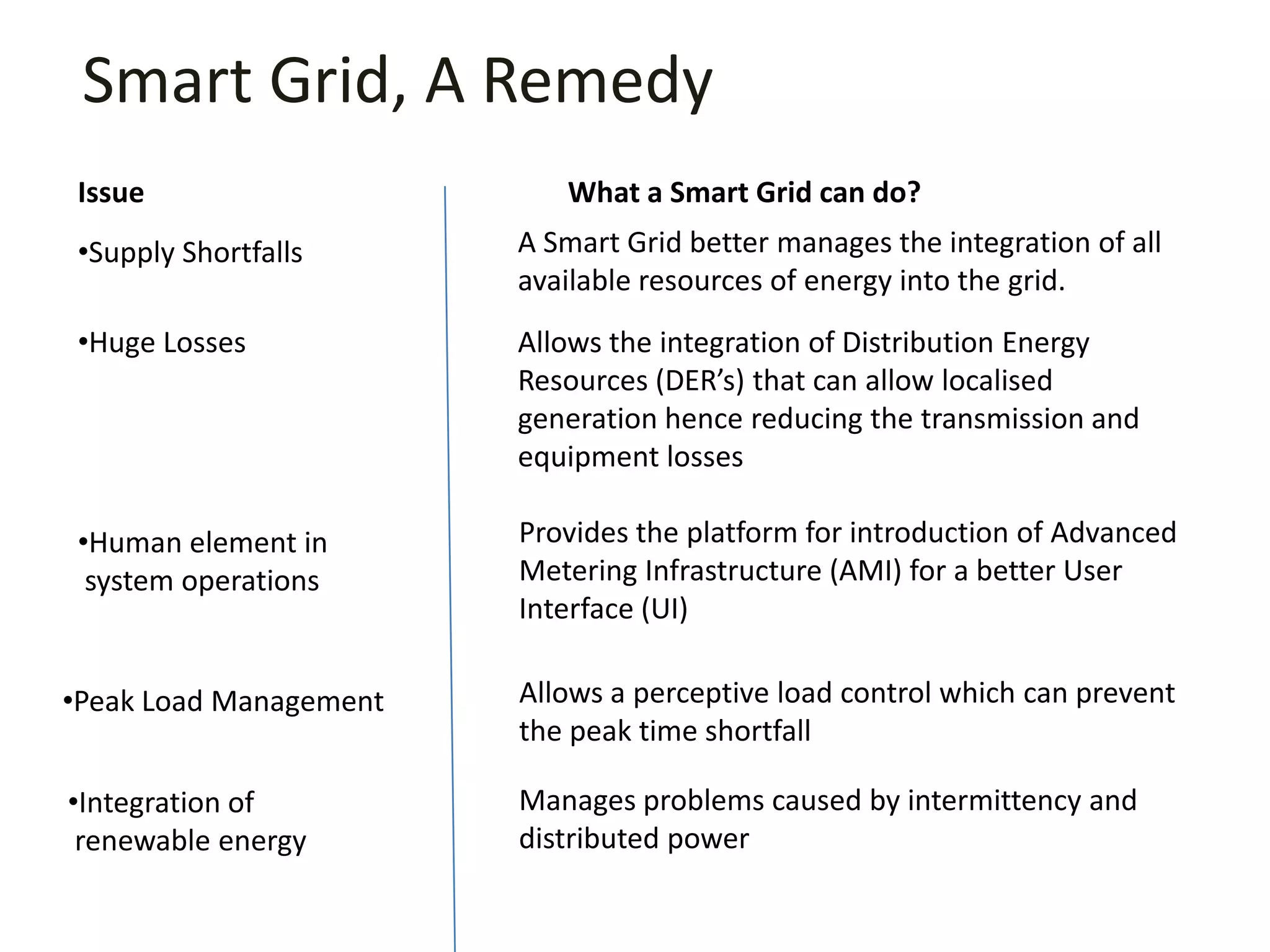
Smart Grid, A Remedy
Issue

What a Smart Grid can do?

•Supply Shortfalls

A Smart Grid better manages the integration of all
available resources of energy into the grid.

•Huge Losses

Allows the integration of Distribution Energy
Resources (DER’s) that can allow localised
generation hence reducing the transmission and
equipment losses

•Human element in
system operations

Provides the platform for introduction of Advanced
Metering Infrastructure (AMI) for a better User
Interface (UI)

•Peak Load Management

Allows a perceptive load control which can prevent
the peak time shortfall

•Integration of
renewable energy

Manages problems caused by intermittency and
distributed power
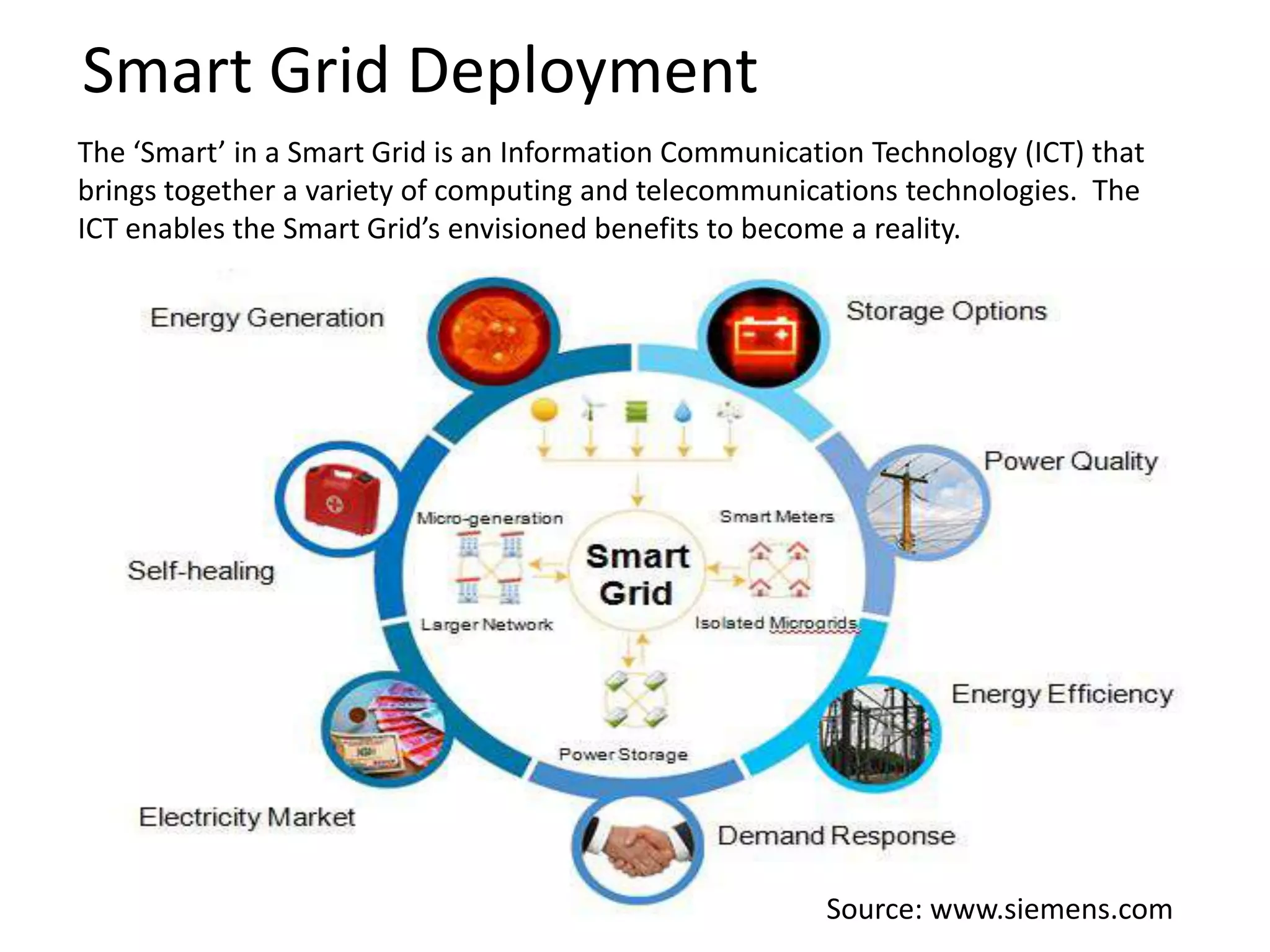
Smart Grid Deployment
The ‘Smart’ in a Smart Grid is an Information Communication Technology (ICT) that
brings together a variety of computing and telecommunications technologies. The
ICT enables the Smart Grid’s envisioned benefits to become a reality.

Source: www.siemens.com
Technology of Smart Grids
Smart Grids encompass a wide range of operations such as
• detecting and identifying faults and a quick response to power outages,
• providing consumers with near real-time information on the amount and
cost of the power they use,
• improving the security of the system, and
• linking all elements of the grid to enable better decision making on the
resource use.

Various technologies in action
• Supervisory Control and Data Acquisition
(SCADA)
• Distribution Management System (DMS)
• Distribution Automation System (DAS)
• Automated Meter Reading (AMR)
• Geographical Information System (GIS)
• Phasor Measurement Units (PMU’s)
Source: www.sandiegofreepress.org
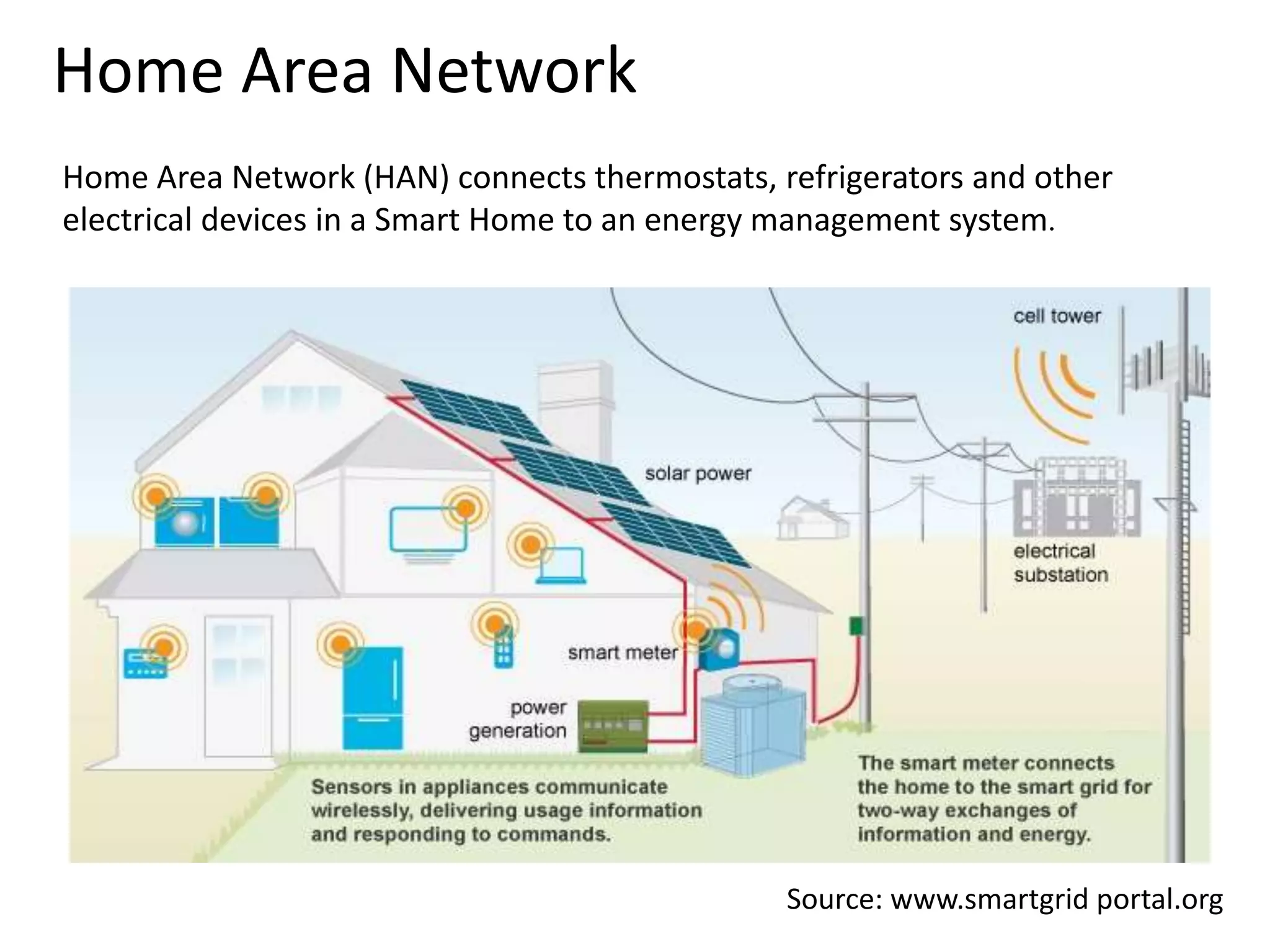
Home Area Network
Home Area Network (HAN) connects thermostats, refrigerators and other
electrical devices in a Smart Home to an energy management system

Source: www.smartgrid portal.org
Integration of Renewable Energy
Integration of Renewable Energy is probably the biggest
thrust for a Smart Grid Deployment in India
• Has to be converged at grid operator level and requires a
superior Energy Management System
• The Smart Grid’s superior capability of introducing new
sources of energy to the grid clearly signifies that more
Distributed Generation can be integrated into it

Solar and Wind energy are crucial and primary factors of a
cleaner and greener energy future
Demerits of Conventional Fuels
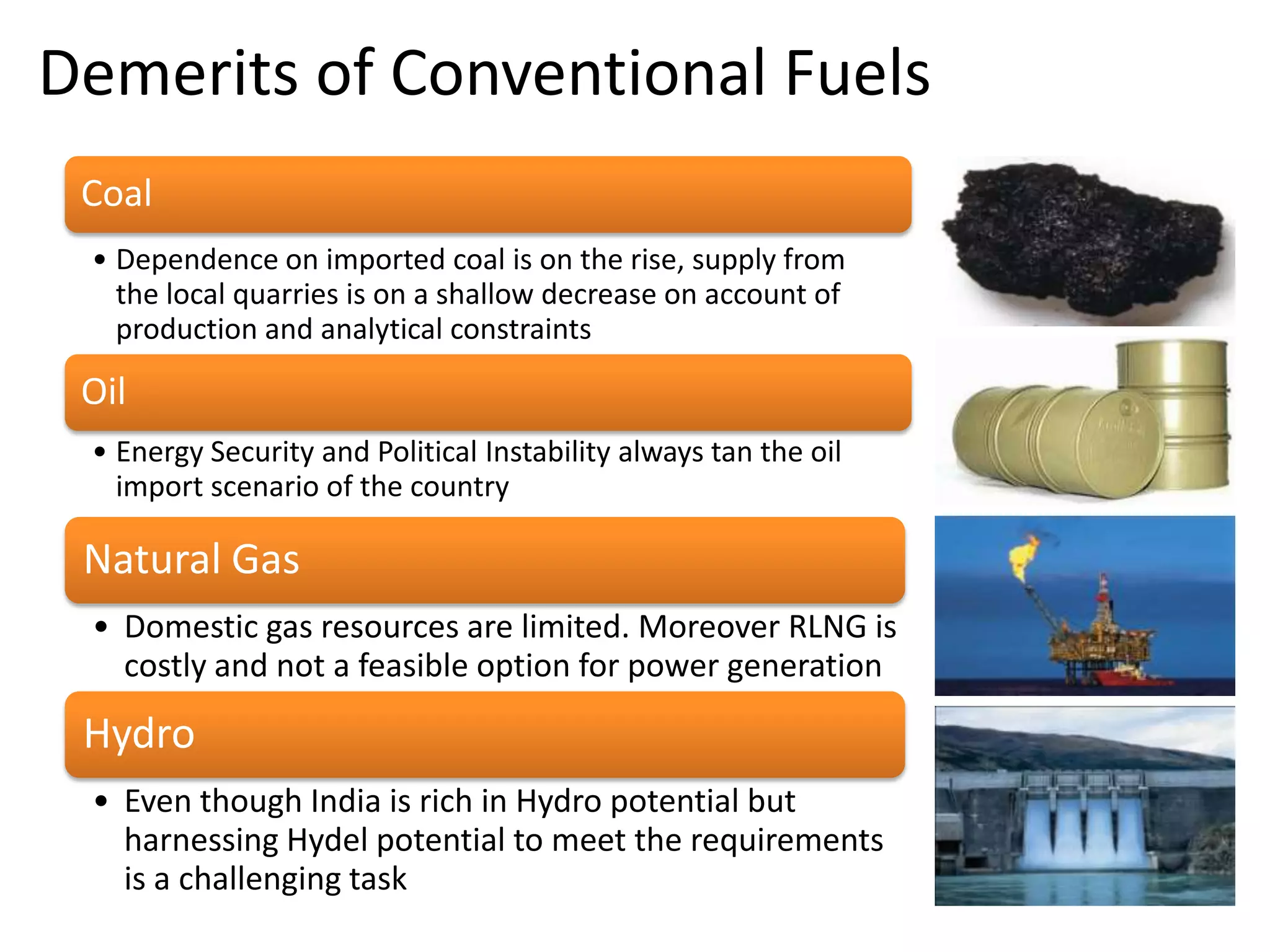
Coal
• Dependence on imported coal is on the rise, supply from
the local quarries is on a shallow decrease on account of
production and analytical constraints

Oil
• Energy Security and Political Instability always tan the oil
import scenario of the country

Natural Gas
• Domestic gas resources are limited. Moreover RLNG is
costly and not a feasible option for power generation

Hydro
• Even though India is rich in Hydro potential but
harnessing Hydel potential to meet the requirements
is a challenging task
India’s Renewable Scenario
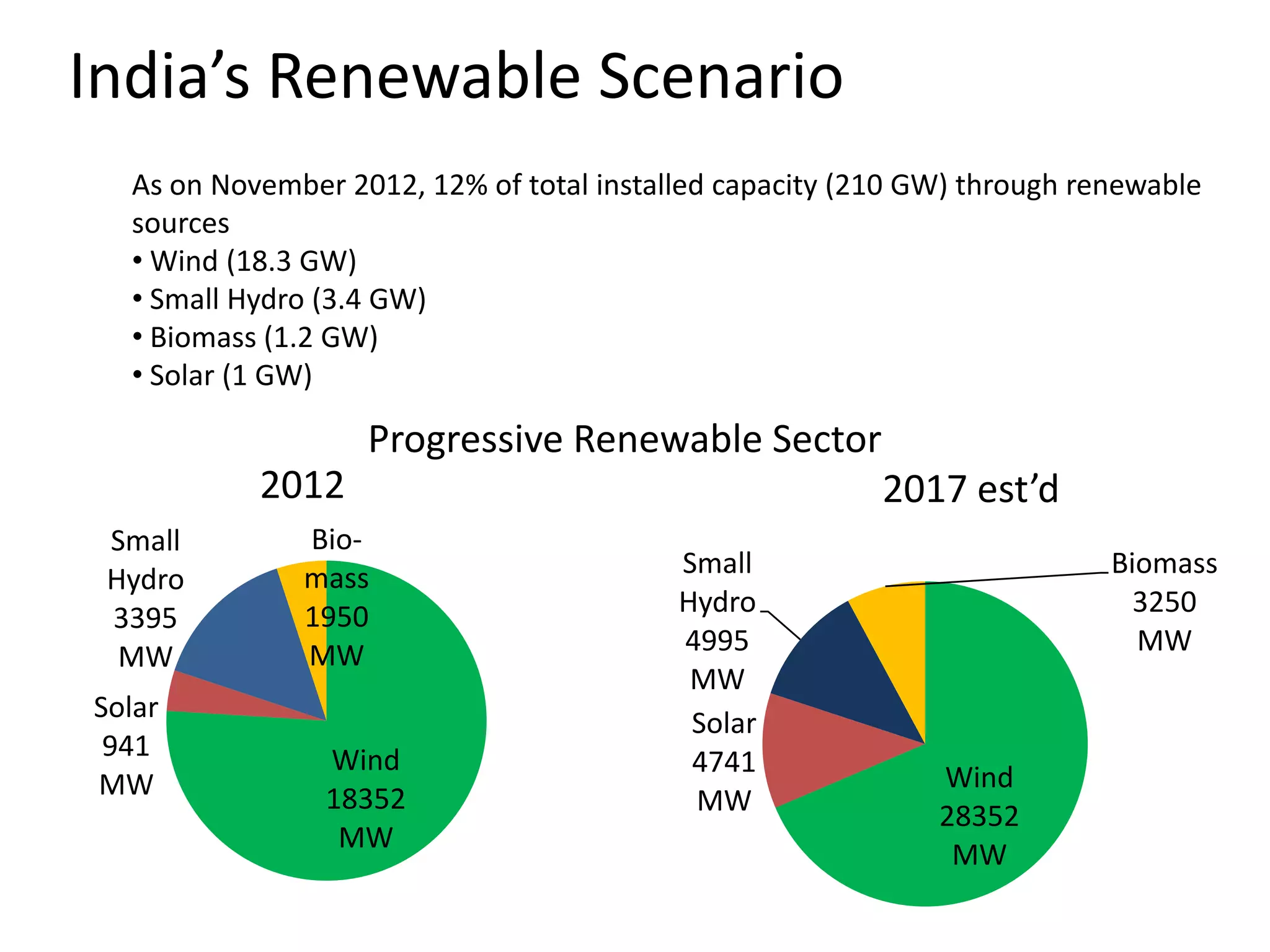
As on November 2012, 12% of total installed capacity (210 GW) through renewable
sources
• Wind (18.3 GW)
• Small Hydro (3.4 GW)
• Biomass (1.2 GW)
• Solar (1 GW)

Progressive Renewable Sector

2012
Small
Hydro
3395
MW
Solar
941
MW

Biomass
1950
MW
Wind
18352
MW

2017 est’d
Small
Hydro
4995
MW
Solar
4741
MW

Biomass
3250
MW

Wind
28352
MW
The Role of Renewable Energy
•

•

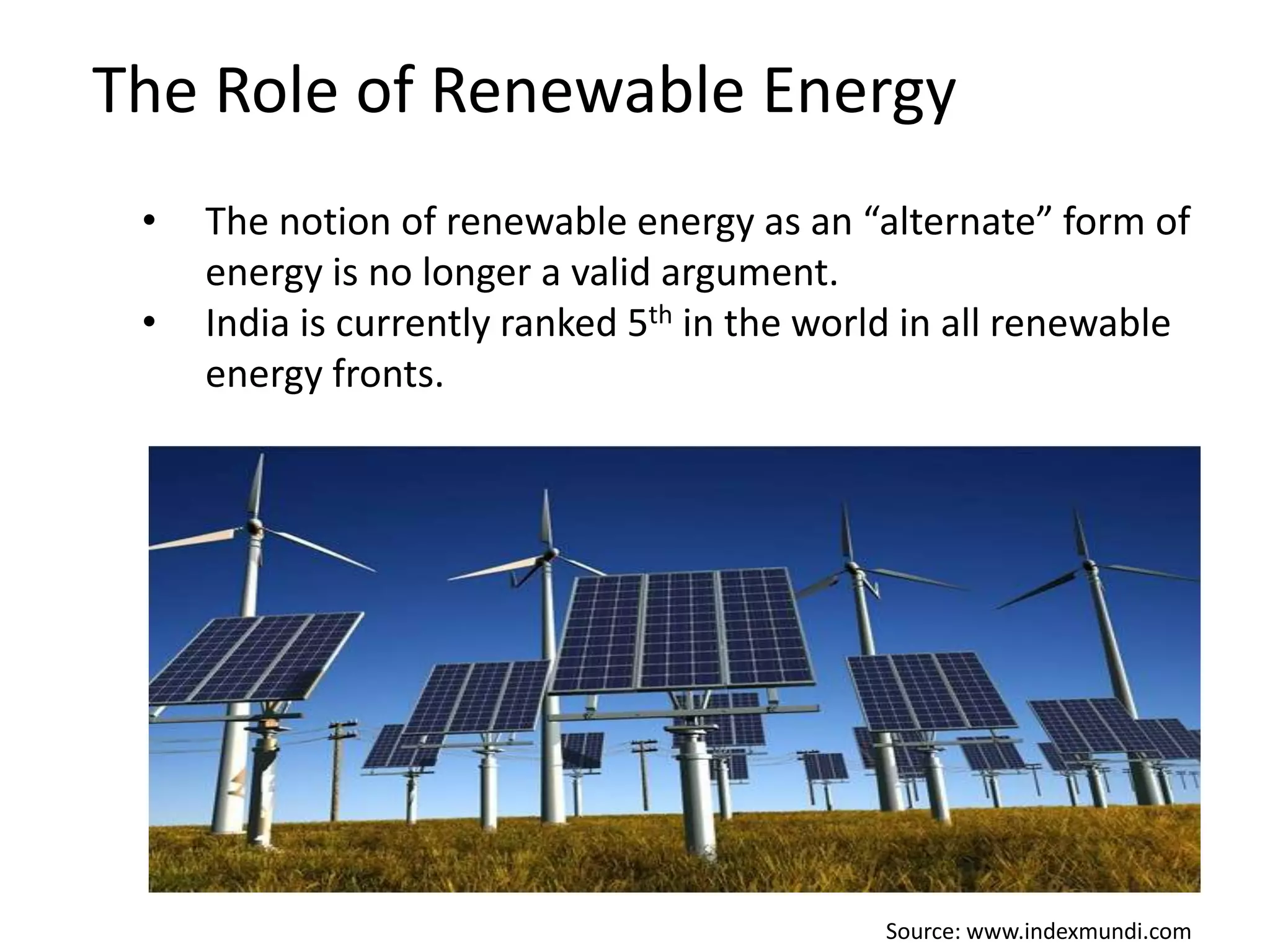
The notion of renewable energy as an “alternate” form of
energy is no longer a valid argument.
India is currently ranked 5th in the world in all renewable
energy fronts.

Source: www.indexmundi.com
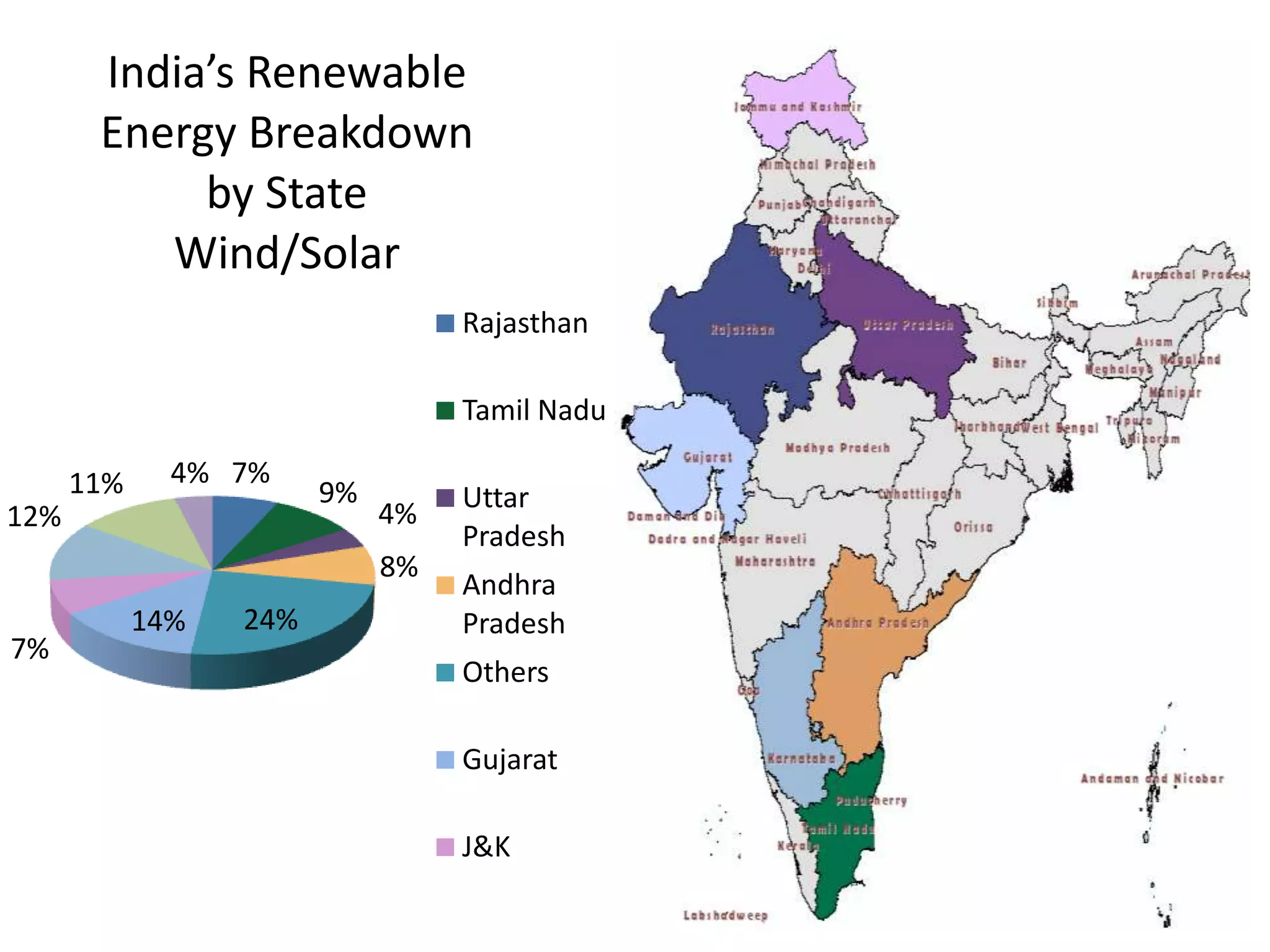
India’s Renewable
Energy Breakdown
by State
Wind/Solar
Rajasthan
Tamil Nadu
11%

4% 7%

12%

9%

4%
8%

7%

14%

24%

Uttar
Pradesh
Andhra
Pradesh
Others
Gujarat
J&K
Wind Energy in India
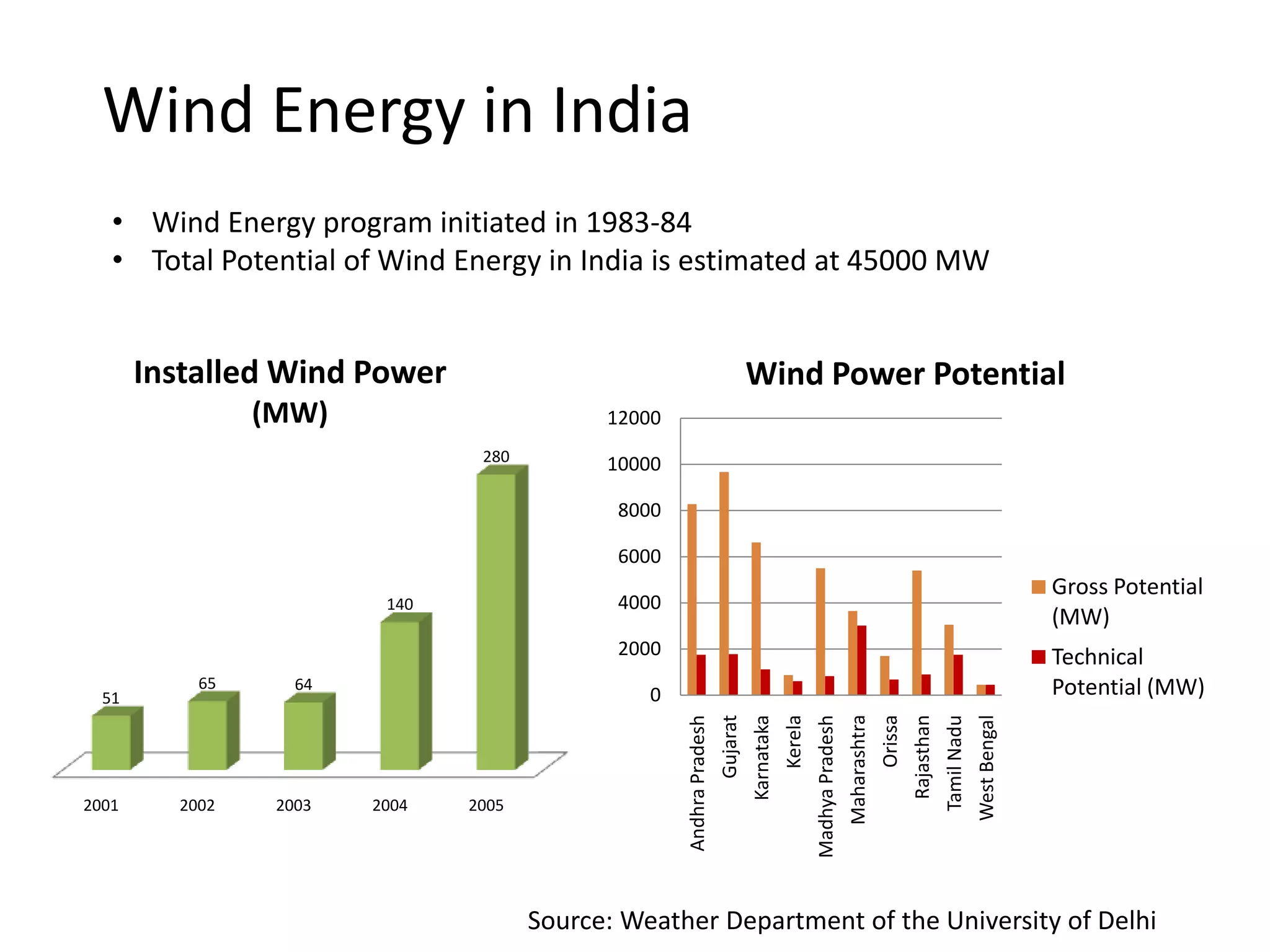
• Wind Energy program initiated in 1983-84
• Total Potential of Wind Energy in India is estimated at 45000 MW

Installed Wind Power

Wind Power Potential

(MW)

12000
280

10000
8000
6000

Gross Potential
(MW)

4000

140

2000

West Bengal

Tamil Nadu

Rajasthan

Orissa

Maharashtra

2005

Madhya Pradesh

2004

Kerela

2003

0
Gujarat

2002

Technical
Potential (MW)
Karnataka

2001

64

Andhra Pradesh

51

65

Source: Weather Department of the University of Delhi
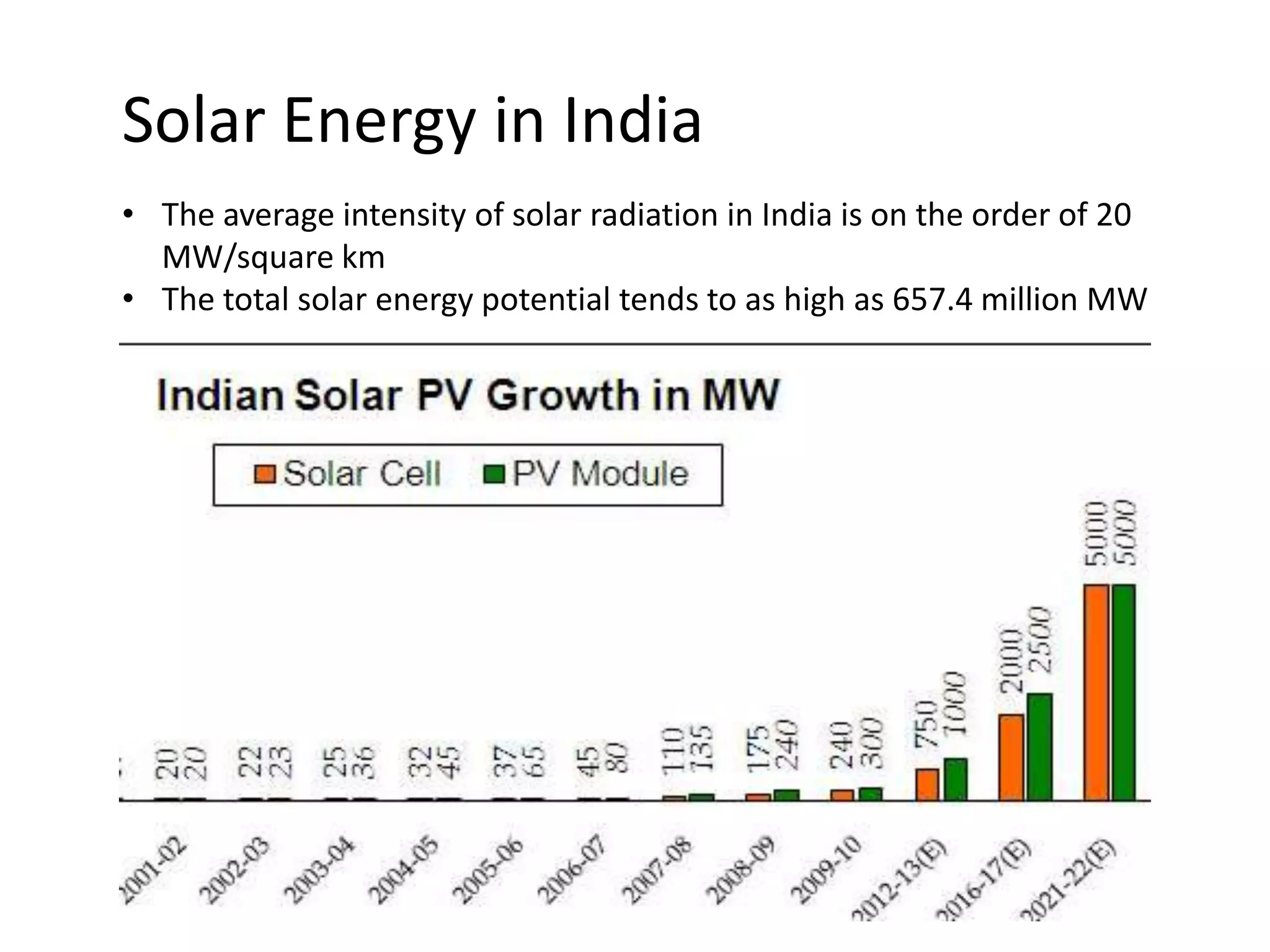
Solar Energy in India
• The average intensity of solar radiation in India is on the order of 20
MW/square km
• The total solar energy potential tends to as high as 657.4 million MW
Why do we need a Smart Grid for
integrating Renewable Energies into the
Grid?
• Location Dependent Resources

• Variability
• Unpredictability
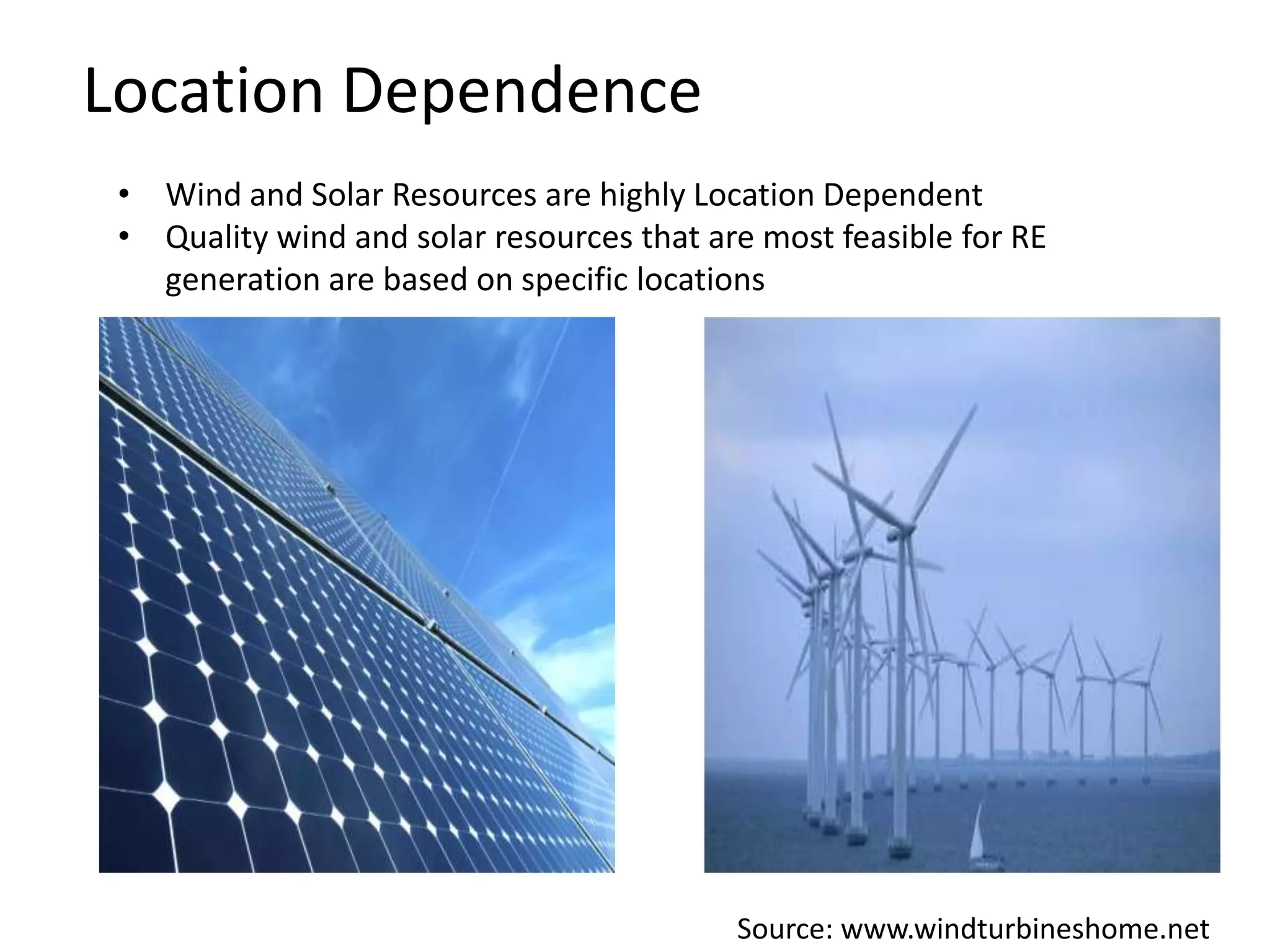
Location Dependence
• Wind and Solar Resources are highly Location Dependent
• Quality wind and solar resources that are most feasible for RE
generation are based on specific locations

Source: www.windturbineshome.net
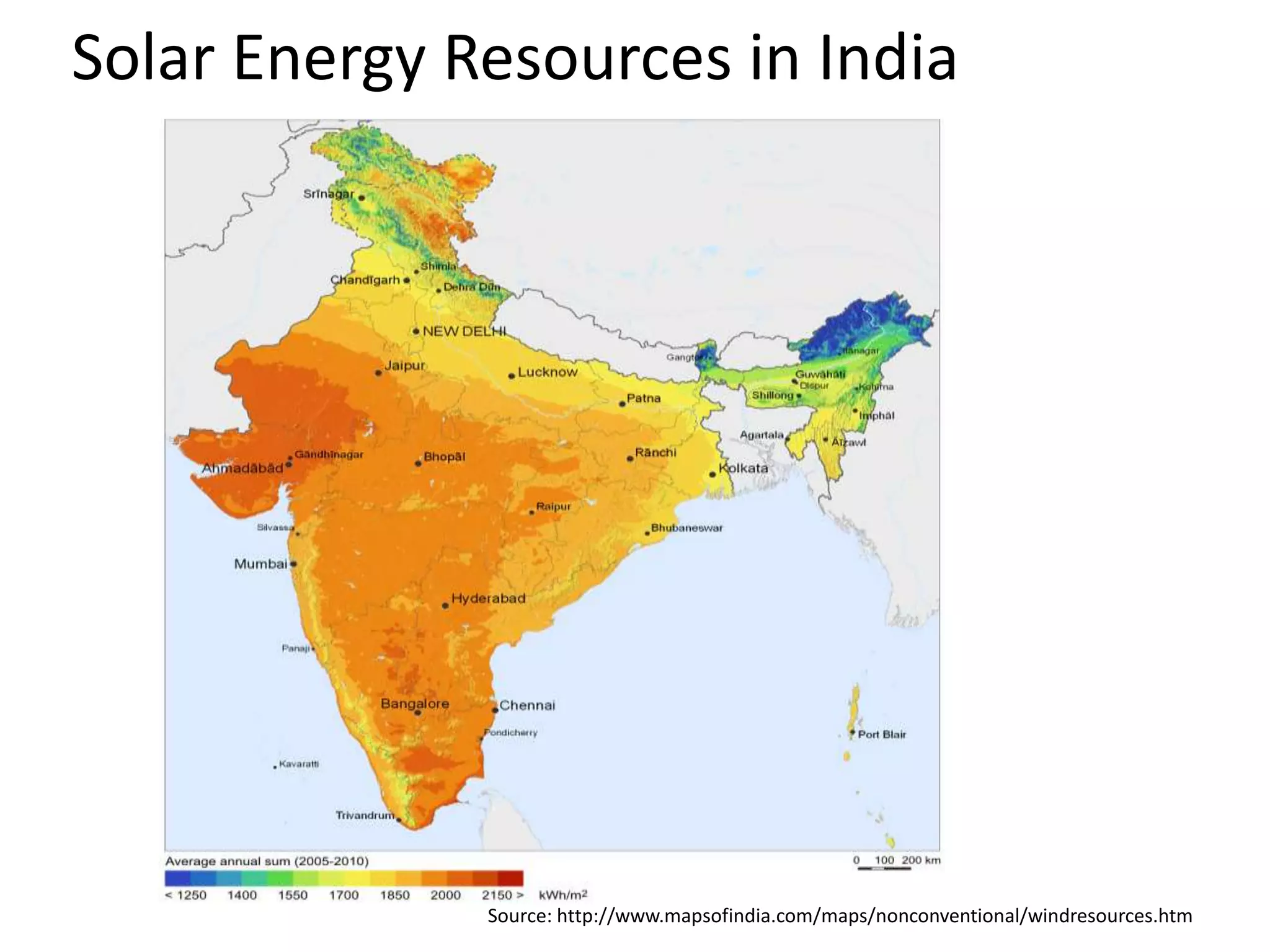
Solar Energy Resources in India

Source: http://www.mapsofindia.com/maps/nonconventional/windresources.htm
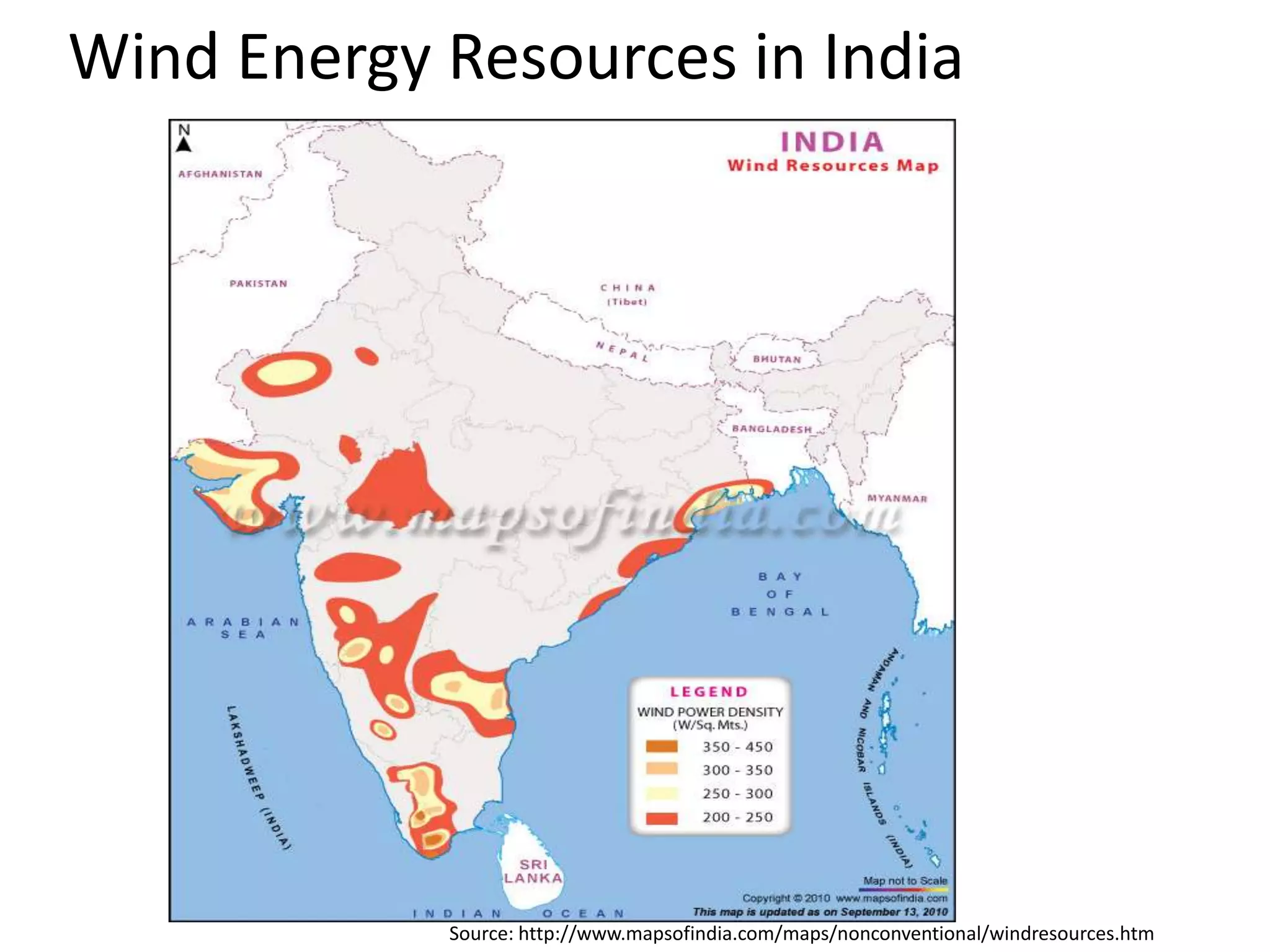
Wind Energy Resources in India

Source: http://www.mapsofindia.com/maps/nonconventional/windresources.htm
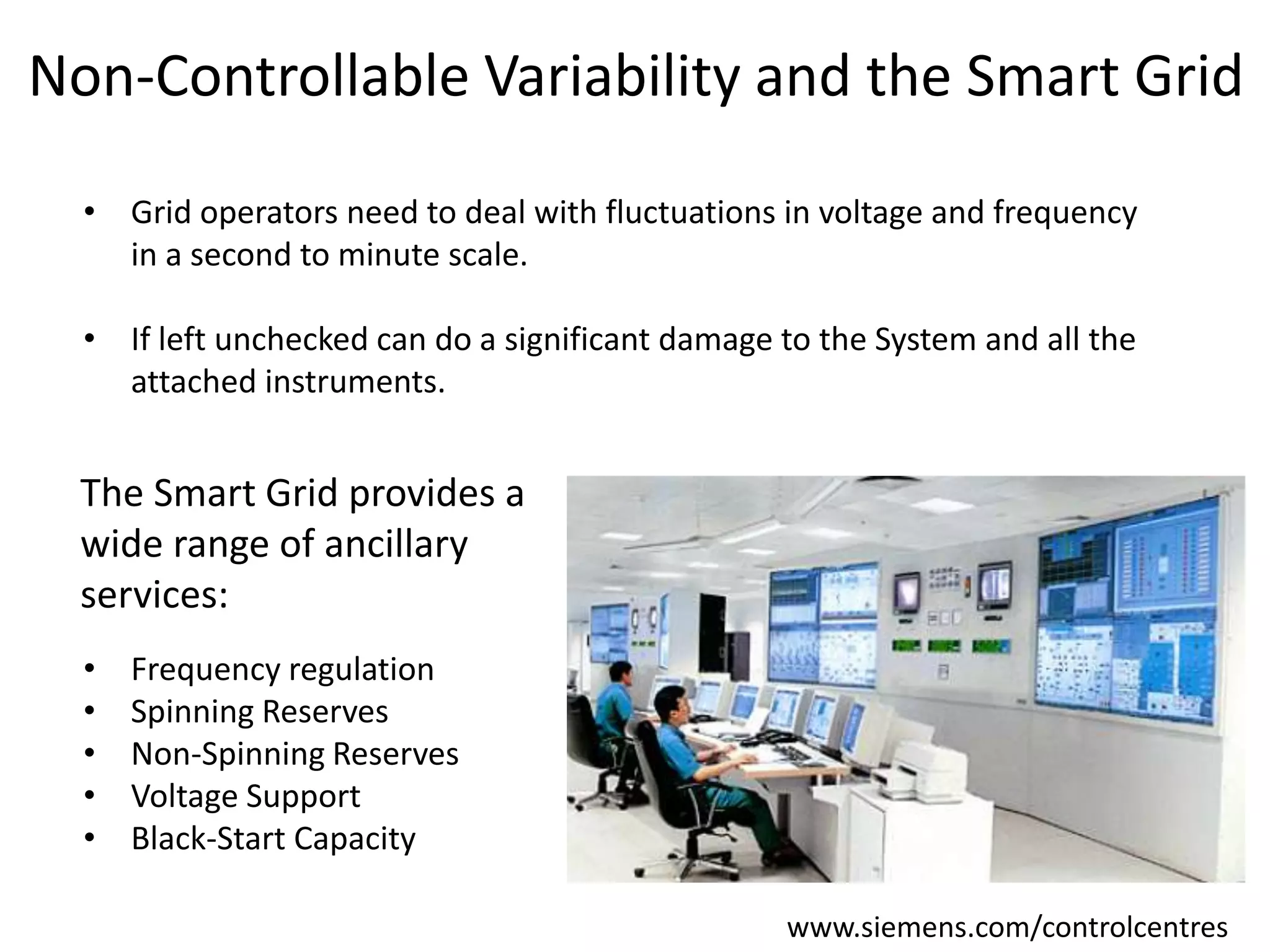
Non-Controllable Variability and the Smart Grid
• Grid operators need to deal with fluctuations in voltage and frequency
in a second to minute scale.
• If left unchecked can do a significant damage to the System and all the
attached instruments.

The Smart Grid provides a
wide range of ancillary
services:
•
•
•
•
•

Frequency regulation
Spinning Reserves
Non-Spinning Reserves
Voltage Support
Black-Start Capacity
www.siemens.com/controlcentres
What has been done in India?
• Smart Grid provides the platform for a more reliable, secure and
sustainable grid in India.
• Pilot Smart Grid projects
o Gujarat
o Chandigarh
• Smart Metering Infrastructure is being planned for a number of
states.
• Dr Sam Pitroda, chairman India Smart Grid Task Force launched
the Smart Grid portal in 2013 : www.IndiaSmartGrid.org
If you have any questions, or would
like to help further this research,
please contact
Mr Farhan Beg, via email:
farhan.beg@geni.org
Farhan Beg is a Power Engineer from the
National Institute of
Technology, Srinagar, India
(www.NITSRI.net) and is a researcher at the
Global Energy Network Institute, San Diego
USA (www.GENI.org)

Integrating wind and solar energy in India for a Smart Grid platform

  • 1.
    Integrating Wind andSolar Energy in India for a Smart Grid Platform Farhan Beg With Support and Editorial by Mr Peter Meissen
  • 2.
  • 3.
    India, Latitude andLongitude Source: www.wikipedia.org/india
  • 4.
    Population Current Population: 1.27Billion Source: CIA world Factbook
  • 5.
  • 6.
    Energy Consumption (quadrillion Btu) 800 700 600 500 OECD 400 Restof the World 300 China and India 200 100 0 1990 2000 2008 2015 Currently 2025 2035 Source : IEA
  • 7.
    India’s Energy Consumptionand GDP Source: EIA
  • 8.
    The Two FastestGrowing Major Economies Peoples Republic of China vs. Republic of India China India Population (July 2013 est.) 1.34 billion 1.28 billion Electricity Installed generation capacity (2012 est.) 1100.78 GW 220.23 GW Electricity from fossil fuels 69.5 % of installed capacity 69.9 % of installed capacity Electricity from Renewable sources 29.6 % of installed capacity 27.6 % of installed capacity Carbon dioxide emission from 8.321 billion Mt consumption of energy.(est 2010) Source: CIA world Factbook 1.696 billion Mt Carbon dioxide emission of China is nearly 5 times more as that of India!
  • 9.
    Acknowledging Power Supplyand Demand The Gap between demand and supply is wide and growing. • Growing economy and massive urbanization is putting more stress on energy and the environment. • The average electricity consumption in India is still among the lowest in the world at just 630 kWh per person per year, but this is expected to grow to 1000 kWh in the near future. Source: CEA, Ministry of Power India
  • 10.
    Population Growth, ElectricityProduction, and Electricity Consumption Population Growth Millions 1500 1000 500 0 Electricity Production MW 1998 2000 2002 2004 2006 2008 2010 2012 2014 1000 500 0 1998 2000 2002 2004 2006 2008 2010 2012 2014 Electricity Consumption MW 1000 Source: Indian Ministry of Power 500 0 1998 2000 2002 2004 2006 2008 2010 2012 2014
  • 11.
    India’s Energy Consumptionfor Electricity Generation Hydro 19% Nuclear 2% Biomass & other Renewable 12% Coal 57% Gas 9% Diesel 1% Source: EIA
  • 12.
    Electricity Scenario ofIndia Key regulatory bodies in the Indian Power Sector Department of Atomic Energy Ministry of Power Central Electricity Regularity Commission Central Electricity Authority State Electricity Regularity Commissions Installed Capacity: 220 GW Peak Demand: 170 GW Peak Deficit: 8.6 % Energy Deficit: 4.8 % Growth Rate: 8-9 % PA For the Year 2011 Source: Central Electricity Authority
  • 13.
    Issues Facing India’sPower Sector Generation Side Transmission Side Distribution Side
  • 14.
    Generation •Fuel (Coal andGas) Shortage is acute. •Many power plants have less than seven days' of coal stocks, a level seen as critical to continuous operation. •Present demand–supply gap of coal is around 85 million tons and it is expected to increase gradually to nearly 140 million tons by 2017. •Capacity addition from hydropower sources slowed in the past couple of years
  • 15.
    Transmission • A huge12 percent of the electricity generated is lost while evacuating power to the consumers as Transmission losses which can go to as high as 50 percent in some states. • The officially declared transmission and losses in India have steadily risen from about 7 percent up to the year 1966-67 to about 12 percent in 1998-99
  • 16.
    Distribution •Distribution companies, mostlystate-owned, are mired with about $35 billion in debt barring them from investing more into the R&D and up gradation of their utilities. •The estimated loss of all the State distribution utilities has been estimated at Rs 2400 million as of March 31, 2012
  • 17.
    Before And Now •Gridinfra-structure established over a 100 years ago •Main purpose was to supply electricity to a few loads •Power Generation was localized and built around small communities (State of Transition) •The needs of the civilization are not modest anymore •Grid structure is becoming complex with every passing day and loads are increasing in size and convulsion •A constant interest related to integrating variable sources of energies that give rise to harmonic instability.
  • 18.
  • 19.
    Smart Grid, ARemedy Issue What a Smart Grid can do? •Supply Shortfalls A Smart Grid better manages the integration of all available resources of energy into the grid. •Huge Losses Allows the integration of Distribution Energy Resources (DER’s) that can allow localised generation hence reducing the transmission and equipment losses •Human element in system operations Provides the platform for introduction of Advanced Metering Infrastructure (AMI) for a better User Interface (UI) •Peak Load Management Allows a perceptive load control which can prevent the peak time shortfall •Integration of renewable energy Manages problems caused by intermittency and distributed power
  • 20.
    Smart Grid Deployment The‘Smart’ in a Smart Grid is an Information Communication Technology (ICT) that brings together a variety of computing and telecommunications technologies. The ICT enables the Smart Grid’s envisioned benefits to become a reality. Source: www.siemens.com
  • 21.
    Technology of SmartGrids Smart Grids encompass a wide range of operations such as • detecting and identifying faults and a quick response to power outages, • providing consumers with near real-time information on the amount and cost of the power they use, • improving the security of the system, and • linking all elements of the grid to enable better decision making on the resource use. Various technologies in action • Supervisory Control and Data Acquisition (SCADA) • Distribution Management System (DMS) • Distribution Automation System (DAS) • Automated Meter Reading (AMR) • Geographical Information System (GIS) • Phasor Measurement Units (PMU’s) Source: www.sandiegofreepress.org
  • 22.
    Home Area Network HomeArea Network (HAN) connects thermostats, refrigerators and other electrical devices in a Smart Home to an energy management system Source: www.smartgrid portal.org
  • 23.
    Integration of RenewableEnergy Integration of Renewable Energy is probably the biggest thrust for a Smart Grid Deployment in India • Has to be converged at grid operator level and requires a superior Energy Management System • The Smart Grid’s superior capability of introducing new sources of energy to the grid clearly signifies that more Distributed Generation can be integrated into it Solar and Wind energy are crucial and primary factors of a cleaner and greener energy future
  • 24.
    Demerits of ConventionalFuels Coal • Dependence on imported coal is on the rise, supply from the local quarries is on a shallow decrease on account of production and analytical constraints Oil • Energy Security and Political Instability always tan the oil import scenario of the country Natural Gas • Domestic gas resources are limited. Moreover RLNG is costly and not a feasible option for power generation Hydro • Even though India is rich in Hydro potential but harnessing Hydel potential to meet the requirements is a challenging task
  • 25.
    India’s Renewable Scenario Ason November 2012, 12% of total installed capacity (210 GW) through renewable sources • Wind (18.3 GW) • Small Hydro (3.4 GW) • Biomass (1.2 GW) • Solar (1 GW) Progressive Renewable Sector 2012 Small Hydro 3395 MW Solar 941 MW Biomass 1950 MW Wind 18352 MW 2017 est’d Small Hydro 4995 MW Solar 4741 MW Biomass 3250 MW Wind 28352 MW
  • 26.
    The Role ofRenewable Energy • • The notion of renewable energy as an “alternate” form of energy is no longer a valid argument. India is currently ranked 5th in the world in all renewable energy fronts. Source: www.indexmundi.com
  • 27.
    India’s Renewable Energy Breakdown byState Wind/Solar Rajasthan Tamil Nadu 11% 4% 7% 12% 9% 4% 8% 7% 14% 24% Uttar Pradesh Andhra Pradesh Others Gujarat J&K
  • 28.
    Wind Energy inIndia • Wind Energy program initiated in 1983-84 • Total Potential of Wind Energy in India is estimated at 45000 MW Installed Wind Power Wind Power Potential (MW) 12000 280 10000 8000 6000 Gross Potential (MW) 4000 140 2000 West Bengal Tamil Nadu Rajasthan Orissa Maharashtra 2005 Madhya Pradesh 2004 Kerela 2003 0 Gujarat 2002 Technical Potential (MW) Karnataka 2001 64 Andhra Pradesh 51 65 Source: Weather Department of the University of Delhi
  • 29.
    Solar Energy inIndia • The average intensity of solar radiation in India is on the order of 20 MW/square km • The total solar energy potential tends to as high as 657.4 million MW
  • 30.
    Why do weneed a Smart Grid for integrating Renewable Energies into the Grid? • Location Dependent Resources • Variability • Unpredictability
  • 31.
    Location Dependence • Windand Solar Resources are highly Location Dependent • Quality wind and solar resources that are most feasible for RE generation are based on specific locations Source: www.windturbineshome.net
  • 32.
    Solar Energy Resourcesin India Source: http://www.mapsofindia.com/maps/nonconventional/windresources.htm
  • 33.
    Wind Energy Resourcesin India Source: http://www.mapsofindia.com/maps/nonconventional/windresources.htm
  • 34.
    Non-Controllable Variability andthe Smart Grid • Grid operators need to deal with fluctuations in voltage and frequency in a second to minute scale. • If left unchecked can do a significant damage to the System and all the attached instruments. The Smart Grid provides a wide range of ancillary services: • • • • • Frequency regulation Spinning Reserves Non-Spinning Reserves Voltage Support Black-Start Capacity www.siemens.com/controlcentres
  • 35.
    What has beendone in India? • Smart Grid provides the platform for a more reliable, secure and sustainable grid in India. • Pilot Smart Grid projects o Gujarat o Chandigarh • Smart Metering Infrastructure is being planned for a number of states. • Dr Sam Pitroda, chairman India Smart Grid Task Force launched the Smart Grid portal in 2013 : www.IndiaSmartGrid.org
  • 36.
    If you haveany questions, or would like to help further this research, please contact Mr Farhan Beg, via email: farhan.beg@geni.org Farhan Beg is a Power Engineer from the National Institute of Technology, Srinagar, India (www.NITSRI.net) and is a researcher at the Global Energy Network Institute, San Diego USA (www.GENI.org)

Editor's Notes

  • #2 This presentation is actually an analysis into the heart of the Indian power sector; what are the problems that the Indian grid is facing and what is the best possible solution to solve them. Smart Grid proposes a dynamic electricity management system which seems to be the need of the hour for the Indian electricity System
  • #3 India’s Location with respect to the world.
  • #4 Tropic of Cancer passes through the country and half of the country is tropical while as half is sub tropical.
  • #5 The population of the country shows a bulge when compared to other countries of the world.
  • #6 Most of the population is concentrated in the East and the South of the country because of the favorable weather and a lot of commerce.
  • #7 Over the years, India and China have shown a steady growth in terms of their Energy consumption while as the OECD countries show a constant energy consumption. This is mostly because of the huge growth rate in India and China.
  • #8 Total Energy Consumption in the country is at a steep rise.
  • #9 Carbon dioxide emission of China is nearly 5 times more as that of India. The electricity installed generation capacity of China is nearly 5 times more than India.
  • #10 The demand for electricity is constantly outstripping the supply and the gap is ever widening.
  • #11 The electricity production is increasing at a steady growth rate trying to match the demand because of the increasing population.
  • #12 More than half of Electricity produced in the country is from conventional fuels and needs a change to a more sustainable and green fuel source.
  • #14 All three facets of extracting electricity from the utilities to the consumer face some very strong issues.
  • #18 There has been a transition from the needs of consumers a century before to today.
  • #19 Grid modernization involving latest technologies and better storage options for integration of renewable energy is important.
  • #20 Smart Grid provides the solution to all of the issues facing the India’s electricity grid.
  • #21 The Smart Grid has to be deployed in certain steps and phases.
  • #23 Even though not a very strong contender for smart grid deployment in India, Home Area Network is a very important parameter for the final green and reliable electricity system in India and abroad.
  • #25 Renewable Sources of energy provide clear benefits over the conventional fuels.
  • #26 Over the years, the Indias Renewable Energy Scene has observed a very steady growth and the growth is expected to continue.
  • #27 Renewable Energy is one of the most important drivers for the Smart Grid deployment in the country. Smart Grid can do a fairly good job in integrating the energy from renewable sources into the grid.
  • #28 Renewable Energy is highly distributed in the country.
  • #29 Wind Energy has gained a lot of ground over the years mostly because of improvement is the wind turbine technologies as well as wind estimation technologies.
  • #30 Banking on government backed missions such as the Jawaharlal Nehru National Solar Mission, tapping solar energy is one of the most important thrust areas for smart grid deployment in the country.
  • #33 Most of the potential Solar resources for electricity generation are found in the western region of the country in the states of Gujarat and Rajasthan.