PRESENTED BY:-
ROHIT VIJAY
RESEARCH SCHOLAR
1.Two wide area synchronous grids connected by HVDC connection.
2. 2nd Highest Pumped storage capacity  27GW, 3rd largest solar PV
capacity (50 GW)
3. 2011 Fukushima Nuclear Disaster. (EASTERN GRID)
4. Japan is an island and resource poor country
(optimal combination of power resources is very necessary)
EASTERN JAPAN
50 HZ
WESTERN JAPAN
60 HZ
1.2 GW CAPACITY
HVDC LINK
YEAR 2010 2015 2017 2019
GENERATED
(TWH)
1028 920 1027 1026
HYDRO 9% 9% 9% 8%
FOSSIL FUEL 62% 83% 75% 71%
COAL 25% 31% 28% 28%
LNG 29% 45% 41% 38%
OIL 8% 8% 7% 5%
NUCLEAR 29% 1% 3% 6%
RENEWABLES 1% 4% 8% 9%
OTHERS 1% 2% 5% 5%
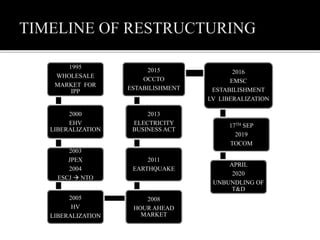
1995
WHOLESALE
MARKET FOR
IPP
2000
EHV
LIBERALIZATION
2003
JPEX
2004
ESCJ  NTO
2005
HV
LIBERALIZATION
2008
HOUR AHEAD
MARKET
2011
EARTHQUAKE
2013
ELECTRICITY
BUSINESS ACT
2015
OCCTO
ESTABILISHMENT
2016
EMSC
ESTABILISHMENT
LV LIBERALIZATION
17TH SEP
2019
TOCOM
APRIL
2020
UNBUNDLING OF
T&D
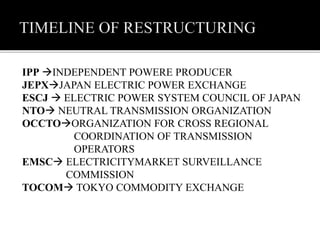
IPP INDEPENDENT POWERE PRODUCER
JEPXJAPAN ELECTRIC POWER EXCHANGE
ESCJ  ELECTRIC POWER SYSTEM COUNCIL OF JAPAN
NTO NEUTRAL TRANSMISSION ORGANIZATION
OCCTOORGANIZATION FOR CROSS REGIONAL
COORDINATION OF TRANSMISSION
OPERATORS
EMSC ELECTRICITYMARKET SURVEILLANCE
COMMISSION
TOCOM TOKYO COMMODITY EXCHANGE
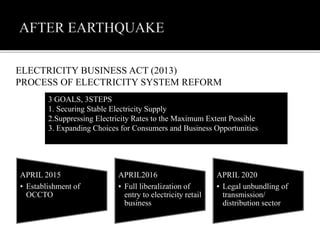
APRIL 2015
• Establishment of
OCCTO
APRIL2016
• Full liberalization of
entry to electricity retail
business
APRIL 2020
• Legal unbundling of
transmission/
distribution sector
ELECTRICITY BUSINESS ACT (2013)
PROCESS OF ELECTRICITY SYSTEM REFORM
3 GOALS, 3STEPS
1. Securing Stable Electricity Supply
2.Suppressing Electricity Rates to the Maximum Extent Possible
3. Expanding Choices for Consumers and Business Opportunities
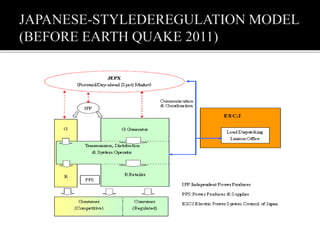
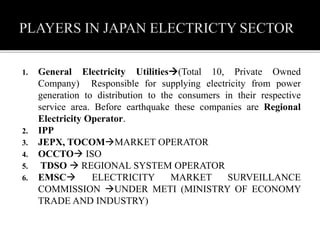
1. General Electricity Utilities(Total 10, Private Owned
Company) Responsible for supplying electricity from power
generation to distribution to the consumers in their respective
service area. Before earthquake these companies are Regional
Electricity Operator.
2. IPP
3. JEPX, TOCOMMARKET OPERATOR
4. OCCTO ISO
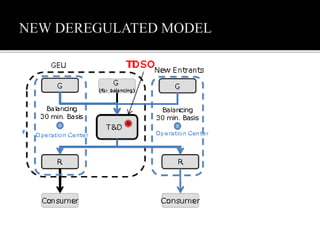
5. TDSO  REGIONAL SYSTEM OPERATOR
6. EMSC ELECTRICITY MARKET SURVEILLANCE
COMMISSION UNDER METI (MINISTRY OF ECONOMY
TRADE AND INDUSTRY)
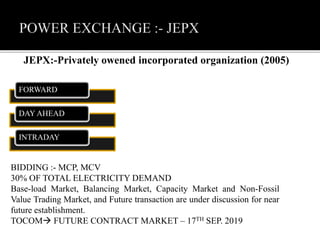
JEPX:-Privately owened incorporated organization (2005)
FORWARD
DAY AHEAD
INTRADAY
BIDDING :- MCP, MCV
30% OF TOTAL ELECTRICITY DEMAND
Base-load Market, Balancing Market, Capacity Market and Non-Fossil
Value Trading Market, and Future transaction are under discussion for near
future establishment.
TOCOM FUTURE CONTRACT MARKET – 17TH SEP. 2019
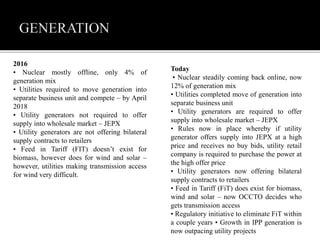
2016
• Nuclear mostly offline, only 4% of
generation mix
• Utilities required to move generation into
separate business unit and compete – by April
2018
• Utility generators not required to offer
supply into wholesale market – JEPX
• Utility generators are not offering bilateral
supply contracts to retailers
• Feed in Tariff (FIT) doesn’t exist for
biomass, however does for wind and solar –
however, utilities making transmission access
for wind very difficult.
Today
• Nuclear steadily coming back online, now
12% of generation mix
• Utilities completed move of generation into
separate business unit
• Utility generators are required to offer
supply into wholesale market – JEPX
• Rules now in place whereby if utility
generator offers supply into JEPX at a high
price and receives no buy bids, utility retail
company is required to purchase the power at
the high offer price
• Utility generators now offering bilateral
supply contracts to retailers
• Feed in Tariff (FiT) does exist for biomass,
wind and solar – now OCCTO decides who
gets transmission access
• Regulatory initiative to eliminate FiT within
a couple years • Growth in IPP generation is
now outpacing utility projects
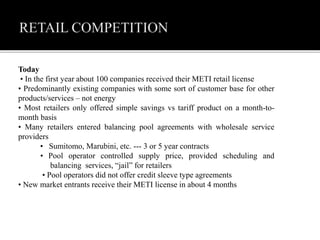
Today
• In the first year about 100 companies received their METI retail license
• Predominantly existing companies with some sort of customer base for other
products/services – not energy
• Most retailers only offered simple savings vs tariff product on a month-to-
month basis
• Many retailers entered balancing pool agreements with wholesale service
providers
• Sumitomo, Marubini, etc. --- 3 or 5 year contracts
• Pool operator controlled supply price, provided scheduling and
balancing services, “jail” for retailers
• Pool operators did not offer credit sleeve type agreements
• New market entrants receive their METI license in about 4 months
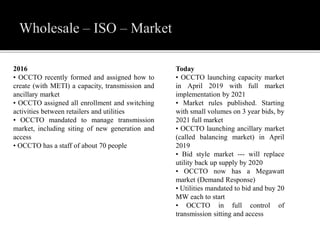
2016
• OCCTO recently formed and assigned how to
create (with METI) a capacity, transmission and
ancillary market
• OCCTO assigned all enrollment and switching
activities between retailers and utilities
• OCCTO mandated to manage transmission
market, including siting of new generation and
access
• OCCTO has a staff of about 70 people
Today
• OCCTO launching capacity market
in April 2019 with full market
implementation by 2021
• Market rules published. Starting
with small volumes on 3 year bids, by
2021 full market
• OCCTO launching ancillary market
(called balancing market) in April
2019
• Bid style market --- will replace
utility back up supply by 2020
• OCCTO now has a Megawatt
market (Demand Response)
• Utilities mandated to bid and buy 20
MW each to start
• OCCTO in full control of
transmission sitting and access
2016
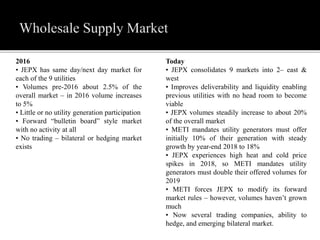
• JEPX has same day/next day market for
each of the 9 utilities
• Volumes pre-2016 about 2.5% of the
overall market – in 2016 volume increases
to 5%
• Little or no utility generation participation
• Forward “bulletin board” style market
with no activity at all
• No trading – bilateral or hedging market
exists
Today
• JEPX consolidates 9 markets into 2– east &
west
• Improves deliverability and liquidity enabling
previous utilities with no head room to become
viable
• JEPX volumes steadily increase to about 20%
of the overall market
• METI mandates utility generators must offer
initially 10% of their generation with steady
growth by year-end 2018 to 18%
• JEPX experiences high heat and cold price
spikes in 2018, so METI mandates utility
generators must double their offered volumes for
2019
• METI forces JEPX to modify its forward
market rules – however, volumes haven’t grown
much
• Now several trading companies, ability to
hedge, and emerging bilateral market.
IEX and JEPX Enter MoU for Cooperation in Electricity Market.
[1] A. Yanagisawa et al., “Economic and Energy Outlook of Japan through FY2019.
Decelerating growth and growing disquiets.,” no. July, pp. 1–30, 2018.
[2] T. Shinkawa, “Electricity System and Market in Japan,” IT World, no. March, 2018.
[3] I. Kurihara, “Deregulation of Electric Power Industry in Japan and the Present Practice,” pp.
143–146, 2000.
[4] H. Asano, “Restructuring the electricity industry and emerging issues in Japan,” 3rd Int.
Conf. Deregul. Restruct. Power Technol. DRPT 2008, no. April, pp. 162–166, 2008.
[5] International Atomic Energy Agency, “Country Nuclear Power Profiles – Germany,” 2018.
[6] I. Kurihara, “Restructuring of the electric power industry and the current state of the power
market in Japan,” 2006 IEEE Power Eng. Soc. Gen. Meet. PES, pp. 1–6, 2006.
[7] M. Marmiroli and Y. Tsukamoto, “Technical impact of deregulation in Japan [power
industry],” PowerCon 2002 - 2002 Int. Conf. Power Syst. Technol. Proc., vol. 1, pp. 178–181,
2002.
[8] “Classification of Businesses Specified in the Electricity Utilities Business Act ( extract from
the Act ),” p. 2019, 2019.
[9] T. C. Exchange, “Overview of TOCOM Electricity Market Electricity Market in Japan,” no.
September, 2019.

Japan power sector liberalization

  • 1.
  • 2.
    1.Two wide areasynchronous grids connected by HVDC connection. 2. 2nd Highest Pumped storage capacity  27GW, 3rd largest solar PV capacity (50 GW) 3. 2011 Fukushima Nuclear Disaster. (EASTERN GRID) 4. Japan is an island and resource poor country (optimal combination of power resources is very necessary) EASTERN JAPAN 50 HZ WESTERN JAPAN 60 HZ 1.2 GW CAPACITY HVDC LINK
  • 3.
    YEAR 2010 20152017 2019 GENERATED (TWH) 1028 920 1027 1026 HYDRO 9% 9% 9% 8% FOSSIL FUEL 62% 83% 75% 71% COAL 25% 31% 28% 28% LNG 29% 45% 41% 38% OIL 8% 8% 7% 5% NUCLEAR 29% 1% 3% 6% RENEWABLES 1% 4% 8% 9% OTHERS 1% 2% 5% 5%
  • 4.
    1995 WHOLESALE MARKET FOR IPP 2000 EHV LIBERALIZATION 2003 JPEX 2004 ESCJ NTO 2005 HV LIBERALIZATION 2008 HOUR AHEAD MARKET 2011 EARTHQUAKE 2013 ELECTRICITY BUSINESS ACT 2015 OCCTO ESTABILISHMENT 2016 EMSC ESTABILISHMENT LV LIBERALIZATION 17TH SEP 2019 TOCOM APRIL 2020 UNBUNDLING OF T&D
  • 5.
    IPP INDEPENDENT POWEREPRODUCER JEPXJAPAN ELECTRIC POWER EXCHANGE ESCJ  ELECTRIC POWER SYSTEM COUNCIL OF JAPAN NTO NEUTRAL TRANSMISSION ORGANIZATION OCCTOORGANIZATION FOR CROSS REGIONAL COORDINATION OF TRANSMISSION OPERATORS EMSC ELECTRICITYMARKET SURVEILLANCE COMMISSION TOCOM TOKYO COMMODITY EXCHANGE
  • 7.
    APRIL 2015 • Establishmentof OCCTO APRIL2016 • Full liberalization of entry to electricity retail business APRIL 2020 • Legal unbundling of transmission/ distribution sector ELECTRICITY BUSINESS ACT (2013) PROCESS OF ELECTRICITY SYSTEM REFORM 3 GOALS, 3STEPS 1. Securing Stable Electricity Supply 2.Suppressing Electricity Rates to the Maximum Extent Possible 3. Expanding Choices for Consumers and Business Opportunities
  • 9.
    1. General ElectricityUtilities(Total 10, Private Owned Company) Responsible for supplying electricity from power generation to distribution to the consumers in their respective service area. Before earthquake these companies are Regional Electricity Operator. 2. IPP 3. JEPX, TOCOMMARKET OPERATOR 4. OCCTO ISO 5. TDSO  REGIONAL SYSTEM OPERATOR 6. EMSC ELECTRICITY MARKET SURVEILLANCE COMMISSION UNDER METI (MINISTRY OF ECONOMY TRADE AND INDUSTRY)
  • 11.
    JEPX:-Privately owened incorporatedorganization (2005) FORWARD DAY AHEAD INTRADAY BIDDING :- MCP, MCV 30% OF TOTAL ELECTRICITY DEMAND Base-load Market, Balancing Market, Capacity Market and Non-Fossil Value Trading Market, and Future transaction are under discussion for near future establishment. TOCOM FUTURE CONTRACT MARKET – 17TH SEP. 2019
  • 12.
    2016 • Nuclear mostlyoffline, only 4% of generation mix • Utilities required to move generation into separate business unit and compete – by April 2018 • Utility generators not required to offer supply into wholesale market – JEPX • Utility generators are not offering bilateral supply contracts to retailers • Feed in Tariff (FIT) doesn’t exist for biomass, however does for wind and solar – however, utilities making transmission access for wind very difficult. Today • Nuclear steadily coming back online, now 12% of generation mix • Utilities completed move of generation into separate business unit • Utility generators are required to offer supply into wholesale market – JEPX • Rules now in place whereby if utility generator offers supply into JEPX at a high price and receives no buy bids, utility retail company is required to purchase the power at the high offer price • Utility generators now offering bilateral supply contracts to retailers • Feed in Tariff (FiT) does exist for biomass, wind and solar – now OCCTO decides who gets transmission access • Regulatory initiative to eliminate FiT within a couple years • Growth in IPP generation is now outpacing utility projects
  • 13.
    Today • In thefirst year about 100 companies received their METI retail license • Predominantly existing companies with some sort of customer base for other products/services – not energy • Most retailers only offered simple savings vs tariff product on a month-to- month basis • Many retailers entered balancing pool agreements with wholesale service providers • Sumitomo, Marubini, etc. --- 3 or 5 year contracts • Pool operator controlled supply price, provided scheduling and balancing services, “jail” for retailers • Pool operators did not offer credit sleeve type agreements • New market entrants receive their METI license in about 4 months
  • 14.
    2016 • OCCTO recentlyformed and assigned how to create (with METI) a capacity, transmission and ancillary market • OCCTO assigned all enrollment and switching activities between retailers and utilities • OCCTO mandated to manage transmission market, including siting of new generation and access • OCCTO has a staff of about 70 people Today • OCCTO launching capacity market in April 2019 with full market implementation by 2021 • Market rules published. Starting with small volumes on 3 year bids, by 2021 full market • OCCTO launching ancillary market (called balancing market) in April 2019 • Bid style market --- will replace utility back up supply by 2020 • OCCTO now has a Megawatt market (Demand Response) • Utilities mandated to bid and buy 20 MW each to start • OCCTO in full control of transmission sitting and access
  • 15.
    2016 • JEPX hassame day/next day market for each of the 9 utilities • Volumes pre-2016 about 2.5% of the overall market – in 2016 volume increases to 5% • Little or no utility generation participation • Forward “bulletin board” style market with no activity at all • No trading – bilateral or hedging market exists Today • JEPX consolidates 9 markets into 2– east & west • Improves deliverability and liquidity enabling previous utilities with no head room to become viable • JEPX volumes steadily increase to about 20% of the overall market • METI mandates utility generators must offer initially 10% of their generation with steady growth by year-end 2018 to 18% • JEPX experiences high heat and cold price spikes in 2018, so METI mandates utility generators must double their offered volumes for 2019 • METI forces JEPX to modify its forward market rules – however, volumes haven’t grown much • Now several trading companies, ability to hedge, and emerging bilateral market.
  • 16.
    IEX and JEPXEnter MoU for Cooperation in Electricity Market.
  • 17.
    [1] A. Yanagisawaet al., “Economic and Energy Outlook of Japan through FY2019. Decelerating growth and growing disquiets.,” no. July, pp. 1–30, 2018. [2] T. Shinkawa, “Electricity System and Market in Japan,” IT World, no. March, 2018. [3] I. Kurihara, “Deregulation of Electric Power Industry in Japan and the Present Practice,” pp. 143–146, 2000. [4] H. Asano, “Restructuring the electricity industry and emerging issues in Japan,” 3rd Int. Conf. Deregul. Restruct. Power Technol. DRPT 2008, no. April, pp. 162–166, 2008. [5] International Atomic Energy Agency, “Country Nuclear Power Profiles – Germany,” 2018. [6] I. Kurihara, “Restructuring of the electric power industry and the current state of the power market in Japan,” 2006 IEEE Power Eng. Soc. Gen. Meet. PES, pp. 1–6, 2006. [7] M. Marmiroli and Y. Tsukamoto, “Technical impact of deregulation in Japan [power industry],” PowerCon 2002 - 2002 Int. Conf. Power Syst. Technol. Proc., vol. 1, pp. 178–181, 2002. [8] “Classification of Businesses Specified in the Electricity Utilities Business Act ( extract from the Act ),” p. 2019, 2019. [9] T. C. Exchange, “Overview of TOCOM Electricity Market Electricity Market in Japan,” no. September, 2019.