

October, 2008
A Rahus Institute Publication
DISCLAIMER:
This Guide is a Rahus Institute publication and was sponsored by commercial and non-profit organizations interested in
solar education and a healthy marketplace. Neither the Rahus Institute nor any of the project sponsors, editors, or advi-
sors makes warranty, expressed or implied, or assumes any legal liability or responsibility for the accuracy, completeness,
or usefulness of any information, product, or process described herein. We have attempted to provide full attribution
for all external sources of data and graphics. Reference herein to any specific commercial product, process, or service
does not imply its endorsement, recommendation, or favoring by the Guide advisors, editors, sponsors, or the Rahus
Institute. This report may be downloaded from CaliforniaSolarCenter.org.

First Edition: October, 2008
Customer’s Guide
                 to
  Solar Power Purchase Agreements


Chapter 1                 Is solar power right for our organization?  .  .  .  .  .  .  .  .  .  .  .  .  .  .  .  .  .  .  .  .  .  .  .  .  .  .  .3


Chapter 2                 What is a Solar Power Purchase Agreement (SPPA)
                          and how will it benefit us?  .  .  .  .  .  .  .  .  .  .  .  .  .  .  .  .  .  .  .  .  .  .  .  .  .  .  .  .  .  .  .  .  .  .  .  .  .  .  .  .5


Chapter 3                 Utility support & financial considerations .  .  .  .  .  .  .  .  .  .  .  .  .  .  .  .  .  .  .  .  .  .  .  .  .  .  .9


Chapter 4                 Steps to a successful project  .  .  .  .  .  .  .  .  .  .  .  .  .  .  .  .  .  .  .  .  .  .  .  .  .  .  .  .  .  .  .  .  .  .  .  .  .  . 14


Chapter 5                 Other ways to buy solar electricity  .  .  .  .  .  .  .  .  .  .  .  .  .  .  .  .  .  .  .  .  .  .  .  .  .  .  .  .  .  .  .  . 19


Chapter 6                 Real world examples  .  .  .  .  .  .  .  .  .  .  .  .  .  .  .  .  .  .  .  .  .  .  .  .  .  .  .  .  .  .  .  .  .  .  .  .  .  .  .  .  .  .  .  .24


Chapter 7                 Summary lessons  .  .  .  .  .  .  .  .  .  .  .  .  .  .  .  .  .  .  .  .  .  .  .  .  .  .  .  .  .  .  .  .  .  .  .  .  .  .  .  .  .  .  .  .  .  .20


Appendix 1: Solar technology basics .  .  .  .  .  .  .  .  .  .  .  .  .  .  .  .  .  .  .  .  .  .  .  .  .  .  .  .  .  .  .  .  .  .  .  .  .  .  .  .  .  .30


Appendix 2: SPPA contracts technical guide  .  .  .  .  .  .  .  .  .  .  .  .  .  .  .  .  .  .  .  .  .  .  .  .  .  .  .  .  .  .  .  .  .  .  . 33
            Resources
            Acronym glossary
            Terms glossary
            List of figures
Guide description                                               Advisory committee
The Customer’s Guide to Solar Power Purchase                    Wally McOuat, HMH Resources; Patrick McCoy,
Agreements is for organizations that would like assis-          California Department of General Services; Morten Lund,
tance navigating purchase and contract decisions as they        Foley & Lardner LLP; Tor Allen, Rahus Institute .
move to host solar power systems . We prepared the Guide
for a broad audience, including businesses, government
agencies, public institutions such as school districts and      Sponsors
non-profits . This project is made possible by solar services   Anaheim Public Utilities, City of Palo Alto Utilities, City of
providers who believe an educated customer is their best        Lodi Electric Utility Department, Energy Trust of Oregon,
business partner .                                              MMA Renewable Ventures, Rahus Institute, Solar Power
                                                                Partners, SunEdison .

Acknowledgments
We are most thankful to our advisory and editorial com-         Core references
mittees for their outstanding contributions and for sharing     Below are some of the core resources used in drafting this
their expertise . In addition, thanks to Robert Martin from     guide .
the San Diego Unified School District and John Supp from
the California Sustainable Energy Center for their insights .   •	 “Guide to Purchasing Green Power,” Green Power
                                                                   Partnership, September 2004 .
                                                                •	 “Solar Power Services: How PPAs Are Changing the PV
Authors                                                            Value Chain,” executive summary, GreenTech Media,
Liz Merry, Verve Solar Consulting, author and editor               February 2008 .
Elisa Wood, RealEnergyWriters .com, co-author                   •	 “Solar Photovoltaic Financing: Deployment on Public
Catherine Paglin, proofreading                                     Property by State and Local Governments,” National
                                                                   Renewable Energy Lab, May 2008 .
                                                                •	 “Power Purchase Agreements: The New Frontier,” forum
Editorial committee                                                held at Solar Power 2007 conference, September 2007,
Gianluca Signorelli, MMA Renewable Ventures; Todd                  Long Beach, California .
Michaels and Todd Halvorsen, Solar Power Partners; Kelly
Speakes-Backman, SunEdison; Betsy Kauffman, Energy
Trust of Oregon .
Chapter 1
Is solar power right for our organization?


Introduction
This Guide is designed to help your organization join the            The Guide focuses solely on grid-tied photovoltaic (PV)
rapidly growing number of school districts, businesses, and          technology, which produces electricity from sunlight for
government institutions that now use solar electricity . We          customers connected to the local utility grid . These sys-
suggest factors to consider and questions to ask as you work         tems reduce, rather than completely replace, the power you
with staff members, solar vendors, and other experts who             now receive from your electric utility . We distinguish these
will help you make the transition to clean energy .                  systems from off-grid solar, which is not paired with back-
                                                                     up electricity from the local utility .
Here you will find detailed information on the increasingly
popular Solar Power Purchase Agreement, a contractual                You are adopting a technology that is growing quickly in
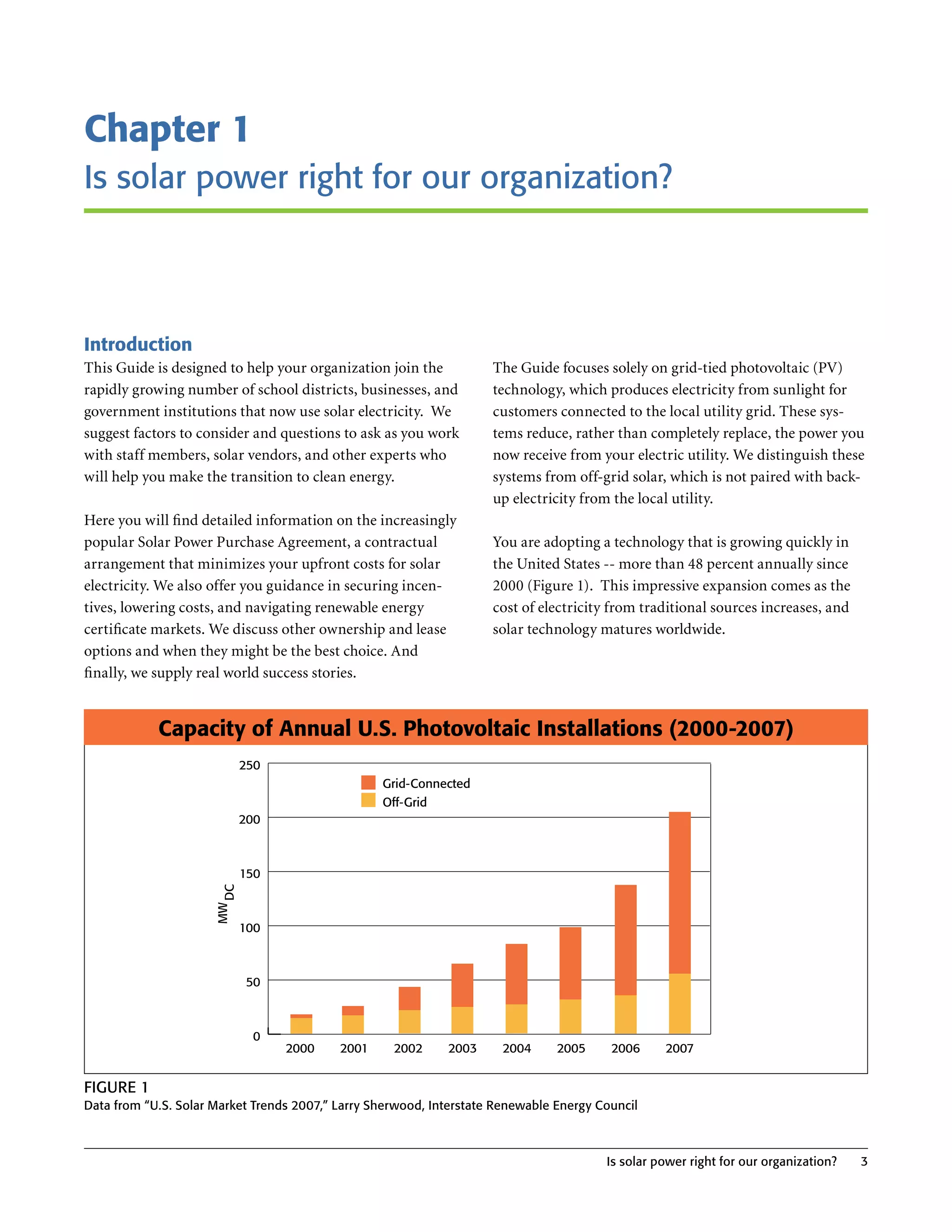
arrangement that minimizes your upfront costs for solar              the United States -- more than 48 percent annually since
electricity . We also offer you guidance in securing incen-          2000 (Figure 1) . This impressive expansion comes as the
tives, lowering costs, and navigating renewable energy               cost of electricity from traditional sources increases, and
certificate markets . We discuss other ownership and lease           solar technology matures worldwide .
options and when they might be the best choice . And
finally, we supply real world success stories .


            Capacity of Annual U.S. Photovoltaic Installations (2000-2007)
                            250
                                                  Grid-Connected
                                                  Off-Grid
                            200


                            150
                       DC
                      MW


                            100


                             50


                             0
                                  2000     2001     2002     2003      2004     2005     2006     2007


FIgure 1
Data from “u.S. Solar Market Trends 2007,” Larry Sherwood, Interstate renewable energy Council


                                                                                        Is solar power right for our organization?   3
Today’s solar industry
Today’s solar technology is highly reliable, safe, and backed    If you are not familiar with solar
by strong equipment warranties based on solid field-testing      technology, please review Appendix 1
data . Customers can find dependable, well-trained solar         to learn how these systems work.
installers who have provided systems for organizations
including major universities, retailers, hotels, and govern-
ment entities . By the end of 2007 more than 43,000 grid-
tied solar electric systems operated in the United States,
producing enough electricity for close to 500,000 homes .
More solar electricity is added daily, as the cost of utility
power rises and customer awareness grows . If financial
support for solar incentives you should seriously consider
using solar power .

Below we list some of the benefits of an on-site solar instal-
lation, as well as challenges that may occur in particular
circumstances .


     Benefits
     •	 Provides a predictable cost for electricity over
        the life of the system
     •	 Makes clear to the public your environmental
        commitment by producing clean electricity at
        your facility
     •	 Offers flexible expansion if your needs change
     •	 May support the local economy and generate
        new jobs
     •	 Produces back-up power in a blackout if storage
        capacity is added


     Challenges
     •	 Not all regions have access to financial solar
        incentives
     •	 May require a high upfront investment if the
        equipment is to be purchased directly
     •	 Requires monitoring over the life of the system
        to ensure proper production
     •	 Involves planning and project management
     •	 Requires owners to retain renewable energy
        certificates associated with the system in order
        to make certain environmental claims (See
        Chapter 3)


4   The Customer’s guide to Solar Power Purchase Agreements
Chapter 2
What is a Solar Power Purchase Agreement (SPPA)
and how will it benefit us?


The Solar Power Purchase Agreement (SPPA) is an alterna-           and WalMart department stores, and institutions, such as
tive to financing and owning the system . It offers you an         airports and water districts, use these agreements for buy-
opportunity to install solar power at your facility without        ing solar electricity . Those familiar with the power indus-
paying upfront costs or worrying about system operation            try will find an SPPA is much like the traditional “power
and maintenance . Sometimes referred to as a “third party”         purchase agreement,” a common contract between utilities
ownership model, this approach lets you focus on your core         and large centralized energy plants . Because SPPAs rep-
mission, while solar experts manage your energy system .           resent a good investment opportunity, major investment
For 15 to 20 years, you enjoy predictable, pre-set electricity     firms such as Goldman Sachs and Morgan Stanley provide
prices, and power from a solar system that is a source of          financing to these projects .
pride for your organization .
                                                                   As you consider the benefits of an SPPA, we also want
Power purchase agreements are a well-established con-              you to know there are other ways to buy solar gener-
tract mechanism . Many large businesses, such as Kohl’s            ated electricity . For example, you might buy your system


    Benefits to you of an SPPA                                     Challenges
    •	 Demands no upfront expense in order to buy                  •	 Demands more complex negotiations and
       solar power                                                    possibly higher transaction costs than buying system
    •	 Provides predetermined electricity rates for                   outright
       term of contract, typically about 15 to 20                  •	 Creates potential conflict between your desire
       years                                                          to achieve green policy goals and save money on
    •	 Offers production monitoring and metering                      electricity
       by experts                                                  •	 Ongoing administrative costs of paying separate
    •	 System owners take responsibility for opera-                   electricity invoices, and allowing accesss to equip-
       tion and maintenance of equipment                              ment by maintenance personnel
    •	 Supports renewable energy industry and local                •	 The SPPA will be owned by a special purpose entity
       jobs (for installation and maintenance)                        that may have limited liability and limited
    •	 Offers possible path to meet your green policy                 assets, and the SPE parties may change over time
       objectives                                                  •	 The host customer may be prohibited from mak-
    •	 Places emphasis on ensuring maximum                            ing changes to property that could affect the solar
       productivity of solar system                                   production
    •	 Option to purchase the system at fair market
       value after set time period


                                                      What is a Solar Power Purchase Agreement (SPPA) and how will it benefit us? 5
Parameters for a good SPPA project
                                                               The ideal SPPA project involves customers who:
      “I’d put my money on the
      sun and solar energy. What a                             •	 Use large amounts of electricity, generally more than
      source of power!”                                           200,000 kWh annually
                                                               •	 Control their property
                               Thomas A . Edison, 1931         •	 Demonstrate credit-worthiness
                          in a comment to Henry Ford           •	 Offer a minimum of 10,000 square feet of unshaded
                                                                  space for installation
                                                               •	 Are located in a region with pro-solar policies and
outright . Ownership requires financing up front, and the         incentives
ability to monitor the system production and maintain the
equipment . You might finance your system with a lease .       Circumstances vary from project to project, and region to
In a lease-to-own financing agreement you typically make       region . The preceding criteria are usually necessary for an
no, or little, down payment, and purchase the system with      SPPA project to go forward .
fixed monthly payments over time . Or, finally, you may
have access to a green power program that allows you to
buy renewable electricity directly from your utility .
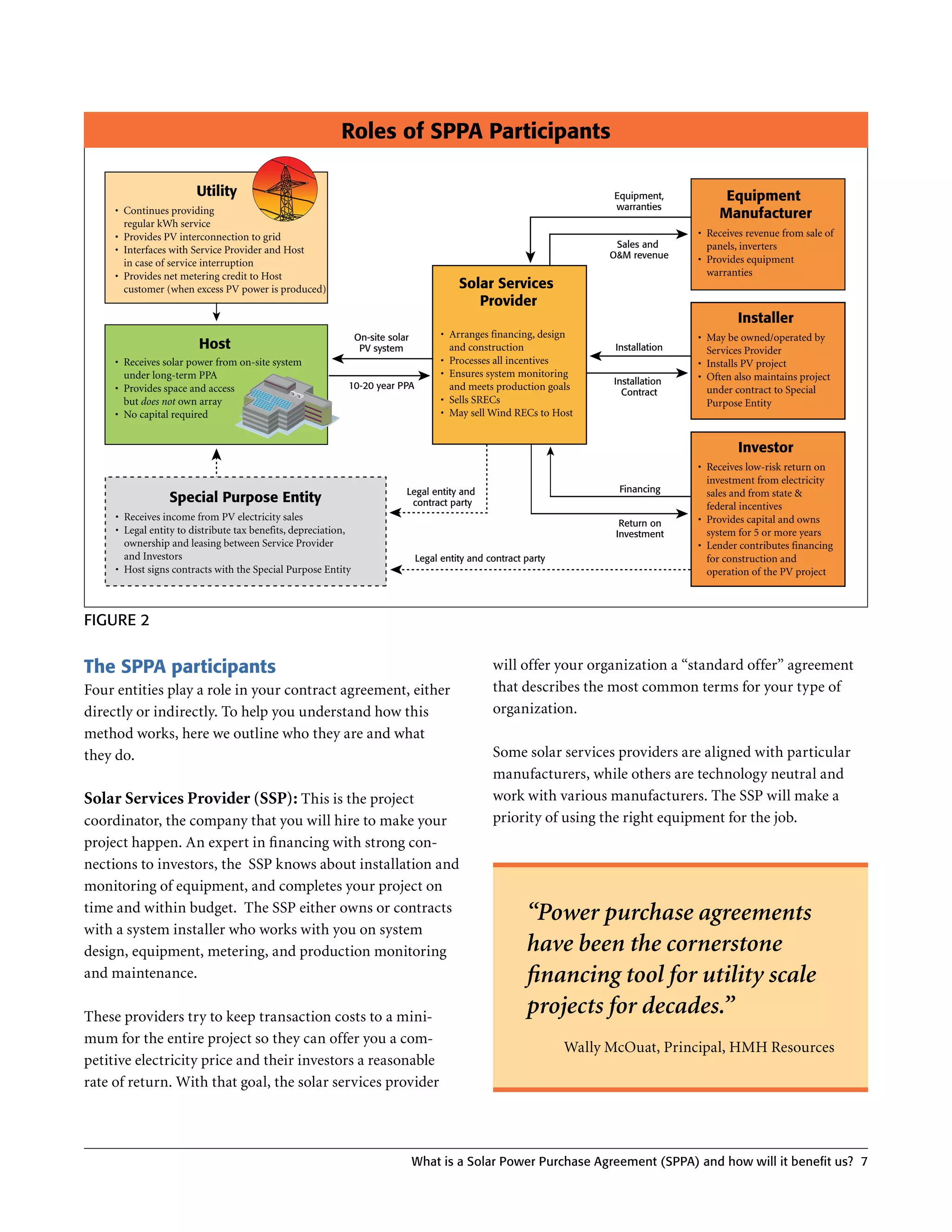
                                                               The SPPA structure
                                                               Your organization contracts with a solar services provider
Both the SPPA approach and system ownership offer great
                                                               that is responsible for financing, designing, installing,
benefits, and some challenges . We describe the power pur-
                                                               monitoring, and maintaining your project . You do not
chase option first so you can compare it against the other
                                                               pay for the installation, but instead buy the electricity the
options which are described in Chapter 5 .
                                                               system generates . You make your payments to the solar ser-
                                                               vices provider for the electricity the solar system produces,
Whatever method you choose, once you install solar energy
                                                               just as you now pay your utility for electricity from large
generating equipment, your organization joins the growing
                                                               central power plants (Figure 2) .
number of wise energy consumers who generate their power
from sunshine, a fuel source that is clean and always free .
                                                               You determine the level of payment in advance, so you
                                                               know what your power costs will be over the life of the
                                                               SPPA contract, usually 15 to 20 years . In this way, SPPAs
     Terms to understand                                       offer very different terms than utilities . With the permis-
     Kilowatt (kW): A unit of measure for the                  sion of regulators, your utility increases your electricity
     amount of electricity needed to operate given             rates at any time . Many believe that electricity rates will
     equipment . Equals 1000 watts .                           rise significantly as climate change legislation is adopted
                                                               because most electricity in the U .S . is produced from
     Kilowatt-hour (kWh): The most commonly-                   carbon-intensive fuels, such as coal and natural gas . So it
     used unit of measure indicating the amount of             is difficult to predict your future energy costs when you
     electricity consumed over time . It means one             buy power from a utility . SPPA contracts avoid unexpected
     kilowatt of electricity supplied for one hour .           price fluctuations because the cost of the fuel is known:
                                                               sunshine is always free .
     Megawatt (MW): Equals 1,000 kW or 1,000,000
     watts . According to the California Independent
     System Operator, one megawatt of utility supplied
     power is enough electrical capacity to power 750
     average homes .


6   The Customer’s guide to Solar Power Purchase Agreements
Roles of SPPA Participants

                        Utility                                                                                          Equipment,          Equipment
                                                                                                                         warranties
     • Continues providing                                                                                                                  Manufacturer
       regular kWh service
     • Provides PV interconnection to grid                                                                                              • Receives revenue from sale of
                                                                                                                         Sales and        panels, inverters
     • Interfaces with Service Provider and Host                                                                        O&M revenue
       in case of service interruption                                                                                                  • Provides equipment
     • Provides net metering credit to Host                                                                                               warranties
       customer (when excess PV power is produced)                                        Solar Services
                                                                                             Provider
                                                                                                                                                 Installer
                                                                On-site solar         • Arranges financing, design                      • May be owned/operated by
                        Host                                     PV system              and construction                 Installation     Services Provider
     • Receives solar power from on-site system                                       • Processes all incentives                        • Installs PV project
       under long-term PPA                                                            • Ensures system monitoring                       • Often also maintains project
                                                            10-20 year PPA                                               Installation
     • Provides space and access                                                        and meets production goals                        under contract to Special
                                                                                                                           Contract
       but does not own array                                                         • Sells SRECs                                       Purpose Entity
     • No capital required                                                            • May sell Wind RECs to Host


                                                                                                                                                 Investor
                                                                                                                                        • Receives low-risk return on
                                                                                                                                          investment from electricity
                                                                            Legal entity and                              Financing       sales and from state &
                 Special Purpose Entity                                      contract party                                               federal incentives
     • Receives income from PV electricity sales                                                                                        • Provides capital and owns
                                                                                                                          Return on
     • Legal entity to distribute tax benefits, depreciation,                                                            Investment       system for 5 or more years
       ownership and leasing between Service Provider                                                                                   • Lender contributes financing
       and Investors                                                            Legal entity and contract party                           for construction and
     • Host signs contracts with the Special Purpose Entity                                                                               operation of the PV project


FIgure 2


The SPPA participants                                                                             will offer your organization a “standard offer” agreement
Four entities play a role in your contract agreement, either                                      that describes the most common terms for your type of
directly or indirectly . To help you understand how this                                          organization .
method works, here we outline who they are and what
they do .                                                                                         Some solar services providers are aligned with particular
                                                                                                  manufacturers, while others are technology neutral and
Solar Services Provider (SSP): This is the project                                                work with various manufacturers . The SSP will make a
coordinator, the company that you will hire to make your                                          priority of using the right equipment for the job .
project happen . An expert in financing with strong con-
nections to investors, the SSP knows about installation and
monitoring of equipment, and completes your project on
time and within budget . The SSP either owns or contracts                                                 “Power purchase agreements
with a system installer who works with you on system
design, equipment, metering, and production monitoring                                                    have been the cornerstone
and maintenance .                                                                                         financing tool for utility scale
These providers try to keep transaction costs to a mini-
                                                                                                          projects for decades.”
mum for the entire project so they can offer you a com-
                                                                                                                  Wally McOuat, Principal, HMH Resources
petitive electricity price and their investors a reasonable
rate of return . With that goal, the solar services provider


                                                                                What is a Solar Power Purchase Agreement (SPPA) and how will it benefit us? 7
Investor and Special Purpose Entity: The solar services           Summary
provider engages financing partners . A lender, usually a         The solar power purchase agreement is becoming a very
bank, may fund the construction of the solar system and           popular option for buying solar electricity in the U .S . In
also provide a long term loan to the project . The investor or    this model a project developer, known as the solar services
group of investors provides equity financing and receives         provider, brings an investor and host customer together
the federal and state tax benefits (called “tax equity”           to install a PV system on the host’s site . The PV electricity
investing) . You may not work directly with the financing         reduces the amount of electricity that must be purchased
partners, but it is useful to understand their requirements       from the local utility . The utility supports the project by
and relationships to ensure your project has solid financial      connecting the solar equipment to the grid and providing
backing .                                                         credit for any solar power sent back through the meter to
                                                                  the grid .
The investors and solar services provider form a special
purpose entity to own the solar electricity system and            Now that you have a basic understanding of the roles and
allocate tax credits and other benefits and risks . A repu-       responsibilities of the SPPA project participants, we move
table solar services provider will attract stable lending and     on to describe the utility policies required to support your
investment partners, who in turn are eager to work with           solar project .
host customers that have a strong credit rating .

The special purpose entity is the legal entity that you
will be dealing over the long-term, and it receives your
payments for the solar kWh .

Host customer (you): As host customer, you agree to
install the solar electricity system on your property, work
with the solar services provider to enable efficient project
installation, pay for all of the electricity the system produc-        “Lenders have this particular
es at the negotiated rate, and provide access to the system            relationship to risk, which is….
for monitoring and maintenance . Depending on the terms
of your agreement, you may purchase the system at fair
                                                                       they don’t take any.”
market value when the contract ends . In some cases this                     Morten Lund, Partner, Foley & Lardner LLP
may be as soon as six years after the system was installed .

Utility: The utility and its treatment of solar electricity is
an important factor in the project, especially given that the
solar equipment may, at times, produce more power than
what is being used on-site . Utility policy will affect project
timing and whether or not you purchase the system at the
end . In the next chapter, we will explain the utility role
and why you will want to learn about interconnection
agreements, net metering, incentives, peak demand,
demand charges, and other elements of your relationship
with your utility .


8   The Customer’s guide to Solar Power Purchase Agreements
Chapter 3
utility support & financial considerations


To get started on your SPPA project, you will need to             ment requirements, and process for connecting to the grid .
research how your utility treats solar electricity installa-      While your utility has a well-defined process for connect-
tions . This chapter describes how to gauge your current          ing centralized energy plants that feed electricity to many
energy costs, how solar systems are connected to the utility      customers on the utility grid, they may not have a process
grid, how the excess solar electricity is credited, and how       for smaller on-site solar projects . To help minimize project
to value the renewable energy certificate (REC), which is a       costs, it is important you have a streamlined process to
financial tool that captures the “green” values of the solar      connect to the grid . Check with your utility to learn how it
power .                                                           may support or restrict connecting your solar project .


Researching your projected electricity                            Net metering
costs                                                             In addition to allowing interconnection to the grid, many
Your local utility may help or hinder your plans to install       utilities will credit you for the electricity you do not use
solar energy . We encourage you to thoroughly investigate         from your solar project . This arrangement is called net
pertinent rules, tariffs, and incentives offered by your          metering . Net-metering regulations include provisions for:
utility . State rules and utility policies vary dramatically
throughout the nation, so it is important that you under-         •	 The amount of electricity that can be sold to the utility
stand your local situation .                                      •	 The rates at which the utility will buy it
                                                                  •	 An ending date for the agreement (in some cases)
To calculate the value of your solar electricity system you
should understand what you are paying now, and what you           Your utility may have a cap on the total amount of net-
will be paying for kWh in the future . While it’s impossible      metered electricity that it will purchase from you . Or the
to predict exactly, your utility can provide price projec-        utility may credit you at a very low rate for the excess solar
tions for your organization . The Energy Information              electricity . Such caps can be deal breakers for customers
Administration, a division of the U .S . Department of            seeking cost-effective solar electricity .
Energy, is also a good source of electricity price forecasts
(See Resources) .                                                 Solar is most valuable when the net-metering agreement
                                                                  allows for at least retail compensation (the price customers
                                                                  pay), and gives you the opportunity to earn enough credit
Interconnection                                                   to entirely offset your energy bill over the course of a year .
It is federal policy that utilities accept interconnection of a
solar power system to their grid . The contract between the       Understanding your net metering options is key to measur-
system owner and the utility is called an interconnection         ing the financial benefits from an on-site generation project
agreement . This agreement includes the conditions, equip-        that will “make the meter spin backward .” If your project


                                                                                        utility support & financial considerations 9
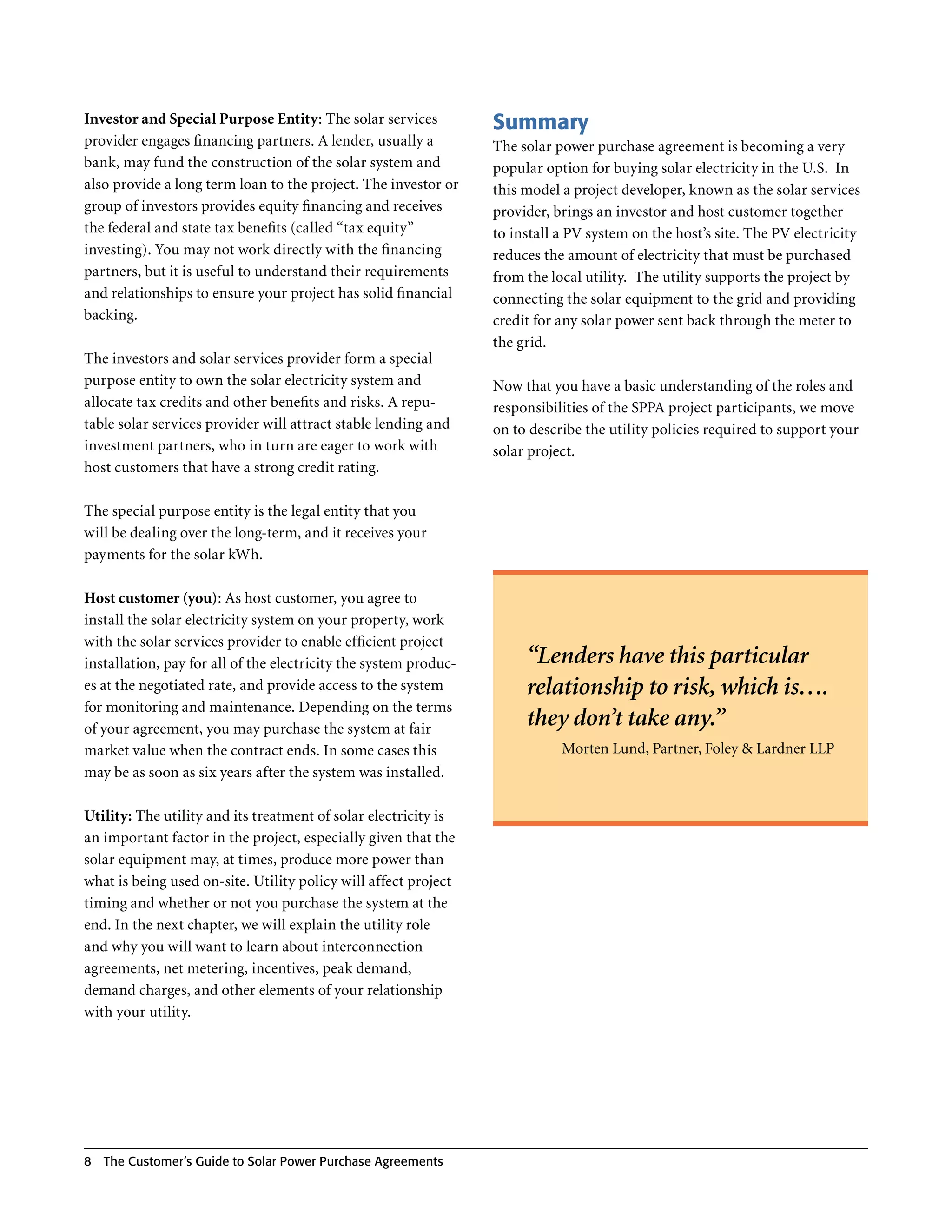
How Net Metering Works with Solar


                                                                                               Utility Power
                                                                                                Purchased


                                    =            |5|0|0|0|0| kWh      |4|0|0|0|0| kWh      |1|0|0|0|0| kWh
                                        ~           Solar               Monthly             Utility Meter          Utility Grid
                                    Inverter      Production        PV Consumption          excess solar
            Solar Panels                                                                    sent to utility


                                                         Questions to ask your utility about net metering solar power
                                  Optional:              • Does the utility provide credit for the PV power going to their grid?
                                  battery for
                                                         • What does the utility pay for the PV kWh?
                                energy storage
                                                         • Is there a limit on the amount they will accept?
                                                         • Can you carry credit over from one billing cycle to the next?


FIgure 3


is sized such that you will never export power to the utility,      Time-of-use rates
net metering is less important (Figure 3) .                         The time-of-use (TOU) tariff recognizes the added value of
                                                                    electricity during peak usage periods when utility opera-
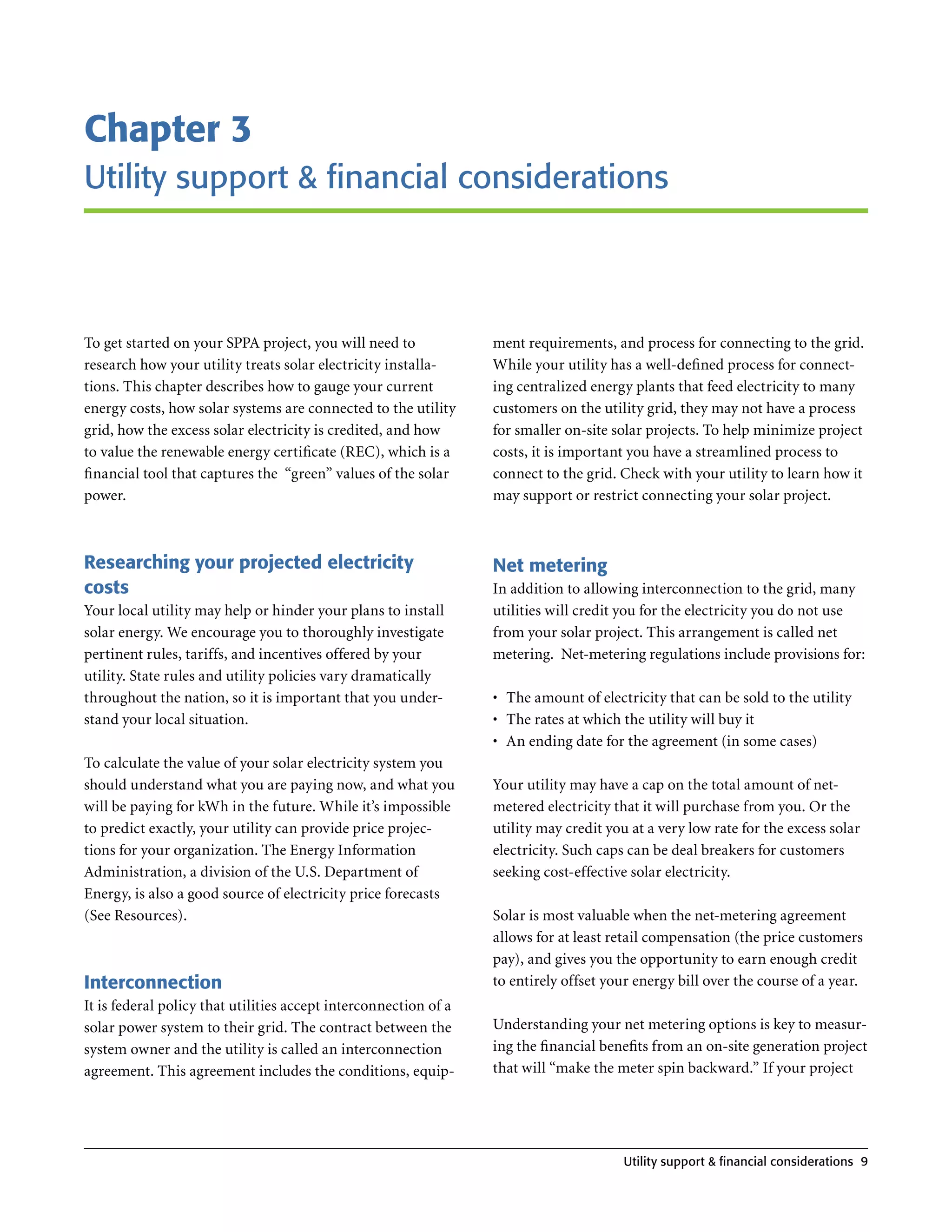
Nearly all the states have some form of net metering rules          tors have to invest additional resources to meet the high
(Figure 4) . Depending on their consumer-friendliness, the          demand for power . With a time-of-use tariff the customer
rules can provide you with a significant credit toward your         pays a premium price for electricity during peak hours, and
energy bill . Net-metering is so named because it refers to         less for power other times . This pricing scheme can greatly
the number of kWhs you buy from the utility minus the               enhance the economics of a green power project, particu-
amount you export to the grid . You pay for the difference          larly if your organization can manage its energy demand
or “net” amount .                                                   by using very little power during the peak demand periods,
                                                                    for instance on summer afternoons .
Example of how net metering works with solar:
100,000kWh electricity purchased from utility before the            If your utility provides full retail credit for the solar elec-
             PV system, then PV system installed                    tricity you send back into the grid, and you are on a time-
- 40,000kWh PV electricity used directly                            of-use agreement, you may be able to sell your PV power at
- 10,000kWh PV electricity exported to utility                      the highest rates (e .g ., 38 cents/kWh), while buying power
             and credited to your account                           from your utility at off-peak rates (e .g ., 10 cents/kWh) at
                                                                    night when your solar panels stop producing power . This
 50,000kWh “net” amount you buy from utility after PV               financial scenario depends on your ability to limit the
           system installed                                         amount of power you use during peak periods, and your
                                                                    PV system consistently making the meter spin backward
                                                                    during these key hours .


10   The Customer’s guide to Solar Power Purchase Agreements
States with Net Metering August 2008


                           100
                                            50                                                                          VT: 250    100
                                                               100
                   25/2,000                                                 40                                                           NH: 100
                                                                                        20                                               MA: 60/1,000/2,000
                                   25/100                                                       30                                       RI: 1,650/2,250/3,500
                                                   25                                                                                    CT: 2,000
                                                                                 500                                              NY:   25/500/2,000
                           1,000                               25                         40         no limit
                                                                                               10                                 PA:   50/3,000/5,000
                                    25/2,000      2,000                                                                           NJ:   2,000
                                               coops, munis:                                                25
                                                  10/25                           100                                             DE:   25/500/2,000
                   1,000                                                                            30
                                                                                                                                  MD:   2,000
                                                                                                                20/100            DC:   100
                                                                                 25/300                                           VA:   10/500
                                   varies      80,000                 100                                    20/100

                                                                                                         10/100
                                                                 50

                                                                                  25/300                                           Net metering is
                                                                                                                                   available in
                                 100                                                                             2000
                                                                                                                                   44 states and D.C.
                            (KIUC: 50)


                   State-wide net metering available for some or all utility types
                   State-wide net metering for certain utility types only (e.g., investor-owned utilities)
                   Net metering offered voluntarily by one or more individual utilities
                   (Note: Numbers indicate individual system size limit in kilowatts (kW).
                   Some states’ limits vary by customer type, technology and/or system application.
                   For complete details, see www.dsireusa.org.)


FIgure 4
Data provided by DSIreuSA.Org


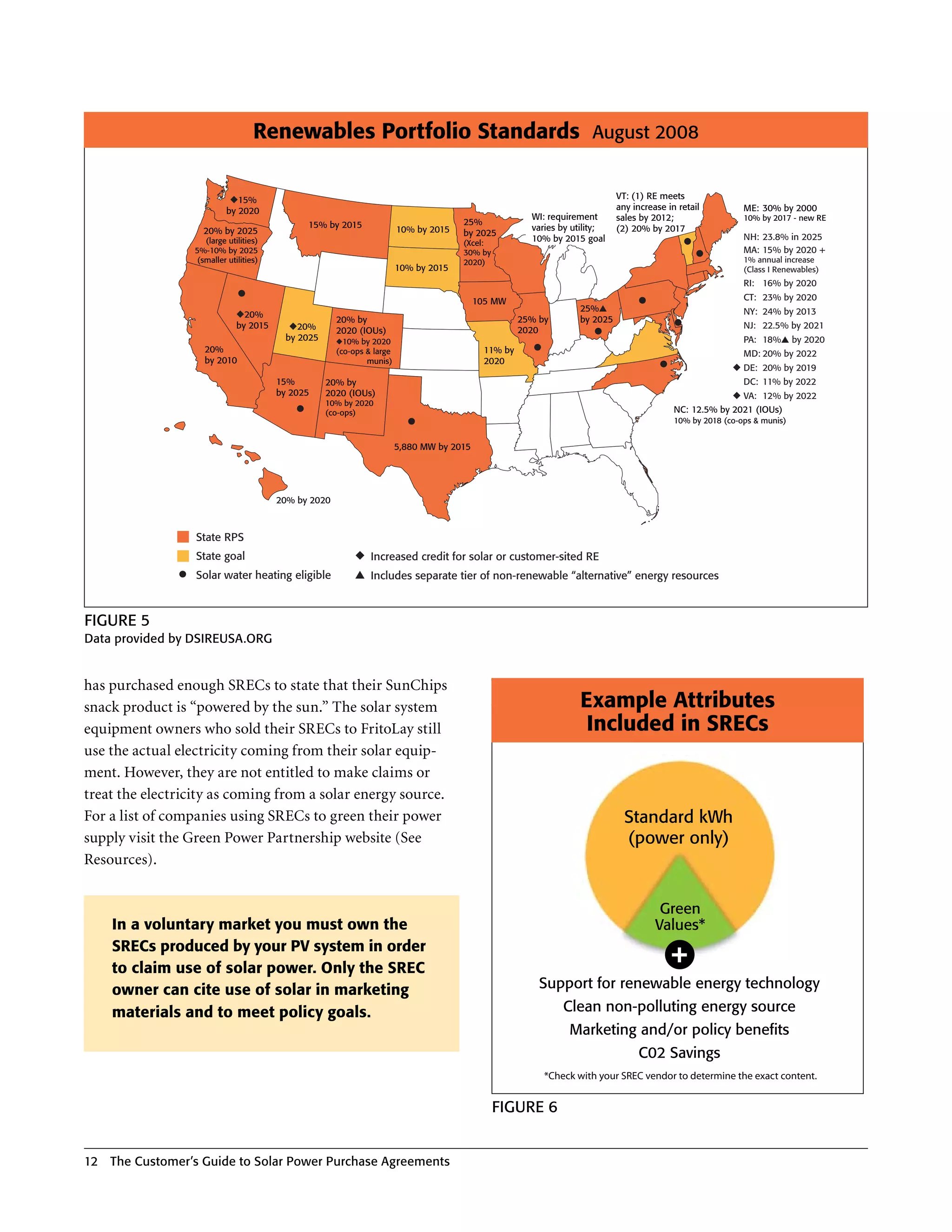
Renewable portfolio standards                                                             can be monetized, and a market for these attributes can be
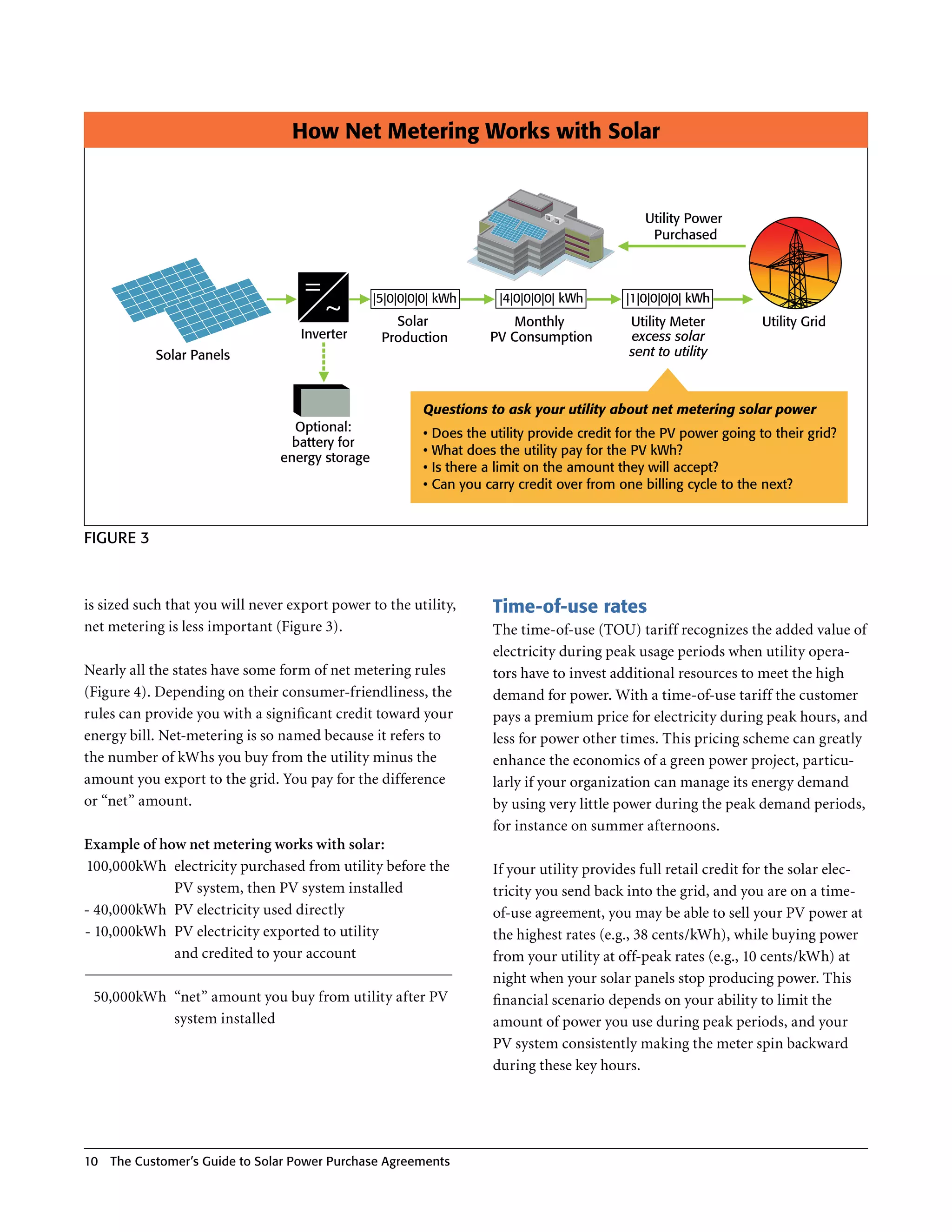
Many states require utilities to provide a certain amount of                              created . A REC represents one megawatt hour of electricity
renewable power in their electricity mix (Figure 5), which                                produced from a renewable energy source, such as solar
is known as a Renewable Portfolio Standard (RPS) . It is                                  system or wind turbine . The majority of these certificates
expected that the federal government will eventually adopt                                sold in the United States are generated by wind turbines, but
a minimum standard that all states will have to meet . A few                              the number of solar RECs, or SRECs, available is increasing
states specifically require that solar energy make up part of                             each year .
the renewable energy mix . This is known as a solar set aside .
Some of these states allow utilities to meet this requirement                             In some states SRECs are used as the incentive mechanism
through a solar incentive mechanism known as solar renew-                                 to promote the use of solar power . This is known as a
able energy certificates (SRECs) .                                                        “compliance market .” In these areas the utility is buying
                                                                                          the certificates from your system in order to meet their RPS
                                                                                          requirement .

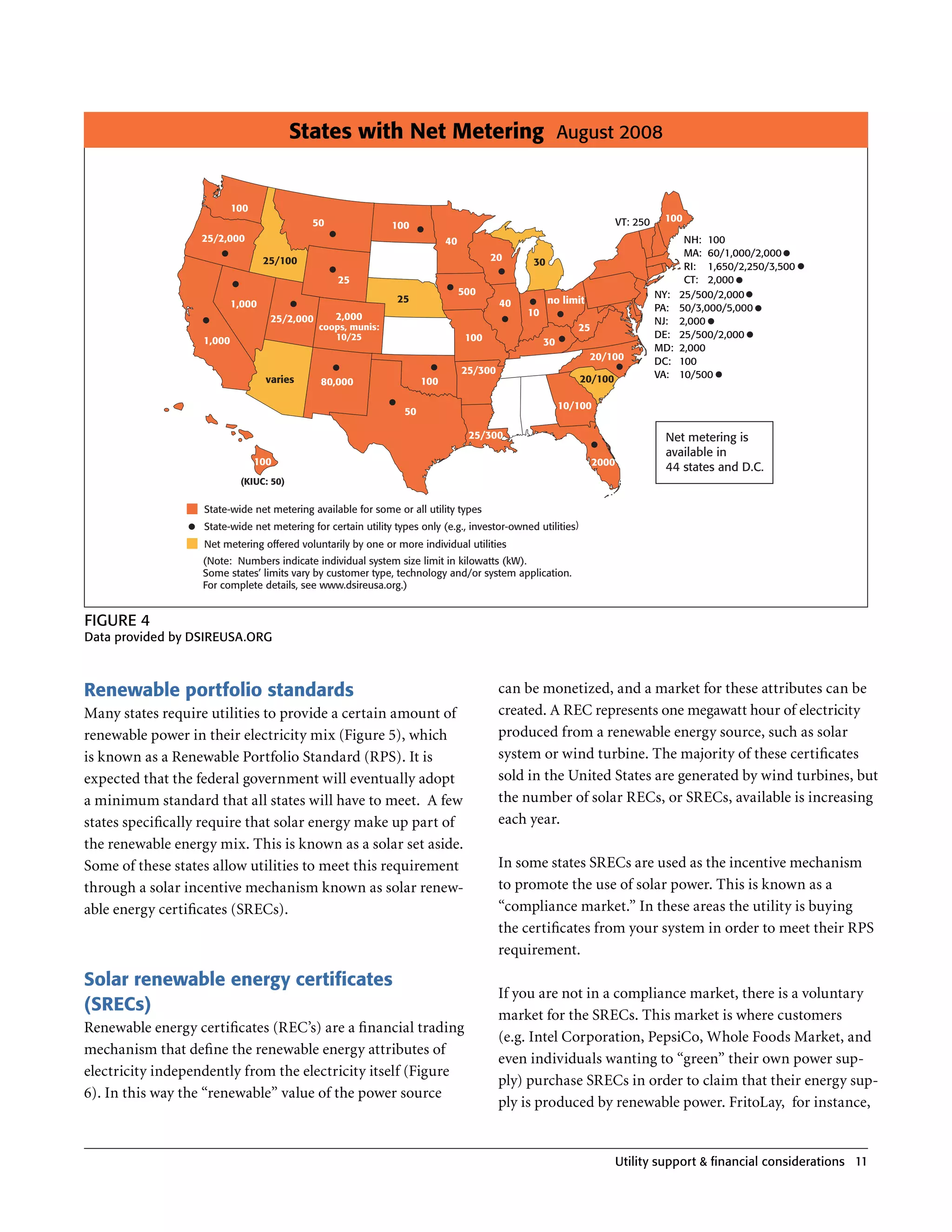
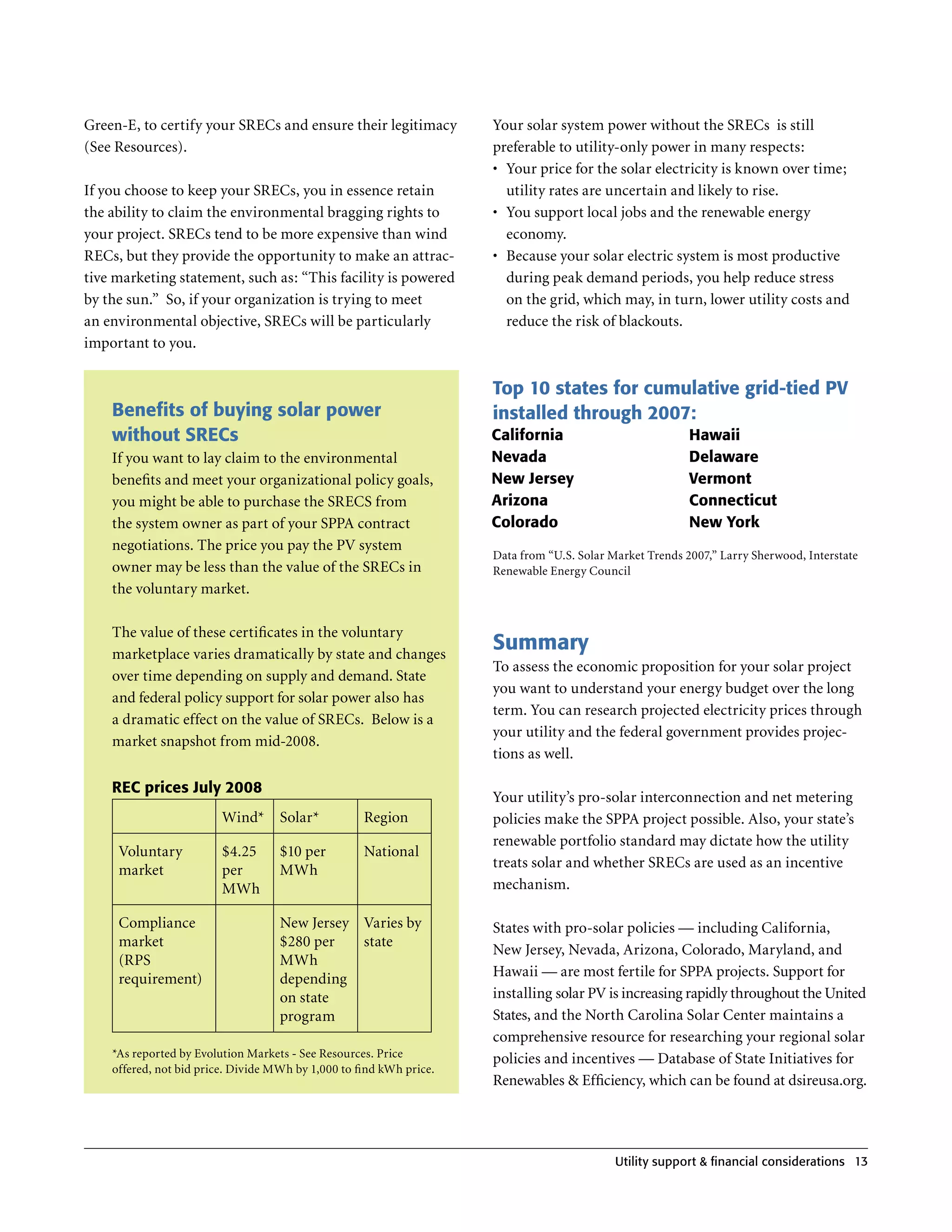
Solar renewable energy certificates
                                                                                          If you are not in a compliance market, there is a voluntary
(SRECs)                                                                                   market for the SRECs . This market is where customers
Renewable energy certificates (REC’s) are a financial trading
                                                                                          (e .g . Intel Corporation, PepsiCo, Whole Foods Market, and
mechanism that define the renewable energy attributes of
                                                                                          even individuals wanting to “green” their own power sup-
electricity independently from the electricity itself (Figure
                                                                                          ply) purchase SRECs in order to claim that their energy sup-
6) . In this way the “renewable” value of the power source
                                                                                          ply is produced by renewable power . FritoLay, for instance,


                                                                                                                      utility support & financial considerations 11
Renewables Portfolio Standards August 2008

                              15%                                                                                             VT: (1) RE meets
                           by 2020                                                                                            any increase in retail          ME: 30% by 2000
                                                                                                         WI: requirement      sales by 2012;                  10% by 2017 - new RE
                                               15% by 2015                             25%
                    20% by 2025                                          10% by 2015                     varies by utility;   (2) 20% by 2017
                                                                                       by 2025                                                                NH: 23.8% in 2025
                     (large utilities)                                                 (Xcel:
                                                                                                         10% by 2015 goal
                  5%-10% by 2025                                                       30% by                                                                 MA: 15% by 2020 +
                   (smaller utilities)                                                 2020)                                                                  1% annual increase
                                                                         10% by 2015                                                                          (Class I Renewables)
                                                                                                                                                              RI: 16% by 2020
                                                                                            105 MW                                                            CT: 23% by 2020
                                                                                                                    25%                                       NY: 24% by 2013
                                 20%
                                                       20% by                                          25% by       by 2025
                               by 2015        20%                                                                                                             NJ: 22.5% by 2021
                                                       2020 (IOUs)                                     2020
                                           by 2025       10% by 2020                                                                                          PA: 18%       by 2020
                     20%                               (co-ops & large                        11% by                                                          MD: 20% by 2022
                     by 2010                                   munis)                         2020
                                                                                                                                                              DE: 20% by 2019
                                         15%         20% by                                                                                                   DC: 11% by 2022
                                         by 2025     2020 (IOUs)                                                                                              VA: 12% by 2022
                                                     10% by 2020
                                                     (co-ops)                                                                                NC: 12.5% by 2021 (IOUs)
                                                                                                                                             10% by 2018 (co-ops & munis)


                                                                         5,880 MW by 2015


                                         20% by 2020


                  State RPS
                  State goal                                    Increased credit for solar or customer-sited RE
                  Solar water heating eligible                  Includes separate tier of non-renewable “alternative” energy resources


FIgure 5
Data provided by DSIreuSA.Org


has purchased enough SRECs to state that their SunChips                                         We strongly advise anyone who buys or sells RECs in the
snack product is “powered by the sun .” The solar system                                                      Example Attributes
                                                                                                voluntary market to be sure the certificate is real, locatable,
equipment owners who sold their SRECs to FritoLay still                                                        Included in SRECs
                                                                                                unique, and retired . Seek an independent program, such as
use the actual electricity coming from their solar equip-
ment . However, they are not entitled to make claims or
treat the electricity as coming from a solar energy source .
For a list of companies using SRECs to green their power                                                                        Standard kWh
supply visit the Green Power Partnership website (See                                                                           (power only)
Resources) .


                                                                                                                                         Green
    In a voluntary market you must own the                                                                                              Values*
    SRECs produced by your PV system in order
    to claim use of solar power. Only the SREC
                                                                                                                                            +
    owner can cite use of solar in marketing                                                               Support for renewable energy technology
    materials and to meet policy goals.                                                                         Clean non-polluting energy source
                                                                                                                  Marketing and/or policy benefits
                                                                                                                                   C02 Savings
                                                                                                            *Check with your SREC vendor to determine the exact content.


                                                                                                FIgure 6


12 The Customer’s guide to Solar Power Purchase Agreements
Green-E, to certify your SRECs and ensure their legitimacy             Your solar system power without the SRECs is still
(See Resources) .                                                      preferable to utility-only power in many respects:
                                                                       •	 Your price for the solar electricity is known over time;
If you choose to keep your SRECs, you in essence retain                   utility rates are uncertain and likely to rise .
the ability to claim the environmental bragging rights to              •	 You support local jobs and the renewable energy
your project . SRECs tend to be more expensive than wind                  economy .
RECs, but they provide the opportunity to make an attrac-              •	 Because your solar electric system is most productive
tive marketing statement, such as: “This facility is powered              during peak demand periods, you help reduce stress
by the sun .” So, if your organization is trying to meet                  on the grid, which may, in turn, lower utility costs and
an environmental objective, SRECs will be particularly                    reduce the risk of blackouts .
important to you .


                                                                       Top 10 states for cumulative grid-tied PV
    Benefits of buying solar power                                     installed through 2007:
    without SRECs                                                      California                            Hawaii
    If you want to lay claim to the environmental                      Nevada                                Delaware
    benefits and meet your organizational policy goals,                New Jersey                            Vermont
    you might be able to purchase the SRECS from                       Arizona                               Connecticut
    the system owner as part of your SPPA contract                     Colorado                              New York
    negotiations . The price you pay the PV system
                                                                       Data from “U .S . Solar Market Trends 2007,” Larry Sherwood, Interstate
    owner may be less than the value of the SRECs in                   Renewable Energy Council
    the voluntary market .

    The value of these certificates in the voluntary
    marketplace varies dramatically by state and changes
                                                                       Summary
                                                                       To assess the economic proposition for your solar project
    over time depending on supply and demand . State
                                                                       you want to understand your energy budget over the long
    and federal policy support for solar power also has
                                                                       term . You can research projected electricity prices through
    a dramatic effect on the value of SRECs . Below is a
                                                                       your utility and the federal government provides projec-
    market snapshot from mid-2008 .
                                                                       tions as well .

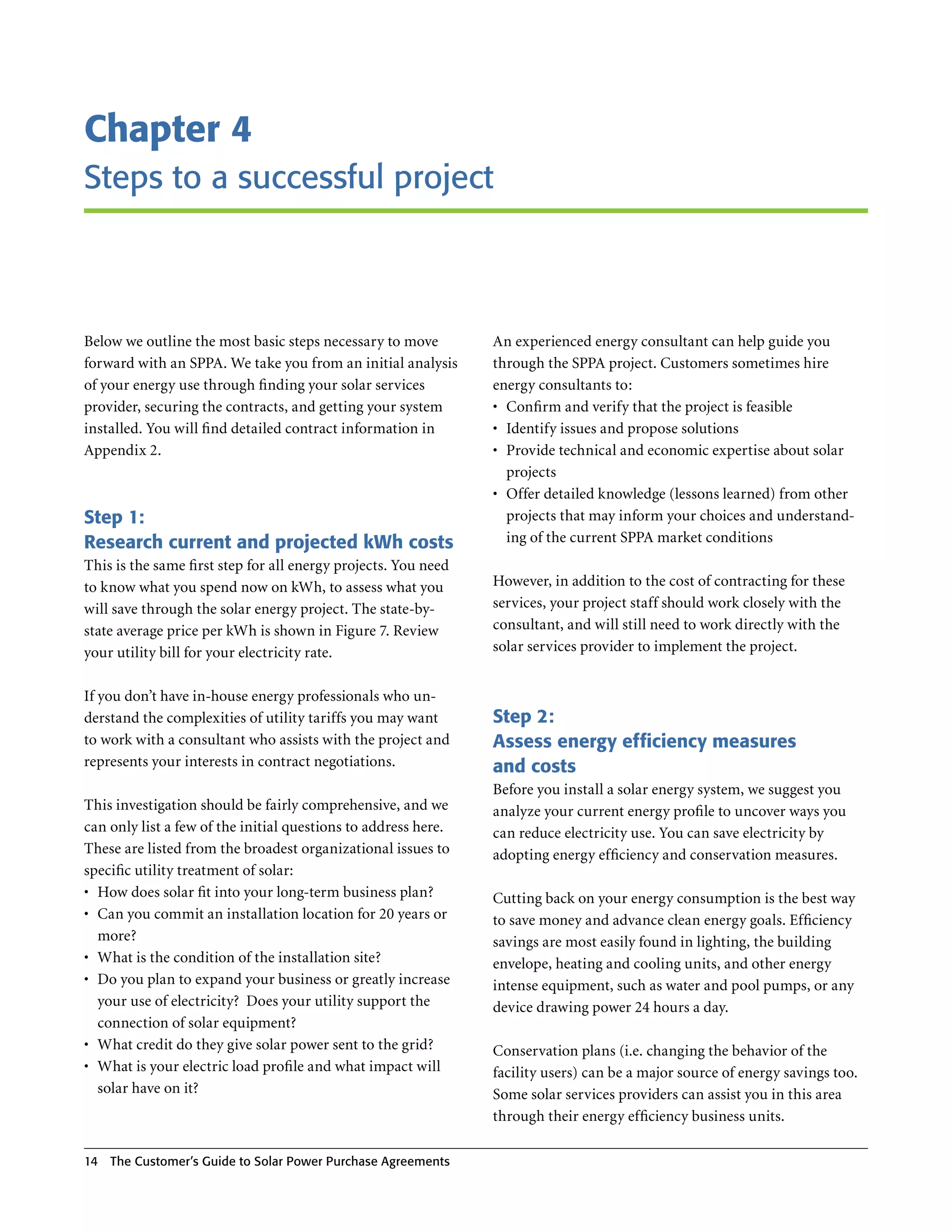
    REC prices July 2008
                                                                       Your utility’s pro-solar interconnection and net metering
                         Wind* Solar*                Region            policies make the SPPA project possible . Also, your state’s
                                                                       renewable portfolio standard may dictate how the utility
     Voluntary           $4 .25      $10 per         National
     market              per         MWh                               treats solar and whether SRECs are used as an incentive
                         MWh                                           mechanism .

     Compliance                      New Jersey Varies by              States with pro-solar policies — including California,
     market                          $280 per   state
                                                                       New Jersey, Nevada, Arizona, Colorado, Maryland, and
     (RPS                            MWh
     requirement)                    depending                         Hawaii — are most fertile for SPPA projects . Support for
                                     on state                          installing solar PV is increasing rapidly throughout the United
                                     program                           States, and the North Carolina Solar Center maintains a
                                                                       comprehensive resource for researching your regional solar
    *As reported by Evolution Markets - See Resources . Price          policies and incentives — Database of State Initiatives for
    offered, not bid price . Divide MWh by 1,000 to find kWh price .
                                                                       Renewables & Efficiency, which can be found at dsireusa .org .


                                                                                              utility support & financial considerations 13
Chapter 4
Steps to a successful project


Below we outline the most basic steps necessary to move          An experienced energy consultant can help guide you
forward with an SPPA . We take you from an initial analysis      through the SPPA project . Customers sometimes hire
of your energy use through finding your solar services           energy consultants to:
provider, securing the contracts, and getting your system        •	 Confirm and verify that the project is feasible
installed . You will find detailed contract information in       •	 Identify issues and propose solutions
Appendix 2 .                                                     •	 Provide technical and economic expertise about solar
                                                                    projects
                                                                 •	 Offer detailed knowledge (lessons learned) from other
Step 1:                                                             projects that may inform your choices and understand-
Research current and projected kWh costs                            ing of the current SPPA market conditions
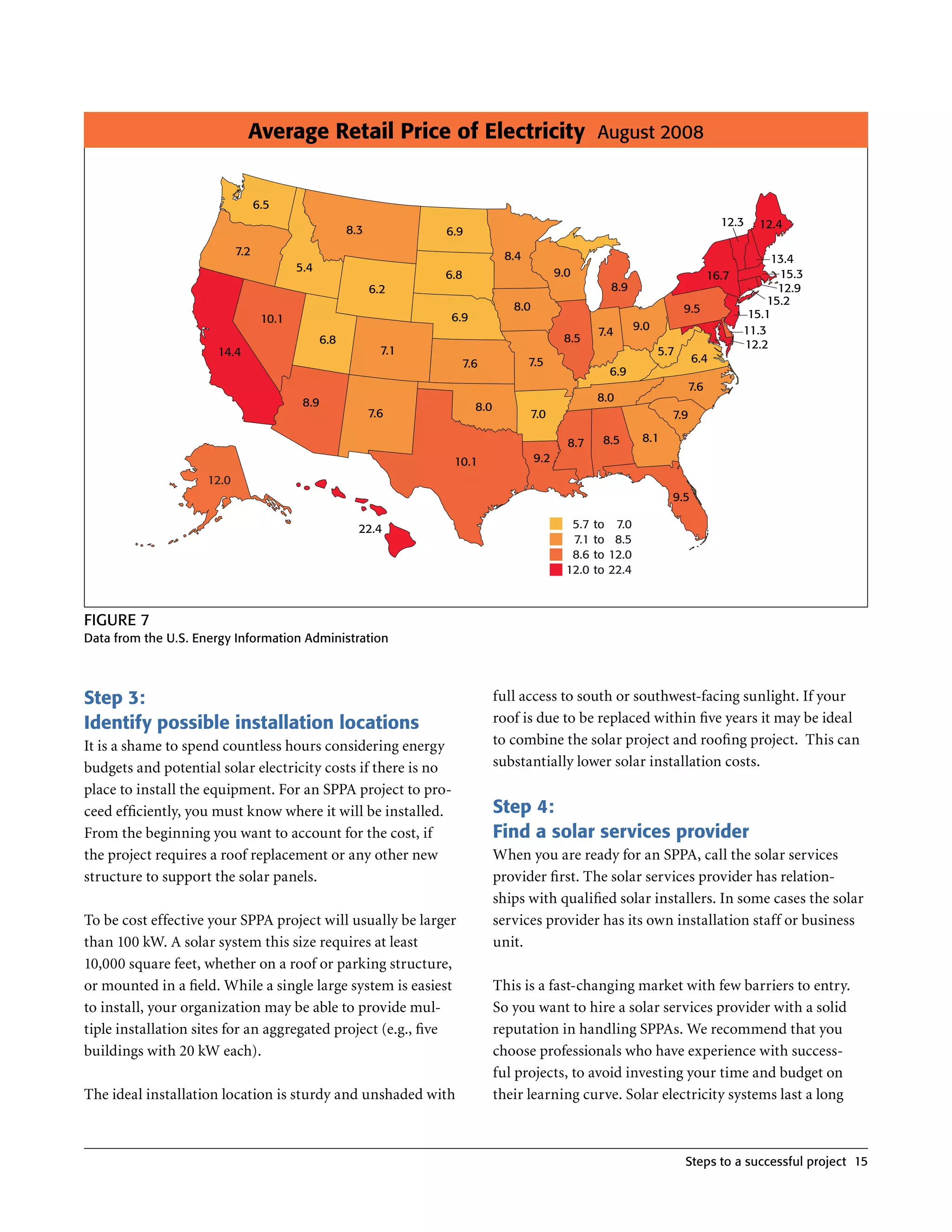
This is the same first step for all energy projects . You need
to know what you spend now on kWh, to assess what you            However, in addition to the cost of contracting for these
will save through the solar energy project . The state-by-       services, your project staff should work closely with the
state average price per kWh is shown in Figure 7 . Review        consultant, and will still need to work directly with the
your utility bill for your electricity rate .                    solar services provider to implement the project .


If you don’t have in-house energy professionals who un-
derstand the complexities of utility tariffs you may want        Step 2:
to work with a consultant who assists with the project and       Assess energy efficiency measures
represents your interests in contract negotiations .             and costs
                                                                 Before you install a solar energy system, we suggest you
This investigation should be fairly comprehensive, and we        analyze your current energy profile to uncover ways you
can only list a few of the initial questions to address here .   can reduce electricity use . You can save electricity by
These are listed from the broadest organizational issues to      adopting energy efficiency and conservation measures .
specific utility treatment of solar:
•	 How does solar fit into your long-term business plan?         Cutting back on your energy consumption is the best way
•	 Can you commit an installation location for 20 years or       to save money and advance clean energy goals . Efficiency
   more?                                                         savings are most easily found in lighting, the building
•	 What is the condition of the installation site?               envelope, heating and cooling units, and other energy
•	 Do you plan to expand your business or greatly increase       intense equipment, such as water and pool pumps, or any
   your use of electricity? Does your utility support the        device drawing power 24 hours a day .
   connection of solar equipment?
•	 What credit do they give solar power sent to the grid?        Conservation plans (i .e . changing the behavior of the
•	 What is your electric load profile and what impact will       facility users) can be a major source of energy savings too .
   solar have on it?                                             Some solar services providers can assist you in this area
                                                                 through their energy efficiency business units .

14   The Customer’s guide to Solar Power Purchase Agreements
Average Retail Price of Electricity August 2008


                                  6.5
                                                                                                                                          12.3   12.4
                                                      8.3           6.9
                            7.2                                                    8.4                                                               13.4
                                          5.4                                                    9.0
                                                                    6.8                                                                 16.7          15.3
                                                            6.2                                              8.9                                      12.9
                                                                                     8.0                                                            15.2
                                                                                                                                9.5             15.1
                                   10.1                              6.9
                                                                                                          7.4       9.0                        11.3
                                                6.8                                               8.5
                                                                                                                                               12.2
                       14.4                                   7.1                                                         5.7
                                                                          7.6            7.5                                      6.4
                                                                                                            6.9
                                                                                                                                  7.6
                                           8.9                                                            8.0
                                                                            8.0
                                                            7.6                          7.0                                7.9

                                                                                                   8.7     8.5       8.1
                                                                     10.1                  9.2
                     12.0
                                                                                                                            9.5

                                                        22.4                                        5.7   to 7.0
                                                                                                    7.1   to 8.5
                                                                                                    8.6   to 12.0
                                                                                                   12.0   to 22.4


FIgure 7
Data from the u.S. energy Information Administration


Step 3:                                                                           full access to south or southwest-facing sunlight . If your
Identify possible installation locations                                          roof is due to be replaced within five years it may be ideal
It is a shame to spend countless hours considering energy                         to combine the solar project and roofing project . This can
budgets and potential solar electricity costs if there is no                      substantially lower solar installation costs .
place to install the equipment . For an SPPA project to pro-
ceed efficiently, you must know where it will be installed .                      Step 4:
From the beginning you want to account for the cost, if                           Find a solar services provider
the project requires a roof replacement or any other new                          When you are ready for an SPPA, call the solar services
structure to support the solar panels .                                           provider first . The solar services provider has relation-
                                                                                  ships with qualified solar installers . In some cases the solar
To be cost effective your SPPA project will usually be larger                     services provider has its own installation staff or business
than 100 kW . A solar system this size requires at least                          unit .
10,000 square feet, whether on a roof or parking structure,
or mounted in a field . While a single large system is easiest                    This is a fast-changing market with few barriers to entry .
to install, your organization may be able to provide mul-                         So you want to hire a solar services provider with a solid
tiple installation sites for an aggregated project (e .g ., five                  reputation in handling SPPAs . We recommend that you
buildings with 20 kW each) .                                                      choose professionals who have experience with success-
                                                                                  ful projects, to avoid investing your time and budget on
The ideal installation location is sturdy and unshaded with                       their learning curve . Solar electricity systems last a long


                                                                                                                                Steps to a successful project 15
time, and power purchase agreements are typically 15 to            Once you have recruited the SSP they will do a site assess-
20 years . So your relationship with your solar services           ment and preliminary design, so basic location and system
provider is like a marriage—you want someone who will be           components are known before you negotiate the SPPA
around for the long haul .                                         contract .

Solar services providers are commonly found through a
Request for Qualifications (RFQ) or Request for Proposals
(RFP) . The RFQ generates a short list of contractors who
meet the standards you seek, and the RFP generates a more
detailed bid for your specific project .
                                                                        “Pricing is the first litmus test.
At CaliforniaSolarCenter .org we have posted web links to               If the (kWh) price isn’t right,
several examples of RFPs, SPPA contracts, and an RFP tem-               there is no deal.”
plate developed by the Prometheus Institute for Sustainable
Development .                                                                Morten Lund, Partner, Foley & Lardner LLP


What makes a good solar services
provider?
The company should offer:
•	 A track record of accomplishment with this kind of              Step 5:
   transaction .                                                   Negotiate contract
•	 Personal references that show experience working with           Before you begin contract negotiations, you will have
   solar electricity systems similar to yours .                    established that your utility supports solar, located a large
•	 Financial partners with the substance and sophistication        unshaded installation location, reviewed your energy costs
   to follow through with the deal .                               and efficiency options, and recruited a solar services pro-
•	 Installation expertise and knowledge . Be sure the solar        vider to coordinate your project .
   services provider works with experienced installers who
   have built a system under SPPA terms . The installer            We suggest you use professionals to represent your organi-
   may continue to work closely for many years with the            zation’s interest . But be sure they have experience with this
   solar services provider to ensure the system produces as        type of contract . It is important that they understand both
   expected .                                                      the utility costs and your interests . Appendix 2 is a detailed
•	 Contract flexibility to support your needs . (But recog-        technical guide to walk you through the contract negotia-
   nize that changes you make to the standard contract             tion process . The appendix describes these key features to
   raise transaction expenses, potentially increasing your         understand about contracts before moving forward:
   price for solar electricity .)                                  •	 Electricity pricing
•	 Monitoring and production reports and feedback . You            •	 Financial incentives
   pay for the power they say the system is producing, so          •	 SREC sales and terms
   you want to know exactly what you purchased .                   •	 Site lease agreement
•	 A defensible savings analysis . Is the company using            •	 End of contract term, and pre-term options
   the proper tariffs in its calculations? Is it providing real-
   istic assumptions about your system’s electricity output .
   Inflating output is the number one “fudge factor” used to
   exaggerate the benefits of solar electricity .
•	 The ability to provide the best equipment for your instal-
   lation location .


16 The Customer’s guide to Solar Power Purchase Agreements
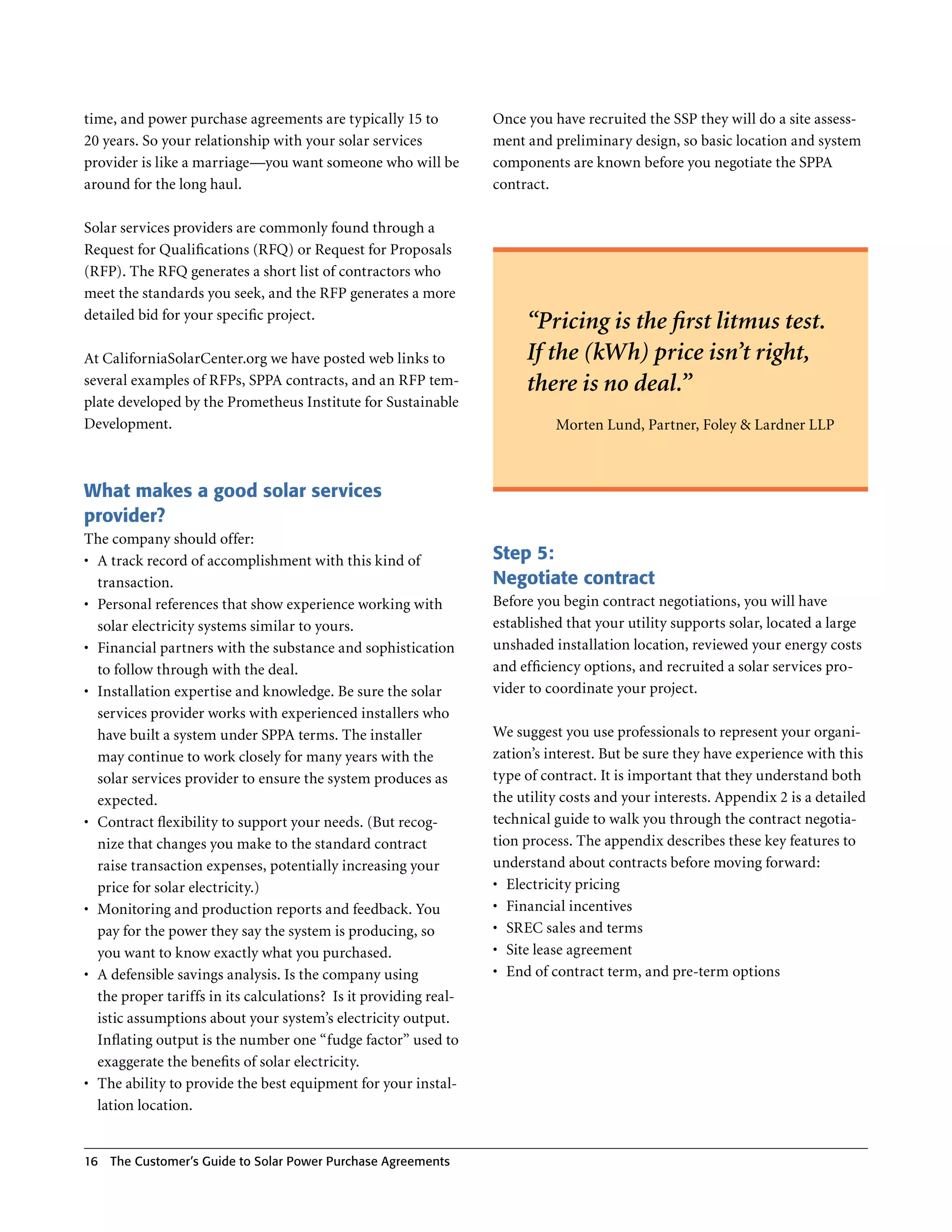
Example SPPA Project Timeline


           Site survey and obtain letter of intent from customer

                      Developer/installer draws full design
                                Submit application for rebate
                                           Sign PPA with customer
                                                     Project investment approval process
                                                               Confirm design & timeline
                                                                        Permitting & construction
                                                                                  Commission & fund system
                                                                                   (Host customer allocates no cash to
                                                                                   install the system)

           1 MONTH                        2 MONTHS                      3 MONTHS                           ASAP


FIgure 8
Adapted courtesy of MMA renewable Ventures


Step 6:                                                         The solar services provider will lead the design and
Collaborate on system design, permitting,                       installation process, working closely with your staff, solar
                                                                installation crews, and your electric utility .
and installation
The contract negotiation process may take several months,
                                                                Within your organization, clear communications about the
depending on the number of approvals required for your
                                                                solar project will save both time and money . Your project
project and whether your solar services provider already
                                                                team leader should try to keep your staff and senior deci-
controls project financing or is recruiting funding . The
                                                                sion makers in the loop about the solar project and work
solar services provider has to secure the various incentives
                                                                with the solar services provider to facilitate project permits
available before the investor will commit, and the incen-
                                                                and approvals . It is important that you and the provider
tives are not always certain until the project financing
                                                                understand the local permitting process as it relates to
is secured . In addition, the project requires approval of
                                                                solar electricity systems . Each project requires a unique set
permits . To save time and money from the outset, include
                                                                of approvals from different agencies .
project timelines and milestones, both for your organiza-
tion and the SSP (Figure 8) .

While the contracting process is detailed, many organiza-       Step 7:
tions like yours have completed it . In Chapter 6 we have       Enjoy your solar power
provided contact information for people who were involved       Once the system is installed it goes through a commission-
in successful SPPA projects .                                   ing process in which the utility checks the interconnection,
                                                                local inspectors ensure the wiring meets electrical codes,


                                                                                                Steps to a successful project 17
and the installer makes sure the system is producing power
as expected . The length of the commissioning process
depends on the size and nature of your system and the level
of support from your electric utility .

After the system is commissioned, the solar services pro-
vider will show you how to read a web-based monitoring
service that describes the amount of solar electricity your
building uses . The kWh billing information is collected
remotely from a revenue-grade production meter .
Additional monitoring equipment will inform you that
everything is working correctly .

The SSP or their maintenance service contractor will repair
and replace equipment as needed to ensure you actually
receive the amount of solar electricity described in your
SPPA contract . Your staff will notify the maintenance
company of any physical changes to the project site that
may create shade or otherwise hinder the system’s
electricity production .


Summary
Implementing an SPPA project can be straightforward,
and hundreds of large businesses and municipal organiza-
tions have used this strategy with excellent results . Clear
communications and planning are the secret to success for
achieving your solar power objectives with an SPPA .


18   The Customer’s guide to Solar Power Purchase Agreements
Chapter 5
Other ways to buy solar electricity


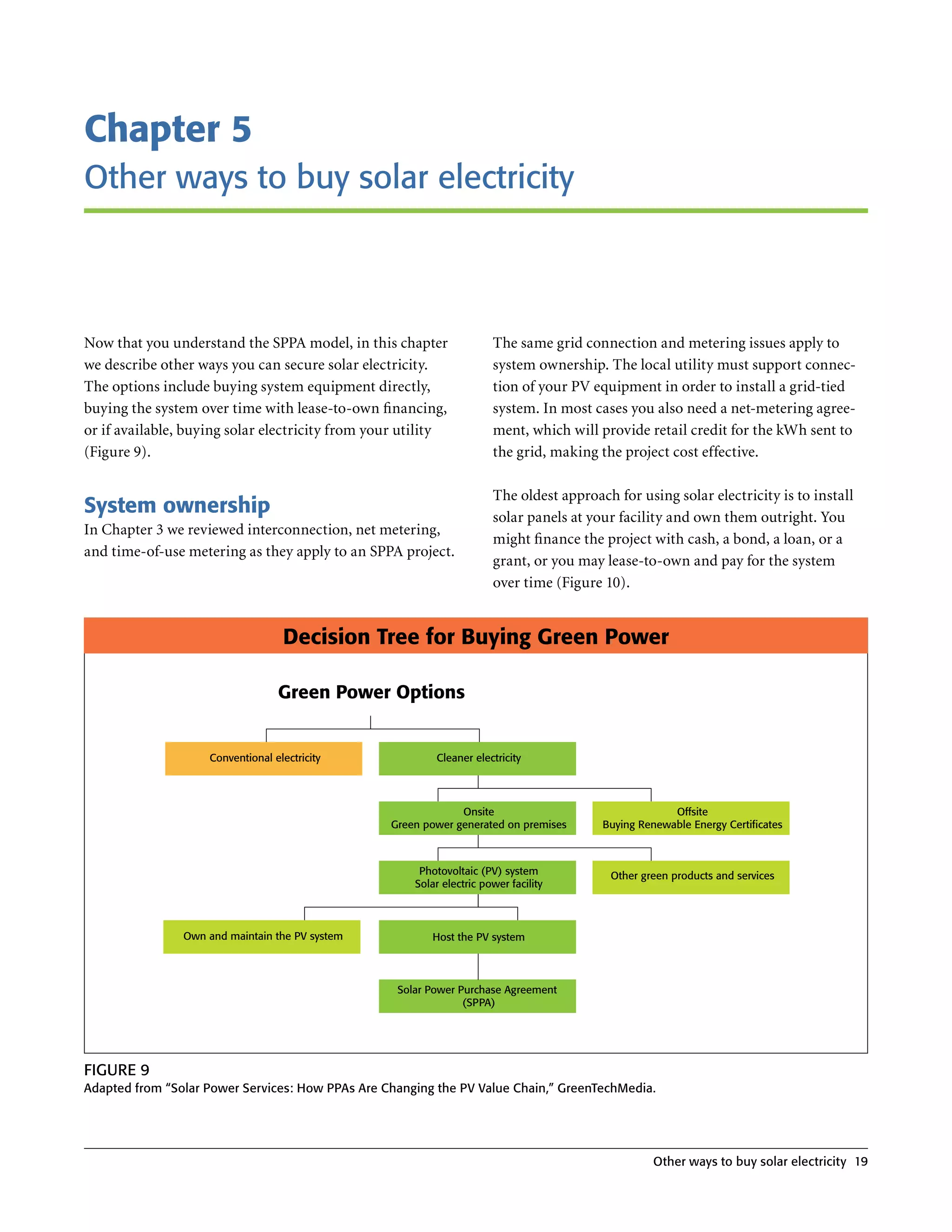
Now that you understand the SPPA model, in this chapter                The same grid connection and metering issues apply to
we describe other ways you can secure solar electricity .              system ownership . The local utility must support connec-
The options include buying system equipment directly,                  tion of your PV equipment in order to install a grid-tied
buying the system over time with lease-to-own financing,               system . In most cases you also need a net-metering agree-
or if available, buying solar electricity from your utility            ment, which will provide retail credit for the kWh sent to
(Figure 9) .                                                           the grid, making the project cost effective .

                                                                       The oldest approach for using solar electricity is to install
System ownership                                                       solar panels at your facility and own them outright . You
In Chapter 3 we reviewed interconnection, net metering,
                                                                       might finance the project with cash, a bond, a loan, or a
and time-of-use metering as they apply to an SPPA project .
                                                                       grant, or you may lease-to-own and pay for the system
                                                                       over time (Figure 10) .


                                   Decision Tree for Buying Green Power

                                  Green Power Options


                    Conventional electricity              Cleaner electricity


                                                               Onsite                                 Offsite
                                                  Green power generated on premises      Buying Renewable Energy Certificates


                                                       Photovoltaic (PV) system           Other green products and services
                                                      Solar electric power facility


                Own and maintain the PV system           Host the PV system


                                                   Solar Power Purchase Agreement
                                                                (SPPA)


FIgure 9
Adapted from “Solar Power Services: How PPAs Are Changing the PV Value Chain,” greenTechMedia.


                                                                                                   Other ways to buy solar electricity 19
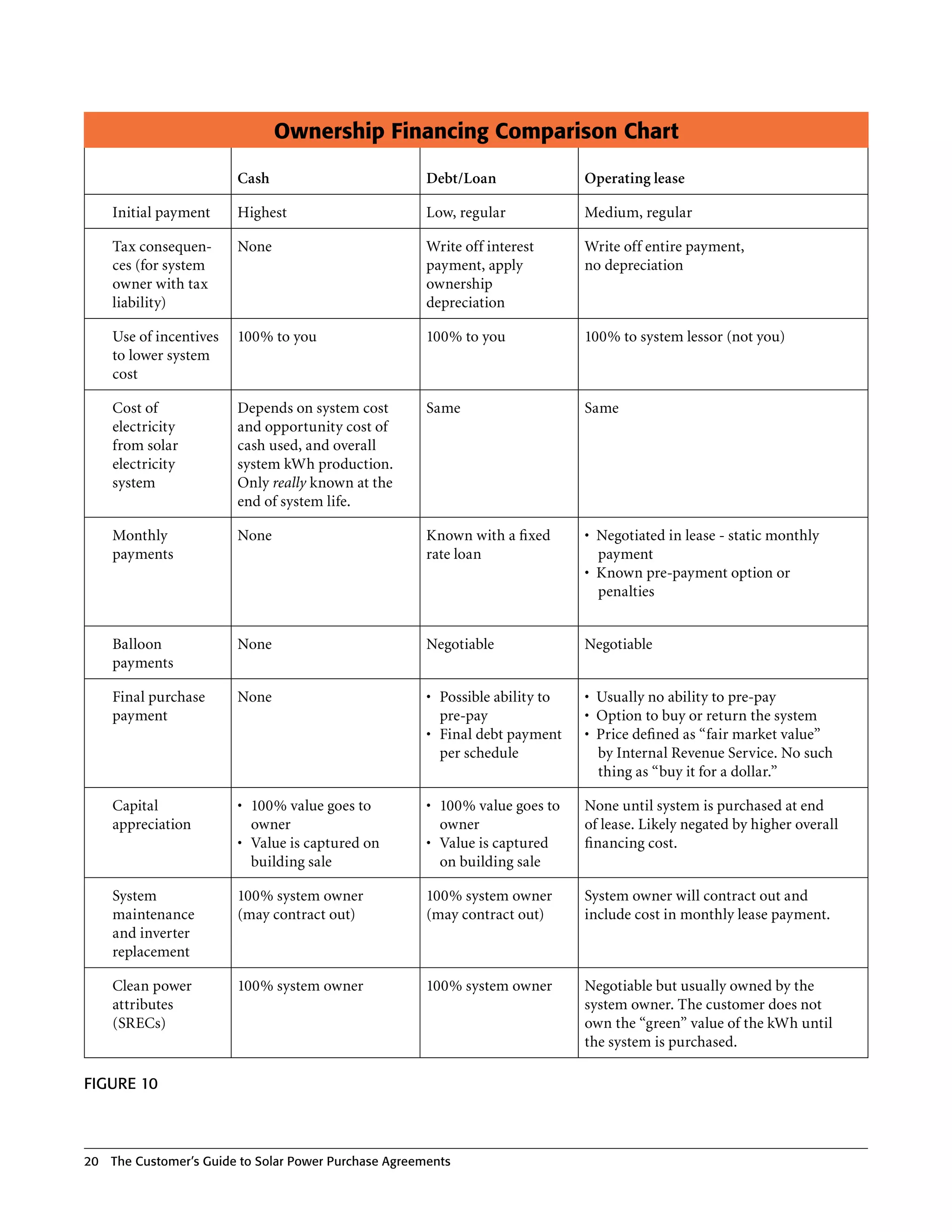
Ownership Financing Comparison Chart

                        Cash                          Debt/Loan                Operating lease

    Initial payment     Highest                       Low, regular             Medium, regular

    Tax consequen-      None                          Write off interest       Write off entire payment,
    ces (for system                                   payment, apply           no depreciation
    owner with tax                                    ownership
    liability)                                        depreciation

    Use of incentives   100% to you                   100% to you              100% to system lessor (not you)
    to lower system
    cost

    Cost of             Depends on system cost        Same                     Same
    electricity         and opportunity cost of
    from solar          cash used, and overall
    electricity         system kWh production .
    system              Only really known at the
                        end of system life .

    Monthly             None                          Known with a fixed       •		Negotiated	in	lease	-	static	monthly	
    payments                                          rate loan                   payment
                                                                               •		Known	pre-payment	option	or	
                                                                                  penalties


    Balloon             None                          Negotiable               Negotiable
    payments

    Final purchase      None                          •	 Possible ability to   •		Usually	no	ability	to	pre-pay	
    payment                                              pre-pay               •		Option	to	buy	or	return	the	system
                                                      •	 Final debt payment    •		Price	defined	as	“fair	market	value”	
                                                         per schedule             by Internal Revenue Service . No such
                                                                                  thing as “buy it for a dollar .”

    Capital             •	 100% value goes to         •	 100% value goes to    None until system is purchased at end
    appreciation           owner                         owner                 of lease . Likely negated by higher overall
                        •	 Value is captured on       •	 Value is captured     financing cost .
                           building sale                 on building sale

    System              100% system owner             100% system owner        System owner will contract out and
    maintenance         (may contract out)            (may contract out)       include cost in monthly lease payment .
    and inverter
    replacement

    Clean power         100% system owner             100% system owner        Negotiable but usually owned by the
    attributes                                                                 system owner . The customer does not
    (SRECs)                                                                    own the “green” value of the kWh until
                                                                               the system is purchased .

FIgure 10


20 The Customer’s guide to Solar Power Purchase Agreements
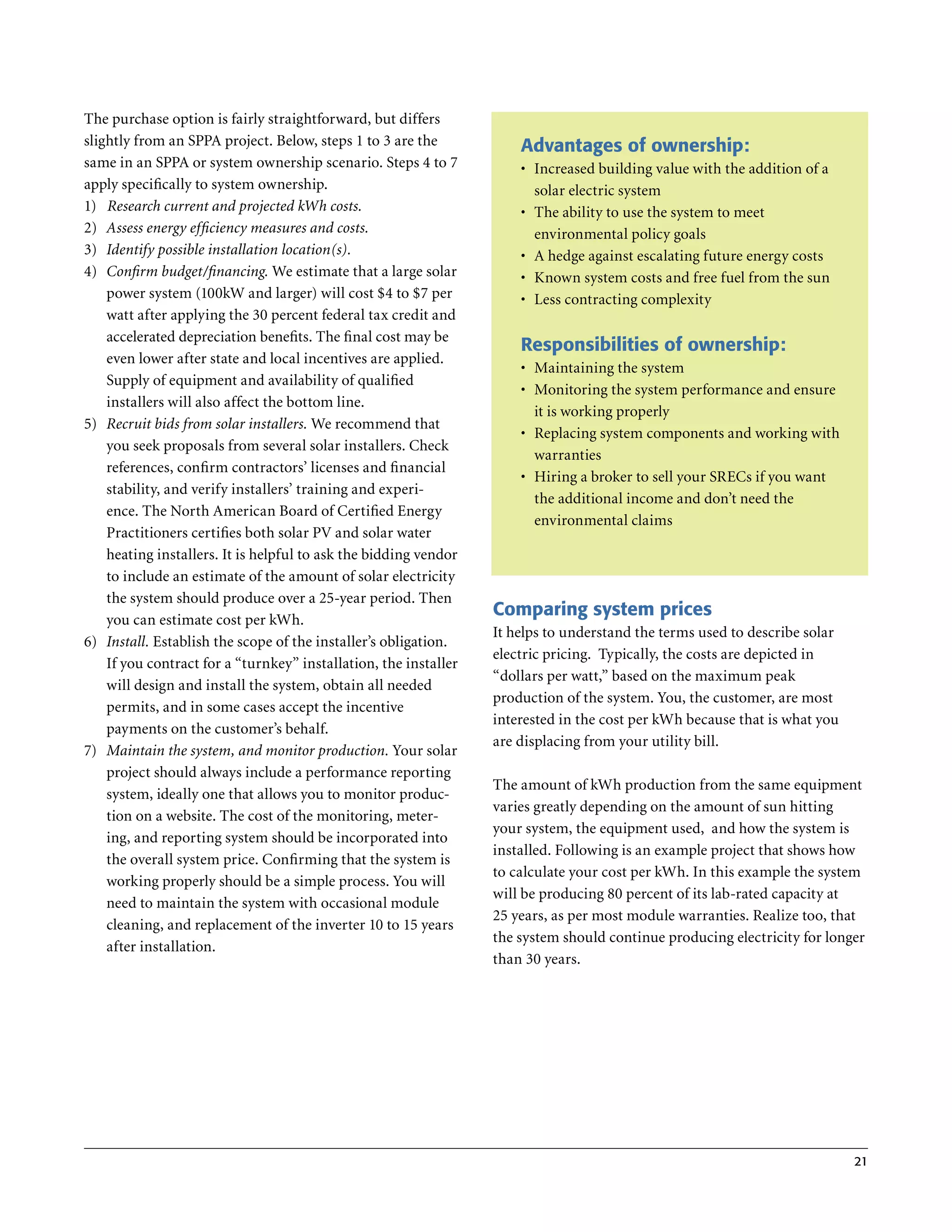
The purchase option is fairly straightforward, but differs
slightly from an SPPA project . Below, steps 1 to 3 are the            Advantages of ownership:
same in an SPPA or system ownership scenario . Steps 4 to 7            •	 Increased building value with the addition of a
apply specifically to system ownership .                                  solar electric system
1) Research current and projected kWh costs.                           •	 The ability to use the system to meet
2) Assess energy efficiency measures and costs.                           environmental policy goals
3) Identify possible installation location(s).                         •	 A hedge against escalating future energy costs
4) Confirm budget/financing. We estimate that a large solar            •	 Known system costs and free fuel from the sun
    power system (100kW and larger) will cost $4 to $7 per             •	 Less contracting complexity
    watt after applying the 30 percent federal tax credit and
    accelerated depreciation benefits . The final cost may be
                                                                       Responsibilities of ownership:
    even lower after state and local incentives are applied .
                                                                       •	 Maintaining the system
    Supply of equipment and availability of qualified
                                                                       •	 Monitoring the system performance and ensure
    installers will also affect the bottom line .
                                                                          it is working properly
5) Recruit bids from solar installers. We recommend that
                                                                       •	 Replacing system components and working with
    you seek proposals from several solar installers . Check
                                                                          warranties
    references, confirm contractors’ licenses and financial
                                                                       •	 Hiring a broker to sell your SRECs if you want
    stability, and verify installers’ training and experi-
                                                                          the additional income and don’t need the
    ence . The North American Board of Certified Energy
                                                                          environmental claims
    Practitioners certifies both solar PV and solar water
    heating installers . It is helpful to ask the bidding vendor
    to include an estimate of the amount of solar electricity
    the system should produce over a 25-year period . Then
    you can estimate cost per kWh .
                                                                   Comparing system prices
                                                                   It helps to understand the terms used to describe solar
6) Install. Establish the scope of the installer’s obligation .
                                                                   electric pricing . Typically, the costs are depicted in
    If you contract for a “turnkey” installation, the installer
                                                                   “dollars per watt,” based on the maximum peak
    will design and install the system, obtain all needed
                                                                   production of the system . You, the customer, are most
    permits, and in some cases accept the incentive
                                                                   interested in the cost per kWh because that is what you
    payments on the customer’s behalf .
                                                                   are displacing from your utility bill .
7) Maintain the system, and monitor production. Your solar
    project should always include a performance reporting
                                                                   The amount of kWh production from the same equipment
    system, ideally one that allows you to monitor produc-
                                                                   varies greatly depending on the amount of sun hitting
    tion on a website . The cost of the monitoring, meter-
                                                                   your system, the equipment used, and how the system is
    ing, and reporting system should be incorporated into
                                                                   installed . Following is an example project that shows how
    the overall system price . Confirming that the system is
                                                                   to calculate your cost per kWh . In this example the system
    working properly should be a simple process . You will
                                                                   will be producing 80 percent of its lab-rated capacity at
    need to maintain the system with occasional module
                                                                   25 years, as per most module warranties . Realize too, that
    cleaning, and replacement of the inverter 10 to 15 years
                                                                   the system should continue producing electricity for longer
    after installation .
                                                                   than 30 years .


                                                                                                                             21
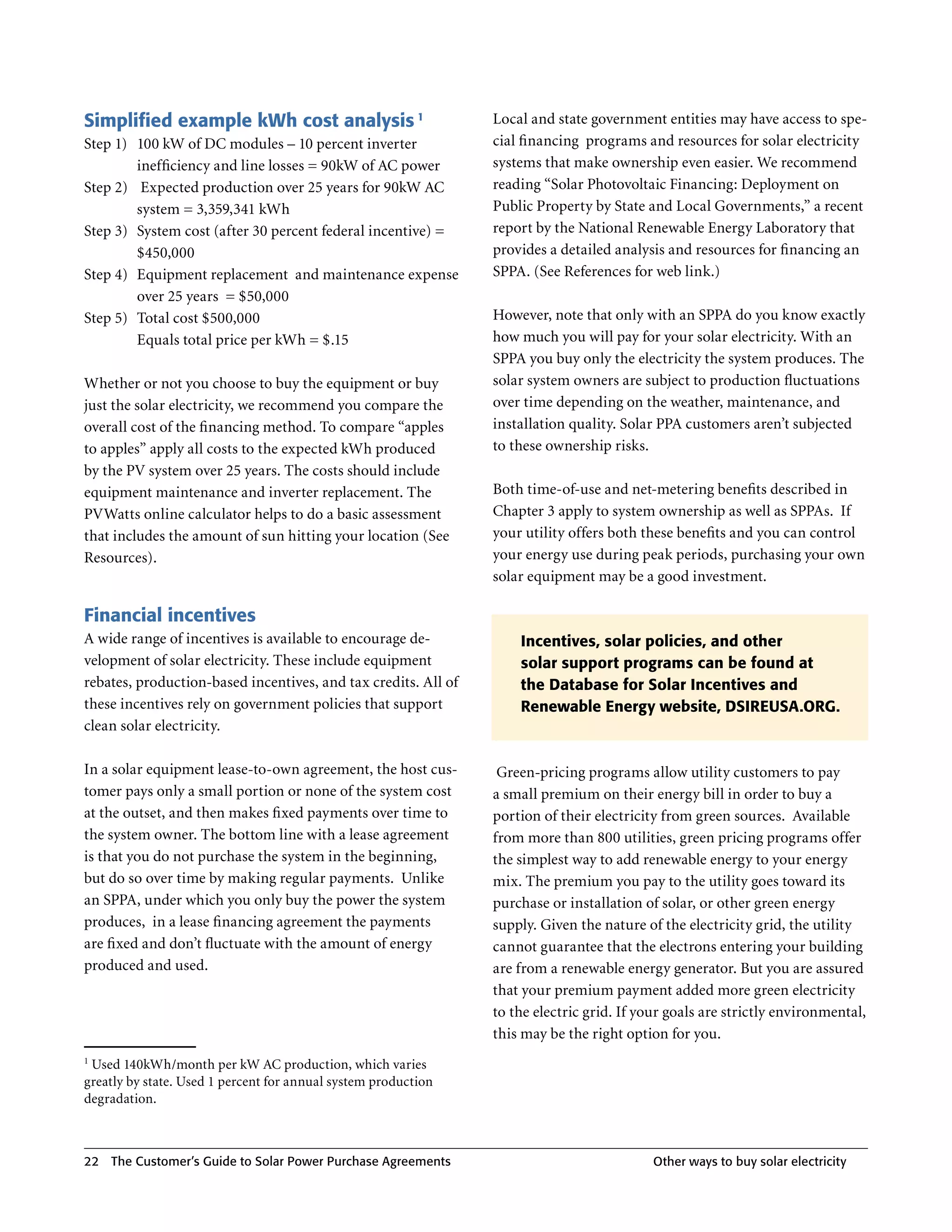
Simplified example kWh cost analysis 1                           Local and state government entities may have access to spe-
Step 1) 100 kW of DC modules – 10 percent inverter               cial financing programs and resources for solar electricity
        inefficiency and line losses = 90kW of AC power          systems that make ownership even easier . We recommend
Step 2) Expected production over 25 years for 90kW AC            reading “Solar Photovoltaic Financing: Deployment on
        system = 3,359,341 kWh                                   Public Property by State and Local Governments,” a recent
Step 3) System cost (after 30 percent federal incentive) =       report by the National Renewable Energy Laboratory that
        $450,000                                                 provides a detailed analysis and resources for financing an
Step 4) Equipment replacement and maintenance expense            SPPA . (See References for web link .)
        over 25 years = $50,000
Step 5) Total cost $500,000                                      However, note that only with an SPPA do you know exactly
        Equals total price per kWh = $ .15                       how much you will pay for your solar electricity . With an
                                                                 SPPA you buy only the electricity the system produces . The
Whether or not you choose to buy the equipment or buy            solar system owners are subject to production fluctuations
just the solar electricity, we recommend you compare the         over time depending on the weather, maintenance, and
overall cost of the financing method . To compare “apples        installation quality . Solar PPA customers aren’t subjected
to apples” apply all costs to the expected kWh produced          to these ownership risks .
by the PV system over 25 years . The costs should include
equipment maintenance and inverter replacement . The             Both time-of-use and net-metering benefits described in
PVWatts online calculator helps to do a basic assessment         Chapter 3 apply to system ownership as well as SPPAs . If
that includes the amount of sun hitting your location (See       your utility offers both these benefits and you can control
Resources) .                                                     your energy use during peak periods, purchasing your own
                                                                 solar equipment may be a good investment .

Financial incentives
A wide range of incentives is available to encourage de-             Incentives, solar policies, and other
velopment of solar electricity . These include equipment             solar support programs can be found at
rebates, production-based incentives, and tax credits . All of       the Database for Solar Incentives and
these incentives rely on government policies that support            Renewable Energy website, DSIREUSA.ORG.
clean solar electricity .

In a solar equipment lease-to-own agreement, the host cus-        Green-pricing programs allow utility customers to pay
tomer pays only a small portion or none of the system cost       a small premium on their energy bill in order to buy a
at the outset, and then makes fixed payments over time to        portion of their electricity from green sources . Available
the system owner . The bottom line with a lease agreement        from more than 800 utilities, green pricing programs offer
is that you do not purchase the system in the beginning,         the simplest way to add renewable energy to your energy
but do so over time by making regular payments . Unlike          mix . The premium you pay to the utility goes toward its
an SPPA, under which you only buy the power the system           purchase or installation of solar, or other green energy
produces, in a lease financing agreement the payments            supply . Given the nature of the electricity grid, the utility
are fixed and don’t fluctuate with the amount of energy          cannot guarantee that the electrons entering your building
produced and used .                                              are from a renewable energy generator . But you are assured
                                                                 that your premium payment added more green electricity
                                                                 to the electric grid . If your goals are strictly environmental,
                                                                 this may be the right option for you .
1
 Used 140kWh/month per kW AC production, which varies
greatly by state . Used 1 percent for annual system production
degradation .


22   The Customer’s guide to Solar Power Purchase Agreements                                Other ways to buy solar electricity
Summary
                                                                  An SPPA may be a better option for you if your
Federal investment tax credit                                     organization:
The U .S . government has supported the use of solar power        •	 has limited financing options
for several years with a federal tax credit . The federal solar   •	 uses a lot of electricity
investment tax credit (ITC) is crucial to the SPPA market .       •	 prefers to pay for solar electricity through the normal
Investors are willing to commit to an SPPA largely because           operating budget instead of all at once through a
it offers them tax advantages through this credit .                  capital investment

Available for commercial solar projects installed by              Solar electricity is an excellent choice for your organization
December 31, 2008, the ITC offers a 30 percent tax credit         whether you own it directly or buy just the electricity .
on the full cost of a system for businesses that own solar .      Using an SPPA to buy the power guarantees the price for
Project owners also take advantage of an accelerated five         the solar electricity, requires no capital investment to buy
and a half-year equipment depreciation schedule . Together,       equipment, and transfers the system maintenance and
these incentives can recover approximately 50 percent of          other risk factors to the equipment owners . Likewise, if
the cost of a PV system . The ITC has spurred the installa-       you can secure system financing through cash, debt, a
tion of thousands of commercial solar electricity systems .       bond, or through lease financing, system ownership has its
                                                                  own benefits . Your SPPA agreement may even include the
                                                                  option to buy the solar power for the first few years, and
    Federal investment tax credit (ITC)                           purchase the system equipment later .


    A federal ITC is vital to the robust growth                   In Chapter 6 we review several real-world SPPA examples .
    of the solar industry in the United States,
    and allows for cost-effective SPPAs.
    If it is not extended, the ITC will end
    December 31, 2008 and the commercial
    credit will revert to 10 percent of the sys-
    tem cost. At press time, Congress had not
    voted to extend the ITC for solar.

    Check SEIA.ORG for the latest update on
    this key policy.


                                                                                            Other ways to buy solar electricity 23
Chapter 6
real world examples

The following project examples come from well-established solar power services
companies. These companies have diverse portfolios, representing many business
sectors and customer types.


Denver International Airport                    (MMA renewable Ventures, 2008)

 System size (AC)     Equipment brands          Term                                  Host customer sector   Location

 2,000kW              Sharp modules             20 years with buyout option at fair   Airport                Denver,
                      Xantrex inverters         market value after Year 6                                    Colorado


Project contact: Woods Allee / Phone: (303) 342-2632 /
Email: Woods .Allee@flydenver .com

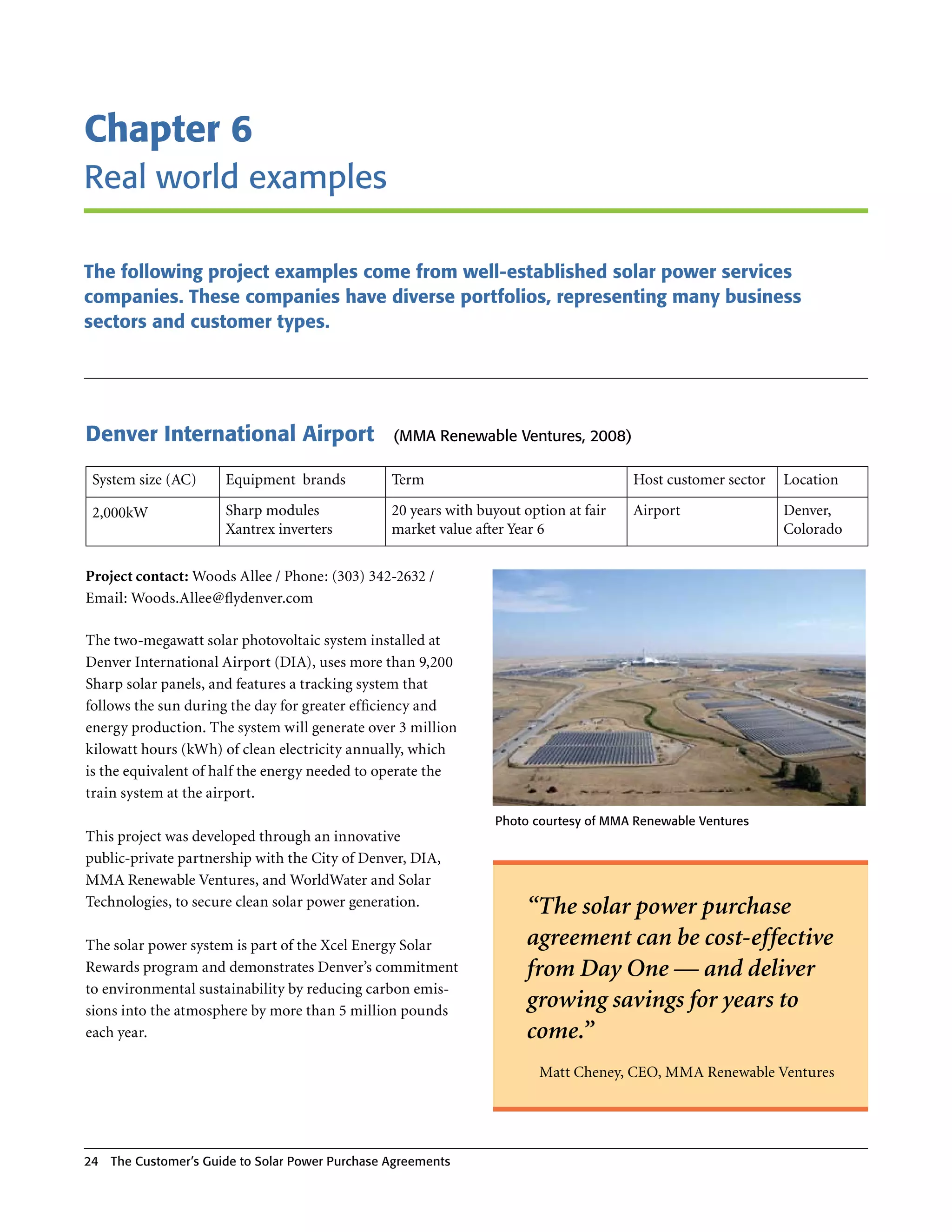
The two-megawatt solar photovoltaic system installed at
Denver International Airport (DIA), uses more than 9,200
Sharp solar panels, and features a tracking system that
follows the sun during the day for greater efficiency and
energy production . The system will generate over 3 million
kilowatt hours (kWh) of clean electricity annually, which
is the equivalent of half the energy needed to operate the
train system at the airport .
                                                                Photo courtesy of MMA renewable Ventures
This project was developed through an innovative
public-private partnership with the City of Denver, DIA,
MMA Renewable Ventures, and WorldWater and Solar
Technologies, to secure clean solar power generation .                “The solar power purchase
The solar power system is part of the Xcel Energy Solar               agreement can be cost-effective
Rewards program and demonstrates Denver’s commitment                  from Day One — and deliver
to environmental sustainability by reducing carbon emis-
sions into the atmosphere by more than 5 million pounds
                                                                      growing savings for years to
each year .                                                           come.”
                                                                        Matt Cheney, CEO, MMA Renewable Ventures


24 The Customer’s guide to Solar Power Purchase Agreements
California State University, Fresno                       (MMA renewable Ventures, 2007)

 System size (AC)     Equipment brands           Term                                   Host customer sector      Location

 1,173kW              Schott modules             20 years with buyout option at fair    State university          Fresno,
                      SatCon inverters           market value after Year 6                                        California


                                                                 Project contact: Dick Smith, Facilities Manager /
                                                                 Phone: (559) 278-2373 / Email: dicks@csufresno .edu

                                                                 Fresno State is a leader in advancing sustainability initia-
                                                                 tives and in the conservation of scarce natural resources .
                                                                 This project is just one of the university’s “green campus”
                                                                 initiatives, which serve as a model in higher education .
                                                                 The solar power system generates energy to cover 20 per-
                                                                 cent of the university’s core campus usage . To build aware-
                                                                 ness and interest in solar generation among students and
                                                                 faculty members, the panels are installed atop carports,
                                                                 and four public kiosks provide the real-time status of the
Photo courtesy of MMA renewable Ventures                         photovoltaic system’s performance .


Lagunitas School District - San Geronimo School                                   (Solar Power Partners, 2008)

 System size (AC)     Equipment brands         Term                               Host customer sector       Location

 49 .3kW              Evergreen modules        15 years with buyout option at     School district            San Geronimo,
                      Solectria inverters      fair market value at term                                     California


Project contact: Amy Prescott, Business Manager /
Phone: (415) 488-9563, ext 226 / Email: aprescott@marin .
k12 .ca .us

This school had reserved a rebate with the state’s solar
incentive program, but found they lacked capital to
purchase the system . Thirty days before the rebate was
to expire, Solar Power Partners received a desperate call
from a green-oriented architect working with the school .
SPP collaborated with a local solar installer on a project
design and developed a corresponding PPA . The estimated
savings of 20 percent starting in Year 1 was very attractive
to the school board . The savings were possible because the
school is closed in summer when the PV is producing the          Photo courtesy of Solar Power Partners
most energy and earning credits at the highest tariff rate .
The project is complete and is being integrated into the
school’s curriculum as well as providing the backdrop for
the community’s “Green Note Festival .”


                                                                                                          real world examples 25
“Energy users with a solar friendly time-of-use profile, like many schools
      and universities, can often obtain the greatest energy cost savings from
      a Solar Power Purchase Agreement. Further, schools and universities
      often have unique needs and similar negotiating points. As a result of
      working with numerous schools and universities, Solar Power Partners
      has tailored a PPA to match these needs and limit negotiation expenses.”
                                                                      Alexander v . Welczeck, CEO, Solar Power Partners


Fresno Airport              (Solar Power Partners, 2008)

 System size (AC)      Equipment brands           Term                                  Host customer sector     Location
 Two 1,200kW           Sharp modules              20 years with buyout option at fair   City airport             Fresno,
 systems               Xantrex inverters          market value at term                                           California


                                                                  Project contact: Russell Widmar, Director of Aviation /
                                                                  Phone: (559) 621-7500 / Email: russ .w idmar@fresno .gov

                                                                  The City of Fresno, owner of the Fresno Yosemite
                                                                  International Airport (FYI), set a goal and course of action
                                                                  through their Fresno Green program to become a national
                                                                  leader in renewable energy use . FYI was identified as an
                                                                  ideal location to implement a large-scale solar electric
                                                                  facility . In the summer of 2007, Solar Power Partners
Photo courtesy of Solar Power Partners                            was approached by World Water and Solar Technologies
                                                                  Corporation to manage the financing and power pur-
                                                                  chase contract awarded by the Fresno City Council . SPP
                                                                  deployed two 1 .2MW DC field installations using an APS
                                                                  single-axis tracking system to maximize annual energy
                                                                  harvest . The installation represents one of the largest
                                                                  distributed PV installations in the U .S . and is expected to
                                                                  produce a combined 4,145,000 kWh annually, approxi-
                                                                  mately 40 percent of the airport’s annual power needs .
                                                                  FYI is expecting to save about $13 million in electricity
                                                                  costs over the 20-year term and offset 62,175 metric tons
                                                                  of carbon dioxide .


26   The Customer’s guide to Solar Power Purchase Agreements
City of Pendleton Water Treatment Plant                            (Honeywell, 2008)

 System size (AC)      Equipment brands         Term                                   Host customer sector     Location

 100kW                 SolarWorld modules       20 years with buyout option at fair    Water district           Pendleton,
                       Solectria inverters      market value at term                                            Oregon


                                                                Project contact: Larry Lehman, City Manager /
                                                                Phone: (541) 966-0221 / Email: larry .lehman@
                                                                ci .pendleton .or .us

                                                                Installing a solar electric system was a natural next step
                                                                for the City of Pendleton after several years of implement-
                                                                ing various sustainability measures . The 100 kW system
                                                                located on the roof of the city’s water treatment plant
                                                                will produce 112,000 kWh per year . City Manager Larry
                                                                Lehman says that the SPPA’s 3 percent yearly escalation
                                                                rate provides predictability for a portion of the city’s
                                                                electric bills . This predictability, combined with the fact
Photo courtesy of energy Trust of Oregon                        that the project came at no cost to the city, made it an easy
                                                                decision . The system is attached to the ribs in the treat-
                                                                ment plant’s metal roof; no roof penetrations were used .


City of San Diego’s Alvarado Water Treatment                                  (Sunedison, 2007)

 System size (AC)      Equipment brands      Term                                 Host customer sector     Location

 1,130kW               Kyocera modules       20 years with buyout option at       Water district           San Diego,
                       SatCon inverters      fair market value at term                                     California


Project contact: Tom Blair, Deputy Director, Energy
Conservation & Management, Environmental Services,
City of San Diego / Phone: (858) 492-6001

More than 6,000 panels atop the concrete roofs of three
water storage reservoirs provide more than 1 .6 million
kWh each year . The system prevented 1 .5 million pounds
of CO2 emissions in the first year, the environmental
equivalent to removing about 140 cars from U .S . roadways
annually, or powering 150 homes each year .


                                                                Photo courtesy of Sunedison


                                                                                                        real world examples 27
Chuckawalla Valley State Prison                         (Sunedison, 2006)

 System size (AC)      Equipment brands            Term                              Host customer sector     Location
 1,000kW               Kyocera and SolarWorld      20 years with buyout option at    California               Blythe,
                       modules                     fair -market value at term        Department of            California
                       SatCon inverters                                              General Services


                                                                  Project contact: Harry Franey, California Department of
                                                                  Corrections and Rehabilitation /
                                                                  Email: harry .franey@cdcr .ca .gov

                                                                  The California Power Authority began deploying solar
                                                                  with SunEdison in 2006, and now hosts 4 MW of clean,
                                                                  renewable solar power at eight locations to meet rising
                                                                  energy costs and a state mandate to implement renew-
                                                                  able energy . One host is Chuckawalla Valley State Prison,
                                                                  a 1 MW ground mounted system installed in June 2006 .
                                                                  The prison achieves three goals in hosting a solar system:
                                                                  it saves money on their energy bills, supports their state
Photo courtesy of Sunedison                                       renewable energy mandates, and incurs no upfront capital
                                                                  expenses .


      “Put your money into your core business. Let us be the energy experts."
                                                                     Jigar Shah, Chief Visionary Officer, SunEdison


28   The Customer’s guide to Solar Power Purchase Agreements
Chapter 7
Summary


Renewable power is becoming an important part            No matter what model you use, you want to under-
of our nation’s energy supply. More and more busi-       stand fully your state and local policy framework,
nesses and organizations seek electricity from green     your utility’s policies, and how your available finan-
sources, particularly from solar power, a tried-and-     cial incentives work. It is also crucial that you seek
true technology that offers free fuel forever.           experienced professionals to help guide you through
                                                         the project. And finally, no matter what the source of
As the solar industry matures, new and innovative        your new clean energy, take time to determine how
approaches emerge to help organizations buy and          you can improve efficiency and conservation. The
finance solar energy. You can install a system at your   kilowatt saved is the cheapest kilowatt available.
site and then own it outright, or finance it with a
lease. Or you can use the SPPA approach and allow a      We hope this guide helped you understand solar
third party to own, operate, and maintain the system     electricity projects and how to assess your options as
at your site. You then purchase the electricity from     you move forward. Please review the Appendices and
the entity. Each method has its own challenges, but      the Resources section for further details. Thank you
only with the SPPA do you buy just the solar power       for going solar!
you use, and at a known rate for 15 to 20 years.


             Whether you sign an SPPA, or decide to own your equipment,
             solar electricity provides many benefits for your organization,
                                 and for our environment.


                                                                                                       Summary 29
Appendix 1
Solar technology basics

• How it works and the main system components
• Technology options and considerations
• Factors affecting production


How it works                                                                                                  When sunlight hits PV modules, high voltage direct cur-
Solar technology has more than 60 years of significant                                                        rent (DC) electricity is generated . The DC flows into the
testing and use in the field . Solar electricity system compo-                                                system inverter which converts it to alternating current
nents include modules, inverters, and “balance of system”                                                     (AC) and steps down the voltage for use in the associated
parts (e .g ., production meter, wiring, racking, switches) .                                                 power panel . The amount of power being generated de-
The systems are relatively simple and quick to install                                                        pends on the size and number of modules, their efficiency,
compared to other renewable energy technologies, and they                                                     their orientation to the sun, and the amount of sunlight
have few if any moving parts to maintain .                                                                    falling on the module array (Figure 11) .


                                                                                  PV System on Building
                             Solar
                             Buy
                             Sell


                                                                                                                                                      Utility Grid
                                                                                                                                                   Supplemental Power
                                     Combiner


                                                              Transformer
                                                   Inverter


                                                                                                    Main
                                                                                               Electrical
                                                                                                  Panel
                                                                             Safety
                                                                            Switch


              Converts DC current
                produced by solar
               panels into usable                                                                  Dashboard Kiosk
                       AC current               Transforms inverter                 Data           for monitoring
                                                 output voltage to               Acquisition       system performance
                                                   utility voltage                 System


FIgure 11
Adapted from eI Solutions “grid-Tied Solar Power System Overview,” greenTechMedia.com


30 The Customer’s guide to Solar Power Purchase Agreements
SYSTEM COMPONENTS                                                tion throughout the year . The system installer should
                                                                 provide maintenance guidance for local weatherconditions .

Modules
                                                                 Maximum production. Solar modules produce at peak
Types. Most solar modules in production today are made
                                                                 efficiency in cool (but not cold) temperatures, with maxi-
of silicon crystal cells . The three main types of silicon-
                                                                 mum sunlight exposure . Direct shading on even a small
based modules are single-crystal, multi-crystal, and
                                                                 portion of the modules will greatly reduce the amount of
amorphous, a type of “thin film” module . There are also
                                                                 power produced . Production will also vary significantly
non-silicon-based thin film modules . Single and multi-
                                                                 according to local climate conditions and the amount of
crystalline modules are more efficient, sturdier, and
                                                                 sunlight hitting the solar modules .
heavier than thin film modules . Thin film modules are
lighter in weight and often applied to flexible materials like
a plastic backing . Thin film modules are commonly found
in building-integrated applications such as roof shingles,
                                                                 Inverters
                                                                 Purpose. Grid-tied inverters condition the DC power
roll-on roof coverings, and windows .
                                                                 produced by PV modules into “utility grade” AC power
                                                                 that flows through the electrical panel for use in the
Efficiency ratings. The module efficiency rating refers to
                                                                 building, or back into the utility meter .
the percent of sunlight that is converted to electricity .
Single and multi-crystal modules are more efficient than
                                                                 Efficiency. The inverter contains the “brains” of the PV
thin film, while thin film is lighter and more flexible . The
                                                                 system, that monitor and control for peak performance
less efficient a module, the more modules and space needed
                                                                 and alert the system operator to any anomalies . Typical
to produce the target amount of power . In order to com-
                                                                 inverter efficiency is 88 to 92 percent, meaning that of 100
pare apples to apples when reviewing project proposals,
                                                                 DC watts coming into the inverter from the modules, only
efficiency is best thought of in terms of cost per kWh
                                                                 88 to 92 watts will be converted into usable AC power .
produced .

                                                                 Safety. If the utility grid goes offline (e .g ., in a blackout),
Capacity. The capacity is the maximum amount of energy
                                                                 the inverter also goes offline and any electricity being
the system can produce based on how many watts of PV are
                                                                 produced by the PV modules is “dumped” through the
installed . The bottom line when comparing solar electricity
                                                                 grounding wires . This feature protects line workers or
equipment options is the cost per watt, or ideally, cost per
                                                                 others when the lines are down .
kWh over the lifetime of the PV system . Solar customers
are ultimately purchasing kilowatt hours (kWhs) .
                                                                 Warranty. The inverter warranty is usually 10 years, with
                                                                 expected performance approximately 15 years . Therefore,
Warranty. Most modules come with a 25-year manufac-
                                                                 the system owner should budget to replace the inverters
turer’s warranty, meaning that after 25 years the modules
                                                                 at least once over the useful life of the PV system . The
should still be producing at least 80 percent of their rated
                                                                 inverter should continue producing at least 50 percent of its
capacity . As there are no moving parts, and the modules
                                                                 rated capacity for more than 30 years .
are built for long-term stability in all weather conditions,
it is likely a PV system will continue producing at least 50
                                                                 Features. Each inverter option has costs and benefits
percent of its rated capacity beyond 30, possibly even 40
                                                                 that must be analyzed in the context of the entire project .
years .
                                                                 The size of the inverter will depend on the number of PV
                                                                 modules and whether more modules are to be added later .
Maintenance. PV modules require very little maintenance .
                                                                 Other considerations are the kWh monitoring and
In dry, or very dusty environments, the system owner
                                                                 reporting features, such as whether the inverter can send
should hose off the modules to ensure maximum produc-
                                                                 production data through a wireless Internet connection .


                                                                                                         Solar technology basics 31
The inverter must usually be replaced usually 10 to 15         Installation structure. PV modules may be installed
years into the project . This cost must be configured into     on building roofs (flat or tilted), shade structures (e .g .,
the project budget .                                           parking lots, parks, pools, transit terminals), or mounted
                                                               on standing poles, along hillsides, or in open fields . Any
Location. Inverters work most efficiently in cool, clean       unshaded solid structure that will last 10 or more years
conditions .                                                   provides a good solar installation location . It is common
                                                               to install the system in conjunction with a re-roofing
                                                               project, or when creating a dual-benefit structure, such as
                                                               a new parking lot shading system with integrated PV .
kWh production factors                                         The system may be mounted on a flat roof, using no-
Installation location and production. The U .S . gener-
                                                               penetration ballast anchors, or on poles with dual tracking
ally has an excellent solar resource . Other countries, such
                                                               to maximize production .
as Germany, have a considerably weaker solar resource,
but nonetheless produce much more solar energy than we
                                                               FindSolar .org and ASES .org are excellent online resources
do because of very generous solar policies and financial
                                                               for installing a solar electric system .
incentives .

These guidelines, for those in the northern hemisphere,
are useful in estimating what size PV system you will need
to install:

•	 Weight: A common roof-mounted system with racking
   weighs 3 to 5 pounds per square foot .
•	 Space: 1,000 to 1,500 square feet per 10,000 watts of
   modules . Plan on 10,000 square feet for a 100kW roof-
   mounted system .
•	 Production: 900 to 1600kWh per month per 10,000
   watts of modules . Production will be higher in sum-
   mer, lower in winter, and vary greatly by location . (See
   PVWatts in Resources for estimate .) The PV modules
   should face southward and be tilted for maximum
   annual kWh production . Production is also boosted by
   adding tracking equipment that tilt the modules toward
   the sun .


32 The Customer’s guide to Solar Power Purchase Agreements
Appendix 2
SPPA contracts technical guide


The contracting process doesn’t have to be complicated,           To assess the economics of your project over 10 to 20 years,
but it’s made easier and faster with some pre-research and        consider:
an understanding of the process . This section attempts to        •	 Capital costs
raise questions and concepts that will help you navigate the      •	 Energy production
SPPA contracting process .                                        •	 Tax credits and incentives
                                                                  •	 Effect of SRECs
Creating variations on the SPP’s standard offer product           •	 Projected discount rate
costs time and money to negotiate, so if you minimize             •	 Operating costs, maintenance, insurance, etc .
special requests and unusual options, you can achieve a           •	 Current price of energy
more attractive electricity price .                               •	 Projected energy price increases

Electricity prices are expected to rise, and in some cases
dramatically . Here is the forecast directly from the Energy      Solar electricity pricing
Information Administration:                                       This section of the SPPA contract describes how much
    Prices. Many utilities are continuing to pursue retail        you will pay for kWh from the PV system, and how this
    electricity rate increases in response to power genera-       amount is adjusted over time . To assess the economics of
    tion fuel costs that have risen dramatically over the         your project over 10 to 20 years, consider your price for PV
    last 2 years. For example, the delivered cost of natural      kWh in terms of:
    gas to the electric power sector in March 2008 was....        •	 Capital costs
    25 percent higher than the average cost in March 2007.        •	 System energy production
    Average U.S. residential electricity prices are expected to   •	 Tax credits and incentives available to owner
    increase by 5 percent in 2008 and by 10 percent in 2009       •	 Effect of SRECs
    (Short-term Energy Outlook, Energy Information                •	 Projects discount rate
    Administration, September 9, 2008) . http://www .eia .        •	 Operating costs, maintenance, insurance, etc .
    doe .gov/emeu/steo/pub/contents .html                         •	 Current price of energy
                                                                  •	 Projected energy price increases
Key contract features
These are the core sections of your SPPA contract, but they           Fixed with escalator. In this price structure, the price
may be combined into one or more documents:                           per kWh is fixed and includes a fixed annual escalation
•	 Solar electricity pricing and assured performance                  rate (%) . The escalation rate accounts for system
•	 SREC sales and terms                                               production decreases over time, and inflation-related
•	 Site lease                                                         cost increases for system operation and maintenance .
•	 Pre-term and end-of-term options
                                                                  Whether the starting price is higher or lower than the
                                                                  customer’s current utility rate depends on how the pricing


                                                                                               SPPA contracts technical guide 33
is structured . The price negotiation includes where to start          either positive or negative, on the demand-related
the kWh rate, using a fixed or step-based escalator rate,              charges on your regular utility bill .
or some combination of kWh rate and inflation schedule             2 . Daily Demand Charges : daily charge based on peak
that accounts for the time-value of money, and provides a              demand
return on investment for the system owners .                       3 . Tariff: this is the rate you pay for kWh and it changes
                                                                       during the seasons . It may also change during the time
Ultimately, the cost of kWh depends on the size and com-               of day if you are on a time-of-use tariff . Ask your utility
plexity of the project, the incentives available to the system         if there is a tariff that could lower your rate for conven-
owner, the various options afforded to the customer, and               tional kWh once you are also using PV power . For
the host’s credit rating .                                             instance, some school districts export PV kWh
                                                                       during the summer and receive credit toward their
The SREC contract, which may be separate from the SPPA                 winter energy bills .
or incorporated within, impacts the kWh rates as well .
                                                                   Once you understand the ‘all inclusive’ kWh price you are
Projects may start with a kWh rate price higher than their         currently paying your utility, known as the “reference
current tariff, but with a flat escalator and known rates for      tariff,” you can then compare this against the proposed
the long term . Typical escalation rates are currently 3 to 5 .5   SPPA PV rate . This part of the SPPA contract describes
percent .                                                          your utility pricing in detail, and the procedure for
                                                                   selecting a new reference tariff for the SPPA in case the
     Fixed non-escalating. With this price structure, the          original tariff changes or is canceled .
     host customer may begin buying the PV kWh at a rate
     higher than their current utility rate, but the rate does     When calculating your electricity costs, and the
     not change over time . This structure makes great sense       corresponding PV power benefits, do not use an “Average
     when the host customer has great confidence their             Unit Cost” method. The average cost method is used for
     utility rates will be increasing significantly .              budgeting purposes and is based on throwing all energy
                                                                   costs together and dividing the bundle by the amount of
     Variable with utility. The kWh price is equal to or less      kWh used . This produces a falsely high kWh rate and fails
     than the utility price, possibly with minimums and            to show the actual effect of the PV system on your utility
     maximums defined . This is a fairly rare SPPA price           bill . For a detailed discussion of the Average Unit Cost visit
     structure and is sometimes referred to as “Business as        Energy Management World’s discussion papers:
     Usual .”                                                      http://www .energymanagementworld .org/diligence .html .


                                                                   Transaction costs
Your electricity bill                                              In most projects the host customer is investing their own
In preparation for the contract negotiation phase of the           transaction costs (e .g ., staff time, consulting services, legal
SPPA project you will have already consulted your electric         fees, travel, etc .) into the project and these costs should
utility about available tariffs and their forecasted electricity   be reflected in their overall economic project analysis . In
prices .                                                           some cases the host customer might bill the SSP for their
                                                                   transaction costs but the funding essentially comes out
Your electricity bill may have several distinct types of           of the hosts’ electric bill from the SSP . Host customers
charges . Here we list the most common rate factors that           requesting this added transaction may be paying for the
change with the amount of kWh being purchased:                     service through the power purchase agreement in the form
1 . Demand Charges: monthly payment based on your                  of higher kWh prices .
    peak demand average from past use . Consult your
    utility and your project consultant to understand
    whether the PV project will have a significant effect,


34   The Customer’s guide to Solar Power Purchase Agreements
Assured performance                                            to the host customer, to offering a certain percentage of
The kWh price and total project economics are based on         them, to not offering them at all .
how much usable electricity the PV system will produce
over the long term . If the PV system does not produce as      Because the SREC market and global warming policies are
much as expected, the customer is purchasing more utility      changing rapidly, the best option for the host customer
power than they planned and potentially losing expected        (in a voluntary REC market) is the option to purchase the
savings . Customers with large enough projects may seek        SRECs, either at the beginning or some point in the future .
minimum performance guarantees, and may want to                In this way the customer has the option to meet policy and
specify compensation should the system fail to produce as      marketing goals with their SRECs as the value of these cer-
expected . Some SSPs don’t include performance provisions      tificates becomes more clear to the marketplace . In all cases
in their standard contracts because it is in the system own-   your SSP should be familiar with the REC marketplace and
er’s interest to ensure maximum system production, and         will provide guidance on meeting your objectives .
therefore maximum kWh income from the host customer .
                                                               For a full discussion of SRECs and the REC marketplace
This section of the contract will also identify the “annual    refer to the Center for Resource Solutions and Green-E
degradation factor,” which is the percent of estimated pro-    websites (References) .
duction decrease from year to year to account for system
degradation over time . For reference, module warranties
often describe that the module should produce at least 80      Site lease
percent of their original power rating after 25 years in the   This section describes the details for facility access and
field, which reflects an annual degradation factor of  .08     maintenance required by the SSP or its subcontractors to
percent .                                                      ensure optimal system performance . It details the provi-
                                                               sions in case of emergency, meter testing, and notification
                                                               provisions in case the system has to be turned off by on-site
Solar renewable energy certificates                            staff . While it is important to clarify these details, the vast
SRECs are described in Chapter 3 of this Guide but, as it’s    majority of PV maintenance and monitoring will take
a fairly complicated concept, we reiterate the information     place via remote system controls .
and go into more detail here to provide guidance relating
to the SREC portion of your contract .                         The site lease also clarifies what happens if the building
                                                               changes ownership or is leased by a new party before the
The SREC represents the renewable energy “attributes”          end of term . Ideally the new owner or building tenant
from a single megawatt hour (MWh) of solar electricity .       will be qualified to take on the SPPA directly, but if not
These trading products are used to promote the use of          the system can be moved to the host’s new location, at the
renewable energy by splitting the green value of the kWh       host’s expense . In the event of property ownership or use
off from the basic power unit . As SRECs are priced in         changes the customer is still committed to buying the PV
MWh, and your contract is based in kWh, remember to            kWh for the term of the contract (15 to 20 years) . Moving
multiply the kWh figure by one thousand when comparing         or selling the building or property on which the PV system
SREC market prices against the price offered by your solar     is installed does not release the customer from purchasing
services provider .                                            the kWh .


In a mandatory REC market, where SRECs are used as a
financial incentive to support the use of solar PV, the sys-   Property taxes
tem owner will use the incentive to help pay for the system    The PV equipment adds value to your property . Even
equipment . In a voluntary market, the standard offer from     though someone else owns the equipment in an SPPA,
your SSP will vary, from always offering the SRECs for sale    your property may be reassessed at a higher value after


                                                                                             SPPA contracts technical guide 35
the system is installed . It is important to the economics of        Insurance
the project that the PV system does not cause additional             Check with your insurance company regarding the
property taxes due to the addition of the solar equipment .          additional riders and required coverage for the PV system .
If additional taxes will be paid be sure to include this cost        The SPPA kWh price reflects insurance costs, so if the Host
when evaluating the costs of the project .                           can insure the system at less cost than the SSP the kWh


     Under the radar issues                                            the PPA at the end of any appropriation period with-
     There are “under-the-radar” issues such as                        out further obligation or payment of any penalty, if
     insurance, property taxes, sales taxes, and other                 and only if, the host was unable to obtain appropria-
     costs that impact project economics and the                       tion for funds to meet future scheduled payments
     feasibility of entering into third-party ownership                and a formal resolution or ordinance is passed .
     agreements .                                                      Often, this type of clause will contain a “best
                                                                       efforts” requirement, i .e ., the customer promises to
     Facility Access. Some plant/facility manag-                       use its best efforts to seek and obtain the necessary
     ers and security staff, may not be comfortable                    appropriation for payment . This provision is com-
     with a third party having access to and installing                mon in tax- exempt leases and is designed to enable
     equipment on their property . Ongoing site access                 the customer to account for the PPA obligation as a
     is critical to the performance of the system and if               current expense instead of debt .
     that is not acceptable, the third-party ownership
     model will unlikely be a viable option .                        •	 Non-substitution clause: In today’s fast-evolving
                                                                        solar industry, non-substitution clauses are used
     Transaction Costs. The third-party ownership                       to protect a project’s viability . If a PPA is canceled
     model requires knowledgeable lawyers to assist                     due to non-appropriation, the clause prohibits the
     with implementing the appropriate contracts                        customer from replacing the hosted equipment
     so that the various federal tax incentives can be                  supported by the PPA with equipment that performs
     monetized . While the host is not involved with                    the same or similar function . A non-substitution
     all of the contracts that need to be signed, it is                 period of 365 days is common, and shorter time
     involved with the PPA itself and must be ready to                  periods are also used . Decisions regarding the length
     allocate resources to ensure its interests are repre-              of the non-substitution period are based partly on
     sented in the final contract .                                     the perceived essential nature of the equipment .
                                                                        Generally, the more essential the equipment is,
     Municipal-Specific Contractual Issues. Most                        the shorter the non-substitution period will be .
     state and local governments approve the funding                    Given the host’s right to cancel under the non-
     of their operating obligations on an annual basis,                 appropriation clause, the non-substitution clause is
     so there is a question about the enforceability                    intended to provide some comfort to the investor
     of a long-term PPA . This is typically addressed                   and the project developer .
     through two mechanisms:
                                                                     Check with your utility to ensure that 3rd party
     •	 Non-appropriation clause: A non-appropriation                ownership of a PV system does not preclude the
        clause permits the hosting customer to terminate             project from accessing available incentives .


“Under the radar issues” reprinted with permission from National Renewable Energy Laboratory Technical Report (NREL/TP-670-43115)
Solar Photovoltaic Financing: Deployment on Public Property by State and Local Governments, (May, 2008), by Karlynn Cory, Jason
Coughlin, and Charles Coggeshall.


36 The Customer’s guide to Solar Power Purchase Agreements
rate will reflect these savings . Insurance companies are not
yet very familiar with PV equipment and you will want to            Whenever the solar equipment is sold,
make sure the system is covered, as well as the building on         it must be sold for fair market value as
which it is installed .                                             determined by an IRS approved valuation
                                                                    process. Vendors who suggest that the
                                                                    equipment may be purchased for less than
Mid-term and end-of-term issues                                     fair market value are misrepresenting the
The mid-term and end of term options will be clearly                established IRS guidelines.
spelled out in this section . Pre-term options might include
the process for when there are changes in the contracted
parties (the special purpose entity, investors, system main-
tenance contractor, building owner, etc .) or purchasing the    Summary
SRECs .                                                         Contracting discussions are a reiterative process . Several
                                                                initiatives will be taking place at the same time and prog-
One of the main pre-term options is whether the host has        ress on any one step may depend on external players, for
the option to purchase of the system prior to the end of the    instance, the PV incentive program or the city permitting
SPPA contract . In many cases the host has this option at       authority . Some SSPs will come to the table with pre-
year six, after the project investors have exhausted the tax    approved funding, others will gather your project details
benefits and accelerated equipment depreciation associated      together and recruit a funder as the project details are
with owning the system . At this point the host may be able     finalized . The Investor will not provide the funding until
to buy the system at “fair market value,” which is deter-       all incentives and contract details are known, and incen-
mined by a process approved by the IRS . The federal tax        tives may not be confirmed until the project financing is in
credits and other benefits that accrue to the system owners     place . As with all large capital projects, clear communica-
and make the SPPA kWh sales possible are highly struc-          tion and planning can make all the difference .
tured and require a tax attorney to fully comprehend . We
recommend that host customers not go into an SPPA with          There are several examples of the RFP and pieces of SPPA
the primary goal of buying the PV system at a significant       contracts, and even more examples of documents from
discount six years into the project . While this may end        Energy Service Performance Contracts . See the APPENDIX
up being possible, the SPPA is primarily designed to be a       for links to these documents .
power purchase agreement, with equipment ownership
transfer a secondary - and not necessarily simple, option .

At the end of the PPA term the system Host will usually
have these options:
•	 purchase the system equipment at “fair market value” or
   a pre-defined ‘residual’ cost, whichever is higher.
•	 Continue (extend) the SPPA and continue arrangement
   as is
•	 SSP will remove the equipment for reuse at some other
   site .


                                                                                            SPPA contracts technical guide 37
Acronym glossary
Resources                                                      AC: Alternating current
American Council on Energy, Efficiency, and the                ACEEE: American Council for an Energy-Efficient
       Environment (ACEEE .ORG)                                    Economy
American Solar Energy Society (ASES .ORG)                      APS: Alternating power source
Center for Resource Solutions (Resource-solutions .org)        CESA: Clean Energy States Alliance
CaliforniaSolarCenter .org                                     CSI: California Solar Initiative
Clean Energy States Alliance (Cleanenergystates .org)          DC: Direct current
Database of State Incentives for Renewable Energy              EPA: Environmental Protection Agency
       (DSIREUSA .ORG)                                         kW: Kilowatt
EPA Green Power Partnership (Epa .gov/grnpower)                kWh: Kilowatt-hour
EvolutionMarkets .com                                          LLC: Limited liability corporation
FindSolar .com                                                 MW: Megawatt
Florida Solar Energy Center (Fsec .ucf .edu)                   MWh: Megawatt-hour
Foley & Lardner, LLP . Contact: Morten Lund                    NREL: National Renewable Energy Laboratory
       Email:mlund@foley.com (FOLEY .COM)                      PV: Photovoltaic
Green-E (GREEN-E .ORG)                                         REC: Renewable energy certificate
GreenTechMedia .com                                            RFQ: Request for qualifications
HMH Resources, Inc . Contact: Wallace McOuat                   RFP: Request for proposal
       (HMHRESOURCES .COM)                                     RPS: Renewable portfolio standard
Interstate Renewable Energy Council (IRECUSA .ORG)             SGIP: Self-Generation Incentive Program
MMA Renewable Energy Ventures (MMARenew .com)                  SSP: Solar service provider
National Renewable Energy Lab (NREL .GOV)                      SPPA: Solar power purchase agreement
North American Board of Certified Energy Practitioners         SPE: Special purpose entity
       (NABCEP .ORG)                                           SREC: Solar renewable energy certificates
Prometheus Institute for Sustainable Development               STC: Standard test conditions
       (PROMETHEUS .ORG)                                       TOU: Time of use
PVWatts (Rredc .nrel .gov/solar/codes_algs/PVWATTS)
RenewableEnergyWorld .com
Solar American Initiative
       (Www1 .eere .energy.gov/solar/solar_america)
Solar Electric Industries Association (SEIA .ORG)
Solar Electric Power Association (SolarElectricPower .org)
SolarPowerPartners .com
SunEdison .com
U .S Energy Efficiency and Renewable Energy Department
       (Eere .energy .gov)
U .S . Energy Information Administration (Eia .doe .gov)


38   The Customer’s guide to Solar Power Purchase Agreements
Terms Glossary
                                                               Megawatt: One-thousand kilowatts (1,000 kW) or one mil-
Alternating current: Alternating current reverses direc-       lion (1,000,000) watts . One megawatt is enough electrical
tion at periodic intervals, called cycles .                    capacity to power 1,000 average homes .


Building envelope: The walls, roof, doors, foundation,         Meter: A device for measuring levels and volumes of a
windows and other aspects of a building that protect the       customer’s gas and electricity use .
indoor environment . The building envelope plays a key
role in regulating interior climate and air flow .             Module: An individual assembly of cells designed to
                                                               produce power when exposed to sunlight .
Direct current: Electric current that flows in a continuous
direction and has a constant polarity .                        Net metering: Legislative provision that allows an
                                                               electrical utility customer to receive credit for electricity
Energy efficiency: Using less energy/electricity to perform    produced by a qualifying generation system, such as solar
the same function .                                            or wind . The energy produced by the generation system
                                                               and sent to the utility is subtracted from the energy con-
Green policy: Government policies that encourage use of        sumed . Negative balances are carried forward for a period
renewable fuels .                                              of time, stipulated by the applicable law . At the end of the
Greenhouse gases: CO2 and other gases trapping excessive       designated period, a reconciliation or “true-up” of the
heat in the earth’s atmosphere .                               account is performed .


Grid-tied: An electrical generator that links to the main      Peak usage period: The electric load that corresponds to
utility infrastructure .                                       a maximum level of electric demand in a specified time
                                                               period .
Interconnection: The linkage of transmission lines
between two utilities, enabling power to be moved in either    Photovoltaic: The effect of sunlight (photons) generating
direction . Interconnections allow the utilities to help       electricity without mechanical conversion .
contain costs while enhancing system reliability .
                                                               Power purchase agreement: Contract fixing the terms of
Inverter: The equipment that turns DC electricity into         an electrical energy service agreement between an energy
AC electricity .                                               service provider and an end user .


Off-grid: A generator that is not connected to a larger        Renewable energy: Resources that constantly renew them-
web of power plants and consumers through power lines .        selves or that are regarded as practically inexhaustible .
An off-grid generator is built near or at the site where the   These include solar, wind, geothermal, small hydroelectric,
power is used . This also is called on-site generation .       and wood . Renewable resources also include some experi-
                                                               mental or less-developed sources such as tidal power, sea
Kilowatt: One thousand (1,000) watts . A unit of measure       currents, and ocean thermal gradients .
of the amount of electricity needed to operate given equip-
ment . On a hot summer afternoon a typical home, with          Renewable energy certificate: A tradable commodity that
central air conditioning and other equipment in use, might     monetizes the environmental or policy attributes of one
have a demand of four kW each hour .                           megawatt hour of renewable energy . These certificates are
                                                               traded separately from the physical electricity generated by
Kilowatt-hour: The most commonly-used unit of measure          a renewable energy plant .
telling the amount of electricity consumed over time . It
means one kilowatt of electricity supplied for one hour .


                                                                                                               references 39
Revenue grade production meter: Refers to accuracy,            List of figures
reliability, and method of electricity metering which is       Figure 1 Capacity of Annual U .S . Photovoltaic Installations
required to meet the criteria for billing or settlement pur-   Figure 2 Roles of SPPA Participants
poses, as established by the governing authority with juris-   Figure 3 How Net Metering Works with Solar
diction over the transaction . Two common revenue-grade        Figure 4 States with Net Metering
meter standards are plus or minus 5 percent or 2 percent .     Figure 5 States with Renewable Portfolio Standards
                                                               Figure 6 Example Attributes Included in SRECs
Solar installers: Person or organization that physically       Figure 7 Average Retail Price of Electricity
places and connects solar equipment .                          Figure 8 Example SPPA Project Timeline
                                                               Figure 9 Decision Tree for Buying Green Power
Solar panel: A photovoltaic cell that can convert light        Figure 10 Ownership Financing Comparison Chart
directly into electricity . Typical solar cells use semi-      Figure 11 PV System on Building
conductors made from silicon .

SRECs: RECs containing values derived specifically from
solar-generated electricity .


40 The Customer’s guide to Solar Power Purchase Agreements
October, 2008
A Rahus Institute Publication

Rahus Solar PPA Customers Guide V20081005 Lr

  • 1.
    October, 2008 A RahusInstitute Publication
  • 2.
    DISCLAIMER: This Guide isa Rahus Institute publication and was sponsored by commercial and non-profit organizations interested in solar education and a healthy marketplace. Neither the Rahus Institute nor any of the project sponsors, editors, or advi- sors makes warranty, expressed or implied, or assumes any legal liability or responsibility for the accuracy, completeness, or usefulness of any information, product, or process described herein. We have attempted to provide full attribution for all external sources of data and graphics. Reference herein to any specific commercial product, process, or service does not imply its endorsement, recommendation, or favoring by the Guide advisors, editors, sponsors, or the Rahus Institute. This report may be downloaded from CaliforniaSolarCenter.org. First Edition: October, 2008
  • 3.
    Customer’s Guide to Solar Power Purchase Agreements Chapter 1 Is solar power right for our organization? . . . . . . . . . . . . . . . . . . . . . . . . . . .3 Chapter 2 What is a Solar Power Purchase Agreement (SPPA) and how will it benefit us? . . . . . . . . . . . . . . . . . . . . . . . . . . . . . . . . . . . . . . . .5 Chapter 3 Utility support & financial considerations . . . . . . . . . . . . . . . . . . . . . . . . . . .9 Chapter 4 Steps to a successful project . . . . . . . . . . . . . . . . . . . . . . . . . . . . . . . . . . . . . . 14 Chapter 5 Other ways to buy solar electricity . . . . . . . . . . . . . . . . . . . . . . . . . . . . . . . . 19 Chapter 6 Real world examples . . . . . . . . . . . . . . . . . . . . . . . . . . . . . . . . . . . . . . . . . . . .24 Chapter 7 Summary lessons . . . . . . . . . . . . . . . . . . . . . . . . . . . . . . . . . . . . . . . . . . . . . .20 Appendix 1: Solar technology basics . . . . . . . . . . . . . . . . . . . . . . . . . . . . . . . . . . . . . . . . . .30 Appendix 2: SPPA contracts technical guide . . . . . . . . . . . . . . . . . . . . . . . . . . . . . . . . . . . 33 Resources Acronym glossary Terms glossary List of figures
  • 4.
    Guide description Advisory committee The Customer’s Guide to Solar Power Purchase Wally McOuat, HMH Resources; Patrick McCoy, Agreements is for organizations that would like assis- California Department of General Services; Morten Lund, tance navigating purchase and contract decisions as they Foley & Lardner LLP; Tor Allen, Rahus Institute . move to host solar power systems . We prepared the Guide for a broad audience, including businesses, government agencies, public institutions such as school districts and Sponsors non-profits . This project is made possible by solar services Anaheim Public Utilities, City of Palo Alto Utilities, City of providers who believe an educated customer is their best Lodi Electric Utility Department, Energy Trust of Oregon, business partner . MMA Renewable Ventures, Rahus Institute, Solar Power Partners, SunEdison . Acknowledgments We are most thankful to our advisory and editorial com- Core references mittees for their outstanding contributions and for sharing Below are some of the core resources used in drafting this their expertise . In addition, thanks to Robert Martin from guide . the San Diego Unified School District and John Supp from the California Sustainable Energy Center for their insights . • “Guide to Purchasing Green Power,” Green Power Partnership, September 2004 . • “Solar Power Services: How PPAs Are Changing the PV Authors Value Chain,” executive summary, GreenTech Media, Liz Merry, Verve Solar Consulting, author and editor February 2008 . Elisa Wood, RealEnergyWriters .com, co-author • “Solar Photovoltaic Financing: Deployment on Public Catherine Paglin, proofreading Property by State and Local Governments,” National Renewable Energy Lab, May 2008 . • “Power Purchase Agreements: The New Frontier,” forum Editorial committee held at Solar Power 2007 conference, September 2007, Gianluca Signorelli, MMA Renewable Ventures; Todd Long Beach, California . Michaels and Todd Halvorsen, Solar Power Partners; Kelly Speakes-Backman, SunEdison; Betsy Kauffman, Energy Trust of Oregon .
  • 5.
    Chapter 1 Is solarpower right for our organization? Introduction This Guide is designed to help your organization join the The Guide focuses solely on grid-tied photovoltaic (PV) rapidly growing number of school districts, businesses, and technology, which produces electricity from sunlight for government institutions that now use solar electricity . We customers connected to the local utility grid . These sys- suggest factors to consider and questions to ask as you work tems reduce, rather than completely replace, the power you with staff members, solar vendors, and other experts who now receive from your electric utility . We distinguish these will help you make the transition to clean energy . systems from off-grid solar, which is not paired with back- up electricity from the local utility . Here you will find detailed information on the increasingly popular Solar Power Purchase Agreement, a contractual You are adopting a technology that is growing quickly in arrangement that minimizes your upfront costs for solar the United States -- more than 48 percent annually since electricity . We also offer you guidance in securing incen- 2000 (Figure 1) . This impressive expansion comes as the tives, lowering costs, and navigating renewable energy cost of electricity from traditional sources increases, and certificate markets . We discuss other ownership and lease solar technology matures worldwide . options and when they might be the best choice . And finally, we supply real world success stories . Capacity of Annual U.S. Photovoltaic Installations (2000-2007) 250 Grid-Connected Off-Grid 200 150 DC MW 100 50 0 2000 2001 2002 2003 2004 2005 2006 2007 FIgure 1 Data from “u.S. Solar Market Trends 2007,” Larry Sherwood, Interstate renewable energy Council Is solar power right for our organization? 3
  • 6.
    Today’s solar industry Today’ssolar technology is highly reliable, safe, and backed If you are not familiar with solar by strong equipment warranties based on solid field-testing technology, please review Appendix 1 data . Customers can find dependable, well-trained solar to learn how these systems work. installers who have provided systems for organizations including major universities, retailers, hotels, and govern- ment entities . By the end of 2007 more than 43,000 grid- tied solar electric systems operated in the United States, producing enough electricity for close to 500,000 homes . More solar electricity is added daily, as the cost of utility power rises and customer awareness grows . If financial support for solar incentives you should seriously consider using solar power . Below we list some of the benefits of an on-site solar instal- lation, as well as challenges that may occur in particular circumstances . Benefits • Provides a predictable cost for electricity over the life of the system • Makes clear to the public your environmental commitment by producing clean electricity at your facility • Offers flexible expansion if your needs change • May support the local economy and generate new jobs • Produces back-up power in a blackout if storage capacity is added Challenges • Not all regions have access to financial solar incentives • May require a high upfront investment if the equipment is to be purchased directly • Requires monitoring over the life of the system to ensure proper production • Involves planning and project management • Requires owners to retain renewable energy certificates associated with the system in order to make certain environmental claims (See Chapter 3) 4 The Customer’s guide to Solar Power Purchase Agreements
  • 7.
    Chapter 2 What isa Solar Power Purchase Agreement (SPPA) and how will it benefit us? The Solar Power Purchase Agreement (SPPA) is an alterna- and WalMart department stores, and institutions, such as tive to financing and owning the system . It offers you an airports and water districts, use these agreements for buy- opportunity to install solar power at your facility without ing solar electricity . Those familiar with the power indus- paying upfront costs or worrying about system operation try will find an SPPA is much like the traditional “power and maintenance . Sometimes referred to as a “third party” purchase agreement,” a common contract between utilities ownership model, this approach lets you focus on your core and large centralized energy plants . Because SPPAs rep- mission, while solar experts manage your energy system . resent a good investment opportunity, major investment For 15 to 20 years, you enjoy predictable, pre-set electricity firms such as Goldman Sachs and Morgan Stanley provide prices, and power from a solar system that is a source of financing to these projects . pride for your organization . As you consider the benefits of an SPPA, we also want Power purchase agreements are a well-established con- you to know there are other ways to buy solar gener- tract mechanism . Many large businesses, such as Kohl’s ated electricity . For example, you might buy your system Benefits to you of an SPPA Challenges • Demands no upfront expense in order to buy • Demands more complex negotiations and solar power possibly higher transaction costs than buying system • Provides predetermined electricity rates for outright term of contract, typically about 15 to 20 • Creates potential conflict between your desire years to achieve green policy goals and save money on • Offers production monitoring and metering electricity by experts • Ongoing administrative costs of paying separate • System owners take responsibility for opera- electricity invoices, and allowing accesss to equip- tion and maintenance of equipment ment by maintenance personnel • Supports renewable energy industry and local • The SPPA will be owned by a special purpose entity jobs (for installation and maintenance) that may have limited liability and limited • Offers possible path to meet your green policy assets, and the SPE parties may change over time objectives • The host customer may be prohibited from mak- • Places emphasis on ensuring maximum ing changes to property that could affect the solar productivity of solar system production • Option to purchase the system at fair market value after set time period What is a Solar Power Purchase Agreement (SPPA) and how will it benefit us? 5
  • 8.
    Parameters for agood SPPA project The ideal SPPA project involves customers who: “I’d put my money on the sun and solar energy. What a • Use large amounts of electricity, generally more than source of power!” 200,000 kWh annually • Control their property Thomas A . Edison, 1931 • Demonstrate credit-worthiness in a comment to Henry Ford • Offer a minimum of 10,000 square feet of unshaded space for installation • Are located in a region with pro-solar policies and outright . Ownership requires financing up front, and the incentives ability to monitor the system production and maintain the equipment . You might finance your system with a lease . Circumstances vary from project to project, and region to In a lease-to-own financing agreement you typically make region . The preceding criteria are usually necessary for an no, or little, down payment, and purchase the system with SPPA project to go forward . fixed monthly payments over time . Or, finally, you may have access to a green power program that allows you to buy renewable electricity directly from your utility . The SPPA structure Your organization contracts with a solar services provider Both the SPPA approach and system ownership offer great that is responsible for financing, designing, installing, benefits, and some challenges . We describe the power pur- monitoring, and maintaining your project . You do not chase option first so you can compare it against the other pay for the installation, but instead buy the electricity the options which are described in Chapter 5 . system generates . You make your payments to the solar ser- vices provider for the electricity the solar system produces, Whatever method you choose, once you install solar energy just as you now pay your utility for electricity from large generating equipment, your organization joins the growing central power plants (Figure 2) . number of wise energy consumers who generate their power from sunshine, a fuel source that is clean and always free . You determine the level of payment in advance, so you know what your power costs will be over the life of the SPPA contract, usually 15 to 20 years . In this way, SPPAs Terms to understand offer very different terms than utilities . With the permis- Kilowatt (kW): A unit of measure for the sion of regulators, your utility increases your electricity amount of electricity needed to operate given rates at any time . Many believe that electricity rates will equipment . Equals 1000 watts . rise significantly as climate change legislation is adopted because most electricity in the U .S . is produced from Kilowatt-hour (kWh): The most commonly- carbon-intensive fuels, such as coal and natural gas . So it used unit of measure indicating the amount of is difficult to predict your future energy costs when you electricity consumed over time . It means one buy power from a utility . SPPA contracts avoid unexpected kilowatt of electricity supplied for one hour . price fluctuations because the cost of the fuel is known: sunshine is always free . Megawatt (MW): Equals 1,000 kW or 1,000,000 watts . According to the California Independent System Operator, one megawatt of utility supplied power is enough electrical capacity to power 750 average homes . 6 The Customer’s guide to Solar Power Purchase Agreements
  • 9.
    Roles of SPPAParticipants Utility Equipment, Equipment warranties • Continues providing Manufacturer regular kWh service • Provides PV interconnection to grid • Receives revenue from sale of Sales and panels, inverters • Interfaces with Service Provider and Host O&M revenue in case of service interruption • Provides equipment • Provides net metering credit to Host warranties customer (when excess PV power is produced) Solar Services Provider Installer On-site solar • Arranges financing, design • May be owned/operated by Host PV system and construction Installation Services Provider • Receives solar power from on-site system • Processes all incentives • Installs PV project under long-term PPA • Ensures system monitoring • Often also maintains project 10-20 year PPA Installation • Provides space and access and meets production goals under contract to Special Contract but does not own array • Sells SRECs Purpose Entity • No capital required • May sell Wind RECs to Host Investor • Receives low-risk return on investment from electricity Legal entity and Financing sales and from state & Special Purpose Entity contract party federal incentives • Receives income from PV electricity sales • Provides capital and owns Return on • Legal entity to distribute tax benefits, depreciation, Investment system for 5 or more years ownership and leasing between Service Provider • Lender contributes financing and Investors Legal entity and contract party for construction and • Host signs contracts with the Special Purpose Entity operation of the PV project FIgure 2 The SPPA participants will offer your organization a “standard offer” agreement Four entities play a role in your contract agreement, either that describes the most common terms for your type of directly or indirectly . To help you understand how this organization . method works, here we outline who they are and what they do . Some solar services providers are aligned with particular manufacturers, while others are technology neutral and Solar Services Provider (SSP): This is the project work with various manufacturers . The SSP will make a coordinator, the company that you will hire to make your priority of using the right equipment for the job . project happen . An expert in financing with strong con- nections to investors, the SSP knows about installation and monitoring of equipment, and completes your project on time and within budget . The SSP either owns or contracts “Power purchase agreements with a system installer who works with you on system design, equipment, metering, and production monitoring have been the cornerstone and maintenance . financing tool for utility scale These providers try to keep transaction costs to a mini- projects for decades.” mum for the entire project so they can offer you a com- Wally McOuat, Principal, HMH Resources petitive electricity price and their investors a reasonable rate of return . With that goal, the solar services provider What is a Solar Power Purchase Agreement (SPPA) and how will it benefit us? 7
  • 10.
    Investor and SpecialPurpose Entity: The solar services Summary provider engages financing partners . A lender, usually a The solar power purchase agreement is becoming a very bank, may fund the construction of the solar system and popular option for buying solar electricity in the U .S . In also provide a long term loan to the project . The investor or this model a project developer, known as the solar services group of investors provides equity financing and receives provider, brings an investor and host customer together the federal and state tax benefits (called “tax equity” to install a PV system on the host’s site . The PV electricity investing) . You may not work directly with the financing reduces the amount of electricity that must be purchased partners, but it is useful to understand their requirements from the local utility . The utility supports the project by and relationships to ensure your project has solid financial connecting the solar equipment to the grid and providing backing . credit for any solar power sent back through the meter to the grid . The investors and solar services provider form a special purpose entity to own the solar electricity system and Now that you have a basic understanding of the roles and allocate tax credits and other benefits and risks . A repu- responsibilities of the SPPA project participants, we move table solar services provider will attract stable lending and on to describe the utility policies required to support your investment partners, who in turn are eager to work with solar project . host customers that have a strong credit rating . The special purpose entity is the legal entity that you will be dealing over the long-term, and it receives your payments for the solar kWh . Host customer (you): As host customer, you agree to install the solar electricity system on your property, work with the solar services provider to enable efficient project installation, pay for all of the electricity the system produc- “Lenders have this particular es at the negotiated rate, and provide access to the system relationship to risk, which is…. for monitoring and maintenance . Depending on the terms of your agreement, you may purchase the system at fair they don’t take any.” market value when the contract ends . In some cases this Morten Lund, Partner, Foley & Lardner LLP may be as soon as six years after the system was installed . Utility: The utility and its treatment of solar electricity is an important factor in the project, especially given that the solar equipment may, at times, produce more power than what is being used on-site . Utility policy will affect project timing and whether or not you purchase the system at the end . In the next chapter, we will explain the utility role and why you will want to learn about interconnection agreements, net metering, incentives, peak demand, demand charges, and other elements of your relationship with your utility . 8 The Customer’s guide to Solar Power Purchase Agreements
  • 11.
    Chapter 3 utility support& financial considerations To get started on your SPPA project, you will need to ment requirements, and process for connecting to the grid . research how your utility treats solar electricity installa- While your utility has a well-defined process for connect- tions . This chapter describes how to gauge your current ing centralized energy plants that feed electricity to many energy costs, how solar systems are connected to the utility customers on the utility grid, they may not have a process grid, how the excess solar electricity is credited, and how for smaller on-site solar projects . To help minimize project to value the renewable energy certificate (REC), which is a costs, it is important you have a streamlined process to financial tool that captures the “green” values of the solar connect to the grid . Check with your utility to learn how it power . may support or restrict connecting your solar project . Researching your projected electricity Net metering costs In addition to allowing interconnection to the grid, many Your local utility may help or hinder your plans to install utilities will credit you for the electricity you do not use solar energy . We encourage you to thoroughly investigate from your solar project . This arrangement is called net pertinent rules, tariffs, and incentives offered by your metering . Net-metering regulations include provisions for: utility . State rules and utility policies vary dramatically throughout the nation, so it is important that you under- • The amount of electricity that can be sold to the utility stand your local situation . • The rates at which the utility will buy it • An ending date for the agreement (in some cases) To calculate the value of your solar electricity system you should understand what you are paying now, and what you Your utility may have a cap on the total amount of net- will be paying for kWh in the future . While it’s impossible metered electricity that it will purchase from you . Or the to predict exactly, your utility can provide price projec- utility may credit you at a very low rate for the excess solar tions for your organization . The Energy Information electricity . Such caps can be deal breakers for customers Administration, a division of the U .S . Department of seeking cost-effective solar electricity . Energy, is also a good source of electricity price forecasts (See Resources) . Solar is most valuable when the net-metering agreement allows for at least retail compensation (the price customers pay), and gives you the opportunity to earn enough credit Interconnection to entirely offset your energy bill over the course of a year . It is federal policy that utilities accept interconnection of a solar power system to their grid . The contract between the Understanding your net metering options is key to measur- system owner and the utility is called an interconnection ing the financial benefits from an on-site generation project agreement . This agreement includes the conditions, equip- that will “make the meter spin backward .” If your project utility support & financial considerations 9
  • 12.
    How Net MeteringWorks with Solar Utility Power Purchased = |5|0|0|0|0| kWh |4|0|0|0|0| kWh |1|0|0|0|0| kWh ~ Solar Monthly Utility Meter Utility Grid Inverter Production PV Consumption excess solar Solar Panels sent to utility Questions to ask your utility about net metering solar power Optional: • Does the utility provide credit for the PV power going to their grid? battery for • What does the utility pay for the PV kWh? energy storage • Is there a limit on the amount they will accept? • Can you carry credit over from one billing cycle to the next? FIgure 3 is sized such that you will never export power to the utility, Time-of-use rates net metering is less important (Figure 3) . The time-of-use (TOU) tariff recognizes the added value of electricity during peak usage periods when utility opera- Nearly all the states have some form of net metering rules tors have to invest additional resources to meet the high (Figure 4) . Depending on their consumer-friendliness, the demand for power . With a time-of-use tariff the customer rules can provide you with a significant credit toward your pays a premium price for electricity during peak hours, and energy bill . Net-metering is so named because it refers to less for power other times . This pricing scheme can greatly the number of kWhs you buy from the utility minus the enhance the economics of a green power project, particu- amount you export to the grid . You pay for the difference larly if your organization can manage its energy demand or “net” amount . by using very little power during the peak demand periods, for instance on summer afternoons . Example of how net metering works with solar: 100,000kWh electricity purchased from utility before the If your utility provides full retail credit for the solar elec- PV system, then PV system installed tricity you send back into the grid, and you are on a time- - 40,000kWh PV electricity used directly of-use agreement, you may be able to sell your PV power at - 10,000kWh PV electricity exported to utility the highest rates (e .g ., 38 cents/kWh), while buying power and credited to your account from your utility at off-peak rates (e .g ., 10 cents/kWh) at night when your solar panels stop producing power . This 50,000kWh “net” amount you buy from utility after PV financial scenario depends on your ability to limit the system installed amount of power you use during peak periods, and your PV system consistently making the meter spin backward during these key hours . 10 The Customer’s guide to Solar Power Purchase Agreements
  • 13.
    States with NetMetering August 2008 100 50 VT: 250 100 100 25/2,000 40 NH: 100 20 MA: 60/1,000/2,000 25/100 30 RI: 1,650/2,250/3,500 25 CT: 2,000 500 NY: 25/500/2,000 1,000 25 40 no limit 10 PA: 50/3,000/5,000 25/2,000 2,000 NJ: 2,000 coops, munis: 25 10/25 100 DE: 25/500/2,000 1,000 30 MD: 2,000 20/100 DC: 100 25/300 VA: 10/500 varies 80,000 100 20/100 10/100 50 25/300 Net metering is available in 100 2000 44 states and D.C. (KIUC: 50) State-wide net metering available for some or all utility types State-wide net metering for certain utility types only (e.g., investor-owned utilities) Net metering offered voluntarily by one or more individual utilities (Note: Numbers indicate individual system size limit in kilowatts (kW). Some states’ limits vary by customer type, technology and/or system application. For complete details, see www.dsireusa.org.) FIgure 4 Data provided by DSIreuSA.Org Renewable portfolio standards can be monetized, and a market for these attributes can be Many states require utilities to provide a certain amount of created . A REC represents one megawatt hour of electricity renewable power in their electricity mix (Figure 5), which produced from a renewable energy source, such as solar is known as a Renewable Portfolio Standard (RPS) . It is system or wind turbine . The majority of these certificates expected that the federal government will eventually adopt sold in the United States are generated by wind turbines, but a minimum standard that all states will have to meet . A few the number of solar RECs, or SRECs, available is increasing states specifically require that solar energy make up part of each year . the renewable energy mix . This is known as a solar set aside . Some of these states allow utilities to meet this requirement In some states SRECs are used as the incentive mechanism through a solar incentive mechanism known as solar renew- to promote the use of solar power . This is known as a able energy certificates (SRECs) . “compliance market .” In these areas the utility is buying the certificates from your system in order to meet their RPS requirement . Solar renewable energy certificates If you are not in a compliance market, there is a voluntary (SRECs) market for the SRECs . This market is where customers Renewable energy certificates (REC’s) are a financial trading (e .g . Intel Corporation, PepsiCo, Whole Foods Market, and mechanism that define the renewable energy attributes of even individuals wanting to “green” their own power sup- electricity independently from the electricity itself (Figure ply) purchase SRECs in order to claim that their energy sup- 6) . In this way the “renewable” value of the power source ply is produced by renewable power . FritoLay, for instance, utility support & financial considerations 11
  • 14.
    Renewables Portfolio StandardsAugust 2008 15% VT: (1) RE meets by 2020 any increase in retail ME: 30% by 2000 WI: requirement sales by 2012; 10% by 2017 - new RE 15% by 2015 25% 20% by 2025 10% by 2015 varies by utility; (2) 20% by 2017 by 2025 NH: 23.8% in 2025 (large utilities) (Xcel: 10% by 2015 goal 5%-10% by 2025 30% by MA: 15% by 2020 + (smaller utilities) 2020) 1% annual increase 10% by 2015 (Class I Renewables) RI: 16% by 2020 105 MW CT: 23% by 2020 25% NY: 24% by 2013 20% 20% by 25% by by 2025 by 2015 20% NJ: 22.5% by 2021 2020 (IOUs) 2020 by 2025 10% by 2020 PA: 18% by 2020 20% (co-ops & large 11% by MD: 20% by 2022 by 2010 munis) 2020 DE: 20% by 2019 15% 20% by DC: 11% by 2022 by 2025 2020 (IOUs) VA: 12% by 2022 10% by 2020 (co-ops) NC: 12.5% by 2021 (IOUs) 10% by 2018 (co-ops & munis) 5,880 MW by 2015 20% by 2020 State RPS State goal Increased credit for solar or customer-sited RE Solar water heating eligible Includes separate tier of non-renewable “alternative” energy resources FIgure 5 Data provided by DSIreuSA.Org has purchased enough SRECs to state that their SunChips We strongly advise anyone who buys or sells RECs in the snack product is “powered by the sun .” The solar system Example Attributes voluntary market to be sure the certificate is real, locatable, equipment owners who sold their SRECs to FritoLay still Included in SRECs unique, and retired . Seek an independent program, such as use the actual electricity coming from their solar equip- ment . However, they are not entitled to make claims or treat the electricity as coming from a solar energy source . For a list of companies using SRECs to green their power Standard kWh supply visit the Green Power Partnership website (See (power only) Resources) . Green In a voluntary market you must own the Values* SRECs produced by your PV system in order to claim use of solar power. Only the SREC + owner can cite use of solar in marketing Support for renewable energy technology materials and to meet policy goals. Clean non-polluting energy source Marketing and/or policy benefits C02 Savings *Check with your SREC vendor to determine the exact content. FIgure 6 12 The Customer’s guide to Solar Power Purchase Agreements
  • 15.
    Green-E, to certifyyour SRECs and ensure their legitimacy Your solar system power without the SRECs is still (See Resources) . preferable to utility-only power in many respects: • Your price for the solar electricity is known over time; If you choose to keep your SRECs, you in essence retain utility rates are uncertain and likely to rise . the ability to claim the environmental bragging rights to • You support local jobs and the renewable energy your project . SRECs tend to be more expensive than wind economy . RECs, but they provide the opportunity to make an attrac- • Because your solar electric system is most productive tive marketing statement, such as: “This facility is powered during peak demand periods, you help reduce stress by the sun .” So, if your organization is trying to meet on the grid, which may, in turn, lower utility costs and an environmental objective, SRECs will be particularly reduce the risk of blackouts . important to you . Top 10 states for cumulative grid-tied PV Benefits of buying solar power installed through 2007: without SRECs California Hawaii If you want to lay claim to the environmental Nevada Delaware benefits and meet your organizational policy goals, New Jersey Vermont you might be able to purchase the SRECS from Arizona Connecticut the system owner as part of your SPPA contract Colorado New York negotiations . The price you pay the PV system Data from “U .S . Solar Market Trends 2007,” Larry Sherwood, Interstate owner may be less than the value of the SRECs in Renewable Energy Council the voluntary market . The value of these certificates in the voluntary marketplace varies dramatically by state and changes Summary To assess the economic proposition for your solar project over time depending on supply and demand . State you want to understand your energy budget over the long and federal policy support for solar power also has term . You can research projected electricity prices through a dramatic effect on the value of SRECs . Below is a your utility and the federal government provides projec- market snapshot from mid-2008 . tions as well . REC prices July 2008 Your utility’s pro-solar interconnection and net metering Wind* Solar* Region policies make the SPPA project possible . Also, your state’s renewable portfolio standard may dictate how the utility Voluntary $4 .25 $10 per National market per MWh treats solar and whether SRECs are used as an incentive MWh mechanism . Compliance New Jersey Varies by States with pro-solar policies — including California, market $280 per state New Jersey, Nevada, Arizona, Colorado, Maryland, and (RPS MWh requirement) depending Hawaii — are most fertile for SPPA projects . Support for on state installing solar PV is increasing rapidly throughout the United program States, and the North Carolina Solar Center maintains a comprehensive resource for researching your regional solar *As reported by Evolution Markets - See Resources . Price policies and incentives — Database of State Initiatives for offered, not bid price . Divide MWh by 1,000 to find kWh price . Renewables & Efficiency, which can be found at dsireusa .org . utility support & financial considerations 13
  • 16.
    Chapter 4 Steps toa successful project Below we outline the most basic steps necessary to move An experienced energy consultant can help guide you forward with an SPPA . We take you from an initial analysis through the SPPA project . Customers sometimes hire of your energy use through finding your solar services energy consultants to: provider, securing the contracts, and getting your system • Confirm and verify that the project is feasible installed . You will find detailed contract information in • Identify issues and propose solutions Appendix 2 . • Provide technical and economic expertise about solar projects • Offer detailed knowledge (lessons learned) from other Step 1: projects that may inform your choices and understand- Research current and projected kWh costs ing of the current SPPA market conditions This is the same first step for all energy projects . You need to know what you spend now on kWh, to assess what you However, in addition to the cost of contracting for these will save through the solar energy project . The state-by- services, your project staff should work closely with the state average price per kWh is shown in Figure 7 . Review consultant, and will still need to work directly with the your utility bill for your electricity rate . solar services provider to implement the project . If you don’t have in-house energy professionals who un- derstand the complexities of utility tariffs you may want Step 2: to work with a consultant who assists with the project and Assess energy efficiency measures represents your interests in contract negotiations . and costs Before you install a solar energy system, we suggest you This investigation should be fairly comprehensive, and we analyze your current energy profile to uncover ways you can only list a few of the initial questions to address here . can reduce electricity use . You can save electricity by These are listed from the broadest organizational issues to adopting energy efficiency and conservation measures . specific utility treatment of solar: • How does solar fit into your long-term business plan? Cutting back on your energy consumption is the best way • Can you commit an installation location for 20 years or to save money and advance clean energy goals . Efficiency more? savings are most easily found in lighting, the building • What is the condition of the installation site? envelope, heating and cooling units, and other energy • Do you plan to expand your business or greatly increase intense equipment, such as water and pool pumps, or any your use of electricity? Does your utility support the device drawing power 24 hours a day . connection of solar equipment? • What credit do they give solar power sent to the grid? Conservation plans (i .e . changing the behavior of the • What is your electric load profile and what impact will facility users) can be a major source of energy savings too . solar have on it? Some solar services providers can assist you in this area through their energy efficiency business units . 14 The Customer’s guide to Solar Power Purchase Agreements
  • 17.
    Average Retail Priceof Electricity August 2008 6.5 12.3 12.4 8.3 6.9 7.2 8.4 13.4 5.4 9.0 6.8 16.7 15.3 6.2 8.9 12.9 8.0 15.2 9.5 15.1 10.1 6.9 7.4 9.0 11.3 6.8 8.5 12.2 14.4 7.1 5.7 7.6 7.5 6.4 6.9 7.6 8.9 8.0 8.0 7.6 7.0 7.9 8.7 8.5 8.1 10.1 9.2 12.0 9.5 22.4 5.7 to 7.0 7.1 to 8.5 8.6 to 12.0 12.0 to 22.4 FIgure 7 Data from the u.S. energy Information Administration Step 3: full access to south or southwest-facing sunlight . If your Identify possible installation locations roof is due to be replaced within five years it may be ideal It is a shame to spend countless hours considering energy to combine the solar project and roofing project . This can budgets and potential solar electricity costs if there is no substantially lower solar installation costs . place to install the equipment . For an SPPA project to pro- ceed efficiently, you must know where it will be installed . Step 4: From the beginning you want to account for the cost, if Find a solar services provider the project requires a roof replacement or any other new When you are ready for an SPPA, call the solar services structure to support the solar panels . provider first . The solar services provider has relation- ships with qualified solar installers . In some cases the solar To be cost effective your SPPA project will usually be larger services provider has its own installation staff or business than 100 kW . A solar system this size requires at least unit . 10,000 square feet, whether on a roof or parking structure, or mounted in a field . While a single large system is easiest This is a fast-changing market with few barriers to entry . to install, your organization may be able to provide mul- So you want to hire a solar services provider with a solid tiple installation sites for an aggregated project (e .g ., five reputation in handling SPPAs . We recommend that you buildings with 20 kW each) . choose professionals who have experience with success- ful projects, to avoid investing your time and budget on The ideal installation location is sturdy and unshaded with their learning curve . Solar electricity systems last a long Steps to a successful project 15
  • 18.
    time, and powerpurchase agreements are typically 15 to Once you have recruited the SSP they will do a site assess- 20 years . So your relationship with your solar services ment and preliminary design, so basic location and system provider is like a marriage—you want someone who will be components are known before you negotiate the SPPA around for the long haul . contract . Solar services providers are commonly found through a Request for Qualifications (RFQ) or Request for Proposals (RFP) . The RFQ generates a short list of contractors who meet the standards you seek, and the RFP generates a more detailed bid for your specific project . “Pricing is the first litmus test. At CaliforniaSolarCenter .org we have posted web links to If the (kWh) price isn’t right, several examples of RFPs, SPPA contracts, and an RFP tem- there is no deal.” plate developed by the Prometheus Institute for Sustainable Development . Morten Lund, Partner, Foley & Lardner LLP What makes a good solar services provider? The company should offer: • A track record of accomplishment with this kind of Step 5: transaction . Negotiate contract • Personal references that show experience working with Before you begin contract negotiations, you will have solar electricity systems similar to yours . established that your utility supports solar, located a large • Financial partners with the substance and sophistication unshaded installation location, reviewed your energy costs to follow through with the deal . and efficiency options, and recruited a solar services pro- • Installation expertise and knowledge . Be sure the solar vider to coordinate your project . services provider works with experienced installers who have built a system under SPPA terms . The installer We suggest you use professionals to represent your organi- may continue to work closely for many years with the zation’s interest . But be sure they have experience with this solar services provider to ensure the system produces as type of contract . It is important that they understand both expected . the utility costs and your interests . Appendix 2 is a detailed • Contract flexibility to support your needs . (But recog- technical guide to walk you through the contract negotia- nize that changes you make to the standard contract tion process . The appendix describes these key features to raise transaction expenses, potentially increasing your understand about contracts before moving forward: price for solar electricity .) • Electricity pricing • Monitoring and production reports and feedback . You • Financial incentives pay for the power they say the system is producing, so • SREC sales and terms you want to know exactly what you purchased . • Site lease agreement • A defensible savings analysis . Is the company using • End of contract term, and pre-term options the proper tariffs in its calculations? Is it providing real- istic assumptions about your system’s electricity output . Inflating output is the number one “fudge factor” used to exaggerate the benefits of solar electricity . • The ability to provide the best equipment for your instal- lation location . 16 The Customer’s guide to Solar Power Purchase Agreements
  • 19.
    Example SPPA ProjectTimeline Site survey and obtain letter of intent from customer Developer/installer draws full design Submit application for rebate Sign PPA with customer Project investment approval process Confirm design & timeline Permitting & construction Commission & fund system (Host customer allocates no cash to install the system) 1 MONTH 2 MONTHS 3 MONTHS ASAP FIgure 8 Adapted courtesy of MMA renewable Ventures Step 6: The solar services provider will lead the design and Collaborate on system design, permitting, installation process, working closely with your staff, solar installation crews, and your electric utility . and installation The contract negotiation process may take several months, Within your organization, clear communications about the depending on the number of approvals required for your solar project will save both time and money . Your project project and whether your solar services provider already team leader should try to keep your staff and senior deci- controls project financing or is recruiting funding . The sion makers in the loop about the solar project and work solar services provider has to secure the various incentives with the solar services provider to facilitate project permits available before the investor will commit, and the incen- and approvals . It is important that you and the provider tives are not always certain until the project financing understand the local permitting process as it relates to is secured . In addition, the project requires approval of solar electricity systems . Each project requires a unique set permits . To save time and money from the outset, include of approvals from different agencies . project timelines and milestones, both for your organiza- tion and the SSP (Figure 8) . While the contracting process is detailed, many organiza- Step 7: tions like yours have completed it . In Chapter 6 we have Enjoy your solar power provided contact information for people who were involved Once the system is installed it goes through a commission- in successful SPPA projects . ing process in which the utility checks the interconnection, local inspectors ensure the wiring meets electrical codes, Steps to a successful project 17
  • 20.
    and the installermakes sure the system is producing power as expected . The length of the commissioning process depends on the size and nature of your system and the level of support from your electric utility . After the system is commissioned, the solar services pro- vider will show you how to read a web-based monitoring service that describes the amount of solar electricity your building uses . The kWh billing information is collected remotely from a revenue-grade production meter . Additional monitoring equipment will inform you that everything is working correctly . The SSP or their maintenance service contractor will repair and replace equipment as needed to ensure you actually receive the amount of solar electricity described in your SPPA contract . Your staff will notify the maintenance company of any physical changes to the project site that may create shade or otherwise hinder the system’s electricity production . Summary Implementing an SPPA project can be straightforward, and hundreds of large businesses and municipal organiza- tions have used this strategy with excellent results . Clear communications and planning are the secret to success for achieving your solar power objectives with an SPPA . 18 The Customer’s guide to Solar Power Purchase Agreements
  • 21.
    Chapter 5 Other waysto buy solar electricity Now that you understand the SPPA model, in this chapter The same grid connection and metering issues apply to we describe other ways you can secure solar electricity . system ownership . The local utility must support connec- The options include buying system equipment directly, tion of your PV equipment in order to install a grid-tied buying the system over time with lease-to-own financing, system . In most cases you also need a net-metering agree- or if available, buying solar electricity from your utility ment, which will provide retail credit for the kWh sent to (Figure 9) . the grid, making the project cost effective . The oldest approach for using solar electricity is to install System ownership solar panels at your facility and own them outright . You In Chapter 3 we reviewed interconnection, net metering, might finance the project with cash, a bond, a loan, or a and time-of-use metering as they apply to an SPPA project . grant, or you may lease-to-own and pay for the system over time (Figure 10) . Decision Tree for Buying Green Power Green Power Options Conventional electricity Cleaner electricity Onsite Offsite Green power generated on premises Buying Renewable Energy Certificates Photovoltaic (PV) system Other green products and services Solar electric power facility Own and maintain the PV system Host the PV system Solar Power Purchase Agreement (SPPA) FIgure 9 Adapted from “Solar Power Services: How PPAs Are Changing the PV Value Chain,” greenTechMedia. Other ways to buy solar electricity 19
  • 22.
    Ownership Financing ComparisonChart Cash Debt/Loan Operating lease Initial payment Highest Low, regular Medium, regular Tax consequen- None Write off interest Write off entire payment, ces (for system payment, apply no depreciation owner with tax ownership liability) depreciation Use of incentives 100% to you 100% to you 100% to system lessor (not you) to lower system cost Cost of Depends on system cost Same Same electricity and opportunity cost of from solar cash used, and overall electricity system kWh production . system Only really known at the end of system life . Monthly None Known with a fixed • Negotiated in lease - static monthly payments rate loan payment • Known pre-payment option or penalties Balloon None Negotiable Negotiable payments Final purchase None • Possible ability to • Usually no ability to pre-pay payment pre-pay • Option to buy or return the system • Final debt payment • Price defined as “fair market value” per schedule by Internal Revenue Service . No such thing as “buy it for a dollar .” Capital • 100% value goes to • 100% value goes to None until system is purchased at end appreciation owner owner of lease . Likely negated by higher overall • Value is captured on • Value is captured financing cost . building sale on building sale System 100% system owner 100% system owner System owner will contract out and maintenance (may contract out) (may contract out) include cost in monthly lease payment . and inverter replacement Clean power 100% system owner 100% system owner Negotiable but usually owned by the attributes system owner . The customer does not (SRECs) own the “green” value of the kWh until the system is purchased . FIgure 10 20 The Customer’s guide to Solar Power Purchase Agreements
  • 23.
    The purchase optionis fairly straightforward, but differs slightly from an SPPA project . Below, steps 1 to 3 are the Advantages of ownership: same in an SPPA or system ownership scenario . Steps 4 to 7 • Increased building value with the addition of a apply specifically to system ownership . solar electric system 1) Research current and projected kWh costs. • The ability to use the system to meet 2) Assess energy efficiency measures and costs. environmental policy goals 3) Identify possible installation location(s). • A hedge against escalating future energy costs 4) Confirm budget/financing. We estimate that a large solar • Known system costs and free fuel from the sun power system (100kW and larger) will cost $4 to $7 per • Less contracting complexity watt after applying the 30 percent federal tax credit and accelerated depreciation benefits . The final cost may be Responsibilities of ownership: even lower after state and local incentives are applied . • Maintaining the system Supply of equipment and availability of qualified • Monitoring the system performance and ensure installers will also affect the bottom line . it is working properly 5) Recruit bids from solar installers. We recommend that • Replacing system components and working with you seek proposals from several solar installers . Check warranties references, confirm contractors’ licenses and financial • Hiring a broker to sell your SRECs if you want stability, and verify installers’ training and experi- the additional income and don’t need the ence . The North American Board of Certified Energy environmental claims Practitioners certifies both solar PV and solar water heating installers . It is helpful to ask the bidding vendor to include an estimate of the amount of solar electricity the system should produce over a 25-year period . Then you can estimate cost per kWh . Comparing system prices It helps to understand the terms used to describe solar 6) Install. Establish the scope of the installer’s obligation . electric pricing . Typically, the costs are depicted in If you contract for a “turnkey” installation, the installer “dollars per watt,” based on the maximum peak will design and install the system, obtain all needed production of the system . You, the customer, are most permits, and in some cases accept the incentive interested in the cost per kWh because that is what you payments on the customer’s behalf . are displacing from your utility bill . 7) Maintain the system, and monitor production. Your solar project should always include a performance reporting The amount of kWh production from the same equipment system, ideally one that allows you to monitor produc- varies greatly depending on the amount of sun hitting tion on a website . The cost of the monitoring, meter- your system, the equipment used, and how the system is ing, and reporting system should be incorporated into installed . Following is an example project that shows how the overall system price . Confirming that the system is to calculate your cost per kWh . In this example the system working properly should be a simple process . You will will be producing 80 percent of its lab-rated capacity at need to maintain the system with occasional module 25 years, as per most module warranties . Realize too, that cleaning, and replacement of the inverter 10 to 15 years the system should continue producing electricity for longer after installation . than 30 years . 21
  • 24.
    Simplified example kWhcost analysis 1 Local and state government entities may have access to spe- Step 1) 100 kW of DC modules – 10 percent inverter cial financing programs and resources for solar electricity inefficiency and line losses = 90kW of AC power systems that make ownership even easier . We recommend Step 2) Expected production over 25 years for 90kW AC reading “Solar Photovoltaic Financing: Deployment on system = 3,359,341 kWh Public Property by State and Local Governments,” a recent Step 3) System cost (after 30 percent federal incentive) = report by the National Renewable Energy Laboratory that $450,000 provides a detailed analysis and resources for financing an Step 4) Equipment replacement and maintenance expense SPPA . (See References for web link .) over 25 years = $50,000 Step 5) Total cost $500,000 However, note that only with an SPPA do you know exactly Equals total price per kWh = $ .15 how much you will pay for your solar electricity . With an SPPA you buy only the electricity the system produces . The Whether or not you choose to buy the equipment or buy solar system owners are subject to production fluctuations just the solar electricity, we recommend you compare the over time depending on the weather, maintenance, and overall cost of the financing method . To compare “apples installation quality . Solar PPA customers aren’t subjected to apples” apply all costs to the expected kWh produced to these ownership risks . by the PV system over 25 years . The costs should include equipment maintenance and inverter replacement . The Both time-of-use and net-metering benefits described in PVWatts online calculator helps to do a basic assessment Chapter 3 apply to system ownership as well as SPPAs . If that includes the amount of sun hitting your location (See your utility offers both these benefits and you can control Resources) . your energy use during peak periods, purchasing your own solar equipment may be a good investment . Financial incentives A wide range of incentives is available to encourage de- Incentives, solar policies, and other velopment of solar electricity . These include equipment solar support programs can be found at rebates, production-based incentives, and tax credits . All of the Database for Solar Incentives and these incentives rely on government policies that support Renewable Energy website, DSIREUSA.ORG. clean solar electricity . In a solar equipment lease-to-own agreement, the host cus- Green-pricing programs allow utility customers to pay tomer pays only a small portion or none of the system cost a small premium on their energy bill in order to buy a at the outset, and then makes fixed payments over time to portion of their electricity from green sources . Available the system owner . The bottom line with a lease agreement from more than 800 utilities, green pricing programs offer is that you do not purchase the system in the beginning, the simplest way to add renewable energy to your energy but do so over time by making regular payments . Unlike mix . The premium you pay to the utility goes toward its an SPPA, under which you only buy the power the system purchase or installation of solar, or other green energy produces, in a lease financing agreement the payments supply . Given the nature of the electricity grid, the utility are fixed and don’t fluctuate with the amount of energy cannot guarantee that the electrons entering your building produced and used . are from a renewable energy generator . But you are assured that your premium payment added more green electricity to the electric grid . If your goals are strictly environmental, this may be the right option for you . 1 Used 140kWh/month per kW AC production, which varies greatly by state . Used 1 percent for annual system production degradation . 22 The Customer’s guide to Solar Power Purchase Agreements Other ways to buy solar electricity
  • 25.
    Summary An SPPA may be a better option for you if your Federal investment tax credit organization: The U .S . government has supported the use of solar power • has limited financing options for several years with a federal tax credit . The federal solar • uses a lot of electricity investment tax credit (ITC) is crucial to the SPPA market . • prefers to pay for solar electricity through the normal Investors are willing to commit to an SPPA largely because operating budget instead of all at once through a it offers them tax advantages through this credit . capital investment Available for commercial solar projects installed by Solar electricity is an excellent choice for your organization December 31, 2008, the ITC offers a 30 percent tax credit whether you own it directly or buy just the electricity . on the full cost of a system for businesses that own solar . Using an SPPA to buy the power guarantees the price for Project owners also take advantage of an accelerated five the solar electricity, requires no capital investment to buy and a half-year equipment depreciation schedule . Together, equipment, and transfers the system maintenance and these incentives can recover approximately 50 percent of other risk factors to the equipment owners . Likewise, if the cost of a PV system . The ITC has spurred the installa- you can secure system financing through cash, debt, a tion of thousands of commercial solar electricity systems . bond, or through lease financing, system ownership has its own benefits . Your SPPA agreement may even include the option to buy the solar power for the first few years, and Federal investment tax credit (ITC) purchase the system equipment later . A federal ITC is vital to the robust growth In Chapter 6 we review several real-world SPPA examples . of the solar industry in the United States, and allows for cost-effective SPPAs. If it is not extended, the ITC will end December 31, 2008 and the commercial credit will revert to 10 percent of the sys- tem cost. At press time, Congress had not voted to extend the ITC for solar. Check SEIA.ORG for the latest update on this key policy. Other ways to buy solar electricity 23
  • 26.
    Chapter 6 real worldexamples The following project examples come from well-established solar power services companies. These companies have diverse portfolios, representing many business sectors and customer types. Denver International Airport (MMA renewable Ventures, 2008) System size (AC) Equipment brands Term Host customer sector Location 2,000kW Sharp modules 20 years with buyout option at fair Airport Denver, Xantrex inverters market value after Year 6 Colorado Project contact: Woods Allee / Phone: (303) 342-2632 / Email: Woods .Allee@flydenver .com The two-megawatt solar photovoltaic system installed at Denver International Airport (DIA), uses more than 9,200 Sharp solar panels, and features a tracking system that follows the sun during the day for greater efficiency and energy production . The system will generate over 3 million kilowatt hours (kWh) of clean electricity annually, which is the equivalent of half the energy needed to operate the train system at the airport . Photo courtesy of MMA renewable Ventures This project was developed through an innovative public-private partnership with the City of Denver, DIA, MMA Renewable Ventures, and WorldWater and Solar Technologies, to secure clean solar power generation . “The solar power purchase The solar power system is part of the Xcel Energy Solar agreement can be cost-effective Rewards program and demonstrates Denver’s commitment from Day One — and deliver to environmental sustainability by reducing carbon emis- sions into the atmosphere by more than 5 million pounds growing savings for years to each year . come.” Matt Cheney, CEO, MMA Renewable Ventures 24 The Customer’s guide to Solar Power Purchase Agreements
  • 27.
    California State University,Fresno (MMA renewable Ventures, 2007) System size (AC) Equipment brands Term Host customer sector Location 1,173kW Schott modules 20 years with buyout option at fair State university Fresno, SatCon inverters market value after Year 6 California Project contact: Dick Smith, Facilities Manager / Phone: (559) 278-2373 / Email: dicks@csufresno .edu Fresno State is a leader in advancing sustainability initia- tives and in the conservation of scarce natural resources . This project is just one of the university’s “green campus” initiatives, which serve as a model in higher education . The solar power system generates energy to cover 20 per- cent of the university’s core campus usage . To build aware- ness and interest in solar generation among students and faculty members, the panels are installed atop carports, and four public kiosks provide the real-time status of the Photo courtesy of MMA renewable Ventures photovoltaic system’s performance . Lagunitas School District - San Geronimo School (Solar Power Partners, 2008) System size (AC) Equipment brands Term Host customer sector Location 49 .3kW Evergreen modules 15 years with buyout option at School district San Geronimo, Solectria inverters fair market value at term California Project contact: Amy Prescott, Business Manager / Phone: (415) 488-9563, ext 226 / Email: aprescott@marin . k12 .ca .us This school had reserved a rebate with the state’s solar incentive program, but found they lacked capital to purchase the system . Thirty days before the rebate was to expire, Solar Power Partners received a desperate call from a green-oriented architect working with the school . SPP collaborated with a local solar installer on a project design and developed a corresponding PPA . The estimated savings of 20 percent starting in Year 1 was very attractive to the school board . The savings were possible because the school is closed in summer when the PV is producing the Photo courtesy of Solar Power Partners most energy and earning credits at the highest tariff rate . The project is complete and is being integrated into the school’s curriculum as well as providing the backdrop for the community’s “Green Note Festival .” real world examples 25
  • 28.
    “Energy users witha solar friendly time-of-use profile, like many schools and universities, can often obtain the greatest energy cost savings from a Solar Power Purchase Agreement. Further, schools and universities often have unique needs and similar negotiating points. As a result of working with numerous schools and universities, Solar Power Partners has tailored a PPA to match these needs and limit negotiation expenses.” Alexander v . Welczeck, CEO, Solar Power Partners Fresno Airport (Solar Power Partners, 2008) System size (AC) Equipment brands Term Host customer sector Location Two 1,200kW Sharp modules 20 years with buyout option at fair City airport Fresno, systems Xantrex inverters market value at term California Project contact: Russell Widmar, Director of Aviation / Phone: (559) 621-7500 / Email: russ .w idmar@fresno .gov The City of Fresno, owner of the Fresno Yosemite International Airport (FYI), set a goal and course of action through their Fresno Green program to become a national leader in renewable energy use . FYI was identified as an ideal location to implement a large-scale solar electric facility . In the summer of 2007, Solar Power Partners Photo courtesy of Solar Power Partners was approached by World Water and Solar Technologies Corporation to manage the financing and power pur- chase contract awarded by the Fresno City Council . SPP deployed two 1 .2MW DC field installations using an APS single-axis tracking system to maximize annual energy harvest . The installation represents one of the largest distributed PV installations in the U .S . and is expected to produce a combined 4,145,000 kWh annually, approxi- mately 40 percent of the airport’s annual power needs . FYI is expecting to save about $13 million in electricity costs over the 20-year term and offset 62,175 metric tons of carbon dioxide . 26 The Customer’s guide to Solar Power Purchase Agreements
  • 29.
    City of PendletonWater Treatment Plant (Honeywell, 2008) System size (AC) Equipment brands Term Host customer sector Location 100kW SolarWorld modules 20 years with buyout option at fair Water district Pendleton, Solectria inverters market value at term Oregon Project contact: Larry Lehman, City Manager / Phone: (541) 966-0221 / Email: larry .lehman@ ci .pendleton .or .us Installing a solar electric system was a natural next step for the City of Pendleton after several years of implement- ing various sustainability measures . The 100 kW system located on the roof of the city’s water treatment plant will produce 112,000 kWh per year . City Manager Larry Lehman says that the SPPA’s 3 percent yearly escalation rate provides predictability for a portion of the city’s electric bills . This predictability, combined with the fact Photo courtesy of energy Trust of Oregon that the project came at no cost to the city, made it an easy decision . The system is attached to the ribs in the treat- ment plant’s metal roof; no roof penetrations were used . City of San Diego’s Alvarado Water Treatment (Sunedison, 2007) System size (AC) Equipment brands Term Host customer sector Location 1,130kW Kyocera modules 20 years with buyout option at Water district San Diego, SatCon inverters fair market value at term California Project contact: Tom Blair, Deputy Director, Energy Conservation & Management, Environmental Services, City of San Diego / Phone: (858) 492-6001 More than 6,000 panels atop the concrete roofs of three water storage reservoirs provide more than 1 .6 million kWh each year . The system prevented 1 .5 million pounds of CO2 emissions in the first year, the environmental equivalent to removing about 140 cars from U .S . roadways annually, or powering 150 homes each year . Photo courtesy of Sunedison real world examples 27
  • 30.
    Chuckawalla Valley StatePrison (Sunedison, 2006) System size (AC) Equipment brands Term Host customer sector Location 1,000kW Kyocera and SolarWorld 20 years with buyout option at California Blythe, modules fair -market value at term Department of California SatCon inverters General Services Project contact: Harry Franey, California Department of Corrections and Rehabilitation / Email: harry .franey@cdcr .ca .gov The California Power Authority began deploying solar with SunEdison in 2006, and now hosts 4 MW of clean, renewable solar power at eight locations to meet rising energy costs and a state mandate to implement renew- able energy . One host is Chuckawalla Valley State Prison, a 1 MW ground mounted system installed in June 2006 . The prison achieves three goals in hosting a solar system: it saves money on their energy bills, supports their state Photo courtesy of Sunedison renewable energy mandates, and incurs no upfront capital expenses . “Put your money into your core business. Let us be the energy experts." Jigar Shah, Chief Visionary Officer, SunEdison 28 The Customer’s guide to Solar Power Purchase Agreements
  • 31.
    Chapter 7 Summary Renewable poweris becoming an important part No matter what model you use, you want to under- of our nation’s energy supply. More and more busi- stand fully your state and local policy framework, nesses and organizations seek electricity from green your utility’s policies, and how your available finan- sources, particularly from solar power, a tried-and- cial incentives work. It is also crucial that you seek true technology that offers free fuel forever. experienced professionals to help guide you through the project. And finally, no matter what the source of As the solar industry matures, new and innovative your new clean energy, take time to determine how approaches emerge to help organizations buy and you can improve efficiency and conservation. The finance solar energy. You can install a system at your kilowatt saved is the cheapest kilowatt available. site and then own it outright, or finance it with a lease. Or you can use the SPPA approach and allow a We hope this guide helped you understand solar third party to own, operate, and maintain the system electricity projects and how to assess your options as at your site. You then purchase the electricity from you move forward. Please review the Appendices and the entity. Each method has its own challenges, but the Resources section for further details. Thank you only with the SPPA do you buy just the solar power for going solar! you use, and at a known rate for 15 to 20 years. Whether you sign an SPPA, or decide to own your equipment, solar electricity provides many benefits for your organization, and for our environment. Summary 29
  • 32.
    Appendix 1 Solar technologybasics • How it works and the main system components • Technology options and considerations • Factors affecting production How it works When sunlight hits PV modules, high voltage direct cur- Solar technology has more than 60 years of significant rent (DC) electricity is generated . The DC flows into the testing and use in the field . Solar electricity system compo- system inverter which converts it to alternating current nents include modules, inverters, and “balance of system” (AC) and steps down the voltage for use in the associated parts (e .g ., production meter, wiring, racking, switches) . power panel . The amount of power being generated de- The systems are relatively simple and quick to install pends on the size and number of modules, their efficiency, compared to other renewable energy technologies, and they their orientation to the sun, and the amount of sunlight have few if any moving parts to maintain . falling on the module array (Figure 11) . PV System on Building Solar Buy Sell Utility Grid Supplemental Power Combiner Transformer Inverter Main Electrical Panel Safety Switch Converts DC current produced by solar panels into usable Dashboard Kiosk AC current Transforms inverter Data for monitoring output voltage to Acquisition system performance utility voltage System FIgure 11 Adapted from eI Solutions “grid-Tied Solar Power System Overview,” greenTechMedia.com 30 The Customer’s guide to Solar Power Purchase Agreements
  • 33.
    SYSTEM COMPONENTS tion throughout the year . The system installer should provide maintenance guidance for local weatherconditions . Modules Maximum production. Solar modules produce at peak Types. Most solar modules in production today are made efficiency in cool (but not cold) temperatures, with maxi- of silicon crystal cells . The three main types of silicon- mum sunlight exposure . Direct shading on even a small based modules are single-crystal, multi-crystal, and portion of the modules will greatly reduce the amount of amorphous, a type of “thin film” module . There are also power produced . Production will also vary significantly non-silicon-based thin film modules . Single and multi- according to local climate conditions and the amount of crystalline modules are more efficient, sturdier, and sunlight hitting the solar modules . heavier than thin film modules . Thin film modules are lighter in weight and often applied to flexible materials like a plastic backing . Thin film modules are commonly found in building-integrated applications such as roof shingles, Inverters Purpose. Grid-tied inverters condition the DC power roll-on roof coverings, and windows . produced by PV modules into “utility grade” AC power that flows through the electrical panel for use in the Efficiency ratings. The module efficiency rating refers to building, or back into the utility meter . the percent of sunlight that is converted to electricity . Single and multi-crystal modules are more efficient than Efficiency. The inverter contains the “brains” of the PV thin film, while thin film is lighter and more flexible . The system, that monitor and control for peak performance less efficient a module, the more modules and space needed and alert the system operator to any anomalies . Typical to produce the target amount of power . In order to com- inverter efficiency is 88 to 92 percent, meaning that of 100 pare apples to apples when reviewing project proposals, DC watts coming into the inverter from the modules, only efficiency is best thought of in terms of cost per kWh 88 to 92 watts will be converted into usable AC power . produced . Safety. If the utility grid goes offline (e .g ., in a blackout), Capacity. The capacity is the maximum amount of energy the inverter also goes offline and any electricity being the system can produce based on how many watts of PV are produced by the PV modules is “dumped” through the installed . The bottom line when comparing solar electricity grounding wires . This feature protects line workers or equipment options is the cost per watt, or ideally, cost per others when the lines are down . kWh over the lifetime of the PV system . Solar customers are ultimately purchasing kilowatt hours (kWhs) . Warranty. The inverter warranty is usually 10 years, with expected performance approximately 15 years . Therefore, Warranty. Most modules come with a 25-year manufac- the system owner should budget to replace the inverters turer’s warranty, meaning that after 25 years the modules at least once over the useful life of the PV system . The should still be producing at least 80 percent of their rated inverter should continue producing at least 50 percent of its capacity . As there are no moving parts, and the modules rated capacity for more than 30 years . are built for long-term stability in all weather conditions, it is likely a PV system will continue producing at least 50 Features. Each inverter option has costs and benefits percent of its rated capacity beyond 30, possibly even 40 that must be analyzed in the context of the entire project . years . The size of the inverter will depend on the number of PV modules and whether more modules are to be added later . Maintenance. PV modules require very little maintenance . Other considerations are the kWh monitoring and In dry, or very dusty environments, the system owner reporting features, such as whether the inverter can send should hose off the modules to ensure maximum produc- production data through a wireless Internet connection . Solar technology basics 31
  • 34.
    The inverter mustusually be replaced usually 10 to 15 Installation structure. PV modules may be installed years into the project . This cost must be configured into on building roofs (flat or tilted), shade structures (e .g ., the project budget . parking lots, parks, pools, transit terminals), or mounted on standing poles, along hillsides, or in open fields . Any Location. Inverters work most efficiently in cool, clean unshaded solid structure that will last 10 or more years conditions . provides a good solar installation location . It is common to install the system in conjunction with a re-roofing project, or when creating a dual-benefit structure, such as a new parking lot shading system with integrated PV . kWh production factors The system may be mounted on a flat roof, using no- Installation location and production. The U .S . gener- penetration ballast anchors, or on poles with dual tracking ally has an excellent solar resource . Other countries, such to maximize production . as Germany, have a considerably weaker solar resource, but nonetheless produce much more solar energy than we FindSolar .org and ASES .org are excellent online resources do because of very generous solar policies and financial for installing a solar electric system . incentives . These guidelines, for those in the northern hemisphere, are useful in estimating what size PV system you will need to install: • Weight: A common roof-mounted system with racking weighs 3 to 5 pounds per square foot . • Space: 1,000 to 1,500 square feet per 10,000 watts of modules . Plan on 10,000 square feet for a 100kW roof- mounted system . • Production: 900 to 1600kWh per month per 10,000 watts of modules . Production will be higher in sum- mer, lower in winter, and vary greatly by location . (See PVWatts in Resources for estimate .) The PV modules should face southward and be tilted for maximum annual kWh production . Production is also boosted by adding tracking equipment that tilt the modules toward the sun . 32 The Customer’s guide to Solar Power Purchase Agreements
  • 35.
    Appendix 2 SPPA contractstechnical guide The contracting process doesn’t have to be complicated, To assess the economics of your project over 10 to 20 years, but it’s made easier and faster with some pre-research and consider: an understanding of the process . This section attempts to • Capital costs raise questions and concepts that will help you navigate the • Energy production SPPA contracting process . • Tax credits and incentives • Effect of SRECs Creating variations on the SPP’s standard offer product • Projected discount rate costs time and money to negotiate, so if you minimize • Operating costs, maintenance, insurance, etc . special requests and unusual options, you can achieve a • Current price of energy more attractive electricity price . • Projected energy price increases Electricity prices are expected to rise, and in some cases dramatically . Here is the forecast directly from the Energy Solar electricity pricing Information Administration: This section of the SPPA contract describes how much Prices. Many utilities are continuing to pursue retail you will pay for kWh from the PV system, and how this electricity rate increases in response to power genera- amount is adjusted over time . To assess the economics of tion fuel costs that have risen dramatically over the your project over 10 to 20 years, consider your price for PV last 2 years. For example, the delivered cost of natural kWh in terms of: gas to the electric power sector in March 2008 was.... • Capital costs 25 percent higher than the average cost in March 2007. • System energy production Average U.S. residential electricity prices are expected to • Tax credits and incentives available to owner increase by 5 percent in 2008 and by 10 percent in 2009 • Effect of SRECs (Short-term Energy Outlook, Energy Information • Projects discount rate Administration, September 9, 2008) . http://www .eia . • Operating costs, maintenance, insurance, etc . doe .gov/emeu/steo/pub/contents .html • Current price of energy • Projected energy price increases Key contract features These are the core sections of your SPPA contract, but they Fixed with escalator. In this price structure, the price may be combined into one or more documents: per kWh is fixed and includes a fixed annual escalation • Solar electricity pricing and assured performance rate (%) . The escalation rate accounts for system • SREC sales and terms production decreases over time, and inflation-related • Site lease cost increases for system operation and maintenance . • Pre-term and end-of-term options Whether the starting price is higher or lower than the customer’s current utility rate depends on how the pricing SPPA contracts technical guide 33
  • 36.
    is structured .The price negotiation includes where to start either positive or negative, on the demand-related the kWh rate, using a fixed or step-based escalator rate, charges on your regular utility bill . or some combination of kWh rate and inflation schedule 2 . Daily Demand Charges : daily charge based on peak that accounts for the time-value of money, and provides a demand return on investment for the system owners . 3 . Tariff: this is the rate you pay for kWh and it changes during the seasons . It may also change during the time Ultimately, the cost of kWh depends on the size and com- of day if you are on a time-of-use tariff . Ask your utility plexity of the project, the incentives available to the system if there is a tariff that could lower your rate for conven- owner, the various options afforded to the customer, and tional kWh once you are also using PV power . For the host’s credit rating . instance, some school districts export PV kWh during the summer and receive credit toward their The SREC contract, which may be separate from the SPPA winter energy bills . or incorporated within, impacts the kWh rates as well . Once you understand the ‘all inclusive’ kWh price you are Projects may start with a kWh rate price higher than their currently paying your utility, known as the “reference current tariff, but with a flat escalator and known rates for tariff,” you can then compare this against the proposed the long term . Typical escalation rates are currently 3 to 5 .5 SPPA PV rate . This part of the SPPA contract describes percent . your utility pricing in detail, and the procedure for selecting a new reference tariff for the SPPA in case the Fixed non-escalating. With this price structure, the original tariff changes or is canceled . host customer may begin buying the PV kWh at a rate higher than their current utility rate, but the rate does When calculating your electricity costs, and the not change over time . This structure makes great sense corresponding PV power benefits, do not use an “Average when the host customer has great confidence their Unit Cost” method. The average cost method is used for utility rates will be increasing significantly . budgeting purposes and is based on throwing all energy costs together and dividing the bundle by the amount of Variable with utility. The kWh price is equal to or less kWh used . This produces a falsely high kWh rate and fails than the utility price, possibly with minimums and to show the actual effect of the PV system on your utility maximums defined . This is a fairly rare SPPA price bill . For a detailed discussion of the Average Unit Cost visit structure and is sometimes referred to as “Business as Energy Management World’s discussion papers: Usual .” http://www .energymanagementworld .org/diligence .html . Transaction costs Your electricity bill In most projects the host customer is investing their own In preparation for the contract negotiation phase of the transaction costs (e .g ., staff time, consulting services, legal SPPA project you will have already consulted your electric fees, travel, etc .) into the project and these costs should utility about available tariffs and their forecasted electricity be reflected in their overall economic project analysis . In prices . some cases the host customer might bill the SSP for their transaction costs but the funding essentially comes out Your electricity bill may have several distinct types of of the hosts’ electric bill from the SSP . Host customers charges . Here we list the most common rate factors that requesting this added transaction may be paying for the change with the amount of kWh being purchased: service through the power purchase agreement in the form 1 . Demand Charges: monthly payment based on your of higher kWh prices . peak demand average from past use . Consult your utility and your project consultant to understand whether the PV project will have a significant effect, 34 The Customer’s guide to Solar Power Purchase Agreements
  • 37.
    Assured performance to the host customer, to offering a certain percentage of The kWh price and total project economics are based on them, to not offering them at all . how much usable electricity the PV system will produce over the long term . If the PV system does not produce as Because the SREC market and global warming policies are much as expected, the customer is purchasing more utility changing rapidly, the best option for the host customer power than they planned and potentially losing expected (in a voluntary REC market) is the option to purchase the savings . Customers with large enough projects may seek SRECs, either at the beginning or some point in the future . minimum performance guarantees, and may want to In this way the customer has the option to meet policy and specify compensation should the system fail to produce as marketing goals with their SRECs as the value of these cer- expected . Some SSPs don’t include performance provisions tificates becomes more clear to the marketplace . In all cases in their standard contracts because it is in the system own- your SSP should be familiar with the REC marketplace and er’s interest to ensure maximum system production, and will provide guidance on meeting your objectives . therefore maximum kWh income from the host customer . For a full discussion of SRECs and the REC marketplace This section of the contract will also identify the “annual refer to the Center for Resource Solutions and Green-E degradation factor,” which is the percent of estimated pro- websites (References) . duction decrease from year to year to account for system degradation over time . For reference, module warranties often describe that the module should produce at least 80 Site lease percent of their original power rating after 25 years in the This section describes the details for facility access and field, which reflects an annual degradation factor of .08 maintenance required by the SSP or its subcontractors to percent . ensure optimal system performance . It details the provi- sions in case of emergency, meter testing, and notification provisions in case the system has to be turned off by on-site Solar renewable energy certificates staff . While it is important to clarify these details, the vast SRECs are described in Chapter 3 of this Guide but, as it’s majority of PV maintenance and monitoring will take a fairly complicated concept, we reiterate the information place via remote system controls . and go into more detail here to provide guidance relating to the SREC portion of your contract . The site lease also clarifies what happens if the building changes ownership or is leased by a new party before the The SREC represents the renewable energy “attributes” end of term . Ideally the new owner or building tenant from a single megawatt hour (MWh) of solar electricity . will be qualified to take on the SPPA directly, but if not These trading products are used to promote the use of the system can be moved to the host’s new location, at the renewable energy by splitting the green value of the kWh host’s expense . In the event of property ownership or use off from the basic power unit . As SRECs are priced in changes the customer is still committed to buying the PV MWh, and your contract is based in kWh, remember to kWh for the term of the contract (15 to 20 years) . Moving multiply the kWh figure by one thousand when comparing or selling the building or property on which the PV system SREC market prices against the price offered by your solar is installed does not release the customer from purchasing services provider . the kWh . In a mandatory REC market, where SRECs are used as a financial incentive to support the use of solar PV, the sys- Property taxes tem owner will use the incentive to help pay for the system The PV equipment adds value to your property . Even equipment . In a voluntary market, the standard offer from though someone else owns the equipment in an SPPA, your SSP will vary, from always offering the SRECs for sale your property may be reassessed at a higher value after SPPA contracts technical guide 35
  • 38.
    the system isinstalled . It is important to the economics of Insurance the project that the PV system does not cause additional Check with your insurance company regarding the property taxes due to the addition of the solar equipment . additional riders and required coverage for the PV system . If additional taxes will be paid be sure to include this cost The SPPA kWh price reflects insurance costs, so if the Host when evaluating the costs of the project . can insure the system at less cost than the SSP the kWh Under the radar issues the PPA at the end of any appropriation period with- There are “under-the-radar” issues such as out further obligation or payment of any penalty, if insurance, property taxes, sales taxes, and other and only if, the host was unable to obtain appropria- costs that impact project economics and the tion for funds to meet future scheduled payments feasibility of entering into third-party ownership and a formal resolution or ordinance is passed . agreements . Often, this type of clause will contain a “best efforts” requirement, i .e ., the customer promises to Facility Access. Some plant/facility manag- use its best efforts to seek and obtain the necessary ers and security staff, may not be comfortable appropriation for payment . This provision is com- with a third party having access to and installing mon in tax- exempt leases and is designed to enable equipment on their property . Ongoing site access the customer to account for the PPA obligation as a is critical to the performance of the system and if current expense instead of debt . that is not acceptable, the third-party ownership model will unlikely be a viable option . • Non-substitution clause: In today’s fast-evolving solar industry, non-substitution clauses are used Transaction Costs. The third-party ownership to protect a project’s viability . If a PPA is canceled model requires knowledgeable lawyers to assist due to non-appropriation, the clause prohibits the with implementing the appropriate contracts customer from replacing the hosted equipment so that the various federal tax incentives can be supported by the PPA with equipment that performs monetized . While the host is not involved with the same or similar function . A non-substitution all of the contracts that need to be signed, it is period of 365 days is common, and shorter time involved with the PPA itself and must be ready to periods are also used . Decisions regarding the length allocate resources to ensure its interests are repre- of the non-substitution period are based partly on sented in the final contract . the perceived essential nature of the equipment . Generally, the more essential the equipment is, Municipal-Specific Contractual Issues. Most the shorter the non-substitution period will be . state and local governments approve the funding Given the host’s right to cancel under the non- of their operating obligations on an annual basis, appropriation clause, the non-substitution clause is so there is a question about the enforceability intended to provide some comfort to the investor of a long-term PPA . This is typically addressed and the project developer . through two mechanisms: Check with your utility to ensure that 3rd party • Non-appropriation clause: A non-appropriation ownership of a PV system does not preclude the clause permits the hosting customer to terminate project from accessing available incentives . “Under the radar issues” reprinted with permission from National Renewable Energy Laboratory Technical Report (NREL/TP-670-43115) Solar Photovoltaic Financing: Deployment on Public Property by State and Local Governments, (May, 2008), by Karlynn Cory, Jason Coughlin, and Charles Coggeshall. 36 The Customer’s guide to Solar Power Purchase Agreements
  • 39.
    rate will reflectthese savings . Insurance companies are not yet very familiar with PV equipment and you will want to Whenever the solar equipment is sold, make sure the system is covered, as well as the building on it must be sold for fair market value as which it is installed . determined by an IRS approved valuation process. Vendors who suggest that the equipment may be purchased for less than Mid-term and end-of-term issues fair market value are misrepresenting the The mid-term and end of term options will be clearly established IRS guidelines. spelled out in this section . Pre-term options might include the process for when there are changes in the contracted parties (the special purpose entity, investors, system main- tenance contractor, building owner, etc .) or purchasing the Summary SRECs . Contracting discussions are a reiterative process . Several initiatives will be taking place at the same time and prog- One of the main pre-term options is whether the host has ress on any one step may depend on external players, for the option to purchase of the system prior to the end of the instance, the PV incentive program or the city permitting SPPA contract . In many cases the host has this option at authority . Some SSPs will come to the table with pre- year six, after the project investors have exhausted the tax approved funding, others will gather your project details benefits and accelerated equipment depreciation associated together and recruit a funder as the project details are with owning the system . At this point the host may be able finalized . The Investor will not provide the funding until to buy the system at “fair market value,” which is deter- all incentives and contract details are known, and incen- mined by a process approved by the IRS . The federal tax tives may not be confirmed until the project financing is in credits and other benefits that accrue to the system owners place . As with all large capital projects, clear communica- and make the SPPA kWh sales possible are highly struc- tion and planning can make all the difference . tured and require a tax attorney to fully comprehend . We recommend that host customers not go into an SPPA with There are several examples of the RFP and pieces of SPPA the primary goal of buying the PV system at a significant contracts, and even more examples of documents from discount six years into the project . While this may end Energy Service Performance Contracts . See the APPENDIX up being possible, the SPPA is primarily designed to be a for links to these documents . power purchase agreement, with equipment ownership transfer a secondary - and not necessarily simple, option . At the end of the PPA term the system Host will usually have these options: • purchase the system equipment at “fair market value” or a pre-defined ‘residual’ cost, whichever is higher. • Continue (extend) the SPPA and continue arrangement as is • SSP will remove the equipment for reuse at some other site . SPPA contracts technical guide 37
  • 40.
    Acronym glossary Resources AC: Alternating current American Council on Energy, Efficiency, and the ACEEE: American Council for an Energy-Efficient Environment (ACEEE .ORG) Economy American Solar Energy Society (ASES .ORG) APS: Alternating power source Center for Resource Solutions (Resource-solutions .org) CESA: Clean Energy States Alliance CaliforniaSolarCenter .org CSI: California Solar Initiative Clean Energy States Alliance (Cleanenergystates .org) DC: Direct current Database of State Incentives for Renewable Energy EPA: Environmental Protection Agency (DSIREUSA .ORG) kW: Kilowatt EPA Green Power Partnership (Epa .gov/grnpower) kWh: Kilowatt-hour EvolutionMarkets .com LLC: Limited liability corporation FindSolar .com MW: Megawatt Florida Solar Energy Center (Fsec .ucf .edu) MWh: Megawatt-hour Foley & Lardner, LLP . Contact: Morten Lund NREL: National Renewable Energy Laboratory Email:mlund@foley.com (FOLEY .COM) PV: Photovoltaic Green-E (GREEN-E .ORG) REC: Renewable energy certificate GreenTechMedia .com RFQ: Request for qualifications HMH Resources, Inc . Contact: Wallace McOuat RFP: Request for proposal (HMHRESOURCES .COM) RPS: Renewable portfolio standard Interstate Renewable Energy Council (IRECUSA .ORG) SGIP: Self-Generation Incentive Program MMA Renewable Energy Ventures (MMARenew .com) SSP: Solar service provider National Renewable Energy Lab (NREL .GOV) SPPA: Solar power purchase agreement North American Board of Certified Energy Practitioners SPE: Special purpose entity (NABCEP .ORG) SREC: Solar renewable energy certificates Prometheus Institute for Sustainable Development STC: Standard test conditions (PROMETHEUS .ORG) TOU: Time of use PVWatts (Rredc .nrel .gov/solar/codes_algs/PVWATTS) RenewableEnergyWorld .com Solar American Initiative (Www1 .eere .energy.gov/solar/solar_america) Solar Electric Industries Association (SEIA .ORG) Solar Electric Power Association (SolarElectricPower .org) SolarPowerPartners .com SunEdison .com U .S Energy Efficiency and Renewable Energy Department (Eere .energy .gov) U .S . Energy Information Administration (Eia .doe .gov) 38 The Customer’s guide to Solar Power Purchase Agreements
  • 41.
    Terms Glossary Megawatt: One-thousand kilowatts (1,000 kW) or one mil- Alternating current: Alternating current reverses direc- lion (1,000,000) watts . One megawatt is enough electrical tion at periodic intervals, called cycles . capacity to power 1,000 average homes . Building envelope: The walls, roof, doors, foundation, Meter: A device for measuring levels and volumes of a windows and other aspects of a building that protect the customer’s gas and electricity use . indoor environment . The building envelope plays a key role in regulating interior climate and air flow . Module: An individual assembly of cells designed to produce power when exposed to sunlight . Direct current: Electric current that flows in a continuous direction and has a constant polarity . Net metering: Legislative provision that allows an electrical utility customer to receive credit for electricity Energy efficiency: Using less energy/electricity to perform produced by a qualifying generation system, such as solar the same function . or wind . The energy produced by the generation system and sent to the utility is subtracted from the energy con- Green policy: Government policies that encourage use of sumed . Negative balances are carried forward for a period renewable fuels . of time, stipulated by the applicable law . At the end of the Greenhouse gases: CO2 and other gases trapping excessive designated period, a reconciliation or “true-up” of the heat in the earth’s atmosphere . account is performed . Grid-tied: An electrical generator that links to the main Peak usage period: The electric load that corresponds to utility infrastructure . a maximum level of electric demand in a specified time period . Interconnection: The linkage of transmission lines between two utilities, enabling power to be moved in either Photovoltaic: The effect of sunlight (photons) generating direction . Interconnections allow the utilities to help electricity without mechanical conversion . contain costs while enhancing system reliability . Power purchase agreement: Contract fixing the terms of Inverter: The equipment that turns DC electricity into an electrical energy service agreement between an energy AC electricity . service provider and an end user . Off-grid: A generator that is not connected to a larger Renewable energy: Resources that constantly renew them- web of power plants and consumers through power lines . selves or that are regarded as practically inexhaustible . An off-grid generator is built near or at the site where the These include solar, wind, geothermal, small hydroelectric, power is used . This also is called on-site generation . and wood . Renewable resources also include some experi- mental or less-developed sources such as tidal power, sea Kilowatt: One thousand (1,000) watts . A unit of measure currents, and ocean thermal gradients . of the amount of electricity needed to operate given equip- ment . On a hot summer afternoon a typical home, with Renewable energy certificate: A tradable commodity that central air conditioning and other equipment in use, might monetizes the environmental or policy attributes of one have a demand of four kW each hour . megawatt hour of renewable energy . These certificates are traded separately from the physical electricity generated by Kilowatt-hour: The most commonly-used unit of measure a renewable energy plant . telling the amount of electricity consumed over time . It means one kilowatt of electricity supplied for one hour . references 39
  • 42.
    Revenue grade productionmeter: Refers to accuracy, List of figures reliability, and method of electricity metering which is Figure 1 Capacity of Annual U .S . Photovoltaic Installations required to meet the criteria for billing or settlement pur- Figure 2 Roles of SPPA Participants poses, as established by the governing authority with juris- Figure 3 How Net Metering Works with Solar diction over the transaction . Two common revenue-grade Figure 4 States with Net Metering meter standards are plus or minus 5 percent or 2 percent . Figure 5 States with Renewable Portfolio Standards Figure 6 Example Attributes Included in SRECs Solar installers: Person or organization that physically Figure 7 Average Retail Price of Electricity places and connects solar equipment . Figure 8 Example SPPA Project Timeline Figure 9 Decision Tree for Buying Green Power Solar panel: A photovoltaic cell that can convert light Figure 10 Ownership Financing Comparison Chart directly into electricity . Typical solar cells use semi- Figure 11 PV System on Building conductors made from silicon . SRECs: RECs containing values derived specifically from solar-generated electricity . 40 The Customer’s guide to Solar Power Purchase Agreements
  • 44.
    October, 2008 A RahusInstitute Publication