1 
Field Results of Energy Maximizing 
Distributed DC Topology – 
Residential & Commercial Installations 
John Berdner, SolarEdge 
General Manager for North America 
8. September, 2010
2 
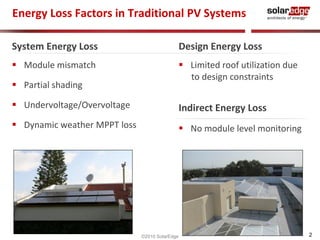
Energy Loss Factors in Traditional PV Systems 
System Energy Loss 
 Module mismatch 
 Partial shading 
 Undervoltage/Overvoltage 
 Dynamic weather MPPT loss 
Design Energy Loss 
 Limited roof utilization due 
Indirect Energy Loss 
 No module level monitoring 
©2010 SolarEdge 
to design constraints
3 
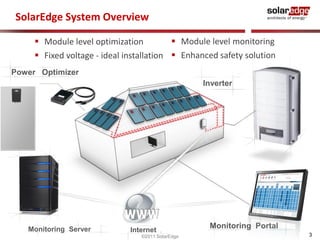
SolarEdge System Overview 
Power Optimizer 
Inverter 
Monitoring Portal 
 Module level optimization 
 Fixed voltage - ideal installation 
 Module level monitoring 
 Enhanced safety solution 
Monitoring Server Internet 
©2011 SolarEdge
4 
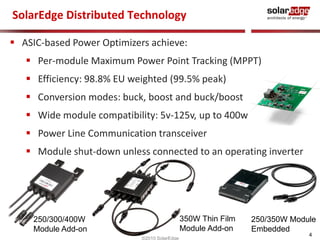
SolarEdge Distributed Technology 
 ASIC-based Power Optimizers achieve: 
 Per-module Maximum Power Point Tracking (MPPT) 
 Efficiency: 98.8% EU weighted (99.5% peak) 
 Conversion modes: buck, boost and buck/boost 
 Wide module compatibility: 5v-125v, up to 400w 
 Power Line Communication transceiver 
 Module shut-down unless connected to an operating inverter 
©2010 SolarEdge 
250/300/400W 
Module Add-on 
250/350W Module 
Embedded 
350W Thin Film 
Module Add-on
5 
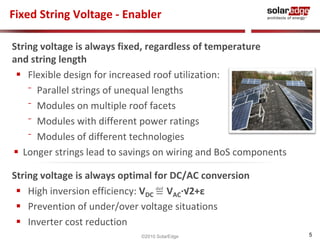
Fixed String Voltage - Enabler 
String voltage is always fixed, regardless of temperature 
and string length 
 Flexible design for increased roof utilization: 
⁻ Parallel strings of unequal lengths 
⁻ Modules on multiple roof facets 
⁻ Modules with different power ratings 
⁻ Modules of different technologies 
 Longer strings lead to savings on wiring and BoS components 
String voltage is always optimal for DC/AC conversion 
 High inversion efficiency: VDC ≝ VAC·√2+ε 
 Prevention of under/over voltage situations 
 Inverter cost reduction 
©2010 SolarEdge
6 
Field Trials and Results 
©2010 SolarEdge
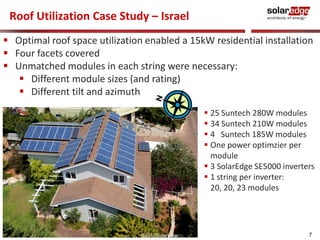
 Optimal roof space utilization enabled a 15kW residential installation 
 Four facets covered 
 Unmatched modules in each string were necessary: 
 25 Suntech 280W modules 
 34 Suntech 210W modules 
 4 Suntech 185W modules 
 One power optimzier per 
module 
 3 SolarEdge SE5000 inverters 
 1 string per inverter: 
20, 20, 23 modules 
7 
Roof Utilization Case Study – Israel 
 Different module sizes (and rating) 
 Different tilt and azimuth 
©2010 SolarEdge
8 
Roof Utilization Case Study – Results 
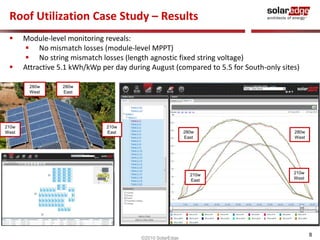
 No mismatch losses (module-level MPPT) 
 No string mismatch losses (length agnostic fixed string voltage) 
 Attractive 5.1 kWh/kWp per day during August (compared to 5.5 for South-only sites) 
280w 
East 
210w 
East 
280w 
West 
210w 
West 
 Module-level monitoring reveals: 
280w 
West 
210w 
West 
280w 
East 
210w 
East 
©2010 SolarEdge
9 
Comparative Energy Case Study Methodology 
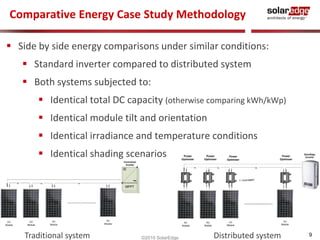
 Side by side energy comparisons under similar conditions: 
 Standard inverter compared to distributed system 
 Both systems subjected to: 
 Identical total DC capacity (otherwise comparing kWh/kWp) 
 Identical module tilt and orientation 
 Identical irradiance and temperature conditions 
 Identical shading scenarios 
Power 
Optimizer 
Power 
Optimizer 
Power 
Optimizer 
Power 
Optimizer 
Traditional system ©2010 SolarEdge Distributed system
10 
Comparative Case Study 1 - Italy 
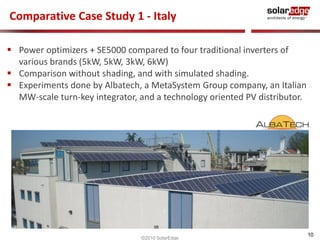
 Power optimizers + SE5000 compared to four traditional inverters of 
various brands (5kW, 5kW, 3kW, 6kW) 
 Comparison without shading, and with simulated shading. 
 Experiments done by Albatech, a MetaSystem Group company, an Italian 
MW-scale turn-key integrator, and a technology oriented PV distributor. 
©2010 SolarEdge
11 
Comparative Case Study 1 – Unshaded 
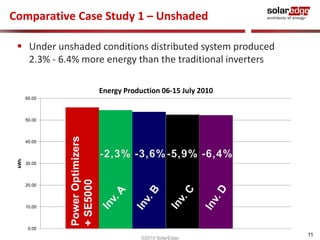
 Under unshaded conditions distributed system produced 
2.3% - 6.4% more energy than the traditional inverters 
60.00 
50.00 
40.00 
30.00 
20.00 
10.00 
0.00 
kWh 
Energy Production 06-15 July 2010 
©2010 SolarEdge 
Power Optimizers 
+ SE5000
Comparative Case Study 1 – Shaded 
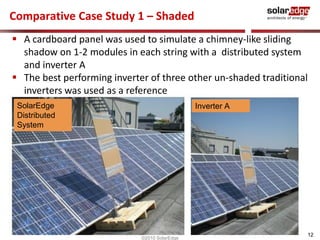
 The best performing inverter of three other un-shaded traditional 
12 
 A cardboard panel was used to simulate a chimney-like sliding 
shadow on 1-2 modules in each string with a distributed system 
and inverter A 
inverters was used as a reference 
SolarEdge 
Distributed 
System 
©2010 SolarEdge 
Inverter A
13 
Comparative Case Study 1 – Shaded (Cont.) 
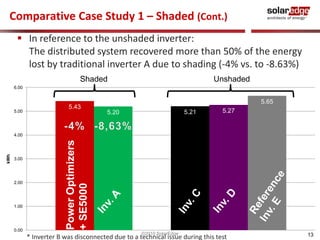
 In reference to the unshaded inverter: 
The distributed system recovered more than 50% of the energy 
lost by traditional inverter A due to shading (-4% vs. to -8.63%) 
©2010 SolarEdge 
5.43 
5.20 5.21 5.27 
5.65 
6.00 
5.00 
4.00 
3.00 
2.00 
1.00 
0.00 
kWh 
Shaded Unshaded 
Power Optimizers 
+ SE5000 
* Inverter B was disconnected due to a technical issue during this test
14 
Comparative Case Study 2 – Czech Republic 
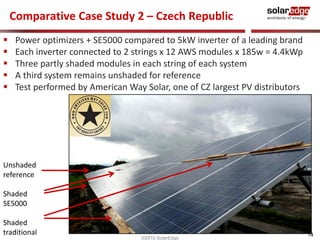
 Power optimizers + SE5000 compared to 5kW inverter of a leading brand 
 Each inverter connected to 2 strings x 12 AWS modules x 185w = 4.4kWp 
 Three partly shaded modules in each string of each system 
 A third system remains unshaded for reference 
 Test performed by American Way Solar, one of CZ largest PV distributors 
©2010 SolarEdge 
Unshaded 
reference 
Shaded 
SE5000 
Shaded 
traditional
15 
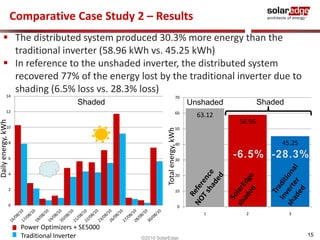
 The distributed system produced 30.3% more energy than the 
traditional inverter (58.96 kWh vs. 45.25 kWh) 
 In reference to the unshaded inverter, the distributed system 
recovered 77% of the energy lost by the traditional inverter due to 
shading (6.5% loss vs. 28.3% loss) 
Shaded Unshaded Shaded 
63.12 
58.96 
45.25 
Comparative Case Study 2 – Results 
70 
60 
50 
40 
30 
20 
10 
0 
1 2 3 
14 
12 
10 
8 
6 
4 
2 
0 
Power Optimizers + SE5000 
Traditional Inverter 
Daily energy, kWh 
Total energy, kWh 
©2010 SolarEdge
16 
Comparative Case Study 3 - Germany 
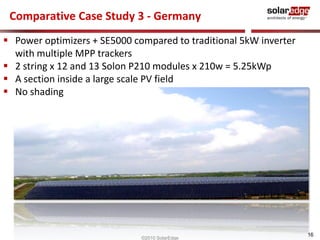
 Power optimizers + SE5000 compared to traditional 5kW inverter 
with multiple MPP trackers 
 2 string x 12 and 13 Solon P210 modules x 210w = 5.25kWp 
 A section inside a large scale PV field 
 No shading 
©2010 SolarEdge
Comparative Case Study 3 - Results 
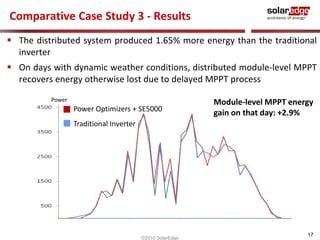
 The distributed system produced 1.65% more energy than the traditional 
17 
inverter 
 On days with dynamic weather conditions, distributed module-level MPPT 
recovers energy otherwise lost due to delayed MPPT process 
Power Optimizers + SE5000 
Traditional Inverter 
Module-level MPPT energy 
gain on that day: +2.9% 
Power 
©2010 SolarEdge
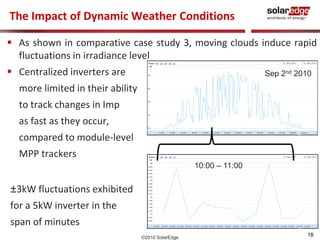
The Impact of Dynamic Weather Conditions 
 As shown in comparative case study 3, moving clouds induce rapid 
18 
fluctuations in irradiance level 
 Centralized inverters are 
more limited in their ability 
to track changes in Imp 
as fast as they occur, 
compared to module-level 
MPP trackers 
©2010 SolarEdge 
±3kW fluctuations exhibited 
for a 5kW inverter in the 
span of minutes 
10:00 – 11:00 
Sep 2nd 2010
19 
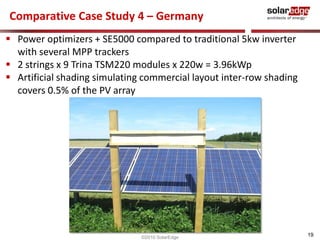
Comparative Case Study 4 – Germany 
 Power optimizers + SE5000 compared to traditional 5kw inverter 
©2010 SolarEdge 
with several MPP trackers 
 2 strings x 9 Trina TSM220 modules x 220w = 3.96kWp 
 Artificial shading simulating commercial layout inter-row shading 
covers 0.5% of the PV array
20 
Comparative Case Study 4 – Results 
Introduction 
 The distributed system produced 4% - 8% more energy than the 
traditional inverter on most days of the month 
 Distributed system production was lower on days with very low 
irradiance, due to sizable self consumption of the prototype DSP 
version of the unit, now replaced by an efficient ASIC 
SolarEdge Daily Energy gain 
vs. traditional inverter [%] 
©2010 SolarEdge
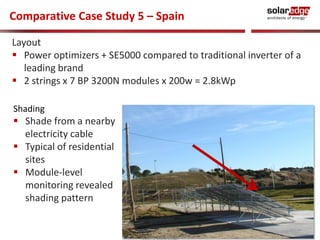
Comparative Case Study 5 – Spain 
Layout 
 Power optimizers + SE5000 compared to traditional inverter of a 
©2010 SolarEdge 21 
leading brand 
 2 strings x 7 BP 3200N modules x 200w = 2.8kWp 
Shading 
 Shade from a nearby 
electricity cable 
 Typical of residential 
sites 
 Module-level 
monitoring revealed 
shading pattern 
©2010 SolarEdge
Traditional [kWh] 
SolarEdge [kWh] 
Weekly Energy 
Gain [%] 
22 
Comparative Case Study 5 – Results 
 Accumulated Energy comparisons shows the distributed system 
consistently produces 4% more energy than the traditional inverter 
Energy Gain in [%] 
©2010 SolarEdge
23 
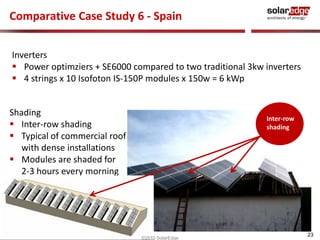
Comparative Case Study 6 - Spain 
Inverters 
 Power optimziers + SE6000 compared to two traditional 3kw inverters 
 4 strings x 10 Isofoton IS-150P modules x 150w = 6 kWp 
Inter-row 
shading 
Shading 
 Inter-row shading 
 Typical of commercial roof 
with dense installations 
 Modules are shaded for 
2-3 hours every morning 
©2010 SolarEdge
24 
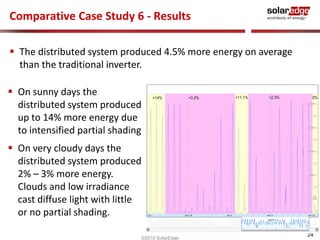
Comparative Case Study 6 - Results 
 The distributed system produced 4.5% more energy on average 
than the traditional inverter. 
 On sunny days the 
distributed system produced 
up to 14% more energy due 
to intensified partial shading 
 On very cloudy days the 
distributed system produced 
2% – 3% more energy. 
Clouds and low irradiance 
cast diffuse light with little 
or no partial shading. 
©2010 SolarEdge
howwhat who where 
howwhat who where 
25 
when 
why 
when 
why 
Questions 
Questions! 
©2010 SolarEdge
26 
Thank you 
John Berdner, General Manager North America 
Email: 
Twitter: 
Blog: 
John.berdner@solaredge.com 
www.twitter.com/SolarEdgePV 
www.solaredge.com/blog 
©2010 SolarEdge 
Website: 
www.solaredge.com

Optimizing Commercial Solar PV Systems : How much energy lost from Partial Shading?

  • 1.
    1 Field Resultsof Energy Maximizing Distributed DC Topology – Residential & Commercial Installations John Berdner, SolarEdge General Manager for North America 8. September, 2010
  • 2.
    2 Energy LossFactors in Traditional PV Systems System Energy Loss  Module mismatch  Partial shading  Undervoltage/Overvoltage  Dynamic weather MPPT loss Design Energy Loss  Limited roof utilization due Indirect Energy Loss  No module level monitoring ©2010 SolarEdge to design constraints
  • 3.
    3 SolarEdge SystemOverview Power Optimizer Inverter Monitoring Portal  Module level optimization  Fixed voltage - ideal installation  Module level monitoring  Enhanced safety solution Monitoring Server Internet ©2011 SolarEdge
  • 4.
    4 SolarEdge DistributedTechnology  ASIC-based Power Optimizers achieve:  Per-module Maximum Power Point Tracking (MPPT)  Efficiency: 98.8% EU weighted (99.5% peak)  Conversion modes: buck, boost and buck/boost  Wide module compatibility: 5v-125v, up to 400w  Power Line Communication transceiver  Module shut-down unless connected to an operating inverter ©2010 SolarEdge 250/300/400W Module Add-on 250/350W Module Embedded 350W Thin Film Module Add-on
  • 5.
    5 Fixed StringVoltage - Enabler String voltage is always fixed, regardless of temperature and string length  Flexible design for increased roof utilization: ⁻ Parallel strings of unequal lengths ⁻ Modules on multiple roof facets ⁻ Modules with different power ratings ⁻ Modules of different technologies  Longer strings lead to savings on wiring and BoS components String voltage is always optimal for DC/AC conversion  High inversion efficiency: VDC ≝ VAC·√2+ε  Prevention of under/over voltage situations  Inverter cost reduction ©2010 SolarEdge
  • 6.
    6 Field Trialsand Results ©2010 SolarEdge
  • 7.
     Optimal roofspace utilization enabled a 15kW residential installation  Four facets covered  Unmatched modules in each string were necessary:  25 Suntech 280W modules  34 Suntech 210W modules  4 Suntech 185W modules  One power optimzier per module  3 SolarEdge SE5000 inverters  1 string per inverter: 20, 20, 23 modules 7 Roof Utilization Case Study – Israel  Different module sizes (and rating)  Different tilt and azimuth ©2010 SolarEdge
  • 8.
    8 Roof UtilizationCase Study – Results  No mismatch losses (module-level MPPT)  No string mismatch losses (length agnostic fixed string voltage)  Attractive 5.1 kWh/kWp per day during August (compared to 5.5 for South-only sites) 280w East 210w East 280w West 210w West  Module-level monitoring reveals: 280w West 210w West 280w East 210w East ©2010 SolarEdge
  • 9.
    9 Comparative EnergyCase Study Methodology  Side by side energy comparisons under similar conditions:  Standard inverter compared to distributed system  Both systems subjected to:  Identical total DC capacity (otherwise comparing kWh/kWp)  Identical module tilt and orientation  Identical irradiance and temperature conditions  Identical shading scenarios Power Optimizer Power Optimizer Power Optimizer Power Optimizer Traditional system ©2010 SolarEdge Distributed system
  • 10.
    10 Comparative CaseStudy 1 - Italy  Power optimizers + SE5000 compared to four traditional inverters of various brands (5kW, 5kW, 3kW, 6kW)  Comparison without shading, and with simulated shading.  Experiments done by Albatech, a MetaSystem Group company, an Italian MW-scale turn-key integrator, and a technology oriented PV distributor. ©2010 SolarEdge
  • 11.
    11 Comparative CaseStudy 1 – Unshaded  Under unshaded conditions distributed system produced 2.3% - 6.4% more energy than the traditional inverters 60.00 50.00 40.00 30.00 20.00 10.00 0.00 kWh Energy Production 06-15 July 2010 ©2010 SolarEdge Power Optimizers + SE5000
  • 12.
    Comparative Case Study1 – Shaded  The best performing inverter of three other un-shaded traditional 12  A cardboard panel was used to simulate a chimney-like sliding shadow on 1-2 modules in each string with a distributed system and inverter A inverters was used as a reference SolarEdge Distributed System ©2010 SolarEdge Inverter A
  • 13.
    13 Comparative CaseStudy 1 – Shaded (Cont.)  In reference to the unshaded inverter: The distributed system recovered more than 50% of the energy lost by traditional inverter A due to shading (-4% vs. to -8.63%) ©2010 SolarEdge 5.43 5.20 5.21 5.27 5.65 6.00 5.00 4.00 3.00 2.00 1.00 0.00 kWh Shaded Unshaded Power Optimizers + SE5000 * Inverter B was disconnected due to a technical issue during this test
  • 14.
    14 Comparative CaseStudy 2 – Czech Republic  Power optimizers + SE5000 compared to 5kW inverter of a leading brand  Each inverter connected to 2 strings x 12 AWS modules x 185w = 4.4kWp  Three partly shaded modules in each string of each system  A third system remains unshaded for reference  Test performed by American Way Solar, one of CZ largest PV distributors ©2010 SolarEdge Unshaded reference Shaded SE5000 Shaded traditional
  • 15.
    15  Thedistributed system produced 30.3% more energy than the traditional inverter (58.96 kWh vs. 45.25 kWh)  In reference to the unshaded inverter, the distributed system recovered 77% of the energy lost by the traditional inverter due to shading (6.5% loss vs. 28.3% loss) Shaded Unshaded Shaded 63.12 58.96 45.25 Comparative Case Study 2 – Results 70 60 50 40 30 20 10 0 1 2 3 14 12 10 8 6 4 2 0 Power Optimizers + SE5000 Traditional Inverter Daily energy, kWh Total energy, kWh ©2010 SolarEdge
  • 16.
    16 Comparative CaseStudy 3 - Germany  Power optimizers + SE5000 compared to traditional 5kW inverter with multiple MPP trackers  2 string x 12 and 13 Solon P210 modules x 210w = 5.25kWp  A section inside a large scale PV field  No shading ©2010 SolarEdge
  • 17.
    Comparative Case Study3 - Results  The distributed system produced 1.65% more energy than the traditional 17 inverter  On days with dynamic weather conditions, distributed module-level MPPT recovers energy otherwise lost due to delayed MPPT process Power Optimizers + SE5000 Traditional Inverter Module-level MPPT energy gain on that day: +2.9% Power ©2010 SolarEdge
  • 18.
    The Impact ofDynamic Weather Conditions  As shown in comparative case study 3, moving clouds induce rapid 18 fluctuations in irradiance level  Centralized inverters are more limited in their ability to track changes in Imp as fast as they occur, compared to module-level MPP trackers ©2010 SolarEdge ±3kW fluctuations exhibited for a 5kW inverter in the span of minutes 10:00 – 11:00 Sep 2nd 2010
  • 19.
    19 Comparative CaseStudy 4 – Germany  Power optimizers + SE5000 compared to traditional 5kw inverter ©2010 SolarEdge with several MPP trackers  2 strings x 9 Trina TSM220 modules x 220w = 3.96kWp  Artificial shading simulating commercial layout inter-row shading covers 0.5% of the PV array
  • 20.
    20 Comparative CaseStudy 4 – Results Introduction  The distributed system produced 4% - 8% more energy than the traditional inverter on most days of the month  Distributed system production was lower on days with very low irradiance, due to sizable self consumption of the prototype DSP version of the unit, now replaced by an efficient ASIC SolarEdge Daily Energy gain vs. traditional inverter [%] ©2010 SolarEdge
  • 21.
    Comparative Case Study5 – Spain Layout  Power optimizers + SE5000 compared to traditional inverter of a ©2010 SolarEdge 21 leading brand  2 strings x 7 BP 3200N modules x 200w = 2.8kWp Shading  Shade from a nearby electricity cable  Typical of residential sites  Module-level monitoring revealed shading pattern ©2010 SolarEdge
  • 22.
    Traditional [kWh] SolarEdge[kWh] Weekly Energy Gain [%] 22 Comparative Case Study 5 – Results  Accumulated Energy comparisons shows the distributed system consistently produces 4% more energy than the traditional inverter Energy Gain in [%] ©2010 SolarEdge
  • 23.
    23 Comparative CaseStudy 6 - Spain Inverters  Power optimziers + SE6000 compared to two traditional 3kw inverters  4 strings x 10 Isofoton IS-150P modules x 150w = 6 kWp Inter-row shading Shading  Inter-row shading  Typical of commercial roof with dense installations  Modules are shaded for 2-3 hours every morning ©2010 SolarEdge
  • 24.
    24 Comparative CaseStudy 6 - Results  The distributed system produced 4.5% more energy on average than the traditional inverter.  On sunny days the distributed system produced up to 14% more energy due to intensified partial shading  On very cloudy days the distributed system produced 2% – 3% more energy. Clouds and low irradiance cast diffuse light with little or no partial shading. ©2010 SolarEdge
  • 25.
    howwhat who where howwhat who where 25 when why when why Questions Questions! ©2010 SolarEdge
  • 26.
    26 Thank you John Berdner, General Manager North America Email: Twitter: Blog: John.berdner@solaredge.com www.twitter.com/SolarEdgePV www.solaredge.com/blog ©2010 SolarEdge Website: www.solaredge.com