The Importance of Using Multiple
Text Sets in Accordance With the
Common Core State Standards
Carmella Prusko
Questar III Literacy Specialist
State Wide Meeting of Assistant Superintendents
November 18, 2010
Overview
• Transition from elementary
to middle school
• New Common Core State
Standards (CCSS) and
what they mean for
teachers and students
• Instructional implications
Literacy in Elementary School
• Large block set aside each day for literacy
– Guided Reading Groups
– Word Work/Spelling Center
– Writer’s Workshop
– Basal Series
• Ability to model concepts learned during
literacy time in different content areas
– Chunking an unfamiliar word in the science text
book
– Using context clues to figure out the meaning of
an unknown vocabulary word in social studies
• Availability of additional instructional
support
– Co-teaching
– Reading Recovery
– Access to a Reading Specialist/Literacy Specialist
– Academic Intervention Services (AIS)
Literacy in Middle & High School
• Students are no longer with one or two
teachers all day
• Decreased instructional time in English
Language Arts
– Literature Circles
– Critical Analysis of Literature
– Compositions comparing different works of
literature and/or analyzing the author’s purpose
• Other reading and writing demands
are being put on the student that they
are unfamiliar with
• Reading and comprehending primary sources
• Expected to write narratively as well as technically
• Research and correctly cite information
• Additional Instructional Support
– AIS
– Resource Room
Common Core State Standards (CCSS)
• New York State officially adopted the CCSS in July 2010
• September 2012
• This initiative is being led by the National Governors
Association Center for Best Practices (NGA) and the
Council of Chief State School Officers (CCSSO)
•The CCSS are research and evidence-based
•Aligned with college and work expectations
•Are informed by other top performing countries so our
students will be equally prepared for our global economy
and society
•Currently, the CCSS do not provide the full level of support
for students with special needs and English language
learners
What Has Changed?
• Alignment with college and
career readiness expectations
• Standards for reading and writing
across content areas
• Larger emphasis on non-fiction
texts
• Large emphasis on proving an
argument is sound when reading
• Large emphasis on the ability to
write arguments to support claims
using valid reasoning and
sufficient evidence
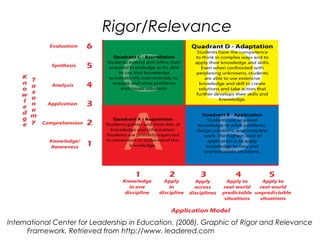
Rigor/Relevance
International Center for Leadership in Education. (2008). Graphic of Rigor and Relevance
Framework. Retrieved from http://www. leadered.com
How to Prepare Our Students
• We need to stop thinking inside our own
individual boxes we need to create one big box
• We need to actively engage our students in our
lessons and content
• We need to move our students past the
acquisitional and application stages of learning
• We need to expose them to these important
themes, concepts, and vocabulary using
several different mediums
– Newspaper articles
– YouTube Clips
– Documentaries
– Artifacts
– Research articles
– Picture Books
– Novels
Instructional Implications
• Use multiple text sets
– Different reading levels, genre, and
media that offer different perspectives
on a common theme
– By using different genres and media it
allows the teacher to reach all of the
different types of learners in his or her
classroom
– A great way to teach grade level
content and themes to students who
may not be reading on grade level
– By providing students with multiple
perspectives it forces them to begin to
question the validity of what they are
reading
The Grapes of Wrath
John Steinbeck
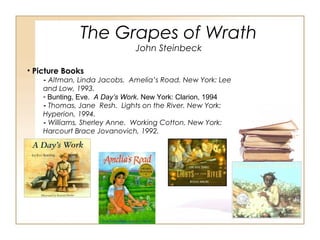
• Picture Books
- Altman, Linda Jacobs. Amelia’s Road. New York: Lee
and Low, 1993.
- Bunting, Eve. A Day’s Work. New York: Clarion, 1994
- Thomas, Jane Resh. Lights on the River. New York:
Hyperion, 1994.
- Williams, Sherley Anne. Working Cotton. New York:
Harcourt Brace Jovanovich, 1992.
The Grapes of Wrath
John Steinbeck
• Fiction and Non-Fiction Chapter Books
- Ashabranner, B.(1985). Dark harvest: Migrant
farmworkers in America. New York: Putnam.
- Hesse, K. (1997).Out of the dust. New York: Scholastic.
- Genasci, S., Velasco, D. (Directors and Producers).
(1990). Troubled Harvest[DVD]. New York: Women
Make Movies.
- Ryan, P.M. (2002). Esperanza Rising. New York:
Scholastic.
- Stanley, J. (1992). Children of the dust bowl: The true
story of the school at weedpatch Camp. New
York: Crown Publishers.
The Grapes of Wrath
John Steinbeck
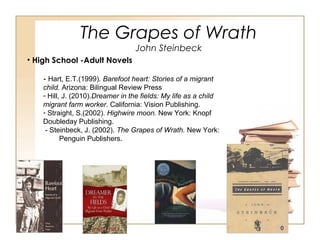
• High School -Adult Novels
- Hart, E.T.(1999). Barefoot heart: Stories of a migrant
child. Arizona: Bilingual Review Press
- Hill, J. (2010).Dreamer in the fields: My life as a child
migrant farm worker. California: Vision Publishing.
- Straight, S.(2002). Highwire moon. New York: Knopf
Doubleday Publishing.
- Steinbeck, J. (2002). The Grapes of Wrath. New York:
Penguin Publishers.
The Grapes of Wrath
John Steinbeck
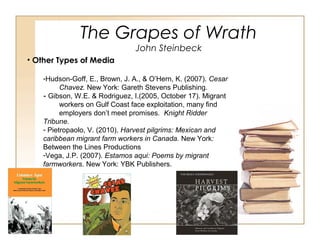
• Other Types of Media
-Hudson-Goff, E., Brown, J. A., & O’Hern, K. (2007). Cesar
Chavez. New York: Gareth Stevens Publishing.
- Gibson, W.E. & Rodriguez, I.(2005, October 17). Migrant
workers on Gulf Coast face exploitation, many find
employers don’t meet promises. Knight Ridder
Tribune.
- Pietropaolo, V. (2010). Harvest pilgrims: Mexican and
caribbean migrant farm workers in Canada. New York:
Between the Lines Productions
-Vega, J.P. (2007). Estamos aqui: Poems by migrant
farmworkers. New York: YBK Publishers.
-
Culinary Arts
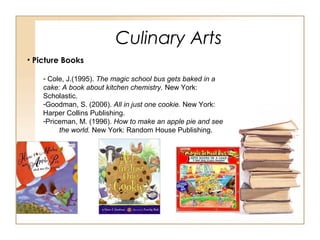
• Picture Books
- Cole, J.(1995). The magic school bus gets baked in a
cake: A book about kitchen chemistry. New York:
Scholastic.
-Goodman, S. (2006). All in just one cookie. New York:
Harper Collins Publishing.
-Priceman, M. (1996). How to make an apple pie and see
the world. New York: Random House Publishing.
Culinary Arts
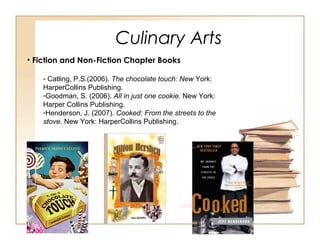
• Fiction and Non-Fiction Chapter Books
- Catling, P.S.(2006). The chocolate touch: New York:
HarperCollins Publishing.
-Goodman, S. (2006). All in just one cookie. New York:
Harper Collins Publishing.
-Henderson, J. (2007). Cooked: From the streets to the
stove. New York: HarperCollins Publishing.
Culinary Arts
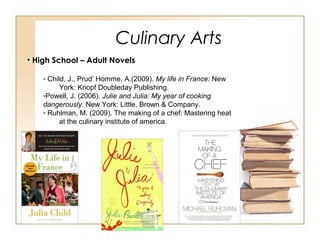
• High School – Adult Novels
- Child, J., Prud’ Homme, A.(2009). My life in France: New
York: Knopf Doubleday Publishing.
-Powell, J. (2006). Julie and Julia: My year of cooking
dangerously. New York: Little, Brown & Company.
- Ruhlman, M. (2009). The making of a chef: Mastering heat
at the culinary institute of america.
Contact Information
Thank you for your attention!
If you have any questions concerning
the information in this presentation,
please feel free to contact me at :
Carmella.prusko@questar.org
Resources
• Costello, J. Introduction to the common core
standards ELA 6-12 [PowerPoint].
Retrieved from after school professional
development.
• International Center for Leadership in
Education. (2008). Graphic of Rigor and
Relevance Framework. Retrieved from
http://www. leadered.com
• n.a. (2010). About the standards. Retrieved from
http://www.corestandards.org
• Richison, J.D., Hernandez, A.C., & Carter, M.
(2002). Blending multiple genres in theme
baskets. English Journal, 92 (2), 76-81.

The importance of using multiple text sets in[1]

  • 1.
    The Importance ofUsing Multiple Text Sets in Accordance With the Common Core State Standards Carmella Prusko Questar III Literacy Specialist State Wide Meeting of Assistant Superintendents November 18, 2010
  • 2.
    Overview • Transition fromelementary to middle school • New Common Core State Standards (CCSS) and what they mean for teachers and students • Instructional implications
  • 3.
    Literacy in ElementarySchool • Large block set aside each day for literacy – Guided Reading Groups – Word Work/Spelling Center – Writer’s Workshop – Basal Series • Ability to model concepts learned during literacy time in different content areas – Chunking an unfamiliar word in the science text book – Using context clues to figure out the meaning of an unknown vocabulary word in social studies • Availability of additional instructional support – Co-teaching – Reading Recovery – Access to a Reading Specialist/Literacy Specialist – Academic Intervention Services (AIS)
  • 4.
    Literacy in Middle& High School • Students are no longer with one or two teachers all day • Decreased instructional time in English Language Arts – Literature Circles – Critical Analysis of Literature – Compositions comparing different works of literature and/or analyzing the author’s purpose • Other reading and writing demands are being put on the student that they are unfamiliar with • Reading and comprehending primary sources • Expected to write narratively as well as technically • Research and correctly cite information • Additional Instructional Support – AIS – Resource Room
  • 5.
    Common Core StateStandards (CCSS) • New York State officially adopted the CCSS in July 2010 • September 2012 • This initiative is being led by the National Governors Association Center for Best Practices (NGA) and the Council of Chief State School Officers (CCSSO) •The CCSS are research and evidence-based •Aligned with college and work expectations •Are informed by other top performing countries so our students will be equally prepared for our global economy and society •Currently, the CCSS do not provide the full level of support for students with special needs and English language learners
  • 6.
    What Has Changed? •Alignment with college and career readiness expectations • Standards for reading and writing across content areas • Larger emphasis on non-fiction texts • Large emphasis on proving an argument is sound when reading • Large emphasis on the ability to write arguments to support claims using valid reasoning and sufficient evidence
  • 7.
    Rigor/Relevance International Center forLeadership in Education. (2008). Graphic of Rigor and Relevance Framework. Retrieved from http://www. leadered.com
  • 8.
    How to PrepareOur Students • We need to stop thinking inside our own individual boxes we need to create one big box • We need to actively engage our students in our lessons and content • We need to move our students past the acquisitional and application stages of learning • We need to expose them to these important themes, concepts, and vocabulary using several different mediums – Newspaper articles – YouTube Clips – Documentaries – Artifacts – Research articles – Picture Books – Novels
  • 9.
    Instructional Implications • Usemultiple text sets – Different reading levels, genre, and media that offer different perspectives on a common theme – By using different genres and media it allows the teacher to reach all of the different types of learners in his or her classroom – A great way to teach grade level content and themes to students who may not be reading on grade level – By providing students with multiple perspectives it forces them to begin to question the validity of what they are reading
  • 10.
    The Grapes ofWrath John Steinbeck • Picture Books - Altman, Linda Jacobs. Amelia’s Road. New York: Lee and Low, 1993. - Bunting, Eve. A Day’s Work. New York: Clarion, 1994 - Thomas, Jane Resh. Lights on the River. New York: Hyperion, 1994. - Williams, Sherley Anne. Working Cotton. New York: Harcourt Brace Jovanovich, 1992.
  • 11.
    The Grapes ofWrath John Steinbeck • Fiction and Non-Fiction Chapter Books - Ashabranner, B.(1985). Dark harvest: Migrant farmworkers in America. New York: Putnam. - Hesse, K. (1997).Out of the dust. New York: Scholastic. - Genasci, S., Velasco, D. (Directors and Producers). (1990). Troubled Harvest[DVD]. New York: Women Make Movies. - Ryan, P.M. (2002). Esperanza Rising. New York: Scholastic. - Stanley, J. (1992). Children of the dust bowl: The true story of the school at weedpatch Camp. New York: Crown Publishers.
  • 12.
    The Grapes ofWrath John Steinbeck • High School -Adult Novels - Hart, E.T.(1999). Barefoot heart: Stories of a migrant child. Arizona: Bilingual Review Press - Hill, J. (2010).Dreamer in the fields: My life as a child migrant farm worker. California: Vision Publishing. - Straight, S.(2002). Highwire moon. New York: Knopf Doubleday Publishing. - Steinbeck, J. (2002). The Grapes of Wrath. New York: Penguin Publishers.
  • 13.
    The Grapes ofWrath John Steinbeck • Other Types of Media -Hudson-Goff, E., Brown, J. A., & O’Hern, K. (2007). Cesar Chavez. New York: Gareth Stevens Publishing. - Gibson, W.E. & Rodriguez, I.(2005, October 17). Migrant workers on Gulf Coast face exploitation, many find employers don’t meet promises. Knight Ridder Tribune. - Pietropaolo, V. (2010). Harvest pilgrims: Mexican and caribbean migrant farm workers in Canada. New York: Between the Lines Productions -Vega, J.P. (2007). Estamos aqui: Poems by migrant farmworkers. New York: YBK Publishers. -
  • 14.
    Culinary Arts • PictureBooks - Cole, J.(1995). The magic school bus gets baked in a cake: A book about kitchen chemistry. New York: Scholastic. -Goodman, S. (2006). All in just one cookie. New York: Harper Collins Publishing. -Priceman, M. (1996). How to make an apple pie and see the world. New York: Random House Publishing.
  • 15.
    Culinary Arts • Fictionand Non-Fiction Chapter Books - Catling, P.S.(2006). The chocolate touch: New York: HarperCollins Publishing. -Goodman, S. (2006). All in just one cookie. New York: Harper Collins Publishing. -Henderson, J. (2007). Cooked: From the streets to the stove. New York: HarperCollins Publishing.
  • 16.
    Culinary Arts • HighSchool – Adult Novels - Child, J., Prud’ Homme, A.(2009). My life in France: New York: Knopf Doubleday Publishing. -Powell, J. (2006). Julie and Julia: My year of cooking dangerously. New York: Little, Brown & Company. - Ruhlman, M. (2009). The making of a chef: Mastering heat at the culinary institute of america.
  • 17.
    Contact Information Thank youfor your attention! If you have any questions concerning the information in this presentation, please feel free to contact me at : Carmella.prusko@questar.org
  • 18.
    Resources • Costello, J.Introduction to the common core standards ELA 6-12 [PowerPoint]. Retrieved from after school professional development. • International Center for Leadership in Education. (2008). Graphic of Rigor and Relevance Framework. Retrieved from http://www. leadered.com • n.a. (2010). About the standards. Retrieved from http://www.corestandards.org • Richison, J.D., Hernandez, A.C., & Carter, M. (2002). Blending multiple genres in theme baskets. English Journal, 92 (2), 76-81.