Barriers to Distributed
  Renewable Energy
  efficient | economical | equitable


                             John Farrell, Senior Researcher
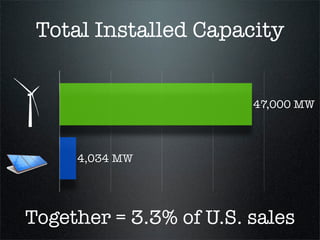
Total Installed Capacity


                        47,000 MW


     4,034 MW


Together = 3.3% of U.S. sales
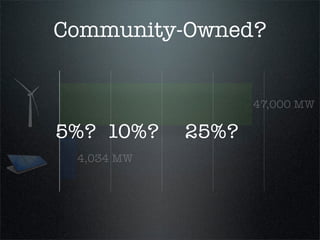
How Much Community-Owned?


                       47,000 MW

   5%? 10%?     25%?
     4,034 MW
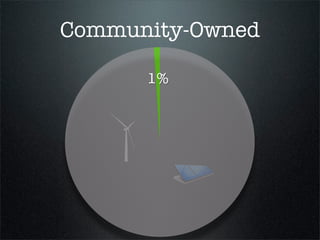
Community-Owned

    just 1%
Why Community-Owned?

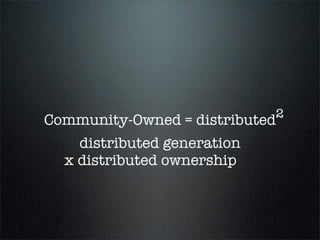
                                               2
 Community-Owned = distributed


(distributed generation) x (distributed ownership)
Barriers to Distributed Generation


• Tradition
• Capital
• Cash Flow
• Legal
• Utility
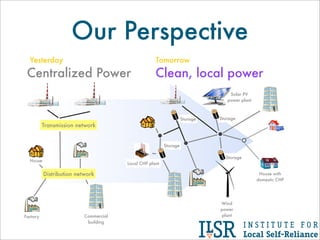
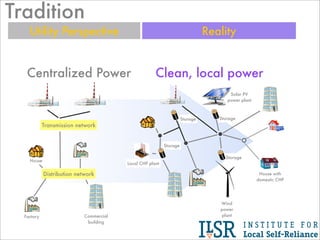
Tradition
    Utility Perspective                                                        Reality


   Centralized Power                                  Clean, local power
                                                                                      Solar PV
                                                                                     power plant


                                                                     Storage      Storage
            Transmission network


                                                           Storage

                                                                                    Storage
    House
                                         Local CHP plant

            Distribution network                                                                    House with
                                                                                                   domestic CHP


                                                                                  Wind
                                                                                  power
  Factory                   Commercial                                            plant
                             building
Barriers to Distributed Generation


• Tradition
• Capital
• Cash Flow
• Legal
• Utility
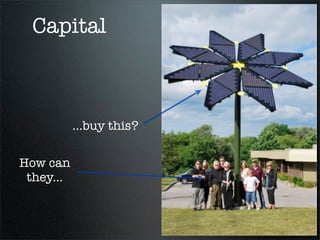
Capital


           ...buy this?

How can
 they...
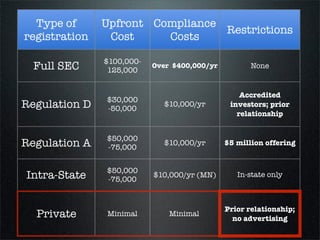
Rules for Raising Capital

• Full registration
• Regulation D
• Regulation A
• Intra-State
• Private
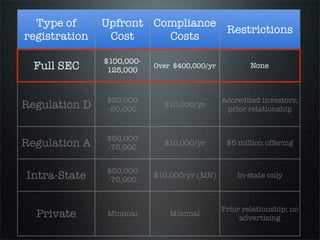
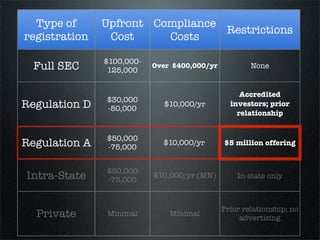
Type of      Upfront Compliance
                                  Restrictions
registration    Cost     Costs

               $100,000-
  Full SEC      125,000
                           Over $400,000/yr           None


               $30,000                        Accredited investors;
Regulation D   -50,000
                             $10,000/yr
                                               prior relationship


               $50,000
Regulation A   -75,000
                             $10,000/yr        $5 million offering


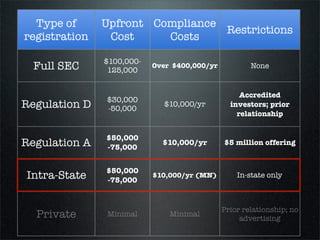
               $50,000
Intra-State    -75,000
                           $10,000/yr (MN)        In-state only


                                              Prior relationship; no
  Private      Minimal         Minimal
                                                   advertising
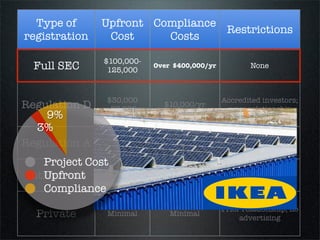
Type of      Upfront Compliance
                                  Restrictions
registration    Cost     Costs

               $100,000-
  Full SEC      125,000
                           Over $400,000/yr           None


               $30,000                        Accredited investors;
Regulation D   -50,000
                             $10,000/yr
                                               prior relationship
    9%
  3%
               $50,000
Regulation A   -75,000
                             $10,000/yr        $5 million offering

   Project Cost
               $50,000
   Upfront
Intra-State    -75,000
                           $10,000/yr (MN)        In-state only
   Compliance
                                              Prior relationship; no
  Private      Minimal         Minimal
                                                   advertising
Type of      Upfront Compliance
                                  Restrictions
registration    Cost     Costs

               $100,000-
  Full SEC      125,000
                           Over $400,000/yr          None


               $30,000                        Accredited investors;
Regulation D   -50,000
                             $10,000/yr
                                               prior relationship


               $50,000
Regulation A   -75,000
                             $10,000/yr        $5 million offering


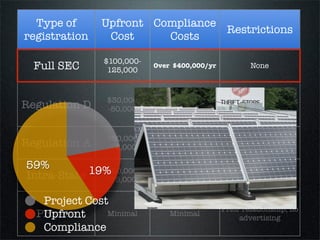
59%
Intra-State 19%$50,000
                           $10,000/yr (MN)        In-state only
               -75,000

   Project Cost
                               Prior relationship; no
  Private
   Upfront     Minimal Minimal
                                    advertising
   Compliance Too costly for small projects
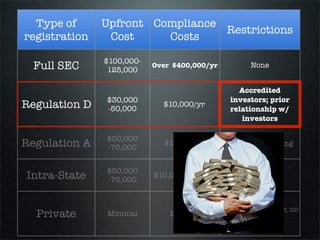
Type of      Upfront Compliance
                                  Restrictions
registration    Cost     Costs

               $100,000-
  Full SEC      125,000
                           Over $400,000/yr           None


                                                  Accredited
               $30,000                          investors; prior
Regulation D   -50,000
                             $10,000/yr
                                                relationship w/
                                                   investors

               $50,000
Regulation A   -75,000
                             $10,000/yr        $5 million offering


               $50,000
Intra-State    -75,000
                           $10,000/yr (MN)        In-state only


                                              Prior relationship; no
  Private      Minimal         Minimal
                                                   advertising
Type of      Upfront Compliance
                                  Restrictions
registration    Cost     Costs

               $100,000-
  Full SEC      125,000
                           Over $400,000/yr           None


                                                   Accredited
               $30,000
Regulation D   -50,000
                             $10,000/yr         investors; prior
                                                  relationship


               $50,000
Regulation A   -75,000
                             $10,000/yr       $5 million offering


               $50,000
Intra-State    -75,000
                           $10,000/yr (MN)        In-state only


                                              Prior relationship; no
  Private      Minimal         Minimal
                                                   advertising
Type of      Upfront Compliance
                                  Restrictions
registration    Cost     Costs

               $100,000-
  Full SEC      125,000
                           Over $400,000/yr           None


                                                   Accredited
               $30,000
Regulation D   -50,000
                             $10,000/yr         investors; prior
                                                  relationship


               $50,000
Regulation A   -75,000
                             $10,000/yr       $5 million offering


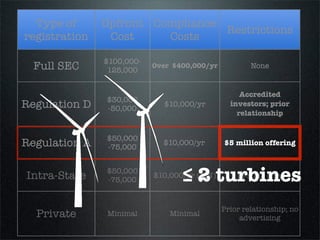
Intra-State    $50,000
               -75,000            ≤ 2 turbines
                           $10,000/yr (MN)        In-state only


                                              Prior relationship; no
  Private      Minimal         Minimal
                                                   advertising
Type of      Upfront Compliance
                                  Restrictions
registration    Cost     Costs

                $100,000-
  Full SEC       125,000
                            Over $400,000/yr           None


                                                    Accredited
                $30,000
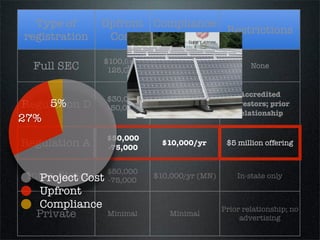
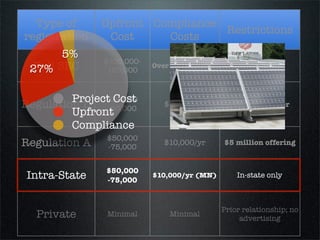
    5%
Regulation D    -50,000
                              $10,000/yr         investors; prior
                                                   relationship
27%
                $50,000
Regulation A    -75,000
                              $10,000/yr        $5 million offering


                $50,000
 Intra-State
   Project Cost -75,000
                            $10,000/yr (MN)        In-state only

   Upfront
   Compliance                                  Prior relationship; no
   Private      Minimal         Minimal
                                                    advertising
                   Still costly for small projects
Type of      Upfront Compliance
                                  Restrictions
registration    Cost     Costs

               $100,000-
  Full SEC      125,000
                           Over $400,000/yr           None


                                                   Accredited
               $30,000
Regulation D   -50,000
                             $10,000/yr         investors; prior
                                                  relationship


               $50,000
Regulation A   -75,000
                             $10,000/yr       $5 million offering


               $50,000
Intra-State    -75,000
                           $10,000/yr (MN)        In-state only


                                              Prior relationship; no
  Private      Minimal         Minimal
                                                   advertising
Type of      Upfront Compliance
                                  Restrictions
registration    Cost     Costs
       5%
                $100,000-
 27% SEC
  Full           125,000
                            Over $400,000/yr           None


                                                    Accredited
         Project Cost
               $30,000
Regulation D    -50,000
                              $10,000/yr         investors; prior
         Upfront                                   relationship
         Compliance
                $50,000
Regulation A    -75,000
                              $10,000/yr       $5 million offering


                $50,000
 Intra-State    -75,000
                            $10,000/yr (MN)        In-state only


                                               Prior relationship; no
  Private       Minimal         Minimal
                                                    advertising
                   Still costly for small projects
Type of      Upfront Compliance
                                  Restrictions
registration    Cost     Costs

               $100,000-
  Full SEC      125,000
                           Over $400,000/yr          None


                                                  Accredited
               $30,000
Regulation D   -50,000
                             $10,000/yr        investors; prior
                                                 relationship


               $50,000
Regulation A   -75,000
                             $10,000/yr       $5 million offering


               $50,000
Intra-State    -75,000
                           $10,000/yr (MN)       In-state only


                                              Prior relationship;
  Private      Minimal         Minimal
                                                no advertising
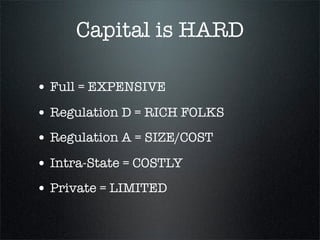
Capital is HARD

• Full = EXPENSIVE
• Regulation D = RICH FOLKS
• Regulation A = SIZE/COST
• Intra-State = COSTLY
• Private = LIMITED
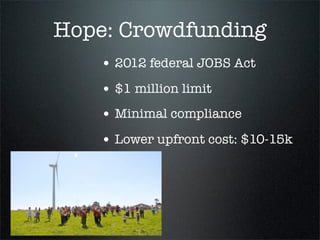
Hope: Crowdfunding
    • 2012 federal JOBS Act
    • $1 million limit
    • Minimal compliance
    • Lower upfront cost: $10-15k
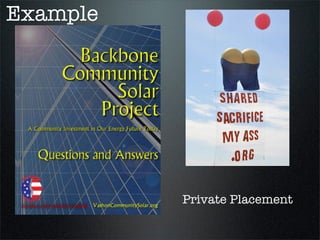
Example


          Private	
  Placement
Barriers to Distributed Generation


• Tradition
• Capital
• Cash Flow
• Legal
• Utility
complex...
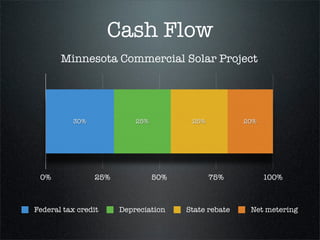
Minnesota Commercial Solar Project Cash Flow


       30%         25%         25%         20%


 0%          25%         50%         75%         100%


      Federal tax credit             Depreciation
      State rebate                   Net metering
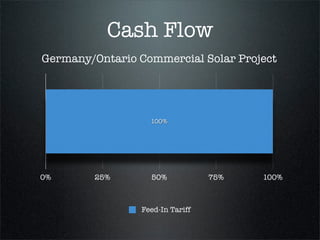
Germany/Ontario Commercial Solar Project Cash Flow


                       100%


    0%       25%       50%           75%   100%


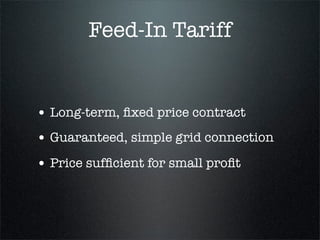
                    Feed-In Tariff
Feed-In Tariff


• Long-term, fixed price contract
• Guaranteed, simple grid connection
• Price sufficient for small profit
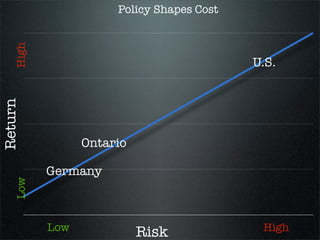
Policy Shapes Cost
    High


                                           U.S.
Return


                 Ontario

           Germany
    Low


           Low             Risk             High
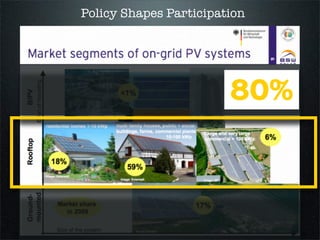
Policy Shapes Participation


                               80%


of German solar is on small rooftops
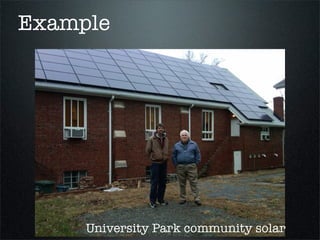
U.S. Exception


      University Park community solar
Barriers to Distributed Generation


• Tradition
• Capital
• Cash Flow
• Legal
• Utility
Which Makes Sense for
 Community Solar?
A.Nonprofit
B.City
C. County
D.Cooperative
E. All of the Above
Which Makes Sense for
 Community Solar?
A.Nonprofit
B.City
C. County
D.Cooperative
E.All of the Above
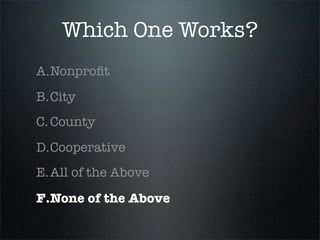
Which One Works?
A.Nonprofit
B.City
C. County
D.Cooperative
E. All of the Above
Which One Works?
A.Nonprofit
B.City
C. County
D.Cooperative
E. All of the Above
F.None of the Above
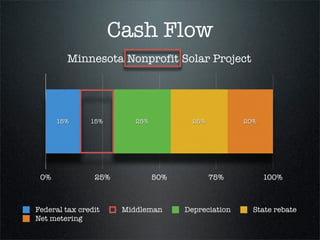
Minnesota Nonprofit Solar Project Cash Flow


     15%   15%     25%         25%         20%


0%         25%           50%         75%         100%


      Federal tax credit             Middleman
      Depreciation                   State rebate
      Net metering
Exception
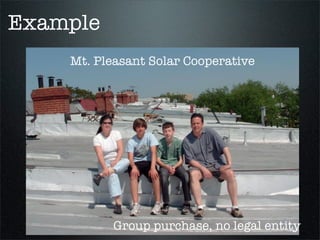
     Mt. Pleasant Solar Cooperative


          Group purchase, no legal entity
Exception
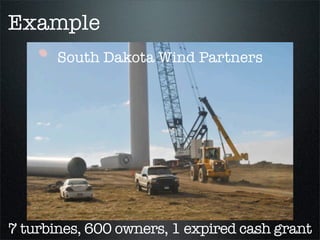
       South Dakota Wind Partners


7 turbines, 600 owners, 1 expired cash grant
Barriers to Distributed Generation


• Tradition
• Capital
• Cash Flow
• Legal
• Utility
True or false?


In 2012, most utilities measure how much
electricity is used during peak periods and
during minimum use periods on their own
grid.
True or false?


In 2012, most utilities measure how much
electricity is used during peak periods and
during minimum use periods on their own
grid.
               FALSE
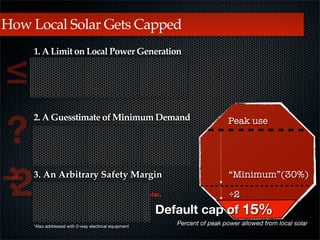
How Local Solar Gets Capped


≤
    1. A Limit on Local Power Generation
    Utilities always want local power generation to be less
    than local minimum electricity demand so that
    electricity will not flow out of neighborhoods and back
    onto the grid.*


?
    2. A Guesstimate of Minimum Demand                                    Peak use
    Whoops! Utilities assume minimum demand
    is about 30% of peak demand, because they
    don’t measure minimum demand.


÷
2   3. An Arbitrary Safety Margin
    Utilities take this 30% threshold and
    divide by 2 to get a 15% cap on local solar.
                                                                           “Minimum”(30%)

                                                                           ÷2
                                                      Default cap of 15%
    *Also addressed with 2-way electrical equipment
                                                         Percent of peak power allowed from local solar
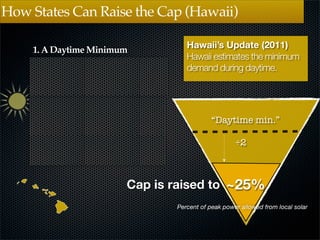
How States Can Raise the Cap (Hawaii)

                                                         Hawaii’s Update (2011)
    1. A Daytime Minimum
    How much solar power is produced at 4 AM?
                                                         Hawaii estimates the minimum
    None. But that’s the time of day utilities used      demand during daytime.
    for their minimum demand calculation.

    Hawaii solar advocates negotiated a change: to
    estimate minimum demand when the sun is
    up (Sundays at noon).
                                                                  “Daytime min.”
    Even though utilities maintain the arbitrary
    “division by 2” safety margin, this change
                                                                          ÷2
    could allow nearly twice as much local solar
    on the grid.


                                      Cap is raised to ~25%
                                                      Percent of peak power allowed from local solar
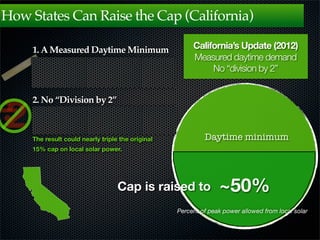
How States Can Raise the Cap (California)

     1. A Measured Daytime Minimum                               California’s Update (2012)
     Utilities must actually measure the minimum                 Measured daytime demand
     demand on a power line between 9 AM and 4 PM                     No “division by 2”
     and no longer use peak demand as a proxy.


÷
2
     2. No “Division by 2”
     Utilities can’t arbitrarily divide the cap by 2, now
     that the power line capacity is actually measured.


     The result could nearly triple the original                     Daytime minimum
     15% cap on local solar power.


                                    Cap is raised to                      ~50%
                                                            Percent of peak power allowed from local solar
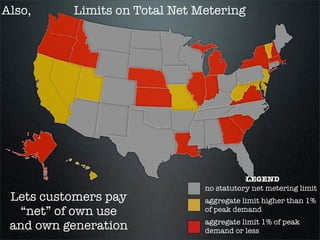
Utilities also Want Limits on Total Net Metering


                                                  LEGEND
                                       no statutory net metering limit
 Lets	
  customers	
  pay	
            aggregate limit higher than 1%
“net”	
  of	
  own	
  use	
  and	
     of peak demand
                                       aggregate limit 1% of peak
  own	
  generation                    demand or less
Exception


    Replicable
 community solar!
Distributed Generation
     Barriers             Exceptions
    • Tradition   •   Mt. Pleasant Solar Coop
                  •   Clean Energy Collective
    • Capital
                  •   Maryland Solar LLC
    • Cash Flow
                  •   SD Wind Partners
    • Legal
    • Utility

      Learn more at
EnergySelfReliantStates.org

Barriers to Distributed Renewable Energy

  • 1.
    Barriers to Distributed Renewable Energy efficient | economical | equitable John Farrell, Senior Researcher
  • 2.
    Total Installed Capacity 47,000 MW 4,034 MW Together = 3.3% of U.S. sales
  • 3.
    How Much Community-Owned? 47,000 MW 5%? 10%? 25%? 4,034 MW
  • 4.
  • 5.
    Why Community-Owned? 2 Community-Owned = distributed (distributed generation) x (distributed ownership)
  • 6.
    Barriers to DistributedGeneration • Tradition • Capital • Cash Flow • Legal • Utility
  • 7.
    Tradition Utility Perspective Reality Centralized Power Clean, local power Solar PV power plant Storage Storage Transmission network Storage Storage House Local CHP plant Distribution network House with domestic CHP Wind power Factory Commercial plant building
  • 8.
    Barriers to DistributedGeneration • Tradition • Capital • Cash Flow • Legal • Utility
  • 9.
    Capital ...buy this? How can they...
  • 10.
    Rules for RaisingCapital • Full registration • Regulation D • Regulation A • Intra-State • Private
  • 11.
    Type of Upfront Compliance Restrictions registration Cost Costs $100,000- Full SEC 125,000 Over $400,000/yr None $30,000 Accredited investors; Regulation D -50,000 $10,000/yr prior relationship $50,000 Regulation A -75,000 $10,000/yr $5 million offering $50,000 Intra-State -75,000 $10,000/yr (MN) In-state only Prior relationship; no Private Minimal Minimal advertising
  • 12.
    Type of Upfront Compliance Restrictions registration Cost Costs $100,000- Full SEC 125,000 Over $400,000/yr None $30,000 Accredited investors; Regulation D -50,000 $10,000/yr prior relationship 9% 3% $50,000 Regulation A -75,000 $10,000/yr $5 million offering Project Cost $50,000 Upfront Intra-State -75,000 $10,000/yr (MN) In-state only Compliance Prior relationship; no Private Minimal Minimal advertising
  • 13.
    Type of Upfront Compliance Restrictions registration Cost Costs $100,000- Full SEC 125,000 Over $400,000/yr None $30,000 Accredited investors; Regulation D -50,000 $10,000/yr prior relationship $50,000 Regulation A -75,000 $10,000/yr $5 million offering 59% Intra-State 19%$50,000 $10,000/yr (MN) In-state only -75,000 Project Cost Prior relationship; no Private Upfront Minimal Minimal advertising Compliance Too costly for small projects
  • 14.
    Type of Upfront Compliance Restrictions registration Cost Costs $100,000- Full SEC 125,000 Over $400,000/yr None Accredited $30,000 investors; prior Regulation D -50,000 $10,000/yr relationship w/ investors $50,000 Regulation A -75,000 $10,000/yr $5 million offering $50,000 Intra-State -75,000 $10,000/yr (MN) In-state only Prior relationship; no Private Minimal Minimal advertising
  • 15.
    Type of Upfront Compliance Restrictions registration Cost Costs $100,000- Full SEC 125,000 Over $400,000/yr None Accredited $30,000 Regulation D -50,000 $10,000/yr investors; prior relationship $50,000 Regulation A -75,000 $10,000/yr $5 million offering $50,000 Intra-State -75,000 $10,000/yr (MN) In-state only Prior relationship; no Private Minimal Minimal advertising
  • 16.
    Type of Upfront Compliance Restrictions registration Cost Costs $100,000- Full SEC 125,000 Over $400,000/yr None Accredited $30,000 Regulation D -50,000 $10,000/yr investors; prior relationship $50,000 Regulation A -75,000 $10,000/yr $5 million offering Intra-State $50,000 -75,000 ≤ 2 turbines $10,000/yr (MN) In-state only Prior relationship; no Private Minimal Minimal advertising
  • 17.
    Type of Upfront Compliance Restrictions registration Cost Costs $100,000- Full SEC 125,000 Over $400,000/yr None Accredited $30,000 5% Regulation D -50,000 $10,000/yr investors; prior relationship 27% $50,000 Regulation A -75,000 $10,000/yr $5 million offering $50,000 Intra-State Project Cost -75,000 $10,000/yr (MN) In-state only Upfront Compliance Prior relationship; no Private Minimal Minimal advertising Still costly for small projects
  • 18.
    Type of Upfront Compliance Restrictions registration Cost Costs $100,000- Full SEC 125,000 Over $400,000/yr None Accredited $30,000 Regulation D -50,000 $10,000/yr investors; prior relationship $50,000 Regulation A -75,000 $10,000/yr $5 million offering $50,000 Intra-State -75,000 $10,000/yr (MN) In-state only Prior relationship; no Private Minimal Minimal advertising
  • 19.
    Type of Upfront Compliance Restrictions registration Cost Costs 5% $100,000- 27% SEC Full 125,000 Over $400,000/yr None Accredited Project Cost $30,000 Regulation D -50,000 $10,000/yr investors; prior Upfront relationship Compliance $50,000 Regulation A -75,000 $10,000/yr $5 million offering $50,000 Intra-State -75,000 $10,000/yr (MN) In-state only Prior relationship; no Private Minimal Minimal advertising Still costly for small projects
  • 20.
    Type of Upfront Compliance Restrictions registration Cost Costs $100,000- Full SEC 125,000 Over $400,000/yr None Accredited $30,000 Regulation D -50,000 $10,000/yr investors; prior relationship $50,000 Regulation A -75,000 $10,000/yr $5 million offering $50,000 Intra-State -75,000 $10,000/yr (MN) In-state only Prior relationship; Private Minimal Minimal no advertising
  • 21.
    Capital is HARD •Full = EXPENSIVE • Regulation D = RICH FOLKS • Regulation A = SIZE/COST • Intra-State = COSTLY • Private = LIMITED
  • 22.
    Hope: Crowdfunding • 2012 federal JOBS Act • $1 million limit • Minimal compliance • Lower upfront cost: $10-15k
  • 23.
    Example Private  Placement
  • 24.
    Barriers to DistributedGeneration • Tradition • Capital • Cash Flow • Legal • Utility
  • 25.
  • 26.
    Minnesota Commercial SolarProject Cash Flow 30% 25% 25% 20% 0% 25% 50% 75% 100% Federal tax credit Depreciation State rebate Net metering
  • 27.
    Germany/Ontario Commercial SolarProject Cash Flow 100% 0% 25% 50% 75% 100% Feed-In Tariff
  • 28.
    Feed-In Tariff • Long-term,fixed price contract • Guaranteed, simple grid connection • Price sufficient for small profit
  • 29.
    Policy Shapes Cost High U.S. Return Ontario Germany Low Low Risk High
  • 30.
    Policy Shapes Participation 80% of German solar is on small rooftops
  • 31.
    U.S. Exception University Park community solar
  • 32.
    Barriers to DistributedGeneration • Tradition • Capital • Cash Flow • Legal • Utility
  • 33.
    Which Makes Sensefor Community Solar? A.Nonprofit B.City C. County D.Cooperative E. All of the Above
  • 34.
    Which Makes Sensefor Community Solar? A.Nonprofit B.City C. County D.Cooperative E.All of the Above
  • 35.
    Which One Works? A.Nonprofit B.City C.County D.Cooperative E. All of the Above
  • 36.
    Which One Works? A.Nonprofit B.City C.County D.Cooperative E. All of the Above F.None of the Above
  • 37.
    Minnesota Nonprofit SolarProject Cash Flow 15% 15% 25% 25% 20% 0% 25% 50% 75% 100% Federal tax credit Middleman Depreciation State rebate Net metering
  • 38.
    Exception Mt. Pleasant Solar Cooperative Group purchase, no legal entity
  • 39.
    Exception South Dakota Wind Partners 7 turbines, 600 owners, 1 expired cash grant
  • 40.
    Barriers to DistributedGeneration • Tradition • Capital • Cash Flow • Legal • Utility
  • 41.
    True or false? In2012, most utilities measure how much electricity is used during peak periods and during minimum use periods on their own grid.
  • 42.
    True or false? In2012, most utilities measure how much electricity is used during peak periods and during minimum use periods on their own grid. FALSE
  • 43.
    How Local SolarGets Capped ≤ 1. A Limit on Local Power Generation Utilities always want local power generation to be less than local minimum electricity demand so that electricity will not flow out of neighborhoods and back onto the grid.* ? 2. A Guesstimate of Minimum Demand Peak use Whoops! Utilities assume minimum demand is about 30% of peak demand, because they don’t measure minimum demand. ÷ 2 3. An Arbitrary Safety Margin Utilities take this 30% threshold and divide by 2 to get a 15% cap on local solar. “Minimum”(30%) ÷2 Default cap of 15% *Also addressed with 2-way electrical equipment Percent of peak power allowed from local solar
  • 44.
    How States CanRaise the Cap (Hawaii) Hawaii’s Update (2011) 1. A Daytime Minimum How much solar power is produced at 4 AM? Hawaii estimates the minimum None. But that’s the time of day utilities used demand during daytime. for their minimum demand calculation. Hawaii solar advocates negotiated a change: to estimate minimum demand when the sun is up (Sundays at noon). “Daytime min.” Even though utilities maintain the arbitrary “division by 2” safety margin, this change ÷2 could allow nearly twice as much local solar on the grid. Cap is raised to ~25% Percent of peak power allowed from local solar
  • 45.
    How States CanRaise the Cap (California) 1. A Measured Daytime Minimum California’s Update (2012) Utilities must actually measure the minimum Measured daytime demand demand on a power line between 9 AM and 4 PM No “division by 2” and no longer use peak demand as a proxy. ÷ 2 2. No “Division by 2” Utilities can’t arbitrarily divide the cap by 2, now that the power line capacity is actually measured. The result could nearly triple the original Daytime minimum 15% cap on local solar power. Cap is raised to ~50% Percent of peak power allowed from local solar
  • 46.
    Utilities also WantLimits on Total Net Metering LEGEND no statutory net metering limit Lets  customers  pay   aggregate limit higher than 1% “net”  of  own  use  and   of peak demand aggregate limit 1% of peak own  generation demand or less
  • 47.
    Exception Replicable community solar!
  • 48.
    Distributed Generation Barriers Exceptions • Tradition • Mt. Pleasant Solar Coop • Clean Energy Collective • Capital • Maryland Solar LLC • Cash Flow • SD Wind Partners • Legal • Utility Learn more at EnergySelfReliantStates.org