Lung Parenchymal infection
Or
Clinical and/Or Radiological
Manifestations of Consolidation
 Common : 5 to 6 million cases/year
 20% are hospitalized ( 10% in ICU)
 No. 1 cause of death from infectious
disease
 Mortality rates :
 Outpatients = 1-5%
 Inpatients = 12% ( higher in ICU- 50%)
• CAP incidence is rising
• Pneumonia is the most common
cause of sepsis
• 10 folds increased rate in age of 85
and more
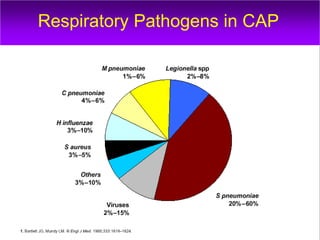
RESPIRATORY PATHOGENS IN CAP
Respiratory Pathogens in CAP
RESPIRATORY PATHOGENS IN CAP
Respiratory Pathogens in CAP
• Innocent bystander
• Causing CAP
• Promoting secondary bacterial
CAP
• Co-etiology of CAP
• About 6% of CAP is due to MDRO
• The most common are
Pseudompnas and Staph Aerius
esp. MRSA
• Structural lung disease
• Antibiotics in the last 90 days
• Recent steroid therapy
• Nursing home residents
• Malnutrition
• Low CRP
• ESKD
• Contact sports Participants
• Crowded conditions
• Male homosexuality
• Recent influenza
• Prisoners
• IV drug abusers
• Previous antiotics in last 90 days
• Hospital in last 90 days
• Need for ICU admission
Signs and Symptoms: Pneumonia
 Fever (may be absent in the elderly or
immunocompromised)
 Cough
 Sputum production
 Dyspnea
 Pleuritic chest pain
 GI Sx: nausea, vomiting, diarrhea
 Mental status changes
 Tachycardia
 Tachypnea
 Leukocytosis or leukopenia
 Infiltrate on CXR - remember that an infiltrate
may not appear in a hypovolemic patient!
 Laboratory Tests:
 CXR
 CBC with differential
 BUN/Cr
 glucose
 liver enzymes
 electrolytes
 Gram stain/culture of sputum
 pre-treatment blood cultures
 oxygen saturation
 PA and lateral for all patients
 To:
1. Establish the diagnosis
2. Show the disease extent
3. Detect complications
4. Detect other pathologies or DD
5. May guide some diagnostic procedures
6. Not advised to follow response (short
term)
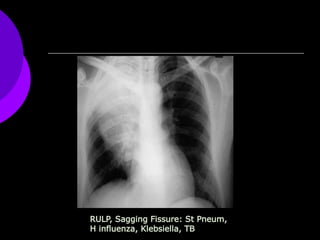
RULP, Sagging Fissure: St Pneum,
H influenza, Klebsiella, TB
Klebsiella Pneumonia
Staph Pneumonia with
pyopneumothorax
Tree In-Bud, Atypical pneumonia
Lobar Pneumonia
Necrotizing Pneumonia
Atypical Pneumonia, GGO
to Consolidation
Staph Pneumonia
Influenza Pneumonia with
ARDS
• Variable
• Depends on: causative organism
and host response and occurnce of
complications
• Not required for follow up of CAP
patients unless for other cause
• Lymphopenic CAP profile carry higher
mortality
• NLR:
< 11.12 early discharge
11.2-13.4 short term hospital
13.4-28.3 moderate hospital
more than 28.3 ICU
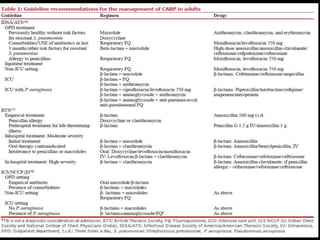
BTS guidelines 2009
IDSA/ATS Guidelines 2007
• Blood & sputum culture, pneumococcal urine Ag:
severe CAP, chronic disease, immune defects
• Legionella urine Ag: severe CAP, pts with recent
travel
(If study performed)
<60mmHg / SO 2 <90%
Pneumonia
Severity Index
(PSI) score
CAP – Management based on
PSI Score
PORT
Class
PSI
Score
Mortality
%
Treatment
Strategy
Class I No RF 0.1 – 0.4 Out patient
Class II  70 0.6 – 0.7 Out patient
Class III 71 - 90 0.9 – 2.8
Brief
hospitalization
Class IV 91 - 130 8.5 – 9.3 Inpatient
Class V > 130 27 – 31.1 IP - ICU
CURB 65 score
CURB 65
Confusion
BUN ≥ 30
RR ≥ 30
BP SBP
<90
/DBP
<60
Age > 65
CURB 0 or 1 Home Rx
CURB 2 Short Hosp
CURB 3
Medical
Ward
CURB 4 or 5 ICU care
Thorax 2003,58:377
CAP: When to start empiric
therapy?
 As soon as possible in ED
 CAP: delay-to-AB> 4h after arrival
 Increased mortality
 Increased LOS
IDSA /ATS Consensus Guidelines on the Management of Community-Acquired
Pneumonia
in Adults. Clinical Infectious Diseases 2007; 44:S27–72
Site of
Care RF
Treatment
1
Treatment
2
Treatment
3
OP No RF AZ CLR ER / Doxy
OP RF FQ  + M  + Doxy
Med
Ward
±RF FQ + AZ 3G + AZ
Carbapenem
+Mac
ICU
±RF
 3G + AZ 3G + FQ FQ+ AZT
Pseud
Extended 
+ Cipro /
Levo
 3G +
AmGly + AZ
 3G +
AmGly + FQ
CA-
MRSA
+ Vanco/Linezo
• As early as possible
• 4-8 hours of admission
• Some studies showed even better
outcome if started within 2 hours
 5-7 days in patients showing
favorable response in the 1st 2-3
days
 Patients should be:
• Afebrile for 2-3 days
• Breathing his baseline O2
• No more than 2 of:
Bl Pr < 90, HR >100, RR>24
Longer duration in:
1. Pseudomonas, MRSA, and
Legionella
2. Complicated Pneumonia (eg
empyema and lung abscess)
3. Extra-pulmonary infection (eg
meningitis)
Switch from intravenous to oral
therapy?
 Afebrile for 24 hours or more
 Functioning GIT
 Clinical improvement “RR, Cough,
Dyspnea”
 WBC returning to normal
 No role for CXR here
Steroids in CAP:
Among adults, there is an overall advantage to corticosteroid
therapy.
The question remains as to whom this benefit applies: who
are the patients that will gain from corticosteroid therapy
18 patients should be treated to prevent one death in severe
CAP
4 patients should be treated to prevent clinical failure
Good in septic shock
dose 40 mg daily of prednisolone
May play a protective role in
• Occurence of CAP
• Progression of CAP
• Complications of CAP
Not recommended to study them
Update in CAP 2019
Update in CAP 2019
Update in CAP 2019
Update in CAP 2019
Update in CAP 2019

Update in CAP 2019

  • 2.
    Lung Parenchymal infection Or Clinicaland/Or Radiological Manifestations of Consolidation
  • 3.
     Common :5 to 6 million cases/year  20% are hospitalized ( 10% in ICU)  No. 1 cause of death from infectious disease  Mortality rates :  Outpatients = 1-5%  Inpatients = 12% ( higher in ICU- 50%)
  • 4.
    • CAP incidenceis rising • Pneumonia is the most common cause of sepsis • 10 folds increased rate in age of 85 and more
  • 7.
    RESPIRATORY PATHOGENS INCAP Respiratory Pathogens in CAP
  • 10.
    RESPIRATORY PATHOGENS INCAP Respiratory Pathogens in CAP
  • 11.
    • Innocent bystander •Causing CAP • Promoting secondary bacterial CAP • Co-etiology of CAP
  • 13.
    • About 6%of CAP is due to MDRO • The most common are Pseudompnas and Staph Aerius esp. MRSA
  • 15.
    • Structural lungdisease • Antibiotics in the last 90 days • Recent steroid therapy • Nursing home residents • Malnutrition • Low CRP
  • 16.
    • ESKD • Contactsports Participants • Crowded conditions • Male homosexuality • Recent influenza • Prisoners • IV drug abusers • Previous antiotics in last 90 days • Hospital in last 90 days • Need for ICU admission
  • 17.
    Signs and Symptoms:Pneumonia  Fever (may be absent in the elderly or immunocompromised)  Cough  Sputum production  Dyspnea  Pleuritic chest pain  GI Sx: nausea, vomiting, diarrhea  Mental status changes  Tachycardia  Tachypnea  Leukocytosis or leukopenia  Infiltrate on CXR - remember that an infiltrate may not appear in a hypovolemic patient!
  • 19.
     Laboratory Tests: CXR  CBC with differential  BUN/Cr  glucose  liver enzymes  electrolytes  Gram stain/culture of sputum  pre-treatment blood cultures  oxygen saturation
  • 20.
     PA andlateral for all patients  To: 1. Establish the diagnosis 2. Show the disease extent 3. Detect complications 4. Detect other pathologies or DD 5. May guide some diagnostic procedures 6. Not advised to follow response (short term)
  • 23.
    RULP, Sagging Fissure:St Pneum, H influenza, Klebsiella, TB
  • 24.
  • 27.
  • 28.
  • 29.
  • 30.
  • 31.
  • 32.
  • 34.
  • 35.
    • Variable • Dependson: causative organism and host response and occurnce of complications • Not required for follow up of CAP patients unless for other cause
  • 36.
    • Lymphopenic CAPprofile carry higher mortality • NLR: < 11.12 early discharge 11.2-13.4 short term hospital 13.4-28.3 moderate hospital more than 28.3 ICU
  • 37.
  • 40.
    IDSA/ATS Guidelines 2007 •Blood & sputum culture, pneumococcal urine Ag: severe CAP, chronic disease, immune defects • Legionella urine Ag: severe CAP, pts with recent travel
  • 41.
    (If study performed) <60mmHg/ SO 2 <90% Pneumonia Severity Index (PSI) score
  • 42.
    CAP – Managementbased on PSI Score PORT Class PSI Score Mortality % Treatment Strategy Class I No RF 0.1 – 0.4 Out patient Class II  70 0.6 – 0.7 Out patient Class III 71 - 90 0.9 – 2.8 Brief hospitalization Class IV 91 - 130 8.5 – 9.3 Inpatient Class V > 130 27 – 31.1 IP - ICU
  • 43.
    CURB 65 score CURB65 Confusion BUN ≥ 30 RR ≥ 30 BP SBP <90 /DBP <60 Age > 65 CURB 0 or 1 Home Rx CURB 2 Short Hosp CURB 3 Medical Ward CURB 4 or 5 ICU care Thorax 2003,58:377
  • 45.
    CAP: When tostart empiric therapy?  As soon as possible in ED  CAP: delay-to-AB> 4h after arrival  Increased mortality  Increased LOS IDSA /ATS Consensus Guidelines on the Management of Community-Acquired Pneumonia in Adults. Clinical Infectious Diseases 2007; 44:S27–72 Site of Care RF Treatment 1 Treatment 2 Treatment 3 OP No RF AZ CLR ER / Doxy OP RF FQ  + M  + Doxy Med Ward ±RF FQ + AZ 3G + AZ Carbapenem +Mac ICU ±RF  3G + AZ 3G + FQ FQ+ AZT Pseud Extended  + Cipro / Levo  3G + AmGly + AZ  3G + AmGly + FQ CA- MRSA + Vanco/Linezo
  • 49.
    • As earlyas possible • 4-8 hours of admission • Some studies showed even better outcome if started within 2 hours
  • 50.
     5-7 daysin patients showing favorable response in the 1st 2-3 days  Patients should be: • Afebrile for 2-3 days • Breathing his baseline O2 • No more than 2 of: Bl Pr < 90, HR >100, RR>24
  • 51.
    Longer duration in: 1.Pseudomonas, MRSA, and Legionella 2. Complicated Pneumonia (eg empyema and lung abscess) 3. Extra-pulmonary infection (eg meningitis)
  • 52.
    Switch from intravenousto oral therapy?  Afebrile for 24 hours or more  Functioning GIT  Clinical improvement “RR, Cough, Dyspnea”  WBC returning to normal  No role for CXR here
  • 53.
    Steroids in CAP: Amongadults, there is an overall advantage to corticosteroid therapy. The question remains as to whom this benefit applies: who are the patients that will gain from corticosteroid therapy 18 patients should be treated to prevent one death in severe CAP 4 patients should be treated to prevent clinical failure Good in septic shock dose 40 mg daily of prednisolone
  • 55.
    May play aprotective role in • Occurence of CAP • Progression of CAP • Complications of CAP Not recommended to study them