Module: 2
Lecture: 3 Oxygen and Nitrogen
Dr. N. K. Patel
N P T E L 14
Module: 2
Lecture: 3
OXYGEN AND NITROGEN
INTRODUCTION
Oxygen
Oxygen (O2) composed of two atoms of the element at (O) bind to form
dioxygen, a very pale blue, odorless, tasteless diatomic gas. Diatomic oxygen gas
constitutes 20.8% of the volume of air. It is necessary to sustain global life.
Oxygen is the highly reactive nonmetallic element that readily forms
compounds or oxides with almost all other elements. Oxygen is a strong oxidizing
agent and has the second-highest electronegativity after fluorine than of all the
elements. By mass, after hydrogen and helium, oxygen is the third-most abundant
element in the universe. Free oxygen is too chemically reactive to appear on Earth
without the photosynthetic action of living organisms, which use the energy of
sunlight to produce elemental oxygen from water. Elemental O2 only began to
accumulate in the atmosphere after the evolutionary appearance of these
organisms, roughly 2.5 billion years ago.
As larger constituent by mass of water, oxygen comprises most of the mass of
living organisms. Elemental oxygen is produced by cyanobacteria, algae and
plants, and is used in cellular respiration for all complex life. Oxygen is toxic to
anaerobic organisms, which were the dominant form of early life on Earth until O2
began to accumulate in the atmosphere.
Oxygen was independently discovered by Carl Wilhelm Scheele and Joseph
Priestley in 1773 and 1774 respectively, but work was first published by Priestley.
Antoine Lavoisier named as oxygen in 1777, whose experiments with oxygen helped
to discredit the then-popular phlogiston theory of combustion and corrosion.
Oxygen is produced industrially by fractional distillation of liquefied air, use of
zeolites with pressure-cycling to concentrate oxygen from air, electrolysis of water
and other means.
Module: 2
Lecture: 3 Oxygen and Nitrogen
Dr. N. K. Patel
N P T E L 15
Nitrogen
Nitrogen (N2) is a colorless, odorless, tasteless, and mostly inert diatomic gas at
standard conditions, constituting 78.09% by volume of Earth's atmosphere. Nitrogen
occurs in all living organisms, primarily in amino acids, proteins and in the nucleic
acids (DNA and RNA). The human body contains about 3% by weight of nitrogen,
the fourth most abundant element after oxygen, carbon, and hydrogen.
Nitrogen was discovered by Daniel Rutherford in 1772, who called it noxious
air or fixed air. He also explains that nitrogen does not support combustion. At the
same time by Carl Wilhelm Scheele, Henry Cavendish, and Joseph Priestley, referred
it as burnt air or phlogisticated air. Antoine Lavoisier referred nitrogen as inert gas
and as "mephitic air" or azote, in which animals died and flames were extinguished.
English word nitrogen entered the language in 1794.
The extremely strong bond in elemental nitrogen causing difficulty for both
organisms and industry in breaking the bond to convert the nitrogen into useful
compounds, but large amounts of useful energy released when the compounds
burn, explode, or decay back into nitrogen gas.
Analysis of Air
Air mainly consist of two gases oxygen and nitrogen, which are practically
considered to constitute 1/5 and 4/5 of air by volume respectively. The list of various
gases present in air by weight percent is as under
Name of the gas % by weight in air
Oxygen 20.99
Nitrogen 78.01
Carbon dioxide 0.03 - 0.07
Argon 0.94
Hydrogen 0.01
Neon 0.0015
Helium and Krypton 0.01 - 0.02
Except CO2 the concentration of all the gases listed above are present in air
are constant. However water vapours and traces of ozone and iodine are present in
air in variable amounts. Also, composition of air also depends on altitude and
distance to sea, in neighbourhood of industry, built up urban areas, nearby volcanic
phenomena. Other gases such as CO, H2S and NO2 are also present in air.
Kinetics and theory of gases
According to kinetic theory a gas consists of swiftly moving molecules moving
in a haphazard manner. During the movement some molecules collide with one
another, some others move away from one another, these phenomena leaving an
Module: 2
Lecture: 3 Oxygen and Nitrogen
Dr. N. K. Patel
N P T E L 16
average distance between the molecules. At lower pressure the average distance is
large, and at high pressure the molecules are brought near to one another.
In all the three state of matter, molecules have two tendencies i.e. Attraction
tendency and Repulsive tendency. The repulsive tendency is most predominant in
gases, and least prominent in solids. While in most of liquids the attractive tendency
in molecules is more than the repulsive tendency, so that the molecules remain
together, but the attracting tendency is still less than in comparison of solids there so
liquid is in fluid state. In the gases as the temperature raises the repulsion tendency
increases, and pressure remaining constant the average distance between
molecules increases i.e. the volume increases. Hence with fall of temperature the
distance diminishes and, the molecules come closer together. Thus it becomes
apparent that the average distance of molecules will progressively diminish with fall
of temperature, and rise of pressure. Change of average distance of gas is
quantitatively expressed by PV/T = constant
Critical temperature
When by decreasing the distance the molecules of a gas are brought close
together the gas assumes the liquid form provided the repulsive tendency has been
diminished beyond a certain point known as critical temperature which is different
for different gases.
Critical temperature is the temperature below which any gas can be
liquefied by increasing the pressure. Above the critical temperature any gas cannot
be liquefied by compression.
Critical pressure
Above critical temperature the gas will never liquefy under any pressure. The
minimum pressure under which gas liquefies at the critical temperature is called as
critical pressure.
Therefore air should be cooled at very high pressure and low temperature for
cooling purpose. The liquid form is obtained when the kinetic energy and the
potential energy of the substance is approximately equal.
Module: 2
Lecture: 3 Oxygen and Nitrogen
Dr. N. K. Patel
N P T E L 17
The critical temperature and critical pressure of some gases are as follows.
Sr.
No.
Gases Critical temperature
(0C)
Critical pressure
(atm.)
1. Ethylene +9.5 50.65
2. Methane -82.85 45.6
3. Nitrogen -147.13 33.49
4. Hydrogen -239.9 12.8
5. Oxygen -118.75 49.7
6. Acetylene +35.5 61.55
7. Ammonia +132.5 112.3
8. Carbon monoxide -138.7 34.6
9. Carbon dioxide +31.3 72.9
Liquefaction of air by Joule - Thomson effect
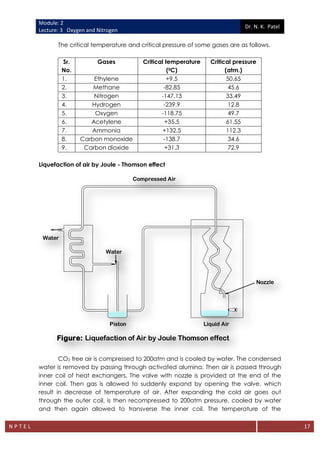
CO2 free air is compressed to 200atm and is cooled by water. The condensed
water is removed by passing through activated alumina. Then air is passed through
inner coil of heat exchangers. The valve with nozzle is provided at the end of the
inner coil. Then gas is allowed to suddenly expand by opening the valve, which
result in decrease of temperature of air. After expanding the cold air goes out
through the outer coil, is then recompressed to 200atm pressure, cooled by water
and then again allowed to transverse the inner coil. The temperature of the
Water
Water
Piston
Compressed Air
Nozzle
Liquid Air
Figure: Liquefaction of Air by Joule Thomson effect
Module: 2
Lecture: 3 Oxygen and Nitrogen
Dr. N. K. Patel
N P T E L 18
incoming air further falls due to the presence of cold air in the outer coil. Now as the
cooled air suddenly expands through the nozzle, the air suffers cooling, the
temperature becomes lower than in the first operation. The colder air now passes
through the outer coil producing an atmosphere of lower temperature. Hence when
the cooled compressed air passes repeatedly through the inner coil and
subsequently undergoes Joule-Thomson effect, the temperature of the air further
drops. In this way progressive cooling takes place until the temperature of air falls
below the critical temperature of oxygen and nitrogen. When this happens air
undergoes liquefaction in the inner coil, so on opening the valve liquid air falls in the
container. A part of liquid air evaporates, through the outer coil, maintaining the low
temperature below the critical temperature.
MANUFACTURE
Oxygen in pure condition is obtained as a byproduct in the manufacture of
H2 by electrolytic process is described in Module: 2, Lecture: 4. Oxygen and nitrogen
are usually separated by rectification of liquid air.
Linde's process (O2 and N2)
The first rectification of N2 and O2 using Joule Thomson effect was carried out
by Linde in 1906. After six year Claude rectified them by combined effect of external
work and internal work in cooling the air to liquefaction point.
Raw materials
Basis: 1000kg Oxygen (95%)
Air = 3600Nm3
Steam = 1750kg
Cooling water = 5000kg
Electricity = 450-480KWH
Manufacture
Block diagram of manufacturing process
Process equipment
Animation
Module: 2
Lecture: 3 Oxygen and Nitrogen
Dr. N. K. Patel
N P T E L 19
The distillation tower is specially designed bubble cap tray double columns
arranged one above another. The two distillation columns are having intermediate
distillation dome for effective separation of liquid enriched with O2. The column feed
is liquefied air at 200atm pressure introduced at the bottom of the column. Since the
boiling point of O2 (-183OC) and N2 (-195OC) are very low, column does not require
any external heating. Distillation take place only due to release of vacuum. Thus a
number of recycling from lower column to upper column and lower column to
dome is required. The construction of dome includes number of internal pipes so that
distillate of the lower column collides to the roof and is returned back to the column
as reflux. The compressed air which arrives from the first section of the plant
which acts as the heating fluid in the heater at the base of the enrichment
column. The same air, always contained within a tube, passes out from the Iower
column of the tower only to reenter it higher up after the pressure to which it is
subjected is reduced by means of a valve, resulting in the lowering of its
temperature. Nitrogen with a small oxygen impurity collects at the top of the
enrichment column, and after expansion to atmospheric pressure; this nitrogen is
sent to back as the reflux in the rectification column situated above. The liquid
which collects in the heater at the base of the enrichment column is fed, after
expansion to atmospheric pressure onto a suitable plate of the rectification column.
Only after number of recycling, liquid with 82% concentration of O2 is taken in
outer part of dome. This liquid goes to further rectification in upper column where it is
refluxed with N2 rich liquid coming from lower column. The final separation in the
Cold Gaseous Nitrogen
Compressed Air
Figure: Manufacturing of Nitrogen & Oxygen by Linde's Process
Water
Water
Compressed Air
Nozzle
Liquid Air
Piston
Module: 2
Lecture: 3 Oxygen and Nitrogen
Dr. N. K. Patel
N P T E L 20
upper column takes place which has less number of trays. Gaseous N2 is the top
product of the column and the bottom product is liquid O2.
Claude process
In Claude process, progressive cooling of compressed air is done by external
work and Joule - Thomson effect. 70% of air is cooled by external work and 30% by
Joule - Thomson effect.
Two variants of Claude process
Molecular sieve variant
Cooling of air is brought about primarily by expansion with the performance
of work. Therefore, there is no need to equip the plant with cycles that use
refrigerants or make use of very high pressures which are employed when free
expansion is used, in order to produce cooling.
Evaporation to diffusion
Cooling of the air can be adopted such as causing liquids which can
evaporate to diffuse air. It is then safe to reabsorb them when necessary.
Kinetics and thermodynamics
Liquefied air is subjected to rectification to separate the oxygen and nitrogen
components present in it. In liquid state both are miscible in all ratios and they do not
form azeotropic mixtures; so they could not separate by boiling the solution.
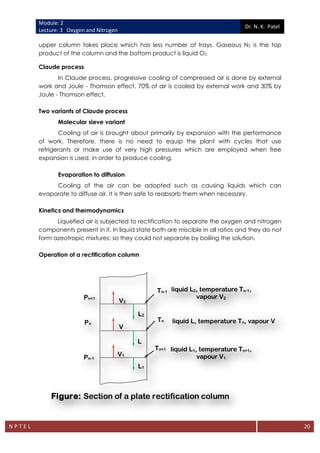
Operation of a rectification column
liquid L2, temperature Tn-1,
vapour V2
Tn-1
liquid L, temperature Tn, vapour V
Tn
liquid L1, temperature Tn+1,
vapour V1
Tn+1
V2
V1
V
L2
L
L1
Pn+1
Pn
Pn-1
Figure: Section of a plate rectification column
Module: 2
Lecture: 3 Oxygen and Nitrogen
Dr. N. K. Patel
N P T E L 21
Rectification is carried out in a 'plate column', which is tall cylindrical structure
inside which repeated condensations and evaporations take place on plates, which
lead to a continuous change in the composition of the binary system throughout the
length of the column. This is continued until one of its pure components exists at top
of the column and the other at the bottom of the column.
For better understanding of rectification of binary mixture a small section of
column is shown in figure which is formed by three plates: an intermediate plate Pn.
and two collateral plates Pn-1 and Pn+1 which are arranged below and above the
plate Pn respectively.
 V1, V, and V2 be the vapours which, as they pass toward the top of the
column, leave the plates Pn-1, Pn, and Pn+1 respectively
 L1, L, and L2 be the liquids which, as they pass down the column, descend
from the plates Pn-1, Pn, and Pn+1 respectively
 Tn+1, Tn and Tn-1 be the temperatures of the plates Pn-1, Pn, and Pn+1 respectively
The rectification of liquid mixture is exclusively on the basis of heat exchange
of the different fraction present in liquid form as well as vapour form. As shown in the
diagram plate Pn is considered as the reference plate having temperature Tn and
liquid composition L, vapour composition V. As pressure is released the more volatile
component i. e. N2 is evaporated out partly and goes to the upper plate Pn+1. The
composition of liquid L2 is having less concentration of N2 at temperature Tn-1.
Similarly liquid below the reference plate is Pn-1 has higher concentration of O2 and
vapour V1 having higher composition of O2 at temperature Tn+1.
Thus the separation of more volatile component N2 in vapour form and low
volatile component O2 in the liquid form is achieved.
Finally:
 The liquids which fall down from the plates toward the heater in the base of
the column (L2, L, L1) become progressively richer in the less volatile
component (oxygen)
 The vapours which rise toward the top of the column (V1, V, V2) gradually
become enriched in the more volatile component (nitrogen)
Subsequently, in a column fitted with a suitable number of plates, O2 is
obtained in pure state at the base of the column and the N2 is obtained in a
practically pure state at the top of the column.
For, perfect operation of a rectification column always requires that:
 The liquid should always be introduced onto a plate which supports a
liquid of the same composition as that of the feedstock liquid
Module: 2
Lecture: 3 Oxygen and Nitrogen
Dr. N. K. Patel
N P T E L 22
 Part of the distillate from the top of the column is recycled in the form of a
'reflux' with the aim of repeated washing on all of the plates which refine the
vapours moving towards the top of the column
Condensation medium
The separation of liquid air into nitrogen and oxygen is not as simple as the
fractionation of any other binary mixture. Because the separation is carried out at
very low temperature around -2000C. It is difficult to find a suitable medium for the
refluxing of a liquid air distillate at this temperature. The only possible media for the
condensation of the reflux would be liquid helium or liquid hydrogen, the use of
which is clearly unacceptable on both economic and operational grounds.
Engineering aspects
Two-section fractionating tower
Designing a fractionating tower consisting of two columns which are
arranged one above the other is the economically acceptable solution. The upper
column is about twice the height of the lower column, and both of them are fitted
with plates spaced at intervals. The average numerical ratio of the repartitioning
between the two columns is 42-25.
The upper column has all the requisites of a rectification column, while the
lower column functions as a simple enrichment column. As a bottom reboiler, the
lower column has a boiler with a curved base. There is no condenser at the top of
the rectification column, and it is closed by means of a gently curved cover with an
outlet aperture.
Fundamentally, one is concerned with two columns, one being situated
above the other, working at different pressures
 Lower column operating at 6atm
 Upper column operates only slightly above atmospheric pressure
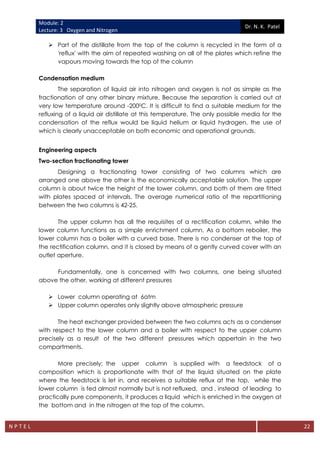
The heat exchanger provided between the two columns acts as a condenser
with respect to the lower column and a boiler with respect to the upper column
precisely as a result of the two different pressures which appertain in the two
compartments.
More precisely: the upper column is supplied with a feedstock of a
composition which is proportionate with that of the liquid situated on the plate
where the feedstock is let in, and receives a suitable reflux at the top, while the
lower column is fed almost normally but is not refluxed, and , instead of leading to
practically pure components, it produces a liquid which is enriched in the oxygen at
the bottom and in the nitrogen at the top of the column.
Module: 2
Lecture: 3 Oxygen and Nitrogen
Dr. N. K. Patel
N P T E L 23
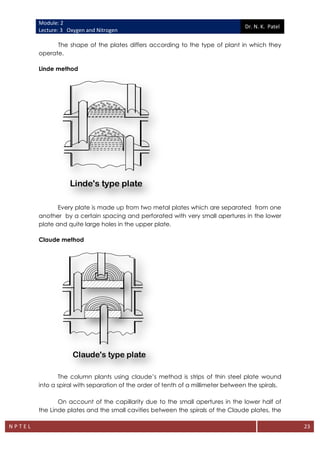
The shape of the plates differs according to the type of plant in which they
operate.
Linde method
Every plate is made up from two metal plates which are separated from one
another by a certain spacing and perforated with very small apertures in the lower
plate and quite large holes in the upper plate.
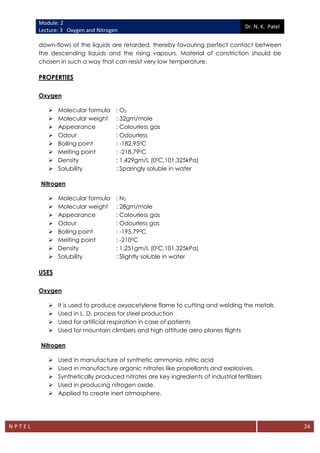
Claude method
The column plants using claude‘s method is strips of thin steel plate wound
into a spiral with separation of the order of tenth of a millimeter between the spirals.
On account of the capillarity due to the small apertures in the lower half of
the Linde plates and the small cavities between the spirals of the Claude plates, the
Linde's type plate
Claude's type plate
Module: 2
Lecture: 3 Oxygen and Nitrogen
Dr. N. K. Patel
N P T E L 24
down-flows of the liquids are retarded, thereby favouring perfect contact between
the descending liquids and the rising vapours. Material of constriction should be
chosen in such a way that can resist very low temperature.
PROPERTIES
Oxygen
 Molecular formula : O2
 Molecular weight : 32gm/mole
 Appearance : Colourless gas
 Odour : Odourless
 Boiling point : -182.950C
 Melting point : -218.790C
 Density : 1.429gm/L (00C,101.325kPa)
 Solubility : Sparingly soluble in water
Nitrogen
 Molecular formula : N2
 Molecular weight : 28gm/mole
 Appearance : Colourless gas
 Odour : Odourless gas
 Boiling point : -195.790C
 Melting point : -2100C
 Density : 1.251gm/L (00C,101.325kPa)
 Solubility : Slightly soluble in water
USES
Oxygen
 It is used to produce oxyacetylene flame to cutting and welding the metals
 Used in L. D. process for steel production
 Used for artificial respiration in case of patients
 Used for mountain climbers and high attitude aero planes flights
Nitrogen
 Used in manufacture of synthetic ammonia, nitric acid
 Used in manufacture organic nitrates like propellants and explosives,
 Synthetically produced nitrates are key ingredients of industrial fertilizers
 Used in producing nitrogen oxide.
 Applied to create inert atmosphere.

Lecture 3-OXYGEN AND NITROGEN INDUSTRIESpdf

  • 1.
    Module: 2 Lecture: 3Oxygen and Nitrogen Dr. N. K. Patel N P T E L 14 Module: 2 Lecture: 3 OXYGEN AND NITROGEN INTRODUCTION Oxygen Oxygen (O2) composed of two atoms of the element at (O) bind to form dioxygen, a very pale blue, odorless, tasteless diatomic gas. Diatomic oxygen gas constitutes 20.8% of the volume of air. It is necessary to sustain global life. Oxygen is the highly reactive nonmetallic element that readily forms compounds or oxides with almost all other elements. Oxygen is a strong oxidizing agent and has the second-highest electronegativity after fluorine than of all the elements. By mass, after hydrogen and helium, oxygen is the third-most abundant element in the universe. Free oxygen is too chemically reactive to appear on Earth without the photosynthetic action of living organisms, which use the energy of sunlight to produce elemental oxygen from water. Elemental O2 only began to accumulate in the atmosphere after the evolutionary appearance of these organisms, roughly 2.5 billion years ago. As larger constituent by mass of water, oxygen comprises most of the mass of living organisms. Elemental oxygen is produced by cyanobacteria, algae and plants, and is used in cellular respiration for all complex life. Oxygen is toxic to anaerobic organisms, which were the dominant form of early life on Earth until O2 began to accumulate in the atmosphere. Oxygen was independently discovered by Carl Wilhelm Scheele and Joseph Priestley in 1773 and 1774 respectively, but work was first published by Priestley. Antoine Lavoisier named as oxygen in 1777, whose experiments with oxygen helped to discredit the then-popular phlogiston theory of combustion and corrosion. Oxygen is produced industrially by fractional distillation of liquefied air, use of zeolites with pressure-cycling to concentrate oxygen from air, electrolysis of water and other means.
  • 2.
    Module: 2 Lecture: 3Oxygen and Nitrogen Dr. N. K. Patel N P T E L 15 Nitrogen Nitrogen (N2) is a colorless, odorless, tasteless, and mostly inert diatomic gas at standard conditions, constituting 78.09% by volume of Earth's atmosphere. Nitrogen occurs in all living organisms, primarily in amino acids, proteins and in the nucleic acids (DNA and RNA). The human body contains about 3% by weight of nitrogen, the fourth most abundant element after oxygen, carbon, and hydrogen. Nitrogen was discovered by Daniel Rutherford in 1772, who called it noxious air or fixed air. He also explains that nitrogen does not support combustion. At the same time by Carl Wilhelm Scheele, Henry Cavendish, and Joseph Priestley, referred it as burnt air or phlogisticated air. Antoine Lavoisier referred nitrogen as inert gas and as "mephitic air" or azote, in which animals died and flames were extinguished. English word nitrogen entered the language in 1794. The extremely strong bond in elemental nitrogen causing difficulty for both organisms and industry in breaking the bond to convert the nitrogen into useful compounds, but large amounts of useful energy released when the compounds burn, explode, or decay back into nitrogen gas. Analysis of Air Air mainly consist of two gases oxygen and nitrogen, which are practically considered to constitute 1/5 and 4/5 of air by volume respectively. The list of various gases present in air by weight percent is as under Name of the gas % by weight in air Oxygen 20.99 Nitrogen 78.01 Carbon dioxide 0.03 - 0.07 Argon 0.94 Hydrogen 0.01 Neon 0.0015 Helium and Krypton 0.01 - 0.02 Except CO2 the concentration of all the gases listed above are present in air are constant. However water vapours and traces of ozone and iodine are present in air in variable amounts. Also, composition of air also depends on altitude and distance to sea, in neighbourhood of industry, built up urban areas, nearby volcanic phenomena. Other gases such as CO, H2S and NO2 are also present in air. Kinetics and theory of gases According to kinetic theory a gas consists of swiftly moving molecules moving in a haphazard manner. During the movement some molecules collide with one another, some others move away from one another, these phenomena leaving an
  • 3.
    Module: 2 Lecture: 3Oxygen and Nitrogen Dr. N. K. Patel N P T E L 16 average distance between the molecules. At lower pressure the average distance is large, and at high pressure the molecules are brought near to one another. In all the three state of matter, molecules have two tendencies i.e. Attraction tendency and Repulsive tendency. The repulsive tendency is most predominant in gases, and least prominent in solids. While in most of liquids the attractive tendency in molecules is more than the repulsive tendency, so that the molecules remain together, but the attracting tendency is still less than in comparison of solids there so liquid is in fluid state. In the gases as the temperature raises the repulsion tendency increases, and pressure remaining constant the average distance between molecules increases i.e. the volume increases. Hence with fall of temperature the distance diminishes and, the molecules come closer together. Thus it becomes apparent that the average distance of molecules will progressively diminish with fall of temperature, and rise of pressure. Change of average distance of gas is quantitatively expressed by PV/T = constant Critical temperature When by decreasing the distance the molecules of a gas are brought close together the gas assumes the liquid form provided the repulsive tendency has been diminished beyond a certain point known as critical temperature which is different for different gases. Critical temperature is the temperature below which any gas can be liquefied by increasing the pressure. Above the critical temperature any gas cannot be liquefied by compression. Critical pressure Above critical temperature the gas will never liquefy under any pressure. The minimum pressure under which gas liquefies at the critical temperature is called as critical pressure. Therefore air should be cooled at very high pressure and low temperature for cooling purpose. The liquid form is obtained when the kinetic energy and the potential energy of the substance is approximately equal.
  • 4.
    Module: 2 Lecture: 3Oxygen and Nitrogen Dr. N. K. Patel N P T E L 17 The critical temperature and critical pressure of some gases are as follows. Sr. No. Gases Critical temperature (0C) Critical pressure (atm.) 1. Ethylene +9.5 50.65 2. Methane -82.85 45.6 3. Nitrogen -147.13 33.49 4. Hydrogen -239.9 12.8 5. Oxygen -118.75 49.7 6. Acetylene +35.5 61.55 7. Ammonia +132.5 112.3 8. Carbon monoxide -138.7 34.6 9. Carbon dioxide +31.3 72.9 Liquefaction of air by Joule - Thomson effect CO2 free air is compressed to 200atm and is cooled by water. The condensed water is removed by passing through activated alumina. Then air is passed through inner coil of heat exchangers. The valve with nozzle is provided at the end of the inner coil. Then gas is allowed to suddenly expand by opening the valve, which result in decrease of temperature of air. After expanding the cold air goes out through the outer coil, is then recompressed to 200atm pressure, cooled by water and then again allowed to transverse the inner coil. The temperature of the Water Water Piston Compressed Air Nozzle Liquid Air Figure: Liquefaction of Air by Joule Thomson effect
  • 5.
    Module: 2 Lecture: 3Oxygen and Nitrogen Dr. N. K. Patel N P T E L 18 incoming air further falls due to the presence of cold air in the outer coil. Now as the cooled air suddenly expands through the nozzle, the air suffers cooling, the temperature becomes lower than in the first operation. The colder air now passes through the outer coil producing an atmosphere of lower temperature. Hence when the cooled compressed air passes repeatedly through the inner coil and subsequently undergoes Joule-Thomson effect, the temperature of the air further drops. In this way progressive cooling takes place until the temperature of air falls below the critical temperature of oxygen and nitrogen. When this happens air undergoes liquefaction in the inner coil, so on opening the valve liquid air falls in the container. A part of liquid air evaporates, through the outer coil, maintaining the low temperature below the critical temperature. MANUFACTURE Oxygen in pure condition is obtained as a byproduct in the manufacture of H2 by electrolytic process is described in Module: 2, Lecture: 4. Oxygen and nitrogen are usually separated by rectification of liquid air. Linde's process (O2 and N2) The first rectification of N2 and O2 using Joule Thomson effect was carried out by Linde in 1906. After six year Claude rectified them by combined effect of external work and internal work in cooling the air to liquefaction point. Raw materials Basis: 1000kg Oxygen (95%) Air = 3600Nm3 Steam = 1750kg Cooling water = 5000kg Electricity = 450-480KWH Manufacture Block diagram of manufacturing process Process equipment Animation
  • 6.
    Module: 2 Lecture: 3Oxygen and Nitrogen Dr. N. K. Patel N P T E L 19 The distillation tower is specially designed bubble cap tray double columns arranged one above another. The two distillation columns are having intermediate distillation dome for effective separation of liquid enriched with O2. The column feed is liquefied air at 200atm pressure introduced at the bottom of the column. Since the boiling point of O2 (-183OC) and N2 (-195OC) are very low, column does not require any external heating. Distillation take place only due to release of vacuum. Thus a number of recycling from lower column to upper column and lower column to dome is required. The construction of dome includes number of internal pipes so that distillate of the lower column collides to the roof and is returned back to the column as reflux. The compressed air which arrives from the first section of the plant which acts as the heating fluid in the heater at the base of the enrichment column. The same air, always contained within a tube, passes out from the Iower column of the tower only to reenter it higher up after the pressure to which it is subjected is reduced by means of a valve, resulting in the lowering of its temperature. Nitrogen with a small oxygen impurity collects at the top of the enrichment column, and after expansion to atmospheric pressure; this nitrogen is sent to back as the reflux in the rectification column situated above. The liquid which collects in the heater at the base of the enrichment column is fed, after expansion to atmospheric pressure onto a suitable plate of the rectification column. Only after number of recycling, liquid with 82% concentration of O2 is taken in outer part of dome. This liquid goes to further rectification in upper column where it is refluxed with N2 rich liquid coming from lower column. The final separation in the Cold Gaseous Nitrogen Compressed Air Figure: Manufacturing of Nitrogen & Oxygen by Linde's Process Water Water Compressed Air Nozzle Liquid Air Piston
  • 7.
    Module: 2 Lecture: 3Oxygen and Nitrogen Dr. N. K. Patel N P T E L 20 upper column takes place which has less number of trays. Gaseous N2 is the top product of the column and the bottom product is liquid O2. Claude process In Claude process, progressive cooling of compressed air is done by external work and Joule - Thomson effect. 70% of air is cooled by external work and 30% by Joule - Thomson effect. Two variants of Claude process Molecular sieve variant Cooling of air is brought about primarily by expansion with the performance of work. Therefore, there is no need to equip the plant with cycles that use refrigerants or make use of very high pressures which are employed when free expansion is used, in order to produce cooling. Evaporation to diffusion Cooling of the air can be adopted such as causing liquids which can evaporate to diffuse air. It is then safe to reabsorb them when necessary. Kinetics and thermodynamics Liquefied air is subjected to rectification to separate the oxygen and nitrogen components present in it. In liquid state both are miscible in all ratios and they do not form azeotropic mixtures; so they could not separate by boiling the solution. Operation of a rectification column liquid L2, temperature Tn-1, vapour V2 Tn-1 liquid L, temperature Tn, vapour V Tn liquid L1, temperature Tn+1, vapour V1 Tn+1 V2 V1 V L2 L L1 Pn+1 Pn Pn-1 Figure: Section of a plate rectification column
  • 8.
    Module: 2 Lecture: 3Oxygen and Nitrogen Dr. N. K. Patel N P T E L 21 Rectification is carried out in a 'plate column', which is tall cylindrical structure inside which repeated condensations and evaporations take place on plates, which lead to a continuous change in the composition of the binary system throughout the length of the column. This is continued until one of its pure components exists at top of the column and the other at the bottom of the column. For better understanding of rectification of binary mixture a small section of column is shown in figure which is formed by three plates: an intermediate plate Pn. and two collateral plates Pn-1 and Pn+1 which are arranged below and above the plate Pn respectively.  V1, V, and V2 be the vapours which, as they pass toward the top of the column, leave the plates Pn-1, Pn, and Pn+1 respectively  L1, L, and L2 be the liquids which, as they pass down the column, descend from the plates Pn-1, Pn, and Pn+1 respectively  Tn+1, Tn and Tn-1 be the temperatures of the plates Pn-1, Pn, and Pn+1 respectively The rectification of liquid mixture is exclusively on the basis of heat exchange of the different fraction present in liquid form as well as vapour form. As shown in the diagram plate Pn is considered as the reference plate having temperature Tn and liquid composition L, vapour composition V. As pressure is released the more volatile component i. e. N2 is evaporated out partly and goes to the upper plate Pn+1. The composition of liquid L2 is having less concentration of N2 at temperature Tn-1. Similarly liquid below the reference plate is Pn-1 has higher concentration of O2 and vapour V1 having higher composition of O2 at temperature Tn+1. Thus the separation of more volatile component N2 in vapour form and low volatile component O2 in the liquid form is achieved. Finally:  The liquids which fall down from the plates toward the heater in the base of the column (L2, L, L1) become progressively richer in the less volatile component (oxygen)  The vapours which rise toward the top of the column (V1, V, V2) gradually become enriched in the more volatile component (nitrogen) Subsequently, in a column fitted with a suitable number of plates, O2 is obtained in pure state at the base of the column and the N2 is obtained in a practically pure state at the top of the column. For, perfect operation of a rectification column always requires that:  The liquid should always be introduced onto a plate which supports a liquid of the same composition as that of the feedstock liquid
  • 9.
    Module: 2 Lecture: 3Oxygen and Nitrogen Dr. N. K. Patel N P T E L 22  Part of the distillate from the top of the column is recycled in the form of a 'reflux' with the aim of repeated washing on all of the plates which refine the vapours moving towards the top of the column Condensation medium The separation of liquid air into nitrogen and oxygen is not as simple as the fractionation of any other binary mixture. Because the separation is carried out at very low temperature around -2000C. It is difficult to find a suitable medium for the refluxing of a liquid air distillate at this temperature. The only possible media for the condensation of the reflux would be liquid helium or liquid hydrogen, the use of which is clearly unacceptable on both economic and operational grounds. Engineering aspects Two-section fractionating tower Designing a fractionating tower consisting of two columns which are arranged one above the other is the economically acceptable solution. The upper column is about twice the height of the lower column, and both of them are fitted with plates spaced at intervals. The average numerical ratio of the repartitioning between the two columns is 42-25. The upper column has all the requisites of a rectification column, while the lower column functions as a simple enrichment column. As a bottom reboiler, the lower column has a boiler with a curved base. There is no condenser at the top of the rectification column, and it is closed by means of a gently curved cover with an outlet aperture. Fundamentally, one is concerned with two columns, one being situated above the other, working at different pressures  Lower column operating at 6atm  Upper column operates only slightly above atmospheric pressure The heat exchanger provided between the two columns acts as a condenser with respect to the lower column and a boiler with respect to the upper column precisely as a result of the two different pressures which appertain in the two compartments. More precisely: the upper column is supplied with a feedstock of a composition which is proportionate with that of the liquid situated on the plate where the feedstock is let in, and receives a suitable reflux at the top, while the lower column is fed almost normally but is not refluxed, and , instead of leading to practically pure components, it produces a liquid which is enriched in the oxygen at the bottom and in the nitrogen at the top of the column.
  • 10.
    Module: 2 Lecture: 3Oxygen and Nitrogen Dr. N. K. Patel N P T E L 23 The shape of the plates differs according to the type of plant in which they operate. Linde method Every plate is made up from two metal plates which are separated from one another by a certain spacing and perforated with very small apertures in the lower plate and quite large holes in the upper plate. Claude method The column plants using claude‘s method is strips of thin steel plate wound into a spiral with separation of the order of tenth of a millimeter between the spirals. On account of the capillarity due to the small apertures in the lower half of the Linde plates and the small cavities between the spirals of the Claude plates, the Linde's type plate Claude's type plate
  • 11.
    Module: 2 Lecture: 3Oxygen and Nitrogen Dr. N. K. Patel N P T E L 24 down-flows of the liquids are retarded, thereby favouring perfect contact between the descending liquids and the rising vapours. Material of constriction should be chosen in such a way that can resist very low temperature. PROPERTIES Oxygen  Molecular formula : O2  Molecular weight : 32gm/mole  Appearance : Colourless gas  Odour : Odourless  Boiling point : -182.950C  Melting point : -218.790C  Density : 1.429gm/L (00C,101.325kPa)  Solubility : Sparingly soluble in water Nitrogen  Molecular formula : N2  Molecular weight : 28gm/mole  Appearance : Colourless gas  Odour : Odourless gas  Boiling point : -195.790C  Melting point : -2100C  Density : 1.251gm/L (00C,101.325kPa)  Solubility : Slightly soluble in water USES Oxygen  It is used to produce oxyacetylene flame to cutting and welding the metals  Used in L. D. process for steel production  Used for artificial respiration in case of patients  Used for mountain climbers and high attitude aero planes flights Nitrogen  Used in manufacture of synthetic ammonia, nitric acid  Used in manufacture organic nitrates like propellants and explosives,  Synthetically produced nitrates are key ingredients of industrial fertilizers  Used in producing nitrogen oxide.  Applied to create inert atmosphere.