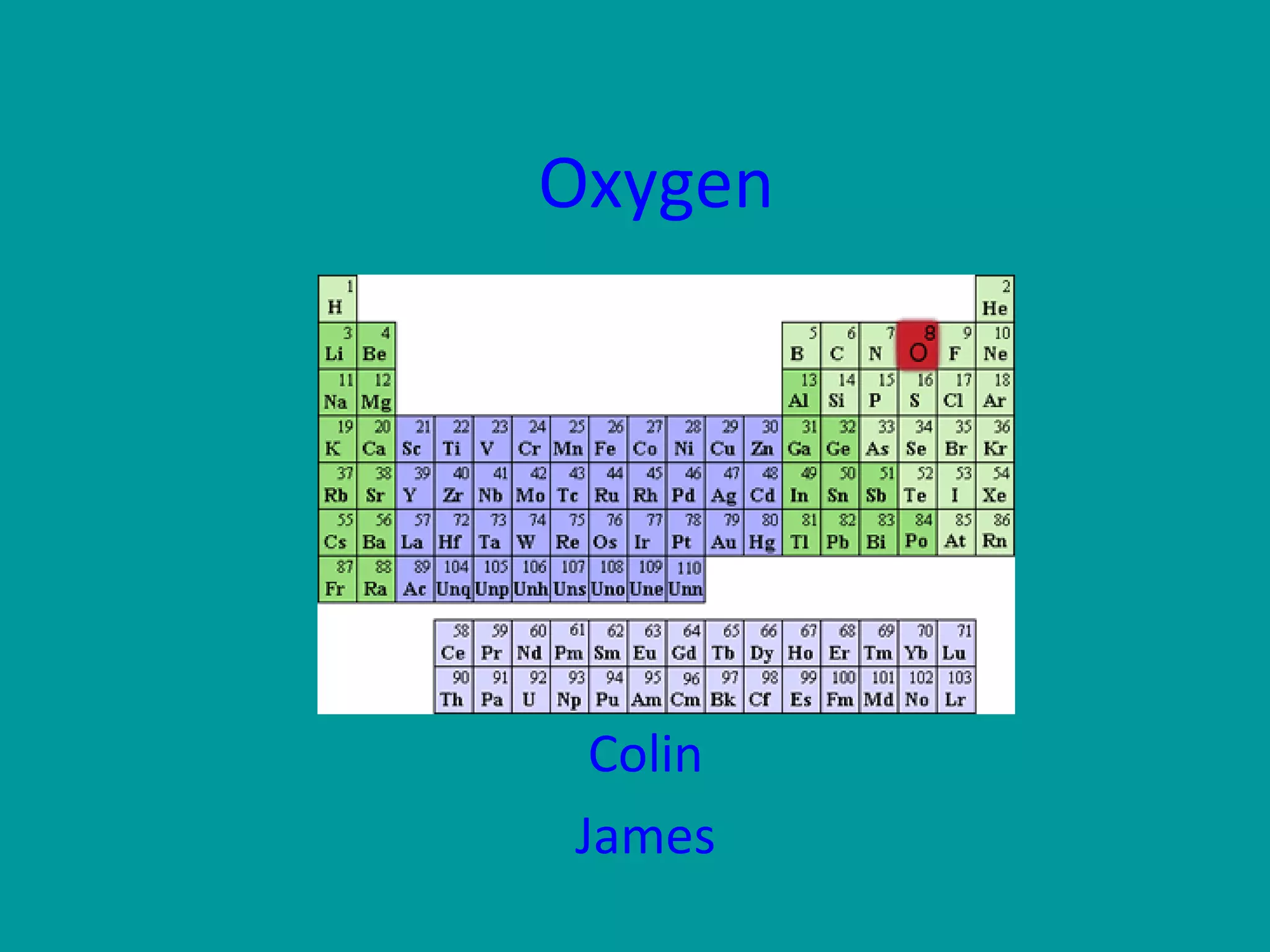
Oxygen Colin James
Atomic Number: 8 (Number of Protons) Atomic Mass: 16 (The total mass of the protons, neutrons and electrons found in the atom.) Oxygen is classified as a nonmetal or gas. Oxygen was the standard measure of weight used to weigh other elements until it was replaced by carbon.  Oxygen Facts
Basic Properties of Oxygen Oxygen is colorless. Oxygen is very reactive in its elemental  form.  Its most common form is O₂. O 3  is another form of oxygen which is called ozone Approximately 70% of the human bodies mass is oxygen.  Oxygen is completely essential for human survival.
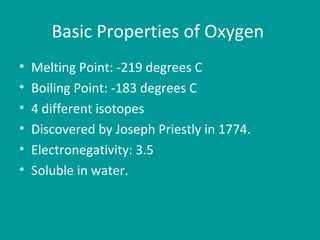
Basic Properties of Oxygen   Melting Point: -219 degrees C Boiling Point: -183 degrees C 4 different isotopes Discovered by Joseph Priestly in 1774. Electronegativity: 3.5  Soluble in water.
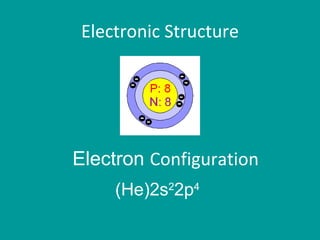
Electronic Structure Electron  Configuration (He)2s 2 2p 4
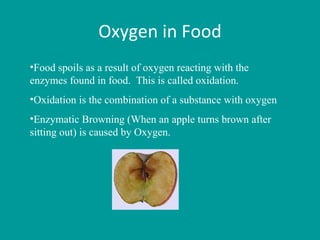
Oxygen in Food Food spoils as a result of oxygen reacting with the enzymes found in food.  This is called oxidation.  Oxidation is the combination of a substance with oxygen Enzymatic Browning (When an apple turns brown after sitting out) is caused by Oxygen.
Oxygen in Food   Oxygen provides humans with over 90% of the needed nutritional energy. The oxygen needed by the body is not absorbed from food.
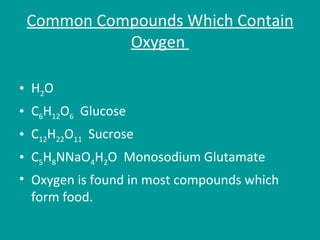
Common Compounds Which Contain Oxygen  H 2 O C 6 H 12 O 6   Glucose C 12 H 22 O 11   Sucrose  C 5 H 8 NNaO 4 H 2 O  Monosodium Glutamate  Oxygen is found in most compounds which form food.
Bibliography (12/15/2003). Oxygen. Retrieved November 18, 2008, from Periodic Table of the  Elements Web site: http://periodic.lanl.gov/elements/8.html  Gagnon, Steve It's Elemental - The Element Oxygen. Retrieved November 18, 2008, from Jefferson Lab Web site: http://education.jlab.org/itselemental/ele008.html  Pollock, Michael What is Oxidation. Retrieved November 18, 2008, from Wise   Geek Web site: http://www.wisegeek.com/what-is-oxidation.htm

Oxygen

  • 1.
  • 2.
    Atomic Number: 8(Number of Protons) Atomic Mass: 16 (The total mass of the protons, neutrons and electrons found in the atom.) Oxygen is classified as a nonmetal or gas. Oxygen was the standard measure of weight used to weigh other elements until it was replaced by carbon. Oxygen Facts
  • 3.
    Basic Properties ofOxygen Oxygen is colorless. Oxygen is very reactive in its elemental form. Its most common form is O₂. O 3 is another form of oxygen which is called ozone Approximately 70% of the human bodies mass is oxygen. Oxygen is completely essential for human survival.
  • 4.
    Basic Properties ofOxygen Melting Point: -219 degrees C Boiling Point: -183 degrees C 4 different isotopes Discovered by Joseph Priestly in 1774. Electronegativity: 3.5 Soluble in water.
  • 5.
    Electronic Structure Electron Configuration (He)2s 2 2p 4
  • 6.
    Oxygen in FoodFood spoils as a result of oxygen reacting with the enzymes found in food. This is called oxidation. Oxidation is the combination of a substance with oxygen Enzymatic Browning (When an apple turns brown after sitting out) is caused by Oxygen.
  • 7.
    Oxygen in Food Oxygen provides humans with over 90% of the needed nutritional energy. The oxygen needed by the body is not absorbed from food.
  • 8.
    Common Compounds WhichContain Oxygen H 2 O C 6 H 12 O 6 Glucose C 12 H 22 O 11 Sucrose C 5 H 8 NNaO 4 H 2 O Monosodium Glutamate Oxygen is found in most compounds which form food.
  • 9.
    Bibliography (12/15/2003). Oxygen.Retrieved November 18, 2008, from Periodic Table of the Elements Web site: http://periodic.lanl.gov/elements/8.html Gagnon, Steve It's Elemental - The Element Oxygen. Retrieved November 18, 2008, from Jefferson Lab Web site: http://education.jlab.org/itselemental/ele008.html Pollock, Michael What is Oxidation. Retrieved November 18, 2008, from Wise Geek Web site: http://www.wisegeek.com/what-is-oxidation.htm