Presented By:
Supta Sarkar
HHM-2013-10
M.Sc Foods & Nutrition
LOOK INSIDE…
• Introduction
• Classification
• Biosynthesis
-Prostanoid pathway
-Leukotriene pathway
• Functions
• Application
• Conclusion
INTRODUCTION
• "Eicosanoid" is derived from a Greek word “eicosa”
meaning "twenty”.
• Eicosanoids is the collective term for the signaling
molecules made by oxidation.
• Eicosanoids are oxygenated derivatives of 3
different 20-carbon fatty acids:
1. Eicosapentanoic acid
2. Arachidonic acid
3. Di-homo-gamma-linolenic acid
• Eicosapentaenoic acid (EPA), an ω-3 fatty acid
with 5 double bonds;
• Arachidonic acid (AA), an ω-6 fatty acid, with 4
double bonds;
• Dihomo-gamma-linolenic acid (DGLA), an ω-6,
with 3 double bonds.
Eicosanoids are derived from either omega-3
(ω-3) or omega-6 (ω-6) fatty acids.
CLASSIFICATION
• Eicosanoids are classified into two main
groups-
1) Prostanoids
2) Leukotrienes and Lipoxins
• Prostanoids are further sub-classified into
three groups-
a) Prostaglandins(PGs)
b) Prostacyclins(PGIs)
c) Thromboxanes (TXs)
BIOSYNTHESIS
• Two families of enzyme catalyze fatty acid
oxygenation to produce the eicosanoids:
• Cyclooxygenase, or COX, generates
the prostanoids.
• Lipoxygenase, or LOX, in several forms.
* 5-lipoxygenase (5-LO) generates the
leukotrienes and via transcellular biosynthesis is
also involved in lipoxin generation.
• Eicosanoids are not stored within cells, but
are synthesized as required.
• Derive from the fatty acids that make up the cell
membrane and nuclear membrane.
• Eicosanoid biosynthesis begins when a cell is
activated by mechanical trauma, cytokines, growth
factors or other stimuli. (The stimulus may even be
an eicosanoid from a neighboring cell.)
• This triggers the release of a phospholipase at
the cell membrane.
• The phospholipase travels to the nuclear membrane.
• There, the phospholipase catalyzes
ester hydrolysis of phospholipid or diacylglycerol
(by phospholipase C).
• This frees a 20-carbon fatty acid.
• This hydrolysis appears to be the rate-
determining step for eicosanoid formation.
• The fatty acids may be released by any of several
phospholipases.
• Of these, type IV cytosolic phospholipase
A2 (cPLA2) is the key actor, as cells lacking
cPLA2 are, in general, devoid of eicosanoid
synthesis.
• The phospholipase cPLA2 is specific for
phospholipids that contain AA, EPA or GPLA at
the SN2 position.
• Interestingly, cPLA2 may also release the
lysophospholipid that becomes platelet-activating
factor.
PROSTANOID PATHWAYS
• Cyclooxygenase (COX) catalyzes the conversion of
the free fatty acids to prostanoids by a two-step
process.
• First, two molecules of O2 are added as two
peroxide linkages, and a 5-member carbon ring is
forged near the middle of the fatty acid chain. This
forms the short-lived, unstable intermediate
Prostaglandin G (PGG).
• Next, one of the peroxide linkages sheds a single
oxygen, forming PGH.
• All three classes of prostanoids originate from PGH.
All have distinctive rings in the center of the
molecule. They differ in their structures.
• The derived prostaglandins contain a single,
unsaturated 5-carbon ring.
• In prostacyclins, this ring is conjoined to another
oxygen-containing ring. In thromboxanes the ring
becomes a 6-member ring with one oxygen.
• The leukotrienes do not have rings.
• Several drugs lower inflammation by blocking
prostanoid synthesis
LEUKOTRIENE PATHWAYS
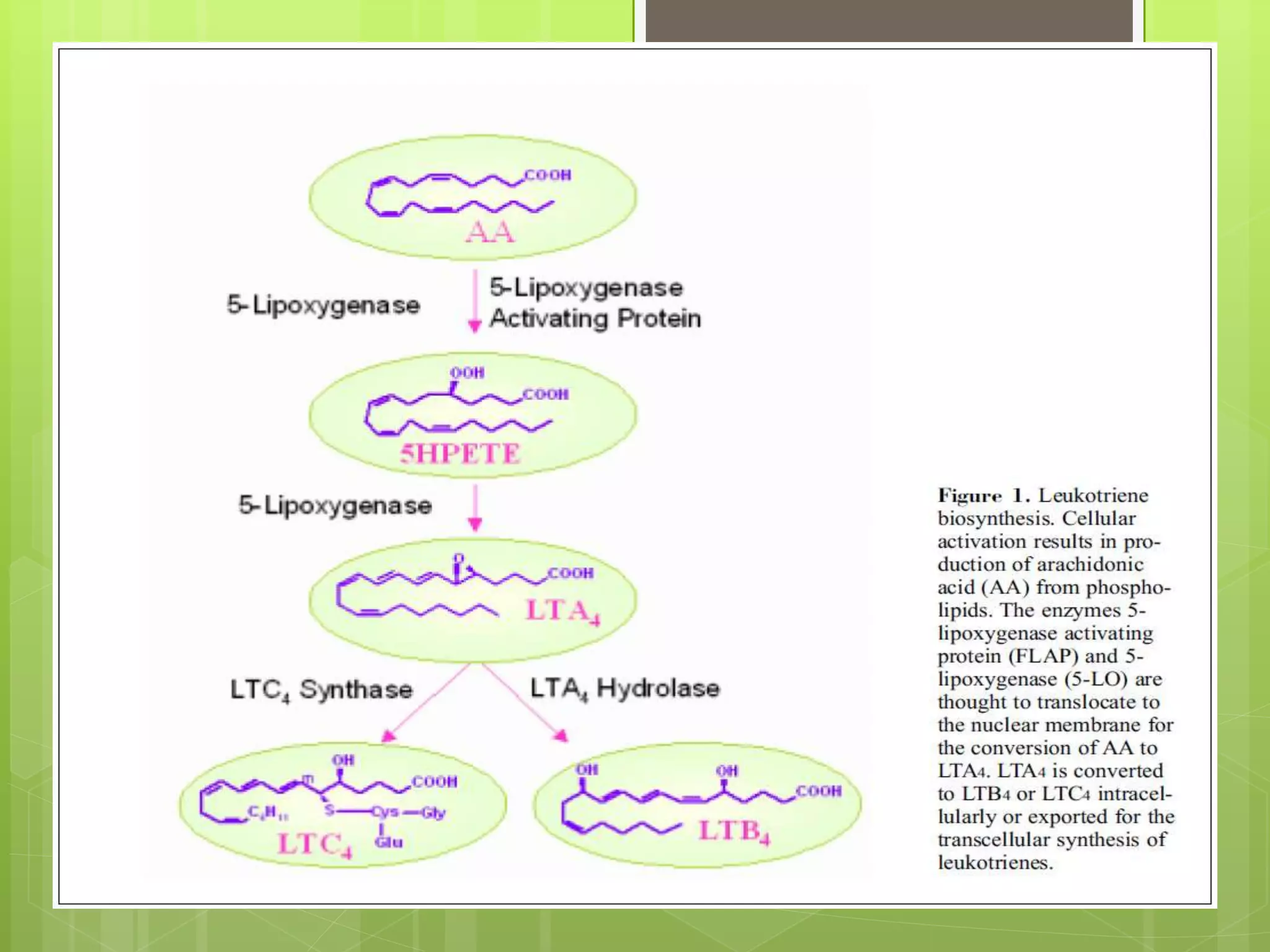
• The enzyme 5-lipoxygenase (5-LO) uses 5-
lipoxygenase activating protein (FLAP) to
convert arachidonic acid into 5-
Hydroperoxyeicosatetraenoic acid (5-HPETE),
which spontaneously reduces to 5-
hydroxyeicosatetraenoic acid (5-HETE).
• The enzyme LTA synthase acts on 5-HPETE to
convert it into leukotriene A4 (LTA4), which may be
converted into LTB4 by the enzyme leukotriene A4
epoxide hydrolase.
• Eosinophils, mast cells, and alveolar macrophages
use the enzyme leukotriene C4 synthase to
conjugate glutathione with LTA4 to make LTC4,
which is transported outside the cell, where
a glutamic acid moiety is removed from it to
make LTD4.
• The leukotriene LTD4 is then cleaved by
dipeptidases to make LTE4.
• The leukotrienes LTC4, LTD4 and LTE4 all contain
cysteine and are collectively known as the
cysteinyl leukotrienes.
FUNCTION
• Eicosanoids exert complex control over many
bodily systems, mainly in inflammation or
immunity, and as messengers in the central
nervous system.
• They are found in most living things.
• In humans, eicosanoids are local hormones that
are released by most cells, act on that same cell
or nearby cells (i.e., they are autocrine and
paracrine mediators), and then are rapidly
inactivated.
On the basis of functions eicosanoids
are again said as 2 types:
FUNCTIONS BASED ON FATTY ACID
DERIVATION:
Action of prostanoids
• Prostanoids mediate local symptoms
of inflammation: vasoconstriction or vasodilation,
coagulation, pain and fever.
• COX-2 is responsible for pain and inflammation,
while COX-1 is responsible for platelet clotting
actions.
• Inhibition of cyclooxygenase, specifically the
inducible COX-2 isoform, is the hallmark
of NSAIDs (non-steroidal anti-inflammatory
drugs).
• Prostanoids activate the PPARγ members of the
steroid/thyroid family of nuclear hormone
receptors, directly influencing gene transcription.
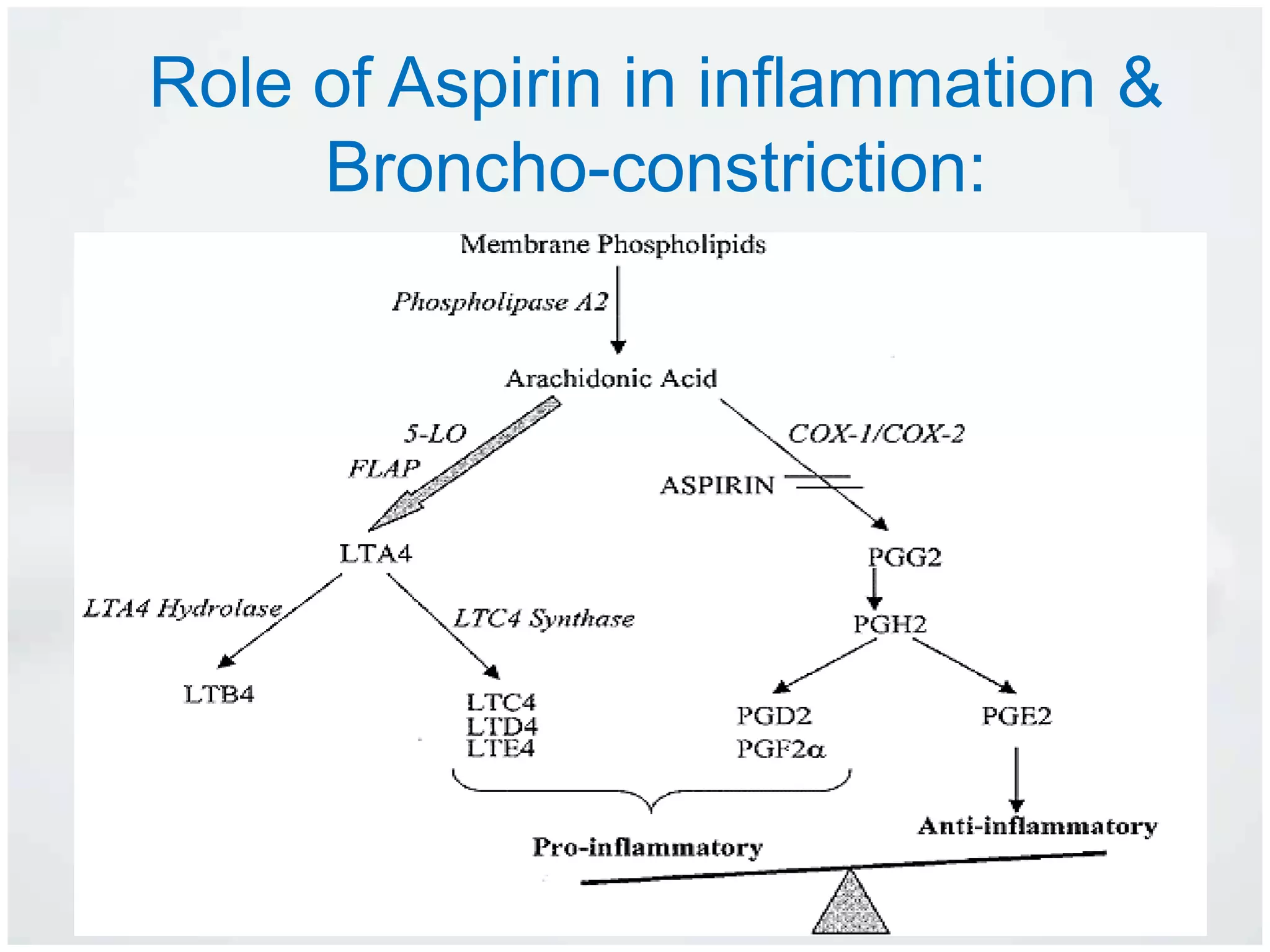
*Aspirin inhibits the COX pathway and consequently
diverts arachidonic acid metabolites to the LO
pathway.
*This also leads to a decrease in the
levels of PGE2, the anti-inflammatory PG.
*LTC4 synthase overexpression further increases the
number of cysteinyl LTs, tilting the balance toward
inflammation and broncho constriction causing
asthma
Role of Aspirin in Inflammation & Broncho-
constriction
Role of Aspirin in inflammation &
Broncho-constriction:
Action of leukotrienes
• Leukotrienes play an important role in
inflammation. There is a neuroendocrine role
for LTC4 in luteinizing hormone secretion.
• LTB4 causes adhesion and chemotaxis of
leukocytes and stimulates aggregation,
enzyme release, and generation
of superoxide in neutrophils.
• Blocking leukotriene receptors can play a role
in the management of inflammatory diseases
such as asthma (by the drugs montelukast and
zafirlukast), psoriasis, and rheumatoid
arthritis.
• The slow reacting substance of anaphylaxis comprises
the cysteinyl leukotrienes. These have a clear role
in pathophysiological conditions such as
asthma,allergic rhinitis and other nasal allergies, and
have been implicated in atherosclerosis and
inflammatory gastrointestinal diseases.
• They are potent bronchoconstrictors, increase vascular
permeability in postcapillary venules, and
stimulate mucus secretion. They are released from the
lung tissue of asthmatic subjects exposed to specific
allergens and play a pathophysiological role
in immediate hypersensitivity reactions.
• Along with PGD, they function in effector
cell[disambiguation needed] trafficking, antigen presentation,
immune cell activation, matrix deposition, and fibrosis.
Eicosanoid
Major site(s) of
synthesis
Major biological activities
PGD2
mast cells,
eosinophils, brain
Induces inflammatory responses principally by
recruiting eosinophils and basophils; induces
bronchoconstriction; involved in androgenetic
alopecia, inhibitors of PGD2 being studied to treat
male pattern baldness
PGE1
Induces vasodilation and inhibits platelet
aggregation
PGE2
kidney, spleen,
heart
Increases vasodilation and camp production,
enhancement of the effects of bradykinin and
histamine, induction of uterine contractions and of
platelet aggregation, maintaining the open
passageway of the fetal ductus arteriosus;
decreases t-cell proliferation and lymphocyte
migration and secretion of il-1α and IL-2
Eicosanoid Major site(s) of synthesis Major biological activities
PGF2α kidney, spleen, heart
increases vasoconstriction,
bronchoconstriction and smooth muscle
contraction
PGH2
precursor to thromboxanes A2 and B2,
induction of platelet aggregation and
vasoconstriction
PGI2
heart, vascular
endothelial cells
inhibits platelet and leukocyte aggregation,
decreases T-cell proliferation and
lymphocyte migration and secretion of IL-1α
and IL-2; induces vasodilation and
production of cAMP
TXA1
induces vasodilation and inhibits platelet
aggregation
TXA2 platelets
induces platelet aggregation,
vasoconstriction, lymphocyte proliferation
and bronchoconstriction
TXB2 platelets induces vasoconstriction
Eicosanoid Major site(s) of synthesis Major biological activities
LTB4
monocytes, basophils,
neutrophils, eosinophils,
mast cells, epithelial cells
powerful inducer of leukocyte chemotaxis
and aggregation, vascular permeability, T-
cell proliferation and secretion of INF-γ, IL-1
and IL-2
LTC4
monocytes and alveolar
macrophages, basophils,
eosinophils, mast cells,
epithelial cells
component of SRS-A, microvascular
vasoconstrictor, vascular permeability and
bronchoconstriction and secretion of INF-γ,
recruitment of leukocytes to sites of
inflammation, enhance mucus secretions in
gut and airway
LTD4
monocytes and alveolar
macrophages, eosinophils,
mast cells, epithelial cells
same as LTC4
LTE4 mast cells and basophils same as LTC4
**SRS-A = slow-reactive substance of anaphylaxis
Pharmacological applications of Eicosanoids
• Cardiovascular uses- pulmonary arterial hypertension,
peripheral vascular disease. For keeping the ductus arteriosus
open until surgery in neonates carrying certain cardiac
malformations and platelet anti-aggregating agents.
• Digestive Uses- indicated in the treatment of gastro duodenal
ulcer and for the prevention of NSAID-induced ulcers.
• Gynecological and obstetrical uses - They induce cervical
dilatation and uterine contractions, particularly in late
pregnancy. Used for medical termination of pregnancy and
induction of labour.
• Ophthalmologic Use- lower intraocular pressure.
• Anti- inflammatory use- Inhibitors of cyclo-
oxygenases have anti-inflammatory properties
and include nonsteroidal anti-inflammatory drugs
or NSAID. The useful effects in therapeutics are-
anti-inflammatory effect
analgesic effect
antipyretic effect
inhibition of platelet aggregation and decrease of
thromboembolic risk (well-known with aspirin at
low doses)
• Ulcerative Colitis- Mesalamine also called mesalazine
or 5 aminosalicyclic acid has antiinflammatory
properties in the colon and is used in the treatment of
ulcerative colitis (Crohn's disease). Its mechanism of
action is complex and as yet incompletely known: in
addition to cyclo-oxygenases, it also inhibits
lipoxygenases.
• Bronchial Asthma- PGE2 agonists and leukotrienes
receptor antagonists are used for the treatment of
bronchial asthma.
SUMMARY:
CONCLUSION
Eicosanoids are oxygenated derivatives of 3 different 20-
carbon fatty acids
Eicosanoids are classified in to 2 main groups:
Prostanoids, and Leukotrienes & Lipoxins
COX & LOX enzymes catalyze fatty acid oxygenation to
produce the eicosanoids.
Exert complex control over many bodily systems, mainly
in inflammation or immunity, and as messengers in
the CNS.
Eicosanoids

Eicosanoids

  • 1.
  • 2.
    LOOK INSIDE… • Introduction •Classification • Biosynthesis -Prostanoid pathway -Leukotriene pathway • Functions • Application • Conclusion
  • 3.
    INTRODUCTION • "Eicosanoid" isderived from a Greek word “eicosa” meaning "twenty”. • Eicosanoids is the collective term for the signaling molecules made by oxidation. • Eicosanoids are oxygenated derivatives of 3 different 20-carbon fatty acids: 1. Eicosapentanoic acid 2. Arachidonic acid 3. Di-homo-gamma-linolenic acid
  • 4.
    • Eicosapentaenoic acid(EPA), an ω-3 fatty acid with 5 double bonds; • Arachidonic acid (AA), an ω-6 fatty acid, with 4 double bonds; • Dihomo-gamma-linolenic acid (DGLA), an ω-6, with 3 double bonds. Eicosanoids are derived from either omega-3 (ω-3) or omega-6 (ω-6) fatty acids.
  • 5.
    CLASSIFICATION • Eicosanoids areclassified into two main groups- 1) Prostanoids 2) Leukotrienes and Lipoxins • Prostanoids are further sub-classified into three groups- a) Prostaglandins(PGs) b) Prostacyclins(PGIs) c) Thromboxanes (TXs)
  • 6.
    BIOSYNTHESIS • Two familiesof enzyme catalyze fatty acid oxygenation to produce the eicosanoids: • Cyclooxygenase, or COX, generates the prostanoids. • Lipoxygenase, or LOX, in several forms. * 5-lipoxygenase (5-LO) generates the leukotrienes and via transcellular biosynthesis is also involved in lipoxin generation.
  • 7.
    • Eicosanoids arenot stored within cells, but are synthesized as required. • Derive from the fatty acids that make up the cell membrane and nuclear membrane. • Eicosanoid biosynthesis begins when a cell is activated by mechanical trauma, cytokines, growth factors or other stimuli. (The stimulus may even be an eicosanoid from a neighboring cell.) • This triggers the release of a phospholipase at the cell membrane. • The phospholipase travels to the nuclear membrane. • There, the phospholipase catalyzes ester hydrolysis of phospholipid or diacylglycerol (by phospholipase C). • This frees a 20-carbon fatty acid.
  • 8.
    • This hydrolysisappears to be the rate- determining step for eicosanoid formation. • The fatty acids may be released by any of several phospholipases. • Of these, type IV cytosolic phospholipase A2 (cPLA2) is the key actor, as cells lacking cPLA2 are, in general, devoid of eicosanoid synthesis. • The phospholipase cPLA2 is specific for phospholipids that contain AA, EPA or GPLA at the SN2 position. • Interestingly, cPLA2 may also release the lysophospholipid that becomes platelet-activating factor.
  • 9.
    PROSTANOID PATHWAYS • Cyclooxygenase(COX) catalyzes the conversion of the free fatty acids to prostanoids by a two-step process. • First, two molecules of O2 are added as two peroxide linkages, and a 5-member carbon ring is forged near the middle of the fatty acid chain. This forms the short-lived, unstable intermediate Prostaglandin G (PGG). • Next, one of the peroxide linkages sheds a single oxygen, forming PGH.
  • 10.
    • All threeclasses of prostanoids originate from PGH. All have distinctive rings in the center of the molecule. They differ in their structures. • The derived prostaglandins contain a single, unsaturated 5-carbon ring. • In prostacyclins, this ring is conjoined to another oxygen-containing ring. In thromboxanes the ring becomes a 6-member ring with one oxygen. • The leukotrienes do not have rings. • Several drugs lower inflammation by blocking prostanoid synthesis
  • 12.
    LEUKOTRIENE PATHWAYS • Theenzyme 5-lipoxygenase (5-LO) uses 5- lipoxygenase activating protein (FLAP) to convert arachidonic acid into 5- Hydroperoxyeicosatetraenoic acid (5-HPETE), which spontaneously reduces to 5- hydroxyeicosatetraenoic acid (5-HETE). • The enzyme LTA synthase acts on 5-HPETE to convert it into leukotriene A4 (LTA4), which may be converted into LTB4 by the enzyme leukotriene A4 epoxide hydrolase.
  • 13.
    • Eosinophils, mastcells, and alveolar macrophages use the enzyme leukotriene C4 synthase to conjugate glutathione with LTA4 to make LTC4, which is transported outside the cell, where a glutamic acid moiety is removed from it to make LTD4. • The leukotriene LTD4 is then cleaved by dipeptidases to make LTE4. • The leukotrienes LTC4, LTD4 and LTE4 all contain cysteine and are collectively known as the cysteinyl leukotrienes.
  • 15.
    FUNCTION • Eicosanoids exertcomplex control over many bodily systems, mainly in inflammation or immunity, and as messengers in the central nervous system. • They are found in most living things. • In humans, eicosanoids are local hormones that are released by most cells, act on that same cell or nearby cells (i.e., they are autocrine and paracrine mediators), and then are rapidly inactivated.
  • 16.
    On the basisof functions eicosanoids are again said as 2 types:
  • 17.
    FUNCTIONS BASED ONFATTY ACID DERIVATION:
  • 18.
    Action of prostanoids •Prostanoids mediate local symptoms of inflammation: vasoconstriction or vasodilation, coagulation, pain and fever. • COX-2 is responsible for pain and inflammation, while COX-1 is responsible for platelet clotting actions. • Inhibition of cyclooxygenase, specifically the inducible COX-2 isoform, is the hallmark of NSAIDs (non-steroidal anti-inflammatory drugs). • Prostanoids activate the PPARγ members of the steroid/thyroid family of nuclear hormone receptors, directly influencing gene transcription.
  • 19.
    *Aspirin inhibits theCOX pathway and consequently diverts arachidonic acid metabolites to the LO pathway. *This also leads to a decrease in the levels of PGE2, the anti-inflammatory PG. *LTC4 synthase overexpression further increases the number of cysteinyl LTs, tilting the balance toward inflammation and broncho constriction causing asthma Role of Aspirin in Inflammation & Broncho- constriction
  • 20.
    Role of Aspirinin inflammation & Broncho-constriction:
  • 21.
    Action of leukotrienes •Leukotrienes play an important role in inflammation. There is a neuroendocrine role for LTC4 in luteinizing hormone secretion. • LTB4 causes adhesion and chemotaxis of leukocytes and stimulates aggregation, enzyme release, and generation of superoxide in neutrophils. • Blocking leukotriene receptors can play a role in the management of inflammatory diseases such as asthma (by the drugs montelukast and zafirlukast), psoriasis, and rheumatoid arthritis.
  • 22.
    • The slowreacting substance of anaphylaxis comprises the cysteinyl leukotrienes. These have a clear role in pathophysiological conditions such as asthma,allergic rhinitis and other nasal allergies, and have been implicated in atherosclerosis and inflammatory gastrointestinal diseases. • They are potent bronchoconstrictors, increase vascular permeability in postcapillary venules, and stimulate mucus secretion. They are released from the lung tissue of asthmatic subjects exposed to specific allergens and play a pathophysiological role in immediate hypersensitivity reactions. • Along with PGD, they function in effector cell[disambiguation needed] trafficking, antigen presentation, immune cell activation, matrix deposition, and fibrosis.
  • 23.
    Eicosanoid Major site(s) of synthesis Majorbiological activities PGD2 mast cells, eosinophils, brain Induces inflammatory responses principally by recruiting eosinophils and basophils; induces bronchoconstriction; involved in androgenetic alopecia, inhibitors of PGD2 being studied to treat male pattern baldness PGE1 Induces vasodilation and inhibits platelet aggregation PGE2 kidney, spleen, heart Increases vasodilation and camp production, enhancement of the effects of bradykinin and histamine, induction of uterine contractions and of platelet aggregation, maintaining the open passageway of the fetal ductus arteriosus; decreases t-cell proliferation and lymphocyte migration and secretion of il-1α and IL-2
  • 24.
    Eicosanoid Major site(s)of synthesis Major biological activities PGF2α kidney, spleen, heart increases vasoconstriction, bronchoconstriction and smooth muscle contraction PGH2 precursor to thromboxanes A2 and B2, induction of platelet aggregation and vasoconstriction PGI2 heart, vascular endothelial cells inhibits platelet and leukocyte aggregation, decreases T-cell proliferation and lymphocyte migration and secretion of IL-1α and IL-2; induces vasodilation and production of cAMP TXA1 induces vasodilation and inhibits platelet aggregation TXA2 platelets induces platelet aggregation, vasoconstriction, lymphocyte proliferation and bronchoconstriction TXB2 platelets induces vasoconstriction
  • 25.
    Eicosanoid Major site(s)of synthesis Major biological activities LTB4 monocytes, basophils, neutrophils, eosinophils, mast cells, epithelial cells powerful inducer of leukocyte chemotaxis and aggregation, vascular permeability, T- cell proliferation and secretion of INF-γ, IL-1 and IL-2 LTC4 monocytes and alveolar macrophages, basophils, eosinophils, mast cells, epithelial cells component of SRS-A, microvascular vasoconstrictor, vascular permeability and bronchoconstriction and secretion of INF-γ, recruitment of leukocytes to sites of inflammation, enhance mucus secretions in gut and airway LTD4 monocytes and alveolar macrophages, eosinophils, mast cells, epithelial cells same as LTC4 LTE4 mast cells and basophils same as LTC4 **SRS-A = slow-reactive substance of anaphylaxis
  • 26.
    Pharmacological applications ofEicosanoids • Cardiovascular uses- pulmonary arterial hypertension, peripheral vascular disease. For keeping the ductus arteriosus open until surgery in neonates carrying certain cardiac malformations and platelet anti-aggregating agents. • Digestive Uses- indicated in the treatment of gastro duodenal ulcer and for the prevention of NSAID-induced ulcers. • Gynecological and obstetrical uses - They induce cervical dilatation and uterine contractions, particularly in late pregnancy. Used for medical termination of pregnancy and induction of labour.
  • 27.
    • Ophthalmologic Use-lower intraocular pressure. • Anti- inflammatory use- Inhibitors of cyclo- oxygenases have anti-inflammatory properties and include nonsteroidal anti-inflammatory drugs or NSAID. The useful effects in therapeutics are- anti-inflammatory effect analgesic effect antipyretic effect inhibition of platelet aggregation and decrease of thromboembolic risk (well-known with aspirin at low doses)
  • 28.
    • Ulcerative Colitis-Mesalamine also called mesalazine or 5 aminosalicyclic acid has antiinflammatory properties in the colon and is used in the treatment of ulcerative colitis (Crohn's disease). Its mechanism of action is complex and as yet incompletely known: in addition to cyclo-oxygenases, it also inhibits lipoxygenases. • Bronchial Asthma- PGE2 agonists and leukotrienes receptor antagonists are used for the treatment of bronchial asthma.
  • 29.
  • 30.
    CONCLUSION Eicosanoids are oxygenatedderivatives of 3 different 20- carbon fatty acids Eicosanoids are classified in to 2 main groups: Prostanoids, and Leukotrienes & Lipoxins COX & LOX enzymes catalyze fatty acid oxygenation to produce the eicosanoids. Exert complex control over many bodily systems, mainly in inflammation or immunity, and as messengers in the CNS.