NITRIC OXIDE[EDRF]
PRESENTED BY-ABHAY
KUMAR YADAV.
DIAGRAM
ENDOTHELIUM
 Endothelium is the thin layer of cells that lines the
interior surface of blood vessels and lymphatic vessels
forming an interface between circulating blood and
lymph in the lumen and the rest of the vessel wall.
 The cells that form the endothelium are called
endothelial cells.
 endothelial cells in direct contact with blood are
called vascular endothelial cells where as those in
direct contact with lymph are known as lymphatic
endothelial cells.
ENDOTHELIAL DYSFUNCTION
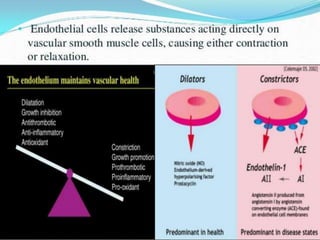
 Endothelial dysfunction,or the loss of proper
endothelial function,is a hallmark for
vascular diseases and is often regarded as
a key early event in the development of
atherosclerosis.
 Impaired endothelial fuctions causing
hypertension and thrombosis,is often seen
in patients with coronary artery
disease,diabetes
mellitus,hypertension,hypercholestrolemia,a
s well as in smokers
INTRODUCTION [NITRIC OXIDE]
 Nitric oxide is a gaseous material diffuses across
cell membranes .it is a free radical[ie.it has an
unpaired electrons in the valence shells]that
is why it is very reactive and participates in
many chemical reactions trying to loose the
extra electron to or gain the missing
electrons from other cell molecules leading
to their damage,that explains why nitric
oxide reacts with many substances inside
the body and is consumed quickly at the site
of its production.
NITRIC OXIDE
 A chemical compound with formula no is a
free radical gas.
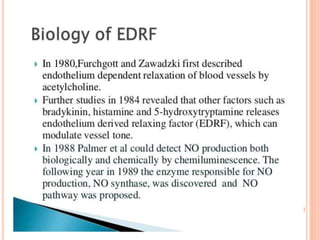
 It is first identified as endothelial derived
releasing factor.[EDRF]
 At high concentration fight against infections
organism and cancer cell.
 At lower concentration helps in regulating
the circulatory and central nervous system.
NITRIC OXIDE-MAIN POINTS
 Nitric oxide differs from other
neurotransmitter and hormones in a way
that it is not regulated by storage release or
targeted degradation.
 NO doesnot require receptor for its action
when synthesized immedietely utilized.
 Calcium calmodulin is necessary for nitric
oxide synthesis
NITRIC OXIDE ANDS ITS METABOLITE
 Excessive production of NO and its
metabolite peroxynitritrite is linked to the
pathogenesis of some neurodegenerative
diseases.
 This is due to the fact that peroxynitrite
causes mitochondrial damage and failure of
the respiratory electron transport
chain.[oxidative phosphorylation]to take
place.this leads to neuronal death.
THE STRUCTURE AND NATURE OF NITRIC
OXIDE
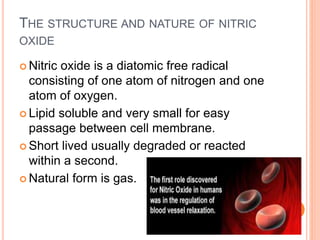
 Nitric oxide is a diatomic free radical
consisting of one atom of nitrogen and one
atom of oxygen.
 Lipid soluble and very small for easy
passage between cell membrane.
 Short lived usually degraded or reacted
within a second.
 Natural form is gas.
TYPES OF NITRIC OXIDE SYNTHASE
 The human and mouse genome contains 3
different genes encoding nitric oxide synthases.
 nNos[orNOS-1]neuronal nos found in neurons.
 iNos[orNOS-2]inducibleNOS expressed in
astrocyte and microglia of the cns in addition to
macrophages and neutrophils.2
 eNOS[orNOS-3]found in the endothelial cells
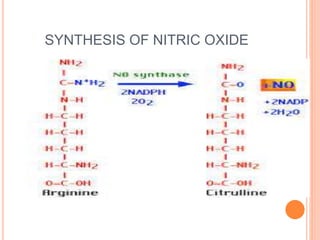
that lining blood vessels.all types of NOS act on
arginine with the aid of molecular oxygen and
NADPH to produce nitric oxide and citrulline.
SYNTHESIS OF NITRIC OXIDE
INDUCTION OF NITRIC OXIDE
 Platelet-derived factors,shear
stress,acetylcholine,and cytokines stimulate
the production of NO by endothelial nitric
oxide synthase [eNOS].
 eNOS synthesizes NO from the terminal
guanidine-nitrogen of l-arginine and oxygen
and yields citrulline as byproduct
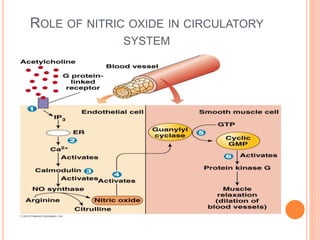
 NO production by eNOS is dependent on
calcium-calmodulin and other cofactors.
MEDICAL USE
 Neonatal use-nitric oxide are used in critical
care to promote capillary and pulmonary
dilation to treat primary pulmonary
hypertension in neonatal patients.
 Antianginal use-nitric oxide is considered an
antianginal drug.it causes vasodilation,
which can help with ischemic pain known as
angina by decreasing the cardiac workload.
NITRIC OXIDE-ROLE IN HEART
ROLE OF NITRIC OXIDE
 No in the nervous system
 No in the circulatory system
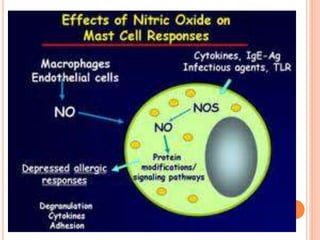
 No in the immune system
 No in the digestive system
 No in the reproductive system.
 No in the gene toxicity.
 No in the apoptosis.
IMPORTANT FUNCTIONS OF NITRIC OXIDE
 Nervous system when nitric oxide is formed
in nerve cells,it can stimulate the brain and
modulate many functions,from behaviour to
git activity.
 Shock if too much nitric oxide produced,it
can dilate blood vessels dropping the blood
pressure.
 Infections huge quantities of nitric oxide are
produced in whole bloodcells to kill invading
bacteria and parasites.
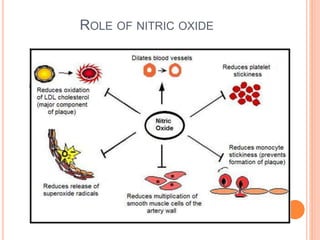
ROLE OF NITRIC OXIDE
 Wbc use nitric oxide to defend the body
against tumors.research are running now to
investigate whether it can be used to stop
the tumour growth.
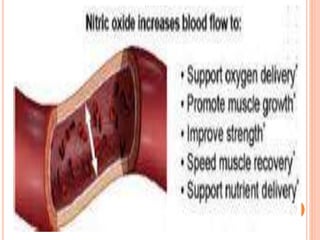
 Increased levels of nitric oxide,thus
widening blood vessels and increasing
blood flow.
 Nitric oxide plays an important role in the
maintenance of healthy blood pressure
and,in turn,cvs.
ROLE OF NITRIC OXIDE IN CIRCULATORY
SYSTEM
PENILE ERECTION
 The vasodilatory effect of no,in turns also
plays a role in development and
maintenance of penile erection.vasodilation
of blood vessels supplying the corpus
cavernosum results in more blood flowing in
and, hence erection.this is the bilogical
basis of sildenefil[viagra].
 It inhibit the enzyme phosphodiesterase
pde5,which lowers the Cgmp concentration
by converting it back to gmp
ROLE OF NITRIC OXIDE IN
REPRODUCTIVE SYSTEM
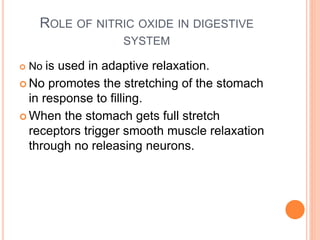
ROLE OF NITRIC OXIDE IN DIGESTIVE
SYSTEM
 No is used in adaptive relaxation.
 No promotes the stretching of the stomach
in response to filling.
 When the stomach gets full stretch
receptors trigger smooth muscle relaxation
through no releasing neurons.
ROLE OF NITRIC OXIDE
NITRIC OXIDE SUPPLEMENTS BENEFITS
 BETTER VASODILATION
 IMPROVED METABOLISM AND
RECOVERY.
 ENHANCED PERFORMANCE
 INCREASED MUSCLE MASS
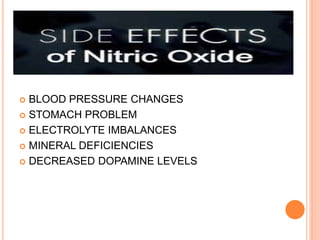
 BLOOD PRESSURE CHANGES
 STOMACH PROBLEM
 ELECTROLYTE IMBALANCES
 MINERAL DEFICIENCIES
 DECREASED DOPAMINE LEVELS
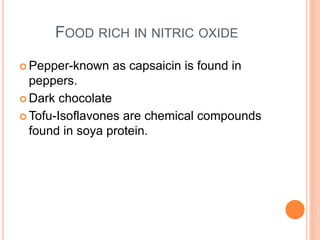
FOOD RICH IN NITRIC OXIDE
 Pepper-known as capsaicin is found in
peppers.
 Dark chocolate
 Tofu-Isoflavones are chemical compounds
found in soya protein.
SIMPLE TIPS TO INCREASE NITRIC
OXIDE IN BODY
 EXERCISE REGULARLY
 SUNLIGHT
Abhay
Abhay

Abhay

  • 1.
  • 2.
  • 3.
    ENDOTHELIUM  Endothelium isthe thin layer of cells that lines the interior surface of blood vessels and lymphatic vessels forming an interface between circulating blood and lymph in the lumen and the rest of the vessel wall.  The cells that form the endothelium are called endothelial cells.  endothelial cells in direct contact with blood are called vascular endothelial cells where as those in direct contact with lymph are known as lymphatic endothelial cells.
  • 6.
    ENDOTHELIAL DYSFUNCTION  Endothelialdysfunction,or the loss of proper endothelial function,is a hallmark for vascular diseases and is often regarded as a key early event in the development of atherosclerosis.  Impaired endothelial fuctions causing hypertension and thrombosis,is often seen in patients with coronary artery disease,diabetes mellitus,hypertension,hypercholestrolemia,a s well as in smokers
  • 7.
    INTRODUCTION [NITRIC OXIDE] Nitric oxide is a gaseous material diffuses across cell membranes .it is a free radical[ie.it has an unpaired electrons in the valence shells]that is why it is very reactive and participates in many chemical reactions trying to loose the extra electron to or gain the missing electrons from other cell molecules leading to their damage,that explains why nitric oxide reacts with many substances inside the body and is consumed quickly at the site of its production.
  • 9.
    NITRIC OXIDE  Achemical compound with formula no is a free radical gas.  It is first identified as endothelial derived releasing factor.[EDRF]  At high concentration fight against infections organism and cancer cell.  At lower concentration helps in regulating the circulatory and central nervous system.
  • 10.
    NITRIC OXIDE-MAIN POINTS Nitric oxide differs from other neurotransmitter and hormones in a way that it is not regulated by storage release or targeted degradation.  NO doesnot require receptor for its action when synthesized immedietely utilized.  Calcium calmodulin is necessary for nitric oxide synthesis
  • 11.
    NITRIC OXIDE ANDSITS METABOLITE  Excessive production of NO and its metabolite peroxynitritrite is linked to the pathogenesis of some neurodegenerative diseases.  This is due to the fact that peroxynitrite causes mitochondrial damage and failure of the respiratory electron transport chain.[oxidative phosphorylation]to take place.this leads to neuronal death.
  • 12.
    THE STRUCTURE ANDNATURE OF NITRIC OXIDE  Nitric oxide is a diatomic free radical consisting of one atom of nitrogen and one atom of oxygen.  Lipid soluble and very small for easy passage between cell membrane.  Short lived usually degraded or reacted within a second.  Natural form is gas.
  • 13.
    TYPES OF NITRICOXIDE SYNTHASE  The human and mouse genome contains 3 different genes encoding nitric oxide synthases.  nNos[orNOS-1]neuronal nos found in neurons.  iNos[orNOS-2]inducibleNOS expressed in astrocyte and microglia of the cns in addition to macrophages and neutrophils.2  eNOS[orNOS-3]found in the endothelial cells that lining blood vessels.all types of NOS act on arginine with the aid of molecular oxygen and NADPH to produce nitric oxide and citrulline.
  • 15.
  • 16.
    INDUCTION OF NITRICOXIDE  Platelet-derived factors,shear stress,acetylcholine,and cytokines stimulate the production of NO by endothelial nitric oxide synthase [eNOS].  eNOS synthesizes NO from the terminal guanidine-nitrogen of l-arginine and oxygen and yields citrulline as byproduct  NO production by eNOS is dependent on calcium-calmodulin and other cofactors.
  • 17.
    MEDICAL USE  Neonataluse-nitric oxide are used in critical care to promote capillary and pulmonary dilation to treat primary pulmonary hypertension in neonatal patients.  Antianginal use-nitric oxide is considered an antianginal drug.it causes vasodilation, which can help with ischemic pain known as angina by decreasing the cardiac workload.
  • 18.
  • 19.
    ROLE OF NITRICOXIDE  No in the nervous system  No in the circulatory system  No in the immune system  No in the digestive system  No in the reproductive system.  No in the gene toxicity.  No in the apoptosis.
  • 20.
    IMPORTANT FUNCTIONS OFNITRIC OXIDE  Nervous system when nitric oxide is formed in nerve cells,it can stimulate the brain and modulate many functions,from behaviour to git activity.  Shock if too much nitric oxide produced,it can dilate blood vessels dropping the blood pressure.  Infections huge quantities of nitric oxide are produced in whole bloodcells to kill invading bacteria and parasites.
  • 21.
    ROLE OF NITRICOXIDE  Wbc use nitric oxide to defend the body against tumors.research are running now to investigate whether it can be used to stop the tumour growth.  Increased levels of nitric oxide,thus widening blood vessels and increasing blood flow.  Nitric oxide plays an important role in the maintenance of healthy blood pressure and,in turn,cvs.
  • 23.
    ROLE OF NITRICOXIDE IN CIRCULATORY SYSTEM
  • 24.
    PENILE ERECTION  Thevasodilatory effect of no,in turns also plays a role in development and maintenance of penile erection.vasodilation of blood vessels supplying the corpus cavernosum results in more blood flowing in and, hence erection.this is the bilogical basis of sildenefil[viagra].  It inhibit the enzyme phosphodiesterase pde5,which lowers the Cgmp concentration by converting it back to gmp
  • 25.
    ROLE OF NITRICOXIDE IN REPRODUCTIVE SYSTEM
  • 26.
    ROLE OF NITRICOXIDE IN DIGESTIVE SYSTEM  No is used in adaptive relaxation.  No promotes the stretching of the stomach in response to filling.  When the stomach gets full stretch receptors trigger smooth muscle relaxation through no releasing neurons.
  • 27.
  • 28.
    NITRIC OXIDE SUPPLEMENTSBENEFITS  BETTER VASODILATION  IMPROVED METABOLISM AND RECOVERY.  ENHANCED PERFORMANCE  INCREASED MUSCLE MASS
  • 29.
     BLOOD PRESSURECHANGES  STOMACH PROBLEM  ELECTROLYTE IMBALANCES  MINERAL DEFICIENCIES  DECREASED DOPAMINE LEVELS
  • 30.
    FOOD RICH INNITRIC OXIDE  Pepper-known as capsaicin is found in peppers.  Dark chocolate  Tofu-Isoflavones are chemical compounds found in soya protein.
  • 31.
    SIMPLE TIPS TOINCREASE NITRIC OXIDE IN BODY  EXERCISE REGULARLY  SUNLIGHT