MIRACLE Molecule(NO)
&
The SILENT killer (CO)!!!
As signalling molecules
1
Nitric oxide(NO)
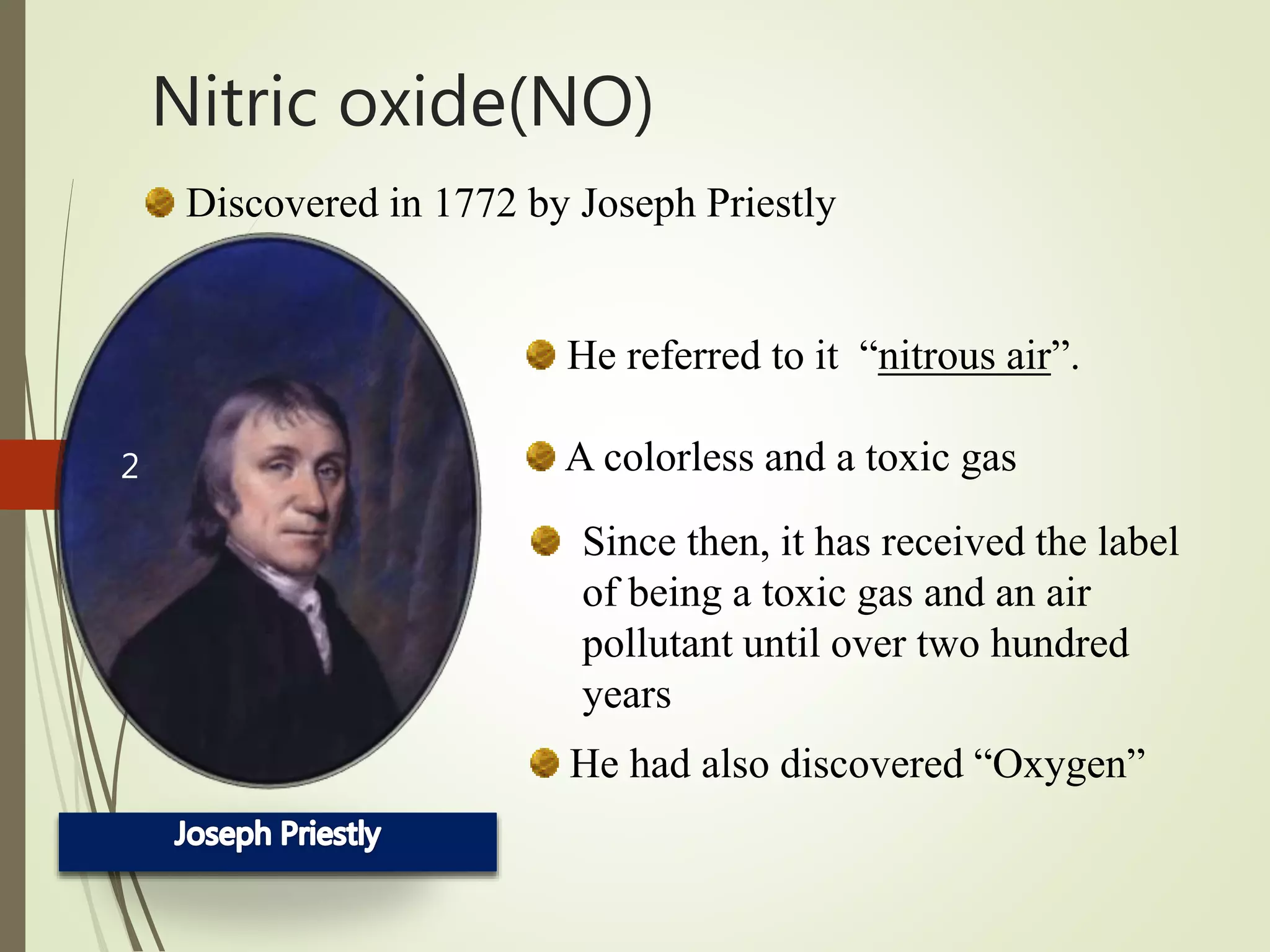
Discovered in 1772 by Joseph Priestly
He referred to it “nitrous air”.
A colorless and a toxic gas
Since then, it has received the label
of being a toxic gas and an air
pollutant until over two hundred
years
He had also discovered “Oxygen”
2
THE NOBEL ASSEMBLY AT KAROLINSKA INSTITUTE
awarded Nobel
Prize in Physiology & Medicine in October 12,1998 jointly to
Robert F. Furchgott, Louis J.
Ignarro and Ferid Murad for their discoveries concerning
“nitric oxide as a signalling molecule in the cardiovascular
system".
J
3
4
What is Nitric Oxide?
 First described in 1979 as a potent relaxant of
peripheral vascular smooth muscle.
 Used by the body as a signaling molecule.
 Serves different functions depending on body
system. i.e. neurotransmitter, vasodilator,
bactericide.
 Environmental Pollutant
 First gas known to act as a biological messenger
5
The structure and nature of
Nitric Oxide
 Nitric oxide is a diatomic free radical consisting of one atom
of nitrogen and one atom of oxygen
 Lipid soluble and very small for easy passage between cell
membranes
 Short lived, usually degraded or reacted within a few seconds
 The natural form is gas
 The nitrogen atom in NO is derived from the terminal guanidino group of L-
arginine
N O
6
Synthesis of Nitric Oxide
Nitric oxide is synthesized from L-arginine
This reaction is catalyzed by nitric oxide
synthase, a 1,294 aa enzyme
COO-
C
(CH2)3
NH
C
H2N
H
NH2+
+H3
N
Arginine
NOS
NADPH
+ O2
NAD+
COO-
C
(CH2)3
NH
C
H+H3
N
N
+
H2N
H
OH
N-w-Hydroxyarginine
COO-
C
(CH2)3
NH
H+H3
N
+ NO
NOS
C
O NH2
Citrulline
7
Types of NOS
 NOS I / nNOS
 Central and peripheral neuronal cells
 Ca+2 dependent, used for neuronal communication
 NOS II / iNOS
 Most nucleated cells, particularly macrophages
 Independent of intracellular Ca+2
 Inducible in presence of inflammatory cytokines
 NOS III / eNOS
 Vascular endothelial cells
 Ca+2 dependent
 Vascular regulation
8
Properties of NOS
 NOS l & NOS lll are called as constitutive forms of NOS
 They produce less NO in the body
 On the other hand NOS ll / iNOS produces more NO in the body
because
1. Its high concentration & Activity in the body
2. Pathological conditions are associated with the cytokines
9
Properties of NOS
 All three NOS are isoenzymes and are dimers
 Similar/homologous with cytochrome P450
 Each isoform contains iron protoporphyrin ix (heam) , flavin adenin
dinucleotide (FAD) , flavin mononucleotide (FMN) &
thetrahydrobiopterin (H4B) as bound prosthetic group
 These prosthetic group and the ligand which is going to bind to the
enzyme in the presence of the reduced NADPH control the assembly
of the enzyme into “The Active Dimer form”
10
Properties of NOS
 NOS enzymes are functionally BIMODAL in nature which is
associated with distinct structural domains
 The oxygease domain binds to Heam while reductase bind to calcium
calmodulin , FMN , FAD , NADPH
 NOS enzymes are the only Flavo Heam enzymes that use H4B as a
redox cofactor
 The crystal nature of the NOS heam (oxygenase) domain in iNOS &
eNOS has revealed how L arginine heam & H4B bind in the active
site
11
Regulation
 L-Arginine is usually present in excess in endothelial cell cytoplasm, so the rate of
production of NO is determined by the activity of the enzyme rather than by
substrate availability.
 Nevertheless, very high doses of L-arginine can restore endothelial NO biosynthesis
in some pathological states (e.g. hypercholesterolaemia) in which endothelial
function is impaired. Possible explanations for this paradox include:
 compartmentation: i.e. existence of a distinct pool of substrate in a cell compartment
with access to the synthase enzyme, which can become depleted despite apparently
plentiful total cytoplasmic arginine concentrations
 competition with endogenous inhibitors of NOS such as asymmetric dimethylarginine
(ADMA), which is elevated in plasma from patients with hypercholesterolaemia
 reassembly/reactivation of enzyme in which transfer of electrons has become
uncoupled from L-arginine
 relative depletion of arginine, which can inhibit NOS activity by inhibiting translation
of iNOS mRNA
12
Activation of NOS
 Glutamate neurotransmitter binds to NMDA receptors
 Ca++ channels open causing Ca influx into cell
 Activation of calmodulin, which activates NOS
 Mechanism for start of synthesis dependent on body
system
 NO synthesis takes place in endothelial cells, lung cells,
and neuronal cells
13
Http://www.kumc.edu/research/medicine/biochemistry/bioc800/sig02-06.h
14
What is the role of Nitric Oxide
in the human body?
 Nitric Oxide in the human body has many uses which are
best summarized under five categories.
 NO in the nervous system
 NO in the circulatory system
 NO in the muscular system
 NO in the immune system
 NO in the digestive system
15
Nitric Oxide in the Nervous
System
 Nitric oxide as a neurotransmitter
 NO is a signaling molecule, but not necessarily a neurotransmitter
 NO signals inhibition of smooth muscle contraction, adaptive
relaxation, and localized vasodilation
 Nitric oxide believed to play a role in long term memory
 Memory mechanism proposed is a retrograde messenger that
facilitates long term potentiation of neurons (memory)
 Synthesis mechanism involving Ca/Calmodulin activates NOS-I
 NO travels from postsynaptic neuron back to presynaptic neuron
which activates guanylyl cyclase, the enzyme that catalyzes cGMP
production
 This starts a cycle of nerve action potentials driven by NO
16
Is Nitric Oxide a
“neurotransmitter?”
 NO serves in the body as a neurotransmitter, but there
are definite differences between other neurotransmitters
used commonly in the body
 NO is synthesized on demand vs. constant synthesis
 NO diffuses out of the cells making it vs. storage in vesicles and release
by exocytosis
 NO does not bind to surface receptors, but instead exits in cytoplasm,
enters the target cell, and binds with intracellular guanylyl cyclase
 Similarities to normal NTs
 Present in presynaptic terminal
 Natural removal from synaptic junction
17
Nitric Oxide in the Circulatory
System
 NO serves as a vasodilator
 Released in response to high blood flow rate and signaling
molecules (Ach and bradykinin)
 Highly localized and effects are brief
 If NO synthesis is inhibited, blood pressure shoots
 NO aids in gas exchange between hemoglobin and cells
 Hemoglobin is a vasoconstrictor, Fe scavenges NO
 NO is protected by cysteine group when O2 binds to hemoglobin
 During O2 delivery, NO locally dilates blood vessels to aid in gas
exchange
 Excess NO is picked up by HGB with CO2
18
Nitric Oxide in the Muscular
System
 NO was orginally called EDRF (endothelium derived
relaxation factor)
 NO signals inhibition of smooth muscle contraction
 Ca2+ is released from the vascular lumen activating NOS
 NO is synthesized from NOS III in vascular endothelial cells
 This causes guanylyl cyclase to produce cGMP
 A rise in cGMP causes Ca+2 pumps to be activated, thus
reducing Ca2+ concentration in the cell
 This causes muscle relaxation
19
20
 Endothelium-derived NO acts locally on underlying vascular smooth
muscle or on adherent monocytes or platelets.
 The potential for action at a distance is neatly demonstrated by Rhodnius
prolixus, a blood-sucking insect that produces a salivary
vasodilator/platelet inhibitor with the properties of a nitrovasodilator. This
consists of a mixture of nitrosylated haemoproteins, which bind NO in the
salivary glands of the insect but release it in the tissues of its prey.
 The consequent vasodilatation and inhibition of platelet activation
presumably facilitates extraction of the bug's meal in liquid form.
 A strong, but still controversial, case has been made that NO can also act
at a distance in the mammalian circulation via reversible interactions with
haemoglobin
21
• Haem has an affinity for NO > 10 000 times greater than for oxygen. In the
absence of oxygen, NO bound to haem is relatively stable, but in the
presence of oxygen NO is converted to nitrate and the haem iron oxidised
to methaemoglobin.
• Distinct from this inactivation reaction, a specific cysteine residue in globin
combines reversibly with NO under physiological conditions.
• The resulting S-nitrosylated haemoglobin is believed to be involved in
various NO-related activities, including the control of vascular resistance,
blood pressure and respiration.
22
• Key features of the proposed mechanism include the following.
• Nitrosylation of haemoglobin is reversible.
• It depends on the state of oxygenation of the haemoglobin, which
consequently takes up NO in the lungs and releases it in tissues, in
concert with release of oxygen.
• Haemoglobin acts as an O2 sensor and could regulate vascular tone
(and hence tissue perfusion) in response to the local partial pressure of
O2 by releasing NO in this way. This mechanism is impaired in sickle cell
disease (a common inherited disorder caused by a molecular variant of
haemoglobin).
• NO is not released into the cytoplasm of erythrocytes (where it would
promptly be inactivated by haem), but is transported out of the red cells
via cysteine residues in the haemoglobin-binding cytoplasmic domain
of an anion exchanger called AE1.
• S-nitrosylated albumin also constitutes a source of circulating NO
bioactivity. An alternative view is that nitrite anion, rather than
nitrosylated protein, is the main intravascular NO storage molecule
23
Nitric Oxide in the Immune
System
 NOS II catalyzes synthesis of NO used in host defense
reactions
Activation of NOS II is independent of Ca+2 in the cell
Synthesis of NO happens in most nucleated cells,
particularly macrophages
NO is a potent inhibitor of viral replication
 NO is a bactericidal agent
NO is created from the nitrates extracted from food near
the gums
This kills bacteria in the mouth that may be harmful to the
body
24
Nitric Oxide in the Digestive
System
 NO is used in adaptive relaxation
 NO promotes the stretching of the stomach in response to
filling.
 When the stomach gets full, stretch receptors trigger
smooth muscle relaxation through NO releasing neurons
25
Nitric Oxide Metabolism
NO may also be involved in the regulation of protein activity
through S-nitrosylation. In the extracellular milieu, NO reacts
with oxygen and water to form nitrates and nitrites.
NO toxicity is linked to its ability to combine with superoxide
anions (O2–) to form peroxynitrite (ONOO–), an oxidizing free
radical that can cause DNA fragmentation and lipid oxidation.
In the mitochondria, ONOO– acts on the respiratory chain (I-
IV) complex and manganese superoxide dismutase
(MnSOD), to generate superoxide anions and hydrogen
peroxide (H2O2), respectively.
26
 By analogy with cytochrome P450, it is believed that the flavins accept
electrons from NADPH and transfer them to the haem iron, which
binds oxygen and catalyses the stepwise oxidation of L-arginine, via a
hydroxyl-arginine intermediate, to NO and citrulline.
 In pathological states, the enzyme can undergo structural change
leading to electron transfer between substrates, enzyme cofactors and
products becoming 'uncoupled', so that electrons are transferred to
molecular oxygen, leading to the synthesis of superoxide anion rather
than NO.
 This is important, as superoxide anion is a reactive oxygen species and
reacts with NO to form a toxic product (peroxynitrite anion)
27
Nitric Oxide Metabolism
SIGMA-ALDRICH
28
New research ideas involving
Nitric Oxide
The role NO might play in neuronal
development
The mechanism of NO inhibiting the different
forms of NOS
Diazeniumdiolates as NO releasing drugs
Excessive NO release as the cause of most brain
damage after stroke
29
Silent Killer !!!
30
Carbon Monoxide
 Carbon monoxide (CO) is a colorless, odorless, and tasteless gas
that is slightly less dense than air. It is toxic to humans when
encountered in concentrations above about 35 ppm
 Carbon monoxide consists of one carbon atom and
one oxygen atom, connected by a triple bond that consists of
two covalent bonds as well as one dative covalent bond. It is the
simplest oxocarbon
31
 In biology, carbon monoxide is naturally produced by the action
of heme oxygenase 1 and 2 on the heme from hemoglobin breakdown.
 This process produces a certain amount of carboxyhemoglobin in
normal persons, even if they do not breathe any carbon monoxide.
Following the first report that carbon monoxide is a
normal neurotransmitter in 1993, as well as one of three gases that
naturally modulate inflammatory responses in the body
32
Carbon monoxide is produced naturally by the human body
as a signaling molecule.
Thus, carbon monoxide have a physiological role in the body,
such as a neurotransmitter or a blood vessel relaxant.
Because of carbon monoxide's role in the body, abnormalities
in its metabolism have been linked to a variety of diseases,
including neurodegenerations, hypertension, heart failure,
and inflammation.
33
The most common symptoms of carbon monoxide poisoning may
resemble other types of poisonings and infections, including
symptoms such as headache, nausea, vomiting, dizziness, fatigue,
and a feeling of weakness.
Affected families often believe they are victims of food poisoning.
Infants may be irritable and feed poorly. Neurological signs
include confusion, disorientation, visual disturbance, syncope and
seizures.
Some descriptions of carbon monoxide poisoning
include retinal hemorrhages, and an abnormal cherry-red blood
hue
34
 carbon monoxide has received a great deal of clinical attention as a
biological regulator. In many tissues, all three gases are known to act
as anti-inflammatories, vasodilators, and encouragers
of neovascular growth.
 However, the issues are complex, as neovascular growth is not always
beneficial, since it plays a role in tumor growth, and also the damage
from wet macular degeneration, a disease for which smoking (a major
source of carbon monoxide in the blood, several times more than
natural production) increases the risk from 4 to 6 times.
 Endogenous
 Exogenous
 Methylene chloride
35
 Endogenous:
› Normal heme
catabolism:
 Only biochemical
reaction in the body
known to produce CO.
› Levels increased in:
 Hemolytic anemia.
 Sepsis
36
 Exogenous:
› House fires.
› Gas–powered electrical
generators.
› Automobile exhaust.
› Propane-powered
vehicles.
› Heaters.
› Camp stoves.
› Boat exhaust.
› Cigarette smoke.
37
 Methylene chloride:
› Paint and adhesive
remover.
› Converted to CO in the
liver after inhalation.
38
 Kills 5,000 people in US each year
 Survivors of CO poisoning can suffer from
brain damage, loss of sight or hearing, or
heart problems
39
 Headache
 Nausea
 Vomiting
 Dizziness
 Confusion
 Tiredness
 Weakness
 Sleepiness
 Tightness in
chest
 Trouble
breathing
 All of these are
flu- like
symptoms
40
41
Mechanism of action of CO
 CO combines reversibly with the oxygen binding sites
of hemoglobin and has an affinity Hemoglobin about
220times that of oxygen. The product formed
carboxyhemoglobin, cannot transport oxygen.
42
Oxyhemoglobin
oxygen
Thus brain and heart are most
affected
The free carboxy group present combines
with hemoglobin, thus forming carboxy
hemoglobin. Therefore Reduces the
oxygen supply to the tissues.
43
1. CO binds to platelet hemoproteins and
increases NO efflux.
2. Platelet-derived NO reacts with neutrophil-
derived superoxide which activates
platelets and causes platelet-neutrophil
aggregates.
3. Reactive products and adhesion molecules
promote firm aggregation and stimulate
degranulation of neutrophils.
4. Endothelial cells acitaved by
myeloperoxidase facilitating firm neutrophil
adhesion and further degranulation.
5. Reactive oxygen species (ROS) initiate lipid
peroxidation and adducts interact with
brain myelin basic protein. The altered
myelin basic protein triggers an adaptive
immunologic response that causes
neurologic dysfunction.
44
CO regulates blood
flow and blood fluidity
Vascular tone SMC proliferation Platelet aggregation
By inhibiting
45
Cross talk between CO AND NO
 CO AND NO are two endogenously produced gases that can act as second
messenger molecules
 Heme oxygenase and nitric oxide synthase are the enzyme systems
responsible for generating CO and NO share similar properties, such as ability
to activate soluble guanylate cyclase to increase cyclic GMP.
 it is becoming increasingly clear that these 2 gases do not always work
independently, but rather can modulate each others activity.
 Although much is known about the heme oxygenase/CO and nitric oxide
synthase/nitric oxide pathways, how these two imp systems interact is Less well
understood.
 The current known relationship between CO and NO it relates to their
production and physiological function.
46
REFERENCES
• RANG and DALE’S Pharmacology. Sixth edition (2007). 265-
274.
• The sources on the world wide web.
47
Thank you
48

No and co final by syed kashifpptx

  • 1.
    MIRACLE Molecule(NO) & The SILENTkiller (CO)!!! As signalling molecules 1
  • 2.
    Nitric oxide(NO) Discovered in1772 by Joseph Priestly He referred to it “nitrous air”. A colorless and a toxic gas Since then, it has received the label of being a toxic gas and an air pollutant until over two hundred years He had also discovered “Oxygen” 2
  • 3.
    THE NOBEL ASSEMBLYAT KAROLINSKA INSTITUTE awarded Nobel Prize in Physiology & Medicine in October 12,1998 jointly to Robert F. Furchgott, Louis J. Ignarro and Ferid Murad for their discoveries concerning “nitric oxide as a signalling molecule in the cardiovascular system". J 3
  • 4.
  • 5.
    What is NitricOxide?  First described in 1979 as a potent relaxant of peripheral vascular smooth muscle.  Used by the body as a signaling molecule.  Serves different functions depending on body system. i.e. neurotransmitter, vasodilator, bactericide.  Environmental Pollutant  First gas known to act as a biological messenger 5
  • 6.
    The structure andnature of Nitric Oxide  Nitric oxide is a diatomic free radical consisting of one atom of nitrogen and one atom of oxygen  Lipid soluble and very small for easy passage between cell membranes  Short lived, usually degraded or reacted within a few seconds  The natural form is gas  The nitrogen atom in NO is derived from the terminal guanidino group of L- arginine N O 6
  • 7.
    Synthesis of NitricOxide Nitric oxide is synthesized from L-arginine This reaction is catalyzed by nitric oxide synthase, a 1,294 aa enzyme COO- C (CH2)3 NH C H2N H NH2+ +H3 N Arginine NOS NADPH + O2 NAD+ COO- C (CH2)3 NH C H+H3 N N + H2N H OH N-w-Hydroxyarginine COO- C (CH2)3 NH H+H3 N + NO NOS C O NH2 Citrulline 7
  • 8.
    Types of NOS NOS I / nNOS  Central and peripheral neuronal cells  Ca+2 dependent, used for neuronal communication  NOS II / iNOS  Most nucleated cells, particularly macrophages  Independent of intracellular Ca+2  Inducible in presence of inflammatory cytokines  NOS III / eNOS  Vascular endothelial cells  Ca+2 dependent  Vascular regulation 8
  • 9.
    Properties of NOS NOS l & NOS lll are called as constitutive forms of NOS  They produce less NO in the body  On the other hand NOS ll / iNOS produces more NO in the body because 1. Its high concentration & Activity in the body 2. Pathological conditions are associated with the cytokines 9
  • 10.
    Properties of NOS All three NOS are isoenzymes and are dimers  Similar/homologous with cytochrome P450  Each isoform contains iron protoporphyrin ix (heam) , flavin adenin dinucleotide (FAD) , flavin mononucleotide (FMN) & thetrahydrobiopterin (H4B) as bound prosthetic group  These prosthetic group and the ligand which is going to bind to the enzyme in the presence of the reduced NADPH control the assembly of the enzyme into “The Active Dimer form” 10
  • 11.
    Properties of NOS NOS enzymes are functionally BIMODAL in nature which is associated with distinct structural domains  The oxygease domain binds to Heam while reductase bind to calcium calmodulin , FMN , FAD , NADPH  NOS enzymes are the only Flavo Heam enzymes that use H4B as a redox cofactor  The crystal nature of the NOS heam (oxygenase) domain in iNOS & eNOS has revealed how L arginine heam & H4B bind in the active site 11
  • 12.
    Regulation  L-Arginine isusually present in excess in endothelial cell cytoplasm, so the rate of production of NO is determined by the activity of the enzyme rather than by substrate availability.  Nevertheless, very high doses of L-arginine can restore endothelial NO biosynthesis in some pathological states (e.g. hypercholesterolaemia) in which endothelial function is impaired. Possible explanations for this paradox include:  compartmentation: i.e. existence of a distinct pool of substrate in a cell compartment with access to the synthase enzyme, which can become depleted despite apparently plentiful total cytoplasmic arginine concentrations  competition with endogenous inhibitors of NOS such as asymmetric dimethylarginine (ADMA), which is elevated in plasma from patients with hypercholesterolaemia  reassembly/reactivation of enzyme in which transfer of electrons has become uncoupled from L-arginine  relative depletion of arginine, which can inhibit NOS activity by inhibiting translation of iNOS mRNA 12
  • 13.
    Activation of NOS Glutamate neurotransmitter binds to NMDA receptors  Ca++ channels open causing Ca influx into cell  Activation of calmodulin, which activates NOS  Mechanism for start of synthesis dependent on body system  NO synthesis takes place in endothelial cells, lung cells, and neuronal cells 13
  • 14.
  • 15.
    What is therole of Nitric Oxide in the human body?  Nitric Oxide in the human body has many uses which are best summarized under five categories.  NO in the nervous system  NO in the circulatory system  NO in the muscular system  NO in the immune system  NO in the digestive system 15
  • 16.
    Nitric Oxide inthe Nervous System  Nitric oxide as a neurotransmitter  NO is a signaling molecule, but not necessarily a neurotransmitter  NO signals inhibition of smooth muscle contraction, adaptive relaxation, and localized vasodilation  Nitric oxide believed to play a role in long term memory  Memory mechanism proposed is a retrograde messenger that facilitates long term potentiation of neurons (memory)  Synthesis mechanism involving Ca/Calmodulin activates NOS-I  NO travels from postsynaptic neuron back to presynaptic neuron which activates guanylyl cyclase, the enzyme that catalyzes cGMP production  This starts a cycle of nerve action potentials driven by NO 16
  • 17.
    Is Nitric Oxidea “neurotransmitter?”  NO serves in the body as a neurotransmitter, but there are definite differences between other neurotransmitters used commonly in the body  NO is synthesized on demand vs. constant synthesis  NO diffuses out of the cells making it vs. storage in vesicles and release by exocytosis  NO does not bind to surface receptors, but instead exits in cytoplasm, enters the target cell, and binds with intracellular guanylyl cyclase  Similarities to normal NTs  Present in presynaptic terminal  Natural removal from synaptic junction 17
  • 18.
    Nitric Oxide inthe Circulatory System  NO serves as a vasodilator  Released in response to high blood flow rate and signaling molecules (Ach and bradykinin)  Highly localized and effects are brief  If NO synthesis is inhibited, blood pressure shoots  NO aids in gas exchange between hemoglobin and cells  Hemoglobin is a vasoconstrictor, Fe scavenges NO  NO is protected by cysteine group when O2 binds to hemoglobin  During O2 delivery, NO locally dilates blood vessels to aid in gas exchange  Excess NO is picked up by HGB with CO2 18
  • 19.
    Nitric Oxide inthe Muscular System  NO was orginally called EDRF (endothelium derived relaxation factor)  NO signals inhibition of smooth muscle contraction  Ca2+ is released from the vascular lumen activating NOS  NO is synthesized from NOS III in vascular endothelial cells  This causes guanylyl cyclase to produce cGMP  A rise in cGMP causes Ca+2 pumps to be activated, thus reducing Ca2+ concentration in the cell  This causes muscle relaxation 19
  • 20.
  • 21.
     Endothelium-derived NOacts locally on underlying vascular smooth muscle or on adherent monocytes or platelets.  The potential for action at a distance is neatly demonstrated by Rhodnius prolixus, a blood-sucking insect that produces a salivary vasodilator/platelet inhibitor with the properties of a nitrovasodilator. This consists of a mixture of nitrosylated haemoproteins, which bind NO in the salivary glands of the insect but release it in the tissues of its prey.  The consequent vasodilatation and inhibition of platelet activation presumably facilitates extraction of the bug's meal in liquid form.  A strong, but still controversial, case has been made that NO can also act at a distance in the mammalian circulation via reversible interactions with haemoglobin 21
  • 22.
    • Haem hasan affinity for NO > 10 000 times greater than for oxygen. In the absence of oxygen, NO bound to haem is relatively stable, but in the presence of oxygen NO is converted to nitrate and the haem iron oxidised to methaemoglobin. • Distinct from this inactivation reaction, a specific cysteine residue in globin combines reversibly with NO under physiological conditions. • The resulting S-nitrosylated haemoglobin is believed to be involved in various NO-related activities, including the control of vascular resistance, blood pressure and respiration. 22
  • 23.
    • Key featuresof the proposed mechanism include the following. • Nitrosylation of haemoglobin is reversible. • It depends on the state of oxygenation of the haemoglobin, which consequently takes up NO in the lungs and releases it in tissues, in concert with release of oxygen. • Haemoglobin acts as an O2 sensor and could regulate vascular tone (and hence tissue perfusion) in response to the local partial pressure of O2 by releasing NO in this way. This mechanism is impaired in sickle cell disease (a common inherited disorder caused by a molecular variant of haemoglobin). • NO is not released into the cytoplasm of erythrocytes (where it would promptly be inactivated by haem), but is transported out of the red cells via cysteine residues in the haemoglobin-binding cytoplasmic domain of an anion exchanger called AE1. • S-nitrosylated albumin also constitutes a source of circulating NO bioactivity. An alternative view is that nitrite anion, rather than nitrosylated protein, is the main intravascular NO storage molecule 23
  • 24.
    Nitric Oxide inthe Immune System  NOS II catalyzes synthesis of NO used in host defense reactions Activation of NOS II is independent of Ca+2 in the cell Synthesis of NO happens in most nucleated cells, particularly macrophages NO is a potent inhibitor of viral replication  NO is a bactericidal agent NO is created from the nitrates extracted from food near the gums This kills bacteria in the mouth that may be harmful to the body 24
  • 25.
    Nitric Oxide inthe Digestive System  NO is used in adaptive relaxation  NO promotes the stretching of the stomach in response to filling.  When the stomach gets full, stretch receptors trigger smooth muscle relaxation through NO releasing neurons 25
  • 26.
    Nitric Oxide Metabolism NOmay also be involved in the regulation of protein activity through S-nitrosylation. In the extracellular milieu, NO reacts with oxygen and water to form nitrates and nitrites. NO toxicity is linked to its ability to combine with superoxide anions (O2–) to form peroxynitrite (ONOO–), an oxidizing free radical that can cause DNA fragmentation and lipid oxidation. In the mitochondria, ONOO– acts on the respiratory chain (I- IV) complex and manganese superoxide dismutase (MnSOD), to generate superoxide anions and hydrogen peroxide (H2O2), respectively. 26
  • 27.
     By analogywith cytochrome P450, it is believed that the flavins accept electrons from NADPH and transfer them to the haem iron, which binds oxygen and catalyses the stepwise oxidation of L-arginine, via a hydroxyl-arginine intermediate, to NO and citrulline.  In pathological states, the enzyme can undergo structural change leading to electron transfer between substrates, enzyme cofactors and products becoming 'uncoupled', so that electrons are transferred to molecular oxygen, leading to the synthesis of superoxide anion rather than NO.  This is important, as superoxide anion is a reactive oxygen species and reacts with NO to form a toxic product (peroxynitrite anion) 27
  • 28.
  • 29.
    New research ideasinvolving Nitric Oxide The role NO might play in neuronal development The mechanism of NO inhibiting the different forms of NOS Diazeniumdiolates as NO releasing drugs Excessive NO release as the cause of most brain damage after stroke 29
  • 30.
  • 31.
    Carbon Monoxide  Carbonmonoxide (CO) is a colorless, odorless, and tasteless gas that is slightly less dense than air. It is toxic to humans when encountered in concentrations above about 35 ppm  Carbon monoxide consists of one carbon atom and one oxygen atom, connected by a triple bond that consists of two covalent bonds as well as one dative covalent bond. It is the simplest oxocarbon 31
  • 32.
     In biology,carbon monoxide is naturally produced by the action of heme oxygenase 1 and 2 on the heme from hemoglobin breakdown.  This process produces a certain amount of carboxyhemoglobin in normal persons, even if they do not breathe any carbon monoxide. Following the first report that carbon monoxide is a normal neurotransmitter in 1993, as well as one of three gases that naturally modulate inflammatory responses in the body 32
  • 33.
    Carbon monoxide isproduced naturally by the human body as a signaling molecule. Thus, carbon monoxide have a physiological role in the body, such as a neurotransmitter or a blood vessel relaxant. Because of carbon monoxide's role in the body, abnormalities in its metabolism have been linked to a variety of diseases, including neurodegenerations, hypertension, heart failure, and inflammation. 33
  • 34.
    The most commonsymptoms of carbon monoxide poisoning may resemble other types of poisonings and infections, including symptoms such as headache, nausea, vomiting, dizziness, fatigue, and a feeling of weakness. Affected families often believe they are victims of food poisoning. Infants may be irritable and feed poorly. Neurological signs include confusion, disorientation, visual disturbance, syncope and seizures. Some descriptions of carbon monoxide poisoning include retinal hemorrhages, and an abnormal cherry-red blood hue 34
  • 35.
     carbon monoxidehas received a great deal of clinical attention as a biological regulator. In many tissues, all three gases are known to act as anti-inflammatories, vasodilators, and encouragers of neovascular growth.  However, the issues are complex, as neovascular growth is not always beneficial, since it plays a role in tumor growth, and also the damage from wet macular degeneration, a disease for which smoking (a major source of carbon monoxide in the blood, several times more than natural production) increases the risk from 4 to 6 times.  Endogenous  Exogenous  Methylene chloride 35
  • 36.
     Endogenous: › Normalheme catabolism:  Only biochemical reaction in the body known to produce CO. › Levels increased in:  Hemolytic anemia.  Sepsis 36
  • 37.
     Exogenous: › Housefires. › Gas–powered electrical generators. › Automobile exhaust. › Propane-powered vehicles. › Heaters. › Camp stoves. › Boat exhaust. › Cigarette smoke. 37
  • 38.
     Methylene chloride: ›Paint and adhesive remover. › Converted to CO in the liver after inhalation. 38
  • 39.
     Kills 5,000people in US each year  Survivors of CO poisoning can suffer from brain damage, loss of sight or hearing, or heart problems 39
  • 40.
     Headache  Nausea Vomiting  Dizziness  Confusion  Tiredness  Weakness  Sleepiness  Tightness in chest  Trouble breathing  All of these are flu- like symptoms 40
  • 41.
  • 42.
    Mechanism of actionof CO  CO combines reversibly with the oxygen binding sites of hemoglobin and has an affinity Hemoglobin about 220times that of oxygen. The product formed carboxyhemoglobin, cannot transport oxygen. 42
  • 43.
    Oxyhemoglobin oxygen Thus brain andheart are most affected The free carboxy group present combines with hemoglobin, thus forming carboxy hemoglobin. Therefore Reduces the oxygen supply to the tissues. 43
  • 44.
    1. CO bindsto platelet hemoproteins and increases NO efflux. 2. Platelet-derived NO reacts with neutrophil- derived superoxide which activates platelets and causes platelet-neutrophil aggregates. 3. Reactive products and adhesion molecules promote firm aggregation and stimulate degranulation of neutrophils. 4. Endothelial cells acitaved by myeloperoxidase facilitating firm neutrophil adhesion and further degranulation. 5. Reactive oxygen species (ROS) initiate lipid peroxidation and adducts interact with brain myelin basic protein. The altered myelin basic protein triggers an adaptive immunologic response that causes neurologic dysfunction. 44
  • 45.
    CO regulates blood flowand blood fluidity Vascular tone SMC proliferation Platelet aggregation By inhibiting 45
  • 46.
    Cross talk betweenCO AND NO  CO AND NO are two endogenously produced gases that can act as second messenger molecules  Heme oxygenase and nitric oxide synthase are the enzyme systems responsible for generating CO and NO share similar properties, such as ability to activate soluble guanylate cyclase to increase cyclic GMP.  it is becoming increasingly clear that these 2 gases do not always work independently, but rather can modulate each others activity.  Although much is known about the heme oxygenase/CO and nitric oxide synthase/nitric oxide pathways, how these two imp systems interact is Less well understood.  The current known relationship between CO and NO it relates to their production and physiological function. 46
  • 47.
    REFERENCES • RANG andDALE’S Pharmacology. Sixth edition (2007). 265- 274. • The sources on the world wide web. 47
  • 48.