Receptor-Mediated Activation of Nitric Oxide
Synthesis by Arginine in the vasculature
MAHESH JOSHI
Nitric Oxide: A marvelous molecule
Historical Background
• 1977 Nitric Oxide activates sGuanylate Cyclase – Murad, F.
• 1980 Endothelium derived relaxing factor (EDRF) discovered –
Furchgott, RF.
• 1987 EDRF is Nitric Oxide – Ignarro, LJ., and Moncada, S.
• 1992 Molecule of the Year – Science Journal
• 1998 Nobel Prize (Physiology and Medicine) - Murad, Furchgott
and Ignarro
Blood vessel anatomy
Smooth muscle cells
Endothelial cells
NO NO
Summary of Nitric Oxide ChemistrySummary of Nitric Oxide Chemistry
Prooxidant and Antioxidant ReactionsProoxidant and Antioxidant Reactions
..
NONO
NONO22
.. ONOOONOO––
RNORNO
NONO––
Me-NOMe-NO
NONO++
antioxidantantioxidant
prooxidantprooxidant
one-electronone-electron
redoxredox
one-electronone-electron
redoxredox
O2 O2
.–
R.Me
+ e–
– e–
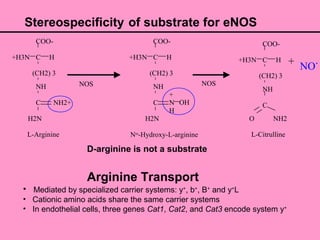
Stereospecificity of substrate for eNOS
D-arginine is not a substrate
Arginine Transport
• Mediated by specialized carrier systems: y+
, b+
, B+
and y+
L
• Cationic amino acids share the same carrier systems
• In endothelial cells, three genes Cat1, Cat2, and Cat3 encode system y+
COO-
C
(CH2) 3
NH
C
H2N
H
NH2+
+H3N
L-Arginine
NOS
COO-
C
(CH2) 3
NH
C
H+H3N
N
+
H2N
H
OH
Nω
-Hydroxy-L-arginine
COO-
C
(CH2) 3
NH
H+H3N + NO
.
NOS
C
O NH2
L-Citrulline
Arginine Paradox
Intracellular [Arginine] = 0.8-2.0 mM
Plasma [Arginine] = 100-150 µM
Km of Arginine for cNOS = 2.9 µM
Exogenous Arginine is beneficial in endothelial-dependent vasodilation.
• Intravenous infusion of L-arginine in healthy humans significantly increased
vasodilation (Bode-Boger et al., 1998)
• Oral L-arginine improves endothelial function in healthy adults older than
70 years (Bode-Boger et al., 2003)
• Oral L-arginine improves endothelial dysfunction in patients with essential
hypertension (Lekakis et al., 2002)
• In cystic fibrosis patients, oral L-arginine was shown to enhance lower
airway NO formation (Grasemann et al., 2005)
Importance of Extracellular Arginine: Plasma
Levels in Disease Conditions
• Low plasma arginine levels in children with cerebral malaria
(Lopansri et al., 2003)
• In newborns with persistent pulmonary hypertension, plasma
arginine utilization for whole body NO synthesis was reduced
(Castillo et al., 1995)
• Women with high resistance placental circulation at risk of pre-
eclampsia have raised plasma ADMA levels (Savvidou et al., 2003)
• Decreased arginine bioavailability and increased arginase activity in
asthma (Morris et al., 2004)
Explanations for arginine paradox
• Endogenous eNOS inhibitors
example: asymmetric dimethylarginine (ADMA)
• Compartmentalization of arginine
eNOS coupled to caveolae
• Antioxidant effects of arginine
L-arginine attenuates O2
-
formation
• Structural similarity to receptor ligands
Imidazoline/alpha-2 receptor ligands have
guanidinium moiety
Structural similarity: L-arginine and imidazoline/α-2 receptor ligands
Generated by CamScanner
ER
Ca2+
Arginine
IP3
IP3
Receptor
Extracellular
eNOS
NO
L-arg
Ca2+
Ca2+
Ca2+
PIP2
Working Hypothesis
Supporting Evidence for Receptor
Hypothesis
Both arginine and α-2 adrenoceptor agonists cause
endothelium-dependent relaxations
 UK-14304 induced dilation of aortic rings from SHR and normotensive
rats (Sunano et al. 1996)
 Clonidine dose-dependently elicited rat mesenteric artery dilation
(Figueroa et al. 2001)
 Injection of Moxonidine reduced mean arterial pressure in Wistar rats
(Moreira et al. 2004)
Imidazoline and α-2 adrenoceptors
• There is very little knowledge about the pharmacological functions of I-
receptors.
• But they are believed to be involved in the control of blood pressure, eating
disorders in rats, mental pathological conditions and neurodenerative
disorders.
• α-2 adrenoceptors have been widely studied due to their role in control of
blood pressure and blood flow, neural modulation, digestion, reproduction,
endocrine and metabolic processes.
• Endothelial cells do contain α-2 adrenoceptors. However, their abundance
in the cell membranes is not known.
Experimental design: Effect of receptor antagonists
Cell cultures
(HUVEC)
L-arg ± antagonists
15-30 min, 37° C
Supernatants
Griess reaction
NO2
-
, NO3
-
Inhibition with imidazoline/α-2 AR receptor antagonist
None
Arginine,5mM
+L-NAME,5mM
0.0
0.4
0.8
1.2
1.6
NO
2
-
+NO
3
-
,µM
*
*A
NO
2
-
+NO
3
-
,µM
None
5mML-Arginine
+10µMIdazoxan
0.0
0.2
0.4
0.6
0.8
1.0
#
#B
In vivo studies in humans
(Bode-Boger et al., 1998)
L-arginine [Plasma arg], mM Peripheral resistance
6 g 0.82 ± 0.059 No effect
30 g 6.22 ± 0.4 Significant decrease
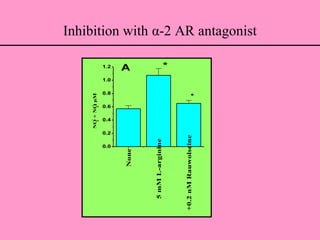
Inhibition with α-2 AR antagonist
None
5mML-arginine
+0.2nMRauwolscine
0.0
0.2
0.4
0.6
0.8
1.0
1.2
NO
2
-
+NO
3
-
,µM
*
*
A
Receptor antagonists inhibited D-arg mediated NO synthesis
None
5mMD-Arginine
+0.2nMRauwolscine
+50µMIdazoxan
0.0
0.2
0.4
0.6
$
NO2
-
+NO3
-
,µM
* #
L-arginine triggered [Ca2+
]i release
0 400 800 1200 1600
0.75
0.80
0.85
0.90
0.95
1.00
1.05
0 300 600 900 1200 1500
0.75
0.80
0.85
0.90
0.95
1.00
1.05
Fluor.ratio(340nm/380nm)
5 mM L-arginine
Time, sec Time, sec
2 nM Rauwolscine
L-arg + Rauwolscine
Role of Ca2+
in L-arginine actions
None
5mML-arginine
+5mMLanthanum
0
200
400
600
800
1000
B. Radiolabeled
45
Ca
2+
45Ca2+,CPM
#
#
None
5mML-arginine
+10mMEGTA
0.0
0.1
0.2
0.3
0.4
0.5
NO2
-
+NO3
-
,µM
*
*
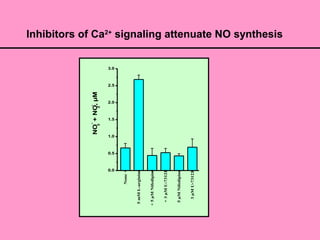
Inhibitors of Ca2+
signaling attenuate NO synthesis
None
5mML-arginine
+5µMNifedipine
+3µMU-73122
5µMNifedipine
3µMU-73122
0.0
0.5
1.0
1.5
2.0
2.5
3.0
NO3
-
+NO2
-
,µM
α-2 AR agonist activates NO synthesis
0.001 0.05 0.5
0.00
0.25
0.50
0.75
1.00
NO
3
-
+NO
2
-
,µM
Dexmedetomidine, nM
*
*
Does G-protein mediate L-arginine
actions?
CYTOPLASM
Extracellular Space
GPCR
Endoplasmic Reticulum

inactive Gq
GDP
active
Gq
GTPGDP
inactive
PLC
active
PLC
DAG
IP3
Ca2+
Ca2+

IP3
GTP
Arginine
eNOS
NO
Ca2+
Ca2+
Pertussis toxin inhibits NO formation
None
5mML-arginine
+200ng/mlPTx
+400ng/mlPTx
0.0
0.4
0.8
1.2
1.6
2.0
#
#
*
*
NO
2
-
+NO
3
-
,µM
Rat gracilis vessel dilation
L-arginine,1mM
+0.2nMRauwolscine
-4
0
4
8
12
16
Max.dilation,µm
*
Arginine as agonist: A problem
Arginine
Agmatine
Ca2+
eNOS
NO
Arginine Decarboxylase (ADC)Receptor
Extracellular
Space
Cytoplasm
1. Millimolar quantities of Arginine are required for activation of NO
2. Both L-and D-arginine activated NO synthesis
Alternative hypothesis: Agmatine as agonist
Is there a mammalian ADC?
• Its activity was detected in rat brain (Don Reis group, Science
1994)
• Partial cloning of ADC from rat kidney was achieved
(Morrissey et al. 1995)
• ADC activity was also demonstrated in membrane enriched
fractions of brain, liver and kidney cortex and medulla (Lortie
et al. 1996)
• Using 15
N-labeled arginine and GC-MS, ADC reaction was
documented in isolated mitochondria from perfused rat liver
(Horyn et al., 2005)
Agmatine: Relevance to NO system
• Agmatine is bioactive in a number of tissues and is present in serum
• A structural analog of L-arginine but not a substrate for Nitric Oxide
Synthases
• Binds to α-2 adrenoceptor and imidazoline receptors in the brain
• It acts as a systemic vasodilator in rat, when injected i.v and in
isolated aorta
Agmatine activates NO synthesis
None
1µMAgmatine
10µMAgmatine
+0.2nMRauwolscine
0.0
0.2
0.4
0.6
0.8
NO
2
-
+NO
3
-
,µM
#
#
Untreated 10 µM Agmatine 10 µM Agm + 1 mM L-NAME
Agmatine activation of cellular NO : DAF-FM diacetate assay
4-amino-5-methylamino-2’,7’-difluoro
fluorescein diacetate; DAF-FM DA
Q: If arginine decaboxylates via ADC to agmatine, why
does it take only micromolar agmatine whereas
millimolar quantities of arginine are required to activate
NO synthesis?
A: Back to Basics
Km of Arginine for ADC: 0.75 - 46 mM
(Horyn et al., 2005; Regunathan,S and Reis, DJ., 2000)
Rat Mesenteric Artery Relaxation
DFMA, arginine decarboxylase inhibitor
EC50
Arginine: 5.8±0.7 mM ; Agmatine; 139±12 µM
Mediation of alpha-2 AR and G-protein
RX821002, alpha-2 antagonist PTx, G-protein inhibitor
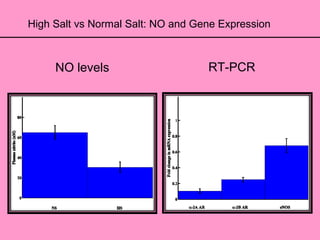
High Salt vs Normal Salt: NO and Gene Expression
NO levels RT-PCR
Conclusions
• The NO formation (from both L-arginine and D-arginine) was inhibited by I-
receptor and α-2 AR antagonists, indicating the possible involvement of
receptor(s) in the NO formation.
• The involvement of G-proteins was indicated by the inhibition of NO by
pertussis toxin, a specific inhibitor of Gi/o-proteins.
• The addition of L-arginine yielded a transient increase in [Ca2+
]i within 1 min
and Ca2+
dependence of NO formation was demonstrated using inhibitors of
intracellular Ca2+
signaling.
• The agmatine directly activated endothelial NO at low concentrations as
compared to arginine and this could be attenuated by α-2 AR antagonist,
rauwolscine.
• L-arginine-initiated dilation of isolated gracilis vessels is being inhibited by α-
2 AR antagonist, rauwolscine and thus establishing the physiological
relevance of our central hypothesis.
Future direction: location, location, location
Caveola
Gα-2 AR
Agmatine
IP3
Ca2+
eNOS
L-Arg
NO
Membrane
Ca2+

Agmatine

  • 1.
    Receptor-Mediated Activation ofNitric Oxide Synthesis by Arginine in the vasculature MAHESH JOSHI
  • 2.
    Nitric Oxide: Amarvelous molecule
  • 3.
    Historical Background • 1977Nitric Oxide activates sGuanylate Cyclase – Murad, F. • 1980 Endothelium derived relaxing factor (EDRF) discovered – Furchgott, RF. • 1987 EDRF is Nitric Oxide – Ignarro, LJ., and Moncada, S. • 1992 Molecule of the Year – Science Journal • 1998 Nobel Prize (Physiology and Medicine) - Murad, Furchgott and Ignarro
  • 4.
    Blood vessel anatomy Smoothmuscle cells Endothelial cells NO NO
  • 5.
    Summary of NitricOxide ChemistrySummary of Nitric Oxide Chemistry Prooxidant and Antioxidant ReactionsProoxidant and Antioxidant Reactions .. NONO NONO22 .. ONOOONOO–– RNORNO NONO–– Me-NOMe-NO NONO++ antioxidantantioxidant prooxidantprooxidant one-electronone-electron redoxredox one-electronone-electron redoxredox O2 O2 .– R.Me + e– – e–
  • 6.
    Stereospecificity of substratefor eNOS D-arginine is not a substrate Arginine Transport • Mediated by specialized carrier systems: y+ , b+ , B+ and y+ L • Cationic amino acids share the same carrier systems • In endothelial cells, three genes Cat1, Cat2, and Cat3 encode system y+ COO- C (CH2) 3 NH C H2N H NH2+ +H3N L-Arginine NOS COO- C (CH2) 3 NH C H+H3N N + H2N H OH Nω -Hydroxy-L-arginine COO- C (CH2) 3 NH H+H3N + NO . NOS C O NH2 L-Citrulline
  • 7.
    Arginine Paradox Intracellular [Arginine]= 0.8-2.0 mM Plasma [Arginine] = 100-150 µM Km of Arginine for cNOS = 2.9 µM Exogenous Arginine is beneficial in endothelial-dependent vasodilation. • Intravenous infusion of L-arginine in healthy humans significantly increased vasodilation (Bode-Boger et al., 1998) • Oral L-arginine improves endothelial function in healthy adults older than 70 years (Bode-Boger et al., 2003) • Oral L-arginine improves endothelial dysfunction in patients with essential hypertension (Lekakis et al., 2002) • In cystic fibrosis patients, oral L-arginine was shown to enhance lower airway NO formation (Grasemann et al., 2005)
  • 8.
    Importance of ExtracellularArginine: Plasma Levels in Disease Conditions • Low plasma arginine levels in children with cerebral malaria (Lopansri et al., 2003) • In newborns with persistent pulmonary hypertension, plasma arginine utilization for whole body NO synthesis was reduced (Castillo et al., 1995) • Women with high resistance placental circulation at risk of pre- eclampsia have raised plasma ADMA levels (Savvidou et al., 2003) • Decreased arginine bioavailability and increased arginase activity in asthma (Morris et al., 2004)
  • 9.
    Explanations for arginineparadox • Endogenous eNOS inhibitors example: asymmetric dimethylarginine (ADMA) • Compartmentalization of arginine eNOS coupled to caveolae • Antioxidant effects of arginine L-arginine attenuates O2 - formation • Structural similarity to receptor ligands Imidazoline/alpha-2 receptor ligands have guanidinium moiety
  • 10.
    Structural similarity: L-arginineand imidazoline/α-2 receptor ligands Generated by CamScanner
  • 11.
  • 12.
    Supporting Evidence forReceptor Hypothesis
  • 13.
    Both arginine andα-2 adrenoceptor agonists cause endothelium-dependent relaxations  UK-14304 induced dilation of aortic rings from SHR and normotensive rats (Sunano et al. 1996)  Clonidine dose-dependently elicited rat mesenteric artery dilation (Figueroa et al. 2001)  Injection of Moxonidine reduced mean arterial pressure in Wistar rats (Moreira et al. 2004)
  • 14.
    Imidazoline and α-2adrenoceptors • There is very little knowledge about the pharmacological functions of I- receptors. • But they are believed to be involved in the control of blood pressure, eating disorders in rats, mental pathological conditions and neurodenerative disorders. • α-2 adrenoceptors have been widely studied due to their role in control of blood pressure and blood flow, neural modulation, digestion, reproduction, endocrine and metabolic processes. • Endothelial cells do contain α-2 adrenoceptors. However, their abundance in the cell membranes is not known.
  • 15.
    Experimental design: Effectof receptor antagonists Cell cultures (HUVEC) L-arg ± antagonists 15-30 min, 37° C Supernatants Griess reaction NO2 - , NO3 -
  • 16.
    Inhibition with imidazoline/α-2AR receptor antagonist None Arginine,5mM +L-NAME,5mM 0.0 0.4 0.8 1.2 1.6 NO 2 - +NO 3 - ,µM * *A NO 2 - +NO 3 - ,µM None 5mML-Arginine +10µMIdazoxan 0.0 0.2 0.4 0.6 0.8 1.0 # #B
  • 17.
    In vivo studiesin humans (Bode-Boger et al., 1998) L-arginine [Plasma arg], mM Peripheral resistance 6 g 0.82 ± 0.059 No effect 30 g 6.22 ± 0.4 Significant decrease
  • 18.
    Inhibition with α-2AR antagonist None 5mML-arginine +0.2nMRauwolscine 0.0 0.2 0.4 0.6 0.8 1.0 1.2 NO 2 - +NO 3 - ,µM * * A
  • 19.
    Receptor antagonists inhibitedD-arg mediated NO synthesis None 5mMD-Arginine +0.2nMRauwolscine +50µMIdazoxan 0.0 0.2 0.4 0.6 $ NO2 - +NO3 - ,µM * #
  • 20.
    L-arginine triggered [Ca2+ ]irelease 0 400 800 1200 1600 0.75 0.80 0.85 0.90 0.95 1.00 1.05 0 300 600 900 1200 1500 0.75 0.80 0.85 0.90 0.95 1.00 1.05 Fluor.ratio(340nm/380nm) 5 mM L-arginine Time, sec Time, sec 2 nM Rauwolscine L-arg + Rauwolscine
  • 21.
    Role of Ca2+ inL-arginine actions None 5mML-arginine +5mMLanthanum 0 200 400 600 800 1000 B. Radiolabeled 45 Ca 2+ 45Ca2+,CPM # # None 5mML-arginine +10mMEGTA 0.0 0.1 0.2 0.3 0.4 0.5 NO2 - +NO3 - ,µM * *
  • 22.
    Inhibitors of Ca2+ signalingattenuate NO synthesis None 5mML-arginine +5µMNifedipine +3µMU-73122 5µMNifedipine 3µMU-73122 0.0 0.5 1.0 1.5 2.0 2.5 3.0 NO3 - +NO2 - ,µM
  • 23.
    α-2 AR agonistactivates NO synthesis 0.001 0.05 0.5 0.00 0.25 0.50 0.75 1.00 NO 3 - +NO 2 - ,µM Dexmedetomidine, nM * *
  • 24.
    Does G-protein mediateL-arginine actions?
  • 25.
    CYTOPLASM Extracellular Space GPCR Endoplasmic Reticulum  inactiveGq GDP active Gq GTPGDP inactive PLC active PLC DAG IP3 Ca2+ Ca2+  IP3 GTP Arginine eNOS NO Ca2+ Ca2+
  • 26.
    Pertussis toxin inhibitsNO formation None 5mML-arginine +200ng/mlPTx +400ng/mlPTx 0.0 0.4 0.8 1.2 1.6 2.0 # # * * NO 2 - +NO 3 - ,µM
  • 27.
    Rat gracilis vesseldilation L-arginine,1mM +0.2nMRauwolscine -4 0 4 8 12 16 Max.dilation,µm *
  • 28.
    Arginine as agonist:A problem Arginine Agmatine Ca2+ eNOS NO Arginine Decarboxylase (ADC)Receptor Extracellular Space Cytoplasm 1. Millimolar quantities of Arginine are required for activation of NO 2. Both L-and D-arginine activated NO synthesis Alternative hypothesis: Agmatine as agonist
  • 29.
    Is there amammalian ADC? • Its activity was detected in rat brain (Don Reis group, Science 1994) • Partial cloning of ADC from rat kidney was achieved (Morrissey et al. 1995) • ADC activity was also demonstrated in membrane enriched fractions of brain, liver and kidney cortex and medulla (Lortie et al. 1996) • Using 15 N-labeled arginine and GC-MS, ADC reaction was documented in isolated mitochondria from perfused rat liver (Horyn et al., 2005)
  • 30.
    Agmatine: Relevance toNO system • Agmatine is bioactive in a number of tissues and is present in serum • A structural analog of L-arginine but not a substrate for Nitric Oxide Synthases • Binds to α-2 adrenoceptor and imidazoline receptors in the brain • It acts as a systemic vasodilator in rat, when injected i.v and in isolated aorta
  • 31.
    Agmatine activates NOsynthesis None 1µMAgmatine 10µMAgmatine +0.2nMRauwolscine 0.0 0.2 0.4 0.6 0.8 NO 2 - +NO 3 - ,µM # #
  • 32.
    Untreated 10 µMAgmatine 10 µM Agm + 1 mM L-NAME Agmatine activation of cellular NO : DAF-FM diacetate assay 4-amino-5-methylamino-2’,7’-difluoro fluorescein diacetate; DAF-FM DA
  • 33.
    Q: If argininedecaboxylates via ADC to agmatine, why does it take only micromolar agmatine whereas millimolar quantities of arginine are required to activate NO synthesis? A: Back to Basics Km of Arginine for ADC: 0.75 - 46 mM (Horyn et al., 2005; Regunathan,S and Reis, DJ., 2000)
  • 34.
    Rat Mesenteric ArteryRelaxation DFMA, arginine decarboxylase inhibitor EC50 Arginine: 5.8±0.7 mM ; Agmatine; 139±12 µM
  • 35.
    Mediation of alpha-2AR and G-protein RX821002, alpha-2 antagonist PTx, G-protein inhibitor
  • 36.
    High Salt vsNormal Salt: NO and Gene Expression NO levels RT-PCR
  • 37.
    Conclusions • The NOformation (from both L-arginine and D-arginine) was inhibited by I- receptor and α-2 AR antagonists, indicating the possible involvement of receptor(s) in the NO formation. • The involvement of G-proteins was indicated by the inhibition of NO by pertussis toxin, a specific inhibitor of Gi/o-proteins. • The addition of L-arginine yielded a transient increase in [Ca2+ ]i within 1 min and Ca2+ dependence of NO formation was demonstrated using inhibitors of intracellular Ca2+ signaling. • The agmatine directly activated endothelial NO at low concentrations as compared to arginine and this could be attenuated by α-2 AR antagonist, rauwolscine. • L-arginine-initiated dilation of isolated gracilis vessels is being inhibited by α- 2 AR antagonist, rauwolscine and thus establishing the physiological relevance of our central hypothesis.
  • 38.
    Future direction: location,location, location Caveola Gα-2 AR Agmatine IP3 Ca2+ eNOS L-Arg NO Membrane Ca2+