BY
ASHUTOSH KUMAR
Content
 Introduction
 Basics
 Thermal Imaging
 Image Enhancement
 Generations
 Night Vision Devices
 Applications
 Advantages
 Disadvantages
 Conclusion
Introduction
 The word “Night vision” itself means the ability to see
objects in low light conditions.
 Humans have poor night vision compared to many other
animals.
 With the proper night vision equipment , we can see a
person standing 200 yards (183 m) on a moonless or
cloudy night.
Basics
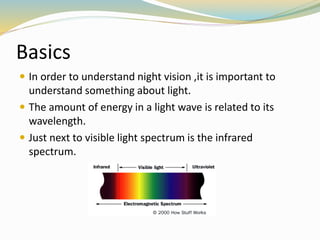
 In order to understand night vision ,it is important to
understand something about light.
 The amount of energy in a light wave is related to its
wavelength.
 Just next to visible light spectrum is the infrared
spectrum.
 Infrared can be split into three categories:
1. near-infrared
2. Mid-infrared
3. Thermal-infrared
 Infrared light is emitted by an object because of what is
happening at atomic level.
Thermal Imaging
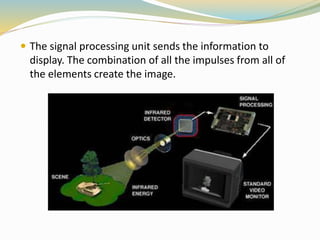
 A special lens focuses the infrared light emitted by all the
objects in view.
 The focused light is scanned by a phased array of infrared
detector elements.
 The detector element creates a very detailed temperature
pattern called Thermogram.
 The thermogram created by detector elements is
translated into electrical impulses.
 The impulses are sent to signal processing unit
 The signal processing unit sends the information to
display. The combination of all the impulses from all of
the elements create the image.
Image Enhancement
 A conventional lens, called the objective lens captures
ambient light and some near-infrared light.
 The gathered light is sent to image intensifier tube.
 The image intensifier tube consists of :
1. Photocathode
2. Micro Channel Plate (MCP)
3. Phosphors coated screen
Fig : Image Enhancement
Generations
 Generation 0 :
The earliest (1950’s) night vision products were based on
image conversion , rather than intensification
 Generation 1 :
1. Vacuum tube technology
2. Full moon operation
3. Amplification : 1,000
4. Operating life : 2,000 Hours
Fig : Generation 1 night vision device
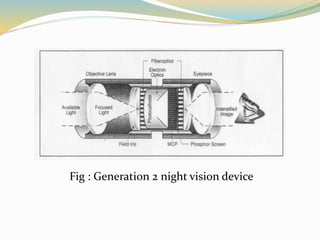
 Generation 2 :
1. First Micro Channel Plate operation
2. One-quarter moon operation
3. Amplification : 20,000
4. Operating life : 2,500 Hours
 Generation 3 :
1. Improved Micro Channel Plate & Photocathode
2. Starlight operation
3. Amplification : 40,000
4. Operating life : 10,000 Hours
Fig : Generation 2 night vision device
Night Vision Devices
 Night vision devices are basically divided into three
categories:
 Scopes : They are monocular normally handheld or
mounted on a weapon.
 Goggles : They are binocular and worn on the head.
 Cameras : Used for transmission and recording.
Applications
 Military
 Wildlife observation
 Hunting
 Surveillance
 Security
 Hidden object detection
Advantages
 Distant vision is possible.
 Detection of objects in absolute darkness.
 Less affected by temperature variations.
Disadvantages
 The image has low contrast and poor resolution.
 Do not see the target through transparent obstacles.
 High cost
Conclusion
 Today in the 21st century we have come a long way in the
development of night vision technology, from the early
1940s.
 In present scenario the applications of night vision
technology is very essential to combat terrorism which is
a major problem being faced by mankind.
Thank you

Night vision technology

  • 1.
  • 2.
    Content  Introduction  Basics Thermal Imaging  Image Enhancement  Generations  Night Vision Devices  Applications  Advantages  Disadvantages  Conclusion
  • 3.
    Introduction  The word“Night vision” itself means the ability to see objects in low light conditions.  Humans have poor night vision compared to many other animals.  With the proper night vision equipment , we can see a person standing 200 yards (183 m) on a moonless or cloudy night.
  • 4.
    Basics  In orderto understand night vision ,it is important to understand something about light.  The amount of energy in a light wave is related to its wavelength.  Just next to visible light spectrum is the infrared spectrum.
  • 5.
     Infrared canbe split into three categories: 1. near-infrared 2. Mid-infrared 3. Thermal-infrared  Infrared light is emitted by an object because of what is happening at atomic level.
  • 6.
    Thermal Imaging  Aspecial lens focuses the infrared light emitted by all the objects in view.  The focused light is scanned by a phased array of infrared detector elements.  The detector element creates a very detailed temperature pattern called Thermogram.  The thermogram created by detector elements is translated into electrical impulses.  The impulses are sent to signal processing unit
  • 7.
     The signalprocessing unit sends the information to display. The combination of all the impulses from all of the elements create the image.
  • 8.
    Image Enhancement  Aconventional lens, called the objective lens captures ambient light and some near-infrared light.  The gathered light is sent to image intensifier tube.  The image intensifier tube consists of : 1. Photocathode 2. Micro Channel Plate (MCP) 3. Phosphors coated screen
  • 9.
    Fig : ImageEnhancement
  • 10.
    Generations  Generation 0: The earliest (1950’s) night vision products were based on image conversion , rather than intensification  Generation 1 : 1. Vacuum tube technology 2. Full moon operation 3. Amplification : 1,000 4. Operating life : 2,000 Hours
  • 11.
    Fig : Generation1 night vision device
  • 12.
     Generation 2: 1. First Micro Channel Plate operation 2. One-quarter moon operation 3. Amplification : 20,000 4. Operating life : 2,500 Hours  Generation 3 : 1. Improved Micro Channel Plate & Photocathode 2. Starlight operation 3. Amplification : 40,000 4. Operating life : 10,000 Hours
  • 13.
    Fig : Generation2 night vision device
  • 14.
    Night Vision Devices Night vision devices are basically divided into three categories:  Scopes : They are monocular normally handheld or mounted on a weapon.
  • 15.
     Goggles :They are binocular and worn on the head.  Cameras : Used for transmission and recording.
  • 16.
    Applications  Military  Wildlifeobservation  Hunting  Surveillance  Security  Hidden object detection
  • 17.
    Advantages  Distant visionis possible.  Detection of objects in absolute darkness.  Less affected by temperature variations.
  • 18.
    Disadvantages  The imagehas low contrast and poor resolution.  Do not see the target through transparent obstacles.  High cost
  • 19.
    Conclusion  Today inthe 21st century we have come a long way in the development of night vision technology, from the early 1940s.  In present scenario the applications of night vision technology is very essential to combat terrorism which is a major problem being faced by mankind.
  • 20.