Development through Military History into Modern Daily Use.
By: Gagandeep Singh
Reg. no: 12416
Branch: Electronics Engg.
 INTRODUCTION
 EARLY DEVELOPMENT
 HOW DOES IT WORK
 THERMAL IMAGING
 IMAGE ENHANCEMENT
 GENERATIONS
 NIGHT VISION DEVICES
 GENERAL PUBLIC USE
 NIGHT VISION IN AUTOMOBILE
 CONCLUSION
 REFERENCES
•The word ‘Night vision’ itself means the ability to
see in low light conditions.
•Humans have poor night vision compared to many
other animals.
•Due to the nature of these early night vision devices
(NVD), they gave away tactical positions.
•Military scientists began to think of ways to improve
night vision to gain a strategic advantage
•Night vision technology has shaped history.
 The first night vision devices (NVD) were
created during WWII. Functioned by placing
an infrared filter over a searchlight.
 Fighters would use special binoculars to see
using the light from the searchlights.
 There were many disadvantages to using the
searchlights and flares.The actual searchlight
was massive and had to be mounted on a
truck or tank.
The images created were streaky and
distorted.
The acceleration of electrons cut the life of
the image intensification tube, which was the
most important and expensive part of the NVD,
very short.
• Two technologies are used for night vision:
(1)Thermal Imaging
(2)Image Enhancement
• Infrared light is used to visualize the things in the
dark.
• Shorter wavelengths have higher energy.
• Of visible light, violet has the most energy, and red
has the least.
• Just next to the visible light spectrum is the
infrared spectrum.
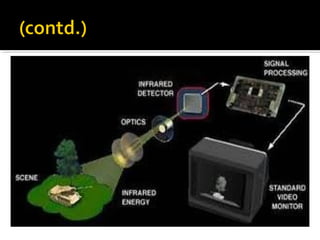
• A special lens focuses the infrared light emitted
by all of the objects in view.
• The focused light is scanned by a phased array of
infrared-detector elements.
• The detector elements create a very detailed
temperature pattern called a thermogram.
• It only takes about one-thirtieth of a second for the
detector array to obtain the temperature
information to make the thermogram.
•The thermogram created by the detector elements is
translated into electric impulses.
•The impulses are sent to a signal-processing unit, a circuit
board with a dedicated chip that translates the information
from the elements into data for the display.
•This information is obtained from several thousand points in
the field of view of the detector array.
•The signal-processing unit sends the information to the
display, where it appears as various colors depending on the
intensity of the infrared emission.
•The combination of all the impulses from all of the elements
creates the image.
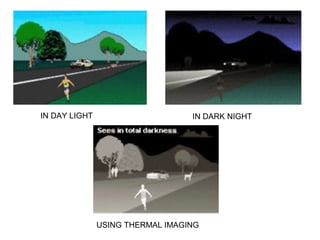
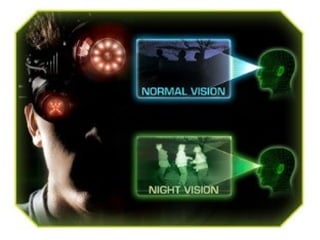
IN DAY LIGHT IN DARK NIGHT
USING THERMAL IMAGING
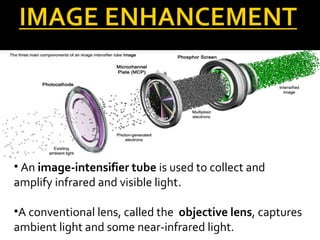
• An image-intensifier tube is used to collect and
amplify infrared and visible light.
•A conventional lens, called the objective lens, captures
ambient light and some near-infrared light.
•The gathered light is sent to the image-intensifier tube.
•The image-intensifier tube has a photocathode, which is used to
convert the photons of light energy into electrons.
•A Microscopic plate(MCP) is a tiny glass disk that has millions of
microscopic holes in it. The MCP is contained in a vacuum and has
metal electrodes on either side of the disc.
•At the end of the image-intensifier tube, the electrons hit a
screen coated with phosphors.
•As electrons pass through the micro channels, they cause thousands of
other electrons to be released in each channel using a process called
cascaded secondary emission.
•These electrons maintain their position in relation to the channel they
passed through, which provides a perfect image since the electrons
stay in the same alignment as the original photons.
•The energy of the electrons causes the phosphors to reach an excited
state and release photons.
•These photons create the image on the screen.
•The green phosphor image is viewed through another lens, called the
ocular lens, which allows you to magnify and focus the image.
•The NVD may be connected to a monitor to display the image.
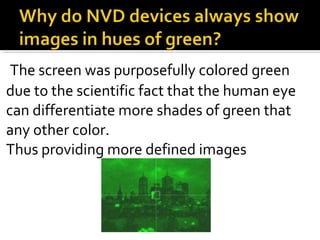
The screen was purposefully colored green
due to the scientific fact that the human eye
can differentiate more shades of green that
any other color.
Thus providing more defined images
 Generation 0
The earliest (1950's) night vision products were
based on image conversion, rather than
intensification.
 Generation 1
 Vacuum Tube Technology
 Full Moon Operation
 Amplification: 1,000
 Operating Life: 2,000 Hours
Generation 2
-First Micro channel Plate Application
-One-Quarter Moon Operation
-Amplification: 20,000
-Operating Life: 2,500 Hours
Generation3
-Improved Micro channel Plate & Photocathode
-Starlight Operation
-Amplification: 40,000
-Operating Life: 10,000 Hour
Generation 4 has less noise than generation 3,
however it has shorter life.
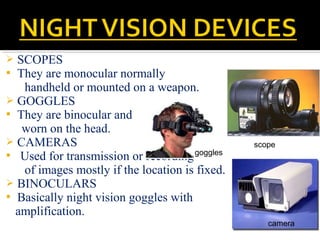
 SCOPES
 They are monocular normally
handheld or mounted on a weapon.
 GOGGLES
 They are binocular and
worn on the head.
 CAMERAS
 Used for transmission or recording
of images mostly if the location is fixed.
 BINOCULARS
 Basically night vision goggles with
amplification.
scope
camera
goggles
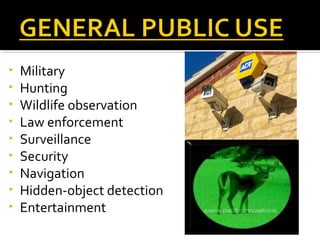
• Military
• Hunting
• Wildlife observation
• Law enforcement
• Surveillance
• Security
• Navigation
• Hidden-object detection
• Entertainment
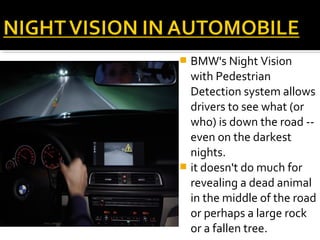
 BMW's Night Vision
with Pedestrian
Detection system allows
drivers to see what (or
who) is down the road --
even on the darkest
nights.
 it doesn't do much for
revealing a dead animal
in the middle of the road
or perhaps a large rock
or a fallen tree.
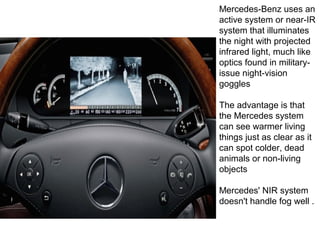
Mercedes-Benz uses an
active system or near-IR
system that illuminates
the night with projected
infrared light, much like
optics found in military-
issue night-vision
goggles
The advantage is that
the Mercedes system
can see warmer living
things just as clear as it
can spot colder, dead
animals or non-living
objects
Mercedes' NIR system
doesn't handle fog well .
 In conclusion I believe that is wonderful how
something originally designed for destruction, can
now help people on an every-day basis.
 Today in the 21st
century we have come a long way in
the development of night vision technology, from the
early 1940’s.
 In present scenario the applications of night vision
technology is very essential to combat terrorism
which is a major problem being faced by mankind.
 http://carl.sandiego.edu
 http://en.wikipedia.org/wiki/Night_vision
 Unknown author, “Night Vision Devices”. BookRags.
11/12/2008
<http://bookrags.com>
 Unknown author, “Night Vision Goggles”. GlobalSecurity.
11/10/2008
<http://www.global securities.org>
 Unknown author, “How Night Vision Works”. How Stuff
Works. 11/11/2008
<http://electronics.howstuffworks.com>

Nightvision

  • 1.
    Development through MilitaryHistory into Modern Daily Use. By: Gagandeep Singh Reg. no: 12416 Branch: Electronics Engg.
  • 2.
     INTRODUCTION  EARLYDEVELOPMENT  HOW DOES IT WORK  THERMAL IMAGING  IMAGE ENHANCEMENT  GENERATIONS  NIGHT VISION DEVICES  GENERAL PUBLIC USE  NIGHT VISION IN AUTOMOBILE  CONCLUSION  REFERENCES
  • 3.
    •The word ‘Nightvision’ itself means the ability to see in low light conditions. •Humans have poor night vision compared to many other animals. •Due to the nature of these early night vision devices (NVD), they gave away tactical positions. •Military scientists began to think of ways to improve night vision to gain a strategic advantage •Night vision technology has shaped history.
  • 4.
     The firstnight vision devices (NVD) were created during WWII. Functioned by placing an infrared filter over a searchlight.  Fighters would use special binoculars to see using the light from the searchlights.  There were many disadvantages to using the searchlights and flares.The actual searchlight was massive and had to be mounted on a truck or tank.
  • 5.
    The images createdwere streaky and distorted. The acceleration of electrons cut the life of the image intensification tube, which was the most important and expensive part of the NVD, very short.
  • 6.
    • Two technologiesare used for night vision: (1)Thermal Imaging (2)Image Enhancement • Infrared light is used to visualize the things in the dark. • Shorter wavelengths have higher energy. • Of visible light, violet has the most energy, and red has the least. • Just next to the visible light spectrum is the infrared spectrum.
  • 7.
    • A speciallens focuses the infrared light emitted by all of the objects in view. • The focused light is scanned by a phased array of infrared-detector elements. • The detector elements create a very detailed temperature pattern called a thermogram. • It only takes about one-thirtieth of a second for the detector array to obtain the temperature information to make the thermogram.
  • 9.
    •The thermogram createdby the detector elements is translated into electric impulses. •The impulses are sent to a signal-processing unit, a circuit board with a dedicated chip that translates the information from the elements into data for the display. •This information is obtained from several thousand points in the field of view of the detector array. •The signal-processing unit sends the information to the display, where it appears as various colors depending on the intensity of the infrared emission. •The combination of all the impulses from all of the elements creates the image.
  • 10.
    IN DAY LIGHTIN DARK NIGHT USING THERMAL IMAGING
  • 11.
    • An image-intensifiertube is used to collect and amplify infrared and visible light. •A conventional lens, called the objective lens, captures ambient light and some near-infrared light.
  • 12.
    •The gathered lightis sent to the image-intensifier tube. •The image-intensifier tube has a photocathode, which is used to convert the photons of light energy into electrons. •A Microscopic plate(MCP) is a tiny glass disk that has millions of microscopic holes in it. The MCP is contained in a vacuum and has metal electrodes on either side of the disc. •At the end of the image-intensifier tube, the electrons hit a screen coated with phosphors.
  • 13.
    •As electrons passthrough the micro channels, they cause thousands of other electrons to be released in each channel using a process called cascaded secondary emission. •These electrons maintain their position in relation to the channel they passed through, which provides a perfect image since the electrons stay in the same alignment as the original photons. •The energy of the electrons causes the phosphors to reach an excited state and release photons. •These photons create the image on the screen. •The green phosphor image is viewed through another lens, called the ocular lens, which allows you to magnify and focus the image. •The NVD may be connected to a monitor to display the image.
  • 14.
    The screen waspurposefully colored green due to the scientific fact that the human eye can differentiate more shades of green that any other color. Thus providing more defined images
  • 15.
     Generation 0 Theearliest (1950's) night vision products were based on image conversion, rather than intensification.  Generation 1  Vacuum Tube Technology  Full Moon Operation  Amplification: 1,000  Operating Life: 2,000 Hours
  • 16.
    Generation 2 -First Microchannel Plate Application -One-Quarter Moon Operation -Amplification: 20,000 -Operating Life: 2,500 Hours Generation3 -Improved Micro channel Plate & Photocathode -Starlight Operation -Amplification: 40,000 -Operating Life: 10,000 Hour Generation 4 has less noise than generation 3, however it has shorter life.
  • 17.
     SCOPES  Theyare monocular normally handheld or mounted on a weapon.  GOGGLES  They are binocular and worn on the head.  CAMERAS  Used for transmission or recording of images mostly if the location is fixed.  BINOCULARS  Basically night vision goggles with amplification. scope camera goggles
  • 19.
    • Military • Hunting •Wildlife observation • Law enforcement • Surveillance • Security • Navigation • Hidden-object detection • Entertainment
  • 20.
     BMW's NightVision with Pedestrian Detection system allows drivers to see what (or who) is down the road -- even on the darkest nights.  it doesn't do much for revealing a dead animal in the middle of the road or perhaps a large rock or a fallen tree.
  • 21.
    Mercedes-Benz uses an activesystem or near-IR system that illuminates the night with projected infrared light, much like optics found in military- issue night-vision goggles The advantage is that the Mercedes system can see warmer living things just as clear as it can spot colder, dead animals or non-living objects Mercedes' NIR system doesn't handle fog well .
  • 22.
     In conclusionI believe that is wonderful how something originally designed for destruction, can now help people on an every-day basis.  Today in the 21st century we have come a long way in the development of night vision technology, from the early 1940’s.  In present scenario the applications of night vision technology is very essential to combat terrorism which is a major problem being faced by mankind.
  • 23.
     http://carl.sandiego.edu  http://en.wikipedia.org/wiki/Night_vision Unknown author, “Night Vision Devices”. BookRags. 11/12/2008 <http://bookrags.com>  Unknown author, “Night Vision Goggles”. GlobalSecurity. 11/10/2008 <http://www.global securities.org>  Unknown author, “How Night Vision Works”. How Stuff Works. 11/11/2008 <http://electronics.howstuffworks.com>