A Seminar on:
 Night Vision Technology
 Presented By:
 MAYANK
 Roll No. 1504310029
 (Bachelor of Technology 3rd Year)
 (Computer Science & Engineering)
1/19
CONTENT
Introduction
Types of night vision
- Biological night vision
- Technical night vision
Night vision devices
Advantage
Disadvantage
Application
Conclusion
2/19
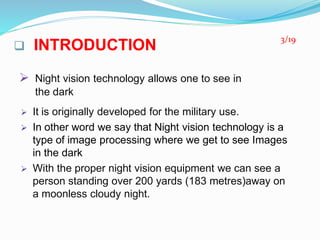
 Night vision technology allows one to see in
the dark
 It is originally developed for the military use.
 In other word we say that Night vision technology is a
type of image processing where we get to see Images
in the dark
 With the proper night vision equipment we can see a
person standing over 200 yards (183 metres)away on
a moonless cloudy night.
 INTRODUCTION
3/19
Introduction Cont.
A tank from
World War II
equipped with a
search light used
for night combat.
4/19
Night vision approaches
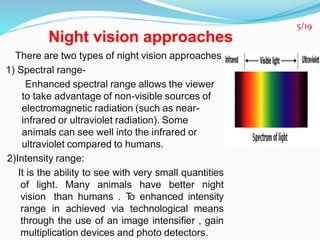
There are two types of night vision approaches
1) Spectral range-
Enhanced spectral range allows the viewer
to take advantage of non-visible sources of
electromagnetic radiation (such as near-
infrared or ultraviolet radiation). Some
animals can see well into the infrared or
ultraviolet compared to humans.
2)Intensity range:
It is the ability to see with very small quantities
of light. Many animals have better night
vision than humans . To enhanced intensity
range in achieved via technological means
through the use of an image intensifier , gain
multiplication devices and photo detectors.
5/19
6/19
7/19
TYPES OF NIGHT VISION
1. Biological Night Vision
2. Technical Night Vision
(A) Image Intensification
(B) Thermal Imaging
8/19
BIOLOGICAL NIGHT VISION
TECHNOLOGY
Some animal like cat , owl and deep sea animals can see in
night because they have a tissue layer called the tapetum
lucidum, in the back of the eye that reflect light back through
the retina .
But human has lack of this layer , hence human can not see
in night .
Hence a chemical called RHODOPOSIN that allows night
vision .
Molecule of rhodoposin in the rods of eye undergoes a
change in shape as they absorb light.
Rhodoposin is extremely sensitive to light .
Hence human can see in night for few hour with the help of
rhodoposin
9/19
WORKING OF TECHNICAL NIGHT
VISION
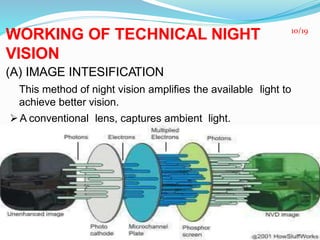
(A) IMAGE INTESIFICATION
This method of night vision amplifies the available light to
achieve better vision.
A conventional lens, captures ambient light.
10/19
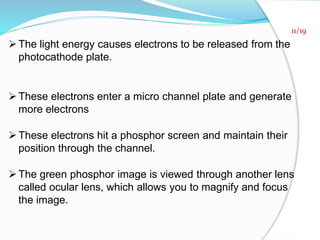
The light energy causes electrons to be released from the
photocathode plate.
These electrons enter a micro channel plate and generate
more electrons
These electrons hit a phosphor screen and maintain their
position through the channel.
The green phosphor image is viewed through another lens
called ocular lens, which allows you to magnify and focus
the image.
11/19
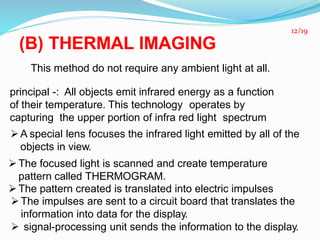
(B) THERMAL IMAGING
This method do not require any ambient light at all.
principal -: All objects emit infrared energy as a function
of their temperature. This technology operates by
capturing the upper portion of infra red light spectrum
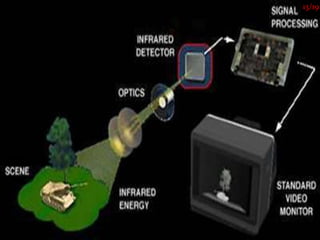
A special lens focuses the infrared light emitted by all of the
objects in view.
The focused light is scanned and create temperature
pattern called THERMOGRAM.
The pattern created is translated into electric impulses
The impulses are sent to a circuit board that translates the
information into data for the display.
 signal-processing unit sends the information to the display.
12/19
13/19
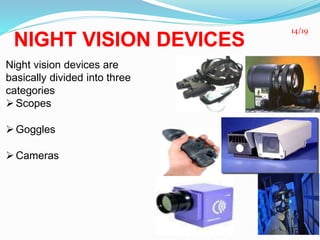
NIGHT VISION DEVICES
Night vision devices are
basically divided into three
categories
Scopes
Goggles
Cameras
14/19
ADVANTAGE
High Sensitivity
Low power Requirement
Able to see in dark
Light Weight
Small in size
15/19
DISADVANTAGE
Image is not good quality with NVT.
Image is not look its original place i.e
farer image is look nearer.
Loose normal eye vision if it use regularly
16/19
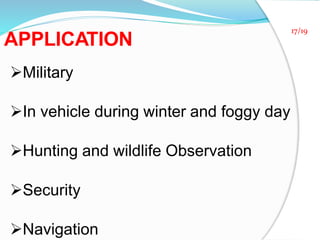
APPLICATION
Military
In vehicle during winter and foggy day
Hunting and wildlife Observation
Security
Navigation
17/19
CONCLUSION
 Night vision technology has some limitations but it is very
useful technology in security purpose and wildlife.
Improving this technology to reduce limitations it can use
in future for military and another purpose because now a
day terrorism is big problem for any country.
 Hence this technology is helpful in war against terrorism
18/19
19
19/19
19/19

Night Vision Technology

  • 1.
    A Seminar on: Night Vision Technology  Presented By:  MAYANK  Roll No. 1504310029  (Bachelor of Technology 3rd Year)  (Computer Science & Engineering) 1/19
  • 2.
    CONTENT Introduction Types of nightvision - Biological night vision - Technical night vision Night vision devices Advantage Disadvantage Application Conclusion 2/19
  • 3.
     Night visiontechnology allows one to see in the dark  It is originally developed for the military use.  In other word we say that Night vision technology is a type of image processing where we get to see Images in the dark  With the proper night vision equipment we can see a person standing over 200 yards (183 metres)away on a moonless cloudy night.  INTRODUCTION 3/19
  • 4.
    Introduction Cont. A tankfrom World War II equipped with a search light used for night combat. 4/19
  • 5.
    Night vision approaches Thereare two types of night vision approaches 1) Spectral range- Enhanced spectral range allows the viewer to take advantage of non-visible sources of electromagnetic radiation (such as near- infrared or ultraviolet radiation). Some animals can see well into the infrared or ultraviolet compared to humans. 2)Intensity range: It is the ability to see with very small quantities of light. Many animals have better night vision than humans . To enhanced intensity range in achieved via technological means through the use of an image intensifier , gain multiplication devices and photo detectors. 5/19
  • 6.
  • 7.
  • 8.
    TYPES OF NIGHTVISION 1. Biological Night Vision 2. Technical Night Vision (A) Image Intensification (B) Thermal Imaging 8/19
  • 9.
    BIOLOGICAL NIGHT VISION TECHNOLOGY Someanimal like cat , owl and deep sea animals can see in night because they have a tissue layer called the tapetum lucidum, in the back of the eye that reflect light back through the retina . But human has lack of this layer , hence human can not see in night . Hence a chemical called RHODOPOSIN that allows night vision . Molecule of rhodoposin in the rods of eye undergoes a change in shape as they absorb light. Rhodoposin is extremely sensitive to light . Hence human can see in night for few hour with the help of rhodoposin 9/19
  • 10.
    WORKING OF TECHNICALNIGHT VISION (A) IMAGE INTESIFICATION This method of night vision amplifies the available light to achieve better vision. A conventional lens, captures ambient light. 10/19
  • 11.
    The light energycauses electrons to be released from the photocathode plate. These electrons enter a micro channel plate and generate more electrons These electrons hit a phosphor screen and maintain their position through the channel. The green phosphor image is viewed through another lens called ocular lens, which allows you to magnify and focus the image. 11/19
  • 12.
    (B) THERMAL IMAGING Thismethod do not require any ambient light at all. principal -: All objects emit infrared energy as a function of their temperature. This technology operates by capturing the upper portion of infra red light spectrum A special lens focuses the infrared light emitted by all of the objects in view. The focused light is scanned and create temperature pattern called THERMOGRAM. The pattern created is translated into electric impulses The impulses are sent to a circuit board that translates the information into data for the display.  signal-processing unit sends the information to the display. 12/19
  • 13.
  • 14.
    NIGHT VISION DEVICES Nightvision devices are basically divided into three categories Scopes Goggles Cameras 14/19
  • 15.
    ADVANTAGE High Sensitivity Low powerRequirement Able to see in dark Light Weight Small in size 15/19
  • 16.
    DISADVANTAGE Image is notgood quality with NVT. Image is not look its original place i.e farer image is look nearer. Loose normal eye vision if it use regularly 16/19
  • 17.
    APPLICATION Military In vehicle duringwinter and foggy day Hunting and wildlife Observation Security Navigation 17/19
  • 18.
    CONCLUSION  Night visiontechnology has some limitations but it is very useful technology in security purpose and wildlife. Improving this technology to reduce limitations it can use in future for military and another purpose because now a day terrorism is big problem for any country.  Hence this technology is helpful in war against terrorism 18/19
  • 19.